• As you build your garden this spring, don’t forget to Plant A Row For The Hungry

(EDITOR’S NOTE: The following article first appeared on this site in April 2010. It is repeated because much of the information remains current and newsworthy.)

As you start to plan your garden for this spring and summer, don’t forget to Plant A Row For The Hungry. The Plant A Row For The Hungry program (also known as Plant A Row or PAR) is a national campaign by the Garden Writers Association of America that got its start in Alaska.

In the cold winter of 1994, Anchorage Daily News garden columnist and former Garden Writers Association of America President Jeff Lowenfels was returning to his hotel after a Washington, D.C., event when he was approached by a homeless person who asked for some money to buy food. Lowenfels said Washington, D.C., had signs saying, “Don’t give money to panhandlers,” so he shook his head and kept on walking. But the man’s reply, “I really am homeless and I really am hungry. You can come with me and watch me eat,” stayed with Lowenfels for the rest of his trip.

Jeff Lowenfels

Jeff Lowenfels

The encounter continued to bother Lowenfels, even as he was flying back to Anchorage. During the flight, Lowenfels came up with an idea when he started writing his weekly garden column (the longest continuously running garden column in the country, with no missed weeks since it started on Nov. 13, 1976). He asked his readers to plant one extra row in their gardens to grow food to donate to Bean’s Café, an Anchorage soup kitchen. The idea took off.

When Anchorage hosted the Garden Writers Association of America convention in 1995, Lowenfels took the GWAA members to Bean’s Café to learn about the Plant A Row For Bean’s Café program. The Garden Writers Association of America liked the idea, and it became the national Plant A Row For The Hungry campaign (also known as Plant A Row or PAR). In 2002, the Garden Writers Association Foundation was created as a national 501(c)(3) nonprofit to manage the Plant A Row For The Hungry program.

“I am not surprised by the growth of PAR,” Lowenfels wrote in an e-mail to the Sitka Local Foods Network. “It is now in all 50 states and across Canada and there are thousands of variations of the original program — from prison gardens for the hungry to botanical gardens donating their produce from public display gardens. This is because gardeners always share information and extra food, so the idea was a natural.”

It took five years for the program to reach its first million pounds of donated food, but the second million only took two years and the next eight years saw a million pounds of donated food (or more) each year. Since 1995, more than 14 million pounds of food have been donated. Not only that, the program is getting ready to expand overseas to Australia, England and other countries with avid gardeners.

“We have supplied something in the vicinity of enough food for 50 million meals,” Lowenfels wrote in his e-mail. “Gardeners can solve this hunger problem without the government. And we don’t need a tea party to do it! Or chemicals, I might add, as author of a book on organic gardening (Teaming With Microbes, written with Wayne Lewis)!”

According to the U.S. Department of Agriculture, one out of every eight U.S. households experiences hunger or the risk of hunger. Many people skip meals or eat too little, sometimes going an entire day or more without food. About 33 million Americans, including 13 million children, have substandard diets or must resort to seeking emergency food because they can’t always afford to buy the food they need. In recent years the demand for hunger assistance has increased 70 percent, and research shows that hundreds of children and adults are turned away from food banks each year because of lack of resources.

While many people credit Lowenfels for creating the Plant A Row For The Hungry program, Lowenfels says the real heroes are the gardeners growing the extra food and donating it to local soup kitchens, senior programs, schools, homeless shelters and neighbors. You can hear him pass along the credit to all gardeners at the end of this interview last year with an Oklahoma television station (video also embedded below).

“One row. That’s all it takes. No rules other than the food goes to the hungry. You pick the drop-off spot or just give it to a needy friend or neighbor. Nothing slips between the lip and the cup, I say,” Lowenfels wrote in his e-mail.

For people wanting to Plant A Row For The Hungry in Sitka, there are several places that would love to help distribute some fresh locally grown veggies or berries to those who are less fortunate, such as the Salvation Army, Sitkans Against Family Violence (SAFV), local churches, Sitka Tribe of Alaska and other organizations. The food the Sitka Local Foods Network grows at St. Peter’s Fellowship Farm communal garden goes to the Sitka Farmers Market, where people who are in the WIC (Women, Infants, Children) supplemental food program (operated in Southeast Alaska by the SouthEast Alaska Regional Health Consortium or SEARHC) can use special farmers market vouchers to buy fresh vegetables.

The Sitka Local Foods Network also takes donations of local produce to sell at the Sitka Farmers Markets, and all proceeds from the Sitka Farmers Markets are used to help pay for Sitka Local Foods Network projects geared toward helping more people in Sitka grow and harvest local food. For more information, contact Sitka Local Foods Network President Kerry MacLane (maclanekerry@yahoo.com), Sitka Local Foods Network Vice President Linda Wilson (lawilson87@hotmail.com) or Sitka Farmers Market Coordinator Johanna Willingham-Guevin (johanna.willingham@gmail.com).

• 2010 Plant A Row For The Hungry marketing brochure

• 2009 Start a local Plant A Row For The Hungry campaign brochure

• Food advocate Andrianna Natsoulas to discuss the food sovereignty movement on Sunday, March 18

Food advocate Andrianna Natsoulas will give a free presentation about the food sovereignty movement at 5 p.m. on Sunday, March 18, at the Kettleson Memorial Library in Sitka.

Andrianna is a longtime advocate for food and environmental issues. She operates the Food Voices website, which features people from around the world (including Sitka) discussing the importance of developing a sustainable and sovereign food system. She also is writing the book, “Food Voices: Stories of the Food Sovereignty Movement.”

The food sovereignty movement is based on community-based agriculture and fishing, rather than industrial food production. More people are becoming concerned about where their food comes from and how it was produced. They are starting to recognize how local food is fresher, tastes better, puts more money back into the local economy, uses less fuel for transportation, and has fewer chemicals and pesticides.

To learn more about the food sovereignty movement, go to Andrianna’s Food Voices website or e-mail her at andrianna@foodvoices.org.

• City and Borough of Sitka issues resolution in support of school meal bills

During its Feb. 14 meeting, the City and Borough of Sitka Assembly passed a resolution in support of SB 3/HB 132, which are bills in the Alaska Legislature that provide funding for school meal programs. The resolution was signed by Mayor Cheryl Westover.

The resolution recognizes that good nutrition is a major requirement of the education process, and many children can’t afford enough food or healthy food. When students don’t have enough food or eat the wrong foods, then they aren’t ready to learn. The resolution was part of a statewide effort by several groups to get movement on the bills. (Anchorage Daily News story)

Of the two bills mentioned in the resolution, SB 3 passed the Senate last year by a near unanimous vote (17 for, 0 against, 3 absent). Unfortunately, the bill has been buried in the House Finance Committee. Two men (Nick Moe in Anchorage and Kokayi Nosakhere in Juneau) started hunger strikes in support of the bill, but both have given up after significant weight loss because the committee chairman Rep. William Stoltze refuses to hold any hearings on the bill. (Anchorage Daily News story)

• Resolution 2012-03 supporting the passage of bills in the Alaska Legislature for funding of school meal programs

• Alaska Food Policy Council releases its 2012-15 strategic plan

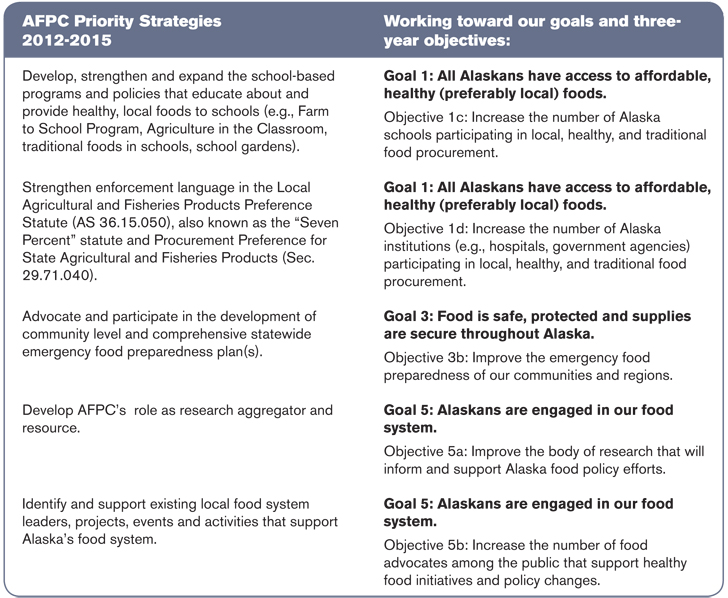
The Alaska Food Policy Council recently released its 2012-15 Alaska Food Policy Strategic Plan, which was about a year in development.

This spring, the council will work on action-planning on its top five priority strategies:

  1. Develop, strengthen and expand the school-based programs and policies that educate about and provide healthy, local foods to schools (e.g., Farm to School Program, Agriculture in the Classroom, traditional foods in schools, school gardens).
  2. Strengthen enforcement language in the Local Agricultural and Fisheries Products Preference Statute (AS 36.15.050), also known as the “Seven Percent” statute and Procurement Preference for State Agricultural and Fisheries Products (Sec. 29.71.040).
  3. Advocate and participate in the development of community level and comprehensive statewide emergency food preparedness plan(s).
  4. Develop AFPC’s role as research aggregator and resource.
  5. Identify and support existing local food system leaders, projects, events, and activities that support Alaska’s food system.

“The Alaska Food Policy Council has been working toward this strategic plan since May 2010,” said Diane Peck, MPH, RD, a community and evaluation specialist with the Alaska Obesity Prevention and Control Program who leads the council. “Initial committees worked to identify Alaska’s food system issues and concerns and then the strategic planning group worked to turn those into our goals and strategies. It’s exciting to see such a broad spectrum of food system stakeholders come together to develop a clear and concise plan that will help guide local, regional and statewide food systems planning in Alaska.”

“The Alaska Food Policy Council works to strengthen Alaska’s food systems to spur local economic development, increase food security, and improve nutrition and health,” according to the council’s website. “The council serves as a resource for information on local and state food systems, and works to identify and propose policy and environmental changes that can improve the production, processing, distribution, health, security and safety of our food.”

According to the council’s website, “the long-term goals of the Alaska Food Policy Council are to identify barriers to building a viable Alaska food system, create a strategic plan to address these barriers, and make the necessary recommendations to decision makers to implement this plan. Diverse stakeholders from around the state have been invited to participate, including representatives for commercial farmers, farmers’ markets and CSAs; fisheries and fish processors; distributors; institutional purchasers; private-sector businesses; legislators; consumers; Alaska Native tribal organizations; food security organizations; environmental organizations; and local, state, and federal government agencies.

”

The Sitka Local Foods Network is represented on the Alaska Food Policy Council by Lisa Sadleir-Hart, MPH, RD, CHES, ACE, community nutrition department manager for SEARHC Health Promotion and the treasurer of the Sitka Local Foods Network.

“Being involved in the Alaska Food Policy Council has deepened my commitment to making local food a reality in Sitka,” Lisa said. “It’s also made me realize that we are already a community ‘on the map’ when it comes to food issues and creative responses. Sitka is considered to be one of the leading communities in the state, on par with Fairbanks/Ester/Delta Junction and Homer.”

The Alaska Food Policy Council will meet April 4-5 in Anchorage for a face-to-face meeting to action-plan the five priority strategies. People interested in providing feedback on the plan should contact Diane Peck at diane.peck@alaska.gov.

• 2012-15 Alaska Food Policy Council Strategic Plan

• Sitka Local Foods Network board of directors to meet on Monday, Feb. 6

The 2011-12 Sitka Local Foods Network Board of Directors at its winter board retreat on Dec. 3, 2011. From left are Lisa Sadleir-Hart, Doug Osborne, Maybelle Filler, Cathy Lieser, Robin Grewe, Linda Wilson and Kerry MacLane. Not pictured are Johanna Willingham-Guevin and Tom Crane.

The 2011-12 Sitka Local Foods Network Board of Directors at its winter board retreat on Dec. 3, 2011. From left are Lisa Sadleir-Hart, Doug Osborne, Maybelle Filler, Cathy Lieser, Robin Grewe, Linda Wilson and Kerry MacLane. Not pictured are Johanna Willingham-Guevin and Tom Crane.

The Sitka Local Foods Network board of directors will hold its monthly meeting from 6:30-8 p.m. on Monday, Feb. 6, at the Sitka Unitarian Universalist Fellowship Building, 408 Marine St. (parking lot is off Spruce Street).

Key topics for the meeting include planning for the Let’s Grow Sitka on March 11, a recap of the Jan. 21 Sitka Local Foods Network annual meeting and potluck, an update on the Sitka Community Greenhouse and Education Center, an update on the Sitka Food Co-op, an update on recent work by the Alaska Food Policy Council, an update on the Sitka Composting Project (Sick-a-Waste), our new logo and t-shirts, planning for spring planting at St. Peter’s Fellowship Farm and other community gardens, planning for upcoming events such as the Sitka Farmers Markets on alternating Saturdays from July 7-Sept. 15, and more.

Board meetings are free and open to the general public, usually once a month (except summer). We always welcome new volunteers interested in helping out with our various projects. For more information, contact Kerry MacLane at 752-0654 or 747-7888.

• Sitka Local Foods Network hosts annual meeting and potluck dinner on Saturday, Jan. 21

Please join the Sitka Local Foods Network for its annual meeting and potluck dinner at 6 p.m. on Saturday, Jan. 21, at the Sitka Unitarian Universalist Fellowship Hall (408 Marine St., parking lot is off Spruce Street).

Join us as we honor our four years of existence and prepare for our fifth year. During this time, the Sitka Local Foods Network has worked on several initiatives — creating the Sitka Farmers Market, building St. Peter’s Fellowship Farm, hosting the Let’s Grow Sitka! garden education event, and more. We supported projects to plant more fruit trees around Sitka, get more local fish served in school lunches and increase Sitka’s ability to compost, and we are working toward starting the Sitka Community Greenhouse and Education Center. We also received a 501(c)(3) non-profit status from the IRS, so people can make tax-deductible gifts to help fund our work.

Our annual meeting and potluck is open to the public, and all Sitka residents are welcome to attend. We will feature local and slow foods, but we really value your attendance. This is our opportunity to say thank you to those who have helped us grow, and it is your chance to learn more about what we’re doing and how you can help.

As we enter 2012, Sitka and the rest of Alaska face some serious food security issues. According to a recent survey by the University of Alaska Fairbanks Cooperative Extension Service, the weekly cost for food for a family of four in Sitka has gone up 44 percent over the past five years. With rising fuel prices, this trend does not figure to change in the near future. Sitka still imports about 90-95 percent of its food from the Lower 48 or other countries, which means transportation is a big part of our food cost. The Sitka Local Foods Network is looking for input from Sitka residents about how we can work to improve Sitka’s food security. We also are working with the Alaska Food Policy Council, which is a statewide organization working on food security issues.

So mark your calendar to attend our annual meeting and potluck dinner at 6 p.m. on Saturday, Jan. 21, at the Unitarian Universalist Fellowship Hall, 408 Marine St. For more information, contact Kerry MacLane at 752-0654.

• Rising grocery prices raise food insecurity concerns in Sitka

(NOTE: The following letter to the editor appeared in the Friday, Dec. 9, 2011, edition of the Daily Sitka Sentinel.)

Dear Editor,

Many in Sitka are feeling squeezed not only by rising fuel costs, but also by escalating food costs. The September 2011 Alaska Food Cost Survey, conducted by University of Alaska Fairbanks Cooperative Extension Service, calculated Sitka’s weekly food cost for a family of four as $198.41. This is a 44-percent increase since 2006, when the same market basket cost was $138.14. Sitka’s food costs are 57 percent higher than in Portland, Ore., 37 percent more than in Anchorage and 30 percent more than in Juneau.

Feeding America 2011 statistics report that 11.7 percent of Sitka’s borough is “food insecure.”  This translates to 1,030 Sitkans and other Baranof Islanders who sometimes are completely without a source of food on a regular basis.

Kids Count Alaska 2009-2010 reports that 46 percent of Sitka’s school age children and youth live in families receiving some form of public assistance i.e., Denali KidCare, food stamps, or Alaska Temporary Assistance. This is a 10-percent increase since 2007.

Alaska behavioral risk factor data from 2009 show that only 23 percent of Alaskans consume the recommended five fruits and vegetables each day and only 17 percent of adolescents eat five daily servings of fruits and vegetables. One of the primary reasons for this low intake is inadequate access to affordable, quality produce.

These combined statistics paint a picture of increasing vulnerability when it comes to securing nutritious food on a regular basis. In the nutrition and public health world, this tenuous access to healthy food is known as food insecurity. So, how can Sitka, collectively and creatively, respond to food insecurity? Sitka can respond by INCREASING ACCESS TO AFFORDABLE LOCAL FOOD.

The Sitka Local Foods Network is working towards improving access to nutritious, local foods through five interconnected strategies. Together, these five strategies can move Sitka toward a more food-secure future. They are:

  1. Promoting traditional and customary food gathering and preservation.
  2. Developing the Let’s Grow Sitka gardening campaign to assist Sitkans in learning to grow some of their own food.
  3. Growing the number of community gardens to augment the garden behind Blatchley Middle School. The 4-year-old St. Peter’s Fellowship Farm is a recent example.
  4. Coordinating regular Sitka Farmers Markets during the summer growing and gathering seasons.
  5. Creating a community greenhouse and promoting commercial greenhouses to increase year-round access to local fruits and vegetables.

If you are interested in supporting this effort, please commit to one of the following actions:

  • Attend the Let’s Grow Sitka extravaganza as part of Artigras from noon-3pm on March 11, 2012, at the ANB Hall to learn how to grow your own food
  • Volunteer to work at St. Peter’s Fellowship Farm this spring or the Sitka Farmers Market this summer
  • Support the Sitka Farmers Market which begins July 7, 2012, and runs every other Saturday morning through Sept. 15, 2012.
  • Mail a tax-deductible, year-end contribution to the Sitka Local Food Network at 408-D Marine Street, Sitka, AK 99835.

Together, we can make food security a reality in Sitka.

Sincerely,

Sitka Local Foods Network Board and Friends
(Lisa Sadleir-Hart, Charles Bingham, Kerry MacLane, Doug Osborne, Ellen Frankenstein, Maybelle Filler, Robin Grewe)

• Sitka Local Foods Network board of directors to meet on Wednesday, Dec. 7

The Sitka Local Foods Network Board of Directors at its winter board retreat on Dec. 3, 2011. From left are Lisa Sadleir-Hart, Doug Osborne, Maybelle Filler, Cathy Lieser, Robin Grewe, Linda Wilson and Kerry MacLane. Not pictured is Tom Crane.

The Sitka Local Foods Network Board of Directors at its winter board retreat on Dec. 3, 2011. From left are Lisa Sadleir-Hart, Doug Osborne, Maybelle Filler, Cathy Lieser, Robin Grewe, Linda Wilson and Kerry MacLane. Not pictured is Tom Crane.

The Sitka Local Foods Network board of directors will hold its monthly meeting from 6:30-8 p.m. on Wednesday, Dec. 7, at the upstairs offices at the Sitka Unitarian Universalist Fellowship Building, 408 Marine St.

Key topics for the meeting include a recap of the recent SLFN board retreat, an update on the Sitka Community Greenhouse and Education Center, an update on the Sitka Food Co-op, an update on recent work by the Alaska Food Policy Council, an update on the Sitka Composting Project, our new logo and t-shirts, planning for upcoming educational events such as Let’s Grow Sitka in March, and more.

Board meetings are free and open to the general public, usually once a month (except summer). We always welcome new volunteers interested in helping out with our various projects. For more information, contact Kerry MacLane at 752-0654 or 747-3475.

• Sitka Local Foods Network board meeting agenda for Dec. 7, 2011

• Sitka Conservation Society, UAF Cooperative Extension Service host organizational meeting for Sitka 4H club

Sitka Conservation Society Community Sustainability Organizer Tracy Gagnon holds a flier introducing a new 4H club for Sitka.

Sitka Conservation Society Community Sustainability Organizer Tracy Gagnon holds a flier introducing a new 4H club for Sitka.

The Sitka Conservation Society and Sitka office of the University of Alaska Fairbanks Cooperative Extension Service will host an organizational meeting for a new Sitka 4H club from 6-7:30 p.m. on Tuesday, Sept. 13, at Room 215 at the University of Alaska Southeast-Sitka Campus.

4H is a national youth development organization that empowers young people to reach their full potential. In Alaska, the 4H program is part of the UAF Cooperative Extension Service. There used to be a 4H club in Sitka many years ago, but that club ceased operations. More information about the new Sitka 4H club can be found by clicking here.

The Sitka Conservation Society is working with the UAF Cooperative Extension Service to start a new club that will focus on Alaska way-of-life traditions, including but not limited to fishing, gardening, food preservation, baking, hiking and survival skills. Join in the harvest by learning to catch, hunt and grow your own food with other Sitka families. This program is organized by the families involved and led by parent volunteers.

The organizational meeting on Sept. 13 will discuss program logistics. Contact Tracy Gagnon at 747-7509 or tracy@sitkawild.org for more information. An RSVP is appreciated.

• Sitka 4H club registration/interest flier

• Sitka Local Foods Network hosts seed-saving workshop on Sept. 11

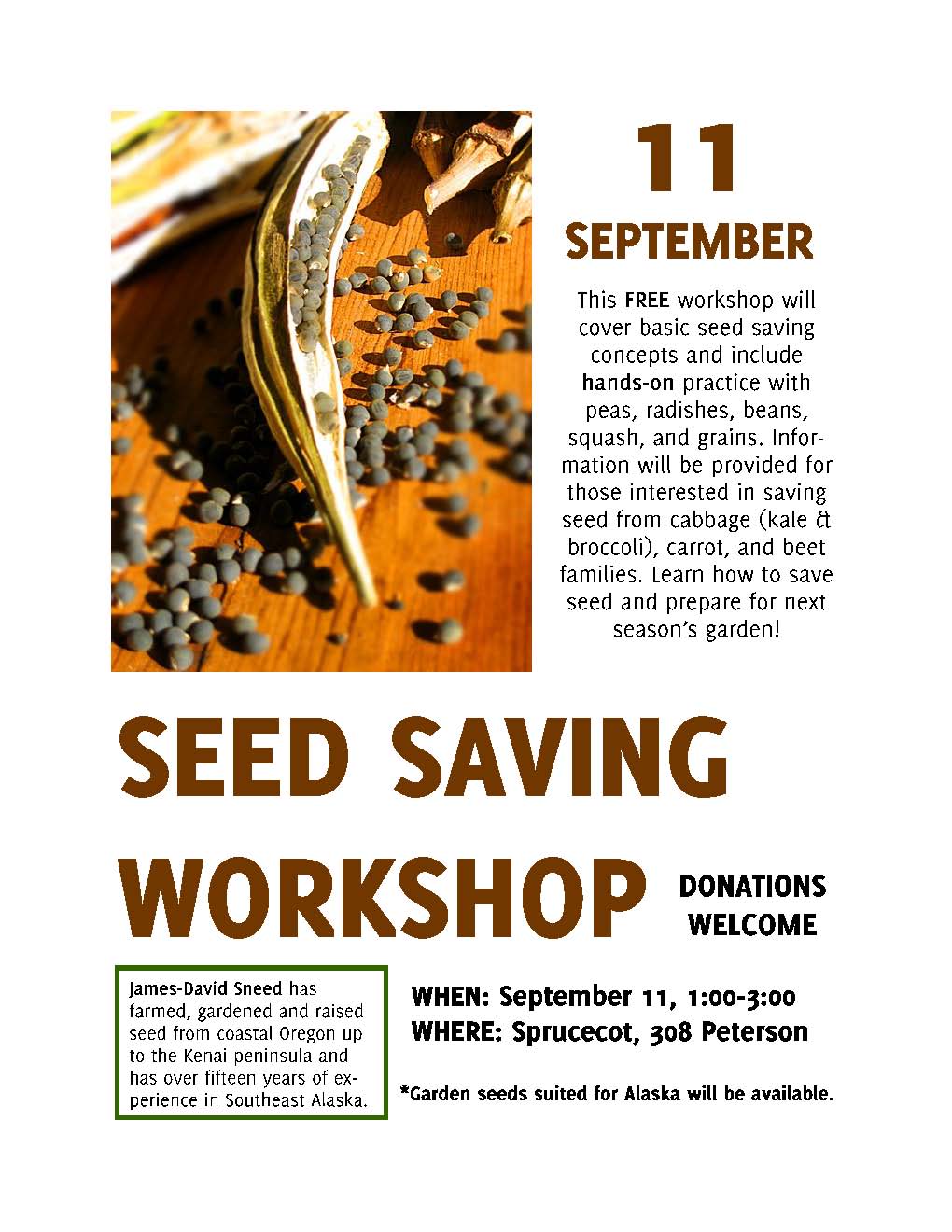
The Sitka Local Foods Network will host a seed-saving workshop with James David Sneed from 1-3 p.m. on Sunday, Sept. 11, at Sprucecot Gardens (308 Peterson).

This free workshop will cover basic seed saving concepts and include hands-on practice with peas, radishes, beans, squash and grains. Information will be provided for those interested in saving seed from the cabbage (kale, broccoli), carrot and beet families.

Learn how to save seed and prepare for next season’s garden.