• Let’s Grow Sitka garden education event is Sunday, March 11, at ANB Hall

Mark your calendars, because the 2012 “Let’s Grow Sitka” gardening education event opens at noon and runs until 3 p.m. on Sunday, March 11, at the Alaska Native Brotherhood Hall on Katlian Street. Don’t forget to set your clocks to spring forward so you can get ready to grow.

This annual event brings together local garden supply stores, local gardeners, landscapers and anybody who is interested in learning how to grow food and/or flowers. Sitka Local Foods Network Vice President Linda Wilson, who is coordinating the event with SLFN Board Member Cathy Lieser, was interviewed during the Morning Edition show Thursday on KCAW-Raven Radio and she provided more details about this event (click the link to listen to the interview), which helps Sitka residents get excited about the upcoming garden season.

There will be a wide variety of individuals and businesses with booths for the event, with some booths providing gardening information geared toward and others selling gardening supplies. Lunch will be available for purchase. Here is a tentative list of some of those planning to host booths:

  • Linda Wilson, Sitka Farmers Market, Grow a Row for the Market
  • Cathy Lieser, Let’s Grow Sitka, Sitka Local Foods Network
  • Doug Osborne. Sitka Local Foods Network?
  • Johanna Willingham, Pacific H.S./Sitka Farmers Market backup.
  • Jud Kirkness, Sicka Waste compost project, Fruit tree map
  • Tom Hart, compost, NZ composter ?
  • Kerry MacLane. Pest management
  • Lisa Sadleir-Hart. St. Peter’s Fellowship Farm
  • Laura Schmidt, St. Peter’s Fellowship Farm/Seed swap & share
  • Maybelle Filler, ???
  • Stanley Schoening, Chickens, fig trees, UAF Cooperative Extension Service
  • Judy Johnstone, High Tunnel program
  • David Lendrum, Guest speaker 3:15, info on new/unusual varieties for Southeast Alaska
  • Jeren Schmidt, Sitka Spruce Catering, lunch for purchase
  • Robert Gorman, UAF Cooperative Extension Service, history of Experimental Station
  • Andrianna Natsoulas, Food Sovereignty
  • Tracy Gagnon, Sitka 4H Club
  • Eve Grutter, Chickens, produce
  • Adam Chinalski, Model greenhouse
  • Penny Brown, Garden Ventures – products for sale
  • Amanda Grearson, True Value – products for sale
  • Lowell Frank, Spenard Building Supply Garden Center ??
  • Michelle Putz, Locally grown environmental benefits?
  • Rick Peterson, Gardening 101 – easiest to grow, need to amend soil, etc…
  • Lori Adams, Down-to-Earth U-Pick Garden – garden promotion and information
  • Mike Tackaberry/Robin Grewe, White’s Inc. – products for sale
  • Mandy Summers, Pacific High School
  • Kelly Smitherman, National Park Service – garden at Bishops House, etc…
  • Lisa Teas, Sitka Farmers Market art debut
  • Florence Welsh, Forget-Me-Not Gardens, local garden booklet, possible plant starts
  • Hope Merritt, Gimbal Botanicals herbal teas – info on wild herbs and herbs to grow
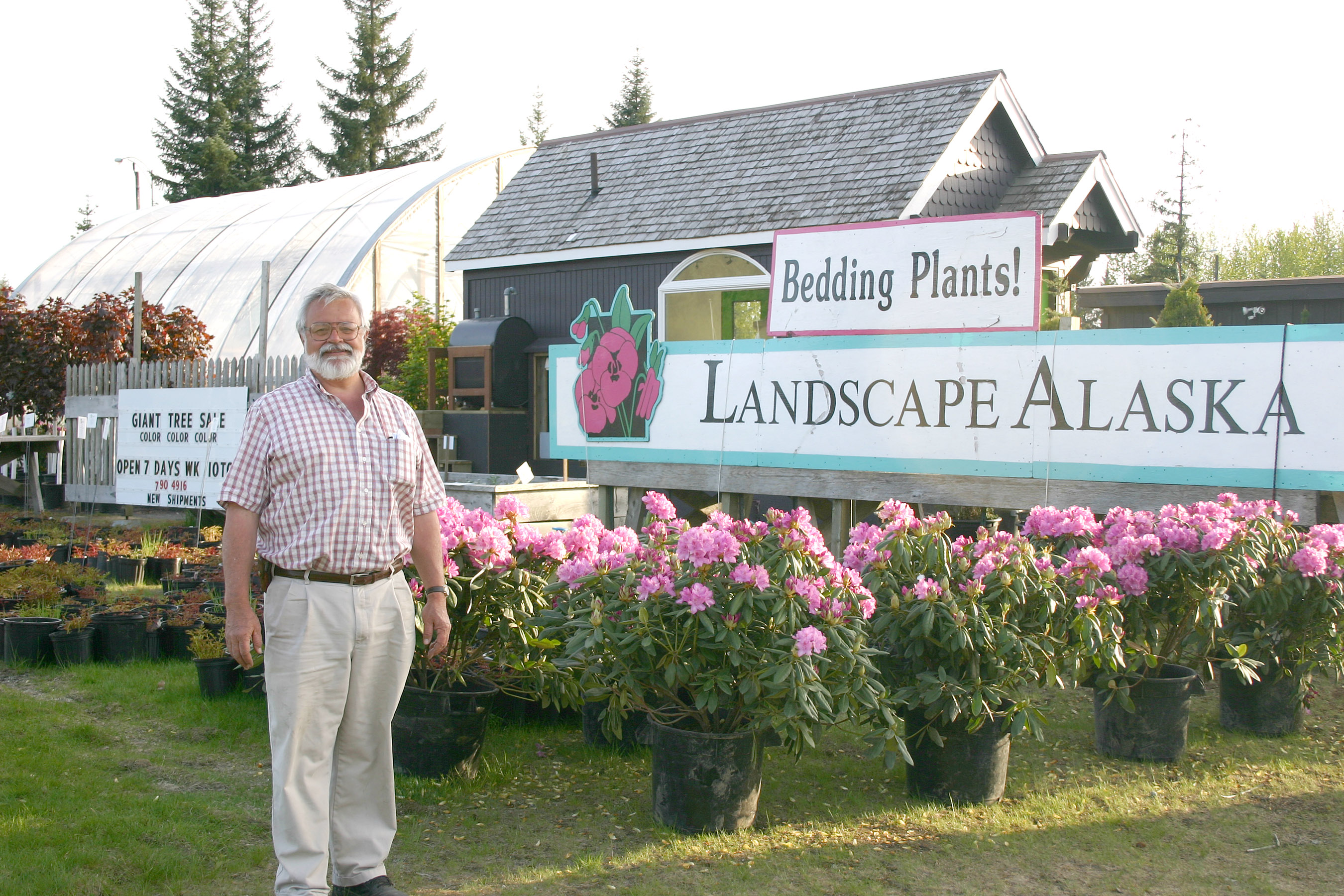
Right after the three-hour Let’s Grow Sitka event ends, guest speaker Dave Lendrum of Juneau will speak at 3:15 p.m. on “New Vegetable Varieties, Small Fruits, and Ornamentals for Southeast Alaska.” Lendrum is a landscape designer who just finished a two-year term as president of the Southeast Alaska Master Gardener Association and with his landscape architect wife, Margaret Tharp, owns Landscape Alaska.
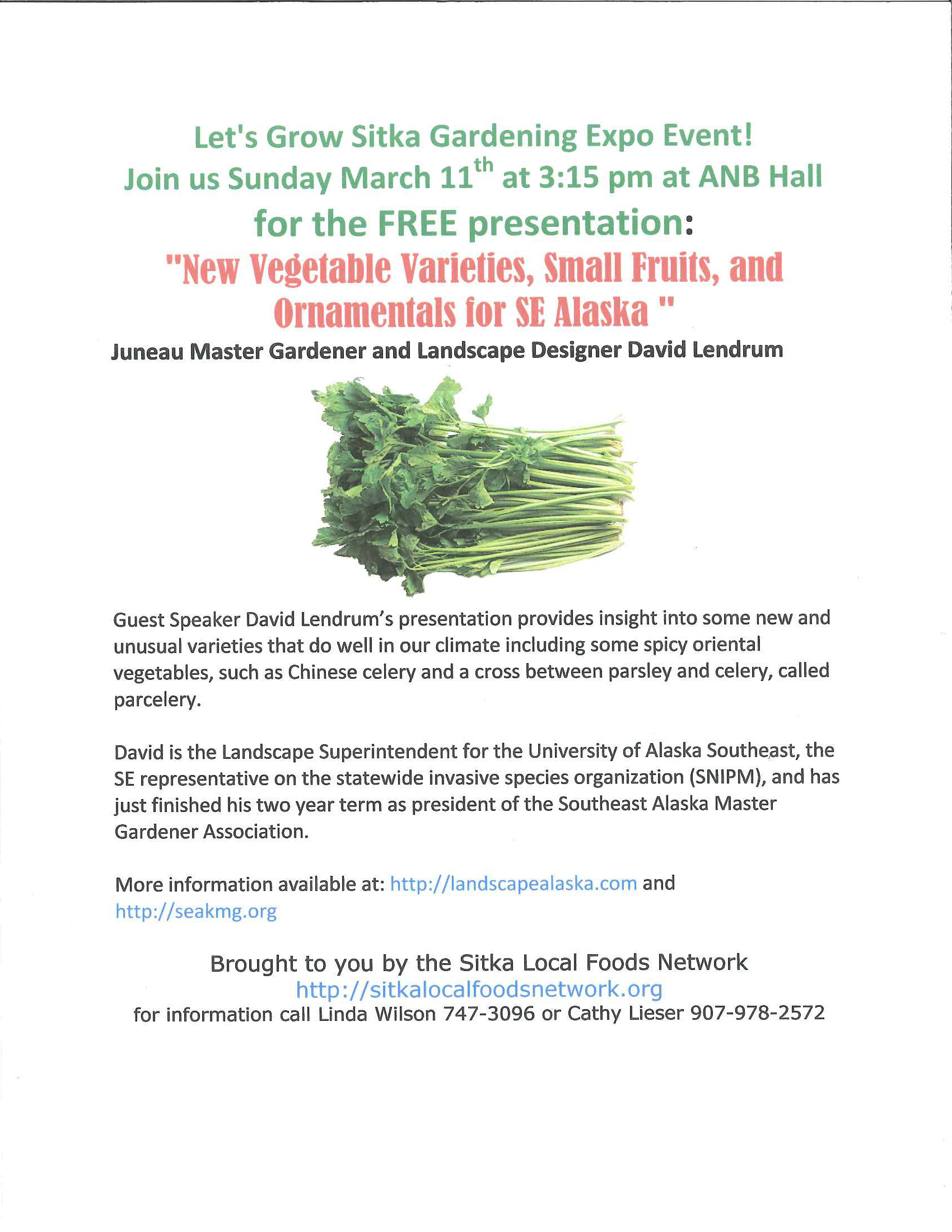
Dave’s life has evolved in partnership with the natural world. He grew up in California on an organic u-pick vegetable farm, learning horticulture from his parents and the 4H club. He did nursery work and continued his post-college adventure in Ecuador by starting a fresh market produce business. After being a city horticulturist at the Eugene (Ore.) Parks Department, Dave started his first nursery, Western Oregon Perennials. A few years later, he found himself in a high-temperature photosynthesis lab at Stanford. In the Pacific Northwest, Dave restored old estate gardens. When he heard Alaska’s call, he moved north to Elfin Cove. Dave and his wife started Landscape Alaska in Juneau 28 years ago. They design and build landscapes on every scale and have won numerous awards both locally and nationally. In addition, Dave is the landscape superintendent for the University of Alaska Southeast and the Southeast representative on the statewide invasive species organization (SNIPM).

For more information about Let’s Grow Sitka, contact Linda Wilson at 747-3096 (evenings, weekends) or lawilson87@hotmail.com, or Cathy Lieser at 978-2572. The two event fliers for this event are posted below as Adobe Acrobat files (PDF files).

• Main flier for 2012 Let’s Grow Sitka event

• Flier for Dave Lendrum presentation after Let’s Grow Sitka event ends

• Lori Adams debuts new ‘Gardening in Sitka’ column in the Daily Sitka Sentinel

(Lori Adams, who owns Down-To-Earth U-Pick Garden and is a frequent vendor at the Sitka Farmers Market, will be writing a regular garden column in the Daily Sitka Sentinel this summer. The Sentinel is allowing us to reprint the columns on this site after they first appear in the newspaper. Her first column appeared on Page 6 of the Friday, March 2, 2012, edition of the Daily Sitka Sentinel.)

GARDENING IN SITKA

By Lori Adams

In an effort to encourage more people in Sitka to start growing their own vegetables, I thought I would share some things that I have learned out at the u-pick garden. This column will address basics for people who are new to gardening.

1. THE SITE

The ideal site in your yard for a garden is the area that gets the most sun. If you own your property it helps a great deal to cut down any trees or brush that block sunlight. Even trees on the east and west sides of your property can block a surprising amount. Trees also rob nutrients and moisture that should be going to your vegetables.

The best orientation for rows is running north to south rather than east to west so that the sun heats up both sides of the bed during the course of the day. It is even better if those rows are on a south sloping hill which causes the sun to hit the soil at a more direct angle so more heat is absorbed.

I have rows that run in both directions. The north to south rows warm up faster and have evenly distributed sunlight allowing each plant grow to its full potential. The rows that run east to west tend to have a sunny side and a shady side and the plants in the front shade the plants in the back. If east to west is your only option then it is best to raise the dirt on the back side of the row and grow shorter plants in the front.

Walk around your yard and notice the paths of your sunlight and shade, but remember that in the summer the sun will be higher than it is now.

Good drainage is also very important. Most successful Sitka gardeners raise their beds higher than their existing yard and pathways by about 9 inches. If your yard is on muskeg or usually has puddles you might want to install some drainage tiles. Hillside gardens usually don’t have drainage problems. Many people think you must terrace a hillside to avoid erosion from rain but I have not had trouble with erosion on my hillside beds. The rain soaks through and seeps out the bottom. Walk around your yard and notice where puddles form.

Once you have selected your site don’t try to get the entire garden ready your first year. Building beds can be back-breaking work and you can quickly get discouraged. Set the realistic goal of completing one bed this spring. You will be rewarded with fresh vegetables this summer, and the knowledge that you gain will give you a better idea how to build the rest of the beds in the following years.

Brought to you by Down-To-Earth U-Pick Garden

Located at 2103 Sawmill Creek Road

Open June-August / Mon-Sat 11:00-6:00

747-6108 or 738-2241

• Alaska Food Policy Council releases its 2012-15 strategic plan

The Alaska Food Policy Council recently released its 2012-15 Alaska Food Policy Strategic Plan, which was about a year in development.

This spring, the council will work on action-planning on its top five priority strategies:

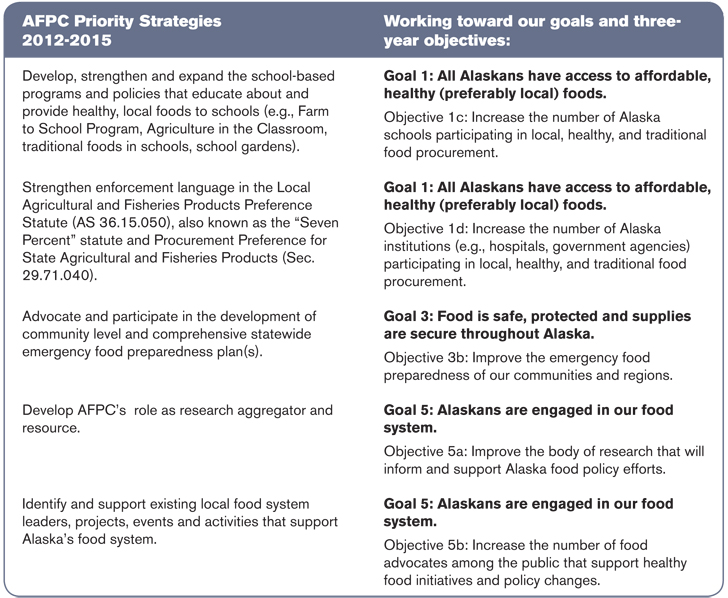
  1. Develop, strengthen and expand the school-based programs and policies that educate about and provide healthy, local foods to schools (e.g., Farm to School Program, Agriculture in the Classroom, traditional foods in schools, school gardens).
  2. Strengthen enforcement language in the Local Agricultural and Fisheries Products Preference Statute (AS 36.15.050), also known as the “Seven Percent” statute and Procurement Preference for State Agricultural and Fisheries Products (Sec. 29.71.040).
  3. Advocate and participate in the development of community level and comprehensive statewide emergency food preparedness plan(s).
  4. Develop AFPC’s role as research aggregator and resource.
  5. Identify and support existing local food system leaders, projects, events, and activities that support Alaska’s food system.

“The Alaska Food Policy Council has been working toward this strategic plan since May 2010,” said Diane Peck, MPH, RD, a community and evaluation specialist with the Alaska Obesity Prevention and Control Program who leads the council. “Initial committees worked to identify Alaska’s food system issues and concerns and then the strategic planning group worked to turn those into our goals and strategies. It’s exciting to see such a broad spectrum of food system stakeholders come together to develop a clear and concise plan that will help guide local, regional and statewide food systems planning in Alaska.”

“The Alaska Food Policy Council works to strengthen Alaska’s food systems to spur local economic development, increase food security, and improve nutrition and health,” according to the council’s website. “The council serves as a resource for information on local and state food systems, and works to identify and propose policy and environmental changes that can improve the production, processing, distribution, health, security and safety of our food.”

According to the council’s website, “the long-term goals of the Alaska Food Policy Council are to identify barriers to building a viable Alaska food system, create a strategic plan to address these barriers, and make the necessary recommendations to decision makers to implement this plan. Diverse stakeholders from around the state have been invited to participate, including representatives for commercial farmers, farmers’ markets and CSAs; fisheries and fish processors; distributors; institutional purchasers; private-sector businesses; legislators; consumers; Alaska Native tribal organizations; food security organizations; environmental organizations; and local, state, and federal government agencies.

”

The Sitka Local Foods Network is represented on the Alaska Food Policy Council by Lisa Sadleir-Hart, MPH, RD, CHES, ACE, community nutrition department manager for SEARHC Health Promotion and the treasurer of the Sitka Local Foods Network.

“Being involved in the Alaska Food Policy Council has deepened my commitment to making local food a reality in Sitka,” Lisa said. “It’s also made me realize that we are already a community ‘on the map’ when it comes to food issues and creative responses. Sitka is considered to be one of the leading communities in the state, on par with Fairbanks/Ester/Delta Junction and Homer.”

The Alaska Food Policy Council will meet April 4-5 in Anchorage for a face-to-face meeting to action-plan the five priority strategies. People interested in providing feedback on the plan should contact Diane Peck at diane.peck@alaska.gov.

• 2012-15 Alaska Food Policy Council Strategic Plan

• Sitka Maritime Heritage Society to host a presentation on the importance of herring in Southeast Alaska

Herring is an important food source in Sitka and the rest of Southeast Alaska. Not only are there huge commercial and subsistence harvests of the fish, and it is an important food source for salmon, halibut, whales, sea lions and other animals in the region.

The Sitka Maritime Heritage Society will host the presentation “Herring: Rakes, Reduction Plants and the Fisheries: A Night of History” during its annual meeting at 7 p.m. on Sunday, Feb. 12, at Harrigan Centennial Hall.

The program features a panel discussion about the importance of herring in Southeast Alaska, from the booming commercial sac roe herring fishery to traditional gathering of herring eggs on hemlock branches. Another panel topic includes the herring reduction plants that once were scattered throughout Southeast Alaska. There also have been recent community discussions about possibly starting a whole-fish herring fishery that won’t target roe. Members of the public will be invited to share their memories of herring fishing and roe harvests. Photos and artifacts will be on hand.

For more information, contact sitkamaritime@gmail.com.

• Sitka Local Foods Network seeks market manager for 2012 Sitka Farmers Markets

The Sitka Local Foods Network Board of Directors is recruiting for a volunteer/contract worker to serve as market manager for the 2012 Sitka Farmers Markets.

This is the fifth year of operation for the Sitka Farmers Market, which features six markets from 10 a.m. to 2 p.m. every other Saturday from July 7 through Sept. 15 (July 7, 21, Aug. 4, 18, Sept. 1 and 15) at the Alaska Native Brotherhood Hall. The farmers markets feature booths from local farmers/gardeners, local fishermen, and artisans and craftspeople. These events are great Sitka gathering places, and we promote local foods and other goods at them.

A detailed description of the market manager duties (compiled by Sitka Local Foods Network vice president Linda Wilson, who has been the market manager the past four years) can be found at the link below. For more information or to submit applications, contact Maybelle Filler at 747-2761 or mocampo25@hotmail.com, or contact Doug Osborne at 747-3752 or doug_las@live.com. Please submit a resume and interest letter to Maybelle and/or Doug by 5 p.m. on Friday, Feb. 24. The market manager of the Sitka Farmers Market reports to the Sitka Local Foods Network Board of Directors.

• Description of duties for market manager of the Sitka Farmers Market

• Booths and vendors needed for the Let’s Grow Sitka! garden education event in March

Sitka residents wander the booths during the 2009 Let's Grow Sitka garden show

Sitka residents wander the booths during the 2009 Let's Grow Sitka garden show

It is time to start planning for the 2012 Let’s Grow Sitka Garden Expo. This year’s event will be from noon to 3 p.m. on Sunday, March 11, at the Alaska Native Brotherhood Hall.

Linda Wilson is coordinating the event, and she is looking for anyone interested in participating. Table spaces are FREE. The only restriction is that your products, services, information, displays, demonstrations, etc., must be related to gardening or food production in Sitka.

Linda is looking for:

  • Vendors selling garden-related products, including seeds, supplies, tools, books, accessories, …
  • Vendors promoting/selling their garden-related services, such as greenhouse and cold frame construction, yard maintenance, …
  • Vendors promoting/selling products and services related to small animal husbandry, such as chickens, ducks, rabbits, pigs, etc., …
  • Someone to host a table, do a display or presentation/demonstration on the following topics:
    • Growing root crops in Sitka (potatoes, carrots, etc…)
    • Root cellars and other methods for storage of vegetables
    • Fruit trees and berry bushes
    • Raising chickens and ducks
    • Composting and using compost
    • Soils and soil amendments
    • Edible flowers and ornamentals
    • Cold frames and other small garden structures that extend the growing season
    • Greenhouses
    • Seed swap and share table
    • Hosting a children’s activity such as decorating a pot and planting pansy, violet, viola seeds to take home.  Or ???
    • Garden pests — slugs, root maggots, etc., …
    • Proper garden drainage – how to construct garden beds to drain properly
    • Anything else you can think of that relates to growing food in Sitka, …

Please consider volunteering to host a table or to be a vendor. We want to make this a bigger and better event for this year,  and to get more people inspired to start or expand a garden. Last year we were unfortunate to be scheduled during the same week as Spring break, but NOT this year!

Please let Linda know, at your earliest convenience, if you would like to reserve a table or booth space. Linda can be reached at lawilson87@hotmail.com or 747-3096 (evenings and weekends).

• Pacific High School and Sitka Conservation Society partner up to serve local fish in school lunches

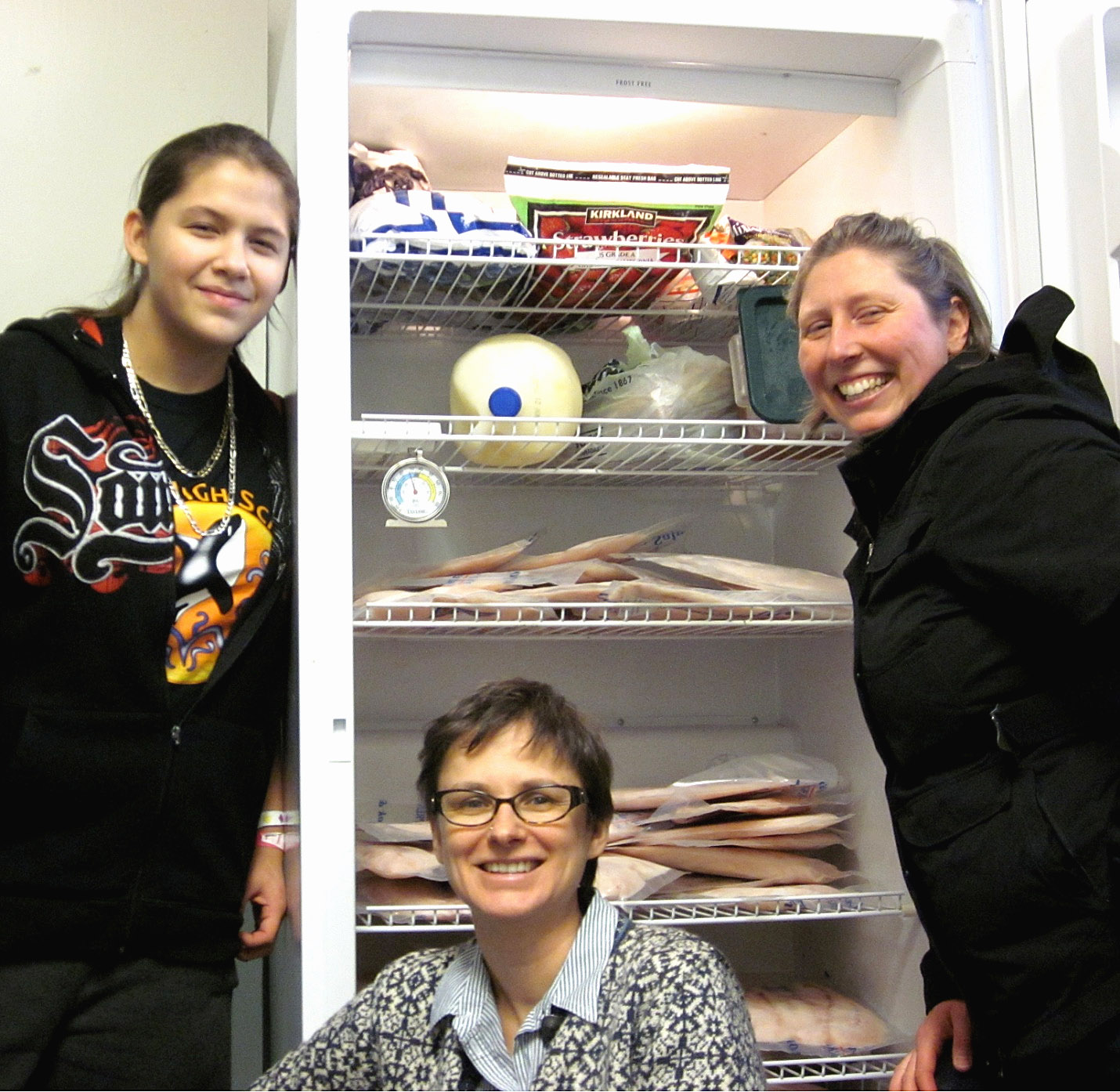
Pacific High School student Jessie Young, left, co-principal Sarah Ferrency, center, and lunch coordinator Johanna Willingham load rockfish into the freezer at Pacific High School. an alternative high school in Sitka, Alaska. (PHOTO COURTESY OF TRACY GAGNON / SITKA CONSERVATION SOCIETY)

Pacific High School student Jessie Young, left, co-principal Sarah Ferrency, center, and lunch coordinator Johanna Willingham load rockfish into the freezer at Pacific High School. an alternative high school in Sitka, Alaska. (PHOTO COURTESY OF TRACY GAGNON / SITKA CONSERVATION SOCIETY)

Pacific High School now serves local seafood in the cafeteria and joins the growing ranks of schools connecting to local foods. Starting Wednesday, Feb. 1, Pacific High students will have a choice of local seafood dishes twice a month due to a partnership with the Sitka Conservation Society.

Sitka, Alaska, is the ninth largest fishing port in the country, but only recently did school children have access to the abundance of local seafood in school lunches. The project began in 2010 after getting more fish in school lunches was voted on as one of Sitka’s four health priorities at the Sitka Health Summit. The Sitka Conservation Society took the lead on the project and partnered with Blatchley Middle School in the winter of 2010-11 school year and then with Keet Gooshi Heen Elementary School in 2011-12 to launch a Fish to Schools program. Due to the success of that program, it has evolved and spread to another school in the community.

Tracy Gagnon, Fish to Schools coordinator at Sitka Conservation Society said, “To kick off the new partnership, SCS’s Fish to Schools program will cook with Pacific High students to rally support for local fish lunches. A favorite recipe will be chosen for an upcoming Fish to Schools benefit.”

LOCALLY MADE– Americorps Volunteer Lauren Hahn, left, and Pacific High School students in the culinary arts program, Brendan Didrickson and Jenny Jeter, prepare a lunch of Caribbean rockfish with sweet potato fries, baked apples and wild rice at the school on Wednesday, Feb. 1. This was the first Pacific High lunch in the Fish to Schools program. The program began in 2010 as a Sitka Health Summit project when Sitka Conservation Society joined Blatchley Middle School to serve locally caught fish in school lunches. Since then, Keet Gooshi Heen Elementary School and now Pacific High have joined the twice-monthly program. On Wednesday, Feb. 8, SCS is inviting commercial fishers to join students at Keet for lunch. (Daily Sitka Sentinel photo by James Poulson, printed in the Tuesday, Feb. 7, 2012, edition)

LOCALLY MADE– Americorps Volunteer Lauren Hahn, left, and Pacific High School students in the culinary arts program, Brendan Didrickson and Jenny Jeter, prepare a lunch of Caribbean rockfish with sweet potato fries, baked apples and wild rice at the school on Wednesday, Feb. 1. This was the first Pacific High lunch in the Fish to Schools program. The program began in 2010 as a Sitka Health Summit project when Sitka Conservation Society joined Blatchley Middle School to serve locally caught fish in school lunches. Since then, Keet Gooshi Heen Elementary School and now Pacific High have joined the twice-monthly program. On Wednesday, Feb. 8, SCS is inviting commercial fishers to join students at Keet for lunch. (Daily Sitka Sentinel photo by James Poulson, printed in the Tuesday, Feb. 7, 2012, edition)

Unlike at the middle and elementary schools, Pacific High (the Sitka School District’s alternative high school) has more flexibility in the dishes it prepares with local fish. For example, the first Pacific High local seafood lunch will be Caribbean rockfish with sweet potato fries, baked apples and wild rice. Students help prepare the meals through the school’s culinary arts program. Every student earns their food handlers’ card and annually they cycle through a six-week cooking class. Students graduate high school with enough experience to enter into the cooking industry, bringing with them the knowledge to prepare scratch meals with healthy and local ingredients.

“We are striving to change the system by incorporating more local and traditional foods that the students want to eat,” said Johanna Willingham, Pacific High School lunch coordinator. “Through our innovative food-based meal program, the students are learning valuable life skills by developing recipes they enjoy and cooking with their local bounty.”

The Fish to Schools program creates new partnerships by uniting the local conservation organization and high school with community-based processors and fishermen. That partnership allows more students access to healthy lunches, as fish are packed with vitamins, proteins and omega-3 fatty acids that promote healthy hearts and healthy brains.

“Our community depends on the fish that comes out of the ocean, yet our school lunches were so disconnected from our local resources,” said Beth Short-Rhoads, Fish to Schools volunteer organizer, mother and fishing woman. “Thanks to Fish to Schools, our children now have access to local seafood. The fact that it is incredibly healthy is an even bigger bonus.”

There are more than 9,000 schools across the United States involved with local Farm to Schools programs. The majority of the programs serve land-based foods in the cafeterias, so Pacific High adds another layer by providing local seafood to students. This is an exciting opportunity to be part of the growing farm — or fish — to school movement across the country,” Gagnon said.

The Fish to Schools program also serves up local fish dishes at Blatchley Middle School and Keet Gooshi Heen Elementary School on the second and fourth Wednesdays during the school year. On Wednesday, Feb. 8, the program is honoring local commercial fishermen by inviting them to join the students at lunch so they can share the meal and answer questions the students may have about the fish. (Editor’s note: On Feb. 6, Tracy Gagnon, Beth Short-Rhoads and students Grace Gjertsen, Zofia Danielson and Sienna Reid were interviewed by Robert Woolsey about the We Love Our Fishermen! promotion on the Morning Edition show on KCAW-Raven Radio.)

The Sitka Conservation Society has been working to protect the temperate rain forest of Southeast Alaska and Sitka’s quality of life since 1967. SCS is based in the small coastal town of Sitka, in the heart of the Tongass National Forest, the nation’s largest national forest. For more information, go to http://www.sitkawild.org. To learn more about the Fish to Schools program, contact Tracy Gagnon at tracy@sitkawild.org or 747-7509.

• Sitka Local Foods Network hosts annual meeting and potluck dinner on Saturday, Jan. 21

Please join the Sitka Local Foods Network for its annual meeting and potluck dinner at 6 p.m. on Saturday, Jan. 21, at the Sitka Unitarian Universalist Fellowship Hall (408 Marine St., parking lot is off Spruce Street).

Join us as we honor our four years of existence and prepare for our fifth year. During this time, the Sitka Local Foods Network has worked on several initiatives — creating the Sitka Farmers Market, building St. Peter’s Fellowship Farm, hosting the Let’s Grow Sitka! garden education event, and more. We supported projects to plant more fruit trees around Sitka, get more local fish served in school lunches and increase Sitka’s ability to compost, and we are working toward starting the Sitka Community Greenhouse and Education Center. We also received a 501(c)(3) non-profit status from the IRS, so people can make tax-deductible gifts to help fund our work.

Our annual meeting and potluck is open to the public, and all Sitka residents are welcome to attend. We will feature local and slow foods, but we really value your attendance. This is our opportunity to say thank you to those who have helped us grow, and it is your chance to learn more about what we’re doing and how you can help.

As we enter 2012, Sitka and the rest of Alaska face some serious food security issues. According to a recent survey by the University of Alaska Fairbanks Cooperative Extension Service, the weekly cost for food for a family of four in Sitka has gone up 44 percent over the past five years. With rising fuel prices, this trend does not figure to change in the near future. Sitka still imports about 90-95 percent of its food from the Lower 48 or other countries, which means transportation is a big part of our food cost. The Sitka Local Foods Network is looking for input from Sitka residents about how we can work to improve Sitka’s food security. We also are working with the Alaska Food Policy Council, which is a statewide organization working on food security issues.

So mark your calendar to attend our annual meeting and potluck dinner at 6 p.m. on Saturday, Jan. 21, at the Unitarian Universalist Fellowship Hall, 408 Marine St. For more information, contact Kerry MacLane at 752-0654.

• Sitka Composting Project to meet on Monday, Jan. 9

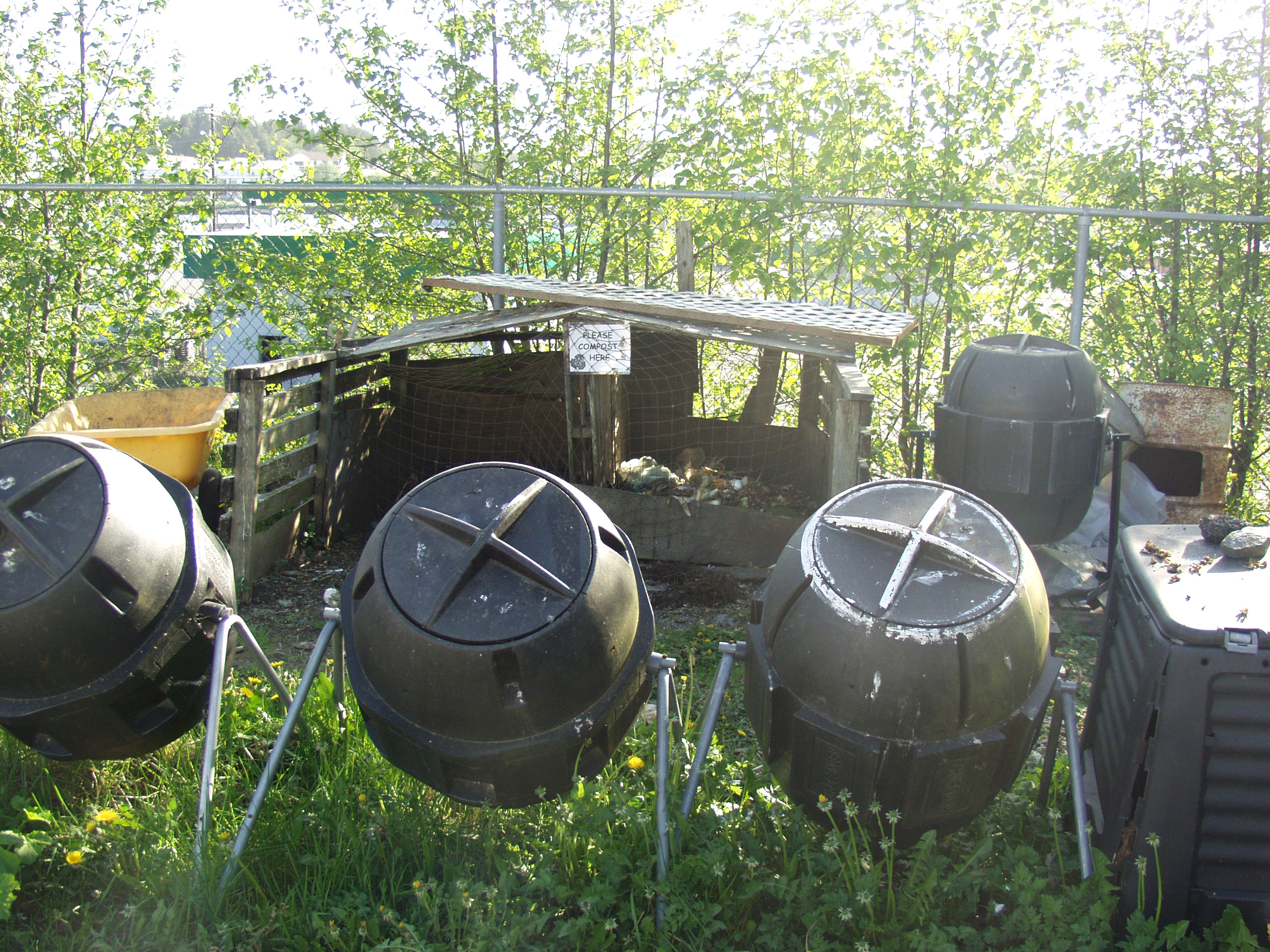
Compost bins at Blatchley Community Garden

Compost bins at Blatchley Community Garden

The next meeting of the Sitka Composting Project (aka Sick-a Waste) will be at 7 p.m. on Monday, Jan. 9, at Harrigan Centennial Hall in the Pestchouroff Room.

This meeting will include an update on the project, which is one of this year’s three community health priority projects selected during the 2011 Sitka Health Summit. The agenda will include a discussion of recent meetings with the City and Borough of Sitka and the Sitka School District about improvements to the compost site at the Blatchley Community Garden behind Blatchley Middle School. The city and school district both have been supportive, so the next steps include submitting grants and further developing the project’s business plan.

For more information, contact Justin Overdevest at 747-7509.

• Draft of Sitka Compost Project business proposal (PDF file)

• Alaska chef Robert Kinneen creates webinar series about cooking with traditional foods

Local food from Sitka is featured prominently in the new Fresh49.com webisode series about using traditional foods created by Alaska chef Robert Kinneen of Anchorage and Dr. Gary Ferguson, ND, the director of the Wellness and Prevention program at the Alaska Native Tribal Health Consortium (ANTHC).

Guest chef Robert Kinneen of Anchorage demonstrates a dish using scallops during the first Sitka Seafood Festival in 2010.

Guest chef Robert Kinneen of Anchorage demonstrates a dish using scallops during the first Sitka Seafood Festival in 2010.

The first webisodes in the series are about the Store Outside Your Door, and they feature traditional foods Kinneen gathered around Sitka with Steve Johnson, a Tlingít elder-in-training from Sitka. Some of the webisodes featuring Sitka include a foraged salad, Alaskan fresh rolls, venison skewers and rockfish fumet. There is a Store Outside Your Door page on Facebook, as well as a channel on YouTubewhere people can find the webisodes.

Even though he currently lives and works in Anchorage, Kinneen is no stranger to Southeast Alaska. He is Tlingít and was born in Petersburg. Kinneen is a graduate of the Culinary School of America and has been a chef at several of Anchorage’s top restaurants over the years. He also has been a guest chef at the first two Sitka Seafood Festivals.

Dr. Ferguson, who is Aleut originally from Sand Point, is a Doctor of Naturopathy who earned his degree from the National College of Naturopathic Medicine. He has a special interest in diabetes treatment and prevention, which is one of the reasons Dr. Ferguson and Kinneen got together to do the series. Research has shown that traditional diets can play a big role in diabetes prevention.

In the first webisodes, they also worked with health educator Renae Mathson of Sitka (Tlingít), who works with the SouthEast Alaska Regional Health Consortium (SEARHC) Diabetes and Health Promotion programs, and registered dietitian Desirée Simeon (Tlingít/Haida), who works with ANTHC. They currently are filming webisodes from other parts of Alaska, featuring traditional foods from those areas.