• It’s time … get ready for spring vegetable gardening with classes from the Sitka Local Foods Network

SLFNSpringGardenClasses2016

Thinking about your garden, especially with our warm winter weather? It’s time to mark your calendars with several upcoming Spring 2016 garden classes offered by the Sitka Local Foods Network Education Committee.

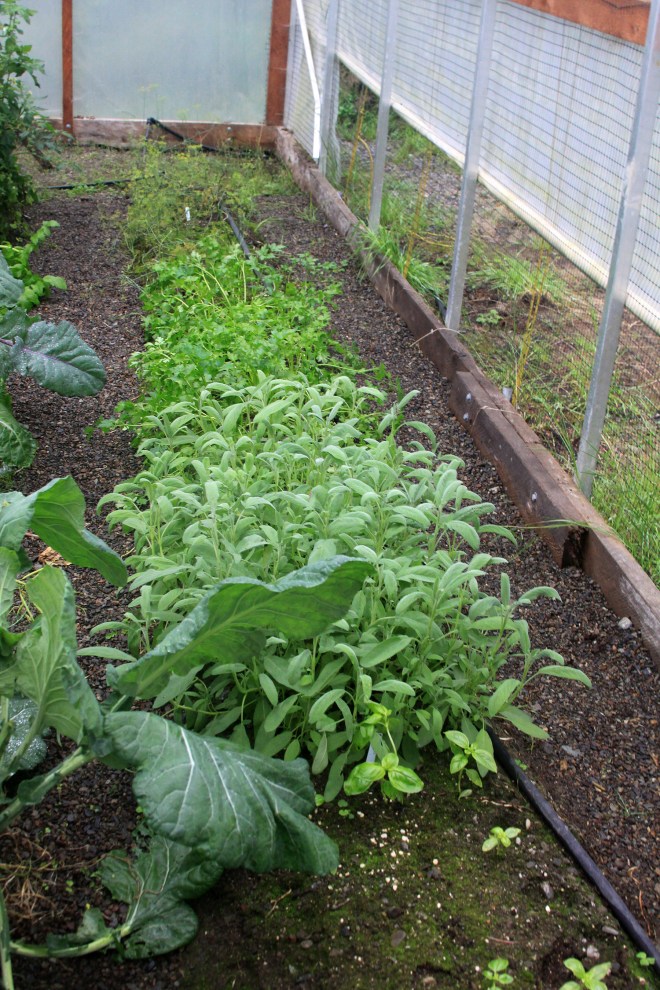
GreensInHoopHouseStPetersThese classes will cover a variety of topics, from gardening basics and choosing what veggies to grow in Sitka to extending your gardening season, composting and seed-starting. But wait, there’s more. There’s also a class on abundant landscaping, plus classes on growing rhubarb and potatoes. Some of the classes have limited space and require preregistration, so sign up early. Most of the classes are free, but we accept donations. There is one class with a minimal materials fee.

We will be adding more classes to this list as they become available, so check the website for updates. We plan to post individual class announcements as we get closer to the actual class dates.

And now, here’s the list of classes so far:

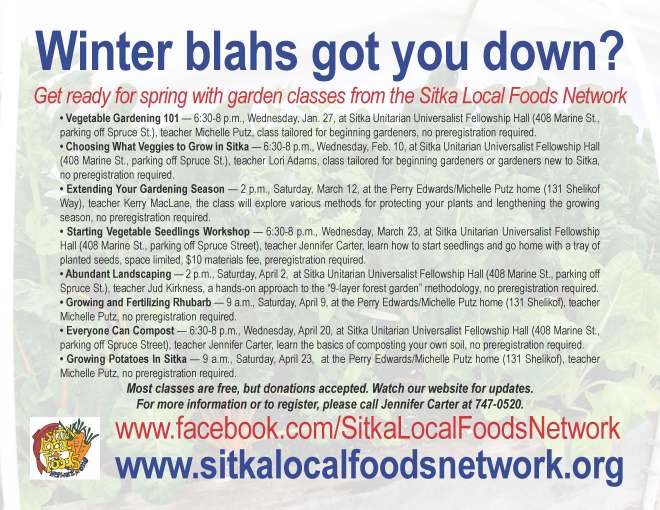
  • Vegetable Gardening 101 — 6:30-8 p.m., Wednesday, Jan. 27, at Sitka Unitarian Universalist Fellowship Hall (408 Marine St., parking off Spruce St.), teacher Michelle Putz, class tailored for beginning gardeners, no preregistration required.
  • Choosing What Veggies to Grow in Sitka — 6:30-8 p.m., Wednesday, Feb. 10, at Sitka Unitarian Universalist Fellowship Hall (408 Marine St., parking off Spruce St.), teacher Lori Adams, class tailored for beginning gardeners or gardeners new to Sitka, no preregistration required.
  • Extending Your Gardening Season — 2 p.m., Saturday, March 12, at the Perry Edwards/Michelle Putz home (131 Shelikof Way), teacher Kerry MacLane, the class will explore various methods for protecting your plants and lengthening the growing season, no preregistration required.
  • Starting Vegetable Seedlings Workshop — 6:30-8 p.m., Wednesday, March 23, at Sitka Unitarian Universalist Fellowship Hall (408 Marine St., parking off Spruce Street), teacher Jennifer Carter, learn how to start seedlings and go home with a tray of planted seeds, space limited, $10 materials fee, preregistration required.
  • Abundant Landscaping — 2 p.m., Saturday, April 2,  at Sitka Unitarian Universalist Fellowship Hall (408 Marine St., parking off Spruce St.), teacher Jud Kirkness, a hands-on approach to the “9-layer forest garden” methodology, no preregistration required.
  • Growing and Fertilizing Rhubarb — 9 a.m., Saturday, April 9, at the Perry Edwards/Michelle Putz home (131 Shelikof), teacher Michelle Putz, no preregistration required.
  • Everyone Can Compost — 6:30-8 p.m., Wednesday, April 20, at Sitka Unitarian Universalist Fellowship Hall (408 Marine St., parking off Spruce Street), teacher Jennifer Carter, learn the basics of composting your own soil, no preregistration required.
  • Growing Potatoes In Sitka — 9 a.m., Saturday, April 23,  at the Perry Edwards/Michelle Putz home (131 Shelikof), teacher Michelle Putz, no preregistration required.

In addition, we’ll be launching our new downtown teaching garden as we get closer to growing season and all of those classes will be open to the public. Feel free to help the Sitka Local Foods Network education committee plan new programming at its next monthly meeting, from 6:30-8 p.m. on Thursday, Jan. 28, at the Sitka Unitarian Universalist Fellowship Hall (408 Marine Street, parking off Spruce Street).

For more information or to sign up for classes requiring preregistration, contact Jennifer Carter at 747-0520 or 1-850-491-2666 (cell).

• Spring 2016 garden education classes from the Sitka Local Foods Network (opens as PDF)

• Sitka Local Foods Network education committee to meet on Thursday, Jan. 28

GreensInHoopHouseStPeters

The Sitka Local Foods Network education committee will host its monthly meeting from 6:30-8 p.m. on Thursday, Jan. 28, at the Sitka Unitarian Universalist Fellowship Hall (408 Marine Street, parking is off Spruce Street).

During this meeting we will go over our spring schedule of gardening classes, select our new garden mentor program families, get updates on our new downtown teaching garden program, get an update on upcoming Sitka Kitch cooking classes, and look into other educational opportunities we can offer in Sitka (such as a garden tour or local foods directory).

This meeting is open to the public and all are invited. We also need volunteers who can help with our classes. For more information, contact Jennifer Carter at 747-0520.

• Highlights from 2015 for your Sitka Local Foods Network

Some carrots grown at St. Peter's Fellowship Farm communal garden on sale at the Sitka Farmers Market

Some carrots grown at St. Peter’s Fellowship Farm communal garden on sale at the Sitka Farmers Market

As 2015 comes to a close, here are some highlights from the past year for your Sitka Local Foods Network. We are looking forward to a lot of new adventures in 2016, and encourage people to join us. We always need new volunteers, and please donate to us through Pick.Click.Give. when you file for your Alaska Permanent Fund Dividend starting on Jan. 1 and ending March 31. Your donations help fund a variety of Sitka Local Foods Network programs, such as the Sitka Farmers Market, St. Peter’s Fellowship Farm communal garden, and a host of garden and food education opportunities.

Our annual meeting and potluck will be from 5:30-8 p.m. on Saturday, Jan. 30, at the Sitka Unitarian Universalist Fellowship Hall (408 Marine Street, parking is off Spruce Street). This event is open to the public, just bring a dish (preferably with local foods) to share with everybody. We usually introduce new board members, confirm our new officers, and give an update on our finances and programs.

And now here are those 2015 highlights from your Sitka Local Foods Network:

Grew food at St. Peter’s Fellowship Farm and extension gardens

St. Peter's Fellowship Farm communal garden

St. Peter’s Fellowship Farm communal garden

For the eighth straight year, the Sitka Local Foods Network expanded its produce-growing operations at the St. Peter’s Fellowship Farm communal garden and our extension gardens, such as the one on land owned by Pat Arvin. The food grown from these gardens is sold at the Sitka Farmers Market, where Sitka residents, including people with SNAP (food stamps) and WIC (supplemental nutrition program for women, infants and children) benefits, have access to fresh local produce. In addition to supplying the Sitka Farmers Market, this year we grew enough to sell to some school lunch programs, at the Sitka Seafood Festival, at the Running of the Boots costumed fun run, and at a booth on days when Chelan Produce was in Sitka.

Hosted six Sitka Farmers Market events

Some of the booths at the Sitka Farmers Market

Some of the booths at the Sitka Farmers Market

We hosted the Sitka Farmers Market for the eighth straight summer, and this year there were six markets on alternate Saturdays from July 4 through Sept. 12. In addition to selling produce from St. Peter’s Fellowship Farm and our extension gardens, the Sitka Farmers Market serves as a business incubator where budding entrepreneurs sell jams/jellies, baked goods, fish, prepared food ready to eat, and a variety of local arts and crafts. Our emphasis is on local products always. The Sitka Farmers Market also provides a venue for local musicians (we hire a few to play at each market). One of the highlights this year was a brief performance by the students involved in the musical with the Sitka Fine Arts Camp. Another highlight was the inaugural Sitka Slug Races, where Sitka residents brought their own slugs (or rented ones we harvested) for a series of races on a glass table.

Taught a variety of garden education classes and mentored some novice gardeners

Tammy O'Neill, a student in the garden mentor program, poses with her garden beds after her second year in the program

Tammy O’Neill, a student in the garden mentor program, poses with her garden beds during her second year in the program

The Sitka Local Foods Network education committee hosted a variety of classes this year for local food gardeners. We started out with a couple of classes about basic gardening in Sitka, and followed those with classes on starting seeds, composting, chickens, rabbits, fruit trees, potatoes, carrots, rhubarb, and more. In addition, we hosted the second year of our family garden mentoring program with funding from First Bank. In this program we provided one-on-one mentoring for four families of novice gardeners and two families returning for a second year of the program. We are hoping to bring this innovative program back in 2016 and we are recruiting for new families. This fall we received a small grant from the United Way of Southeast Alaska that we will use to develop a teaching garden at Baranof Elementary School near downtown Sitka.

Partnered with several organizations to launch and operate the Sitka Kitch

LisaSadleirHartHelpsRebaAndRobertScoopCultureStarterIntoMilk

Sitka Kitch “Cooking From Scratch” instructor Lisa Sadleir-Hart, center, helps Reba Traini and Robert Baines make homemade yogurt

This year we partnered with the Sitka Conservation Society, UAF Cooperative Extension Service, First Presbyterian Church, Sitka Food Co-op, and other organizations to help launch the Sitka Kitch community rental commercial kitchen, which officially opened in March 2015. The Sitka Kitch is available for cottage food entrepreneurs to rent as they make their products, plus we have been offering a variety of food preservation and cooking classes. The Sitka Kitch also is available for people to rent who need a larger kitchen to cook a community meal.

Helped launch the Sitka Food Collaborative

Toward the end of the year, the Sitka Local Foods Network, Sitka Conservation Society, Sitka Kitch, Sitka Food Co-op, Sitka Seedling Farms, and other food groups created the Sitka Food Collaborative and then submitted an application for a USDA grant to conduct a Sitka Food Systems Assessment. This will build on the work done in 2013-14 with the Sitka Community Food Assessment, but will look at ways we can improve our local food system so we have better food security.

Fundraising and strategic planning

50-states-logoThe Sitka Local Foods Network is maturing as an organization, and this year we decided we needed to start raising money so we eventually can hire a part-time director to take care of some of the daily chores dealt with by our volunteer board of directors. We have started to set aside a little bit of money, still have a ways to go. This year we received a grant from the Alaska Community Foundation that will allow us to work with the Foraker Group in 2016 to create a fundraising and long-term strategic plan. We participated in the Pick.Click.Give. program for the second year, and we are preparing for our third year of receiving donations from Alaskans when they file for their Permanent Fund Dividends. We launched an online donation page on Razoo.com (a donation website for nonprofit groups), and hosted fundraisers for St. Peter’s Fellowship Farm, the Sitka Sound Suppers (with a totally local meal) and #GivingTuesday (#GivingTuesdayAK in Alaska). This fall we received a small grant from the United Way of Southeast Alaska that we will use to develop a teaching garden at Baranof Elementary School near downtown Sitka. In December, the Sitka Local Foods Network was named Alaska’s winner in the 50 States For Good contest, hosted by Tom’s of Maine. Each of the winning community nonprofits from each state won $20,000 to improve their programming, which we should receive in January.

• USDA Natural Resources Conservation Service offers funding support program for high tunnels

picture8

The deadline has been set for the next round of applications for the U.S. Department of Agriculture’s Natural Resources Conservation Service (NRCA) cost-sharing program. This program enables qualifying landowners who produce food to build high tunnels with financial assistance from the USDA.

The next NRCS Alaska program deadline is June 15, 2016. However, the program usually sets two applications deadlines a year so applications can be batched and ranked. Applications that miss the June 15 deadline will be held for the next deadline (usually about Oct. 15, but it hasn’t yet been posted online for 2016). Applicants are encouraged to apply outside two deadline cycles, because sometimes funding is available.

“The next deadline is June 15, 2016 – for funding in the 2017 fiscal year,” said Samia Savell, of the Juneau Field Office of the USDA-NRCS. “However, we often get additional funding in the current fiscal year and have the opportunity to fund applications that have been submitted past the prior deadlines. In other words, if you know of people who are interested in the program, please have them contact me to get the application materials. We do accept applications at any time.”

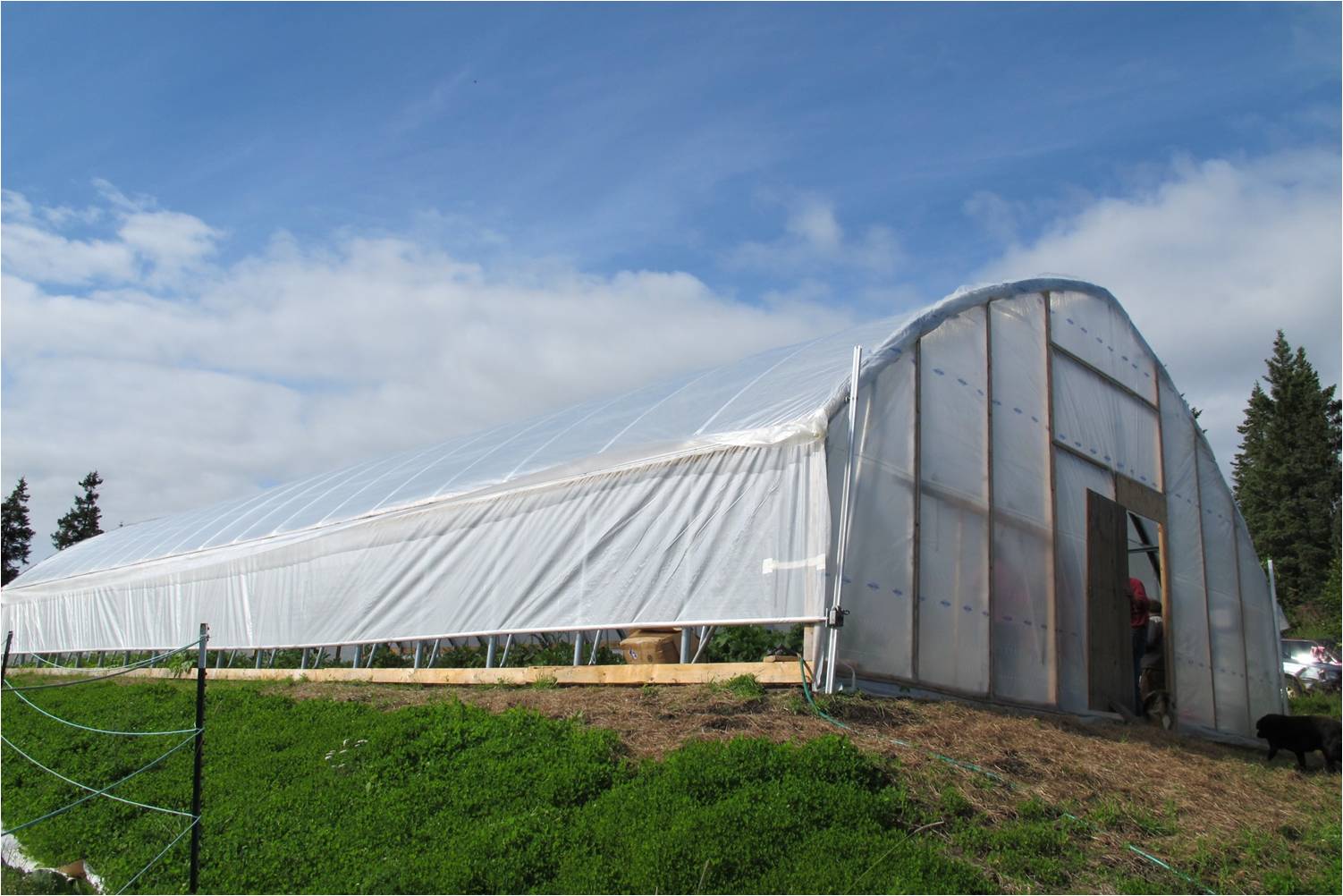
High tunnels, also known as hoop houses or temporary greenhouses, extend the growing season so more food is produced before and after the traditional weather dates for growing stuff outdoors. They also can help with irrigation and drainage, and with pest control.

High tunnels are different than greenhouses in that they are passively heated by the sun, so they have lower energy costs than greenhouses. High tunnels are at least nine feet tall (an increase from six feet tall in recent years), so people can walk upright in them. Low tunnels, which usually involve some PVC pipe bent over a garden bed and covered with row cover, aren’t eligible in this program. Food in high tunnels is planted either directly into the ground or in raised beds, not in containers. To learn more about the USDA’s high tunnel program, click here, and click here to get information about the application procedure. This link has frequently asked questions and answers about seasonal high tunnel systems for crops.

Picture10This program started a couple of years ago as a pilot program, but now is a permanent part of of the NRCS EQIP (Environmental Quality Incentive Programs). The program recently was revamped, and one major change is there now is no size restriction on the structures NRCS provides cost-sharing funds (previously it was limited to up to 2,178 square feet, or 5 percent of one acre). Also, geodesic domes are now eligible. Both the land owner and land must meet certain eligibility requirements.

Funding is provided on a reimbursable status once the high tunnel is installed and certified to meet NRCS standards. In 2012 there was just one high tunnel in Sitka, but in 2013 there were six. Other areas of the state, such as Homer, have built dozens of high tunnels through the program.

For information regarding the NRCS technical service or program participation in Southeast Alaska, please contact Samia Savell or Will Murray at the Juneau field office at (907) 586-7220 or 586-7208, or send email to samia.savell@ak.usda.gov or william.murray@ak.usda.gov. The June 15, 2016, deadline is the first deadline for the Fiscal Year 2017 funding cycle. Click here for a link to the Alaska NRCS page. Click here for an interview with Samia Savell on KRBD-FM (Ketchikan) about the program.

• High Tunnels In Alaska Fact Sheet (October 2015)

• Flier about Southeast Alaska cost-sharing program for FY2016 (March 2015, note, information should be similar for FY2017)

• The Inuit Circumpolar Council-Alaska (ICC-AK) releases report on Inuit food security

Food Security Summary and Reccomendations Report _Page_01
Drastic changes are occurring within the Arctic and Inuit are on the forefront of these changes. In recent years food security has increasingly become a topic of conversation and is gaining more attention. But what does food security mean to those that call the Arctic home?

Through this Inuit Circumpolar Council-Alaska (ICC-AK) project led by the Alaskan Inuit (Iñupiaq, St. Lawrence Island Yupik, Central Yup’ik and Cup’ik), the Alaskan Inuit Food Security Conceptual Framework: How to Access the Arctic from an Inuit Perspective report illuminates the meaning of Alaskan Inuit food security and lay out an assessment process.

In the report it is clear that Inuit food security is more than calories, more than nutrients, as explained by a contributing author:  “We are speaking about the entire Arctic ecosystem and the relationships between all components within; we are talking about how our language teaches us when, where and how to obtain, process, store and consume food; we are talking about the importance of dancing and potlucks to share foods and how our economic system is tied to this; we are talking about our rights to govern how we obtain, process, store and consume food; about our Indigenous knowledge and how it will aid in illuminating these changes that are occurring. We are talking about what food security means to us, to our people, to our environment and how we see this environment; we are talking about our culture.” — Executive Summary

The report is the product of 146 contributing Inuit authors, a 12-member advisory committee, ICC-AK and their membership organizations. A summary and recommendations report was created for those who are looking for a quick glimpse at what food security means to Alaskan Inuit, what it means to apply a food security lens to assessments, and recommendations for strengthening food security. For a deeper understanding and more in-depth discussion, a technical report has been created. Within both reports you will find: 1) recommendations, 2) key barriers, 3) the food security conceptual framework, and 4) drivers of food security and insecurity. The technical report also lays out a food security assessment process.

“To look at environmental health through an Inuit food security lens requires one to undergo a paradigm shift. One must be willing to attempt to understand the Inuit culture to know what Inuit mean when they talk about food security.” — James Stotts

ICC-Alaska hopes that the report will be of use to a broad spectrum of people. Villages may use the report to aid in communicating with those from outside their communities. Decision-makers, academics, environmentalists, policy-makers and industry may use the reports as a tool to enhance their understanding of the Arctic. The report is accessible on the ICC-Alaska website.

The food security report also is linked below:

• Inuit Circumpolar Council-Alaska Food Security Summary and Recommendations Report

• Inuit Circumpolar Council-Alaska Food Security Technical Report

• Sitka Seedling Farms project to host informational lunch meeting on Dec. 18

GreensInUAFHoopHouse

Farm DesignSitka Seedling Farms is an initiative to meet Sitka’s food system needs in a thought-out, comprehensive way. Many food-related initiatives have been proposed over the last several years, but most have stalled for lack of space.

Sitka Seedling Farms, which is a finalist in the Paths to Prosperity economic development contest for Southeast Alaska, will solve this problem by exploring innovative land relationships with major landowners in our community to develop the resources Sitka’s food system needs to thrive, such as production space for food entrepreneurs, community greenhouses, food storage and processing facilities and more. Sitka Seedling Farms is currently in the land exploration phase.

To learn more about this local foods systems project, there will be an informational lunch meeting from noon until 1 p.m. on Friday, Dec. 18, at the Larkspur Café. Please contact Matthew Jackson with questions or comments at 907-821-1412. Also, please feel free to sign this online letter of support to the city to help promote the project.

• Sitka Seedling Farms business plan executive summary (Fall 2015)

• Potential Sitka Seedling Farms community farm design (by Monique Anderson)

• Scenes from the Sitka Kitch venison class hosted by UAF Cooperative Extension, SEARHC

22747125432_327d8c7356_o

kitch_logo_mainSitka residents love their venison, so the University of Alaska Fairbanks Cooperative Extension Service and the SouthEast Alaska Regional Health Consortium (SEARHC) WISEFAMILIES Traditional Foods program hosted a free class on canning, smoking, and making deer jerky on Oct. 30 at the Sitka Kitch community rental commercial kitchen.

The Oct. 30 class featured lessons on how to can venison in jars, taught by Ellen Ruhle, as well as info about how to prepare deer jerky and how to smoke venison roasts, taught by Jud Kirkness. Due to the popularity of the class, the Sitka Kitch is hoping to schedule a second class on deer/venison in the near future.

Below is a slideshow of photos taken during the class by Jasmine Shaw of the UAF Cooperative Extension Service Sitka District Office.

This slideshow requires JavaScript.


• Sitka rooftop greenhouse project to meet on Tuesday, Nov. 17

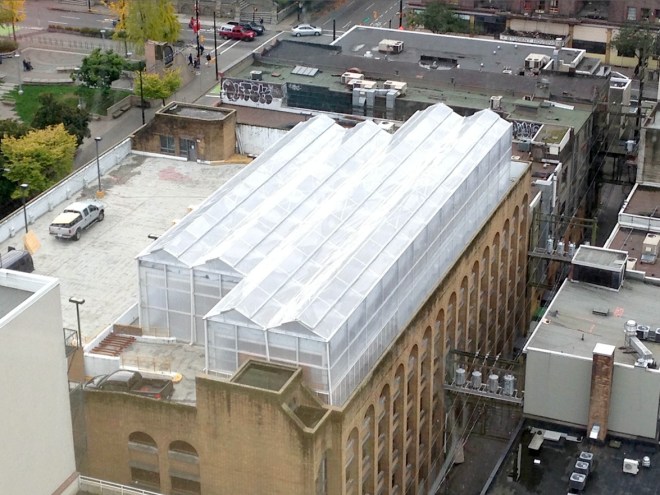
Rooftop greenhouses, such as this one on top of a parking garage in Vancouver, British Columbia, are becoming more popular around the world. The rooftop greenhouse project from the 2015 Sitka Health Summit is hoping this might be an option for Sitka, where land is at a premium. (Photo from http://www.cityfarmer.info/)

Rooftop greenhouses, such as this one on top of a parking garage in Vancouver, British Columbia, are becoming more popular around the world. The rooftop greenhouse project from the 2015 Sitka Health Summit is hoping this might be an option for Sitka, where land is at a premium. (Photo from http://www.cityfarmer.info/)

The rooftop greenhouse project from the 2015 Sitka Health Summit will meet from 5-6:30 p.m. on Tuesday, Nov. 17, at the Sitka Pioneers’ Home manager’s house/Brave Heart Volunteers office.

Sitka's city-owned cold storage plant on Katlian Street is one place that has been suggested for a possible rooftop greenhouse.

Sitka’s city-owned cold storage plant on Katlian Street is one place that has been suggested for a possible rooftop greenhouse.

After several years of running into problems finding useable land for a Sitka Community Greenhouse and Education Center that didn’t require large investments in remediation, the group hopes a rooftop greenhouse on a flat-roofed building, such as the city’s cold storage plant on Katlian Street, might be the solution. Not only would wasted heat be recaptured for the greenhouse, but moving it onto the roof will provide better sun exposure and fewer garden pests (such as snails and deer).

Rooftop greenhouses of all sizes are becoming more popular around the world, and there have been several large ones pop up in New York City, Chicago, Montréal, Berlin, and other communities. Come join us as we see if this option is possible for Sitka. For more information, please contact Charles Bingham at 623-7660 or charleswbingham3@gmail.com

• SEARHC, UAF Cooperative Extension Service to host deer/venison canning classes

Participants in Sitka's Alaska Way Of Life 4-H program, aka the Sitka Spruce Tips 4-H program, learn how to skin and butcher a deer. (Photo courtesy of the Sitka Conservation Society/Sitka Spruce Tips 4-H program)

Participants in Sitka’s Alaska Way Of Life 4-H program, aka the Sitka Spruce Tips 4-H program, learn how to skin and butcher a deer. (Photo courtesy of the Sitka Conservation Society/Sitka Spruce Tips 4-H program)

kitch_logo_mainThe SouthEast Alaska Regional Health Consortium (SEARHC) WISEFAMILIES Traditional Foods program and the University of Alaska Fairbanks Cooperative Extension Service are teaming up to offer a deer and venison workshop from 3-7 p.m. on Friday, Oct. 30, at the Sitka Kitch.

The Sitka Kitch is a rental community commercial kitchen project coordinated by the Sitka Conservation Society, in partnership with the Sitka Local Foods Network, located inside the First Presbyterian Church, 505 Sawmill Creek Road. The Sitka Kitch was a project from the 2013 Sitka Health Summit designed to improve food security in Sitka while also providing a space for people wanting to get into the cottage food business or wanting to preserve their harvest for storage in the home pantry. Sitka Kitch officially opened in March 2015 after a series of renovations to make it pass Alaska Department of Environmental Conservation commercial kitchen food safety standards.

The Oct. 30 class will feature lessons on how to can venison in jars, taught by Ellen Ruhle, as well as how to prepare deer jerky and how to smoke venison, taught by Jud Kirkness.

There is a possibility we will be able to harvest a deer next week, and if so we will add on a portion of the workshop to focus on butchering and meat care. And this time we are just offering the food preservation class (canning, jerky, and smoking hind quarters).

Thanks to a grant from the SEARHC WISEFAMILIES Traditional Foods program, all ingredients, jars, and equipment will be supplied in class.

The SEARHC WISEFAMILIES Traditional Foods program promotes healthy lifestyles by connecting Alaska Natives in Southeast Alaska to their culture. Members of the program learn how to harvest, cook, and preserve their traditional Alaska Native foods, which usually are healthier than heavily processed store-bought foods. In addition, participants learn traditional language, dancing, carving, weaving, and other skills that help reconnect them to their culture.

The UAF Cooperative Extension Service offers a variety of programs geared toward food, how to grow it, how to preserve it for storage, and how to make it into cottage foods you can sell. For those who can’t make the classes, the service offers a series of free online tutorials about home canning called Preserving Alaska’s Bounty.

Pre-registration is required for this class, and there are only 12 spots available. For more information and to pre-register, please contact Jasmine Shaw at 747-9440 or jdshaw2@alaska.edu.

• Sitka Farmers Market earns top ranking from Alaska in American Farmland Trust’s Farmers Market Celebration

SnapshotFarmersMarketStandings

FARMMARKETCELEB_LOGO_DThank you to everybody who supported the Sitka Farmers Market in the seventh annual American Farmland Trust‘s Farmers Market Celebration, which ended on Wednesday, Sept. 23.

Your votes helped the Sitka Farmers Market rank as the top farmers market in Alaska in all five categories — People’s Choice, Focus on Farmers, Healthy Food For All, Pillar of the Community, and Champion for the Environment. We ranked 49th nationally in Champion of the Environment, 55th in People’s Choice, 57th in Healthy Food For All, 57th in Pillar of the Community, and 58th in the Focus on Farmers categories.

SitkaFarmersMarketSignIf you’re not familiar with the American Farmland Trust’s Farmers Market Celebration, you can learn more here. The Sitka Local Foods Network hosted six Sitka Farmers Markets this summer — on Saturdays, July 4, July 18, Aug. 1, Aug. 15, Aug. 29, and Sept. 12, at the Alaska Native Brotherhood Founders Hall.

While our markets are over for the summer, the Sitka Local Foods Network will host a fresh produce booth from 10 a.m. to noon this Saturday, Sept. 26, downtown near St. Michael’s Russian Orthodox Cathedral at our 21st annual Running of the Boots fundraiser.