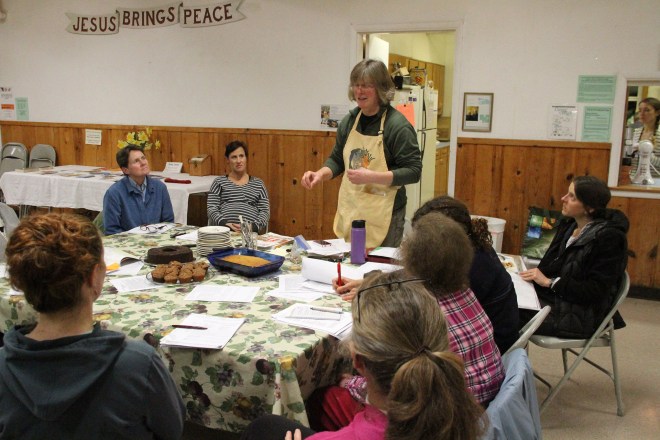
• Scenes from the fourth class in the Sitka Kitch’s Cooking From Scratch series — Making Yogurt From Low-Fat Powdered Milk

LisaSadleirHartHelpsRebaAndRobertScoopCultureStarterIntoMilk

kitch_logo_mainThe fourth of four classes in the Sitka Kitch‘s Cooking From Scratch lesson series — Making Yogurt From Low-Fat Powdered Milk — was held on Monday, Dec. 7, at the Sitka Kitch community rental commercial kitchen.

Students learned the basics of making yogurt from instructor Lisa Sadleir-Hart, and each student took home a quart jar of yogurt (that needed to culture overnight) and the supplies to make a second batch. The class focussed on powdered milk due to the cost savings, though regular milk can be used.

This was the fourth and final class in a fall series of Cooking From Scratch classes. Lisa Sadleir-Hart, a registered dietitian and certified health educator, coordinated the class series and also taught the first two classes —Beans 101 and Baking Whole-Grain Bread. Bridget Kauffman taught the third class — Gluten-Free Holiday Baking.

All classes took place at the Sitka Kitch community rental commercial kitchen (link opens Facebook page) located at the First Presbyterian Church, 505 Sawmill Creek Road. Watch for updates about upcoming classes this winter and spring, including a Culinary Skills series of classes in March geared toward giving prospective restaurant and catering employees the skills they need to get jobs in the industry.

There also will be more Cooking From Scratch classes. The Cooking from Scratch series goal is to teach basic cooking skills using high-quality ingredients, and to help Sitkans take back their kitchens and reduce their food budgets. Interested individuals can register for Sitka Kitch classes at https://sitkakitch.eventsmart.com/ (click on the event title to register, and pay when you attend the class).

Here is a slideshow of several photos from the fourth class in the Cooking From Scratch series, Making Yogurt From Low-Fat Powdered Milk.

This slideshow requires JavaScript.

• Check out the December 2015 edition of the Sitka Local Foods Network newsletter

SLFNDecember2015NewsletterScreenshot

The Sitka Local Foods Network just sent out the December 2015 edition of its newly launched monthly newsletter. Feel free to click this link to get a copy.

This edition of the newsletter has brief stories about how one 140-character tweet won the Sitka Local Foods Network $20,000 from Tom’s of Maine, how the opening of the new Sitka Biotoxin Lab on Katlian Street will mean safer shellfish in Southeast Alaska, and an appeal for new first-year gardening families for the garden mentor program. Each story has links to our website for more information.

You can sign up for future editions of our newsletter by clicking on the registration form image in the right column of our website and filling in the information. If you received a copy but didn’t want one, there is a link at the bottom of the newsletter so you can unsubscribe. Our intention is to get the word out about upcoming events and not to spam people. We will protect your privacy by not sharing our email list with others.

• New biotoxin lab in Sitka allows for quicker, better monitoring of harmful algal blooms in Southeast Alaska

MichaelJamrosChrisWhiteheadEstherKennedyJohnDorothyOrbisonDeanOrbison

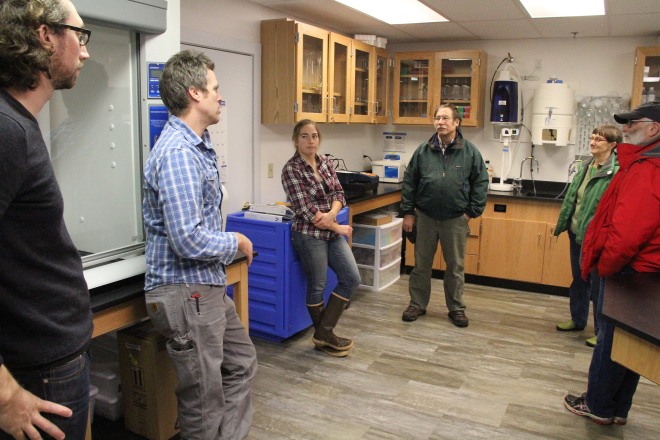
From left, Sitka Tribe of Alaska Environmental Lab Manager Michael Jamros, STA Environmental Program Manager Chris Whitehead, and STA Environmental Specialist Esther Kennedy discuss the new Sitka Biotoxin Lab with visitors to an open house on Monday, Nov. 30, 2015. The new lab will help Southeast subsistence and sport shellfish harvesters learn about harmful algal blooms in the region so they can avoid paralytic shellfish poisoning (PSP) or amnesic shellfish poisoning (ASP).

Most shellfish eaters are aware of the massive algal bloom that shut down many shellfish operations on the Pacific Coast this summer. The algal bloom even reached Sitka’s Starrigavan Beach with the June discovery of Pseudo-nitzchia, a species of plankton that sometimes produces domoic acid which can cause amnesic shellfish poisoning (ASP). ASP causes gastrointestinal issues in mild cases, such as nausea, vomiting, diarrhea, and abdominal cramps. In more severe cases there will be neurological problems, such as headaches, confusion, hallucinations, short-term memory loss, respiratory difficulty, seizures, coma, and in extreme cases, death.

SEAKTribalToxinsSEATTPartnerLocationsUntil two years ago, Southeast Alaska beaches and subsistence- and sport-harvested shellfish weren’t tested for harmful biotoxins. That changed with the Southeast Alaska Tribal Testing (SEATT) program, a partnership of regional tribes coordinated by Sitka Tribe of Alaska, that began training technicians from six villages (now 12 villages) in the region on how to gather water samples so they could be tested. SEATT is part of a program called Southeast Alaska Tribal Ocean Research (SEATOR).

Now the project has moved to the next phase, the creation of a Sitka Biotoxin Lab, located at 429 Katlian Street, that can provide quicker and better testing results to people in the region who want to eat shellfish. Instead of sending samples to the Lower 48 for testing, which can take more than a week or two, samples from Southeast Alaska can be tested in Sitka and data can be available in less than 24 hours, Sitka Tribe of Alaska Environmental Program Manager Chris Whitehead said during an open house at the lab on Monday, Nov. 30. Before the lab opened, the program just took water samples. But now it will be able to actually test the shellfish for biotoxins.

Whitehead said one of the purposes of the lab is to give shellfish harvesters as much information as possible about possible harmful algal blooms so they can make informed decisions about if they still want to harvest and eat local shellfish. Harmful algal blooms spread a variety of biotoxins, such as domoic acid and saxitoxin, which can cause paralytic shellfish poisoning (PSP) and amnesic shellfish poisoning (ASP). PSP and ASP can be deadly, and in 2010 there were two people in Southeast Alaska who died from PSP.

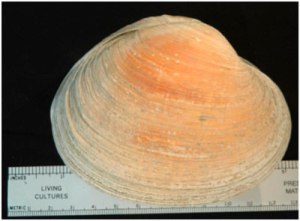
Cockles-Alaska-Department-of-Health-and-Social-Services“The toxins can stay in butter clams for 2 1/2 to three years,” Whitehead said, disproving the common local myth that shellfish is safe to eat in months with R in the name. “We’re still seeing blooms in December.”

Whitehead said he’s hoping to eventually be able to do baseline sampling of a variety of beaches in Southeast Alaska. He said they are sampling bays for cyst beds by digging cores in the beach soil, and they’ve found cysts 3-4 meters (9-13 feet) below the surface. While the beach might be safe for now, if people start building piers or docks it can stir up the cyst beds and launch a harmful algal bloom.

The lab and testing program is funded by the Environmental Protection Agency (EPA) Indian Environmental General Assistance Program, the Bureau of Indian Affairs (BIA) and Tribal Cooperative Landscape Conservation Program, and the Administration for Native Americans’Environmental Regulatory Enhancement program. The National Oceanic and Atmospheric Administration (NOAA) Marine Biotoxin Programs from Seattle, Wash., and Charleston, S.C., provided training through workshops to help develop the SEATT program.

raw-clams-350Michael Jamros, PhD, was hired in October as the STA Environmental Lab Manager, and he will be handling most of the actual testing and diagnosis of the seawater and shellfish. He said right now the lab is focused on subsistence and sports harvests, but down the road it’s hoping to become FDA-certified so it can test commercial harvests.

Esther Kennedy is the STA Environmental Specialist, and she said “every week I go plankton hunting.” This summer all of her tests were at Starrigavan State Recreation Area, but now that the lab is open she will be able to test in more areas, “wherever you think people might harvest shellfish.”

pe-fig1“I think this will help our food security,” Kennedy said. “People will be able to see this abundant resource of shellfish, and now they’ll have better information about whether it’s safe to harvest.”

In addition to the Sitka staff, the program also trains monitors from 12 partner villages to test in their areas, which range from Ketchikan on the south to Yakutat on the north. These monitors come to Sitka twice a year for training, with their most recent training in early November. A slideshow of photos from the training is posted below.

This slideshow requires JavaScript.

• Tom’s of Maine awards $20,000 to Sitka Local Foods Network in 50 States For Good program

Toms-GoodnessBadge-Blue-062215

A short tweet last summer has resulted in a major contribution for a Sitka nonprofit.

In July, Sitka Local Foods Network Communications Director/Board Member Charles Bingham noticed a Tom’s of Maine promotion asking people to tweet about how they would use $20,000 to support a community nonprofit organization, so he created a Twitter account and tweeted about how he’d like the money to help the Sitka Local Foods Network’s work to improve food security in Sitka.

50-states-logoToday, Tom’s of Maine announced that the Sitka Local Foods Network has been selected as one of 52 winners from across the country in its seventh annual “50 States for Good” community-giving program. The Sitka Local Foods Network will receive $20,000 to fund important community projects and services in its mission to increase the amount of locally produced and harvested food in the diets of Southeast Alaskans.

“Due to my current work situation (or lack thereof), I don’t have much money to contribute to my favorite nonprofits. So I saw the promotion as a way to potentially get some funding for a local cause I believe in,” Bingham said. “It’s neat to see the power of 140 characters.”

“The Sitka Local Foods Network is elated to be receiving one of Tom’s of Maine’s 50 States of Good awards,” Sitka Local Foods Network President Lisa Sadleir-Hart said. “These funds will bolster our efforts to engage Sitka around issues of community food security and sustainability. Additionally, they’ll help us expand our programming efforts focused on food production at household, organizational and community levels. Finally, the award will assist Sitka in planning for a more robust, resilient food system that can feed us into the future as we participate in the upcoming community comprehensive planning process.”

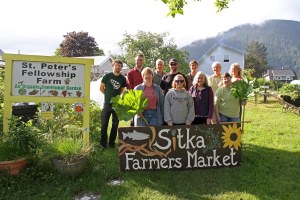
PHOTO COURTESY OF SITKA LOCAL FOODS NETWORK Sitka Local Foods Network board members and supporters pose at the St. Peter's Fellowship Farm communal garden on Monday. St. Peter's Fellowship Farm supplies most of the local produce sold at the Sitka Farmers Markets during the summer. The first Sitka Farmers Market of the season is from 10 a.m. to 1 p.m. on Saturday, July 4, at the Alaska Native Brotherhood Founders Hall, 235 Katlian St. The other five Sitka Farmers Market dates are July 18, Aug. 1, Aug. 15, Aug. 29, and Sept. 12. Pictured are, front row from left, Michelle Putz, Muriel Sadleir-Hart, Lisa Sadleir-Hart, and Kathy Jones. Back row, Matthew Jackson, Jonathan Adler, Peter Gorman, Jud Kirkness, Brandie Cheatham, Mary Therese Thomson, and Laura Schmidt.

PHOTO COURTESY OF SITKA LOCAL FOODS NETWORK
Sitka Local Foods Network board members and supporters pose at the St. Peter’s Fellowship Farm communal garden in June 2015. St. Peter’s Fellowship Farm supplies most of the local produce sold at the Sitka Farmers Markets during the summer. Pictured are, front row from left, Michelle Putz, Muriel Sadleir-Hart, Lisa Sadleir-Hart, and Kathy Jones. Back row, Matthew Jackson, Jonathan Adler, Peter Gorman, Jud Kirkness, Brandie Cheatham, Mary Therese Thomson, and Laura Schmidt.

To accomplish its mission, the Sitka Local Foods Network hosts the annual Sitka Farmers Market in the summer, operates the St. Peter’s Fellowship Farm communal garden (which grows produce to sell at the Sitka Farmers Market), and offers a variety of garden and food preservation classes throughout the year (including an innovative garden mentoring project for beginning gardeners).

According to Sadleir-Hart, the Tom’s of Maine award will work to “grow” our garden education and garden mentoring programs, which are key elements of the Sitka Local Foods Network’s mission to “increase the amount of locally produced and harvested food in the diets of Southeast Alaskans.” Additionally, the monies will support production improvements at St. Peter’s Fellowship Farm and at Pat Arvin’s extension garden.

TomsOfMaineTweetPassionate community members took to their social media pages to share #OneWaytoHelp their communities, amassing nearly 10,000 submissions. One entrant representing each state and Washington, D.C., was selected to designate a local nonprofit in their area to receive project funding from Tom’s of Maine (there also was a random UPC code winner).

“This year’s nonprofit recipients bring to life an inspiring picture of the care that Americans have for each other and their communities,” said Susan Dewhirst, goodness programs manager at Tom’s of Maine. “People often think giving back to their community is time intensive, and we wanted to show there are easy ways to make a difference, like raising awareness for a cause you love and supporting brands that strive to make the world a better place for future generations.”

Tom’s of Maine is a natural products company focused on oral and personal care with a variety of products including toothpaste, antiperspirant, deodorant, bar soap, lip balm, and baby shampoo. It has given 10 percent of its profits back to the community since 1970 and encourages employees to use 5 percent (12 days) of paid time off to volunteer every year. For more information about Tom’s of Maine, visit http://www.tomsofmaine.com or https://www.facebook.com/TomsofMaine. A complete list of winners can be found here, http://blog.tomsofmaine.com/index.php/50sfg/.

To learn more about the Sitka Local Foods Network, go to http://www.sitkalocalfoodsnetwork.org/. You also can like our Facebook page at https://www.facebook.com/SitkaLocalFoodsNetwork, and you can follow us on Twitter at https://www.twitter.com/SitkaLocalFoods (@SitkaLocalFoods).

• Sitka Local Foods Network launches its first #GivingTuesdayAK online fundraiser (FUNDRAISER EXTENDED TO DEC. 31)

save-the-date-sparkle-blue2-1024x438

Most people have heard about Black Friday, Small-Business Saturday, and Cyber Monday, three consumer-oriented days geared toward shopping for the holidays. But have you heard about Giving Tuesday, which takes place on Dec. 1 this year?

Giving Tuesday, also listed at #GivingTuesday (and known as #GivingTuesdayAK in Alaska), is a day for people to celebrate generosity and give to worthy nonprofits who support the local community. This year, the Sitka Local Foods Network is launching its own Giving Tuesday online fundraiser to help us meet our mission of increasing the amount of locally produced and harvested food in the diets of Southeast Alaskans.

(NOTICE: Since our online donation site, Razoo.com, recently announced it is waiving transaction fees through the end of the year, we are extending our #GivingTuesday campaign through Dec. 31. If you decide to donate, please use our #GivingTuesday page to help us avoid the transaction fees. We appreciate your support.)

When you donate to the Sitka Local Foods Network you support us as we host the Sitka Farmers Markets during the summer, grow food at the St. Peter’s Fellowship Farm communal garden, and teach people about gardening and food preservation through our education program (which includes a garden mentor program for beginning gardeners). We also help with other local-food-related projects in town, such as Fish To Schools (which puts more locally caught seafood in school meals), our fruit tree project (where we got more community apple and cherry trees in town) or the Sitka Community Food Assessment (which gave us baseline data on food security issues in Sitka).

It’s easy to donate to our Giving Tuesday fundraiser through our secure donation page hosted by Razoo.com (an online site that collects donations for nonprofit organizations). The minimum donation through this site is $10, but we appreciate whatever you can give. A donation of $1,000 will provide all the materials, lessons and mentoring needed for a summer with one of our garden mentoring families (we usually add three new families each year, and we offer the families two years in the program).

For those who prefer to donate the old-fashioned way, you can send a check to the Sitka Local Foods Network, 408 Marine Street, Suite D, Sitka, Alaska, 99835. For those looking for end-of-the-year tax deductions, we are a 501(c)(3) nonprofit and our EIN is 26-4629930. Please let us know if you need a receipt.

We thank you for supporting local foods in Sitka, Alaska. Your donation is greatly appreciated. If you need more information about our organization or a receipt for tax purposes, you can email the Sitka Local Foods Network board of directors at sitkalocalfoodsnetwork@gmail.com.

• Sitka Local Foods Network to host education brainstorming session on Dec. 3

GreensInHoopHouseStPeters

Are you an experienced gardener who might be willing to help teach a class about growing food in Sitka? Maybe you’ll let people tour your garden? We might even start a Sitka Garden Club.

Join the Sitka Local Foods Network education committee for a brainstorming session as we try and come up with education activities for the upcoming year. We’ll meet from 6:30-8 p.m. on Thursday, Dec. 3, at the Sitka Unitarian Universalist Fellowship Hall (408 Marine Street, parking off Spruce Street).

For more information, contact Jennifer Carter at 747-0520.

• Three community wellness projects receive MAPP Tier 2 grant funding from SEARHC

SitkaMAPPGraphic
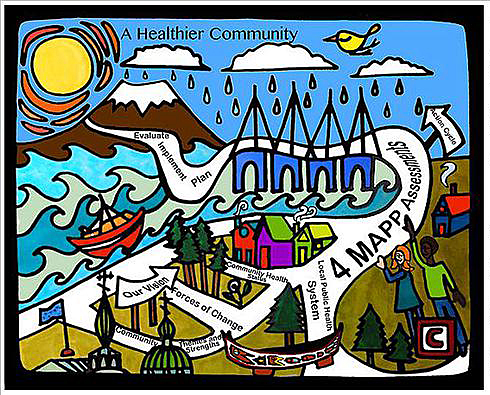
Three Sitka community wellness projects will each receive $10,000 in funding through the MAPP (Mobilizing for Action through Planning and Partnerships) Tier 2 grants from the SouthEast Alaska Regional Health Consortium (SEARHC).

SEARHC-logo-rgb-150-web“Fostering health and wellness in a community is complex and multifaceted,” SEARHC Health Educator Lauren Hughey said. “We are pleased to support these three projects with MAPP Teir 2 funding because while each project has a different approach. All will make Sitka a healthier place to live.”

Earlier this year, the Sitka Health Summit collected MAPP data about community health issues in Sitka, identifying healthy weight as a key focus area. In order to help more Sitkans achieve a healthy weight, SEARHC and the Sitka Health Summit requested project proposals that addressed this key area using the identified strategies that also address the health status of Alaska Native people.

Projects must use one of these strategies and plan an intervention based on evidence-based policy, systems, and environmental (PSE) changes. PSE changes will increase access to and use of traditional and other healthy foods or increase health literacy by making them more readily available at home, work, and in the community. PSE changes are long term changes and reach a large proportion of the population. PSE changes can occur in the community, tribal organizations, schools, healthcare systems, childcare facilities, worksites, or in families.

Here are brief descriptions about the three projects to receive MAPP Tier 2 grant funding:

  • Sitka Seedling Farms (project info provided by Matthew Jackson) — Sitka Seedling Farms is an initiative to meet Sitka’s food system needs in a thought-out, comprehensive way. Many food-related initiatives have been proposed over the last several years, but most have stalled for lack of space. Sitka Seedling Farms, which is a finalist in the Paths to Prosperity economic development contest for Southeast Alaska, will solve this problem by exploring innovative land relationships with major landowners in our community to develop the resources Sitka’s food system needs to thrive, such as production space for food entrepreneurs, community greenhouses, food storage and processing facilities and more. Sitka Seedling Farms is currently in the land exploration phase. Please contact Matthew Jackson with questions or comments at 907-821-1412.
  • Sitka Community Playground (project info provided by Lynne Brandon) — The grant award is to assist with the Sitka Community Playground Project Phase II, the design process. The design will help with the subsequent fundraising effort. The Phase III goal is to construct the new playground during the summer of 2017. Phase I was establishing a steering committee with volunteers, getting Assembly approval for the playground location at Crescent Harbor Park playground incorporating one of the three tennis courts, creating a funding plan and a timeline with tasks. The Sitka Community Playground project also is a 2015 Sitka Health Summit community wellness project.
  • Hames Center Elder Connect project (project info provided by Caitlin Blaisdell) — The Hames Center‘s Tier 2 grant will be used to create delegated senior hours for everyone older than age 65 and their caregivers to use our gym floor free of cost. These hours will incorporate group fitness activities, serve as an indoor walking space, create senior service information dissemination, and spark active, social groups for our growing senior demographic. Through bringing seniors together at the Hames Center with transportation assistance, we aim to remove many of the obstacles, such as social isolation, transportation limitations, and fixed income restrictions, that seniors may face in maintaining their physical and mental well-being all year round. The Hames Center Elder Connect project also is a 2015 Sitka Health Summit community wellness project.

Selected projects are awarded up to $10,000 for the project period of Nov. 1, 2015, through Oct. 31, 2016. For more information about the MAPP Tier 2 grant program, please contact Lauren Hughey at 966-8797 or lauren.hughey@searhc.org.


• Scenes from the third class in the Sitka Kitch’s Cooking From Scratch series — Gluten-Free Holiday Baking

BridgetKauffmanDiscussesGlutenFreeBaking

kitch_logo_mainThe third of four classes in the Sitka Kitch‘s Cooking From Scratch lesson series — Gluten-Free Holiday Baking — was held on Monday, Nov. 2, at the Sitka Kitch. In this class, taught by Bridget Kauffman, students learned about baking a variety of gluten-free holiday treats and then made a cinnamon coffee cake.

The class series is coordinated by Lisa Sadleir-Hart, a registered dietitian and certified health educator. She will teach three of the four classes (the first two classes were Beans 101 and Baking Whole-Grain Bread), with Bridget Kauffman teaching the other. All classes will take place at the Sitka Kitch community rental commercial kitchen (link opens Facebook page) located at the First Presbyterian Church, 505 Sawmill Creek Road. The last class in the series is:

The Cooking from Scratch series goal is to teach basic cooking skills using high-quality ingredients, and to help Sitkans take back their kitchens and reduce their food budgets. Interested individuals can register at https://sitkakitch.eventsmart.com/ (click on the event title to register, and pay when you attend the class).

Each class is $20, plus a food cost that will be split between all the students in the class. People should pre-register by 8 a.m. on the Saturday before the scheduled class. We need at least six people registered so we can guarantee the class will happen. Since space is limited, if you register and can’t make it, please contact Lisa Sadleir-Hart at 747-5985 so someone from the waiting list can be invited to the class.

Also, watch for a variety of new classes coming this spring.

Here is a slideshow of several photos from the third class in the series, Gluten-Free Holiday Baking.

This slideshow requires JavaScript.

• Sitka Local Foods Network education committee seeks new families for garden mentor program

KubackiCoupleWithGarden

For a third straight year (2015-16), the Sitka Local Foods Network (SLFN) education committee wants to help families in Sitka learn how easy it can be to grow some of their own food. We are looking for up to three families who would like to learn about and try vegetable gardening in their own backyard through our Family Garden Mentor project.

Through a series of six workshops to be held at the families’ homes, Sitka Local Foods Network education committee volunteers will help the families:

  • Choose a location for a vegetable bed (learning about sun, drainage, etc.),
  • Build (or find) a planter/container or raised bed, and acquire soil and soil amendments,
  • Learn about soil and prepare the soil for planting,
  • Plant 2-4 easy-to-grow plants — specifically potatoes, lettuce, kale, and maybe a perennial edible such as rhubarb or fruit bushes,
  • Learn to take care of their plants over the summer — teaching how to care for and pick the vegetables (without killing the plant),
  • Harvest potatoes, and
  • Cook a meal using the vegetables they have grown.

IMG_0005The Sitka Local Foods Network will provide all materials — soil, lumber, seeds, etc. — free to the participating families. Families will be expected to provide the labor, enthusiasm for gardening, and healthy appetites to eat the vegetables they grow.

The requirement to own your property or home was dropped in 2015, and people who rent now are participating through container gardening. Interested families must meet only three requirements:

  1. They must be first-time vegetable gardeners (this project is meant to help people who are just starting to garden, not people with previous experience, even if it was not in Alaska),
  2. They must want to try vegetable gardening and be committed to participating throughout the summer, and
  3. They must agree to let others come and attend classes at their property.

Other criteria, such as availability and interest in a second year of mentoring, will also be used to help select the final three families. Families that are not selected will be placed on a waiting list in the hope of future continuation and expansion of this project.

IMG_0751The Sitka Local Foods Network has expanded the program this year to include more families and to include at least two households living in rental housing that will garden in portable containers or planters appropriately sized for their space (in case moving is necessary). We also will offer a second year of mentoring to previous participants, so families can expand their knowledge and try growing more “difficult” vegetables, such as carrots, green onions, chard and peas.

IMG_0022Workshops may start as early as this fall or winter with selecting the garden site, ramp up in the spring of 2016 and run through September’s late harvest. First-year classes will focus on the easiest-to-grow vegetables (and fruit) in Sitka — potatoes, lettuce, kale, and rhubarb.

Families interested in participating in the 2016 program should contact Michelle Putz at 747-2708 before Jan. 15, and provide a name, address, and contact phone number.

A slideshow of scenes from our first two years of the family garden mentoring program is posted below.

This slideshow requires JavaScript.

• Scenes from the Sitka Kitch venison class hosted by UAF Cooperative Extension, SEARHC

22747125432_327d8c7356_o

kitch_logo_mainSitka residents love their venison, so the University of Alaska Fairbanks Cooperative Extension Service and the SouthEast Alaska Regional Health Consortium (SEARHC) WISEFAMILIES Traditional Foods program hosted a free class on canning, smoking, and making deer jerky on Oct. 30 at the Sitka Kitch community rental commercial kitchen.

The Oct. 30 class featured lessons on how to can venison in jars, taught by Ellen Ruhle, as well as info about how to prepare deer jerky and how to smoke venison roasts, taught by Jud Kirkness. Due to the popularity of the class, the Sitka Kitch is hoping to schedule a second class on deer/venison in the near future.

Below is a slideshow of photos taken during the class by Jasmine Shaw of the UAF Cooperative Extension Service Sitka District Office.

This slideshow requires JavaScript.