Patagonia headquarters chef Tracy On in Sitka to develop new Fish to Schools program recipes

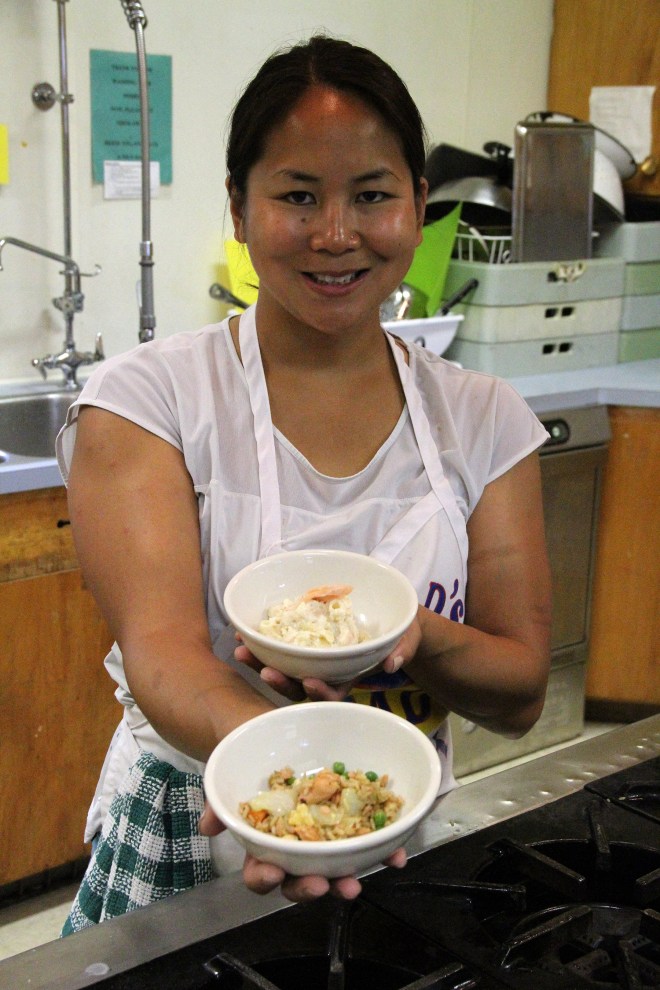
TracyOnWithSalmonFriedRiceSalmonMacAndCheese

Tracy On shows off a serving of chum salmon fried rice (front) and pink salmon macaroni and cheese that she tested Friday (Aug. 26) at the Sitka Kitch community rental commercial kitchen. Tracy is in town for a two-week internship with the Sitka Conservation Society to develop new recipes for the Fish to Schools program.

TracyOnPreparesToSliceChumSalmonIn her regular job, Tracy On is the chef at Patagonia headquarters in Ventura, Calif., serving about 500 breakfasts and lunches a day to Patagonia employees. For her summer vacation, Tracy is in Sitka developing new recipes for the Fish to Schools program as part of a two-week internship with the Sitka Conservation Society.

“I’m working on recipes for Fish to Schools, so we can incorporate a little more local salmon in the school lunches,” Tracy said. “I also had personal reasons for coming here. I wanted to learn more about the fishing industry and how to connect the kids to their local food sources. I’m also a little selfish. I’ve always wanted to come to Alaska and this is my first trip.”

During her first week in Sitka, Tracy spent several days at the Sitka Kitch community rental commercial kitchen testing new recipes. She also did a morning interview with KCAW-Raven Radio on Wednesday to help spread the word about her visit. On Friday, Tracy prepared a chum salmon fried rice dish and a pink salmon macaroni and cheese dish, then took a tour of the newly renovated Sitka Salmon Shares plant. She also has been working on a salmon corn dog and other recipes.

Tracy is trying to create recipes the kids will enjoy, what she called “comfort classics kids love,” while also keeping costs down because most school districts don’t receive more than $2 or $3 per student meal for their school lunch programs. That’s one reason she has been working with pink and chum salmon while in Sitka, because the costs are lower. She also is testing recipes that can be cooked from scratch, as well as ones that just require reheating, since school districts use different methods to prepare their meals. The Sitka Conservation Society will host an invitation-only tasting this week where SCS members and guests can try out a few of the new meals.

TrayOfChumSalmon“The main reason to host Tracy is to bring the Fish to Schools program to the next step,” said Sophie Nethercut, who coordinates the program for the Sitka Conservation Society. “We’ve been running this program on donations, and with the funding climate the way it is, we wanted to create a line of minimally processed recipes using pink and chum salmon that can be marketed to schools, nursing homes and hospitals.”

Tracy isn’t the first intern the Sitka Conservation Society has hosted from Patagonia, which has been sending employees to Sitka for the past three years to work on a variety of projects. Other Patagonia interns held workshops on repairing outdoor gear or helped with computer systems while in Sitka.

Tracy will be in town one more week, which will include a couple of sessions working on new recipes at the Sitka Kitch and the tasting event. She also hopes to get out on a commercial fishing boat and possibly visit other seafood processors in town.

Also, local commercial fishermen can still donate coho salmon to the Fish to Schools program, as the annual donation drive has been extended until Aug. 30.


Scenes from the fifth Sitka Farmers Market of the 2016 summer

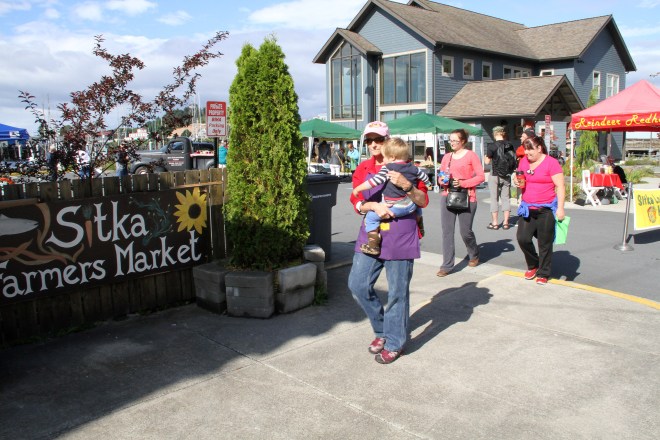
SitkaFarmersMarketCrowdAtEntrance

For the first time in eight years, the Sitka Local Foods Network hosted Sitka Farmers Markets in back-to-back weeks, with our fifth of seven Sitka Farmers Markets of the 2016 summer taking place on Saturday, Aug. 20, at the Alaska Native Brotherhood Founders Hall. We also had a rainy market on Aug. 13, so it was nice to see a bit of sun for this week’s market.

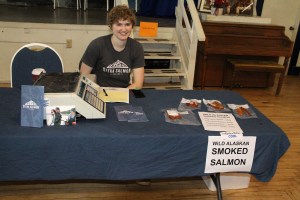
SitkaSalmonSharesBoothGenevieveCrowOne of our new vendors this week was Sitka Salmon Shares, a community-supported fishery program that sells a variety of fish caught in Sitka and other parts of Southeast Alaska to 2,500 subscribers in six Midwest states. Sitka Salmon Shares, which sells fish in 23 farmers markets in the Lower 48, brought out some of its new smoked salmon products to the Sitka Farmers Market.

We always welcome new vendors who want to sell produce they’ve grown, fish they’ve caught, and local cottage food products they’ve made. To learn more about how to be a vendor, contact Matthew Jackson at (907) 821-1412 or jackson.mw08@gmail.com.

AudreySaizAnnaSaizHomemadeFudgeThe two remaining markets this summer are from 10 a.m. to 1 p.m. on Saturdays, Sept. 3, and Sept. 10 at the ANB Founders Hall (235 Katlian St.). The Sitka Farmers Markets receive sponsorship funding from the SouthEast Alaska Regional Health Consortium (SEARHC). Don’t forget to vote for the Sitka Farmers Market in the American Farmland Trust’s eighth annual Farmers Market Celebration.

Also, mark your calendars for Saturday, Sept. 17, which is the tentative date of the annual Running of the Boots costumed fun-run fundraiser for the Sitka Local Foods Network. We’ll post more details later, once we get the event organized.

A slideshow of scenes from the fifth Sitka Farmers Market of the 2016 summer is below.

This slideshow requires JavaScript.

New harmful algal bloom warnings issued for shellfish harvested in Starrigavan Beach, other SE beaches

SEATORPSPWarningAug17

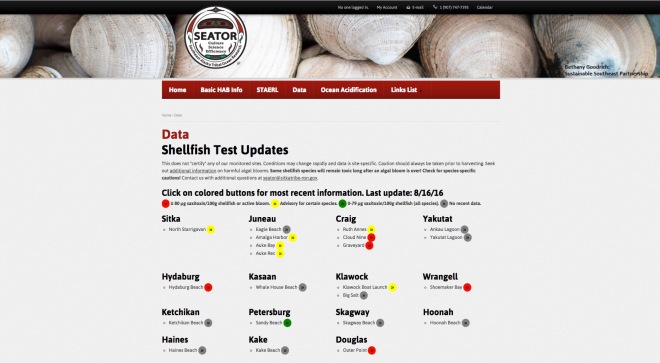
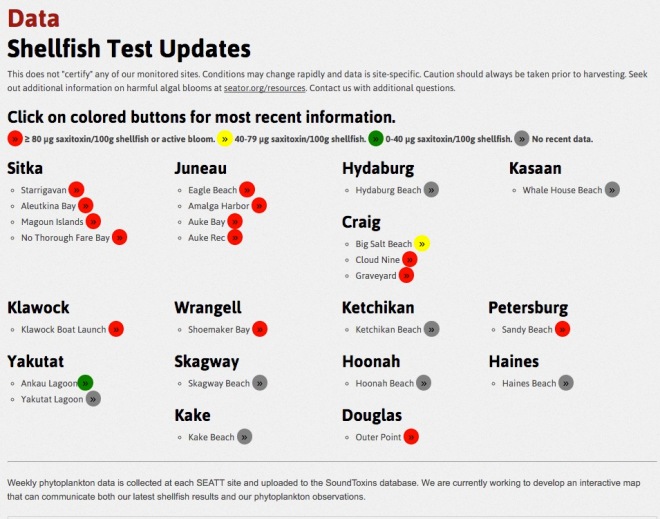
The SouthEast Alaska Tribal Ocean Research (SEATOR) project, SouthEast Alaska Tribal Toxins (SEATT) partnership and the Sitka Tribe of Alaska Environmental Research Lab (STAERL) on Wednesday, Aug. 17, issued a warning that people should not eat shellfish harvested at Starrigavan Beach in Sitka and Hydaburg Beach in Hydaburg.

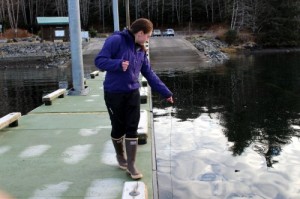
Esther Kennedy of the Sitka Tribe of Alaska Resource Protection Department samples water near the Starrigavan Recreation Area dock for marine biotoxins such as paralytic shellfish poisoning. (Photos by Emily Kwong, KCAW-Raven Radio)

Esther Kennedy of the Sitka Tribe of Alaska Resource Protection Department samples water near the Starrigavan Recreation Area dock for marine biotoxins such as paralytic shellfish poisoning in 2015. (Photo by Emily Kwong, KCAW-Raven Radio)

Samples harvested Aug. 17 at those beaches showed the presence of Alexandrium, a phytoplankton that produces saxitoxins that can cause paralytic shellfish poisoning (PSP). Mulluscan shellfish (bivalve shellfish such as clams, mussels, oysters, cockles, scallops, etc.) from these sites should not be harvested at this time.

In addition, mulluscan shellfish from Hydaburg Beach on Aug. 17 tested near or above the regulatory limit of 80μg/100g for saxitoxins and all species of mulluscan shellfish should not be harvested at this time. On Aug. 18, butter clams from Shoemaker Beach in Wrangell tested near or above the regulatory limit of 80μg/100g for saxitoxins and should not be harvested at this time.

The PSP advisory is for bivalve shellfish that have been recreationally or subsistence harvested. It does not apply to commercially harvested shellfish, which are tested before they enter the market. The advisory does not apply to other shellfish, such as crabs or shrimp, which do not carry PSP (unless you eat the crab butter or viscera).

There have been several harmful algal bloom alerts released by SEATOR this summer, but it’s the first one in about a month or so for Sitka. In addition to the saxitoxins that cause PSP, the lab in Sitka has been monitoring for other blooms that cause amnesic shellfish poisoning (ASP). PSP and ASP can cause severe health problems, including death in some cases.

According to SEATOR, “This does not ‘certify’ any of our monitored sites. Conditions may change rapidly and data is site-specific. Caution should always be taken prior to harvesting.”

The butter clam has one set of rings that go one direction only, around the same center point (Photo courtesy of Alaska Department of Environmental Conservation)

The butter clam has one set of rings that go one direction only, around the same center point (Photo courtesy of Alaska Department of Environmental Conservation)

SEATOR posts updates and information to its website at seator.org/data, which can help provide Southeast Alaska residents with reliable information so they can choose whether or not to harvest shellfish. In addition to testing water samples weekly from certain Southeast beaches, STAERL also tests samples of butter clams, littleneck clams, and blue mussels (which is STAERL’s indicator species, because of how quickly blue mussels absorb saxotoxins).

Since most beaches in Alaska aren’t tested for harmful algal blooms, SEATOR and the SEATT partnership were formed in October 2014 to train people to test beaches in Southeast Alaska. In April 2015, the Sitka Tribe of Alaska opened a regional lab on Katlian Street, so samples could be tested in Sitka without having to be sent to the Lower 48, which delayed results. By testing for harmful algal blooms, SEATOR and the SEATT partnership hope to be able to provide information so people can make informed choices whether or not to harvest or eat shellfish.

Harmful algal blooms, such as paralytic shellfish poisoning (PSP), typically have not been monitored in Southeast Alaska for subsistence and recreational harvesters of clams, mussels, oysters, cockles, and other bivalves (commercial harvests are tested). Even though many people in Southeast Alaska love to harvest shellfish, eating it comes with some risks. There have been several PSP outbreaks in recent years that sent people to the hospital, and in 2010 two deaths were attributed to PSP and other HABs, such as Alexandrium, Pseudo-nitzchia and Dinophysis.

To learn more about harmful algal blooms and how they can raise the risk for PSP and ASP (amnesic shellfish poisoning, which also can be fatal), go to SEATOR’s resources page. If you have shellfish you recently harvested and want to test it, click this link to learn what you need to do to have it tested by STAERL. Please contact STAERL at 747-7395 with any additional questions.

Fish to Schools program seeks donations of coho salmon from commercial fishermen

Spencer2

The Fish to Schools program needs help from Sitka’s commercial fishermen. The program needs a few hundred pounds of coho salmon to help make Fish to Schools meals for Sitka students during the upcoming 2016-17 school year. The program also is seeking photos of commercial fishermen at work, which can be used to teach the students more about how the fish got to their plates.

The coho salmon donation period is Wednesday. Aug. 17, through Tuesday, Aug. 23. To donate, commercial fishermen can sign up and indicate how many pounds they want to donate when they offload at Seafood Producers Cooperative or Sitka Sound Seafoods during the donation period. The program can only accept commercially caught fish (no sport or subsistence fish). The hope is to get enough coho donated that locally caught salmon can be offered to students at least once a week. Sign-up sheets will be posted at the scale shacks and in the main offices. Coho salmon is preferred.

Excited red haired kidThe Sitka Fish To Schools project (click here to see short video) got its start as a community wellness project at the 2010 Sitka Health Summit, and now is managed by the Sitka Conservation Society. It started by providing a monthly fish dish as part of the school lunch as Blatchley Middle School, and since then has grown to feature regular fish dishes as part of the lunch programs at Baranof Elementary School, Keet Gooshi Heen Elementary SchoolBlatchley Middle School, Sitka High SchoolPacific High School (where the alternative high school students cook the meals themselves), the SEER School, and Mount Edgecumbe High School.

In addition to serving locally caught fish meals as part of the school lunch program, the Fish To Schools program also brings local fishermen, fisheries biologists and chefs to the classroom to teach the kids about the importance of locally caught fish in Sitka. The program received an innovation award from the Alaska Farm To Schools program during a community celebration dinner in May 2012, and now serves as a model for other school districts from coastal fishing communities. In May 2014, the Fish to Schools program released a guidebook so other school districts in Alaska could create similar programs.

For more information, contact Sophie Nethercut of the Sitka Conservation Society at sophie@sitkawild.org or 747-7509.

Sitka Salmon Shares brings Southeast Alaska fish to Midwest markets

MarshSkeeleHoldsSalmonAsGuyFilletsBehind

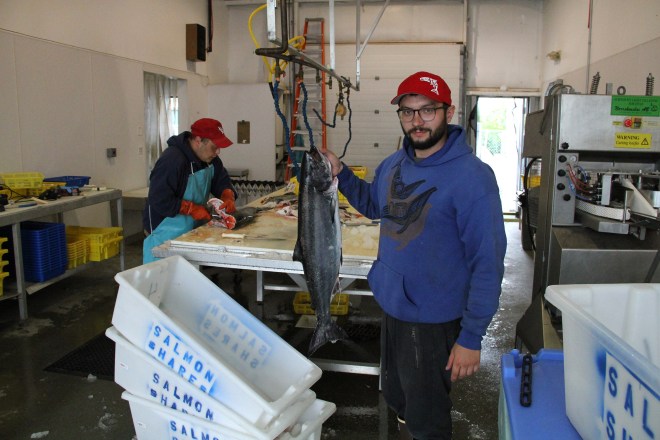
Sitka Salmon Shares vice president-fisherman Marsh Skeele holds up a chinook salmon during a recent tour of the company’s new plant on Smith Street in Sitka.

NicolaasMinkWithBookOnSalmon

Sitka Salmon Shares founder-president Nicolaas Mink holds a copy of his book “Salmon: A Global History” during a 2014 visit to Sitka.

What started out as a one-off fundraiser for a Sitka nonprofit has grown into a thriving business with sales approaching $4 million, with 2,500 members and 100 wholesale accounts spread out over six states.

Sitka Salmon Shares is a community-supported fishery (CSF) program, where members buy shares in the harvest similar to the process of a community-supported agriculture (CSA) program. But instead of the members being local to Sitka, where most of the fish is caught, the members of Sitka Salmon Shares live in Indiana, Illinois, Wisconsin, Michigan, Minnesota and Iowa.

“Each member gets a five-pound box of fish delivered to their door nine months of the year,” said Marsh Skeele, who serves as Sitka Salmon Shares vice president/co-founder and one of its 13 fishermen-owners. “A lot of them are former Alaskans or from Seattle, so they know good fish. The fish in the grocery stores there tends to have poor quality.”
SitkaSalmonSharesSignThe company distributes four types of salmon (chinook, coho, sockeye and chum), rockfish, ling cod, halibut, spot prawns, Pacific cod and blackcod, with most of the fish caught out of Sitka or Juneau. Sitka Salmon Shares also sells fish at 23 different farmers markets around the Midwest. Last year, Sitka Salmon Shares bought the former Big Blue Fisheries plant in Sitka, and is renovating it so the company can keep up with the special processing and freezing needs of its growing customer base while also developing new value-added products such as smoked salmon to add to the mix.

Sitka Salmon Shares got its start in 2011, when founder-president Nicolaas “Nic” Mink was in Sitka with a couple of his Knox College students working on a sustainable fishing and food-sourcing project with the Sitka Conservation Society. Mink, who still teaches environmental science part-time at Knox (he had a brief stint at Butler University a couple of years ago), decided to take some fish back with him to Galesburg, Ill., which he personally delivered to customers. Then those customers asked for more fish, and Sitka Salmon Shares was born.

TraysOfSalmonPortions“I think that first load of 750 pounds of fish raised about $10,000,” Mink said. “This year, our sixth, we sold more than 100,000 pounds of fish, just under $4 million.”

Some people laughed at his business plan when Mink decided to sell fish more than 2,000 miles away from its source, with a headquarters in a landlocked Midwest town away from most fish markets. But Mink and his partners found out that even people in the Midwest want high-quality fish from sustainable sources, fish that’s well-treated along the journey so it’s still in good shape when it reaches its customers.

“They want to be fish-eaters, but they don’t know how,” Mink said. “Sitka Salmon Shares gives them steps to know how, and it gave us a lot of opportunities to sell fish. Midwesterners are used to eating farmed salmon, but they heard about wild salmon. They want to eat wild, because it’s more resilient and sustainable than farmed.”

GuysFilletingFishEducation is a big part of the Sitka Salmon Shares story. In addition to providing the monthly boxes of fish, there is a newsletter with information about the fishermen-owners, where and how the fish is caught, and a variety of recipes geared toward wild fish and not farmed. The recipes come from four sources — Sitka Salmon Shares members, our chefs, the Alaska Seafood Marketing Institute (ASMI) Cook It Frozen site and from online sources.

“If you take a piece of coho (aka, silver salmon) and cook it as long as a piece of farmed salmon, the flesh becomes mealy and doesn’t taste good,” Mink said. “There’s a lot of education. With farmed salmon, the flesh is soft and thicker than wild salmon, so people need to cook it twice as long as wild salmon. We know wild salmon doesn’t need a lot of time on the grill, and that’s been one of the biggest hurdles.”

“We provide a lot of information,” Skeele said. “They definitely want to know more when you provide them with quality fish. We teach them about pressure bleeding, flash freezing, accountability and traceability. They want to know as much information as we can tell them about the fish that comes through our plant.”
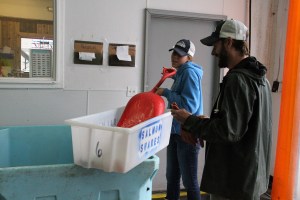
AriannaShovelsIceIntoToteWithJasonCroftThe owner-fishermen are longliners and trollers, for the most part, with some who gillnet sockeye and use pots to catch the spot prawns. Skeele said all of the fishermen are owners in the company, “so they have some skin in the game.” By having skin in the game, the fishermen are more likely to treat the fish better once it comes onto the boat, so it maintains its high quality.

Right now, Sitka Salmon Shares doesn’t sell a lot of its fish in Sitka, although it does sell fish to a couple of local restaurants such as the Westmark HotelTotem Square Inn and Sitka Hotel. Sitka Salmon Shares doesn’t want to compete locally with the Alaskans Own Seafood CSF program that sells to members in Alaska. But now that Sitka Salmon Shares has its own plant, it does offer local processing of fish to charter fishing operations, personal-use and sport fishermen from Sitka, and to commercial fishermen who sell their own fish to various markets around the country.

“We’d like to sell more locally, and it would be great to have our fish in Sea Mart,” Mink said. “We’re excited about our community processing program, and we’re trying to do more processing for Sitka fishermen.”
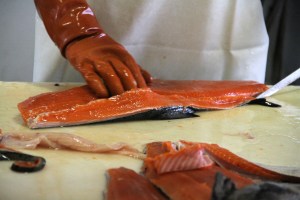
CloseUpOfSalmonFilletingIn recent years, Sitka Salmon Shares has received national exposure with articles in Food & Wine, New Food Economy, Entrepreneur and Forbes, plus a variety of regional publications and Sitka exposure with a story on KCAW-Raven Radio. Mink said there is still more Sitka Salmon Shares can do in the Midwest and Alaska.

“With our plant, we have our own ice and our own value-added room,” Mink said. “We have a talented individual, Pat Glabb, rebuilding Big Blue. He built Silver Bay Seafoods plant. Right now we’re focused on the Midwest, and we have a ways to go to develop our markets there. But we have assets on the ground and systems in place and tons of room to grow. We think there are a lot of cool things to do with value-added. For example, we have Chris Eley, a chef-butcher from the Smoking Goose Meatery in Indianapolis, developing some salmon sausages for us.”

Fishermen wanting to learn more about the Sitka Salmon Shares community processing program can call Jason Croft at 966-9999, or stop by the plant on Smith Street (across from Baranof Island Brewing Company). You also can visit the Sitka Salmon Shares website at http://www.sitkasalmonshares.com/.

This slideshow requires JavaScript.

Check out the August 2016 edition of the Sitka Local Foods Network newsletter

August2016SLFNNewsletterScreenshot

The Sitka Local Foods Network just sent out the August 2016 edition of its newly launched monthly newsletter. Feel free to click this link to get a copy.

This edition of the newsletter has brief stories about the Sitka Farmers Markets, a series of ‘Building A Local Food System’ articles by intern Claire Chang, a reminder that you can still add Pick.Click.Give. donations to your Alaska Permanent Fund Dividend application through Aug. 31, and an update on the Sitka Local Foods Network board of directors. Each story has links to our website for more information.

You can sign up for future editions of our newsletter by clicking on the registration form image in the right column of our website and filling in the information. If you received a copy but didn’t want one, there is a link at the bottom of the newsletter so you can unsubscribe. Our intention is to get the word out about upcoming events and not to spam people. We will protect your privacy by not sharing our email list with others.

Sitka chef Colette Nelson to represent Alaska in Great American Seafood Cook-Off

ColetteGarnishesRabbitThighs

Ludvig’s Bistro owner and executive chef Colette Nelson garnishes rabbit thighs with beach asparagus for a special local foods dinner she prepared as a February 2015 fundraiser for The Sawmill Farm.

Next week, Sitka chef Colette Nelson will carry a special cargo in a violin case when she heads to New Orleans to represent Alaska in the Great American Seafood Cook-Off.

Nelson, the owner and executive chef of Ludvig’s Bistro, will be carrying a frozen white king salmon in her violin case, the fish she plans to cook for the annual contest. The white king salmon was caught July 4 by troller Lou Barr of Auke Bay (who Nelson used to commercial fish with) and flash-frozen earlier this month. Nelson doesn’t plan to let the fish out of her control as she travels to New Orleans.

“I’m going to hold that fish with me. I’m not going to let somebody put it under the plane because that’s our gold,” Nelson told the Juneau Empire in a July 25 article.

On Aug. 6, Nelson will compete against chefs from Alabama, Arkansas, Florida, Louisiana, Massachusetts, Mississippi, Oregon, South Carolina, Texas and Utah. The Great American Seafood Cook-Off is sponsored by the Louisiana Seafood Promotion and Marketing Board, and focuses on domestic, sustainable seafood and local ingredients.

Nelson, who will compete with her sous chef Josh Miller, hopes to become the second straight Alaska chef to win the Best Seafood Chef title, joining Beau Schooler and Travis Hotch of The Rookery Café in Juneau who won last year with a sockeye salmon dish. Nelson was nominated for this year’s contest by Gov. Bill Walker.

Nelson hasn’t said exactly how she plans to cook her white king salmon, but did hint that it will have a Spanish theme in keeping with her restaurant’s use of Mediterranean flavors.

“For me this experience is not only about representing Alaska, but it’s about what Alaska has given to me,” Nelson told the Empire. “I came here to fish in college so that I could study abroad in Spain. I did that and had a great time fishing. I fished for three seasons, then went to Spain and fell in love with the cuisine and with Mediterranean food as a whole. So to go to this competition 25 years later — after being in both the seafood industry and the restaurant business — it feels complete to go there with Spanish ideas.”

The dish will feature a pan-seared fillet of the fish that includes the belly meat.

“For anybody that knows king salmon, the belly meat is where the best flavor is,” Nelson said. “We like it just perfectly cooked so it just starts to separate, when the flakes come off. You can feel the oil, get it on your lips and really taste it.”

Nelson opened Ludvig’s Bistro in 2002, and has been a big supporter of local foods in Sitka (including using her restaurant to host fundraisers for the Sitka Local Foods Network and developing recipes and lesson plans for Sitka’s Fish To Schools lunch program coordinated by the Sitka Conservation Society). She grew up in Oregon and attended the University of Washington, where she trained under Seattle restauranteur Susan Kaufman, who also had a food cart and restaurants in Juneau. She moved to Alaska in 1998, working as chef for Kingfisher Charters & Lodge in Sitka before opening her restaurant.

During the competition, Nelson and sous chef Josh Miller will have an hour to prepare six plates for the judges and one for photos. Nelson and Miller have been practicing, and now feel they’re ready.

“We do this all the time. We cook under pressure,” Nelson said. “When we were practicing (Sunday) I said, ‘Look, we’re just having a dinner party for seven guests and let’s just make it in an hour. We got this.’”

Harmful algal bloom expands PSP advisory to several Southeast Alaska beaches

SEATORDataUpdate06102016

Seator-Logo-Best-June-30-2015-7pm-215x215The SouthEast Alaska Tribal Ocean Research (SEATOR) project, SouthEast Alaska Tribal Toxins (SEATT) partnership and the Sitka Tribe of Alaska Environmental Research Lab (STAERL) have expanded a recent paralytic shellfish poisoning (PSP) advisory to include more beaches in Southeast Alaska.

The advisory, initially announced on May 26, now includes multiple beaches in Sitka, Juneau, Craig, Petersburg, and Klawock. The PSP advisory is for bivalve shellfish — such as clams, mussels, oysters, cockles, scallops, geoducks, etc. — that have been recreationally or subsistence harvested. It does not apply to commercially harvested shellfish, which are tested before they enter the market. The advisory does not apply to other shellfish, such as crabs or shrimp, which do not carry PSP (unless you eat the crab butter/viscera).

According to a SEATOR press release, “Recent samples on June 6 confirmed elevated levels of Alexandrium, the phytoplankton species that produces saxtoxins causing PSP, have been observed at the following locations and shellfish from these sites should not be harvested at this time.” The affected beaches from June 6 are Auke Bay, Amalga Harbor, Eagle Beach, and Auke Rec beaches in Juneau; Cloud 9 and Graveyard beaches in Craig; Starrigavan beach in Sitka; and the Boat Ramp beach in Klawock.

The butter clam has one set of rings that go one direction only, around the same center point (Photo courtesy of Alaska Department of Environmental Conservation)

The butter clam has one set of rings that go one direction only, around the same center point (Photo courtesy of Alaska Department of Environmental Conservation)

In addition, the press release said, “On June 9 shellfish from the following sites tested above the regulatory limit of 80µg/100g for saxitoxins and should not be harvested at this time.” The June 9 list of beaches includes Sandy Beach in Petersburg (butter clams only); Auke Bay, Amalga Harbor, Eagle Beach, and Auke Rec beaches in Juneau; Aleutkina Bay, No Through Fare Bay, Magoun Islands, and Starrigavan (butter clams only) beaches in Sitka; and the Boat Ramp beach in Klawock. The advisory is for all shellfish on all beaches, except where noted.

According to SEATOR, “This does not ‘certify’ any of our monitored sites. Conditions may change rapidly and data is site-specific. Caution should always be taken prior to harvesting.”

SEATOR posts updates and information to its website at seator.org/data, which can help provide Southeast Alaska residents with reliable information so they can choose whether or not to harvest shellfish. In addition to testing water samples weekly from certain Southeast beaches, STAERL also tests samples of butter clams, littleneck clams, and blue mussels (which is STAERL’s indicator species because of how quickly blue mussels absorb saxotoxins).

Since most beaches in Alaska aren’t tested for harmful algal blooms, SEATOR and the SEATT partnership were formed in October 2014 to train people to test beaches in Southeast Alaska. In April 2015, the Sitka Tribe of Alaska opened a regional lab on Katlian Street, so samples could be tested in Sitka without having to be sent to the Lower 48, which delayed results. By testing for harmful algal blooms, SEATOR and the SEATT partnership hope to be able to provide information so people can make informed choices whether or not to harvest or eat shellfish.

Harmful algal blooms, such as paralytic shellfish poisoning (PSP), typically have not been monitored in Southeast Alaska for subsistence and recreational harvesters of clams, mussels, oysters, cockles, and other bivalves (commercial harvests are tested). Even though many people in Southeast Alaska love to harvest shellfish, eating it comes with some risks. There have been several PSP outbreaks in recent years that sent people to the hospital, and in 2010 two deaths were attributed to PSP and other HABs, such as Alexandrium, Pseudo-nitzchia and Dinophysis.

To learn more about harmful algal blooms and how they can raise the risk for PSP and ASP (amnesic shellfish poisoning, which also can be fatal), go to SEATOR’s resources page. If you have shellfish you recently harvested and want to test it, click this link to learn what you need to do to have it tested by STAERL. Please contact STAERL at 747-7395 with any additional questions.

• June 10, 2016, press release about PSP advisory for Southeast Alaska

Check out the June 2016 edition of the Sitka Local Foods Network newsletter

June2016SLFNNewsletterScreenshot

The Sitka Local Foods Network just sent out the June 2016 edition of its newly launched monthly newsletter. Feel free to click this link to get a copy.

This edition of the newsletter has brief stories about a couple of Sitka commercial trollers starting the Edible Alaska magazine, our recruiting new board members, the dates for the 2016 Sitka Farmers Markets, the second batch of classes for the garden mentor program, and a recent shellfish advisory issued for several beaches in Southeast Alaska. Each story has links to our website for more information.

You can sign up for future editions of our newsletter by clicking on the registration form image in the right column of our website and filling in the information. If you received a copy but didn’t want one, there is a link at the bottom of the newsletter so you can unsubscribe. Our intention is to get the word out about upcoming events and not to spam people. We will protect your privacy by not sharing our email list with others.

Harmful algal bloom warning listed for shellfish harvested at Sitka, Craig, Klawock and Petersburg

Clam diggers work the beach at Starrigavan in this file photo. The Sitka Tribe of Alaska is warning Sitkans against harvesting clams in the area due to a harmful algae detected Monday, June 8, 2015. (Daily Sitka Sentinel file photo by James Poulson)

Clam diggers work the beach at Starrigavan in this file photo. The Sitka Tribe of Alaska is warning Sitkans against harvesting clams in the area due to a harmful algae detected Tuesday, May 25, 2016. (Daily Sitka Sentinel file photo by James Poulson)

Seator-Logo-Best-June-30-2015-7pm-215x215The SouthEast Alaska Tribal Ocean Research (SEATOR) project coordinated by the Sitka Tribe of Alaska on Wednesday, May 26, issued a harmful algal bloom warning for shellfish harvested in four Southeast Alaska communities. The warning is for shellfish harvested on Starrigavan Beach in Sitka, Graveyard Beach in Craig, the Klawock Boat Launch, and Sandy Beach in Petersburg.

(Editor’s Note: On Thursday, June 2, SEATOR and the University of Alaska Fairbanks School of Fisheries and Ocean Sciences in Juneau announced a similar shellfish advisory for shellfish harvested on June 1 from several beaches in the Juneau area — Auke Bay, Point Louisa/Auke Rec, Amalga Harbor and Eagle Beach. For more information on Juneau, contact Elizabeth Tobin at 1-907-796- 5455 or edtobin@alaska.edu or Chris Whitehead of SEATOR at chris.whitehead@sitkatribe-nsn.gov. On June 3, SEATOR added Cloud 9 Beach in Craig to the list of beaches affected by the shellfish advisory.)

“The Sitka Tribe of Alaska Environmental Research Lab (STAERL) has been collecting shellfish samples to test for biotoxins, specifically paralytic shellfish poisoning (PSP),” STAERL announced in a press release. “Recent samples on May 25, 2016, confirm that clams at the following beaches have elevated levels of toxins above the FDA regulatory limit of 80µg/100g and should not be harvested at this time.”

The butter clam has one set of rings that go one direction only, around the same center point (Photo courtesy of Alaska Department of Environmental Conservation)

The butter clam has one set of rings that go one direction only, around the same center point (Photo courtesy of Alaska Department of Environmental Conservation)

SEATOR, the Southeast Alaska Tribal Toxins (SEATT) partnership, and the Sitka Tribe of Alaska have been monitoring saxitoxin on Starrigavan Beach in Sitka and other beaches around Southeast Alaska since late 2014. Saxitoxin is produced by the phytoplankton Alexandrium and can get highly concentrated in shellfish, leading to paralytic shellfish poisoning (PSP), which can be fatal.

SEATOR posts updates and information to its website at seator.org/data, which can help provide Southeast Alaska residents with reliable information so they can choose whether or not to harvest shellfish. On May 6, SEATOR announced an advisory for shellfish harvest on Starrigavan Beach in Sitka, when it found Alexandrium in its weekly phytoplankton samples and high levels of saxitoxin in butter clams, littleneck clams, and blue mussels. Because of the high levels, SEATOR advised Sitka residents not to harvest shellfish at the time.

Since most beaches in Alaska aren’t tested for harmful algal blooms, SEATOR and the SEATT partnership were formed in October 2014 to train people to test beaches in Southeast Alaska. In April 2015, the Sitka Tribe of Alaska opened a regional lab on Katlian Street, so samples could be tested in Sitka without having to be sent to the Lower 48, which delayed results. By testing for harmful algal blooms, SEATOR and the SEATT partnership hope to be able to provide information so people can make informed choices whether or not to harvest or eat shellfish.

Harmful algal blooms, such as paralytic shellfish poisoning (PSP), typically have not been monitored in Southeast Alaska for subsistence and recreational harvesters of clams, mussels, oysters, cockles, and other bivalves (commercial harvests are tested). Even though many people in Southeast Alaska love to harvest shellfish, eating it comes with some risks. There have been several PSP outbreaks in recent years that sent people to the hospital, and in 2010 two deaths were attributed to PSP and other HABs, such as Alexandrium, Pseudo-nitzchia and Dinophysis.

To learn more about harmful algal blooms and how they can raise the risk for PSP and ASP (amnesic shellfish poisoning, which also can be fatal), go to SEATOR’s resources page. If you have shellfish you recently harvested and want to test it, click this link to learn what you need to do to have it tested by STAERL.

• Press release about shellfish advisory, May 26, 2016

• Joint SEATOR/UAF School of Fisheries and Ocean Studies press release about Juneau shellfish advisory, June 2, 2016

• June 3, 2016, SEATOR press release updating the list of affected beaches