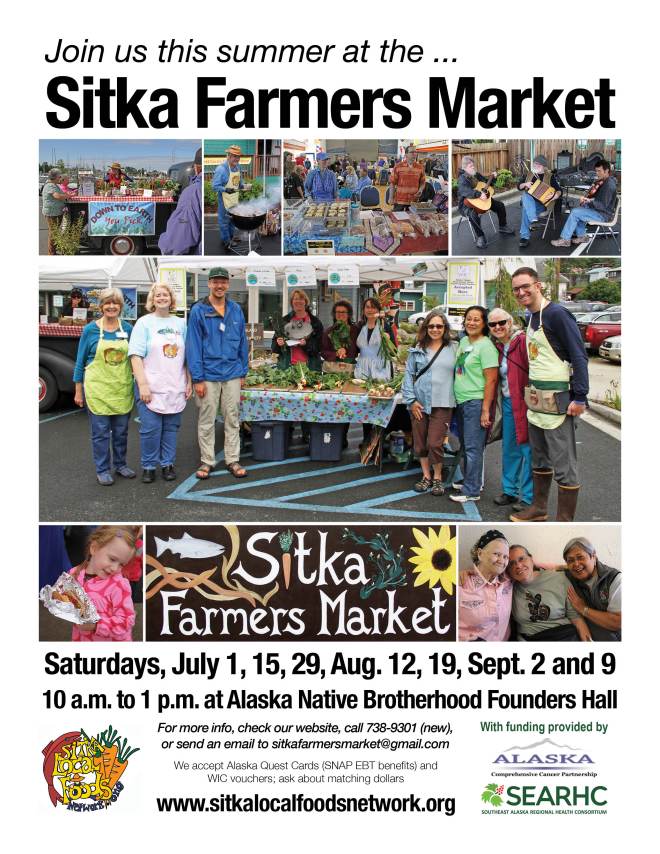
Scenes from the first Sitka Farmers Market of the 2017 summer season

PHOTO COURTESY OF THE SITKA LOCAL FOODS NETWORK

Sitka Farmers Market Manager Nina Vizcarrondo, left, presents the Table of the Day Award to 10-year-old Abigail Ward, who was participating in the new kids vendor program at the first Sitka Farmers Market of the 2017 summer season, held Saturday, July 1, at the Alaska Native Brotherhood Founders Hall. Abigail won a certificate, a Sitka Local Foods Network tote bag, some rhubarb, a bag of Alaska Flour Company barley chocolate chip cookie mix, and some Alaska Grown stickers. She sold homemade baked goods, some handmade first aid kit pouches and candles. 

It was a crowded house, despite the wind and rain, as we held our first Sitka Farmers Market of the 2017 summer season on Saturday, July 1, at the Alaska Native Brotherhood Founders Hall (235 Katlian Street).

While our cold weather meant we didn’t have as much produce as we would have liked, we still had about three dozen vendors at the market (between those inside ANB Founders Hall and those outside in the Baranof Island Housing Authority parking lot) so there was a nice variety of items being sold. Vendors sold harvested foods (such as beach asparagus, chaga tea, etc.), homemade baked goods, banana-Nutella crepes, hot seafood dishes, fresh smoothies, reindeer hot dogs, blackcod tips, arts and crafts, and you could even screenprint your own Sitka Farmers Market t-shirt or hoodie. We also had an expanded selection of Alaska Grown products at the Sitka Local Foods Network farm stand.

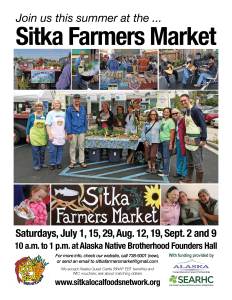
The next Sitka Farmers Market takes place from 10 a.m. to 1 p.m. on Saturday, July 15, at the ANB Founders Hall. There also are markets scheduled for July 29, Aug. 12, Aug. 19, Sept. 2, and Sept. 9. To learn how to be a vendor at the market, contact market manager Nina Vizcarrondo at (907) 738-9301 (new number) or assistant manager Charles Bingham (907) 623-7660, or email us at sitkafarmersmarket@gmail.com. We also have a new kids vendor program at the market for young entrepreneurs age 12 or younger.

A slideshow of scenes from the first Sitka Farmers Market is posted below.

This slideshow requires JavaScript.

Sitka Local Foods Network to host seven Sitka Farmers Markets in 2017 summer

The Sitka Local Foods Network is bringing the excitement back to the Sitka Farmers Market, which opens its 10th season of markets on Saturday. There will be some new innovations at the market, and some of the vendors who skipped last year’s markets are back this summer.

“Last year was a learning experience for us,” said Sitka Local Foods Network president Charles Bingham, who is assisting Sitka Farmers Market manager Nina Vizcarrondo. “We tried to make the market’s focus be more on local food and less on arts and crafts, but we didn’t have enough local food producers to make up for the lost craft vendors. We lost some of the community-gathering feel to the market with the lost vendors. This year we returned to our 2015 vendor rates, which is bringing back many of lost vendors. We want the market to be a community happening again. The market is a great way to connect with neighbors and support local entrepreneurs.”

Other new innovations this year include a kids vendor program for youth ages 12 and younger, and new Alaska Grown food products for sale at the Sitka Local Foods Network’s farm stand. In addition to freshly grown produce from the St. Peter’s Fellowship Farm communal garden, there will be Alaska Flour Company barley products from Delta Junction, Evie’s Brinery fermented foods from Anchorage, and Kahiltna Birchworks birch syrup products from Palmer. There still is a focus on local and Alaska food products, with the Alaska Grown products being a way to inspire Sitka food entrepreneurs to try making new food items locally. The more local products we have, the more the money circulates in Sitka’s economy.

“Come support our local farmers, artisans and musicians,” Vizcarrondo said. “By keeping our money local, we create a more sustainable economy.”

The first Sitka Farmers Market of the season takes place from 10 a.m. to 1 p.m. on Saturday, July 1, at the Alaska Native Brotherhood Founders Hall (235 Katlian St.). The other markets this summer take place from 10 a.m. to 1 p.m. on Saturdays, July 15, July 29, Aug. 12, Aug. 19, Sept. 2, and Sept. 9, at ANB Founders Hall.

The markets feature a variety of locally grown produce, seafood, cottage foods, a hot lunch, locally made arts and crafts, live music and fun. The Sitka Farmers Market was the first market in Southeast Alaska to accept Alaska Quest (SNAP) electronic benefits transfers (EBT) and WIC coupons. We have a matching program where SNAP and WIC clients can double up to $20 of their benefits in local produce.

“In recent years we’ve been proud to welcome Alaska Quest EBT and WIC shoppers at the market,” Bingham said. “It is so important to make sure local food is accessible to everyone.”

The April 2008 Sitka Health Summit planted the seeds for the Sitka Farmers Market, as Sitka residents chose starting a local foods market as one of their community wellness initiatives for the year. About the same time, St. Peter’s By The Sea Episcopal Church was looking for a way to put some recently cleared land behind the church’s See House into use for a community project. St. Peter’s offered to lease the land to the group that became the Sitka Local Foods Network for $1 a year, and in May 2008 a group of Sitka residents built raised garden beds and planted a variety of crops. Later that summer, there was enough produce grown at St. Peter’s to supply our first three Sitka Farmers Markets starting in August 2008.

There were five markets in 2009, followed by six markets each year from 2010-15 and now seven markets in 2016. Led by lead gardener Laura Schmidt, the production of local produce at St. Peter’s has grown each year, and there now are satellite gardens, such as the one on land owned by Pat Arvin. Most of the food grown at St. Peter’s and the satellite gardens is sold at the Sitka Farmers Market, but there has been enough for the Sitka Local Foods Network to also have a table when Chelan Produce is in town and to sell to local school lunch programs and restaurants. The money raised helps support the Sitka Local Foods Network, a 501(c)(3) nonprofit, in its mission “to increase the amount of locally produced and harvested food in the diets of Southeast Alaskans.”

To learn more about the Sitka Farmers Market and how you can become a vendor, contact Nina Vizcarrondo at (907) 738-9301 (new number) or sitkafarmersmarket@gmail.com. The Sitka Local Foods Network website, http://www.sitkalocalfoodsnetwork.org/, has more info on the markets and links to vendor rules and registration forms. The Sitka Local Foods Network receives sponsorship funding from the Alaska Comprehensive Cancer Partnership, the SouthEast Alaska Regional Health Consortium (SEARHC), and the Sitka True Value.

Alaskans invited to join the new $5 Alaska Grown, Five Month Challenge

Starting Wednesday, June 1, the Alaska Division of Agriculture is launching a brand-new $5 Alaska Grown, Five Month Challenge to support the growth of Alaska’s agriculture industry.

From June through October, Alaskans are encouraged to spend $5 per week on Alaska Grown products at their local grocery stores and/or farmers markets. If every Alaskan participates in the challenge, tens of millions of dollars in local purchases could be circulated within local economies rather than sent outside of Alaska. According to the Alaska Farm Bureau, if every Alaskan spent $5 per week on Alaska Grown products, year-round, it would have a $188 million dollar impact.

For the $5 Alaska Grown Challenge, the Division of Agriculture is partnering with dozens of retailers across the state including Carrs-Safeway, Fred Meyer, Wal-mart and SaveUMore. These retailers will be creating specialty Alaska Grown displays in their stores that prominently place and showcase the Alaska Grown products they carry, making it easy for customers to find Alaska Grown products on which to spend $5 per week.

The challenge will run for the five-month period when Alaska Grown products are most available. Each month, new produce and flowers will be introduced into stores as they become seasonally available. Customers can also spend their $5 per week on year-round Alaska Grown products including meat (including fish), fresh eggs and packaged products at their local retailers.

In Sitka, Alaskans can participate by purchasing Alaska Grown produce at the Sitka Farmers Markets. There will be seven Sitka Farmers Markets this summer, from 10 a.m. to 1 p.m. on Saturdays, July 1, July 15, July 29, Aug. 12, Aug. 19, Sept. 2, and Sept. 9, at the Alaska Native Brotherhood Founders Hall (235 Katlian St.). In addition, there are several growers in town, and you can find out more about them in the Alaska Grown Source Book.

“Why buy Alaska grown?” the Alaska Farm Bureau website asks. “Not only are you supporting Alaskans and boosting our economy, you’re also getting a fresher, tastier, more nutritious product. In a blind taste test, 82 percent of Alaskans surveyed could taste the difference between products grown here and those shipped up. Adults and kids say Alaska grown is sweeter, fresher-tasting and crispier.”

• Taste of Alaska White Paper (taste tests of Alaska vs. Lower 48 produce from 2011 Alaska State Fair in Palmer)

Celebrate local farmers and gardeners on Alaska Agriculture Day on Tuesday, May 2

Alaskans will celebrate Alaska Agriculture Day on Tuesday, May 2. On this day, Alaskans are encouraged to support local agriculture by seeking out and purchasing products produced in Alaska and educating youth about the vital role that agriculture plays in our economy. This is Alaska’s version of National Ag Day (which took place on March 21 this year, when many parts of Alaska were still thawing out).

Here are a few ideas from the Division of Agriculture on how to celebrate Alaska Agriculture Day:

In Sitka, you can celebrate Alaska Agriculture Day by starting a food garden (even a couple of containers on your deck can provide you with potatoes, carrots or greens). Teachers are encouraged to offer a lesson plan or two about the importance of agriculture in Alaska and in Sitka. Here’s a link to an article about how Sitka was Alaska’s original garden city back in the late 19th and early 20th Centuries. Also, the Sitka History Minute feature on KCAW-Raven Radio has had several episodes about agriculture in Sitka (click here to listen to a feature about the potato in Sitka, click here to listen to a feature about the Sitka Agricultural Station, and click here to listen to a feature about the cows of Iris Meadows).

During the growing season, please support the Sitka farmers and production gardeners listed in the 2016-17 Alaska Grown Source Book (chief contact in parentheses) — Anam Cara Family Garden (Lisa Sadleir-Hart), Blatchley Community Gardens (David Nuetzel, this garden closed in 2016 and there is a group seeking a new location for what will be called Sitka Community Gardens), Down To Earth U-Pick Garden (Lori Adams, switched to a CSA in 2017 and no longer is a public u-pick garden), Finn Island Farm (Keith Nyitray), Sprucecot Gardens (Judy Johnstone), and St. Peter’s Fellowship Farm (Laura Schmidt/Sitka Local Foods Network). There also are a few Sitka farms and production gardens not listed in the 2016-17 Alaska Grown Source Book, such as Humpback Farm (Peter Williams), Middle Island Organic Produce (Andrea Fraga/Kaleb Aldred), Sea View Garden (Linda Wilson), The Sawmill Farm (Bobbi Daniels), Sitka Seedling Farms (Matthew Jackson) and Welsh Family Forget-Me-Not Garden(Florence Welsh).

Many of these farms and gardens will be vendors during the Sitka Farmers Markets this summer. The Sitka Farmers Markets take place from 10 a.m. to 1 p.m. on Saturdays, July 1, July 15, July 29, Aug. 12, Aug. 19, Sept. 2, and Sept 9, at the Alaska Native Brotherhood Founders Hall (235 Katlian St.).

Celebrate local farmers and gardeners on Alaska Agriculture Day on Tuesday, May 3

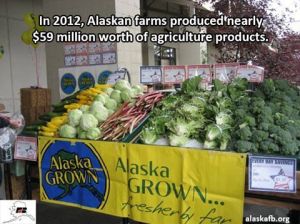
AlaskaGrownImpact

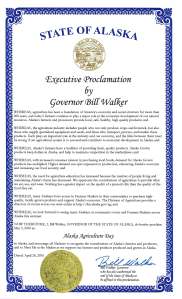
AgDayProclamationMay32016Alaskans will celebrate Alaska Agriculture Day on Tuesday, May 3. On this day, Alaskans are encouraged to support local agriculture by seeking out and purchasing products produced in Alaska and educating youth about the vital role that agriculture plays in our economy.

Here are a few ideas from the Division of Agriculture on how to celebrate Alaska Agriculture Day:

  • Join the 49,005 people who “like” the Alaska Grown Facebook page at https://www.facebook.com/dnr.alaskagrown and learn about the exciting things Alaskans are producing around the state.
  • Contact your local agriculture groups/chapters (such as FFA, Farm Bureau, Agriculture in the Classroom etc.) to see if they are hosting an event in your area.
  • Sign up for a Community Supported Agriculture (CSA) program at a local farm.
  • Buy and incorporate Alaska Grown products into your meals.
  • If you are a farmer, consider asking a local school if you can visit a classroom to educate children about your operation and Alaska agriculture.
  • Visit and thank a local farmer in person. To find a farm near you, check the Alaska Grown Source Book at http://dnr.alaska.gov/ag/sourcebook/sourcebookindex2014.html.

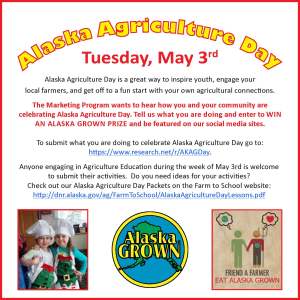
ak ag day flyerIn Sitka, you can celebrate Alaska Agriculture Day by starting a food garden (even a couple of containers on your deck can provide you with potatoes, carrots or greens). Teachers are encouraged to offer a lesson plan or two about the importance of agriculture in Alaska and in Sitka. Here’s a link to an article about how Sitka was Alaska’s original garden city back in the late 19th and early 20th Centuries. Also, click here to listen to a Sitka History Minute feature about the potato in Sitka from KCAW-Raven Radio).

During the growing season, please support the Sitka farmers and production gardeners listed in the Alaska Grown Source Book (chief contact in parentheses) — Anam Cara Family Garden (Lisa Sadleir-Hart), Blatchley Community Gardens (David Nuetzel), Down To Earth U-Pick Garden (Lori Adams), Finn Island Farm (Keith Nyitray), Sprucecot Gardens (Judy Johnstone), and St. Peter’s Fellowship Farm (Laura Schmidt). There also are a few Sitka farms and production gardens not listed in the Alaska Grown Source Book, such as Sea View Garden (Linda Wilson), The Sawmill Farm (Bobbi Daniels), Sitka Seedling Farms (Matthew Jackson) and Welsh Family Forget-Me-Not Garden (Florence Welsh). Many of these farms and gardens will be vendors during the Sitka Farmers Markets, which start on July 2 this summer.

• Take the $5 Per Week Alaska Grown Challenge and help improve Alaska’s food security

AlaskaGrown2_Graphic

AlaskaGrown3_GraphicThe Alaska Farm Bureau announces the $5 Per Week Alaska Grown Challenge – a statewide campaign to increase consumer spending on Alaska Grown products with the goal of strengthening local economies and increasing Alaska’s food security.

The Kenai Peninsula Chapter of the Alaska Farm Bureau, in partnership with the Kenai Soil and Water Conservation District and several other local organizations (including the Sitka Local Foods Network), launched the $5 Per Week Alaska Grown Challenge on May 5, in honor of Alaska Agriculture Day. Now the Challenge is going statewide with the help of social media, Alaska Farm Bureau chapters, and local food advocates across the state.

“We’d like to see the state investing in agriculture the way it invests in the resource extraction industries,” said Heidi Chay, district manager of the Kenai Soil and Water Conservation District. “After all, everyone needs to eat, and Alaska is at the end of a very long and vulnerable food chain. The signs of agriculture’s growth potential are all around us. … However, if the state can’t or won’t invest in agriculture the way it should, it’s on Alaskan consumers to take the lead. That’s why the District joined with local partners last month to launch the $5 Per Week Alaska Grown Challenge. We’re calling on Alaskans to invest a small part of their food dollars in the future of Alaskan agriculture, by spending $5 per week per person year-round. Farmers market season is a great time to start.”

Sitka residents will be able to participate in the Challenge by purchasing local veggies at the Sitka Farmers Markets this summer. The markets take place from 10 a.m. to 1 p.m. on alternate Saturdays, July 4, July 18, Aug. 1, Aug. 15, Aug. 29, and Sept. 12, at the Alaska Native Brotherhood Founders Hall, 235 Katlian St.

“I’m excited by the prospect of growing local producers pocketbooks with the $5 Per Week Alaska Grown Challenge in Sitka,” said Lisa Sadleir-Hart, Sitka Local Foods Network Board President. “It’s about supporting local foods and your neighbors as well as giving your body the benefit of fresh food. I plan on spending at least $5 a week on local food and doing it at the Sitka Farmers Market makes absolute sense.”

The Challenge calls on Alaskans to spend $5 per week per person on Alaska Grown products year-round. With farmers market season just around the corner, this is the perfect time for Alaskans to commit to investing a portion of their consumer dollars in the future of Alaskan agriculture.

graphic1Agriculture has played an important role in Alaska’s history. Today it is a growing industry with increasing numbers of farms producing food, forage and fiber for local consumers, as well as peonies and rhodiola for sale around the world.

Although farm production is rising, the economic potential of Alaskan farms is far from realized.  More than 95 percent of Alaska’s food is imported, which means that most of our food dollars are leaving the state.

Are Alaska farmers prepared to scale up to meet increasing demand? Yes. According to the Alaska Division of Agriculture, 67 percent of Alaska farmers surveyed indicate that they would increase production if they had more market options. Meanwhile, a warming climate and the rapid adoption of season-extension technologies such as high tunnels are creating more favorable conditions for agriculture.

The Alaska Farm Bureau is calling on every resident in Alaska to join the $5 Per Week Alaska Grown Challenge. If every Alaskan spent $5 per week on Alaska Grown products, year-round, it would have a $188 million dollar impact.

Why buy Alaska grown? Not only are you supporting Alaskans and boosting our economy, you’re also getting a fresher, tastier, more nutritious product. In a blind taste test, 82 percent of Alaskans surveyed could taste the difference between products grown here and those shipped up. Adults and kids say Alaska grown is sweeter, fresher-tasting and crispier.

The $5 Per Week Alaska Grown Challenge isn’t hard. The key, simply enough, is to eat what grows here. You can find a wide variety of produce and value-added products like bread, jam and pickles at farmers markets throughout the summer. Alaska Grown carrots, potatoes, cabbage, milk and barley products (flour, couscous and even pancake mix!) are available year-round in local grocery stores, joined by lettuce, tomatoes, cucumbers and broccoli during the growing season. Local farms produce meat, poultry, eggs and honey, which are available direct from the farm and at locally-owned retailers. Farmers grow more than just food; Alaska also has cut flower and natural fiber industries with products available. Local restaurants, breweries, distilleries and wineries purchase local products to use in their recipes. And don’t forget our local seafood products.

Not sure where to find Alaska Grown? Check out the $5 Per Week Alaska Grown Challenge website (http://www.alaskafb.org/challenge/) where you will find links to local and statewide resources including the Alaska Grown Source Book, a list of local producers and farmers markets. Be sure to ask for Alaska Grown when you are eating out as well.

Take the challenge: $5 per person per week. You’ll help local farmers, boost the local economy, increase Alaska’s food security, and eat better too. Sign up for the challenge here, http://www.alaskafb.org/challenge.

• Taste of Alaska white paper

• Celebrate local farmers and gardeners on Alaska Agriculture Day on Tuesday, May 5

04.22.15 Alaska Agriculture Day

Alaskans will celebrate Alaska Agriculture Day on Tuesday, May 5. On this day, Alaskans are encouraged to support local agriculture by seeking out and purchasing products produced in Alaska and educating youth about the vital role that agriculture plays in our economy.

Here are a few ideas from the Division of Agriculture on how to celebrate Alaska Agriculture Day:

  • Join the 34,278 people who “like” the Alaska Grown Facebook page at https://www.facebook.com/dnr.alaskagrown and learn about the exciting things Alaskans are producing around the state.
  • Contact your local agriculture groups/chapters (such as FFA, Farm Bureau, Agriculture in the Classroom etc.) to see if they are hosting an event in your area.
  • Sign up for a Community Supported Agriculture (CSA) program at a local farm.
  • Buy and incorporate Alaska Grown products into your meals.
  • If you are a farmer, consider asking a local school if you can visit a classroom to educate children about your operation and Alaska agriculture.
  • Visit and thank a local farmer in person. To find a farm near you, check the Alaska Grown Source Book at http://dnr.alaska.gov/ag/sourcebook/sourcebookindex2014.html.

In Sitka, you can celebrate Alaska Agriculture Day by starting a food garden (even a couple of containers on your deck can provide you with potatoes, carrots or greens). Teachers are encouraged to offer a lesson plan or two about the importance of agriculture in Alaska and in Sitka (also, click here to listen to a Sitka History Minute feature about the potato in Sitka from KCAW-Raven Radio).

During the growing season, please support the Sitka farmers and production gardeners listed in the Alaska Grown Source Book (chief contact in parentheses) — Anam Cara Family Garden (Lisa Sadleir-Hart), Blatchley Community Gardens (David Nuetzel), Down To Earth U-Pick Garden (Lori Adams), Finn Island Farm (Keith Nyitray), Sprucecot Gardens (Judy Johnstone), and St. Peter’s Fellowship Farm (Lisa Sadleir-Hart or Laura Schmidt). There also are a few Sitka farms and production gardens not listed in the Alaska Grown Source Book, such as Sea View Garden (Linda Wilson), The Sawmill Farm (Bobbi Daniels) and Welsh Family Forget-Me-Not Garden (Florence Welsh). Many of these farms and gardens will be vendors during the Sitka Farmers Markets, which start on July 4 this summer.

• Buying local food during a Southeast Alaska summer

Sitka Local Foods Network Board Vice President Cathy Lieser distributes "Alaska Grown" bumper stickers during the July Fourth parade in Sitka (Photo by Heike Hüttenkofer)

Sitka Local Foods Network Board Vice President Cathy Lieser distributes “Alaska Grown” bumper stickers during the July Fourth parade in Sitka (Photo by Heike Hüttenkofer)

By CATHY LIESER
Sitka Local Foods Network Board Vice President

I am cooking on a boat throughout Southeast Alaska this summer, so on May 5, I planted seeds in my garden, covered it with bird netting and wished it well until my return. The text from my friend read, “the weeds are winning,” luckily I have an herb garden on the boat.

I have been on the hunt for local food in the towns where we provision. It was a late spring, so early on I watched plots greening up and took mental notes. There was kale and rhubarb in Tenakee, with one grower who sells on Friday — The Party Time Bakery — which uses local produce for delicious meals. We bought a rhubarb-berry pie fresh out of the oven and took it back to the boat.

In Juneau, we stocked up at Pinkies Fish Market where the mission is to create a local food economy by sourcing local seafood and other farm fresh items. I toured the Jensen-Olson Arboretum (click here for Facebook page) with Merrill Jensen while he shared about their process toward having a certified virus-free Tlingít potato. The Wild Oven sourdough bakery found me sampling chewy and flavorful loaves that I found out got better with age. At the Second Saturday Market, I bought greenhouse-fresh basil picked that morning.

I barely missed the first Sitka Farmers Market on July 6, but did raid my garden for spinach, kale, lettuce, corn salad and miner’s lettuce. I thank those who watered for me during the hot month of June. Our next boat destination was Petersburg, where I finally arrived on a day where two growers were selling.

The Garden, which participates in the Alaska Grown program, is an abundant oasis of organic produce in the middle of town. Tonna Parker has turned a family lot into a production powerhouse using French intensive methods. For the last four years she has sold direct to the community, just stop by on a Tuesday or Saturday to see what she has available. I bought cucumbers and snap peas that did not make it home, I snacked while Tonna gave me a tour. She has beautiful raised beds, chickens, ducks and compact greenhouses where she is able to grow an astounding variety. Winter squash, pumpkins, tomatoes, cucumbers, zucchini, bok choi, kale, corn salad, arugula, carrots, beans, peas, berries, eggs, the abundance went on and on.

I was incredibly inspired by her approach toward finding varieties that thrive in her micro climate, ones that are tough and aggressive growers. She trials open-pollinated varieties and saves her own seed for many of her plantings. Freely sharing her knowledge, Tonna said she would happily work herself out of a job, she just wants folks to grow local and reap the benefits.

Farragut Farm makes the trip into Petersburg by boat to sell direct twice a month. Marja Smets and Bo Varsano had beautiful, tender and sweet produce for sale. Radishes nearly the size of golf balls, collards, kale, chard, green onions, carrots, garlic scapes, edible flowers, pea shoots, peas, Napa cabbage, turnips, beets, and lettuce. Wow, to have root crops and full-sized heads of Romaine lettuce and cabbage this early on is a testament to dedicated growing. I had heard that Farragut sells to charter boats and indeed I can place an order via email to be picked up one hour on either side of the high tide in Farragut Bay. They will row and deliver to the boat.

If you love fresh flowers, Craig Olson and Deb Hurley of the Flower Farm run a flower CSA.  For a $100 subscription they deliver six bouquets a summer.  Stunning dahlia, snapdragon, campanula, linaria, veronica, delphinum, and ageratum to name a few.  They grow in three hoophouses and three heated greenhouses that were funded with a $20,000 grant from the Petersburg Development Fund. Planting starts on Jan. 9, and 60 percent of their sales are in veggie and flower bedding plants.

Inga’s Galley (click here for Facebook page) is the Petersburg reinvention of Sitka’s late-but-beloved Two Chicks on a Kabob Stick food cart. Amyee Peeler (one of the Two Chicks from Sitka) sources local produce whenever she can, and of course all of the seafood is local.

Unfortunately, the The Market In Petersburg was not happening on the Friday while I was in town, but I hope to hit it on July 19.

I’ll keep looking over the next two months wherever we dock, I am heartened to see folks committed to growing and sourcing the best food in Southeast. If you know of anyone that I’ve missed leave me a note at sitkalocalfoodsnetwork@gmail.com (put “Attention Cathy” in the subject line).

This slideshow requires JavaScript.

• Newly published Alaska Farmers Market Cookbook helps you turn your produce into a delicious meal

Are you looking for ideas on how to turn your farmers market produce into a delicious meal? Heidi Rader of Fairbanks recently published the Alaska Farmers Market Cookbook, which should provide you with lots of inspiration to cook “simply good food full of Alaska Grown ingredients.”

According to Heidi’s website, “The Alaska Farmers Market Cookbook is an unpretentious cookbook featuring Alaska Grown ingredients. It’s the only cookbook you’ll need to turn your basket of Alaska Farmers Market produce into a delicious meal. Organized by season, you’ll find recipes that make use of local, Alaskan ingredients in the spring, summer, fall, and winter. Many of the recipes were developed using produce from the Little Alaskan Garden. This full-color cookbook features many photographs taken by Heidi Rader. Recipes like Rhubarb Pie with Saffron and Mayan Zucchini Brownies will make you forget all about peach pie or banana bread.”

The book can be purchased off Heidi’s website by going to the book’s page clicking the “Buy Now” link, which takes you to a PayPal page. Heidi is charging $19.95, plus $6.99 shipping and handling ($26.94 total). Alaska farmers market groups interested in selling the book should contact Heidi to discuss possible bulk-purchase discounts. The cookbook is supported in part by the Alaska Division of Agriculture‘s Alaska Grown ProgramFairbanks Daily News-Miner.

Heidi is a lifelong Alaskan who earned a master’s degree in natural resources (with an agriculture focus) from the University of Alaska Fairbanks. She also holds a bachelor’s degree in biology from the University of Colorado. In addition to her Little Alaska Garden farm, Heidi also serves as the tribes extension educator for the University of Alaska Fairbanks Cooperative Extension Service and Tanana Chiefs Conference, and she provides agriculture education to remote communities around the state. To learn more about Heidi and her work, check out this recent feature from the Fairbanks Daily News-Miner.

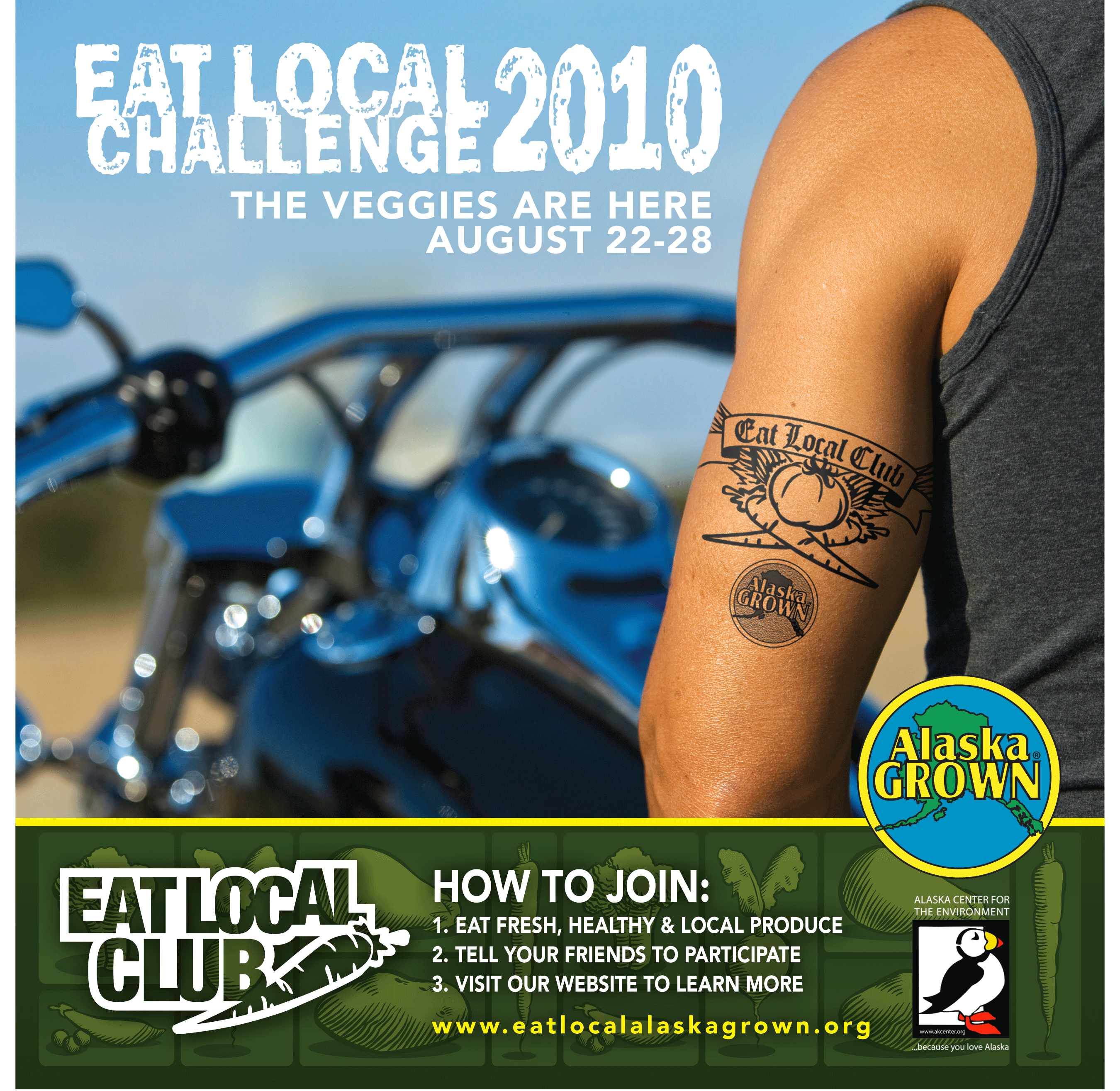
• Alaska Grown, Alaska Center For The Environment team up to host the Eat Local Challenge 2010 on Aug. 22-28

The state’s Alaska Grown program will host its “Eat Local Challenge 2010” on Sunday through Saturday, Aug. 22-28 (click here to read more). This year, the Alaska Center for the Environment, has joined Alaska Grown as a sponsor as part of the center’s local foods and sustainable communities program.

Alaskans have many ways to eat local, from veggies they grow in their own gardens or buy from Alaska farmers, berries they pick, fish they catch, game meat they hunt, seaweed and other beach greens they gather, etc. The benefit of eating local food is it’s fresher so it tastes better and has more nutrients, and you cut out the thousands of miles of transportation costs needed to ship food from the Lower 48 and other countries to Alaska. Growing local food makes a community more sustainable.

During the week of Aug. 22-28, Alaska residents are encouraged to:

  • Try eating at least one home-cooked meal this week, made of mostly local ingredients.
  • Try to incorporate at least one never-before-used local ingredient into a meal.
  • Try “brown-bagging” at least one meal this week made primarily of local ingredients.
  • Try talking to at least one local food retailer and one food producer about local food options.
  • Try to choose local food products whenever possible.

By the way, a good time to buy local food for the Eat Local Challenge is during the third Sitka Farmers Market of the summer on Saturday, Aug. 14, and during the fourth market on Saturday, Aug. 28. The Sitka Farmers Markets take place from 10 a.m. to 2 p.m. on alternate Saturdays (through Sept. 11) at historic Alaska Native Brotherhood Hall, 235 Katlian St. We’ll see you there.