Sitka Kitch to host Holiday Make and Take class on Dec. 12

make-and-take-class

nickiemakeThe holidays are upon us! Join Nickie Knight for a Holiday Make and Take class from 6-8:30 p.m. on Monday, Dec. 12, at the Sitka Kitch community rental commercial kitchen. The Sitka Kitch is located inside First Presbyterian Church, 505 Sawmill Creek Road.

Treat yourself, or leave with a variety of gifts to share. Luxurious, organic bath and body products don’t need to be expensive. Learn how to make some of your favorite concoctions in the kitchen using all natural ingredients and 100-percent pure essential oils. Nickie is an essential oil aficionado, who has been an advocate for the removal of toxins in the home for more than a decade.

The Holiday Make and Take class is $20.00 per person, plus the cost of supplies. Students should prepay for the class through the Sitka Kitch online registration site using PayPal.

Students will leave with finished products including — Body Butter, Luxurious Sugar Scrub, Lip Balm, and Holiday Cheer Room Spray. The supply fee (about $15, paid at the class) allows students to make one each of the body butter, sugar scrub, and room spray; and five tubes of lip balm. (Also, ask Nickie how to get your class fee reimbursed!)

revised2cookingfromscratch2016flierTo learn more about the class, contact Nickie at nickie@essentialwellnessak.com. To learn more about the Sitka Kitch, send an email to sitkakitch@sitkawild.org.

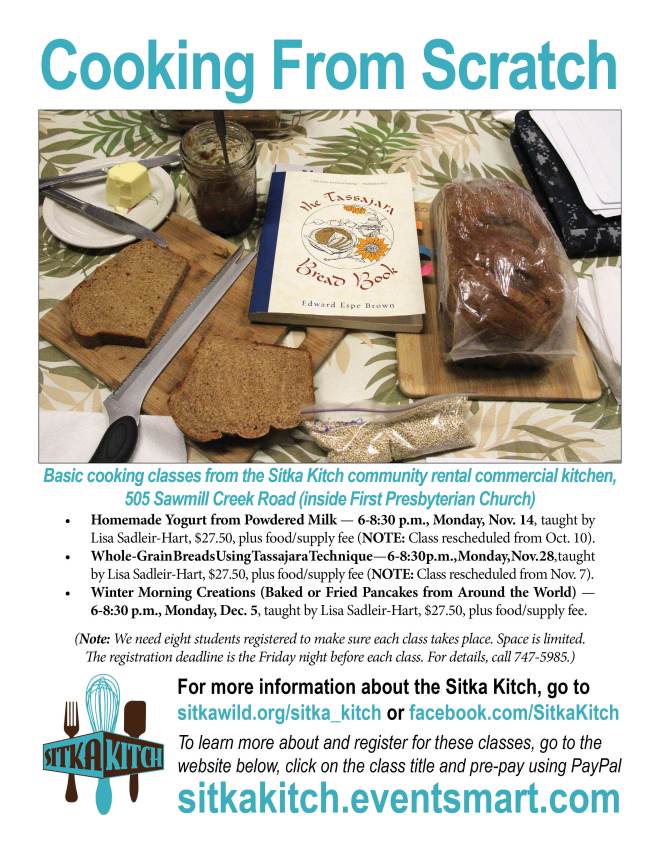
Also, the Sitka Kitch still has a few openings in its last two Cooking From Scratch classes — Whole-Grain Breads Using the Tassajara Techinique from 6-8:30 p.m. on Monday, Nov. 28, and Winter Morning Creations (baked and fried pancakes from around the world) from 6-8:30 p.m. on Monday, Dec. 5. These classes are taught by Lisa Sadleir-Hart and they cost $27.50 each, plus a food/supply fee based on the number of students in each class. Space is limited and we need a minimum of eight students registered in each of these two classes to guarantee they happen. You can register at http://sitkakitch.eventsmart.com (just click on the class title).

Sitka Local Foods Network launches its second #GivingTuesdayAK online fundraiser


2016-gt-logo-wdate1

Most people have heard about Black Friday, Small-Business Saturday, and Cyber Monday, three consumer-oriented days geared toward shopping for the holidays. But have you heard about Giving Tuesday, which takes place on Nov. 29 this year?

Giving Tuesday, also listed at #GivingTuesday (known as #GivingTuesdayAK in Alaska), is a day for people to celebrate generosity and give to worthy nonprofits who support the local community. This year, the Sitka Local Foods Network is launching its second Giving Tuesday online fundraiser to help us meet our mission of increasing the amount of locally produced and harvested food in the diets of Southeast Alaskans.

When you donate to the Sitka Local Foods Network you support us as we host the Sitka Farmers Markets during the summer, grow food at the St. Peter’s Fellowship Farm communal garden, and teach people about gardening and food preservation through our education program (which includes a garden buddy/mentor program for beginning gardeners). We also help with other local-food-related projects in town, such as Fish To Schools (which puts more locally caught seafood in school meals), our fruit tree project (where we got more community apple and cherry trees in town), the Sitka Kitch community rental commercial kitchen, or the Sitka Community Food Assessment (which gave us baseline data on food security issues in Sitka).

It’s easy to donate to our Giving Tuesday fundraiser through our secure donation page hosted by Razoo.com (an online site that collects donations for nonprofit organizations). The minimum donation through this site is $5, but we appreciate whatever you can give. A donation of $10 can help us purchase some seeds or work gloves, while a gift of $100 can buy wood, soil and seeds to build a raised garden bed. While #GivingTuesday launches on Nov. 29 this year, our #GivingTuesday donation page will accept gifts through Dec. 31 in case you need some charitable write-offs for tax purposes.

We just received our Pick.Click.Give. donations for 2016, $2,800 from 42 donors, and we thank all those people who chose to share part of their Alaska Permanent Fund Dividends with us. Unfortunately, the Sitka Local Foods Network will not be in the 2017 Pick.Click.Give. program due to a clerical snafu. We hope to return to the program in 2018.

For those who prefer to donate the old-fashioned way, you can send a check to the Sitka Local Foods Network, 408 Marine Street, Suite D, Sitka, Alaska, 99835. For those looking for end-of-the-year tax deductions, we are a 501(c)(3) nonprofit and our EIN is 26-4629930. Please let us know if you need a receipt. We hold a Bronze level rating with GuideStar.org, and we also are listed with Benevity.org (a site where employee donations to nonprofits sometimes are matched by larger corporations).

We thank you for supporting local foods in Sitka, Alaska. Your donation is greatly appreciated. If you need more information about our organization or a receipt for tax purposes, you can email the Sitka Local Foods Network board of directors at sitkalocalfoodsnetwork@gmail.com.

Scenes from the Cooking From Scratch homemade yogurt class at the Sitka Kitch

lisasadleirhartwithjuliecheryllibbykristenatstove

kitch_logo_mainStudents learned how to make homemade yogurt from non-fat powdered milk during the first Cooking From Scratch series class held Monday, Nov. 14, at the Sitka Kitch community rental commercial kitchen.

The homemade yogurt class was the first of three classes in the Fall 2016 Cooking From Scratch series at the Sitka Kitch, which is located at First Presbyterian Church (505 Sawmill Creek Road). The three classes are taught by Lisa Sadleir-Hart, a registered dietitian and health educator. Theclasses designed to help Sitka residents learn how to expand their culinary skills while also eating healthy foods and stretching their food dollars.

The second Sitka Kitch Cooking from Scratch class is from 6-8:30 p.m. on Monday, Nov. 28 (rescheduled from Nov. 7), and will focus on basic whole-grain breads (registration link) using the Tassajara bread technique. This class was offered last year and the students enjoyed learning this simple way to bake whole-grain breads.

homemadeyogurtwithcranberrysaucecrushednutsThe third Cooking from Scratch class will focus on winter morning creations (registration link), featuring baked and fried pancakes from around the world. It will be taught at 6-8:30 p.m. on Monday, Dec. 5. This class is new this fall, and it will teach students how to make a Finnish baked pancake called Krupso, the Eastern/Middle Eastern potato pancakes called Latke, Swedish pancakes, and Strata, a baked bread and egg dish.

The Cooking from Scratch series goal is to teach basic cooking skills using high-quality ingredients, and to help Sitkans take back their kitchens and reduce their food budgets. Interested individuals can register at https://sitkakitch.eventsmart.com/ (click on the event title to register, and use our PayPal feature to pay for the class). We need at least eight students registered for each class to guarantee they happen.

revised2cookingfromscratch2016flierClass size is limited, so register early. The cost is $27.50 per class, plus a food/supply fee that will be divided among registered participants. The registration deadline is late on the Friday night before each class. For more information about the class series, call Lisa Sadleir-Hart at 747-5985.

In addition, the Sitka Kitch will host a Holiday Make and Take class with Nickie Knight from 6-8:30 p.m. on Monday, Dec. 12, where students will learn how to make a variety of organic bath and body products using essential oils (such as body butter, luxurious sugar scrub, lip balm and holiday cheer room spray). This class will cost $20 and more details will be available on our registration site soon. We’re also putting together a Cooking Around The World class series for this spring, so watch for updates once details are confirmed.

A slideshow of scenes from the homemade yogurt class can be found below.

This slideshow requires JavaScript.

Paralytic shellfish poisoning (PSP) advisory lifted for Starrigavan Beach North in Sitka, but others remain

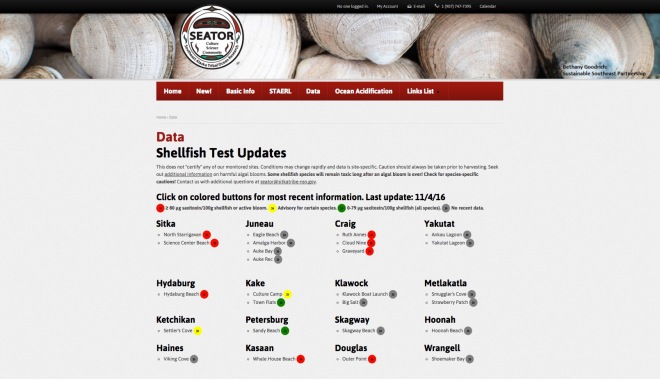
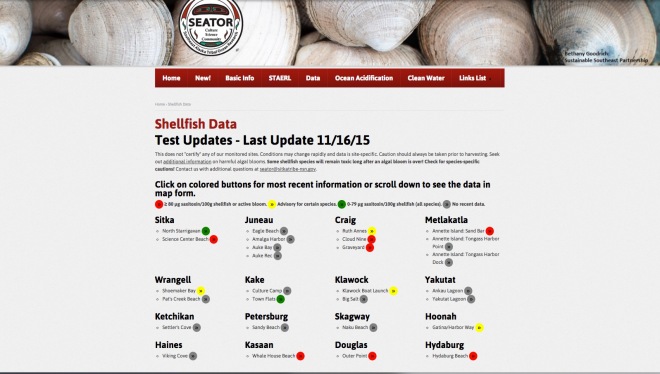
snapshotseatorshellfish11172016

The SouthEast Alaska Tribal Ocean Research (SEATOR) project, SouthEast Alaska Tribal Toxins (SEATT) partnership and the Sitka Tribe of Alaska Environmental Research Lab (STAERL) on Thursday, Nov. 17, lifted an advisory warning that people should not eat molluscan shellfish (bivalves such as clams, oysters, scallops, mussels, geoducks, cockles, etc.) harvested at Starrigavan Beach North in Sitka.

However, the recent harmful algal bloom warning for the Sitka Sound Science Center Beach remains in place. There also have been new warnings issued on Wednesday, Nov. 16, for Gartina/Harbor Way Beach in Hoonah and the Annette Island/Moss Point and Sand Bar beaches in Metlakatla.
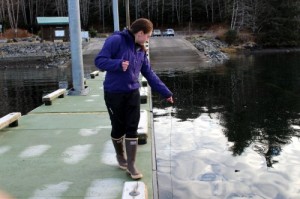
Esther Kennedy of the Sitka Tribe of Alaska Resource Protection Department samples water near the Starrigavan Recreation Area dock for marine biotoxins such as paralytic shellfish poisoning. (Photos by Emily Kwong, KCAW-Raven Radio)

Esther Kennedy of the Sitka Tribe of Alaska Resource Protection Department samples water near the Starrigavan Recreation Area dock for marine biotoxins such as paralytic shellfish poisoning. (Photo by Emily Kwong, KCAW-Raven Radio)

Samples harvested by STAERL at Starrigavan Beach North on Monday, Oct. 31, had elevated levels of the paralytic shellfish poisoning (PSP) toxins above the FDA regulatory limit of 80µg/100g. When samples were taken on Monday, Nov. 14, the toxin levels had dropped below the regulatory limit, which allowed SEATOR to lift the advisory, which includes little-neck clams, butter clams and cockle clams.

The Sitka Sound Science Center Beach advisory is based on shellfish harvested on Oct. 24. Molluscan shellfish from this site should not be harvested at this time. The Hoonah and Metlakatla advisories are based on shellfish harvested on Monday, Nov. 14, having PSP toxins above the FDA regulatory limit.

The PSP advisories are for bivalve shellfish that have been recreationally or subsistence harvested. It does not apply to commercially harvested shellfish, which are tested before they enter the market. The advisory does not apply to other shellfish, such as crabs or shrimp, which do not carry PSP (unless you eat the crab butter or viscera).

There have been several harmful algal bloom alerts released by SEATOR this summer, but this recent announcement is a good reminder that PSP can happen throughout the year. It also discredits the myth that you don’t have to worry about shellfish harvested in months containing an R.

According to SEATOR, “This does not ‘certify’ any of our monitored sites. Conditions may change rapidly and data is site-specific. Caution should always be taken prior to harvesting.”

The butter clam has one set of rings that go one direction only, around the same center point (Photo courtesy of Alaska Department of Environmental Conservation)

SEATOR posts updates and information to its website at seator.org/data, which can help provide Southeast Alaska residents with reliable information so they can choose whether or not to harvest shellfish. In addition to testing water samples weekly from certain Southeast beaches, STAERL also tests samples of butter clams, littleneck clams, and blue mussels (which is STAERL’s indicator species, because of how quickly blue mussels absorb saxotoxins).

In addition to the saxitoxins that cause PSP, the lab in Sitka has been monitoring for other blooms that cause amnesic shellfish poisoning (ASP). PSP and ASP can cause severe health problems, including death in some cases.

Since most beaches in Alaska aren’t tested for harmful algal blooms, SEATOR and the SEATT partnership were formed in October 2014 to train people to test beaches in Southeast Alaska. In April 2015, the Sitka Tribe of Alaska opened a regional lab on Katlian Street, so samples could be tested in Sitka without having to be sent to the Lower 48, which delayed results. By testing for harmful algal blooms, SEATOR and the SEATT partnership hope to be able to provide information so people can make informed choices whether or not to harvest or eat shellfish.

Harmful algal blooms, such as paralytic shellfish poisoning (PSP), typically have not been monitored in Southeast Alaska for subsistence and recreational harvesters of clams, mussels, oysters, cockles, and other bivalves (commercial harvests are tested). Even though many people in Southeast Alaska love to harvest shellfish, eating it comes with some risks. There have been several PSP outbreaks in recent years that sent people to the hospital, and in 2010 two deaths were attributed to PSP and other HABs, such as Alexandrium, Pseudo-nitzchia and Dinophysis.

To learn more about harmful algal blooms and how they can raise the risk for PSP and ASP (amnesic shellfish poisoning, which also can be fatal), go to SEATOR’s resources page. If you have shellfish you recently harvested and want to test it, click this link to learn what you need to do to have it tested by STAERL or watch this video. SEATOR also has a new Facebook page, where people can find updates. Please contact STAERL at 747-7395 with any additional questions.

Sitka Kitch to host second annual Cooking From Scratch class series in Fall 2016 (Rescheduled dates)

revised2cookingfromscratch2016flier

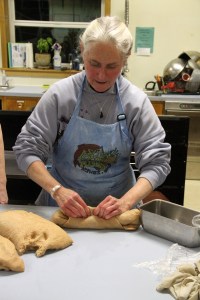
LisaSadleirHartPinchesKneadedBreadDoughEver wanted to learn how to cook more and better food for less money?

Join us for the second annual Cooking from Scratch series of cooking classes at the Sitka Kitch community rental commercial kitchen, which is located in the First Presbyterian Church (505 Sawmill Creek Road). Registered dietitian and health educator Lisa Sadleir-Hart, MPH, RD, will teach three classes designed to help Sitka residents learn how to expand their culinary skills while also eating healthy and stretching their food dollars. Please note that two of the three classes have been rescheduled from their originally announced dates.

The first class in this year’s fall series will focus on how to make yogurt using nonfat dried milk (registration link). It will be offered from 6-8:30 p.m. on Monday, Nov. 14 (this class was rescheduled from its original Oct. 10 date). We offered this class last year, and it was a big hit.

The second Sitka Kitch Cooking from Scratch class is from 6-8:30 p.m. on Monday, Nov. 28 (rescheduled from Nov. 7), and will focus on basic whole-grain breads (registration link) using the Tassajara bread technique. This class was offered last year and the students enjoyed learning this simple way to bake whole-grain breads.

LisaSadleirHartHoldsUpJarOfYogurtThe third Cooking from Scratch class will focus on winter morning creations (registration link), featuring baked and fried pancakes from around the world. It will be taught at 6-8:30 p.m. on Monday, Dec. 5. This class is new this fall, and it will teach students how to make a Finnish baked pancake called Krupso, the Eastern/Middle Eastern potato pancakes called Latke, Swedish pancakes, and Strata, a baked bread and egg dish.

The Cooking from Scratch series goal is to teach basic cooking skills using high-quality ingredients, and to help Sitkans take back their kitchens and reduce their food budgets. Interested individuals can register at https://sitkakitch.eventsmart.com/ (click on the event title to register, and use our PayPal feature to pay for the class). We need at least eight students registered for each class to guarantee they happen.

Class size is limited, so register early. The cost is $27.50 per class, plus a food/supply fee that will be divided among registered participants. The registration deadline is late on the Friday night before each class. For more information about the class series, call Lisa Sadleir-Hart at 747-5985.

New harmful algal bloom warning issued for shellfish harvested in Starrigavan Beach North in Sitka

snapshotpspadvisory

The SouthEast Alaska Tribal Ocean Research (SEATOR) project, SouthEast Alaska Tribal Toxins (SEATT) partnership and the Sitka Tribe of Alaska Environmental Research Lab (STAERL) on Friday, Nov. 4, issued a warning that people should not eat molluscan shellfish (bivalves such as clams, oysters, scallops, mussels, geoducks, cockles, etc.) harvested at Starrigavan Beach North in Sitka. There also is a recent harmful algal bloom warning for the Sitka Sound Science Center Beach.

Esther Kennedy of the Sitka Tribe of Alaska Resource Protection Department samples water near the Starrigavan Recreation Area dock for marine biotoxins such as paralytic shellfish poisoning. (Photos by Emily Kwong, KCAW-Raven Radio)

Esther Kennedy of the Sitka Tribe of Alaska Resource Protection Department samples water near the Starrigavan Recreation Area dock for marine biotoxins such as paralytic shellfish poisoning. (Photo by Emily Kwong, KCAW-Raven Radio)

Samples at Starrigavan Beach North harvested Oct. 31 had elevated levels of the paralytic shellfish poisoning (PSP) toxins above theFDA regulatory limit of 80µg/100g. The Sitka Sound Science Center Beach advisory is based on shellfish harvested on Oct. 24. Molluscan shellfish from these sites should not be harvested at this time.

The PSP advisory is for bivalve shellfish that have been recreationally or subsistence harvested. It does not apply to commercially harvested shellfish, which are tested before they enter the market. The advisory does not apply to other shellfish, such as crabs or shrimp, which do not carry PSP (unless you eat the crab butter or viscera).

There have been several harmful algal bloom alerts released by SEATOR this summer, but this recent announcement is a good reminder that PSP can happen throughout the year. It also discredits the myth that you don’t have to worry about shellfish harvested in months containing an R.

According to SEATOR, “This does not ‘certify’ any of our monitored sites. Conditions may change rapidly and data is site-specific. Caution should always be taken prior to harvesting.”

The butter clam has one set of rings that go one direction only, around the same center point (Photo courtesy of Alaska Department of Environmental Conservation)

SEATOR posts updates and information to its website at seator.org/data, which can help provide Southeast Alaska residents with reliable information so they can choose whether or not to harvest shellfish. In addition to testing water samples weekly from certain Southeast beaches, STAERL also tests samples of butter clams, littleneck clams, and blue mussels (which is STAERL’s indicator species, because of how quickly blue mussels absorb saxotoxins).

In addition to the saxitoxins that cause PSP, the lab in Sitka has been monitoring for other blooms that cause amnesic shellfish poisoning (ASP). PSP and ASP can cause severe health problems, including death in some cases.

Since most beaches in Alaska aren’t tested for harmful algal blooms, SEATOR and the SEATT partnership were formed in October 2014 to train people to test beaches in Southeast Alaska. In April 2015, the Sitka Tribe of Alaska opened a regional lab on Katlian Street, so samples could be tested in Sitka without having to be sent to the Lower 48, which delayed results. By testing for harmful algal blooms, SEATOR and the SEATT partnership hope to be able to provide information so people can make informed choices whether or not to harvest or eat shellfish.

Harmful algal blooms, such as paralytic shellfish poisoning (PSP), typically have not been monitored in Southeast Alaska for subsistence and recreational harvesters of clams, mussels, oysters, cockles, and other bivalves (commercial harvests are tested). Even though many people in Southeast Alaska love to harvest shellfish, eating it comes with some risks. There have been several PSP outbreaks in recent years that sent people to the hospital, and in 2010 two deaths were attributed to PSP and other HABs, such as Alexandrium, Pseudo-nitzchia and Dinophysis.

To learn more about harmful algal blooms and how they can raise the risk for PSP and ASP (amnesic shellfish poisoning, which also can be fatal), go to SEATOR’s resources page. If you have shellfish you recently harvested and want to test it, click this link to learn what you need to do to have it tested by STAERL or watch this video. SEATOR also has a new Facebook page, where people can find updates. Please contact STAERL at 747-7395 with any additional questions.

Check out the November 2016 edition of the Sitka Local Foods Network newsletter

november2016slfnmonthlynewsletterscreenshot

The Sitka Local Foods Network just sent out the November 2016 edition of its monthly newsletter. Feel free to click this link to get a copy.

This edition of the newsletter has brief stories about our need for new board members, a new #GivingTuesday fundraising campaign that launches on Nov. 29, two food-related projects chosen at the recent Sitka Health Summit, and the Sitka Kitch hosting a Cooking From Scratch class series for Fall 2016. Each story has links to our website for more information.

You can sign up for future editions of our newsletter by clicking on the registration form image in the right column of our website and filling in the information. If you received a copy but didn’t want one, there is a link at the bottom of the newsletter so you can unsubscribe. Our intention is to get the word out about upcoming events and not to spam people. We will protect your privacy by not sharing our email list with others.

Sitka Health Summit chooses two community wellness projects related to local food

groupshotofcitizenplanners

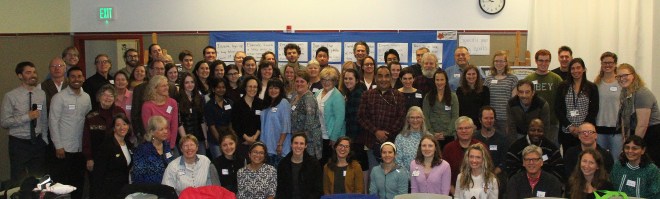
newsitkahealthsummitlogoHealthy nutritious local food was the theme as about 75 Sitka residents gathered to choose two community wellness projects to pursue in 2016-17 at the 10th annual Sitka Health Summit planning day Friday, Oct. 21, at the University of Alaska Southeast Sitka Campus.

The citizen planners chose one specific topic project (which can be finished in one year) and one broad topic (which may become a multi-year project). Identifying, developing, organizing and maintaining a new community garden was the choice for specific topic project. Combining all healthy and local food organizations into one nonprofit was broad topic project chosen.

dougosbornereadsoffprojectideasbeforevotingThese two projects were chosen from 21 specific topic project and nine broad topic project ideas introduced by the citizen planners (some similar project ideas were combined into one submission before voting). The topic ideas submitted by the citizen planners fell into a variety of categories, such as physical activity, nutrition, mental health, health equity, etc. The two chosen projects will each receive $2,000 in seed money, as well as some facilitation services from the Sitka Health Summit advisory team, to help get the projects off the ground.

Each of the two chosen community wellness projects will host a kick-off event in the near future, and these events are open to the public and anybody who wants to help with the project. More information about the projects, their kick-off meetings, and contact people are listed below.

  • emptyblatchleycommunitygardenIdentify, develop, organize and maintain new community gardens in Sitka — 6 p.m., Thursday, Nov. 3, Harrigan Centennial Hall, contact Dave Nuetzel, 738-8372, community.garden@hotmail.com — This project is to create one or more community garden spaces in Sitka, which has become a need due to the recent closure of the Blatchley Community Gardens behind Blatchley Middle School. Building more community gardens will allow landless Sitkans and those who don’t have good sun exposure to have a place to grow their own food. The former Blatchley Community Gardens page on Facebook has been renamed the Sitka Community Gardens page, https://www.facebook.com/Sitka-Community-Gardens-210713299032006/, which people can like for more information.
  • Combine all healthy and local food organizations into one nonprofit — 6:30 p.m., Thursday, Nov. 10, Harrigan Centennial Hall contact Charles Bingham, 623-7660, charleswbingham3@gmail.com — This project’s goal is to help the large number of Sitka groups working on healthy and local food projects (such as the Sitka Local Foods Network, Sitka Kitch, Sitka Food Co-Op, etc.) find ways to collaborate and work together to become more efficient and not burn out so many board members and volunteers because of the duplication of efforts. This project may result in some organizations combining into one, or at least finding ways to collaborate. The project may take longer than one year, as the various groups merge their missions, purposes, values, and organizational structures, while avoiding turf wars. But the overall goal is to make sure “Every Sitkan has access to healthy, affordable food.”

dougosbornepresentsawardtogirlscouttroop4140In addition to choosing two community wellness projects, the Sitka Health Summit recognized Girl Scout Troop 4140 for its work in promoting and improving the safety of the Peterson Street and Halibut Point Road intersection following recent car-bike and car-walker collisions that left people seriously injured.

The Sitka Health Summit is coordinated and funded by a coalition of local groups that includes Brave Heart Volunteers, the SouthEast Alaska Regional Health Consortium (SEARHC), Sitka Community Hospital, the Sitka Community Hospital Foundation, and the University of Alaska Southeast Sitka Campus, with additional financial help from Guardian Flight, Southeast Radiation Oncology, White’s Pharmacy, Lakeside-Milam Recovery Centers, Sitka Vision Clinic, Unity Botanicals, and the Federal Reserve Bank of San Francisco-Seattle Branch Community Development Division.

For more information about the Sitka Health Summit and its current and past projects, go to http://www.sitkahealthsummit.org/. A slideshow of scenes from the 10th annual Sitka Health Summit is posted below, as well as a slideshow of scenes from the now-empty Blatchley Community Gardens.

This slideshow requires JavaScript.

This slideshow requires JavaScript.

Sitka Kitch to host second annual Cooking From Scratch class series in Fall 2016

revisedcookingfromscratch2016flier

LisaSadleirHartPinchesKneadedBreadDoughEver wanted to learn how to cook more and better food for less money?

Join us for the second annual Cooking from Scratch series of cooking classes at the Sitka Kitch community rental commercial kitchen, which is located in the First Presbyterian Church (505 Sawmill Creek Road). Registered dietitian and health educator Lisa Sadleir-Hart, MPH, RD, will teach three classes designed to help Sitka residents learn how to expand their culinary skills while also eating healthy and stretching their food dollars.

The first Sitka Kitch Cooking from Scratch class is from 6-8:30 p.m. on Monday, Nov. 7, and will focus on basic whole-grain breads (registration link) using the Tassajara bread technique. This class was offered last year and the students enjoyed learning this simple way to bake whole-grain breads.

The second class in this year’s fall series will focus on how to make yogurt using nonfat dried milk (registration link). It will be offered from 6-8:30 p.m. on Monday, Nov. 14 (this class was rescheduled from its original Oct. 10 date). We offered this class last year, and it was a big hit.

LisaSadleirHartHoldsUpJarOfYogurtThe third Cooking from Scratch class will focus on winter morning creations (registration link), featuring baked and fried pancakes from around the world. It will be taught at 6-8:30 p.m. on Monday, Dec. 5. This class is new this fall, and it will teach students how to make a Finnish baked pancake called Krupso, the Eastern/Middle Eastern potato pancakes called Latke, Swedish pancakes, and Strata, a baked bread and egg dish.

The Cooking from Scratch series goal is to teach basic cooking skills using high-quality ingredients, and to help Sitkans take back their kitchens and reduce their food budgets. Interested individuals can register at https://sitkakitch.eventsmart.com/ (click on the event title to register, and use our PayPal feature to pay for the class). We need at least eight students registered for each class to guarantee they happen.

Class size is limited, so register early. The cost is $27.50 per class, plus a food/supply fee that will be divided among registered participants. The registration deadline is late on the Friday night before each class. For more information about the class series, call Lisa Sadleir-Hart at 747-5985.

Sitka Local Foods Network one of 11 Alaska organizations in the 2016 Good Food Org Guide

gfog_1500x900_2

good-food-org-guide-2016The Sitka Local Foods Network is one of 11 Alaska food organizations included in the Food Tank and James Beard Foundation‘s 2016 Good Food Org Guide, released on Oct. 17. This year’s third annual guide expands on last year’s second list and is more than triple the size of last year’s inaugural offering.

According to the Food Tank website, ‘This definitive guide highlights nonprofit organizations that are doing exemplary work in the United States in the areas of food and agriculture, nutrition and health, hunger and obesity, and food justice. Only nonprofit, scholarly, and municipal initiatives have been selected in order to spotlight efforts that are focused on community building and engagement, advocacy, and service.”

The guide is meant to be a definitive resource that highlights the exemplary work non-profit organizations in the United States are doing on food and agriculture, nutrition and health, hunger and obesity, and food justice.

In addition to the Sitka Local Foods Network, the other Alaska groups included in the guide for the third straight year are the Alaska Food Coalition, the Alaska Food Policy Council, the Kenai Peninsula Food Bank, and Kids’ Kitchen, Inc of Anchorage. Making the guide for the second year are the Alaska Sustainable Fisheries Trust/Alaskans Own Seafoods of Sitka, the Southeast Soil and Water Conservation District of Juneau, the University of Alaska Fairbanks Cooperative Extension Service, and Alaska Community Agriculture of Fairbanks. New to the guide this year are the Alaska Farmland Trust of Palmer and the Calypso Farm and Ecology Center of Fairbanks.

You can view the online version of the 2016 Good Food Org Guide by clicking this link, or you can download a hard copy of the 2016 Food Org Guide by clicking the link below.

• Food Tank and James Beard Foundation’s 2016 Good Food Org Guide