New harmful algal bloom warnings issued for shellfish harvested in Starrigavan Beach, other SE beaches

SEATORPSPWarningAug17

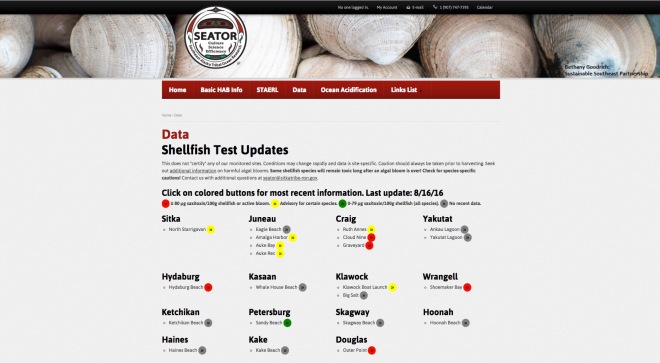
The SouthEast Alaska Tribal Ocean Research (SEATOR) project, SouthEast Alaska Tribal Toxins (SEATT) partnership and the Sitka Tribe of Alaska Environmental Research Lab (STAERL) on Wednesday, Aug. 17, issued a warning that people should not eat shellfish harvested at Starrigavan Beach in Sitka and Hydaburg Beach in Hydaburg.
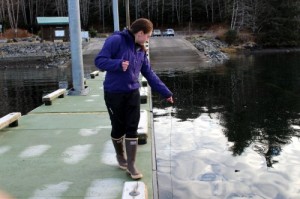
Esther Kennedy of the Sitka Tribe of Alaska Resource Protection Department samples water near the Starrigavan Recreation Area dock for marine biotoxins such as paralytic shellfish poisoning. (Photos by Emily Kwong, KCAW-Raven Radio)

Esther Kennedy of the Sitka Tribe of Alaska Resource Protection Department samples water near the Starrigavan Recreation Area dock for marine biotoxins such as paralytic shellfish poisoning in 2015. (Photo by Emily Kwong, KCAW-Raven Radio)

Samples harvested Aug. 17 at those beaches showed the presence of Alexandrium, a phytoplankton that produces saxitoxins that can cause paralytic shellfish poisoning (PSP). Mulluscan shellfish (bivalve shellfish such as clams, mussels, oysters, cockles, scallops, etc.) from these sites should not be harvested at this time.

In addition, mulluscan shellfish from Hydaburg Beach on Aug. 17 tested near or above the regulatory limit of 80μg/100g for saxitoxins and all species of mulluscan shellfish should not be harvested at this time. On Aug. 18, butter clams from Shoemaker Beach in Wrangell tested near or above the regulatory limit of 80μg/100g for saxitoxins and should not be harvested at this time.

The PSP advisory is for bivalve shellfish that have been recreationally or subsistence harvested. It does not apply to commercially harvested shellfish, which are tested before they enter the market. The advisory does not apply to other shellfish, such as crabs or shrimp, which do not carry PSP (unless you eat the crab butter or viscera).

There have been several harmful algal bloom alerts released by SEATOR this summer, but it’s the first one in about a month or so for Sitka. In addition to the saxitoxins that cause PSP, the lab in Sitka has been monitoring for other blooms that cause amnesic shellfish poisoning (ASP). PSP and ASP can cause severe health problems, including death in some cases.

According to SEATOR, “This does not ‘certify’ any of our monitored sites. Conditions may change rapidly and data is site-specific. Caution should always be taken prior to harvesting.”

The butter clam has one set of rings that go one direction only, around the same center point (Photo courtesy of Alaska Department of Environmental Conservation)

The butter clam has one set of rings that go one direction only, around the same center point (Photo courtesy of Alaska Department of Environmental Conservation)

SEATOR posts updates and information to its website at seator.org/data, which can help provide Southeast Alaska residents with reliable information so they can choose whether or not to harvest shellfish. In addition to testing water samples weekly from certain Southeast beaches, STAERL also tests samples of butter clams, littleneck clams, and blue mussels (which is STAERL’s indicator species, because of how quickly blue mussels absorb saxotoxins).

Since most beaches in Alaska aren’t tested for harmful algal blooms, SEATOR and the SEATT partnership were formed in October 2014 to train people to test beaches in Southeast Alaska. In April 2015, the Sitka Tribe of Alaska opened a regional lab on Katlian Street, so samples could be tested in Sitka without having to be sent to the Lower 48, which delayed results. By testing for harmful algal blooms, SEATOR and the SEATT partnership hope to be able to provide information so people can make informed choices whether or not to harvest or eat shellfish.

Harmful algal blooms, such as paralytic shellfish poisoning (PSP), typically have not been monitored in Southeast Alaska for subsistence and recreational harvesters of clams, mussels, oysters, cockles, and other bivalves (commercial harvests are tested). Even though many people in Southeast Alaska love to harvest shellfish, eating it comes with some risks. There have been several PSP outbreaks in recent years that sent people to the hospital, and in 2010 two deaths were attributed to PSP and other HABs, such as Alexandrium, Pseudo-nitzchia and Dinophysis.

To learn more about harmful algal blooms and how they can raise the risk for PSP and ASP (amnesic shellfish poisoning, which also can be fatal), go to SEATOR’s resources page. If you have shellfish you recently harvested and want to test it, click this link to learn what you need to do to have it tested by STAERL. Please contact STAERL at 747-7395 with any additional questions.


Fish to Schools program seeks donations of coho salmon from commercial fishermen

Spencer2

The Fish to Schools program needs help from Sitka’s commercial fishermen. The program needs a few hundred pounds of coho salmon to help make Fish to Schools meals for Sitka students during the upcoming 2016-17 school year. The program also is seeking photos of commercial fishermen at work, which can be used to teach the students more about how the fish got to their plates.

The coho salmon donation period is Wednesday. Aug. 17, through Tuesday, Aug. 23. To donate, commercial fishermen can sign up and indicate how many pounds they want to donate when they offload at Seafood Producers Cooperative or Sitka Sound Seafoods during the donation period. The program can only accept commercially caught fish (no sport or subsistence fish). The hope is to get enough coho donated that locally caught salmon can be offered to students at least once a week. Sign-up sheets will be posted at the scale shacks and in the main offices. Coho salmon is preferred.

Excited red haired kidThe Sitka Fish To Schools project (click here to see short video) got its start as a community wellness project at the 2010 Sitka Health Summit, and now is managed by the Sitka Conservation Society. It started by providing a monthly fish dish as part of the school lunch as Blatchley Middle School, and since then has grown to feature regular fish dishes as part of the lunch programs at Baranof Elementary School, Keet Gooshi Heen Elementary SchoolBlatchley Middle School, Sitka High SchoolPacific High School (where the alternative high school students cook the meals themselves), the SEER School, and Mount Edgecumbe High School.

In addition to serving locally caught fish meals as part of the school lunch program, the Fish To Schools program also brings local fishermen, fisheries biologists and chefs to the classroom to teach the kids about the importance of locally caught fish in Sitka. The program received an innovation award from the Alaska Farm To Schools program during a community celebration dinner in May 2012, and now serves as a model for other school districts from coastal fishing communities. In May 2014, the Fish to Schools program released a guidebook so other school districts in Alaska could create similar programs.

For more information, contact Sophie Nethercut of the Sitka Conservation Society at sophie@sitkawild.org or 747-7509.

Scenes from the fourth Sitka Farmers Market of the 2016 summer

DownToEarthUPickGardenLoriAdamsKickedBack

SitkaFarmersMarketSignLast week was National Farmers Market Week (Aug. 7-13), but someone forgot to tell the weatherman. So we had a bit of rain and inclement weather during our fourth of seven Sitka Farmers Markets of the 2016 summer on Saturday, Aug. 13, at the Alaska Native Brotherhood Founders Hall.

Things will be a bit different, as we host another Sitka Farmers Market from 10 a.m. to 1 p.m. on Saturday, Aug. 20, at the ANB Founders Hall (235 Katlian Street). That’s right, we’re having markets on back-to-back Saturdays for the first time in history.

SalvationArmyBreadDavidKitkaMajorTurnieWrightWe always welcome new vendors who want to sell produce they’ve grown, fish they’ve caught, and local cottage food products they’ve made. To learn more about how to be a vendor, contact Matthew Jackson at (907) 821-1412 or jackson.mw08@gmail.com.

The other markets this summer are on Saturdays, Sept. 3, and Sept. 10. The Sitka Farmers Markets receive sponsorship funding from the SouthEast Alaska Regional Health Consortium (SEARHC). Don’t forget to vote for the Sitka Farmers Market in the American Farmland Trust’s eighth annual Farmers Market Celebration.

A slideshow of scenes from the fourth Sitka Farmers Market of the 2016 summer is below.

This slideshow requires JavaScript.

Building a Local Food System: Andrea Fraga and Middle Island Organic Produce

MiddleIslandOrganicProduceAndreaFragaKalebAldred

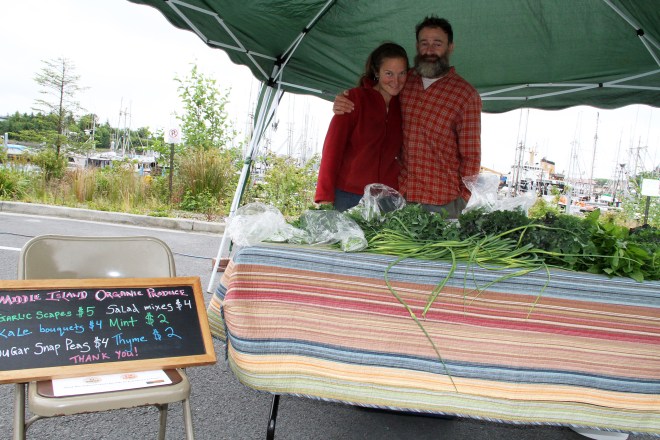
Andrea Fraga, left, and partner Kaleb Aldred, hosted their Middle Island Organic Produce booth at the July 16 Sitka Farmers Market.

(Editor’s Note: The Sitka Local Foods Network’s Bulldog on Baranof intern this summer, Claire Chang, is writing the Building a Local Food System series of articles about Sitkans working to improve food security. This is the fourth article of the series.)

WP_20160704_11_00_23_ProAndrea Fraga grew up in Hawaii and lived in Oregon for 10 years before she moved to Sitka. While in Oregon, she met a friend from Sitka who invited her to visit, and after her third trip she decided to embrace the rainy weather and move here. Sitka’s tremendous opportunities for subsistence appealed to her desire to become more self-sufficient. “I had been really interested in leading more of a subsistence lifestyle for a while” Fraga said.

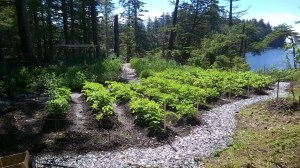
Fraga lives on Middle Island with her partner, Kaleb Aldred. They started with a small garden on the beach, and then established a garden with a greenhouse behind their home. They have since expanded to a lot due south of their house. “We had always lusted to have that space as an ideal garden spot,” she said.

Creating the “small farm or large garden” on Middle Island was not an easy task. They had to cut down trees and rent a machine to pull the stumps out. When they tried to dig the stumps out by hand, removing one stump took a whole week. The machine that removed the stumps compacted the soil, so they then had to dig a trench and fill it with gravel to provide the boggy field with adequate drainage. “I never thought I’d be someone to say, ‘Yeah, let’s cut down all the trees,’ but it’s necessary if you want to garden here,” Fraga said. Removing trees created a sunnier space and also has enabled Fraga to plant fruit trees along the perimeter of her garden.

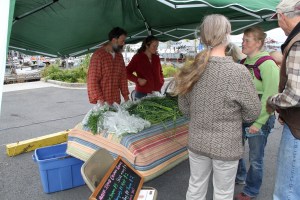
MiddleIslandOrganicProduceKalebAldredAndreaFragaWithCustomersOn occasion, Fraga sells vegetables at the Sitka Farmers Market through their Middle Island Organic Produce stand. She and Aldred hope to grow garlic commercially one day, although they are well aware that “weather and crop failure coalesce and can slow plans down.”

Currently, they have planted about a quarter of their garden in garlic so that they can harvest enough to plant a larger area in the future. Seed garlic costs about $25 dollars a pound from most sources, so generating seed on site will help save a significant amount of money. Fraga said growing garlic commercially makes sense because deer and slugs do not eat it and it is not highly perishable. Furthermore, unlike most garden vegetables she plants in the spring, garlic goes in the ground in the fall, so she can distribute her labor throughout the year.

At a commercial growers conference last spring, Fraga learned about using plastic mulch on garlic to control moisture levels and minimize weeds. The infrared- transmitting plastic transmits heat wavelengths of sunlight that warm the soil and absorbs the wavelengths that plants require for photosynthesis, so weeds cannot grow beneath it. Fraga has begun using the plastic mulch on her own garden this year.

Having farmed in Oregon where one can cultivate a wider variety of plants with greater ease than in Sitka, Fraga does find adapting to Sitka’s weather challenging. Living on an island also has its challenges. For example, in the fall and winter, storms and darkness can restrict travel to and from town. However, Fraga views these challenges as small tradeoffs that allow her to live and garden in a “beautiful, quiet place away from all the noises and distractions of town” and where she is “more in touch with the environment.”

WP_20160707_18_03_42_ProExperiencing beauty is, in large part, what Fraga finds so appealing about subsistence. She explained that gardens, berry thickets, and areas where she forages for mushrooms and seaweed are all beautiful places to spend time. For her, gardening “is just such a beautiful process.” She appreciates the exercise and fresh air involved in gardening, as well as the taste and nutritional value of fresh food. Fraga especially appreciates when she can refer to her dinner as a “Middle Island meal” because all of its components, apart from perhaps the fish,” came from the island that is her home. “It’s really satisfying to eat something that’s entirely grown or harvested yourself.”

Fraga is also a part of a gardening group that meets at one member’s garden every week to work there together. “It’s really great because garden projects that seem daunting end up being fun when you have people to work with,” Fraga said.

For those who find the prospect of starting a garden daunting, Fraga recommends “starting small and simple.” For example, one could begin by growing hearty plants like kale and potatoes that do not require extremely fertile soil. Learning about wild edibles also intimidates many people. Fraga took a class on mushroom identification through University of Alaska Southeast, but she also pointed out one can learn by reading field guides and talking with individuals who willing to share their knowledge on the subject. Gardening and foraging “are really rewarding,” she said. “They don’t have to be discouraging.”

For questions about her garden on Middle Island, contact Andrea Fraga at 738-5135.

Check out the August 2016 edition of the Sitka Local Foods Network newsletter

August2016SLFNNewsletterScreenshot

The Sitka Local Foods Network just sent out the August 2016 edition of its newly launched monthly newsletter. Feel free to click this link to get a copy.

This edition of the newsletter has brief stories about the Sitka Farmers Markets, a series of ‘Building A Local Food System’ articles by intern Claire Chang, a reminder that you can still add Pick.Click.Give. donations to your Alaska Permanent Fund Dividend application through Aug. 31, and an update on the Sitka Local Foods Network board of directors. Each story has links to our website for more information.

You can sign up for future editions of our newsletter by clicking on the registration form image in the right column of our website and filling in the information. If you received a copy but didn’t want one, there is a link at the bottom of the newsletter so you can unsubscribe. Our intention is to get the word out about upcoming events and not to spam people. We will protect your privacy by not sharing our email list with others.

Help celebrate National Farmers Market Week by attending the Sitka Farmers Market on Aug. 13

SLFNNationalFarmersMarketWeekPoster

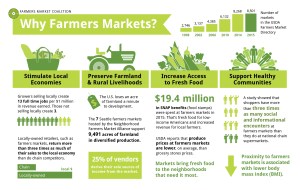
WhyMarkets_2016The 17th annual National Farmers Market Week is Aug. 7-13 this year, so stop by the Sitka Farmers Market to join the celebration, from 10 a.m. to 1 p.m. on Saturday, Aug. 13, at the Alaska Native Brotherhood Founders Hall.

The annual National Farmers Market Week celebration is the first full week of August, when growing season is peaking around the country. This year’s theme is “Farmers Markets and Community Education,” which highlights how farmers markets help communities reconnect to and learn about their food sources (from farms and farmers to local food relief programs). Click here to read this year’s National Farmers Market Week proclamation from U.S. Secretary of Agriculture Thomas Vilsack.

SitkaFarmersMarketSignThe number of farmers markets in the country has tripled since 1998, growing from 2,746 markets in 1998 to more than 8,500 in 2015. There has been similar growth in Alaska, and now markets can be found in many Bush communities from Bethel to Thorne Bay. This growth has improved Alaska’s food security while also serving as an incubator for new businesses.

According to the Farmers Market Coalition, farmers markets …

  • Preserve America’s rural livelihoods and farmland. Farmers markets provide one of the only low-barrier entry points for beginning farmers, allowing them to start small, test the market, and grow their businesses.
  • Stimulate local economies. Growers selling locally create 13 full-time farm operator jobs per $1 million in revenue earned. Those growers that do not sell locally create three jobs.
  • Increase access to fresh, nutritious food. Several  studies have found lower prices for conventional and organic produce at farmers markets than at supermarkets. Due to this and other factors, 52 percent more SNAP households shop at farmers markets and from direct marketing farmers today than in 2011. The Sitka Farmers Market was the first market in Southeast Alaska to accept SNAP and WIC benefits.
  • Support healthy communities. Farmers market vendors educate their shoppers. Four out of five farmers selling at markets discuss farming practices with their customers, and three in five discuss nutrition and how to prepare food.
  • Promote sustainability. Three out of every four farmers selling at farmers markets say they use practices consistent with organic standards.

Don’t forget, you still can add Pick.Click.Give. donations to your 2016 PFD application through Aug. 31

2016PickClickGiveFlier

PCGFarmersMarket2016NEWIf you’re like most Alaskans you probably filed your 2016 Alaska Permanent Fund Dividend (PFD) application before the March deadline and haven’t given it a second thought since. But did you know you still can add Pick.Click.Give.donations to your 2016 application through Monday, Aug. 31? If you haven’t already, please consider making a Pick.Click.Give. donation to the Sitka Local Foods Network.

Here’s how to add or change your Pick.Click.Give. donations. First, go to the Alaska Permanent Fund Dividend application website, http://pfd.alaska.gov/, and find the green “Add A Pick.Click.Give. Donation” bar in the right column. Click the green bar, and follow the directions. You’ll need to enter your driver’s license number, Social Security number, and birthday to access your application, but once on the page you’ll be able to see your current Pick.Click.Give. donations (if any) and you can add or change them. Click here for an FAQ page about making Pick.Click.Give. donations.

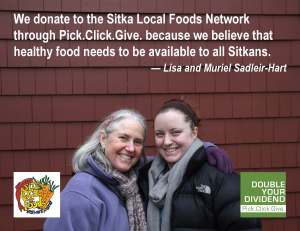
PCGTestemonialLisaAndMurielSadleirHart2016Unfortunately, new donations made after the March 31 Alaska Permanent Fund Dividend filing deadline do not qualify for entry into the Double Your Deadline Sweepstakes, where 10 lucky Alaskans will win the equivalent of a second PFD. But you still get the satisfaction of sharing the wealth with the more than 600 Alaska nonprofit organizations participating in the Pick.Click.Give. program, including 24 from Sitka.

This is the third year the Sitka Local Foods Network is participating in the Pick.Click.Give. program, which allows people to donate in $25 increments to their favorite statewide and local 501(c)(3) nonprofit organizations when they file their PFD applications. When you choose to donate part of your PFD to the Sitka Local Foods Network, you support the Sitka Farmers Market, St. Peter’s Fellowship Farm, education programs about growing and preserving food, the Sitka Kitch community rental commercial kitchen, Blatchley Community Gardens, the sustainable use of traditional foods, the Sitka Community Food Assessment, the Sitka Food Summit, the Fish-To-Schools program, and a variety of other projects designed to increase access to healthy local foods in Sitka.

PCGTestemonialLindaWilson2016You still can donate to the Sitka Local Foods Network if you aren’t from Alaska or aren’t eligible for a 2016 PFD. To donate, send your check to the Sitka Local Foods Network, 408 Marine St., Suite D, Sitka, Alaska, 99835. Our EIN is 26-4629930. You also can make an online donation through our Razoo.com crowdfunding page. Please let us know if you need a receipt for tax purposes. The Sitka Local Foods Network now has a Bronze rating from the GuideStar Nonprofit Profile Service, and we are listed with the Benevity Causes Portal used by larger corporations for employee giving programs. For more information about donating, you can send an email to sitkalocalfoodsnetwork@gmail.com.

Thank you to everybody making a Pick.Click.Give. donation to your Sitka Local Foods Network. We appreciate your support.

Scenes from the third Sitka Farmers Market of the 2016 summer

SLFNBoothMatthewJacksonWithAlyssaRussellPeterWilliams

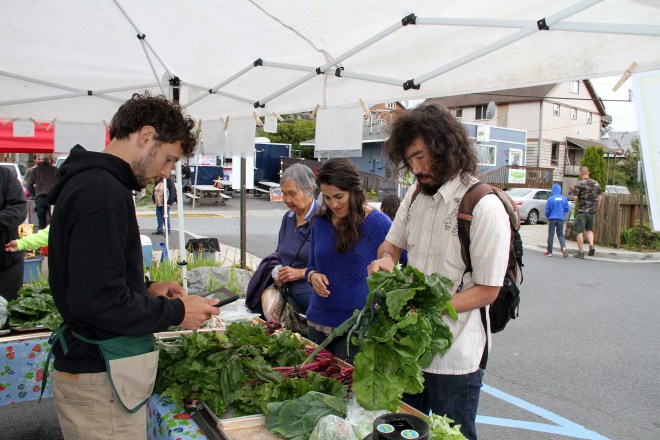
SitkaFarmersMarketSignAfter a week of rain, we lucked out with no rain when we held the third of the seven Sitka Farmers Markets of the 2016 summer on Saturday, July 30, at the Alaska Native Brotherhood Founders Hall.

PeoplCheckOut4HFairWe had several new vendors at this market, and the Sitka Spruce Tips 4H club sponsored by the UAF Cooperative Extension Service and Sitka Conservation Society hosted the first 4H Fair at this market, with lots of exhibits by the 4H kids.

We always welcome new vendors who want to sell produce they’ve grown, fish they’ve caught, and local cottage food products they’ve made. To learn more about how to be a vendor, contact Matthew Jackson at (907) 821-1412 or jackson.mw08@gmail.com.

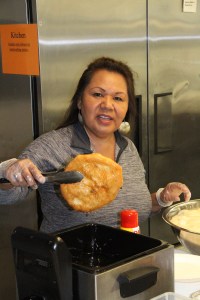
RachelMorenoWithFrybreadThe next Sitka Farmers Market will be from 10 a.m. to 1 p.m. on Saturday, Aug. 13, at the ANB Founders Hall. National Farmers Market Week is Aug. 7-13, so celebrate by coming to the market on Aug. 13.

The other markets this summer are on Saturdays, Aug. 20, Sept. 3, and Sept. 10. The Sitka Farmers Markets receive sponsorship funding from the SouthEast Alaska Regional Health Consortium (SEARHC). Don’t forget to vote for the Sitka Farmers Market in the American Farmland Trust’s eighth annual Farmers Market Celebration.

A slideshow of scenes from the third Sitka Farmers Market of the 2016 summer is below.

This slideshow requires JavaScript.

Building a Local Food System: Dave Nuetzel and Blatchley Community Gardens

DaveNuetzelMemorialGardenKathySwanberg

Dave Nuetzel, right, helps build a memorial garden bed for longtime Blatchley Community Gardens supporter Kathy Swanberg.

(Editor’s Note: The Sitka Local Foods Network’s Bulldog on Baranof intern this summer, Claire Chang, is writing the Building a Local Food System series of articles about Sitkans working to improve food security. This is the third article of the series.)

BlatchleyCommunityGardenSignDave Nuetzel has held the role of lead gardener at Blatchley Community Gardens since 2007. Nuetzel grew up outside of Cleveland, and he toured around the country on a two-year road trip after he graduated from college. At the end of the trip, he wound up in Anchorage. In 2005, he followed his partner, who came to Sitka to work at the Sitka Fine Arts Camp, and he has lived here ever since. With a background in special education, he originally worked for the SouthEast Alaska Regional Health Consortium (SEARHC), and he now works for Southeast Alaska Independent Living (SAIL).

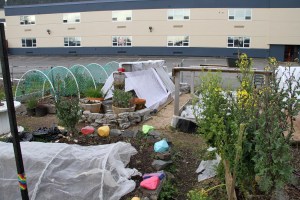
The Blatchley Community Gardens, located behind Sitka’s middle school on what used to be a gravel terrace, started in 2000 as a project of Sitka Community Schools. When Sitka Community Schools lacked the staff to run the garden, Nuetzel took on his role as lead gardener. This year the garden has transitioned from Sitka Community Schools to become a program of Blatchley Middle School. The community garden consists of about fifty garden plots, approximately 6-by-12-feet each. It is personal-use garden, although it does contain a few communal plots of plants such as mint, rhubarb, and flowers. Gardeners pay for the square footage of a plot, and Nuetzel explained that the community garden particularly appeals to people who live in apartments, on boats, or in houses with yards that receive little sunlight.

MiddleOfBlatchleyCommunityGardenAs someone who “has always liked to fix things and learn new skills,” Nuetzel had small gardens when he was growing up, as well as in college. In addition to his personal plots at the Blatchley Community Gardens, Neutzel says that he has “basically cultivated his whole yard.” Any areas around his house where he is not growing vegetables or flowers contain salmonberry, blueberry, or raspberry plants. Gardening appeals to Nuetzel’s desire to strive for self-sufficiency; he also fishes and forages for beach asparagus for subsistence.

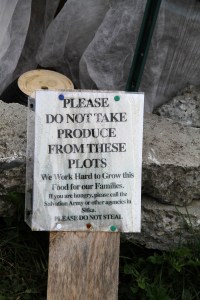
LeaveProduceAloneSignBlatchleyCommunityGardenNuetzel explained that, as lead gardener of Blatchley Community Gardens, maintaining a unified vision for the garden has posed a challenge. At the community garden, each plot represents the gardener’s individual approach to cultivation. Some gardeners devote themselves to experimentation, and they use their plots as a space for attempting to grow one type of vegetable that they have never succeeded in cultivating before. Others are committed to growing a wide variety of plants that they know will yield an ample harvest. Furthermore, gardeners choose to amend the soil in unique ways; while one might opt for buried salmon carcasses, kelp, and ground-up shells, another might rely more heavily on compost and coffee grounds.

An even larger challenge that Nuetzel has faced in his role is coordinating the management of common plots. Dividing up the responsibility of caring for a plot of chard, for example, becomes difficult when gardeners travel schedules and family obligations interfere. Furthermore, trying to ensure that everyone has equal to the resources of common plots, such as the apples from a communal apple tree, can be tricky.

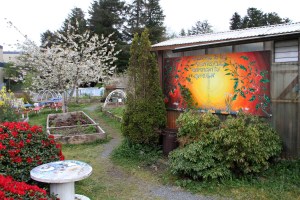
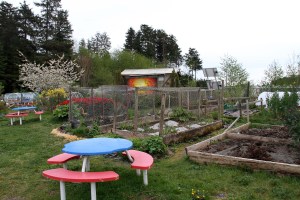
BlatchleyCommunityGardenPicnicTableAndBedsNevertheless, Nuetzel appreciates Blatchley Community Gardens as a space where he and others can experience the tangible results of physical labor. Regular visits to the garden allow him to appreciate how well one can grow food for oneself when one puts in the effort. Nuetzel believes that gardening has grown more popular in Sitka in recent years. He has seen new gardens emerge in yard, and in the future, he would like to see new community gardens established in town. As gardening in the community becomes more popular, he wishes that more people would view gardening as a basic need, not just a hobby.

CherryBlossomsBlatchleyCommunityGarden“At one time, producing food was a requirement for life,” Nuetzel said. “Now, people think that gardening is only something you do if you have lots of ‘extra’ time. But if you provide people with a little bit of guidance and get them invested in the process of gardening, they will value it and treat it like something that is necessary.”

To learn more about Blatchley Community Gardens, go to the Facebook page or contact Dave Nuetzel at community.garden@hotmail.com.

Sitka chef Colette Nelson to represent Alaska in Great American Seafood Cook-Off

ColetteGarnishesRabbitThighs

Ludvig’s Bistro owner and executive chef Colette Nelson garnishes rabbit thighs with beach asparagus for a special local foods dinner she prepared as a February 2015 fundraiser for The Sawmill Farm.

Next week, Sitka chef Colette Nelson will carry a special cargo in a violin case when she heads to New Orleans to represent Alaska in the Great American Seafood Cook-Off.

Nelson, the owner and executive chef of Ludvig’s Bistro, will be carrying a frozen white king salmon in her violin case, the fish she plans to cook for the annual contest. The white king salmon was caught July 4 by troller Lou Barr of Auke Bay (who Nelson used to commercial fish with) and flash-frozen earlier this month. Nelson doesn’t plan to let the fish out of her control as she travels to New Orleans.

“I’m going to hold that fish with me. I’m not going to let somebody put it under the plane because that’s our gold,” Nelson told the Juneau Empire in a July 25 article.

On Aug. 6, Nelson will compete against chefs from Alabama, Arkansas, Florida, Louisiana, Massachusetts, Mississippi, Oregon, South Carolina, Texas and Utah. The Great American Seafood Cook-Off is sponsored by the Louisiana Seafood Promotion and Marketing Board, and focuses on domestic, sustainable seafood and local ingredients.

Nelson, who will compete with her sous chef Josh Miller, hopes to become the second straight Alaska chef to win the Best Seafood Chef title, joining Beau Schooler and Travis Hotch of The Rookery Café in Juneau who won last year with a sockeye salmon dish. Nelson was nominated for this year’s contest by Gov. Bill Walker.

Nelson hasn’t said exactly how she plans to cook her white king salmon, but did hint that it will have a Spanish theme in keeping with her restaurant’s use of Mediterranean flavors.

“For me this experience is not only about representing Alaska, but it’s about what Alaska has given to me,” Nelson told the Empire. “I came here to fish in college so that I could study abroad in Spain. I did that and had a great time fishing. I fished for three seasons, then went to Spain and fell in love with the cuisine and with Mediterranean food as a whole. So to go to this competition 25 years later — after being in both the seafood industry and the restaurant business — it feels complete to go there with Spanish ideas.”

The dish will feature a pan-seared fillet of the fish that includes the belly meat.

“For anybody that knows king salmon, the belly meat is where the best flavor is,” Nelson said. “We like it just perfectly cooked so it just starts to separate, when the flakes come off. You can feel the oil, get it on your lips and really taste it.”

Nelson opened Ludvig’s Bistro in 2002, and has been a big supporter of local foods in Sitka (including using her restaurant to host fundraisers for the Sitka Local Foods Network and developing recipes and lesson plans for Sitka’s Fish To Schools lunch program coordinated by the Sitka Conservation Society). She grew up in Oregon and attended the University of Washington, where she trained under Seattle restauranteur Susan Kaufman, who also had a food cart and restaurants in Juneau. She moved to Alaska in 1998, working as chef for Kingfisher Charters & Lodge in Sitka before opening her restaurant.

During the competition, Nelson and sous chef Josh Miller will have an hour to prepare six plates for the judges and one for photos. Nelson and Miller have been practicing, and now feel they’re ready.

“We do this all the time. We cook under pressure,” Nelson said. “When we were practicing (Sunday) I said, ‘Look, we’re just having a dinner party for seven guests and let’s just make it in an hour. We got this.’”