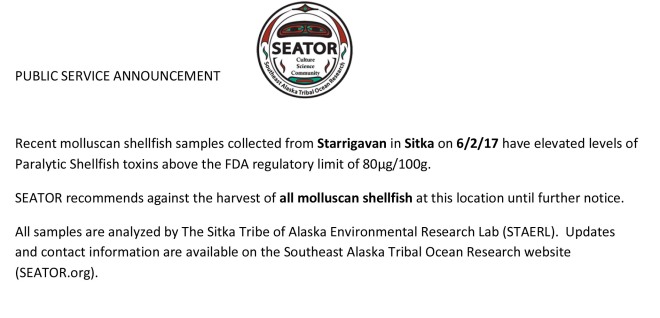
 The SouthEast Alaska Tribal Ocean Research (SEATOR) project, SouthEast Alaska Tribal Toxins (SEATT) partnership and the Sitka Tribe of Alaska Environmental Research Lab (STAERL) on Monday, June 5, issued an advisory warning that people should not eat molluscan shellfish (bivalves such as clams, oysters, scallops, mussels, geoducks, cockles, etc.) harvested at North Starrigavan Beach North in Sitka.
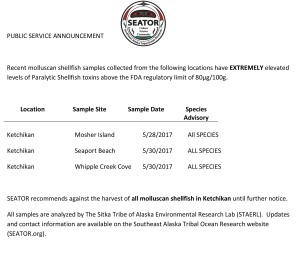
This is one of several recent advisory warnings issued by SEATOR about elevated levels of the paralytic shellfish poisoning (PSP) toxins above the FDA regulatory limit of 80µg/100g. Recent warnings have been issued for all species of molluscan shellfish at three beaches in Ketchikan (with extremely high levels that could be deadly), Metlakatla, Craig, Kodiak and Hoonah. There also are species-specific warnings issued in Klawock and Skagway.
Harmful algal blooms, such as paralytic shellfish poisoning (PSP), typically have not been monitored in Southeast Alaska for subsistence and recreational harvesters of clams, mussels, oysters, cockles, and other bivalves (commercial harvests are tested). Even though many people in Southeast Alaska love to harvest shellfish, eating it comes with some risks. There have been several PSP outbreaks in recent years that sent people to the hospital, and in 2010 two deaths were attributed to PSP and other HABs, such as Alexandrium, Pseudo-nitzchia and Dinophysis.
 The PSP advisories are for bivalve shellfish that have been recreationally or subsistence harvested. It does not apply to commercially harvested shellfish, which are tested before they enter the market. The advisory does not apply to other shellfish, such as crabs or shrimp, which do not carry PSP (unless you eat the crab butter or viscera).
The warnings, according to SEATOR, “This does not ‘certify’ any of our monitored sites. Conditions may change rapidly and data is site-specific. Caution should always be taken prior to harvesting.”
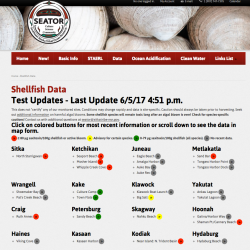
SEATOR posts updates and information to its website at seator.org/data, which can help provide Southeast Alaska residents with reliable information so they can choose whether or not to harvest shellfish. In addition to testing water samples weekly from certain Southeast beaches, STAERL also tests samples of butter clams, littleneck clams, and blue mussels (which is STAERL’s indicator species, because of how quickly blue mussels absorb saxotoxins).
In addition to the saxitoxins that cause PSP, the lab in Sitka has been monitoring for other blooms that cause amnesic shellfish poisoning (ASP). PSP and ASP can cause severe health problems, including death in some cases.
Since most beaches in Alaska aren’t tested for harmful algal blooms, SEATOR and the SEATT partnership were formed in October 2014 to train people to test beaches in Southeast Alaska. In April 2015, the Sitka Tribe of Alaska opened a regional lab on Katlian Street, so samples could be tested in Sitka without having to be sent to the Lower 48, which delayed results. By testing for harmful algal blooms, SEATOR and the SEATT partnership hope to be able to provide information so people can make informed choices whether or not to harvest or eat shellfish.
To learn more about harmful algal blooms and how they can raise the risk for PSP and ASP (amnesic shellfish poisoning, which also can be fatal), go to SEATOR’s resources page. If you have shellfish you recently harvested and want to test it, click this link to learn what you need to do to have it tested by STAERL or watch this video. SEATOR also has a new Facebook page, where people can find updates. Please contact STAERL at 747-7395 with any additional questions.


 June is National Men’s Health Month, and June 12-18 is National Men’s Health Week, so the SouthEast Alaska Regional Health Consortium (SEARHC) Health Promotion Program will host a quick and heart-healthy food demonstration for men. The free cooking demonstration takes place from 6-7:30 p.m. on Tuesday, June 13, at the Sitka Kitch community rental commercial kitchen, located inside the First Presbyterian Church (505 Sawmill Creek Road).



 Sitka Local Foods Network
You must be logged in to post a comment.