• Sitka Health Summit chooses three 2015-16 community wellness projects

SitkaHealthSummitGroup

newsitkahealthsummitlogoSitka residents decided to find ways to honor and support our elders, build an accessible community playground near Crescent Harbor, and build a community greenhouse on the roof of the city cold storage building (or a similar-flat-roofed structure), choosing those as the three community wellness projects Sitka residents chose to pursue in 2015-16 at the ninth annual Sitka Health Summit planning day Friday, Oct. 9, at the University of Alaska Southeast Sitka Campus.
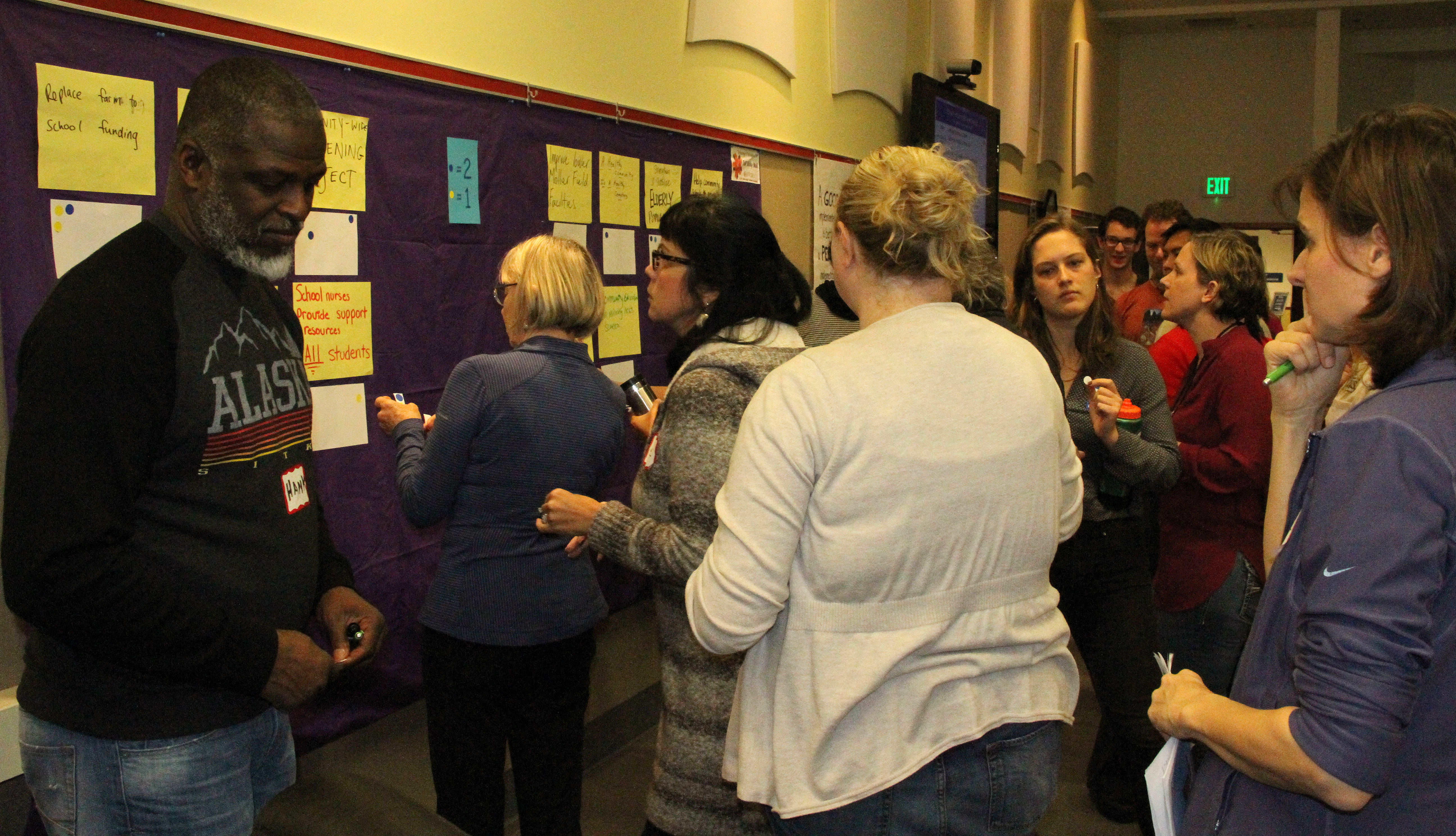
VotingForBroadProjectsThese three projects (one broad topic, and two specific topic projects that tied as top vote-getters) each were awarded with $2,000 in Tier 1 seed money to help get them started. The three projects were picked after 57 Sitka residents brainstormed and discussed the advantages and disadvantages of a wide variety of community wellness projects. In addition to the Tier 1 awards, the Sitka Health Summit also made applications available for Tier 2 grants of $10,000 for projects dealing with nutrition (applications are due Oct. 23, contact Lauren Hughey at lauren.hughey@searhc.org or go to http://www.sitkahealthsummitak.org/ for more information).

LynneBrandonAwardThe Sitka Health Summit also honored Lynne Brandon with a lifetime achievement award for her work promoting healthy lifestyles during her 13 years as Sitka’s Director of Parks and Recreation and now in her new position as executive director of Sitka Trail Works Inc.

Each of the three Tier 1 projects will host a kick-off event in the near future, and these events are open to the public and anybody who wants to help with the project. More information about the projects, their kick-off meetings, and contact people are listed below.

  • Design and build an ADA-accessible Sitka Community Playground, 6 p.m., Monday, Oct. 26, Sitka Community Hospital classroom, contact Kealoha Harmon, 747-3500 — This project is to create an accessible, attractive, low maintenance and safe community playground that will meet the needs of both children and their families. Right now Sitka does not have any playgrounds that are compliant with the Americans with Disability Act. Building the community playground was selected as a Sitka Health Summit goal in 2011, and a lot of important work has been done. Now it’s time to move this community-supported project forward.
  • Build a Sitka Community Greenhouse on the roof of the city cold storage plant (or similar flat-roofed building), 6 p.m., Wednesday, Oct. 28, Sitka Pioneer’s Home Manager’s House (Brave Heart Volunteers building), contact Charles Bingham, 623-7660 or charleswbingham3@gmail.com — This project’s goal is to increase local food production and food security by using greenhouses, including ones situated on rooftops, a practice growing in popularity around the world. Everyone needs the nutritional boost that only vegetables provide and the more we grow locally the better. There are so many benefits to growing food here; freshness, nutritional value, sustainability and the economic benefits that come from keeping dollars in Sitka. Rooftop greenhouses also can capture waste heat and provide a flat, slug-free growing environment that will help us with food security. Rooftop greenhouses can be a point of interest for visitors, a point of learning for students, and a point of community pride for everyone who believes in innovation and using space wisely.
  • Create a way to honor and support the well-being of elders in Sitka, 3 p.m., Friday, Nov. 6, Hames Athletic and Wellness Center, contact Caitlin Blaisdell, 747-5080 — One of the largest and fastest-growing populations in Sitka is its elders. The Elder Connection action group is focused on organizing systems to support the health and well-being of seniors living is Sitka. We want everyone’s Golden Years to be just that, and we know that we can do more to support this critical group of wisdom keepers.
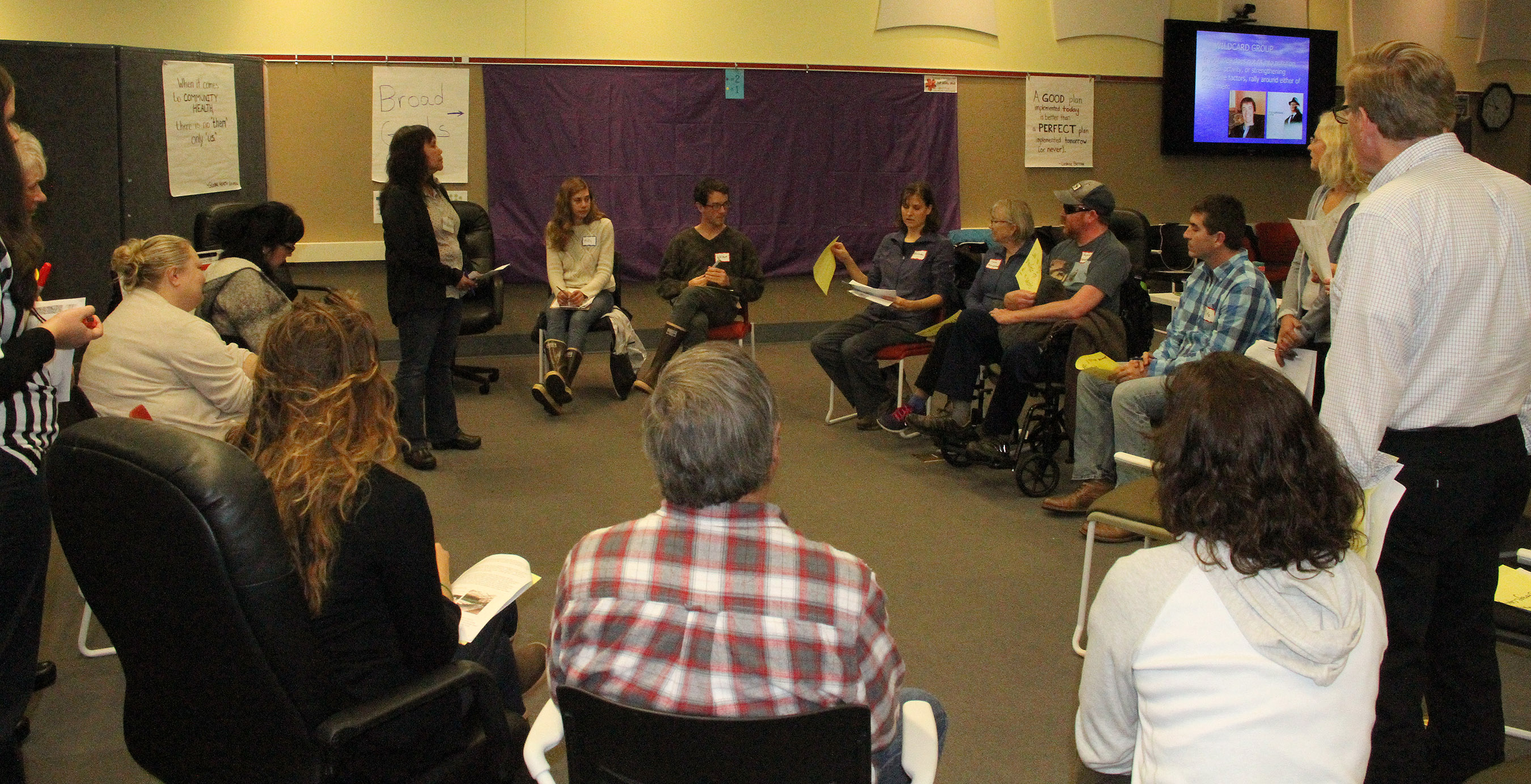
NutritionGroupDiscussesProjectIdeasThe Sitka Health Summit is coordinated by a coalition of local groups that includes the SouthEast Alaska Regional Health Consortium (SEARHC), Sitka Community Hospital, Brave Heart Volunteers, the University of Alaska Southeast Sitka Campus, and the State of Alaska Division of Public Health Nursing, with financial help from the Federal Reserve Bank of San Francisco-Seattle Branch Community Development Division.

Over the years there have been a variety of Sitka Health Summit projects — create a local market for local fish and produce, build a Sitka community greenhouse, become a Bicycle Friendly Community, become a Walk Friendly Community, encourage more kids and families to get outdoors for recreation, support a community health and wellness center (Hames), plant fruit trees around town, get more local fish into school lunches, build a Choose Respect mural, Revitalize Sitka, the Sick-a-Waste compost project, the Sitka Community Food AssessmentPark PrescriptionsTogether for a Meth-Free Sitka, and Sitka Kitch (a project to create a community rental kitchen and improve Sitka’s emergency food storage capacity). The 2014 Sitka Health Summit projects were Celebrate Katlian Street: A Vibrant Community and the Southeast Youth Resource Guide (which evolved into Family Fun Days at the Hames Athletic and Wellness Center).

For more information about the Sitka Health Summit and its current and past projects, go to http://www.sitkahealthsummitak.org/.
• Final classes set for 2015 Sitka Local Foods Network garden mentor program

TamiONeillGarden 2015

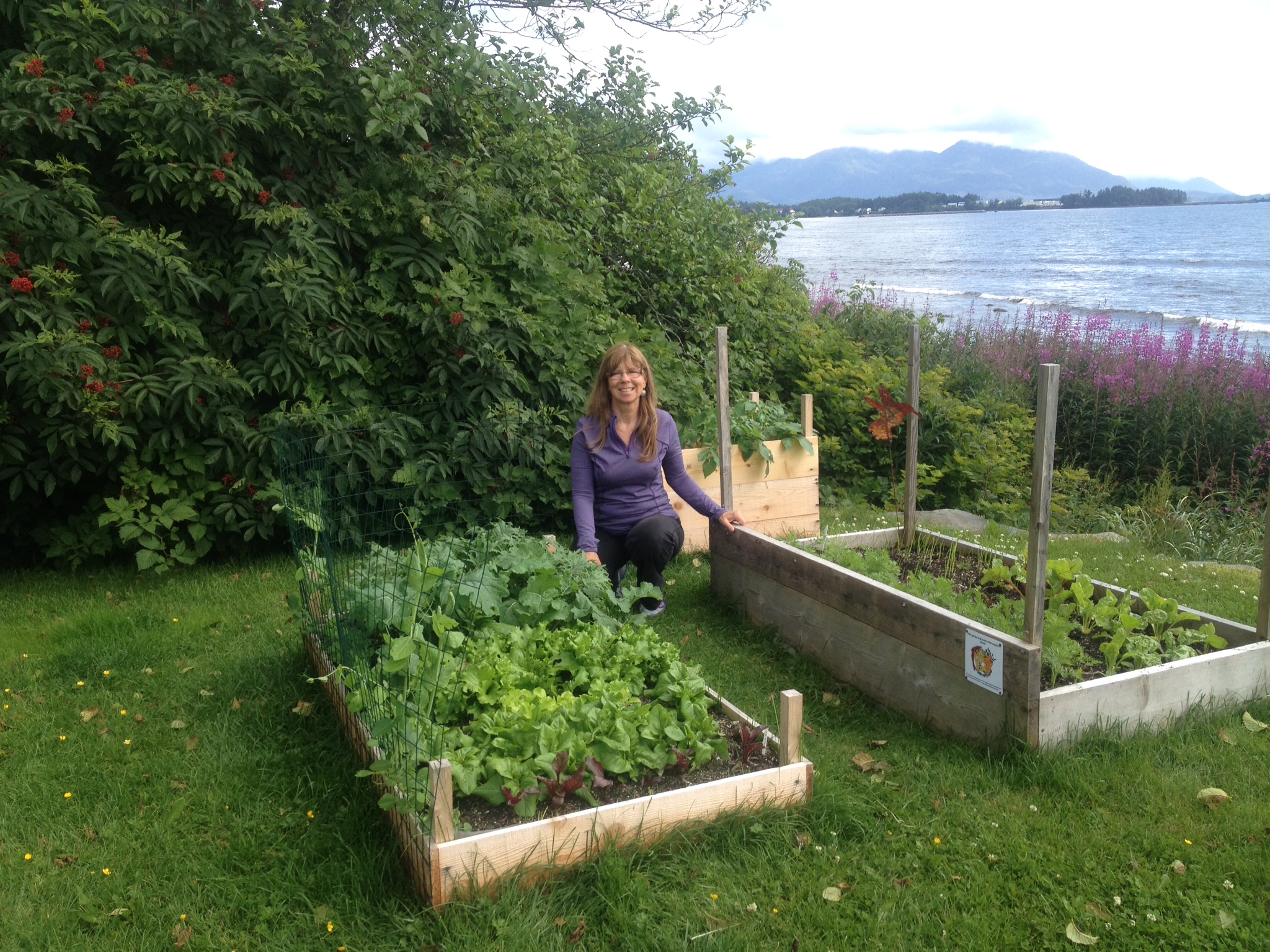
Tammy O’Neill shows off her garden from the Sitka Local Foods Network’s garden mentoring program. After growing in just one garden bed last year, she added new garden beds this year for her second year of the program.

Tammy O'Neill with her first carrot

Tammy O’Neill with her first carrot.

The 2015 gardening season is coming to a close, and the Sitka Local Foods Network garden mentor program is scheduling its final classes of the season to teach novice gardeners how to harvest their produce and winterize their gardens so they are ready for next spring.

So far classes have been set for four of our six garden mentor program students, with the other two TBA. Our four first-year students (A.J. Bastian, Rebecca Kubacki, Breezy and Josephine Dasalla) have been growing lettuce, kale, potatoes and rhubarb, four crops that grow well here in Sitka without a lot of fuss. Our two second-year students (Tammy O’Neill and Anna Bradley) have grown carrots, chard, green onions and peas, four crops that can grow well in Sitka but need a bit more loving care.

In addition to having experienced gardeners mentor them, all six students agreed to allow the classes taught at their garden plots be open to the public. The classes scheduled so far are:

  • A.J. Bastian, 207 Brady St. — noon, Wednesday, Sept. 23.
  • Rebecca Kubacki, 1202 Halibut Point Rd. — noon, Tuesday, Sept. 29.
  • Anna Bradley, 4764 Halibut Point Road, 1 p.m. on Tuesday, Sept. 29.
  • Tammy O’Neill, 2309 Merganser Drive, 1 p.m. on Thursday, Oct. 8.
DSCN0398

Rebecca Kubacki and her family with their garden.

Our two second-year students had never gardened for food before they started the program. They said they learned a lot and recommend the program to other new gardeners.

“I have so much more confidence and appreciate all the hands-on (help) I received,” O’Neill said, adding that her garden helped her save a lot of money on vegetables. “I don’t think I would have done it without the help and encouragement I had. I now have a network of people I can call to help with any questions or concerns I may have. I love eating local, fresh organic produce.”

After having a successful growing season last year, our returning students and a couple of the new ones had some soil problems this year. The gardens grew well in May and June, but in mid-July the plants seemed to stop growing even though the plants were well-formed. After some soil tests, it was discovered that some of the purchased compost was lower in nutrients than listed and the soil was more alkaline than normal (most soil in Sitka tends to be acidic).

DSCN0250

A.J. Bastian and her family with their newly planted garden.

“I learned that mostly the grade of the soil is important,” Bradley said. “We did a lot of work gathering the soil and beach herring, only to have maybe not enough fertilizer. The only thing we did different this year is not put in store bought soil. I look forward to gathering my potatoes and plan to read up more on gardening. Hopefully next year we will be more successful.”

Michelle Putz has been contracted to coordinate the program and design lesson plans, after the Sitka Local Foods Network received a community development grant from First Bank. We also have about a half-dozen experienced Sitka gardeners who serve as mentors for the program. Also, we have started to recruit for 2-3 participants to join next year’s first-year program.

For more information about the garden mentor program, please contact Michelle Putz at 747-2708.

IMG_0022

Garden mentor Linda Wilson with Anna Bradley and Anna’s daughter in 2014.

• Sitka residents team up to run neighborhood chicken coop co-ops

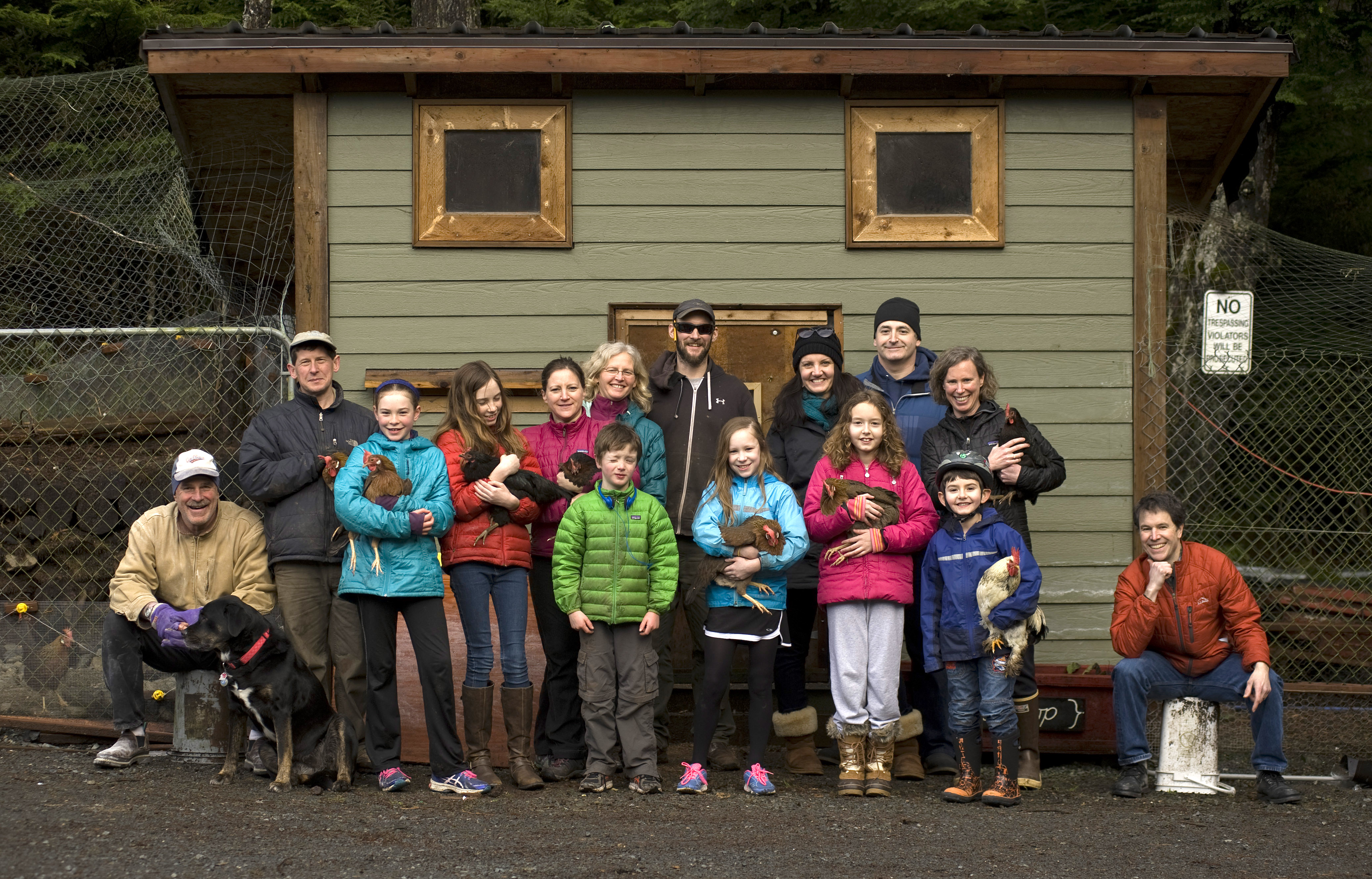
Some of the members of Le Coop, one of Sitka's chicken coop co-ops, pose with a few of their birds. (Daily Sitka Sentinel Photo by James Poulson, other photos in story are by Charles Bingham)

Some of the members of Le Coop, one of Sitka’s chicken coop co-ops, pose with a few of their birds. (Daily Sitka Sentinel Photo by James Poulson, other photos in story are by Charles Bingham)

Many Sitka families joined the backyard agriculture movement by starting gardens, but they hesitated when it came time to take the next step — raising chickens.

Chickens require daily feeding and watering, protection from predators, and other care that can be daunting for novices. However, a few Sitka families found an easier way. There now are a couple of chicken coop-co-ops in town, where neighbors or friends team up to share the duties and expense of raising chickens.

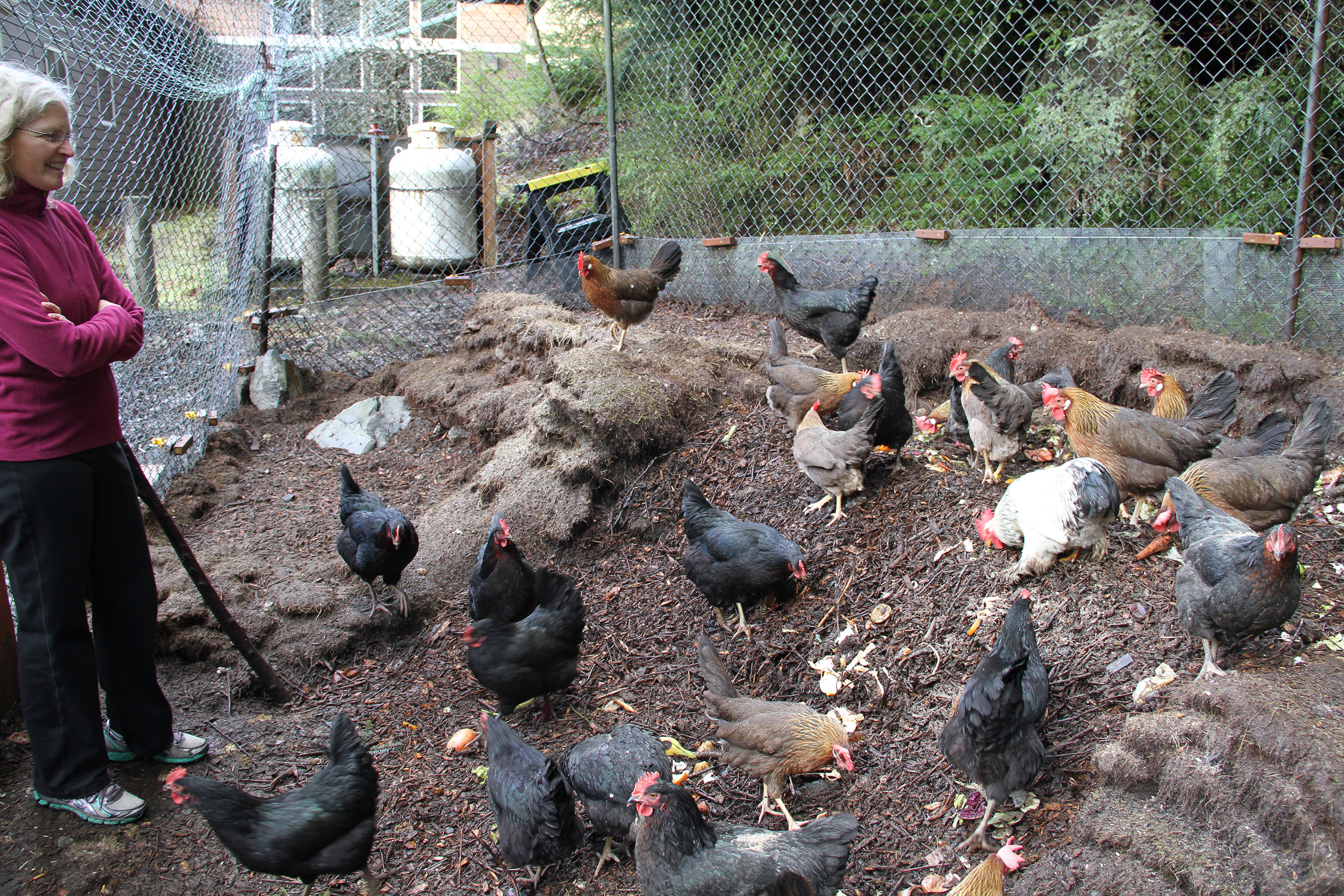
LeCoopOne of these chicken coop co-ops, Le Coop, is hidden in a back corner of the Sheldon Jackson Campus, where seven families are raising about 30 hens and one rooster. Le Coop is about 15 feet by 80 feet, with a hen house flanked by two outdoor chicken runs. The fence surrounding Le Coop is electrified (buried at least a foot below the surface to keep out varmints), with netting over the top to protect the chickens from eagles and other raptors. Inside the hen house are a dust bath for the hens, food and water buckets, an egg-laying box, and shelf space to store supplies such as extra feed.

“The advantage are only being responsible one day a week for regular chores such as feed, water, opening/closing, etc. Everything else is done at the whim of individual enthusiasms, and occasional work parties,” said Jud Kirkness, one of the co-op members. “Plus seven families means that many more people finding useful materials and resources and splitting the feed bill seven ways.”

LauraSchmidtWatchesChickensFeedLaura Schmidt, who Jud called the lead organizer/treasurer of the group, said there are six families of four and one couple, so 26 people. “About one person per hen,” she said. ” Each family typically gets about 18-30 eggs on their chicken duty day, with the hens laying more eggs in the summer.

Most of the hens were purchased as chicks last spring, and there are 15 each of red leghorns and black stars. The white rooster is of indeterminate origin, and he was added to the flock when another coop was culling its flock. Many people who raise chickens don’t like to keep roosters, but Laura said this one is small and the hens seem to be able to handle him.

The members of Le Coop have various levels of experience with raising chickens, and Erika Knox said Laura and Jud are the most experienced so they have been mentoring the other families. Erika said she wouldn’t be able to raise chickens at her house because there isn’t enough space, and lately she had to stop composting at home due to rats and other varmints getting into it.

EggsInLayingBox“This is a nice place to bring my compost, and the chickens love it,” Erika said. “It’s nice to have eggs that are fresh and organic. I give some away.”

Roger Schmidt and Kristen Homer called themselves the weak links of the group. “We just collect eggs,” Kristen said. “We let them (Laura and Jud) tell us what needs to be done.”

“It’s great because we have chicken experts like Jud and Laura, and we’ve got building experts,” said Roger, Laura’s brother and the director of the Sitka Fine Arts Camp, which owns the Sheldon Jackson Campus where Le Coop is located. He said there have been a couple of occasions when he was in a meeting on campus and suddenly remembered he had chicken duty that day.

RedLeghornAndRoosterBesides being able to share duties and costs with the chicken coop co-op, another advantage to having Le Coop on campus is the learning experiences it provides.

“It’s good for the kids. They learn a lot about chickens,” Roger said. “I bring the Head Start kids back here all the time to check on the chickens.”

“The kids love it,” Kristen said. “Razie Guillory (Laura’s daughter) did a science project charting the growth of the hens, and Asa Dow is doing a project about the economics of the co-op.”

Jud said as soon as he gets this chicken coop to where he wants it, he plans to start another chicken coop co-op for other Sitka families. “I hope it provides some inspiration.”

This slideshow requires JavaScript.

• Local merchants provide coffee grounds, spent beer grain for garden compost

Alana Peterson shows where gardeners can find used coffee grounds from the Back Door Café.

Alana Peterson shows where gardeners can find used coffee grounds from the Back Door Café.

Sitka’s constant rains tend to wash the nutrients from our soil, which means many Sitka gardeners also use compost to build new soil. Some local merchants provide used coffee grounds and spent beer grain so gardeners can add them to their compost piles.

Alana Peterson of the Back Door Café (104 Barracks St.) said the person who normally collects her business’ used coffee grounds has reached his max capacity, so now they are available for other gardeners to gather. She usually puts them in one of the plastic containers outside the main entrance to the shop, under the tree by the large black plastic garbage container. The coffee grounds are in plastic bags, so they’re easy for gardeners to grab.

The Baranof Island Brewing Company, aka BIBCO (215 Smith St.), provides free spent beer grain for gardeners. The spent grain is kept in a tote near the brewery’s Tap Room, and gardeners need to bring their own buckets to carry the grain home (a shovel is in the tote).

At both businesses the compost items are available on a first-come, first-served basis. Please double-check with the merchants if you have any questions.

• Sitka Health Summit planning day is Oct. 3 at Harrigan Centennial Hall

Planning Day Flyer 1 - 2014NewSitkaHealthSummitLogoJoin us for the eighth annual Sitka Health Summit planning day, which takes place from 8:30 a.m. to 4:30 p.m. on Friday, Oct. 3, at Harrigan Centennial Hall.

The Sitka Health Summit got its start in 2007 when then-Sitka Community Hospital CEO Moe Chaudry and then-SouthEast Alaska Regional Health Consortium (SEARHC) Vice President of Hospital Services Frank Sutton decided they needed to bridge the gaps between Sitka’s largest two health services. They launched the Sitka Health Summit, with the help of other supporters in Sitka, as a way to improve community wellness, honor local wellness champions, and more.

One of the highlights of the Sitka Health Summit has been the annual community wellness planning day. During planning day, Sitka residents get together to discuss the health needs of the community and create community wellness projects to address these needs.

Over the years there have been a variety of Sitka Health Summit projects — create a local market for local fish and produce, build a Sitka community greenhouse, become a Bicycle Friendly Community, become a Walk Friendly Community, encourage more kids and families to get outdoors for recreation, support a community health and wellness center (Hames), plant fruit trees around town, get more local fish into school lunches, build a Choose Respect mural, Revitalize Sitka, the Sick-a-Waste compost project, the Sitka Community Food Assessment, and Park Prescriptions. The 2013 Sitka Health Summit projects were Together for a Meth-Free Sitka and Sitka Kitch (a project to create a community rental kitchen and improve Sitka’s emergency food storage capacity). The 2014 Sitka Health Summit will choose two new projects, which will receive $2,000 in seed money to get started.

To register for the Sitka Heath Summit planning day, go to http://www.sitkahealthsummitak.org/ or call 738-0468. A free lunch with locally sourced food will be provided.


• Seventh annual Sitka Health Summit helps celebrate a culture of wellness in Sitka

Layout 1

The seventh annual Sitka Health Summit is coming up, and this year’s event features health fair, lunch-and-learn, community planning day and community wellness awards.

This annual event got its start in 2007, when leaders from Sitka Community Hospital and the SouthEast Alaska Regional Health Consortium (SEARHC) got together to try and build bridges between their health organizations. Working with other partners, they created the Sitka Health Summit as a way to help improve the health culture in Sitka.

Summit_LogoThis year’s summit opens with the Sitka Community Health Fair, which takes place from 8:30 a.m. to 12:30 p.m. on Saturday, Sept. 21, at Sweetland Hall on the Sheldon Jackson Campus. This event features workers from the Alaska Health Fair Inc., who will provide a variety of medical tests such as cholesterol checks, glucose tests, vision screenings, flu shots, and more. It also includes informational booths from a variety of health-related programs in Sitka.

At noon on Monday, Sept. 23, at Kettleson Memorial Library will be a lunch-and-learn with Dr. Don Lehmann, a local physician and sports medicine specialist. He will give a brief talk called “Whistle While You Walk,” which will feature highlights about Sitka’s trail system. Participants can enter for a chance to win a set of walking sticks.

The “Community Planning Day: Selecting Sitka’s Wellness Goals” is from 8:30 a.m. to 4:30 p.m. on Friday, Sept. 27, at Sweetland Hall. This all-day event is when members of the community get together and select two community wellness projects to work on this year. The two projects will receive $1,500 in seed money, plus facilitation to help get the project going. Last year’s three winning projects included the Sitka Downtown Revitalization project, Walk Sitka‘s work in applying for a Walk Friendly Communities award, and the Sitka Community Food Assessment. Some of the top projects from previous years include the Sitka Bicycle Friendly Community award applications in 2008 and 2012, the Choose Respect mural at Blatchley Middle School to raise awareness about sexual and domestic violence, the Sitka Outdoor Recreation Coalition’s Get Out, Sitka! project to get more families and kids outdoors, supporting the Hames Athletic and Wellness Center as a community resource, etc. There also have been several projects related to local foods, such as creating a Sitka Farmers Market, expanding community gardens and building a community greenhouse, planting dozens of fruit trees around town, promoting more local fish in school lunches, community composting,, and more. The first 65 people to RSVP will receive a free lunch (contact Clara Gray at clara.gray@searhc.org).

Finally, this year’s Sitka Community Wellness Champion Awards will be presented as part of the Monthly Grind at 7 p.m. on Friday, Oct. 5, at the Sheet’ká Kwáan Naa Kahídi on Katlian Street. The awards are made in a variety of categories, such as physical fitness, nutrition, tobacco control and policy, holistic health, injury prevention, and general wellness.

For more information, call Doug Osborne at 966-8734 or go to the Sitka Health Summit’s website at http://www.sitkahealthsummitak.org/.

• Lori Adams discusses composting in her latest Daily Sitka Sentinel garden column

(Lori Adams, who owns Down-To-Earth U-Pick Garden and is a frequent vendor at the Sitka Farmers Market, will be writing a regular garden column in the Daily Sitka Sentinel this summer. The Sentinel is allowing us to reprint the columns on this site after they first appear in the newspaper. This column appeared on Page 4 of the Wednesday, June 27, 2012, edition of the Daily Sitka Sentinel.)

GARDENING IN SITKA

By Lori Adams

COMPOSTING

Sitka has poor soil. Any plant waste thrown into our garbage cans travels by barge and truck to Eastern Washington. Bagged soil is expensive and travels by truck and barge to get here. Garden waste can be turned into soil. COMPOSTING IS IMPORTANT!

Concentrated fertilizers provide plants with basic nutrients and are potent enough that they only need to be applied once or twice a year. Compost feeds plants with a gentler mixture of basic nutrients and a multitude of micronutrients, but must be applied about once a month to adequately feed your plants. Many people use a combination of the two.

“Compost” is defined as “a mixture of decaying organic material used to improve soil structure and provide nutrients.” Basically it’s the process of throwing excess plants and plant parts into a pile to rot down and turn into soil. This process can take about a year, but if you educate yourself and compost with a plan there are ways to speed up the process.

Plant parts fall into two main categories — Carbon/Brown and Nitrogen/Green. Composting experts suggest using 30 parts carbon to 1 part nitrogen.

  • EXAMPLES OF CARBON MATERIALS: untreated sawdust, straw, leaves, shredded newspaper, corn stalks and cobs, needles and cones, wood ashes (be sure the ashes are cold!)
  • EXAMPLES OF NITROGEN MATERIALS: manure, seaweed, chemical-free grass clippings, coffee grounds, food waste, spent brewer’s grain, fish waste
  • EXAMPLES OF MATERIALS NOT TO USE: cooking oil, soap, cat or dog poop, walnuts, maple leaves, colored paper, weed seed heads or roots, diseased plants
  • LOCATION: anywhere in the sun where it’s safe from rats, dogs and bears

There are many styles of composting bins you can purchased, but I think the ideal setup would be three bins side by side, no larger than 4 feet by 4 feet, made from pallets with see-through roofing to keep out the rain. The bottom would be just dirt to allow free movement of worms and bacteria and the fronts would be open.

In Bin No. 1 accumulate plant material. At some point, spend a day gathering bulk materials and layer them with your plant material in Bin No. 2. (Any new material that accumulates from now on is held in Bin No. 1.)  After a week use a pitch fork to “flip” the pile into Bin No. 3. Flipping gets oxygen throughout the whole pile better than stirring does which will really speed up the decomposition process. You should now notice quite a bit of heat coming from the pile and it should not stink.

Flip the pile once a week back and forth between Bins No. 2 and No. 3 for about two months.  By then it should resemble dirt. Sift it for use and throw all the chunks into Bin No. 1.

Remember that compost is not magical … whatever you put into your pile is what you will get out of it as far as nutrition is concerned. Be sure to adjust your pH level by adding some lime or seashell sand to it before you use it.

If you want to learn more about composting, I highly suggest you read these two books — “Let It Rot,” by Stu Campbell, and “The Complete Compost Gardening Guide,” by Barbara Pleasant and Deborah L. Martin.

Once your compost is ready you can spread it about 1 inch thick around your plants and watch them grow!!

Brought to you by Down-To-Earth U-Pick Garden

2103 Sawmill Creek Road

Open June-August / Monday to Saturday, 11 a.m. to 6 p.m.

747-6108 or 738-2241

http://downtoearthupick.blogspot.com/


• Sick-A-Waste group to host Sitka Compost Expo on Saturday, June 16, at the Hames Center parking lot

Where does your organic waste go? Do you compost it, or does it end up with the other trash on its way to the Lower 48? Join us from 1-4 p.m. on Saturday, June 16, at the Hames Athletic and Wellness Center parking lot to get the dirt on the situation as the Sick-A-Waste Compost Group hosts the Sitka Compost Expo.

This free event features a panel discussion from 1-2 p.m. featuring local gardeners, recyclers and other experts on composting, then there will be demonstrations from 2-4 p.m. on various compost methods. Learn how to get the most out of your organic waste, which will produce rich, healthy soil for growing new food while also saving the city the price of shipping compostable organic trash to the Lower 48.

The Sitka Compost Expo is one of several projects from the Sick-A-Waste Compost Group, which got its start during the 2011 Sitka Health Summit. The group also is setting up a large demonstration compost project in the Sawmill Cove area, which eventually will include fish plant waste and other compostable items. Several smaller groups also have compost areas — such as the Blatchley Community Gardens behind Blatchley Middle School (please follow the special parking instructions during this summer’s construction project at the school) and the St. Peter’s Fellowship Farm behind St. Peter’s By The Sea Episcopal Church — where individuals and businesses can take their leftover banana peels, coffee grounds, food scraps, lawn clippings and other items. Sitka has a desperate need for quality soil, and composting is one way to create new soil that’s great for gardening.

Klaudia Leccese of Sick-A-Waste was interviewed during the Wednesday, June 13, KCAW-Raven Radio Morning Edition show. The Sitka Compost Expo also was featured in the Friday, June 15, 2012, edition of the Daily Sitka Sentinel (password required to read story).

For more information about the Sitka Compost Expo, please contact Klaudia Leccese at 747-5830 or 752-5830.

• Sitka Local Foods Network board of directors to meet on Monday, Feb. 6

The 2011-12 Sitka Local Foods Network Board of Directors at its winter board retreat on Dec. 3, 2011. From left are Lisa Sadleir-Hart, Doug Osborne, Maybelle Filler, Cathy Lieser, Robin Grewe, Linda Wilson and Kerry MacLane. Not pictured are Johanna Willingham-Guevin and Tom Crane.

The 2011-12 Sitka Local Foods Network Board of Directors at its winter board retreat on Dec. 3, 2011. From left are Lisa Sadleir-Hart, Doug Osborne, Maybelle Filler, Cathy Lieser, Robin Grewe, Linda Wilson and Kerry MacLane. Not pictured are Johanna Willingham-Guevin and Tom Crane.

The Sitka Local Foods Network board of directors will hold its monthly meeting from 6:30-8 p.m. on Monday, Feb. 6, at the Sitka Unitarian Universalist Fellowship Building, 408 Marine St. (parking lot is off Spruce Street).

Key topics for the meeting include planning for the Let’s Grow Sitka on March 11, a recap of the Jan. 21 Sitka Local Foods Network annual meeting and potluck, an update on the Sitka Community Greenhouse and Education Center, an update on the Sitka Food Co-op, an update on recent work by the Alaska Food Policy Council, an update on the Sitka Composting Project (Sick-a-Waste), our new logo and t-shirts, planning for spring planting at St. Peter’s Fellowship Farm and other community gardens, planning for upcoming events such as the Sitka Farmers Markets on alternating Saturdays from July 7-Sept. 15, and more.

Board meetings are free and open to the general public, usually once a month (except summer). We always welcome new volunteers interested in helping out with our various projects. For more information, contact Kerry MacLane at 752-0654 or 747-7888.

• Sitka Local Foods Network hosts annual meeting and potluck dinner on Saturday, Jan. 21

Please join the Sitka Local Foods Network for its annual meeting and potluck dinner at 6 p.m. on Saturday, Jan. 21, at the Sitka Unitarian Universalist Fellowship Hall (408 Marine St., parking lot is off Spruce Street).

Join us as we honor our four years of existence and prepare for our fifth year. During this time, the Sitka Local Foods Network has worked on several initiatives — creating the Sitka Farmers Market, building St. Peter’s Fellowship Farm, hosting the Let’s Grow Sitka! garden education event, and more. We supported projects to plant more fruit trees around Sitka, get more local fish served in school lunches and increase Sitka’s ability to compost, and we are working toward starting the Sitka Community Greenhouse and Education Center. We also received a 501(c)(3) non-profit status from the IRS, so people can make tax-deductible gifts to help fund our work.

Our annual meeting and potluck is open to the public, and all Sitka residents are welcome to attend. We will feature local and slow foods, but we really value your attendance. This is our opportunity to say thank you to those who have helped us grow, and it is your chance to learn more about what we’re doing and how you can help.

As we enter 2012, Sitka and the rest of Alaska face some serious food security issues. According to a recent survey by the University of Alaska Fairbanks Cooperative Extension Service, the weekly cost for food for a family of four in Sitka has gone up 44 percent over the past five years. With rising fuel prices, this trend does not figure to change in the near future. Sitka still imports about 90-95 percent of its food from the Lower 48 or other countries, which means transportation is a big part of our food cost. The Sitka Local Foods Network is looking for input from Sitka residents about how we can work to improve Sitka’s food security. We also are working with the Alaska Food Policy Council, which is a statewide organization working on food security issues.

So mark your calendar to attend our annual meeting and potluck dinner at 6 p.m. on Saturday, Jan. 21, at the Unitarian Universalist Fellowship Hall, 408 Marine St. For more information, contact Kerry MacLane at 752-0654.