• Sitka Conservation Society to host its annual Wild Foods Potluck on Sunday, Nov. 15

Wild foods potluck poster 2015 - CRAB

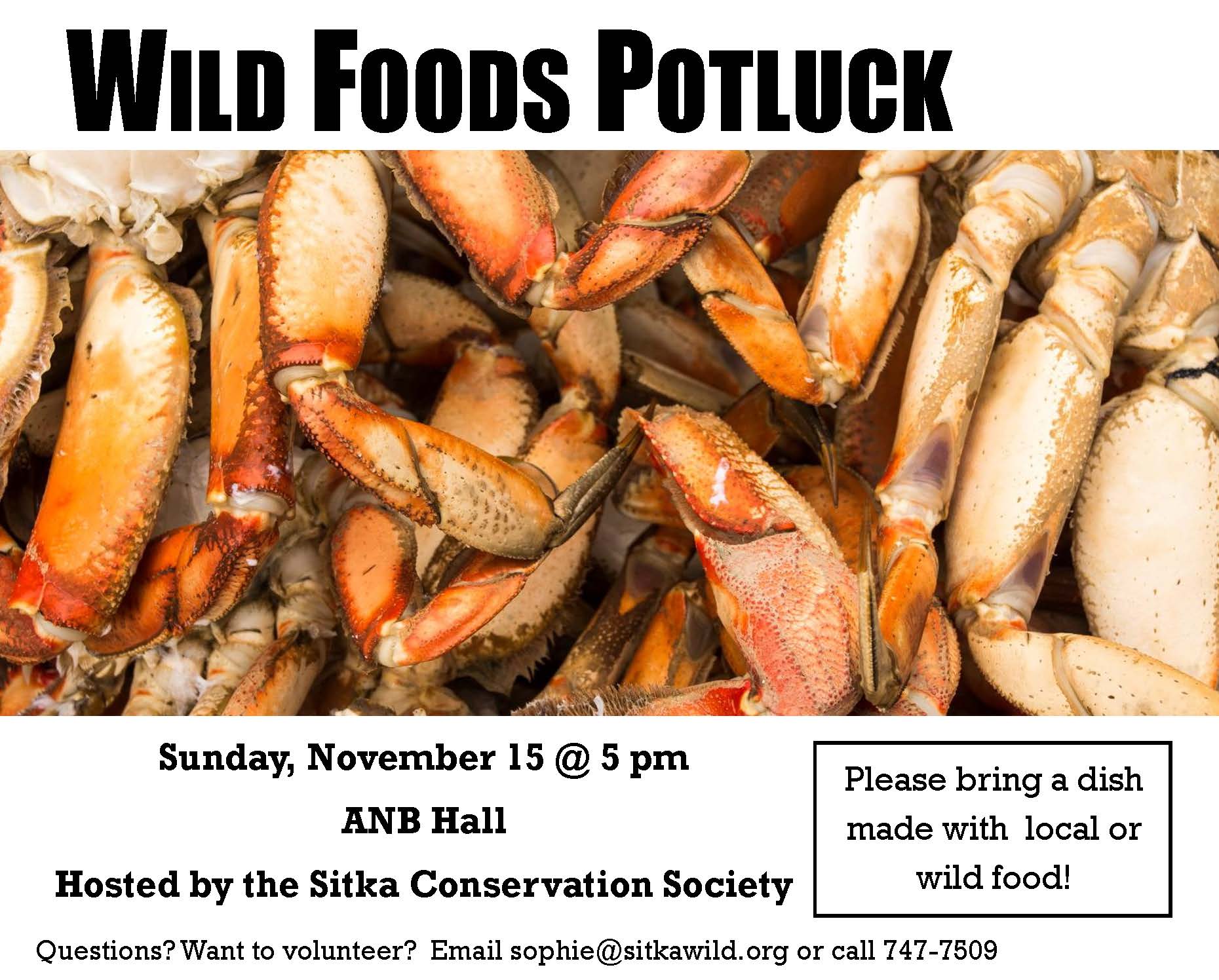
The Sitka Conservation Society will host its annual Wild Foods Potluck from 5-7 p.m. on Sunday, Nov. 15, at the Alaska Native Brotherhood Founders Hall (235 Katlian St.).

Please bring a dish featuring ingredients that were fished, foraged, hunted, or cultivated in Southeast Alaska. Prizes will be awarded for first place in the following categories — Best Dish, Best Dessert, and Most Creative.

The event will highlight subsistence stories and the work performed by the Sitka Conservation Society over the last year. SCS members can pick up their 2016 SCS Calendars at the potluck.

The potluck is open to SCS members, friends, family, and anyone else interested in learning about the Sitka Conservation Society. Come celebrate Alaska’s wild food bounty.

Interested in volunteering at the potluck or want more information? Contact Sophie Nethercut at sophie@sitkawild.org or call 747-7509.

• SEARHC, UAF Cooperative Extension Service to host deer/venison canning classes

Participants in Sitka's Alaska Way Of Life 4-H program, aka the Sitka Spruce Tips 4-H program, learn how to skin and butcher a deer. (Photo courtesy of the Sitka Conservation Society/Sitka Spruce Tips 4-H program)

Participants in Sitka’s Alaska Way Of Life 4-H program, aka the Sitka Spruce Tips 4-H program, learn how to skin and butcher a deer. (Photo courtesy of the Sitka Conservation Society/Sitka Spruce Tips 4-H program)

kitch_logo_mainThe SouthEast Alaska Regional Health Consortium (SEARHC) WISEFAMILIES Traditional Foods program and the University of Alaska Fairbanks Cooperative Extension Service are teaming up to offer a deer and venison workshop from 3-7 p.m. on Friday, Oct. 30, at the Sitka Kitch.

The Sitka Kitch is a rental community commercial kitchen project coordinated by the Sitka Conservation Society, in partnership with the Sitka Local Foods Network, located inside the First Presbyterian Church, 505 Sawmill Creek Road. The Sitka Kitch was a project from the 2013 Sitka Health Summit designed to improve food security in Sitka while also providing a space for people wanting to get into the cottage food business or wanting to preserve their harvest for storage in the home pantry. Sitka Kitch officially opened in March 2015 after a series of renovations to make it pass Alaska Department of Environmental Conservation commercial kitchen food safety standards.

The Oct. 30 class will feature lessons on how to can venison in jars, taught by Ellen Ruhle, as well as how to prepare deer jerky and how to smoke venison, taught by Jud Kirkness.

There is a possibility we will be able to harvest a deer next week, and if so we will add on a portion of the workshop to focus on butchering and meat care. And this time we are just offering the food preservation class (canning, jerky, and smoking hind quarters).

Thanks to a grant from the SEARHC WISEFAMILIES Traditional Foods program, all ingredients, jars, and equipment will be supplied in class.

The SEARHC WISEFAMILIES Traditional Foods program promotes healthy lifestyles by connecting Alaska Natives in Southeast Alaska to their culture. Members of the program learn how to harvest, cook, and preserve their traditional Alaska Native foods, which usually are healthier than heavily processed store-bought foods. In addition, participants learn traditional language, dancing, carving, weaving, and other skills that help reconnect them to their culture.

The UAF Cooperative Extension Service offers a variety of programs geared toward food, how to grow it, how to preserve it for storage, and how to make it into cottage foods you can sell. For those who can’t make the classes, the service offers a series of free online tutorials about home canning called Preserving Alaska’s Bounty.

Pre-registration is required for this class, and there are only 12 spots available. For more information and to pre-register, please contact Jasmine Shaw at 747-9440 or jdshaw2@alaska.edu.

• Sitka Economic Development Association to host Sitka Seafood Innovation Summit

INVITATION SSIS poster_web

The Sitka Economic Development Association (SEDA) invites anyone interested in developing the opportunities of our local and regional seafood industry to attend the Sitka Seafood Innovation Summit at 6:30 p.m. on Thursday, Oct. 1, in the Sheet’ka Kwáan Naa Kahídi.

Presenters will provide examples of some innovative products and processes now being developed and marketed. Learn how the Iceland Ocean Cluster model is working, and how Iceland, despite a 60 percent reduction in their codfish harvest, has used innovation to increase the value of each pound of fish harvested by more than 400 percent.

Want to learn more? Then come to this free event sponsored and hosted by the Sitka Economic Development Association. For more information, contact Garry White, 747-2660.

• New Silver Bay Seafoods cannery gives bonus to Sitka Sound Science Center

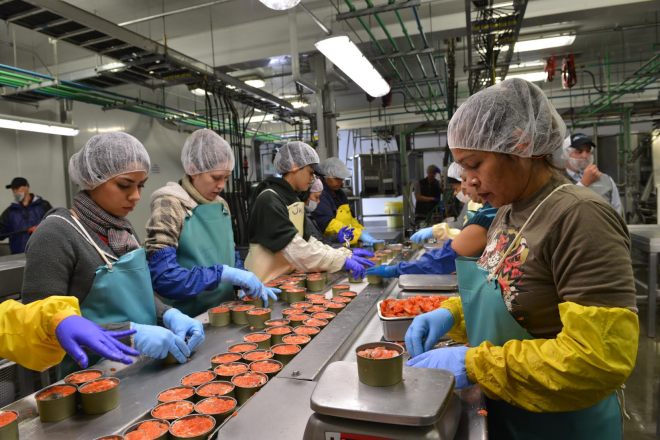
Workers pack sockeye salmon on the final day of seasonal canning operations Tuesday (Sept. 8, 2015) at Silver Bay Seafoods. (Daily Sitka Sentinel Photo by James Poulson)

Workers pack sockeye salmon on the final day of seasonal canning operations Tuesday (Sept. 8, 2015) at Silver Bay Seafoods. (Daily Sitka Sentinel Photo by James Poulson)

(Note: The following article ran on Pages 1 and 10 of the Friday, Sept. 11, 2015, edition of the Daily Sitka Sentinel. It is reprinted here with permission.)

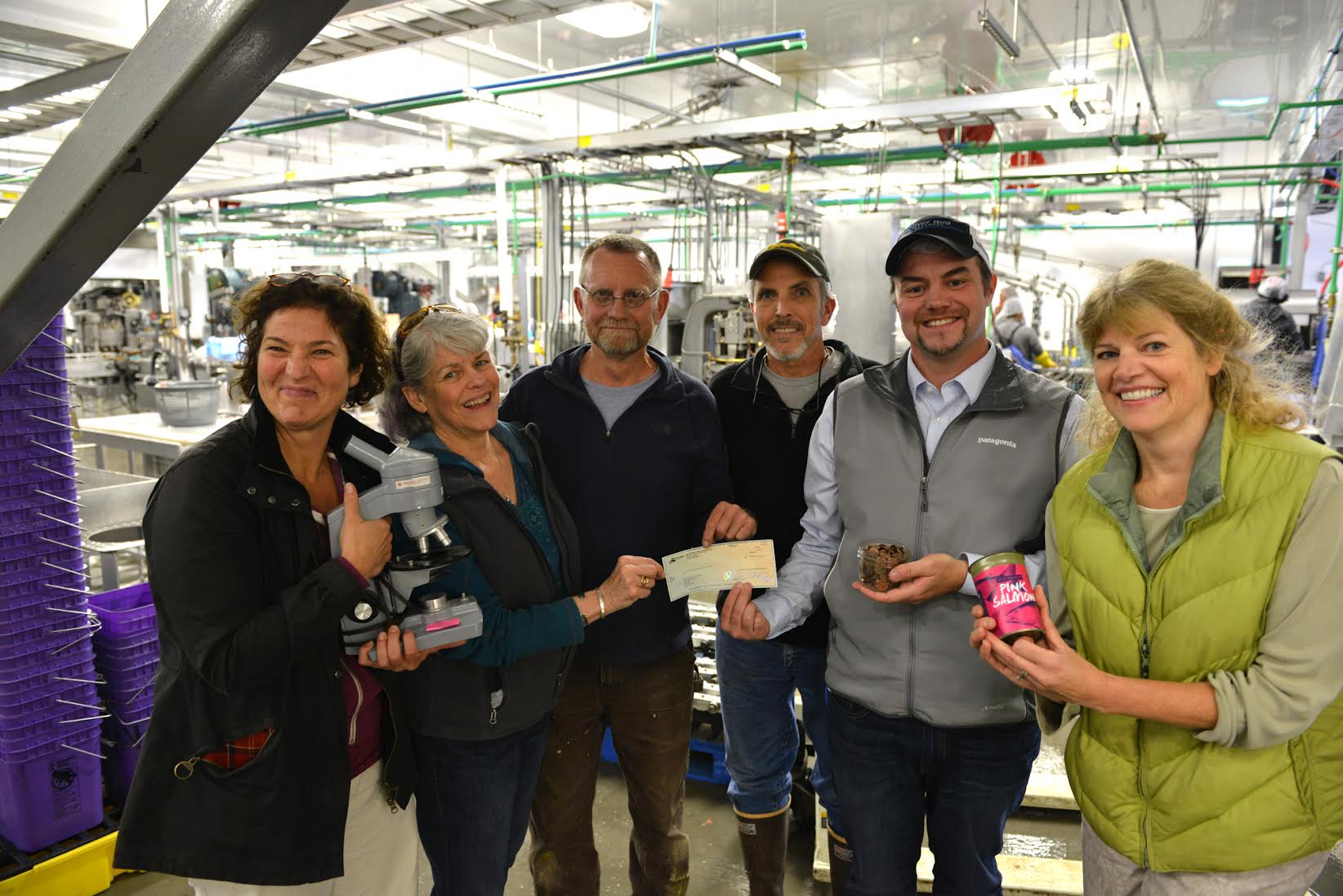
Sitka Sound Science Center Director Lisa Busch, left, and the center’s board of directors receive a $75,000 check from Silver Bay Seafoods CEO Rich Riggs and plant manager Wayne Unger recently at SBS’s new canning facility. From left are Busch, Linda Waller, Steve Clayton, Unger, Riggs, and Trish White. (Daily Sitka Sentinel Photo by James Poulson)

Sitka Sound Science Center Director Lisa Busch, left, and the center’s board of directors receive a $75,000 check from Silver Bay Seafoods CEO Rich Riggs and plant manager Wayne Unger recently at SBS’s new canning facility. From left are Busch, Linda Waller, Steve Clayton, Unger, Riggs, and Trish White. (Daily Sitka Sentinel Photo by James Poulson)

By TOM HESSE
Daily Sitka Sentinel Staff Writer

In a story that’s going to have a lot of digits, the number 12 might be the most important.

All canned goods have a coded number on the bottom that gives the location of where the food came from, when it was canned and who packaged it.

If the code on the bottom of canned salmon starts with a number 12, it means it was canned in Sitka. It also means the Sitka Sound Science Center received a one-cent donation for the production of that can of salmon.

And — if you’re Silver Bay Seafoods CEO Rich Riggs — it’s also a call-out to the fans of your favorite football team.

“So if you’re a (Seattle) Seahawks fan, that’s good news,” Riggs said.

Silver Bay has just wrapped up the inaugural year of its canning operation. The $7 million capital investment was the latest expansion of the Sitka-based company, founded in 2007 at the old Alaska Pulp Corp. mill site where it processed salmon for the fresh and frozen fish market.

Before Silver Bay Seafoods started canning fish there hadn’t been a cannery in Sitka for more than 50 years.

Earlier this week Riggs gave a tour of the canning line to the Sitka Sound Science Center board of directors. It was to celebrate a partnership between the two in which Silver Bay donated one cent for every can that rolled off the line.

Sitka Sound Science Center Director Lisa Busch said it’s one of the best examples there is of an industry supporting research in its own field of business.

“We are linked with the fishing industry and we really wanted to find some stable support, basically from the fishing industry,” Busch said. “We want to be partnered with fishermen and the fishing industry.”

Riggs said the rationale for that connection is obvious at any fish hatchery in the state. And then there’s the fact that the Sitka Sound Science Center is heir to the fishery science program pioneered by Sheldon Jackson College, which closed in 2007.

“You look and a lot of managers in the state have had some educational component at SJ. We firmly believe that sustainable fisheries are critical to Alaska’s communities and Alaska fishermen,” Riggs said.

Canning operations started in the second week of July, with three lines for three different sized cans. The largest cans run through the system at a rate of around 250 per minute, and the other sizes at around 215 cans per minute.

To the Sitka Sound Science Center, 60 minutes of canning results in a donation about equal to the hourly rate of some attorneys.

“I’m really excited that they’re so into this idea,” Busch said. “I feel like it’s really going to allow us to move forward to have somewhat stable funding from the fishing industry.”

Because of business interests, Silver Bay Seafoods won’t disclose how many cans it produced this year, but the first payment to the Sitka Sound Science Center was for $75,000.

The new canning line expands the total Silver Bay Seafoods warehouse footprint to more than 80,000 square feet, Riggs said.

The expansion was headed up by Mike Duckworth, who has 34 years of experience building and maintaining canning lines. One of the first things he had to do was acquire all the pieces, because most of the key elements for canning salmon date back to before his career even started.

“The filling machine has actually not been replicated the same,” Duckworth said. “There have been companies that’s tried to replicate them, but they found out it’s not feasible. They literally put millions of dollars into it and just couldn’t make money off of them.”

The technology dates back to the 1930s and ’40s, and Duckworth said the last major production of filling machines ended in the ’60s.

“Our equipment was probably cast in the late ’40s to the ’50s,” Duckworth said, adding that rebuilding those filling machines is a key piece of canning salmon in Alaska.

“It’s something everybody does. If you’re going to be in the industry then once every 7-10 years you completely rebuild these things,” Duckworth said. “We spent the last year (rebuilding). We had a crew of seasoned, Alaska canning machinists that were working with me in rebuilding and setting up the equipment and getting it ready for installation.”

The old equipment is then blended with new systems to create the modern canning system.

“That plant, it’s just a good blend of the old technology and the new,” Duckworth said.

A special slime line handles the salmon destined for canning, processing them in the usual manner. The fish are fed into one of the three canning lines where more than a dozen employees help monitor the process.

As salmon move along the line, they are packaged in cans that drop down a track from a room in the second story of the warehouse. A machine fills the can while employees check for bones and quality. Between the machine that affixes the lid and the track that kicks out defective cans is a printer that marks each can with a code, all of which start with the number 12.

Once sealed, the cans are loaded onto carts and taken to a separate station to cook before being stacked, wrapped and loaded into trucks to send them as far away as Australia.

Despite a low salmon year, Riggs said the canning operation was close to its projected target this season and there’s room to grow next year.

Tuesday (Sept. 8) was the last day of canning for the year, and it was frozen Bristol Bay sockeye that went through the process. The majority of the fish processed this year, however, cam from Southeast Alaska.

“The concept is the salmon season is over in Southeast, but then we can continue to operate the plant with the sockeye season in Bristol Bay going on,” Riggs said. “So we wanted to increase our capacity to process local fish as well as pick up some of those other Alaska fisheries, and the canning line allows us to do that.”

And if things continue to run as they did this year, the canning line also will allow for continued research into fisheries at the Sitka Sound Science Center.

“It funds all science center things,” Busch said. “So it goes toward research and education programs here in town and also toward our hatchery.”

Funding for independent science centers in Alaska can be tough to come by, and Busch said it can often be from unrelated industries, such as oil. Silver Bay Seafoods has worked with the Sitka Sound Science Center in the past, for example in the center’s cost-recovery fishery, and this new program is a logical continuation of their partnership, Busch said.

“We’re doing stuff that the fishermen are interested in,” Busch said. “To me this is so great that a big company, and a local company at that, are this invested in what we’re doing.”

Or, as Silver Bay Seafoods and the Sitka Sound Science Center are putting it, salmon makes cents.

• Fish to Schools program seeks donations of coho salmon, photos from commercial fishermen

FishtoSchool

The Fish to Schools program needs help from Sitka’s commercial fishermen. The program needs a few hundred pounds of coho salmon to help make Fish to Schools meals for Sitka students during the upcoming 2015-16 school year. The program also is seeking photos of commercial fishermen at work, which can be used to teach the students more about how the fish got to their plates.

The coho salmon donation period is Monday. Aug. 24, through Monday, Aug. 31. To donate, commercial fishermen can sign up and indicate how many pounds they want to donate when they offload at Seafood Producers Cooperative or Sitka Sound Seafoods during the donation period. The program can only accept commercially caught fish (no sport or subsistence fish). The hope is to get enough coho donated that locally caught salmon can be offered to students at least once a week.

The Sitka Fish To Schools project (click here to see short video) got its start as a community wellness project at the 2010 Sitka Health Summit, and now is managed by the Sitka Conservation Society. It started by providing a monthly fish dish as part of the school lunch as Blatchley Middle School, and since then has grown to feature regular fish dishes as part of the lunch programs at Baranof Elementary School, Keet Gooshi Heen Elementary SchoolBlatchley Middle School, Sitka High SchoolPacific High School (where the alternative high school students cook the meals themselves), the SEER School, and Mount Edgecumbe High School.

FishtoSchool2In addition to serving locally caught fish meals as part of the school lunch program, the Fish To Schools program also brings local fishermen, fisheries biologists and chefs to the classroom to teach the kids about the importance of locally caught fish in Sitka. The program received an innovation award from the Alaska Farm To Schools program during a community celebration dinner in May 2012, and now serves as a model for other school districts from coastal fishing communities. In May 2014, the Fish to Schools program released a guidebook so other school districts in Alaska could create similar programs.

For more information, contact Sophie Nethercut of the Sitka Conservation Society, sophie@sitkawild.org or 747-7509. You also can contact Beth Short-Rhoads at 738-9942 or elianise@yahoo.com. Photos and captions of commercial fishermen working out on the water should be sent to Sophie.

• Scenes from the 2015 Sitka Seafood Festival events held Saturday, Aug. 8

SonnyCropleyScoopsOutShrimp

ssflogo2There were tote races, a parade, a marathon/half-marathon, food booths, live music, canning classes, salmon-head bobbing, halibut-head tossing, the Sitka Highland Games, and scores of other events Saturday during the sixth annual Sitka Seafood Festival at Sheldon Jackson Campus.

There also was nice weather — a little cloudy with light rain for the marathon/half-marathon, followed by warm sunny weather for the tote races, parade, and marketplace events later in the day.

A few scenes from the 2015 Sitka Seafood Festival are in a slideshow below.

This slideshow requires JavaScript.

• Scenes from the third Sitka Farmers Market of the 2015 summer

Sitka Farmers Market Manager Debe Brincefield, left, and Sitka Farmers Market Assistant Manager Francis Wegman-Lawless, right, present the Table Of The Day Award to Linda Wilson of Sea View Garden at the third Sitka Farmers Market of the 2015 summer on Saturday, Aug. 1, at the Alaska Native Brotherhood Founders Hall in Sitka. Wilson is a longtime vendor at the market, selling rhubarb and other veggies from her garden, rhubarb jams and jellies, banana bread, rhubarb black tea, and her homemade jewelry. Wilson received a gift bag with fresh greens and fresh rhubarb. This is the eighth year of Sitka Farmers Markets, hosted by the Sitka Local Foods Network. The next market is from 10 a.m. to 1 p.m. on Saturday, Aug. 15, at the Alaska Native Brotherhood Founders Hall, 235 Katlian St. Don’t forget Aug. 2-8 is National Farmers Market Week, so even though we don't have a full market scheduled the Sitka Local Foods Network will host a produce booth at the Sitka Seafood Festival Marketplace from noon to 6 p.m. on Saturday, Aug. 8, at Sheldon Jackson Campus. For more information about the Sitka Farmers Markets and Sitka Local Foods Network, go to http://www.sitkalocalfoodsnetwork.org/ or check out our Facebook page at https://www.facebook.com/SitkaLocalFoodsNetwork. (PHOTO COURTESY OF SITKA LOCAL FOODS NETWORK)

Sitka Farmers Market Manager Debe Brincefield, left, and Sitka Farmers Market Assistant Manager Francis Wegman-Lawless, right, present the Table Of The Day Award to Linda Wilson of Sea View Garden at the third Sitka Farmers Market of the 2015 summer on Saturday, Aug. 1, at the Alaska Native Brotherhood Founders Hall in Sitka. Wilson is a longtime vendor at the market, selling rhubarb and other veggies from her garden, rhubarb jams and jellies, banana bread, rhubarb black tea, and her homemade jewelry. Wilson received a gift bag with fresh greens and fresh rhubarb. This is the eighth year of Sitka Farmers Markets, hosted by the Sitka Local Foods Network. The next market is from 10 a.m. to 1 p.m. on Saturday, Aug. 15, at the Alaska Native Brotherhood Founders Hall, 235 Katlian St. Don’t forget Aug. 2-8 is National Farmers Market Week, so even though we don’t have a full market scheduled the Sitka Local Foods Network will host a produce booth at the Sitka Seafood Festival Marketplace from noon to 6 p.m. on Saturday, Aug. 8, at Sheldon Jackson Campus. For more information about the Sitka Farmers Markets and Sitka Local Foods Network, go to http://www.sitkalocalfoodsnetwork.org/, check out our Facebook page at https://www.facebook.com/SitkaLocalFoodsNetwork, or follow us on Twitter at https://www.twitter.com/SitkaLocalFoods. (PHOTO COURTESY OF SITKA LOCAL FOODS NETWORK)

Sitka kicked off National Farmers Market Week (Aug. 2-8) with its third Sitka Farmers Market of the summer on Saturday, Aug. 1, at the Alaska Native Brotherhood Founders Hall.

Blessed by warm, sunny weather, we had the highest number of vendors for the season, giving customers a wide variety of local products to purchase.

Since we don’t have a Sitka Farmers Market scheduled during the official National Farmers Market Week, the Sitka Local Foods Network will host a booth at the Sitka Seafood Festival Marketplace from noon to 6 p.m. on Saturday, Aug. 8, at the Sheldon Jackson Campus. We also will host our usual table with local produce Aug. 8-9 when the Chelan Produce truck is in town.

A reminder, due to health codes we can’t allow any pets in the ANB Hall or the parking lot other than service dogs. We also don’t allow smoking at the Sitka Farmers Market because this is a health event (our event started out as a Sitka Health Summit project).

Finally, if you’ve ever wanted to be a vendor you can learn more by clicking this link or sending an email to sitkafarmersmarket@gmail.com. We always need new vendors, especially those selling produce from their home gardens, commercially caught fish or locally baked bread.

A slideshow from the third Sitka Farmers Market is posted below.

This slideshow requires JavaScript.

• Food preservation classes to be offered in conjunction with Sitka Seafood Festival

Sitka food preservation classes

ssflogo2Leslie Shallcross from the University of Alaska Fairbanks Cooperative Extension Service‘s Anchorage District Office will be in Sitka to offer a series of food preservation classes on Aug. 6-8 as part of the Sitka Seafood Festival.

The classes on Thursday and Friday, Aug. 6-7, will take place at the Sitka Kitch community rental commercial kitchen (inside First Presbyterian Church, 505 Sawmill Creek Road), while the Saturday, Aug. 8, classes will be at Sweetland Hall on the Sheldon Jackson Campus. Each of the classes will cost $15, but jars and other materials will be provided by the Sitka Seafood Festival.

The class schedule is:

  • Thursday, Aug. 6, 2-4:30 p.m., at Sitka Kitch — Low-sugar jams and jellies — Learn how to use a boiling water bath canner for preserving fruit by making low-sugar jams and jellies.
  • Thursday, Aug. 6, 6-8 p.m., at Sitka Kitch — Local garden greens — Learn how to cook with and preserve your garden greens.
  • Friday, Aug. 7, 10 a.m. to noon, at Sitka Kitch — Kelp pickles and sauerkraut — Learn how to make kelp pickles. You will “start” some sauerkraut as well as learn some of the science of fermentation.
  • Friday, Aug. 7, 3-5 p.m., at Sitka Kitch — Canning salmon — Learn how to use a pressure canner for preserving fresh, frozen or smoked fish.
  • Saturday, Aug. 8, 10 a.m. to noon, at Sweetland Hall — Canning salmon — Learn how to use a pressure canner for preserving fresh, frozen or smoked fish.
  • Saturday, Aug. 8, 1-2:30 p.m., at Sweetland Hall — Process of smoking salmon — Learn the steps in smoking fish.

kitch_logo_mainFor those who might miss the classes but still want to learn more about home canning, the UAF Cooperative Extension Service has a series of online tutorials on its website called “Preserving Alaska’s Bounty.” Also, don’t forget to make sure your pressure canner gauge is tested at least once a year. Jasmine Shaw from the Sitka District Office of the UAF Cooperative Extension Service has a tester in her office and you can call her at 747-9440 to schedule a test.

To register for the classes, please contact Jasmine Shaw at 747-9440 or jdshaw2@alaska.edu.


• Scenes from a series of home canning and cottage foods classes July 16-18 at Sitka Kitch

SarahLewisPlacesLidOnAllAmericanCanner kitch_logo_mainOn July 16-18, the Sitka Kitch project hosted Sarah Lewis of the Juneau District Office of the University of Alaska Fairbanks Cooperative Extension Service to host four classes in Sitka on the cottage food industry and home canning. These classes were free and paid for by a grant from the SouthEast Alaska Regional Health Consortium (SEARHC) WISEFAMILIES Traditional Foods program. In addition, Sarah had a table at the Sitka Farmers Market on July 18 where she tested pressure canner gauges.

For those who missed the classes and want to learn more about home canning, the UAF Cooperative Extension Service has a series of online tutorials on its website called “Preserving Alaska’s Bounty.” In addition, Leslie Shallcross from the Anchorage District Office of the UAF Cooperative Extension Service will be in town during the Sitka Seafood Festival to teach canning classes on Thursday and Friday, Aug. 6-7, at Sitka Kitch, and on Saturday, Aug. 8, at Sweetland Hall on the Sheldon Jackson Campus. Watch for a class schedule to be posted soon (note, these classes will cost $15 each).

A reminder, pressure canner gauges should be tested at least once a year to make sure they are hitting the right pressures for safe food preservation. For those who couldn’t get to the July 18 Sitka Farmers Market for pressure canner gauge testing, the Sitka District Office of the UAF Cooperative Extension Service has a tester in its office and you can call Jasmine Shaw at 747-9440 to set up an appointment for testing. The office also has a variety of resources — many of them free — on home canning, gardening and other topics.

Sitka Kitch is a community wellness project from the 2013 Sitka Health Summit designed to improve food security in Sitka. The different parts of the project include creating a community kitchen Sitka residents can rent to prepare food for their small businesses or to preserve their family harvest of fish, game, or garden veggies; expanding Sitka’s emergency food storage capacity; and providing education about preserving food and building family emergency food pantries.

For more information about the Sitka Kitch project, go to the Sitka Kitch website or Facebook page. For rental information, contact Kristy Miller at sitkakitch@sitkawild.org. Click this link to take a quick tour of the facility.

Slideshows featuring scenes from Friday’s class on canning salmon and berries and Saturday’s class on canning soups and sauces are below. Also, KCAW-Raven Radio attended the pickling and fermenting class and filed this story (which also includes a slideshow at the bottom). The Alaska Dispatch News recently posted this link on how to can salmon.

This slideshow requires JavaScript.


Slideshow from the Friday, July 17, class about canning salmon and berries (above).


This slideshow requires JavaScript.


Slideshow from the Saturday, July 18, class about canning soups and sauces (above).

• Free pressure canner gauge testing offered at the Sitka Farmers Market on Saturday, July 18

Canner

SarahLewisTestsCannerGaugeThis is a great time of the year to be in Sitka. The fish are running, gardens are starting to produce, and berries are ripe for the picking.

Many Sitka residents have pressure canners to preserve their harvest, and this weekend Sarah Lewis of the Juneau District Office of the University of Alaska Fairbanks Cooperative Extension Service is in town to teach four classes about canning on Thursday, Friday and Saturday at the Sitka Kitch (a rental community commercial kitchen at First Presbyterian Church, 505 Sawmill Creek Road, note, all classes are full). She also provide free pressure canner gauge testing at the Sitka Farmers Market from 10 a.m. to 1 p.m. on Saturday, July 18, at the Alaska Native Brotherhood Founders Hall.

“People can bring the gauge or the lid with the gauge still attached,” Sarah said about the pressure canner gauge testing. “If they have any questions about the full canner (gaskets, damage, how to use, etc.) they can bring the whole thing.”

In addition to testing pressure canner gauges, Sarah plans to work with Jasmine Shaw of the Sitka District Office of the UAF Cooperative Extension Service to have a wide variety of publications available about home canning. In addition, the UAF Cooperative Extension Service has a series of online tutorials on its website called “Preserving Alaska’s Bounty.” Pressure canner gauges should be tested at least once a year to make sure they are hitting the right pressures for safe food preservation.

A reminder about the Sitka Farmers Market, due to health codes we can’t allow any pets other than licensed service dogs in the ANB Hall or the parking lot. We also don’t allow smoking at the Sitka Farmers Market (in ANB Hall or the parking lot) because this is a health event.

Also, if you are in Sitka and you can’t make the pressure canner gauge testing event at the Sitka Farmers Market, you can call Jasmine Shaw at 747-9440 at the Sitka office of the UAF Cooperative Extension Service to set up a time when you can stop by and have her test your gauge in the office. She now has a gauge and is trained on using it.