Local food ventures from Sitka, Petersburg win 2015 Path to Prosperity competition

PathToProsperity

2015 Path to Prosperity competition winners Mindy Anderson of the Salty Pantry in Petersburg (fourth from left) and Bobbi Daniels of the Sawmill Farm in Sitka (fifth from left) pose with the organizers of the annual Southeast Alaska-based economic development contest, which is sponsored by Haa Aaní CDFI and The Nature Conservancy. Mindy and Bobbi each won $40,000 in technical support to help develop and improve their business plans. (Photo courtesy of Bethany Goodrich from Sustainable Southeast)

P2P_logoThe Path to Prosperity (P2P) has announced the winners of this year’s sustainable business development competition. The Sawmill Farm in Sitka and The Salty Pantry in Petersburg were selected as the winning businesses for the 2015 competition. Winners were featured at the 2016 Innovation Summit Feb. 8 at Centennial Hall in Juneau, where they received a $40,000 award, as well as one year of business development support.

Bobbi Daniels with two goats (Photo courtesy of Lori Adams of Down-To-Earth U-Pick Gardens)

Bobbi Daniels with two of her goats (Photo courtesy of Lori Adams of Down-To-Earth U-Pick Gardens)

“Anyone who has ever started a business knows how overwhelming it is to manage the whole picture and move forward, and doing that has you too busy to connect with the help that you need to make your job easier. P2P closes that gap,” said Bobbi Daniels of The Sawmill Farm, who was making her third appearance as a finalist in the competition.

The Sawmill Farm uses cast-off food from grocery stores and restaurants to feed locally raised, hormone- and antibiotic-free livestock. “Winning this award radically changes how quickly we will be able to grow The Sawmill Farm,” Daniels said.

Mindy Anderson, owner of The Salty Pantry, agrees. “The Path to Prosperity competition has taught me to take an in-depth look into my business idea of opening a small market and deli in Petersburg, by guiding me through the process of completing a business plan I can use as a valuable tool for planning, operating my business, recruiting, and for driving my business in the future,” said Anderson.
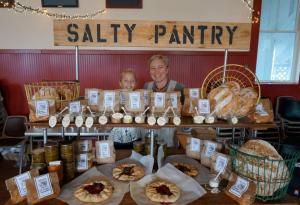
SaltyPantry

The Salty Pantry (photo from The Salty Pantry page on Facebook)

The Salty Pantry will be a family-owned deli in Petersburg, specializing in rustic comfort dishes made with seasonal produce from local producers. The commercial kitchen will be available for local artisans to create products to sell and for educating the community through cooking classes, demonstrations and on the job training.

The Sawmill Farm and The Salty Pantry were selected from several applications from Southeast Alaska businesses. In July, 12 finalists were chosen and they received technical support to develop their business plans. That included a three-day boot camp held in Juneau. In addition to The Sawmill Farm, there was a second Sitka project among the 12 finalists, Matthew Jackson’s Sitka Seedling Farms.

Continued Success

P2P is a partnership between Haa Aaní CDFI (Community Development Fund) and The Nature Conservancy. The contest targets Southeast Alaska residents with ideas for triple-bottom-line-oriented businesses; those that will have a positive economic, social, and environmental impact on their communities. Over three competition cycles, the program has received applications from more than 105 businesses and start-ups from across Southeast Alaska, and has provided intense management training to 36 entrepreneurs during the signature business boot camp weekend in Juneau.

The program’s success has garnered attention from beyond Southeast. In 2015, Path to Prosperity was presented a Silver Award for Excellence in Economic Development by the International Economic Development Council. Joe Morrison of Biz21 Consulting in Anchorage has praised the program for its results. “Path to Prosperity is a results-driven competition — you can see the impact it’s having by looking at its outcomes, and the businesses that have been through the program. It is the best-in-class business development program in Alaska,” said Morrison.

A unique feature of the program is that the resources at boot camp weekend benefit all twelve finalists, regardless of whether or not they go on to win the program. “Although I did not win the competition, the information, education and consulting that I received was invaluable,” said 2015 finalist Tina Steffen of Skya’ana Coffee Company in Klawock. “This competition has changed the way I run my businesses. I am so thankful for everything that I learned through P2P. Be it a start-up or an existing business, participating in the Path 2 Prosperity Competition is a valuable experience.”

Looking Toward the Future

Haa Aaní CDFI and The Nature Conservancy are excited with the level of entrepreneurial activity the competition has inspired, and as sponsors, they are seeking funding to continue the program.“The number of participants receiving technical assistance and training resources from our rural communities has been increasing,” said Ed Davis, director of Haa Aaní CDFI. “The strong relationships Haa Aani has built across the region has helped bring this program and its resources to our communities. Program participants and partners recognize this, and it is a key component of P2P’s success.”

Norman Cohen, Southeast Alaska Program Director for The Nature Conservancy, is eager to see Path to Prosperity supporting innovative regional entrepreneurs. “The businesses making sustainable use of local natural resources are the ones that will form the backbone of sustainable economies and vibrant rural communities for years to come,” said Cohen.

This year’s winners are just happy for the support. “I am in awe of the long-term vision of Haa Aaní and The Nature Conservancy to understand that the future of sustainability lies in entrepreneurship,” said Daniels. “We are honored to be able to count them in our corner.”

The 2016 competition will launch in March and April, when the program will visit several villages in the region to recruit participants. Those in larger Southeast Alaska communities can contact the contest organizers for information about how to participate. To learn more, please visit http://www.p2pweb.org/ or email p2p@sealaska.com.

• UAF Cooperative Extension Service, Alaska Sea Grant team up to offer online course on the specialty food business

Specialty food business March 2016

Are you interested in starting a specialty food business? The University of Alaska Fairbanks Cooperative Extension Service and the UAF Alaska Sea Grant program are teaming up to offer a five-class online course about how to start a specialty foods course in March.

The class is only available online and it will be from 5:30-8 p.m. on March 1, 3, 8, 10 and 15. You must attend all five classes during the times they are offered. The course costs $50 and is limited to the first 25 who register from around the state. More details about the class and its technology requirements can be found here. The instructors will be Quentin Fong of the Alaska Sea Grant program and Kate Idzorek of the UAF Cooperative Extension Service.

This course is intended for individuals interested in starting and operating a specialty food business to sell foods under the DEC Cottage Foods Exemption, a temporary DEC permit, DEC-permitted food production businesses to sell wholesale in Alaska or DEC-permitted Mobile Food Units (food trucks). This course is NOT intended for individuals starting or operating a restaurant or starting an interstate or international wholesale food business. It is for people who want to make specialty food products, such as jams and jellies, handmade chocolates, salsa, pickled fish, or operate a food truck. Many specialty food products are perfect for selling at the Sitka Farmers Market.

To register online, go to http://bit.ly/ces-workshops. For more information, contact Kate Idzorek of the UAF Cooperative Extension Service at 1-907-474-5391 (Fairbanks number).

• UAS Sitka Campus offers ‘Flora of Southeast Alaska’ course as a hybrid

Salmonberries await picking near the entrance to Sitka National Historical Park

Salmonberries await picking near the entrance to Sitka National Historical Park

A newish biology class by University of Alaska Southeast Sitka Campus associate professor Kitty LaBounty will itself be a “hybrid”, and it’s back for its second year.

FloraOfSEAK_Poster11x17_2016The DNA of most traditional botany classes is to gather students around a table of samples and look at them in a face-to-face classroom setting. By offering Flora of Southeast Alaska as both a local and distance-delivery (eLearning) class, students from anywhere can get up to speed on how to identify the common native trees, shrubs and herbs of southeast and south central Alaska. Local students can participate in the lectures on campus, while students across Alaska can see the imagery online and hear the lectures either live or via digital recording.

Flora of Southeast Alaska is a one-credit, seven-week workshop. The focus will be on identification of common species and attaining an understanding of their place in the ecosystem of Southeast Alaska. Students will discover how these plants interact with other plants and animals, and how humans use these plants for food, fuel, medicine, or simply enjoyment.

In addition to illustrated weekly lectures, there will be written exercises and “check for understanding” activities. The class is available to any student without prerequisites. It does not count as credit toward a biology major at UAS.

Professor LaBounty brings her lifelong passion as a gardener and scientist to this topic, along with more than 25 years experience working on plant identification for state, federal and nonprofit agencies in Alaska.

The class will meet from 5:30-7 p.m. on Thursdays from Feb. 25 to April 30 — with time off for spring break. The cost is $187 for local students and $227 for eLearning (distance) students.

For more information, contact Kitty LaBounty at UAS Sitka Campus. 747-9432. To register, call 747-7700. or toll-free, 800-478-6653.

• Northwest Farm Credit Services awards grants to Alaskans Own and Sitka Kitch projects

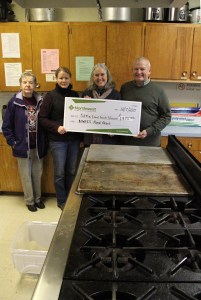
From left, Linda Behnken of the Alaska Longline Fisherman's Association and Anya Grenier of the Alaskans Own Seafood community supported fishery project receive a check for $4,500 from Michael Wittman of Northwest Farm Credit Services to help promote local seafood for Alaskans.

From left, Linda Behnken of the Alaska Longline Fisherman’s Association and Anya Grenier of the Alaskans Own Seafood community supported fishery project receive a check for $4,500 from Michael Wittman of Northwest Farm Credit Services to help promote local seafood for Alaskans.

image003Northwest Farm Credit Services recently awarded two rural community grants to help fund a pair of local foods projects in Sitka. The Alaska Longline Fishermen’s Association received $4,500 for its Alaskans Own Seafood community supported fisheries program, and the Sitka Local Foods Network received $1,975 for a series of basic culinary skills classes to take place in March at the Sitka Kitch community rental commercial kitchen (which is coordinated by the Sitka Conservation Society with assistance from the Sitka Local Foods Network).

“The support of Northwest Farm Credit Services will allow ALFA to improve and expand Alaskans Own so we can provide premium seafood to more rural residents,” said Linda Behnken, ALFA’s executive director.  “We believe healthy fisheries and healthy fishing communities go together and with this grant support we will reinvest in both.”

Alaskans Own connects residents of Alaska’s rural communities with great Alaskan seafood through monthly subscriptions. Subscription sales support ALFA’s research and conservation work to promote sustainable fisheries and sustainable fishing communities. Click here for KCAW-Raven Radio’s coverage of the grant.

From left, Dorrie Farrell and Kristy Miller of the Sitka Kitch community rental commercial kitchen advisory team and Sitka Local Foods Network president Lisa Sadleir-Hart receive a check for $1,975 from Michael Wittman of Northwest Farm Credit Services to support a Sitka Kitch project to teach basic culinary skills to people wanting to get jobs in the food/restaurant industry. The classes will take place in March.

From left, Dorrie Farrell and Kristy Miller of the Sitka Kitch community rental commercial kitchen advisory team and former Sitka Local Foods Network president/interim Sitka Kitch project coordinator Lisa Sadleir-Hart receive a check for $1,975 from Michael Wittman of Northwest Farm Credit Services to support a Sitka Kitch project to teach basic culinary skills to people wanting to get jobs in the food/restaurant industry. The classes will take place in March.

“Sitka Kitch will use the resources to launch a basic culinary training series taught by Chef Kathy Jones (executive chef for the Westmark Sitka Hotel),” said Lisa Sadleir-Hart, Sitka Kitch interim coordinator and former Sitka Local Foods Network board president. “Chef Kathy will model the four-session training on a curriculum from Indianapolis. She sees it as a way to get local Sitkans trained on entry-level culinary skills that could land them jobs in one of Sitka’s many restaurants or food-related businesses.”

The Sitka Kitch basic culinary skills training series is modeled after a similar program designed to help give people work skills for the restaurant/catering industry offered by a hunger relief nonprofit called Second Helpings in Indianapolis. More details about the Sitka Kitch basic culinary skills program will be announced in the next week or so. The classes also will be open to Sitka residents wanting to improve their home culinary skills.

Sitka Kitch is a community wellness project from the 2013 Sitka Health Summit designed to improve food security in Sitka. The different parts of the project include creating a community kitchen Sitka residents can rent to prepare food for their small businesses or to preserve their family harvest of fish, game, or garden veggies; expanding Sitka’s emergency food storage capacity; and providing education about cooking and preserving food and building family emergency food pantries.

Northwest Farm Credit Services is committed to helping rural communities succeed. In 2015, Northwest FCS awarded 62 rural grants totaling more than $134,000 to projects in Alaska, Idaho, Montana, Oregon, and Washington. Since the program’s inception in 2007, the company has presented 464 rural grants totaling more than $948,000.

The next rural grant deadline is Feb. 1, with two other deadline cycles later in the year. If you think your rural project may be eligible for a grant, visit http://northwestfcs.com/Stewardship/Rural-Communities for more information and an application.

Northwest FCS is a financial cooperative providing financing and related services to farmers, ranchers, agribusinesses, commercial fishermen, timber producers, rural homeowners and crop insurance customers in Montana, Idaho, Oregon, Washington and Alaska. Northwest FCS provides approximately $13 billion in loans and is a member of the Farm Credit System, a nationwide network of borrower-owned lending institutions that provide approximately $221 billion in loans to rural America. For more information, go to http://northwestfcs.com.

• Highlights from 2015 for your Sitka Local Foods Network

Some carrots grown at St. Peter's Fellowship Farm communal garden on sale at the Sitka Farmers Market

Some carrots grown at St. Peter’s Fellowship Farm communal garden on sale at the Sitka Farmers Market

As 2015 comes to a close, here are some highlights from the past year for your Sitka Local Foods Network. We are looking forward to a lot of new adventures in 2016, and encourage people to join us. We always need new volunteers, and please donate to us through Pick.Click.Give. when you file for your Alaska Permanent Fund Dividend starting on Jan. 1 and ending March 31. Your donations help fund a variety of Sitka Local Foods Network programs, such as the Sitka Farmers Market, St. Peter’s Fellowship Farm communal garden, and a host of garden and food education opportunities.

Our annual meeting and potluck will be from 5:30-8 p.m. on Saturday, Jan. 30, at the Sitka Unitarian Universalist Fellowship Hall (408 Marine Street, parking is off Spruce Street). This event is open to the public, just bring a dish (preferably with local foods) to share with everybody. We usually introduce new board members, confirm our new officers, and give an update on our finances and programs.

And now here are those 2015 highlights from your Sitka Local Foods Network:

Grew food at St. Peter’s Fellowship Farm and extension gardens

St. Peter's Fellowship Farm communal garden

St. Peter’s Fellowship Farm communal garden

For the eighth straight year, the Sitka Local Foods Network expanded its produce-growing operations at the St. Peter’s Fellowship Farm communal garden and our extension gardens, such as the one on land owned by Pat Arvin. The food grown from these gardens is sold at the Sitka Farmers Market, where Sitka residents, including people with SNAP (food stamps) and WIC (supplemental nutrition program for women, infants and children) benefits, have access to fresh local produce. In addition to supplying the Sitka Farmers Market, this year we grew enough to sell to some school lunch programs, at the Sitka Seafood Festival, at the Running of the Boots costumed fun run, and at a booth on days when Chelan Produce was in Sitka.

Hosted six Sitka Farmers Market events

Some of the booths at the Sitka Farmers Market

Some of the booths at the Sitka Farmers Market

We hosted the Sitka Farmers Market for the eighth straight summer, and this year there were six markets on alternate Saturdays from July 4 through Sept. 12. In addition to selling produce from St. Peter’s Fellowship Farm and our extension gardens, the Sitka Farmers Market serves as a business incubator where budding entrepreneurs sell jams/jellies, baked goods, fish, prepared food ready to eat, and a variety of local arts and crafts. Our emphasis is on local products always. The Sitka Farmers Market also provides a venue for local musicians (we hire a few to play at each market). One of the highlights this year was a brief performance by the students involved in the musical with the Sitka Fine Arts Camp. Another highlight was the inaugural Sitka Slug Races, where Sitka residents brought their own slugs (or rented ones we harvested) for a series of races on a glass table.

Taught a variety of garden education classes and mentored some novice gardeners

Tammy O'Neill, a student in the garden mentor program, poses with her garden beds after her second year in the program

Tammy O’Neill, a student in the garden mentor program, poses with her garden beds during her second year in the program

The Sitka Local Foods Network education committee hosted a variety of classes this year for local food gardeners. We started out with a couple of classes about basic gardening in Sitka, and followed those with classes on starting seeds, composting, chickens, rabbits, fruit trees, potatoes, carrots, rhubarb, and more. In addition, we hosted the second year of our family garden mentoring program with funding from First Bank. In this program we provided one-on-one mentoring for four families of novice gardeners and two families returning for a second year of the program. We are hoping to bring this innovative program back in 2016 and we are recruiting for new families. This fall we received a small grant from the United Way of Southeast Alaska that we will use to develop a teaching garden at Baranof Elementary School near downtown Sitka.

Partnered with several organizations to launch and operate the Sitka Kitch

LisaSadleirHartHelpsRebaAndRobertScoopCultureStarterIntoMilk

Sitka Kitch “Cooking From Scratch” instructor Lisa Sadleir-Hart, center, helps Reba Traini and Robert Baines make homemade yogurt

This year we partnered with the Sitka Conservation Society, UAF Cooperative Extension Service, First Presbyterian Church, Sitka Food Co-op, and other organizations to help launch the Sitka Kitch community rental commercial kitchen, which officially opened in March 2015. The Sitka Kitch is available for cottage food entrepreneurs to rent as they make their products, plus we have been offering a variety of food preservation and cooking classes. The Sitka Kitch also is available for people to rent who need a larger kitchen to cook a community meal.

Helped launch the Sitka Food Collaborative

Toward the end of the year, the Sitka Local Foods Network, Sitka Conservation Society, Sitka Kitch, Sitka Food Co-op, Sitka Seedling Farms, and other food groups created the Sitka Food Collaborative and then submitted an application for a USDA grant to conduct a Sitka Food Systems Assessment. This will build on the work done in 2013-14 with the Sitka Community Food Assessment, but will look at ways we can improve our local food system so we have better food security.

Fundraising and strategic planning

50-states-logoThe Sitka Local Foods Network is maturing as an organization, and this year we decided we needed to start raising money so we eventually can hire a part-time director to take care of some of the daily chores dealt with by our volunteer board of directors. We have started to set aside a little bit of money, still have a ways to go. This year we received a grant from the Alaska Community Foundation that will allow us to work with the Foraker Group in 2016 to create a fundraising and long-term strategic plan. We participated in the Pick.Click.Give. program for the second year, and we are preparing for our third year of receiving donations from Alaskans when they file for their Permanent Fund Dividends. We launched an online donation page on Razoo.com (a donation website for nonprofit groups), and hosted fundraisers for St. Peter’s Fellowship Farm, the Sitka Sound Suppers (with a totally local meal) and #GivingTuesday (#GivingTuesdayAK in Alaska). This fall we received a small grant from the United Way of Southeast Alaska that we will use to develop a teaching garden at Baranof Elementary School near downtown Sitka. In December, the Sitka Local Foods Network was named Alaska’s winner in the 50 States For Good contest, hosted by Tom’s of Maine. Each of the winning community nonprofits from each state won $20,000 to improve their programming, which we should receive in January.

• USDA Natural Resources Conservation Service offers funding support program for high tunnels

picture8

The deadline has been set for the next round of applications for the U.S. Department of Agriculture’s Natural Resources Conservation Service (NRCA) cost-sharing program. This program enables qualifying landowners who produce food to build high tunnels with financial assistance from the USDA.

The next NRCS Alaska program deadline is June 15, 2016. However, the program usually sets two applications deadlines a year so applications can be batched and ranked. Applications that miss the June 15 deadline will be held for the next deadline (usually about Oct. 15, but it hasn’t yet been posted online for 2016). Applicants are encouraged to apply outside two deadline cycles, because sometimes funding is available.

“The next deadline is June 15, 2016 – for funding in the 2017 fiscal year,” said Samia Savell, of the Juneau Field Office of the USDA-NRCS. “However, we often get additional funding in the current fiscal year and have the opportunity to fund applications that have been submitted past the prior deadlines. In other words, if you know of people who are interested in the program, please have them contact me to get the application materials. We do accept applications at any time.”

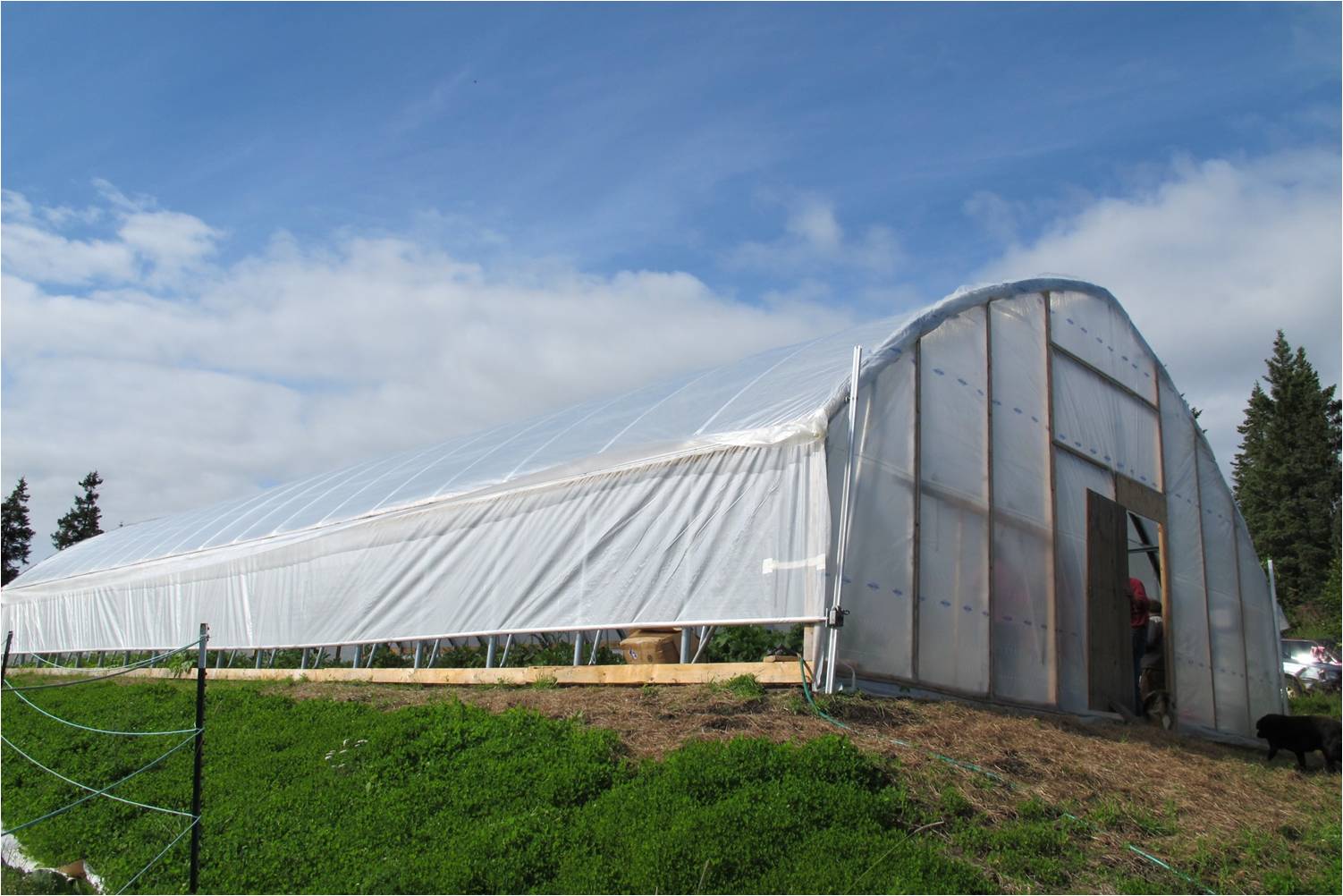
High tunnels, also known as hoop houses or temporary greenhouses, extend the growing season so more food is produced before and after the traditional weather dates for growing stuff outdoors. They also can help with irrigation and drainage, and with pest control.

High tunnels are different than greenhouses in that they are passively heated by the sun, so they have lower energy costs than greenhouses. High tunnels are at least nine feet tall (an increase from six feet tall in recent years), so people can walk upright in them. Low tunnels, which usually involve some PVC pipe bent over a garden bed and covered with row cover, aren’t eligible in this program. Food in high tunnels is planted either directly into the ground or in raised beds, not in containers. To learn more about the USDA’s high tunnel program, click here, and click here to get information about the application procedure. This link has frequently asked questions and answers about seasonal high tunnel systems for crops.

Picture10This program started a couple of years ago as a pilot program, but now is a permanent part of of the NRCS EQIP (Environmental Quality Incentive Programs). The program recently was revamped, and one major change is there now is no size restriction on the structures NRCS provides cost-sharing funds (previously it was limited to up to 2,178 square feet, or 5 percent of one acre). Also, geodesic domes are now eligible. Both the land owner and land must meet certain eligibility requirements.

Funding is provided on a reimbursable status once the high tunnel is installed and certified to meet NRCS standards. In 2012 there was just one high tunnel in Sitka, but in 2013 there were six. Other areas of the state, such as Homer, have built dozens of high tunnels through the program.

For information regarding the NRCS technical service or program participation in Southeast Alaska, please contact Samia Savell or Will Murray at the Juneau field office at (907) 586-7220 or 586-7208, or send email to samia.savell@ak.usda.gov or william.murray@ak.usda.gov. The June 15, 2016, deadline is the first deadline for the Fiscal Year 2017 funding cycle. Click here for a link to the Alaska NRCS page. Click here for an interview with Samia Savell on KRBD-FM (Ketchikan) about the program.

• High Tunnels In Alaska Fact Sheet (October 2015)

• Flier about Southeast Alaska cost-sharing program for FY2016 (March 2015, note, information should be similar for FY2017)

• The Inuit Circumpolar Council-Alaska (ICC-AK) releases report on Inuit food security

Food Security Summary and Reccomendations Report _Page_01
Drastic changes are occurring within the Arctic and Inuit are on the forefront of these changes. In recent years food security has increasingly become a topic of conversation and is gaining more attention. But what does food security mean to those that call the Arctic home?

Through this Inuit Circumpolar Council-Alaska (ICC-AK) project led by the Alaskan Inuit (Iñupiaq, St. Lawrence Island Yupik, Central Yup’ik and Cup’ik), the Alaskan Inuit Food Security Conceptual Framework: How to Access the Arctic from an Inuit Perspective report illuminates the meaning of Alaskan Inuit food security and lay out an assessment process.

In the report it is clear that Inuit food security is more than calories, more than nutrients, as explained by a contributing author:  “We are speaking about the entire Arctic ecosystem and the relationships between all components within; we are talking about how our language teaches us when, where and how to obtain, process, store and consume food; we are talking about the importance of dancing and potlucks to share foods and how our economic system is tied to this; we are talking about our rights to govern how we obtain, process, store and consume food; about our Indigenous knowledge and how it will aid in illuminating these changes that are occurring. We are talking about what food security means to us, to our people, to our environment and how we see this environment; we are talking about our culture.” — Executive Summary

The report is the product of 146 contributing Inuit authors, a 12-member advisory committee, ICC-AK and their membership organizations. A summary and recommendations report was created for those who are looking for a quick glimpse at what food security means to Alaskan Inuit, what it means to apply a food security lens to assessments, and recommendations for strengthening food security. For a deeper understanding and more in-depth discussion, a technical report has been created. Within both reports you will find: 1) recommendations, 2) key barriers, 3) the food security conceptual framework, and 4) drivers of food security and insecurity. The technical report also lays out a food security assessment process.

“To look at environmental health through an Inuit food security lens requires one to undergo a paradigm shift. One must be willing to attempt to understand the Inuit culture to know what Inuit mean when they talk about food security.” — James Stotts

ICC-Alaska hopes that the report will be of use to a broad spectrum of people. Villages may use the report to aid in communicating with those from outside their communities. Decision-makers, academics, environmentalists, policy-makers and industry may use the reports as a tool to enhance their understanding of the Arctic. The report is accessible on the ICC-Alaska website.

The food security report also is linked below:

• Inuit Circumpolar Council-Alaska Food Security Summary and Recommendations Report

• Inuit Circumpolar Council-Alaska Food Security Technical Report

• New ‘Make It Local’ cookbook highlights Alaska recipes for kids

make_it_local_cookbook_cover-600x391

There has been a renaissance of local food in Alaska in recent years, but sometimes it’s difficult to get the kids to eat meals sourced with food from Alaska.

A new cookbook, “Make It Local: Recipes For Alaska’s Children,” produced by the Alaska Child Nutrition Programs, is full of kid-friendly recipes from around the state. The 111-page cookbook can be downloaded free online, or you can order a printed copy (see info at the bottom of the story). The cookbook is a joint project of the Alaska Department of Education and Early Development, the University of Alaska Fairbanks Cooperative Extension Service, and the Farm to School Program. It is funded by a grant from USDA Team Nutrition.

The cookbook features a variety of recipes, such as reindeer ratatouille, baked halibut, and teriyaki salmon Caesar salad. It also includes portion sizes and nutrition info that meets the strict USDA requirements for school lunch programs. All of the recipes have been sampled by kids from around the state.

Unfortunately, the cookbook didn’t become available until after the state’s Nutritional Alaskan Foods in Schools program was cut from the budget. That program helped school districts purchase local foods for their students, and also helped Alaska farmers and fishermen meet expenses.

Tanya Dube, the kitchen manager for the Bristol Bay Borough School District, told Dillingham radio station KDLG the cuts made it difficult for small school districts to keep buying local foods. She said she sent a letter to Gov. Bill Walker asking him to return the Nutritional Alaskan Foods in Schools program to the 2017 budget.

“Here in Naknek, or up on the North Slope, or in the Southwest Region School District, we can’t really dedicate money to pay $3.99 a pound for Alaska carrots when we can get carrots grown way far away for $1.00 a pound,” Dube said. “So, losing those funds was a big hit for a lot of districts, but I think rural districts took the biggest hit.”

With deeper budget cuts on their way, Dube is not optimistic about that request, but she says she has to try.

“Asking for money is kind of an exercise in futility, but I feel like if we don’t ask, they’re gonna forget,” Dube said. “They’re gonna forget that there’s not only school children that benefit from having these products, but it benefits growers and producers. It benefits Alaska businesses, because they can plant more barley, or raise more cattle or pigs. It really benefits the whole food supply chain.”

This cookbook is available for online downloads at https://education.alaska.gov/tls/cnp/cookbook/Make_It_Local.pdf.  If you are interested in a printed copy, please contact Jan Mays at jan.mays@alaska.gov or 907-465-8712.

• Sitka Seedling Farms project to host informational lunch meeting on Dec. 18

GreensInUAFHoopHouse

Farm DesignSitka Seedling Farms is an initiative to meet Sitka’s food system needs in a thought-out, comprehensive way. Many food-related initiatives have been proposed over the last several years, but most have stalled for lack of space.

Sitka Seedling Farms, which is a finalist in the Paths to Prosperity economic development contest for Southeast Alaska, will solve this problem by exploring innovative land relationships with major landowners in our community to develop the resources Sitka’s food system needs to thrive, such as production space for food entrepreneurs, community greenhouses, food storage and processing facilities and more. Sitka Seedling Farms is currently in the land exploration phase.

To learn more about this local foods systems project, there will be an informational lunch meeting from noon until 1 p.m. on Friday, Dec. 18, at the Larkspur Café. Please contact Matthew Jackson with questions or comments at 907-821-1412. Also, please feel free to sign this online letter of support to the city to help promote the project.

• Sitka Seedling Farms business plan executive summary (Fall 2015)

• Potential Sitka Seedling Farms community farm design (by Monique Anderson)

• Check out the December 2015 edition of the Sitka Local Foods Network newsletter

SLFNDecember2015NewsletterScreenshot

The Sitka Local Foods Network just sent out the December 2015 edition of its newly launched monthly newsletter. Feel free to click this link to get a copy.

This edition of the newsletter has brief stories about how one 140-character tweet won the Sitka Local Foods Network $20,000 from Tom’s of Maine, how the opening of the new Sitka Biotoxin Lab on Katlian Street will mean safer shellfish in Southeast Alaska, and an appeal for new first-year gardening families for the garden mentor program. Each story has links to our website for more information.

You can sign up for future editions of our newsletter by clicking on the registration form image in the right column of our website and filling in the information. If you received a copy but didn’t want one, there is a link at the bottom of the newsletter so you can unsubscribe. Our intention is to get the word out about upcoming events and not to spam people. We will protect your privacy by not sharing our email list with others.