Monday’s the day to start filing your PFD applications with Pick.Click.Give. donations

As 2017 winds to a close, many Alaskans already are thinking about applying for their 2018 Alaska Permanent Fund Dividend check in January. As usual, Alaskans can share their wealth with a variety of Alaska nonprofits, including the Sitka Local Foods Network, through the PFD’s Pick.Click.Give. program.
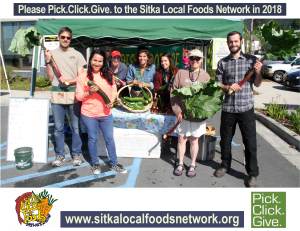
This is the fourth year the Sitka Local Foods Network will participate in the Pick.Click.Give. program, which allows people to donate in $25 increments to their favorite statewide and local 501(c)(3) nonprofit organizations when they file their PFD applications from Jan. 1 through March 31. We missed 2017 due to a clerical snafu, but we’re back in the program for 2018.

When you choose to donate part of your PFD to the Sitka Local Foods Network, you support the Sitka Farmers Market, St. Peter’s Fellowship Farm, education programs about growing and preserving food, the Sitka Kitch community rental commercial kitchen, Sitka Community Gardens, matching dollars at the Sitka Farmers Market for SNAP/WIC beneficiaries, the sustainable use of traditional foods, the Sitka Community Food Assessment, the Sitka Food Summit, and a variety of other projects designed to increase access to healthy local foods in Sitka.

In 2017 Alaskans contributed $2.7 million to 668 Alaska nonprofit organizations, and more than $18.5 million has been donated since the program started in 2009. Some Alaskans choose to donate to just one group, while others may spread several donations around to many groups. There now are more than 600 total 501(c)(3) nonprofit organizations participating in Pick.Click.Give. for 2017 (including multi-location nonprofits), including 23 from Sitka. In 2017, Alaskans donated $100,500 to Sitka-based nonprofits.

To encourage more Alaskans to donate through the Pick.Click.Give. program, the Double Your Dividend contest has been revised to encourage philanthropy. Anybody who makes a non-anonymous Pick.Click.Give. donation to at least one of the registered nonprofits will be entered into a contest where five lucky Alaskans will win a second PFD check for their favorite participating Pick.Click.Give. nonprofit (or couple of nonprofits). The winners no longer receive a second PFD for themselves, just one to donate to an organization. The winners will be announced in October, about the time the PFDs start hitting bank accounts.

So how do you make a donation to the Sitka Local Foods Network through the Pick.Click.Give. program? First, go fill out your Alaska Permanent Fund Dividend application at http://pfd.alaska.gov/. When you get to the section of the application asking if you want to participate in Pick.Click.Give. Charitable Contributions program, click on the PCG link and search for the Sitka Local Foods Network. You also can look for us by using the town search for Sitka.

The Pick.Click.Give. program is available only to people who file their PFD applications online, and not to those who file by mail. Even though you can’t file a new PFD application after March 31, you can go back into your application and update your Pick.Click.Give. donations through Aug. 31 each year.

You still can donate to the Sitka Local Foods Network if you aren’t from Alaska or aren’t eligible for a 2018 PFD. To donate, send your check to the Sitka Local Foods Network, 408D Marine St., Sitka, Alaska, 99835. You also can donate online by going to our online fundraising page on Razoo.com, and clicking the Donate button to make an online contribution. You also can send in a check or make an online donation if you are trying to make nonprofit donations before the end of the 2017 tax year. Please let us know if you need a receipt for tax purposes. For more information about donating, you can send an email to sitkalocalfoodsnetwork@gmail.com.

Thank you for supporting our mission of promoting and encouraging the growing, harvesting and eating of local foods in Sitka and Southeast Alaska.

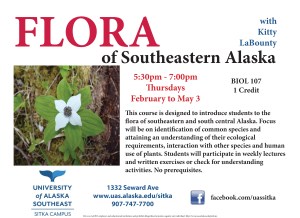
UAS Sitka Campus offers ‘Flora of Southeast Alaska’ course as a hybrid class

Salmonberries await picking near the entrance to Sitka National Historical Park

Flora of Southeastern Alaska, a biology class taught by University of Alaska Southeast Sitka Campus associate professor Kitty LaBounty, is back for its fourth year.

The DNA of most traditional botany classes is to gather students around a table of samples and look at them in a face-to-face classroom setting. By offering Flora of Southeast Alaska as both a hybrid local and distance-delivery (eLearning) class, students from anywhere can get up to speed on how to identify the common native trees, shrubs and herbs of southeast and south central Alaska. Local students can participate in the lectures on campus, while students across Alaska can see the imagery online and hear the lectures either live or via digital recording.

Flora of Southeast Alaska is a one-credit, 11-week workshop. The focus will be on identification of common species and attaining an understanding of their place in the ecosystem of Southeast Alaska. Students will discover how these plants interact with other plants and animals, and how humans use these plants for food, fuel, medicine, or simply enjoyment.

In addition to illustrated weekly lectures, there will be written exercises and “check for understanding” activities. The class is available to any student without prerequisites. It does not count as credit toward a biology major or as a science elective at UAS.

Professor LaBounty brings her lifelong passion as a gardener and scientist to this topic, along with more than 25 years experience working on plant identification for state, federal and nonprofit agencies in Alaska.

The class will meet from 5:30-7 p.m. on Thursdays from Feb. 15 to May 5 — with time off for spring break. The cost is $202 for the class, plus $32 in registration fees. Students will need to buy a copy of Native Plants of Southeast Alaska, by Judy Kathryn Hall, or a copy of Plants of the Pacific Northwest Coast, by Jim Pojar and Andy MacKinnon, or both.

For more information, contact Kitty LaBounty at UAS Sitka Campus. 747-9432. To register, call 747-7700. or toll-free, 800-478-6653.

Check out the December 2017 edition of the Sitka Local Foods Network newsletter

The Sitka Local Foods Network just sent out the December 2017 edition of its monthly newsletter. Feel free to click this link to get a copy.

This month’s newsletter includes brief items about our #GivingTuesday fundraising campaigns on Nov. 28, info about the 2018 sponsorship program for businesses and individuals, and an invitation to join our board of directors. Each story has links to our website for more information.

You can sign up for future editions of our newsletter by clicking on the newsletter image in the right column of our website and filling in the information. If you received a copy but didn’t want one, there is a link at the bottom of the newsletter so you can unsubscribe. Our intention is to get the word out about upcoming events and not to spam people. We will protect your privacy by not sharing our email list with others. Don’t forget to like us on Facebooklike our new Sitka Farmers Market page on Facebook and follow us on Twitter.

Sitka Fish and Game Advisory Committee to meet on Nov. 29 to discuss herring issues

The Sitka Fish and Game Advisory Committee will be holding a public meeting at 6 p.m. on Wednesday, Nov. 29, at Harrigan Centennial Hall.

The agenda includes Southeast Alaska finfish/herring proposals to the Alaska Board of Fisheries. For more information on the proposals, go to this link.

The Alaska Board of Fisheries will meet Jan. 11-23 in Sitka, with shellfish issues discussed on Jan. 11-14 and finfish issues on Jan. 15-23. A full list and explanation of Southeast Alaska Board of Fish proposals can be found at http://www.adfg.alaska.gov/index.cfm?adfg=fisheriesboard.main.

The Alaska Board of Fisheries consists of seven members serving three-year terms. The board’s primary role is to conserve and develop the fishery resources of the state.

The Sitka Fish and Game Advisory Committee is one of 84 local advisory committees made up of local stakeholders who are knowledgable on local fisheries and resource use. Local advisory committees can advise and give comments to the Alaska Board of Fisheries and represent local knowledge and insights. An member of the public also can comment on specific proposals to the Alaska Board of Fisheries.

For further information, contact Lena Gilbertson at the Department of Fish & Game at 907-465-4046.

Advisory committees are local groups that meet to discuss fishing and wildlife issues and to provide recommendations to Alaska Board of Fisheries and Alaska Board of Game. All meetings are open to the public. Advisory committees are intended to provide a local forum on fish and wildlife issues. Their purpose includes: 1) developing regulatory proposals, 2) evaluating regulatory proposals and making recommendations to the appropriate board, 3) providing a local forum for fish and wildlife conservation and use, including matters relating to habitat, 4) advising the appropriate regional council on resources, and 5) consulting with individuals, organizations, and agencies.

If you are a person who needs a special accommodation in order to participate in any of these public meetings, please contact Boards Support at 907-465-4110 no later than 48 hours prior to the meeting, to make any necessary arrangements.

For more information, contact Lena Gilbertson, Boards Support Section, PO Box 115526, Juneau AK 99811-5526, phone 907-465-4046, fax 907-465-6094, email address lena.gilbertson@alaska.gov.


Like what we do? Now you or your business can sponsor the Sitka Local Foods Network in 2018

The Sitka Local Foods Network created a sponsorship program to help promote our mission, and Sitka businesses and individuals are welcome to join for 2018. The goal of the sponsorship program is to make the projects we undertake (Sitka Farmers Market, St. Peter’s Fellowship Farm, gardening education, etc.) more sustainable.

“Sitka has a precarious position when it comes to food security, and the Sitka Local Foods Network is trying to improve our food security through our mission to increase the amount of locally harvested and produced foods in the diets of Southeast Alaskans,” Sitka Local Foods Network president Charles Bingham said. “Sponsors of the Sitka Local Foods Network are working with an organization and a farmers market that values local food and businesses, fun, premium quality goods and experiences.”

In recent years, the Sitka Local Foods Network has hosted seven Sitka Farmers Markets during the summer (from July to September). We haven’t set our 2018 dates yet, but we anticipate we will have seven markets again this summer. In addition, we grow most of the local produce sold at the markets at St. Peter’s Fellowship Farm communal garden and a couple of other locations in town. We also offer a variety of garden education classes in the spring. One way we ensure fresh, local produce is available to lower-income Sitkans is through our matching program for WIC and SNAP beneficiaries (the first $20 spent on produce at the farmers market). This year we also hope to launch a new food business innovation contest to inspire food entrepreneurs in Sitka.

There are four levels of sponsorship available, and each has its own set of perks.

  • Grower ($2,500-plus) — We’ll hang your banner at ANB Hall during the Sitka Farmers Markets, include your logo and company name prominently in our merchandise and advertisements, and thank you on our social media and web pages. If appropriate for the Sitka Farmers Market, you may set up a free promotional booth.
  • Harvester ($1,000-$2,499) — We’ll hang your banner at ANB Hall during the Sitka Farmers Markets and include your logo and company name in our merchandise and advertisements.
  • Planter ($250-$999) — Your banner will hang at ANB Hall during the Sitka Farmers Markets.
  • Friend ($50-$249) — You are listed on our online sponsor page.

We have limited space for banners at the Sitka Farmers Markets, so please contact us before May 1 to guarantee your spot. To learn more about the sponsorship program, click the link below for details and a registration form. For more information, contact Charles Bingham at (907) 623-7660 or by email at charleswbingham3@gmail.com, or email us at sitkalocalfoodsnetwork@gmail.com.

• 2018 Sitka Local Foods Network sponsorship program details and registration form

Scenes from the Cooking From Scratch Great American Seafood Cook-Off demonstration at the Sitka Kitch

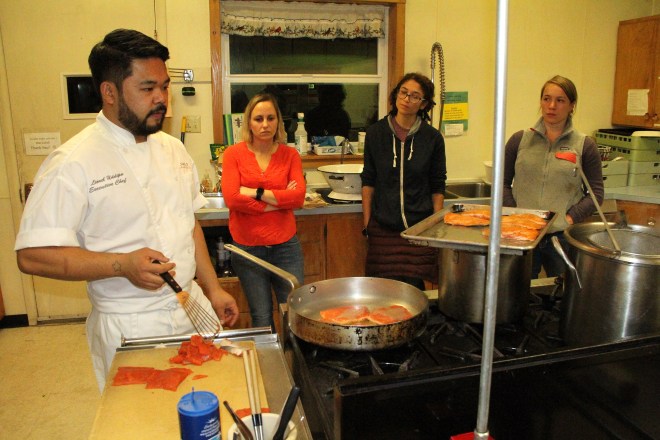
Students learned how to make a variation of national-award-winning chef Lionel Uddipa’s winning dish during a Cooking From Scratch demonstration taught Nov. 9 at the Sitka Kitch community rental commercial kitchen. Chef Nel, of SALT restaurant in Juneau, was brought to town through a partnership with the Sitka Seafood Festival.

During this demonstration, Chef Nel taught students how to make a dish of risotto with Alaska spot prawns, artichokes and pea sprouts. In August, Chef Nel and his sous chef Jacob Packer won the 2017 Great American Seafood Cook-Off in New Orleans, where they made a sea asparagus risotto with Alaska king crab. He switched from king crab to spot prawns for this demonstration due to availability and cost. Chef Nel will have more dishes to sample at the Sitka Conservation Society‘s Wild Foods Potluck from 5-7 p.m. on Sunday, Nov. 12, at Harrigan Centennial Hall.

This demonstration was offered as part of the Cooking From Scratch class series at the Sitka Kitch, and on Nov. 8 Chef Nel taught students how to make seared coho salmon with orzo pasta and a chicken-veggie stock broth. Here are the remaining Cooking From Scratch classes coming up later in November:

The Cooking from Scratch series goal is to teach basic cooking skills using high-quality ingredients, and to help Sitkans take back their kitchens and reduce their food budgets. Interested individuals can register at https://sitkakitch.eventsmart.com/ (click on the event title to register). Please pre-pay online using credit/debit cards or PayPal. If you want to pre-pay using cash or check, please contact Chandler, Claire or Clarice at Sitka Conservation Society (747-7509) to arrange payment. We need at least eight students registered for each class to guarantee they happen.

Class size is limited, so register early. The usual class cost is $27.50 per class, plus a food/supply fee that will be divided among registered participants. The registration deadline is late on the second night before each class. For more information about the class series, call Lisa Sadleir-Hart at 747-5985 or Jasmine Shaw at 747-9440.

A slideshow of photos from Thursday’s Great American Seafood Cook-Off demonstration is posted below.

This slideshow requires JavaScript.

Scenes from the Cooking From Scratch class on Fish ‘n Veggies at the Sitka Kitch

Students learned how to make seared coho salmon with orzo pasta and chicken-veggie stock during a Cooking From Scratch class taught Nov. 8 at the Sitka Kitch community rental commercial kitchen. The class was taught by national-award-winning chef Lionel Uddipa of SALT restaurant in Juneau, who was brought to town through a partnership with the Sitka Seafood Festival.

During this class, students learned how to prepare the chicken stock, how to chop the veggies, how to sear the salmon, how to make the garnish, and more.

Chef Nel and his sous chef Jacob Packer won the 2017 Great American Seafood Cook-Off in August in New Orleans, and from 7-9 p.m. on Thursday, Nov. 9, at the Sitka Kitch (505 Sawmill Creek Road, inside First Presbyterian Church), Chef Nel will demonstrate a version of his award-winning recipe. He will make sea asparagus risotto with Alaska spot prawns (he used Alaska king crab in the competition, but switched to spot prawns for this demonstration due to availability and cost). This demonstration costs $20 and participants will get a large, nearly meal-sized sample to taste. We will accept walk-in participants for this event, but prefer people pre-register online by 11:55 a.m. Thursday so we know how many supplies we need.

In addition, here are other Cooking From Scratch classes coming up later in November:

There also may be a rescheduled Beans 101 class taught by Lisa Sadleir-Hart in late November or December (this class was originally supposed to take place on Oct. 30).

The Cooking from Scratch series goal is to teach basic cooking skills using high-quality ingredients, and to help Sitkans take back their kitchens and reduce their food budgets. Interested individuals can register at https://sitkakitch.eventsmart.com/ (click on the event title to register). Please pre-pay online using credit/debit cards or PayPal. If you want to pre-pay using cash or check, please contact Chandler, Claire or Clarice at Sitka Conservation Society (747-7509) to arrange payment. We need at least eight students registered for each class to guarantee they happen.

Class size is limited, so register early. The usual class cost is $27.50 per class, plus a food/supply fee that will be divided among registered participants. The registration deadline is late on the second night before each class. For more information about the class series, call Lisa Sadleir-Hart at 747-5985 or Jasmine Shaw at 747-9440.

A slideshow of photos from Wednesday’s Fish ‘n Veggies class is posted below.

This slideshow requires JavaScript.

Sitka Tribe of Alaska receives EPA grant to study microplastics in subsistence foods

Sockeye salmon hangs from racks in the smoker.

The Sitka Tribe of Alaska (STA) has been awarded a one-year, $30,000 grant from the Environmental Protection Agency‘s Environmental Justice Small Grant Program. The grant project, “Microplastics in Tribal Subsistence Foods In Southeast Alaska,” will include the University of Alaska, Mount Edgecumbe High School, the Southeast Alaska Watershed Coalition (SAWC), and Sitka Conservation Society as partners.

Esther Kennedy of the Sitka Tribe of Alaska Resource Protection Department samples water near the Starrigavan Recreation Area dock for marine biotoxins such as paralytic shellfish poisoning. (Photo by Emily Kwong, KCAW-Raven Radio)

“STA will collect water and subsistence food samples from four locations within STA’s traditional territory to test for the presence of microplastics and associated toxins,” Sitka Tribe of Alaska grant administrator Rachel Henderson wrote in an email. “These results will be compared to commercially purchased foods and safety standards. These results will be shared with the public so they can make informed decisions about harvesting traditional foods. Local students will assist with the sampling of local food and water.”

Henderson said Jennifer Hamblen is the project manager for the tribe, and she is working with Jeff Feldspaugh of the tribe’s resource protection department and the tribe’s partner agencies.

“Part of STA’s mission is to help ensure that subsistence resources for STA Tribal Citizens are available and safe,” Hamblen said. “In recent years, there have been many studies and publications from other places, such as British Columbia, about microplastics and their associated toxins having devastating consequences on animals, and potentially affecting the people who consume them. This is a pilot project to see if there are microplastics in subsistence foods in our area and comparing locally collected seafood to seafood available at supermarkets.”

Microplastics, aka phthalates, found at low tide. There are concerns microplastics are getting into subsistence foods and that will impact people’s health. (Photo courtesy of EPA.gov)

University of Alaska Southeast was written in as a project partner and the UAS conference in July is one of the places that STA will present the results, Henderson said. The Southeast Alaska Watershed Coalition (SAWC) has done microplastic water collection on behalf of salmon in the past, and Sitka Conservation Society (SCS) is very invested and knowledgeable about microplastics and their effects on the environment.

“We’ll be collecting shellfish from the Starrigavan estuary to process for microplastic consumption. We will also collect water samples using the methods already established by SAWC,” Henderson said.

While the project is just starting to launch, it has had one setback, Henderson said. “When we wrote the grant, we were going to send the samples to a certified, plastic-free laboratory, such as the University of Alaska Anchorage’s Applied Science, Engineering, and Technology Laboratory. That lab ran out of funding and is no longer operational, so we’re looking for another lab. Right now Jenn’s writing the QAPP (an EPA requirement before an sample collection that has to be approved before we can start work) so we can collect samples and we’ll look at presence/absence of microplastics with students from Mount Edgecumbe High School. We’ll save samples in case we get an opportunity for a larger project and find an appropriate lab to run phthalate samples. There will be photos with MEHS collecting samples and processing samples after the QAPP is approved.”

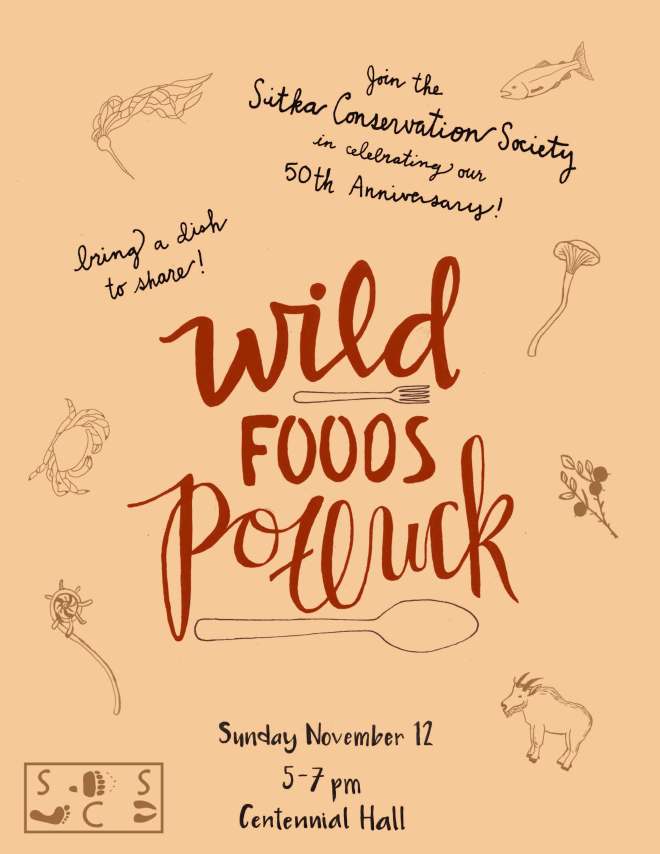
Sitka Conservation Society to host annual Wild Foods Potluck on Sunday, Nov. 12

The Sitka Conservation Society is hosting its annual Wild Foods Potluck, starting at 5 p.m. on Sunday, Nov. 12, at Harrigan Centennial Hall. It’s more important than ever to come together to celebrate all the ways the Tongass National Forest feeds and sustains us. Please bring a dish that features ingredients that were fished, foraged, hunted, or cultivated in Southeast Alaska.

Did you know that Sitka Conservation Society is celebrating its 50th year? At the potluck, SCS will have an amazing photography display showcasing 50 years of grassroots conservation activism. SCS dug through its archives to find old photos and videos from the early days of Sitka Conservation Society to pair with newer photos, illustrating the enduring legacy of conservation in Sitka. Also, if you’re a SCS member or want to become one, you can pick up your 2018 SCS calendar at the potluck.

The potluck is open to the entire community, especially SCS members, friends, family, and anyone else interested in learning about the Sitka Conservation Society. Come celebrate Alaska’s wild food bounty with your friends and neighbors.

Interested in volunteering at the potluck or want more information? Contact info@sitkawild.org or call 747-7509.

Sitka Ranger District, Sitka Tribe to harvest Tlingit community potato garden

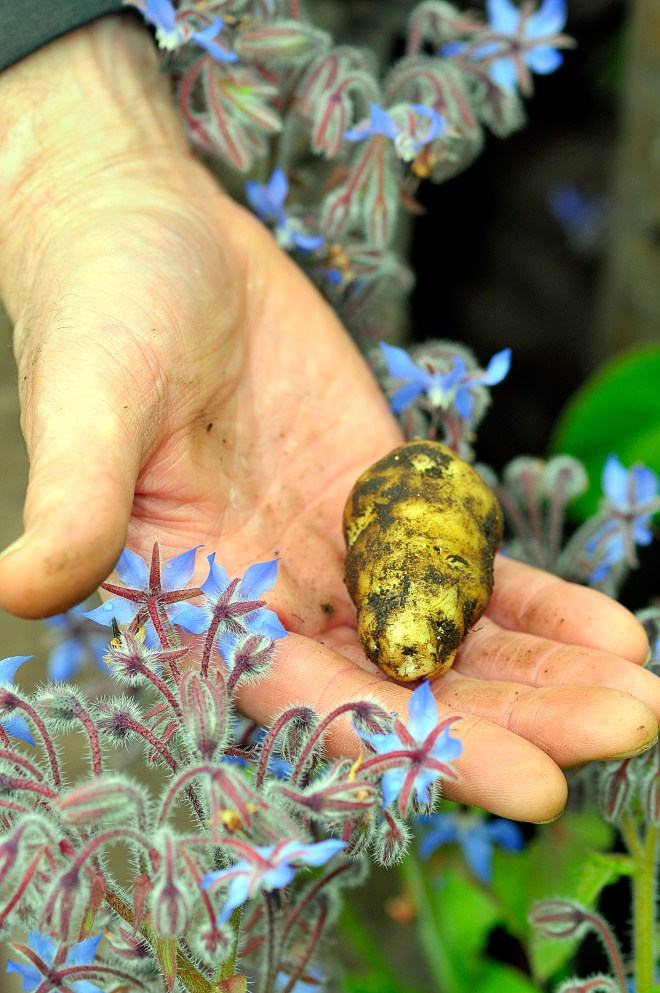
(Photo courtesy of Klas Stolpe/Juneau Empire) Bill Ehlers, assistant gardener at the Jensen-Olson Arboretum in Juneau, holds a Tlingít potato next to some of the potato plant’s flowers.

The community is invited to help harvest the Sitka Ranger District/Sitka Tribe of Alaska Tlingit potato garden and learn scientific and cultural information about the unique crop at 3 p.m. on Monday, Sept. 25, at the USDA Forest Service Sitka Ranger District office, 2108 Halibut Point Road.

Leading Tlingit potato researcher Elizabeth Kunibe will join the group to present information on the biology, history, and cultural aspects Tlingit potatoes. Topics will include harvesting potatoes, learning to store potatoes for seed and for food, preparation for next year’s garden, and the cultural aspects of Tlingit potatoes and native gardening.

The Sitka Ranger District provided the sunny plot of land for the shared potato garden and tended the garden over the summer after volunteers from the Sitka Tribe’s Traditional Foods Program, the gardening class from Pacific High School, and others from the community planted the potatoes in April.

Community involvement is needed for the harvest. Participants should come prepared for the weather as all activities will occur outdoors. All of the attendees are asked to wear boots, gardening gloves, and bring hand trowels or shovels. Bringing buckets of kelp to incorporate into the soil after harvesting would be beneficial.

The potatoes will need to be dried and prepared for storage. Many of the potatoes harvested will be saved for next year’s seed potatoes, Depending on the size of the harvest, the group hopes to share the harvest among the volunteers and through the Sitka Tribe’s Traditional Foods Program and Social Services.

Tlingit potatoes (sometimes called Maria’s potatoes) have been present in Tlingit gardens for over 200 years. The potatoes originate from Mexico or Chile and were a trade item in Southeast Alaska in the early 1800s.

This work day and educational opportunity will be at the Sitka Ranger District office, located at 2108 Halibut Point Road. For more information, contact Michelle Putz at 907-747-2708 or mputz@fs.fed.us. For interviews and information to be used for publication, contactthe Tongass Public Affairs Officer Paul Robbins at 907-228-6201 or paulrobbins@fs.fed.us.