Join us for the ninth annual Sitka Health Summit planning day, which takes place from 8:30 a.m. to 4 p.m. on Friday, Oct. 9, at the University of Alaska Southeast Sitka Campus.
The Sitka Health Summit got its start in 2007 when then-Sitka Community Hospital CEO Moe Chaudry and then-SouthEast Alaska Regional Health Consortium (SEARHC) Vice President of Hospital Services Frank Sutton decided they needed to bridge the gaps between Sitka’s largest two health services. They launched the Sitka Health Summit, with the help of other supporters in Sitka, as a way to improve community wellness, honor local wellness champions, and more.
One of the highlights of the Sitka Health Summit has been the annual community wellness planning day. During planning day, Sitka residents get together to discuss the health needs of the community and create community wellness projects to address these needs.
This year community members will select two Tier One projects, which will receive $2,000 in seed money to get started. Also, qualifying projects will have the opportunity to apply for Tier Two funding of up to an additional $20,000.
To register for the Sitka Heath Summit planning day, call Zachary Desmond at 747-4600 or email him at zachary@braveheartvolunteers.org. A free lunch with locally sourced food will be provided.
I was hired by SouthEast Alaska Regional Health Consortium (SEARHC) as the Traditional Foods Project Assistant. When I took over for the 2013 growing season, I really had no gardening experience. I posted notices for the community to let them know the garden was available. We had 22 plots available for growing, and that summer half were in production.
Many community members made important contributions; our gravel business donated two large loads of fine sand and the time and skills shared made building the garden easier. Soon there was a dirt sifter to screen out the many rocks in the local dirt and heavy equipment leveled the ground. The Southeast Soil and Water Conservation District in Juneau sold us 14 berry plants at a discounted price. A community member donated 30 strawberry plants. Our space was soon coming together.
Most of our gardeners have prior gardening experience. Some used their own soil. Last year the zucchini, broccoli, potatoes, beets, bush beans and snap peas did well. The biggest challenge came from the ravens. After putting in starts, out of their curiosity, they would fly down when everyone left and pull them up.
We ask that our gardeners not use fish in their compost so the bears won’t come by to check us out and so far the deer have left the plots alone. Lia Heifetz from the Sustainable Southeast Partnership was a big help with our garden last year; she acquired some fence to protect our plots from critters. We hope to get the fence up this year. Lia also came to the William and Mary Johnson Youth Center to teach the Big Brothers Big Sisters of Hoonah about composting with her worm bin and then we gathered seaweed for the garden.
For 2015 we are off to a great start with six returning and four new gardeners. Community members donated 20 raspberry plants and 20 gooseberry plants. Through the program, I purchased and planted a Nadine plum tree and a Terry Berry apple tree. My husband volunteers at the Hoonah Senior Center and is helping me with the traditional foods plot, as well as planting three plots for the seniors.
I just received an email from Lauren Hughey, a Community Health Educator based out of SEARHC Sitka. What exciting news! They just received a diabetes grant carry-forward. With the approval of this grant, Hoonah will receive $1,650 with the main goal of reducing the financial barriers to gardening for American Indian/Alaska Native diabetic patients. This grant will pay for plot fees and gardening supplies in the community garden: soil, seeds, raised-bed repair supplies, shovels, pots, gloves, buckets, and cold frames.
If you are ever in Hoonah please stop by to see us. The garden is in town next to the Sacred Heart Catholic Church. Sharing about the Hoonah Healing Community Garden lets our and other communities be informed that food security starts with us. Also that it really does work! For additional information, feel free to contact me at kathymc@searhc.org.
A slideshow of Hoonah community garden photos from former Sitka Local Foods Network board member Cathy Lieser is posted below.
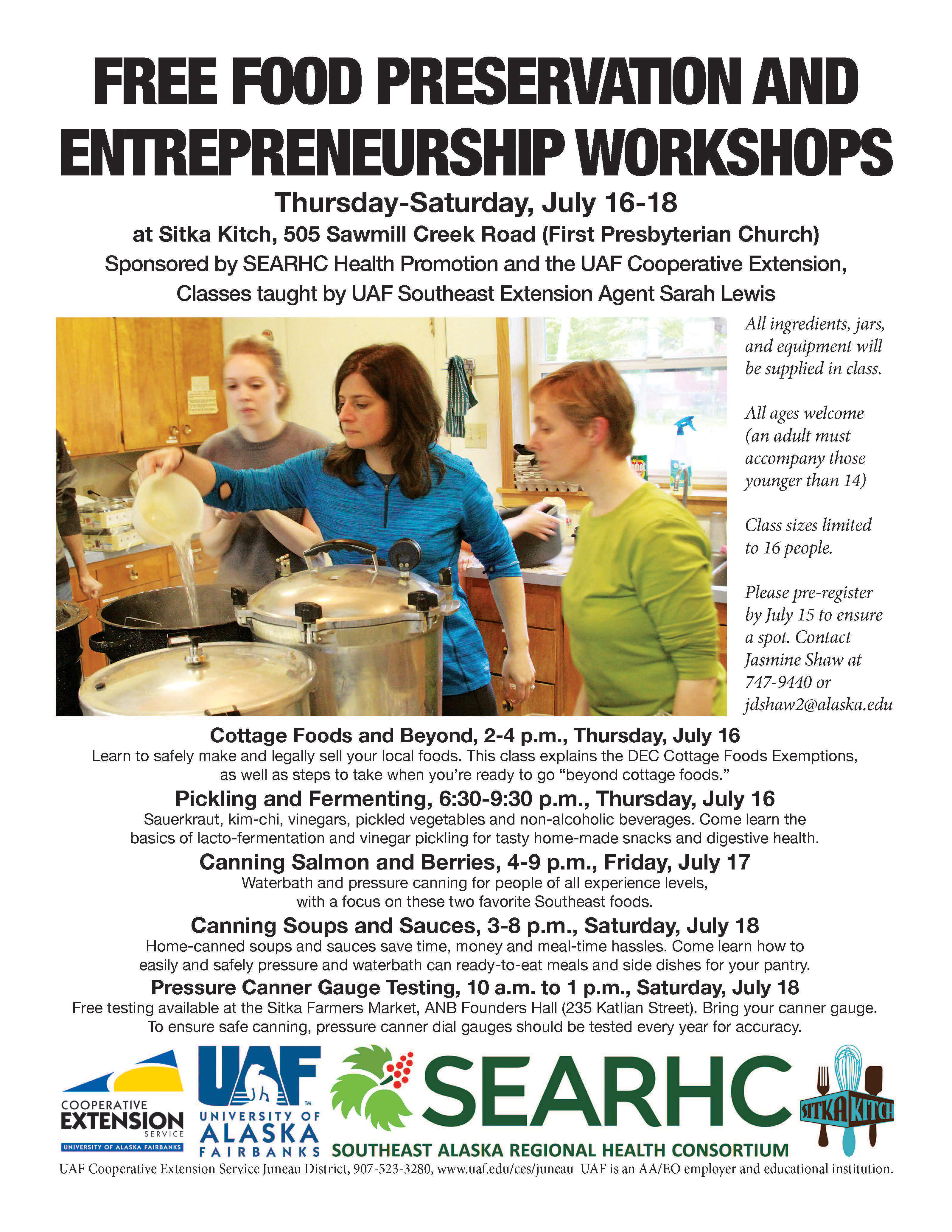
The Sitka Kitch is a rental community commercial kitchen project coordinated by the Sitka Conservation Society, in partnership with the Sitka Local Foods Network, located inside the First Presbyterian Church, 505 Sawmill Creek Road. The Sitka Kitch was a project from the 2013 Sitka Health Summit designed to improve food security in Sitka while also providing a space for people wanting to get into the cottage food business or wanting to preserve their harvest for storage in the home pantry. Sitka Kitch officially opened in March 2015 after a series of renovations to make it pass Alaska Department of Environmental Conservation commercial kitchen food safety standards.
UAF Southeast Extension Agent Sarah Lewis of the Juneau District Office will teach four classes — Cottage Foods and Beyond, Pickling and Fermenting, Canning Salmon and Berries, and Canning Soups and Sauces. These classes are open to Sitka residents of all ages, but an adult must accompany those younger than 14 years old. Class sizes are limited to 16 people. Thanks to a grant from the SEARHC WISEFAMILIES Traditional Foods program, all ingredients, jars, and equipment will be supplied in class.
“The WISEFAMILIES Traditional Foods program is partnering with the UAF Cooperative Extension Service because their work complements our purposes, which is to help Native families reduce their risk for disease while working toward getting back to a traditional way of eating,” said SEARHC Health Educator Clara Gray, of the SEARHC WISEFAMILIES Traditional Foods program.
The SEARHC WISEFAMILIES Traditional Foods program promotes healthy lifestyles by connecting Alaska Natives in Southeast Alaska to their culture. Members of the program learn how to harvest, cook, and preserve their traditional Alaska Native foods, which usually are healthier than heavily processed store-bought foods. In addition, participants learn traditional language, dancing, carving, weaving, and other skills that help reconnect them to their culture.
The UAF Cooperative Extension Service offers a variety of programs geared toward food, how to grow it, how to preserve it for storage, and how to make it into cottage foods you can sell. For those who can’t make the classes, the service offers a series of free online tutorials about home canning called Preserving Alaska’s Bounty.
“As a UAF Cooperative Extension Agent, I try to teach that family and community resilience are strengthened when local foods are used to cook meals at home,” Lewis said. “Through my food preservation and entrepreneurship workshops I offer the knowledge and skills needed for people to discover the nutritional benefits and financial stability that come from making and preserving homemade meals with local ingredients.”
Here are the details and schedules of the four classes:
Cottage Foods and Beyond, 2-4 p.m., Thursday, July 16 — Learn to safely make and legally sell your local foods. This class explains the DEC Cottage Foods Exemptions, as well as steps to take when you’re ready to go “beyond cottage foods.”
Pickling and Fermenting, 6:30-9:30 p.m., Thursday, July 16 — Sauerkraut, kim-chi, vinegars, pickled vegetables and non-alcoholic beverages. Come learn the basics of lacto-fermentation and vinegar pickling for tasty home-made snacks and digestive health.
Canning Salmon and Berries, 4-9 p.m., Friday, July 17 — Waterbath and pressure canning for people of all experience levels, with a focus on these two favorite Southeast foods.
Canning Soups and Sauces, 3-8 p.m., Saturday, July 18 — Home-canned soups and sauces save time, money and meal-time hassles. Come learn how to easily and safely pressure and waterbath can ready-to-eat meals and side dishes for your pantry.
In addition to teaching the four classes, Lewis will offer free pressure canner gauge testing at the Sitka Farmers Market, from 10 a.m. to 1 p.m. on Saturday, July 18, at the Alaska Native Brotherhood Founders Hall, 235 Katlian Street. She also will provide other resources about home canning and food preservation. To ensure safe canning, pressure canner dial gauges should be tested every year for accuracy.
Due to limited class space, please pre-register by Wednesday, July 15, to ensure a spot. To pre-register, contact Jasmine Shaw of the Sitka District Office of the UAF Cooperative Extension Service at 747-9440 or jdshaw2@alaska.edu.
(EDITOR’S NOTE: The following article first appeared on this site in April 2010. It is repeated because much of the information remains current and newsworthy.)
In the cold winter of 1994, Anchorage Daily News (now called the Alaska Dispatch News) garden columnist and former Garden Writers Association of America President Jeff Lowenfels was returning to his hotel after a Washington, D.C., event when he was approached by a homeless person who asked for some money to buy food. Lowenfels said Washington, D.C., had signs saying, “Don’t give money to panhandlers,” so he shook his head and kept on walking. But the man’s reply, “I really am homeless and I really am hungry. You can come with me and watch me eat,” stayed with Lowenfels for the rest of his trip.
Jeff Lowenfels
The encounter continued to bother Lowenfels, even as he was flying back to Anchorage. During the flight, Lowenfels came up with an idea when he started writing his weekly garden column (the longest continuously running garden column in the country, with no missed weeks since it started on Nov. 13, 1976). He asked his readers to plant one extra row in their gardens to grow food to donate to Bean’s Café, an Anchorage soup kitchen. The idea took off.
When Anchorage hosted the Garden Writers Association of America convention in 1995, Lowenfels took the GWAA members to Bean’s Café to learn about the Plant A Row For Bean’s Café program. The Garden Writers Association of America liked the idea, and it became the national Plant A Row For The Hungry campaign (also known as Plant A Row or PAR). In 2002, the Garden Writers Association Foundation was created as a national 501(c)(3) nonprofit to manage the Plant A Row For The Hungry program.
“I am not surprised by the growth of PAR,” Lowenfels wrote in an e-mail to the Sitka Local Foods Network. “It is now in all 50 states and across Canada and there are thousands of variations of the original program — from prison gardens for the hungry to botanical gardens donating their produce from public display gardens. This is because gardeners always share information and extra food, so the idea was a natural.”
It took five years for the program to reach its first million pounds of donated food, but the second million only took two years and the next eight years saw a million pounds of donated food (or more) each year. Since 1995, more than 14 million pounds of food have been donated. Not only that, the program is getting ready to expand overseas to Australia, England and other countries with avid gardeners.
“We have supplied something in the vicinity of enough food for 50 million meals,” Lowenfels wrote in his e-mail. “Gardeners can solve this hunger problem without the government. And we don’t need a tea party to do it! Or chemicals, I might add, as author of a book on organic gardening (Teaming With Microbes, written with Wayne Lewis)!” (Lowenfels recently released a second book, Teaming With Nutrients, which is a follow-up to his first book).
According to the U.S. Department of Agriculture, one out of every eight U.S. households experiences hunger or the risk of hunger. Many people skip meals or eat too little, sometimes going an entire day or more without food. About 33 million Americans, including 13 million children, have substandard diets or must resort to seeking emergency food because they can’t always afford to buy the food they need. In recent years the demand for hunger assistance has increased 70 percent, and research shows that hundreds of children and adults are turned away from food banks each year because of lack of resources.
While many people credit Lowenfels for creating the Plant A Row For The Hungry program, Lowenfels says the real heroes are the gardeners growing the extra food and donating it to local soup kitchens, senior programs, schools, homeless shelters and neighbors. You can hear him pass along the credit to all gardeners at the end of this 2009 interview with an Oklahoma television station (video also embedded below).
“One row. That’s all it takes. No rules other than the food goes to the hungry. You pick the drop-off spot or just give it to a needy friend or neighbor. Nothing slips between the lip and the cup, I say,” Lowenfels wrote in his e-mail.
For people wanting to Plant A Row For The Hungry in Sitka, there are several places that would love to help distribute some fresh locally grown veggies or berries to those who are less fortunate, such as the Salvation Army, Sitkans Against Family Violence (SAFV), local churches, Sitka Tribe of Alaska and other organizations. The food the Sitka Local Foods Network grows at St. Peter’s Fellowship Farm communal garden goes to the Sitka Farmers Market, school lunches and other programs.
The Sitka Local Foods Network also takes donations of local produce to sell at the Sitka Farmers Markets, and all proceeds are used to help pay for SLFN projects geared toward helping more people in Sitka grow and harvest local food. For more information, contact SLFN President Lisa Sadleir-Hart or one of the other board members at sitkalocalfoodsnetwork@gmail.com.
Join us for the eighth annual Sitka Health Summit planning day, which takes place from 8:30 a.m. to 4:30 p.m. on Friday, Oct. 3, at Harrigan Centennial Hall.
The Sitka Health Summit got its start in 2007 when then-Sitka Community Hospital CEO Moe Chaudry and then-SouthEast Alaska Regional Health Consortium (SEARHC) Vice President of Hospital Services Frank Sutton decided they needed to bridge the gaps between Sitka’s largest two health services. They launched the Sitka Health Summit, with the help of other supporters in Sitka, as a way to improve community wellness, honor local wellness champions, and more.
One of the highlights of the Sitka Health Summit has been the annual community wellness planning day. During planning day, Sitka residents get together to discuss the health needs of the community and create community wellness projects to address these needs.
To register for the Sitka Heath Summit planning day, go to http://www.sitkahealthsummitak.org/ or call 738-0468. A free lunch with locally sourced food will be provided.
The Sitka Community Food Assessment Indicators Report was released on Monday, and the findings will help guide future food system planning in Sitka.
A 2012 Sitka Health Summit project, the Sitka Community Food Assessment has examined where Sitka residents get their food, what types they eat, what they grow, what they hunt and fish for, where they shop, what type of access people have to healthy food, and other questions about Sitka’s food supply. The findings of the food assessment will help Sitka improve its food security.
After Sitka residents chose the Sitka Community Food Assessment as a project at the September 2012 Sitka Health Summit, the work group received a grant to hire a coordinator and contract with a data person. A revised version of a questionnaire from a similar project on the Kenai Peninsula was posted online, available at the library, and discussed in focus groups, with more than 400 residents answering the 36 questions. In November 2013, some of the initial data was presented at the Sitka Food Summit, where about 60 residents discussed the results and noted any further research that needed to be done. Since then, the work group, in partnership with The Island Institute and others, fine-tuned the data before writing and editing the indicators report.
“We hope the Sitka Community Food Assessment Indicators Report can guide future food system planning and plant seeds for innovative responses that will strengthen Sitka’s food landscape,” project coordinator Lisa Sadleir-Hart wrote in the 26-page document’s introduction. “The Sitka Community Food Assessment Indicators Report uncovers many weaknesses in our food system as well as some incredible assets that define Sitka’s food culture — a rich ecosystem filled with nutritious gems from the land and sea plus a generous spirit of sharing with our neighbors. Now that we’ve defined the current foodscape in Sitka, let’s work together to build a more resilient food system that can deeply nourish the entire community for generations to come.”
The Sitka Community Food Assessment Indicators Report opens with Sitka’s demographics and several Sitka food facts. It then features data about how many people in Sitka hunt, fish, gather, and/or grow their own food, as well as some barriers. Next is information about where people in Sitka shop for their food, followed by how many people in Sitka are on some form of food assistance. The report also includes information about food in the schools, and local food manufacturing.
The findings will be presented to the community during an upcoming meeting of the Sitka Assembly, and the report will be posted online here (see below) and on The Island Institute’s website.
(EDITOR’S NOTE: The following article first appeared on this site in April 2010. It is repeated because much of the information remains current and newsworthy.)
As you start to plan your garden for this spring and summer, don’t forget to Plant A Row For The Hungry. The Plant A Row For The Hungry program (also known as Plant A Row or PAR) is a national campaign by the Garden Writers Association of America that got its start in Alaska.
In the cold winter of 1994, Anchorage Daily News garden columnist and former Garden Writers Association of America President Jeff Lowenfels was returning to his hotel after a Washington, D.C., event when he was approached by a homeless person who asked for some money to buy food. Lowenfels said Washington, D.C., had signs saying, “Don’t give money to panhandlers,” so he shook his head and kept on walking. But the man’s reply, “I really am homeless and I really am hungry. You can come with me and watch me eat,” stayed with Lowenfels for the rest of his trip.
Jeff Lowenfels
The encounter continued to bother Lowenfels, even as he was flying back to Anchorage. During the flight, Lowenfels came up with an idea when he started writing his weekly garden column (the longest continuously running garden column in the country, with no missed weeks since it started on Nov. 13, 1976). He asked his readers to plant one extra row in their gardens to grow food to donate to Bean’s Café, an Anchorage soup kitchen. The idea took off.
When Anchorage hosted the Garden Writers Association of America convention in 1995, Lowenfels took the GWAA members to Bean’s Café to learn about the Plant A Row For Bean’s Café program. The Garden Writers Association of America liked the idea, and it became the national Plant A Row For The Hungry campaign (also known as Plant A Row or PAR). In 2002, the Garden Writers Association Foundation was created as a national 501(c)(3) nonprofit to manage the Plant A Row For The Hungry program.
“I am not surprised by the growth of PAR,” Lowenfels wrote in an e-mail to the Sitka Local Foods Network. “It is now in all 50 states and across Canada and there are thousands of variations of the original program — from prison gardens for the hungry to botanical gardens donating their produce from public display gardens. This is because gardeners always share information and extra food, so the idea was a natural.”
It took five years for the program to reach its first million pounds of donated food, but the second million only took two years and the next eight years saw a million pounds of donated food (or more) each year. Since 1995, more than 14 million pounds of food have been donated. Not only that, the program is getting ready to expand overseas to Australia, England and other countries with avid gardeners.
“We have supplied something in the vicinity of enough food for 50 million meals,” Lowenfels wrote in his e-mail. “Gardeners can solve this hunger problem without the government. And we don’t need a tea party to do it! Or chemicals, I might add, as author of a book on organic gardening (Teaming With Microbes, written with Wayne Lewis)!” (Lowenfels recently released a second book, Teaming With Nutrients, which is a follow-up to his first book).
According to the U.S. Department of Agriculture, one out of every eight U.S. households experiences hunger or the risk of hunger. Many people skip meals or eat too little, sometimes going an entire day or more without food. About 33 million Americans, including 13 million children, have substandard diets or must resort to seeking emergency food because they can’t always afford to buy the food they need. In recent years the demand for hunger assistance has increased 70 percent, and research shows that hundreds of children and adults are turned away from food banks each year because of lack of resources.
While many people credit Lowenfels for creating the Plant A Row For The Hungry program, Lowenfels says the real heroes are the gardeners growing the extra food and donating it to local soup kitchens, senior programs, schools, homeless shelters and neighbors. You can hear him pass along the credit to all gardeners at the end of this interview last year with an Oklahoma television station (video also embedded below).
“One row. That’s all it takes. No rules other than the food goes to the hungry. You pick the drop-off spot or just give it to a needy friend or neighbor. Nothing slips between the lip and the cup, I say,” Lowenfels wrote in his e-mail.
For people wanting to Plant A Row For The Hungry in Sitka, there are several places that would love to help distribute some fresh locally grown veggies or berries to those who are less fortunate, such as the Salvation Army, Sitkans Against Family Violence (SAFV), local churches, Sitka Tribe of Alaska and other organizations. The food the Sitka Local Foods Network grows at St. Peter’s Fellowship Farm communal garden goes to the Sitka Farmers Market.
The Sitka Local Foods Network also takes donations of local produce to sell at the Sitka Farmers Markets, and all proceeds are used to help pay for SLFN projects geared toward helping more people in Sitka grow and harvest local food. For more information, contact SLFN President Lisa Sadleir-Hart or one of the other board members at sitkalocalfoodsnetwork@gmail.com.
The Sitka Community Food Assessment work group will present its findings during the inaugural Sitka Food Summit, from 6-9 p.m. on Thursday, Nov. 14, at Harrigan Centennial Hall.
A 2012 Sitka Health Summit project, the Sitka Community Food Assessment has examined where Sitka residents get their food, what types they eat, what they grow, what they hunt and fish for, where they shop, what type of access people have to healthy food, and other questions about Sitka’s food supply. The findings of the food assessment will help Sitka improve its food security.
“The Sitka Community Food Assessment work group decided early on that there needed to be an opportunity for Sitka to engage with the food data and shape the writing of the food assessment indicator report,” project coordinator Lisa Sadleir-Hart said. “The inaugural Sitka Food Summit will use a format that was first tested in the late 1990s when the Island Institute was developing Sitka’s initial indicator report. We’ll interact individually with the data, then use a conversation café model to discuss what the data brings up for us as Sitkans. The working group wanted to create a venue that meets the needs of a wide range of citizens.”
For more information, contact Lisa Sadleir-Hart at 747-5895 or sitkafoodassessment@gmail.com. (Editor’s note: A few photos from the Sitka Food Summit are posted below.)
(EDITOR’S NOTE: The following article first appeared on this site in April 2010. It is repeated because much of the information remains current and newsworthy.)
As you start to plan your garden for this spring and summer, don’t forget to Plant A Row For The Hungry. The Plant A Row For The Hungry program (also known as Plant A Row or PAR) is a national campaign by the Garden Writers Association of America that got its start in Alaska.
In the cold winter of 1994, Anchorage Daily News garden columnist and former Garden Writers Association of America President Jeff Lowenfels was returning to his hotel after a Washington, D.C., event when he was approached by a homeless person who asked for some money to buy food. Lowenfels said Washington, D.C., had signs saying, “Don’t give money to panhandlers,” so he shook his head and kept on walking. But the man’s reply, “I really am homeless and I really am hungry. You can come with me and watch me eat,” stayed with Lowenfels for the rest of his trip.
Jeff Lowenfels
The encounter continued to bother Lowenfels, even as he was flying back to Anchorage. During the flight, Lowenfels came up with an idea when he started writing his weekly garden column (the longest continuously running garden column in the country, with no missed weeks since it started on Nov. 13, 1976). He asked his readers to plant one extra row in their gardens to grow food to donate to Bean’s Café, an Anchorage soup kitchen. The idea took off.
When Anchorage hosted the Garden Writers Association of America convention in 1995, Lowenfels took the GWAA members to Bean’s Café to learn about the Plant A Row For Bean’s Café program. The Garden Writers Association of America liked the idea, and it became the national Plant A Row For The Hungry campaign (also known as Plant A Row or PAR). In 2002, the Garden Writers Association Foundation was created as a national 501(c)(3) nonprofit to manage the Plant A Row For The Hungry program.
“I am not surprised by the growth of PAR,” Lowenfels wrote in an e-mail to the Sitka Local Foods Network. “It is now in all 50 states and across Canada and there are thousands of variations of the original program — from prison gardens for the hungry to botanical gardens donating their produce from public display gardens. This is because gardeners always share information and extra food, so the idea was a natural.”
It took five years for the program to reach its first million pounds of donated food, but the second million only took two years and the next eight years saw a million pounds of donated food (or more) each year. Since 1995, more than 14 million pounds of food have been donated. Not only that, the program is getting ready to expand overseas to Australia, England and other countries with avid gardeners.
“We have supplied something in the vicinity of enough food for 50 million meals,” Lowenfels wrote in his e-mail. “Gardeners can solve this hunger problem without the government. And we don’t need a tea party to do it! Or chemicals, I might add, as author of a book on organic gardening (Teaming With Microbes, written with Wayne Lewis)!” (Lowenfels recently released a second book, Teaming With Nutrients, which is a follow-up to his first book).
According to the U.S. Department of Agriculture, one out of every eight U.S. households experiences hunger or the risk of hunger. Many people skip meals or eat too little, sometimes going an entire day or more without food. About 33 million Americans, including 13 million children, have substandard diets or must resort to seeking emergency food because they can’t always afford to buy the food they need. In recent years the demand for hunger assistance has increased 70 percent, and research shows that hundreds of children and adults are turned away from food banks each year because of lack of resources.
While many people credit Lowenfels for creating the Plant A Row For The Hungry program, Lowenfels says the real heroes are the gardeners growing the extra food and donating it to local soup kitchens, senior programs, schools, homeless shelters and neighbors. You can hear him pass along the credit to all gardeners at the end of this interview last year with an Oklahoma television station (video also embedded below).
“One row. That’s all it takes. No rules other than the food goes to the hungry. You pick the drop-off spot or just give it to a needy friend or neighbor. Nothing slips between the lip and the cup, I say,” Lowenfels wrote in his e-mail.
For people wanting to Plant A Row For The Hungry in Sitka, there are several places that would love to help distribute some fresh locally grown veggies or berries to those who are less fortunate, such as the Salvation Army, Sitkans Against Family Violence (SAFV), local churches, Sitka Tribe of Alaska and other organizations. The food the Sitka Local Foods Network grows at St. Peter’s Fellowship Farm communal garden goes to the Sitka Farmers Market.
The Sitka Local Foods Network also takes donations of local produce to sell at the Sitka Farmers Markets, and all proceeds are used to help pay for SLFN projects geared toward helping more people in Sitka grow and harvest local food. For more information, contact SLFN President Lisa Sadleir-Hart or one of the other board members at sitkalocalfoodsnetwork@gmail.com.
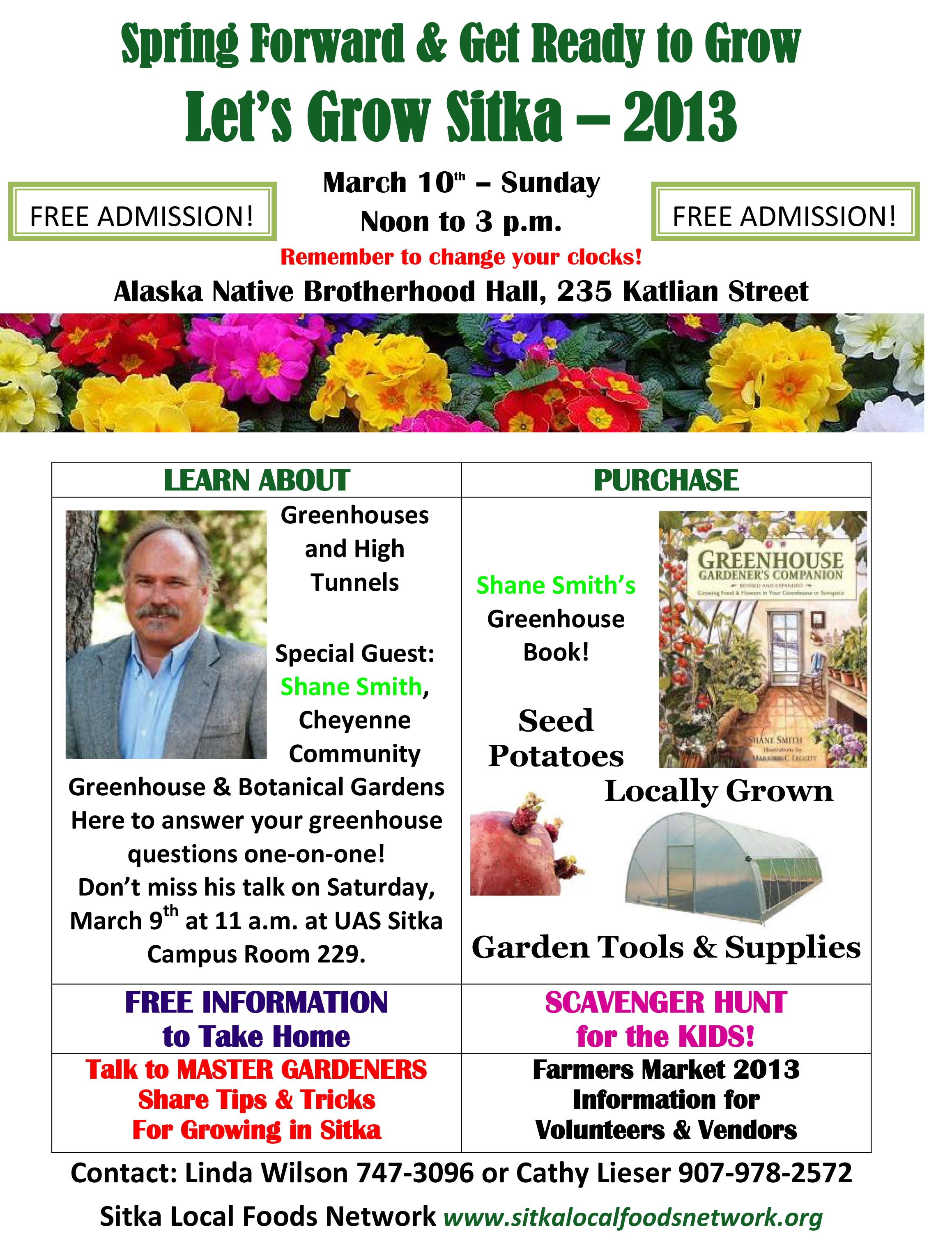
Mark your calendars as the Sitka Local Foods Network will host two big garden events Saturday and Sunday, March 9-10, in Sitka.
The first event is a presentation by Shane Smith of the Cheyenne (Wyo.) Botanic Gardens from 11 a.m. until 12:30 p.m. on Saturday, March 9, in Room 229 of the University of Alaska Southeast Sitka Campus. The second event is the fifth annual Let’s Grow Sitka garden education event from noon until 3 p.m. on Sunday, March 10, at the Alaska Native Brotherhood Founders Hall, 235 Katlian (don’t forget to set your clocks ahead an hour Saturday night).
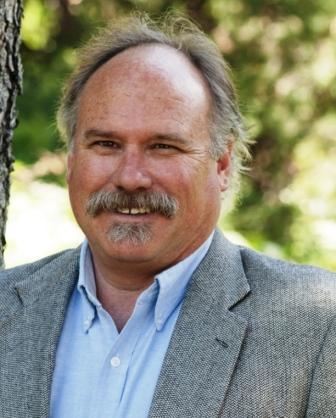
The Sitka Local Foods Network is excited to bring Shane Smith to town to discuss gardens and greenhouses. Shane is the founder of the Cheyenne (Wyo.) Botanic Gardens and has been its director since 1977. Shane is the author of the Greenhouse Gardener’s Companion, and he will be signing copies of his book. Shane received the American Horticulture Society’s 2012 Great American Gardener Award.
Shane also will have a booth at Sunday’s Let’s Grow Sitka event, which is an annual event designed to get Sitka residents excited about the upcoming garden season. This annual event brings together local garden supply stores, local gardeners, landscapers and anybody who is interested in learning how to grow food and/or flowers.
There will be a wide variety of individuals and businesses with booths for the event, with some booths providing gardening information geared toward and others selling gardening supplies. Lunch will be available for purchase. There also will be a chance to learn from certified Master Gardeners, a chance to learn about greenhouses and high tunnels, an opportunity to buy seeds and seed potatoes, and there’s a scavenger hunt for the kids.
For more information, contact Linda Wilson at 747-3096 (evenings and weekends) or Cathy Lieser at 1-907-978-2572. Table space still may be available for people wanting to provide information about different types of gardening or gardening products/services available in Sitka.
The Sitka Local Foods Network thanks the City and Borough of Sitka, Shee Atika Corp., and the SouthEast Alaska Regional Health Consortium (SEARHC) Diabetes Programs for their help in making these events possible.


 Join us for the ninth annual Sitka Health Summit planning day, which takes place from 8:30 a.m. to 4 p.m. on Friday, Oct. 9, at the University of Alaska Southeast Sitka Campus.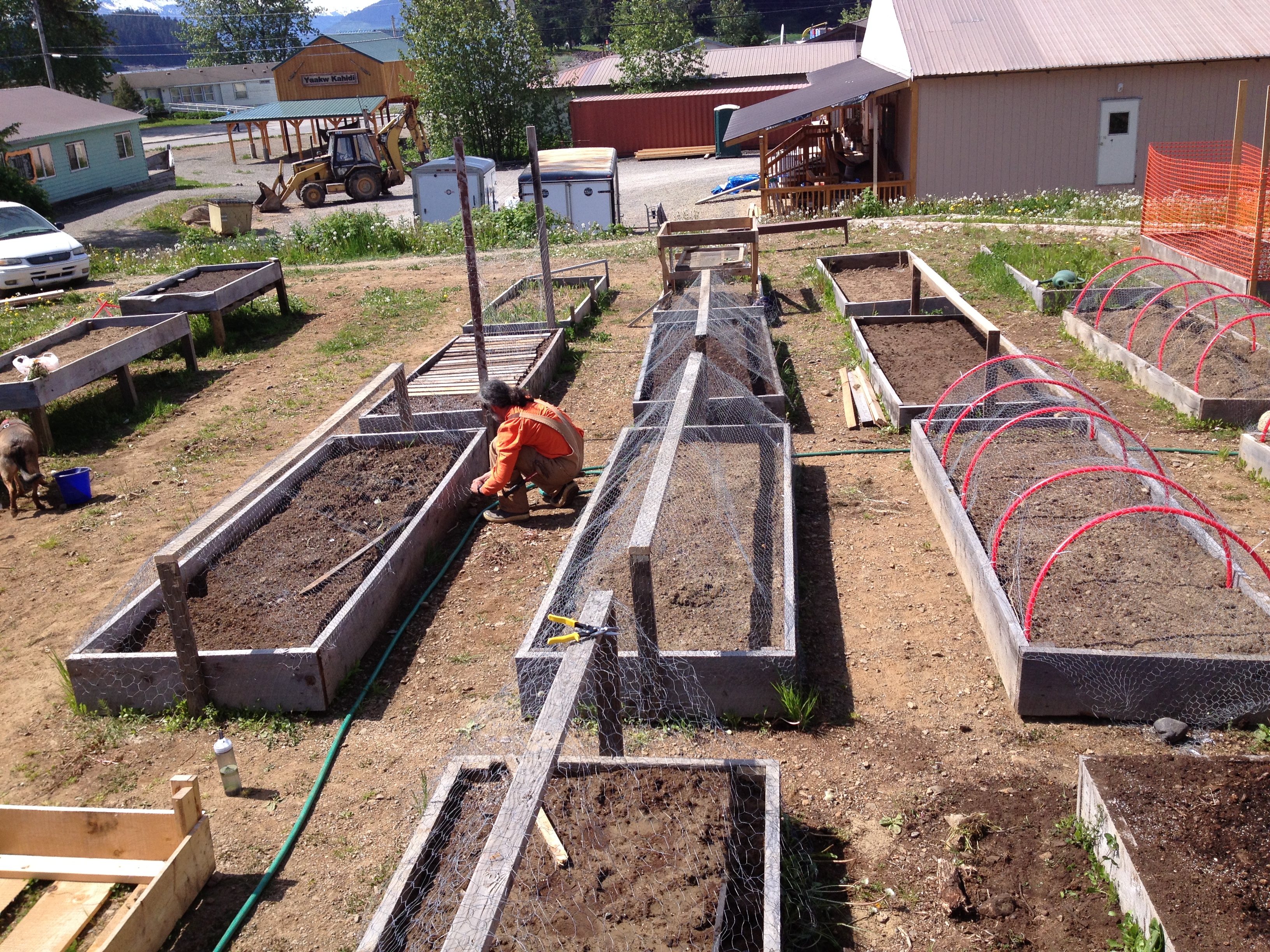









 Sitka Local Foods Network
You must be logged in to post a comment.