Building a Local Food System: Andrea Fraga and Middle Island Organic Produce

MiddleIslandOrganicProduceAndreaFragaKalebAldred

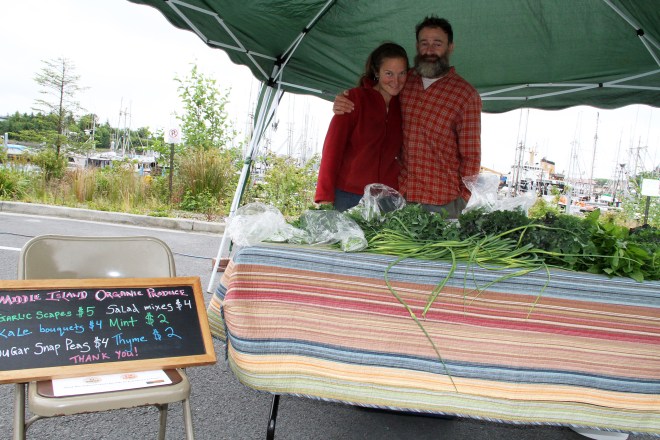
Andrea Fraga, left, and partner Kaleb Aldred, hosted their Middle Island Organic Produce booth at the July 16 Sitka Farmers Market.

(Editor’s Note: The Sitka Local Foods Network’s Bulldog on Baranof intern this summer, Claire Chang, is writing the Building a Local Food System series of articles about Sitkans working to improve food security. This is the fourth article of the series.)
WP_20160704_11_00_23_ProAndrea Fraga grew up in Hawaii and lived in Oregon for 10 years before she moved to Sitka. While in Oregon, she met a friend from Sitka who invited her to visit, and after her third trip she decided to embrace the rainy weather and move here. Sitka’s tremendous opportunities for subsistence appealed to her desire to become more self-sufficient. “I had been really interested in leading more of a subsistence lifestyle for a while” Fraga said.

Fraga lives on Middle Island with her partner, Kaleb Aldred. They started with a small garden on the beach, and then established a garden with a greenhouse behind their home. They have since expanded to a lot due south of their house. “We had always lusted to have that space as an ideal garden spot,” she said.

Creating the “small farm or large garden” on Middle Island was not an easy task. They had to cut down trees and rent a machine to pull the stumps out. When they tried to dig the stumps out by hand, removing one stump took a whole week. The machine that removed the stumps compacted the soil, so they then had to dig a trench and fill it with gravel to provide the boggy field with adequate drainage. “I never thought I’d be someone to say, ‘Yeah, let’s cut down all the trees,’ but it’s necessary if you want to garden here,” Fraga said. Removing trees created a sunnier space and also has enabled Fraga to plant fruit trees along the perimeter of her garden.
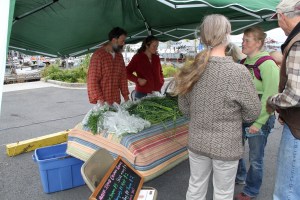
MiddleIslandOrganicProduceKalebAldredAndreaFragaWithCustomersOn occasion, Fraga sells vegetables at the Sitka Farmers Market through their Middle Island Organic Produce stand. She and Aldred hope to grow garlic commercially one day, although they are well aware that “weather and crop failure coalesce and can slow plans down.”

Currently, they have planted about a quarter of their garden in garlic so that they can harvest enough to plant a larger area in the future. Seed garlic costs about $25 dollars a pound from most sources, so generating seed on site will help save a significant amount of money. Fraga said growing garlic commercially makes sense because deer and slugs do not eat it and it is not highly perishable. Furthermore, unlike most garden vegetables she plants in the spring, garlic goes in the ground in the fall, so she can distribute her labor throughout the year.

At a commercial growers conference last spring, Fraga learned about using plastic mulch on garlic to control moisture levels and minimize weeds. The infrared- transmitting plastic transmits heat wavelengths of sunlight that warm the soil and absorbs the wavelengths that plants require for photosynthesis, so weeds cannot grow beneath it. Fraga has begun using the plastic mulch on her own garden this year.

Having farmed in Oregon where one can cultivate a wider variety of plants with greater ease than in Sitka, Fraga does find adapting to Sitka’s weather challenging. Living on an island also has its challenges. For example, in the fall and winter, storms and darkness can restrict travel to and from town. However, Fraga views these challenges as small tradeoffs that allow her to live and garden in a “beautiful, quiet place away from all the noises and distractions of town” and where she is “more in touch with the environment.”

WP_20160707_18_03_42_ProExperiencing beauty is, in large part, what Fraga finds so appealing about subsistence. She explained that gardens, berry thickets, and areas where she forages for mushrooms and seaweed are all beautiful places to spend time. For her, gardening “is just such a beautiful process.” She appreciates the exercise and fresh air involved in gardening, as well as the taste and nutritional value of fresh food. Fraga especially appreciates when she can refer to her dinner as a “Middle Island meal” because all of its components, apart from perhaps the fish,” came from the island that is her home. “It’s really satisfying to eat something that’s entirely grown or harvested yourself.”

Fraga is also a part of a gardening group that meets at one member’s garden every week to work there together. “It’s really great because garden projects that seem daunting end up being fun when you have people to work with,” Fraga said.

For those who find the prospect of starting a garden daunting, Fraga recommends “starting small and simple.” For example, one could begin by growing hearty plants like kale and potatoes that do not require extremely fertile soil. Learning about wild edibles also intimidates many people. Fraga took a class on mushroom identification through University of Alaska Southeast, but she also pointed out one can learn by reading field guides and talking with individuals who willing to share their knowledge on the subject. Gardening and foraging “are really rewarding,” she said. “They don’t have to be discouraging.”

For questions about her garden on Middle Island, contact Andrea Fraga at 738-5135.

Check out the August 2016 edition of the Sitka Local Foods Network newsletter

August2016SLFNNewsletterScreenshot

The Sitka Local Foods Network just sent out the August 2016 edition of its newly launched monthly newsletter. Feel free to click this link to get a copy.

This edition of the newsletter has brief stories about the Sitka Farmers Markets, a series of ‘Building A Local Food System’ articles by intern Claire Chang, a reminder that you can still add Pick.Click.Give. donations to your Alaska Permanent Fund Dividend application through Aug. 31, and an update on the Sitka Local Foods Network board of directors. Each story has links to our website for more information.

You can sign up for future editions of our newsletter by clicking on the registration form image in the right column of our website and filling in the information. If you received a copy but didn’t want one, there is a link at the bottom of the newsletter so you can unsubscribe. Our intention is to get the word out about upcoming events and not to spam people. We will protect your privacy by not sharing our email list with others.

Don’t forget, you still can add Pick.Click.Give. donations to your 2016 PFD application through Aug. 31

2016PickClickGiveFlier

PCGFarmersMarket2016NEWIf you’re like most Alaskans you probably filed your 2016 Alaska Permanent Fund Dividend (PFD) application before the March deadline and haven’t given it a second thought since. But did you know you still can add Pick.Click.Give.donations to your 2016 application through Monday, Aug. 31? If you haven’t already, please consider making a Pick.Click.Give. donation to the Sitka Local Foods Network.

Here’s how to add or change your Pick.Click.Give. donations. First, go to the Alaska Permanent Fund Dividend application website, http://pfd.alaska.gov/, and find the green “Add A Pick.Click.Give. Donation” bar in the right column. Click the green bar, and follow the directions. You’ll need to enter your driver’s license number, Social Security number, and birthday to access your application, but once on the page you’ll be able to see your current Pick.Click.Give. donations (if any) and you can add or change them. Click here for an FAQ page about making Pick.Click.Give. donations.

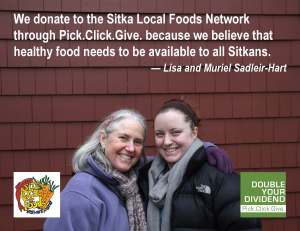
PCGTestemonialLisaAndMurielSadleirHart2016Unfortunately, new donations made after the March 31 Alaska Permanent Fund Dividend filing deadline do not qualify for entry into the Double Your Deadline Sweepstakes, where 10 lucky Alaskans will win the equivalent of a second PFD. But you still get the satisfaction of sharing the wealth with the more than 600 Alaska nonprofit organizations participating in the Pick.Click.Give. program, including 24 from Sitka.

This is the third year the Sitka Local Foods Network is participating in the Pick.Click.Give. program, which allows people to donate in $25 increments to their favorite statewide and local 501(c)(3) nonprofit organizations when they file their PFD applications. When you choose to donate part of your PFD to the Sitka Local Foods Network, you support the Sitka Farmers Market, St. Peter’s Fellowship Farm, education programs about growing and preserving food, the Sitka Kitch community rental commercial kitchen, Blatchley Community Gardens, the sustainable use of traditional foods, the Sitka Community Food Assessment, the Sitka Food Summit, the Fish-To-Schools program, and a variety of other projects designed to increase access to healthy local foods in Sitka.

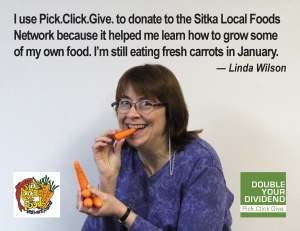
PCGTestemonialLindaWilson2016You still can donate to the Sitka Local Foods Network if you aren’t from Alaska or aren’t eligible for a 2016 PFD. To donate, send your check to the Sitka Local Foods Network, 408 Marine St., Suite D, Sitka, Alaska, 99835. Our EIN is 26-4629930. You also can make an online donation through our Razoo.com crowdfunding page. Please let us know if you need a receipt for tax purposes. The Sitka Local Foods Network now has a Bronze rating from the GuideStar Nonprofit Profile Service, and we are listed with the Benevity Causes Portal used by larger corporations for employee giving programs. For more information about donating, you can send an email to sitkalocalfoodsnetwork@gmail.com.

Thank you to everybody making a Pick.Click.Give. donation to your Sitka Local Foods Network. We appreciate your support.

Building a Local Food System: Dave Nuetzel and Blatchley Community Gardens

DaveNuetzelMemorialGardenKathySwanberg

Dave Nuetzel, right, helps build a memorial garden bed for longtime Blatchley Community Gardens supporter Kathy Swanberg.

(Editor’s Note: The Sitka Local Foods Network’s Bulldog on Baranof intern this summer, Claire Chang, is writing the Building a Local Food System series of articles about Sitkans working to improve food security. This is the third article of the series.)

BlatchleyCommunityGardenSignDave Nuetzel has held the role of lead gardener at Blatchley Community Gardens since 2007. Nuetzel grew up outside of Cleveland, and he toured around the country on a two-year road trip after he graduated from college. At the end of the trip, he wound up in Anchorage. In 2005, he followed his partner, who came to Sitka to work at the Sitka Fine Arts Camp, and he has lived here ever since. With a background in special education, he originally worked for the SouthEast Alaska Regional Health Consortium (SEARHC), and he now works for Southeast Alaska Independent Living (SAIL).

The Blatchley Community Gardens, located behind Sitka’s middle school on what used to be a gravel terrace, started in 2000 as a project of Sitka Community Schools. When Sitka Community Schools lacked the staff to run the garden, Nuetzel took on his role as lead gardener. This year the garden has transitioned from Sitka Community Schools to become a program of Blatchley Middle School. The community garden consists of about fifty garden plots, approximately 6-by-12-feet each. It is personal-use garden, although it does contain a few communal plots of plants such as mint, rhubarb, and flowers. Gardeners pay for the square footage of a plot, and Nuetzel explained that the community garden particularly appeals to people who live in apartments, on boats, or in houses with yards that receive little sunlight.

MiddleOfBlatchleyCommunityGardenAs someone who “has always liked to fix things and learn new skills,” Nuetzel had small gardens when he was growing up, as well as in college. In addition to his personal plots at the Blatchley Community Gardens, Neutzel says that he has “basically cultivated his whole yard.” Any areas around his house where he is not growing vegetables or flowers contain salmonberry, blueberry, or raspberry plants. Gardening appeals to Nuetzel’s desire to strive for self-sufficiency; he also fishes and forages for beach asparagus for subsistence.

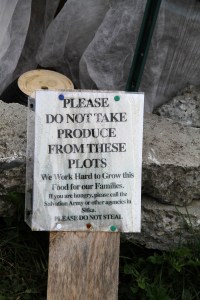
LeaveProduceAloneSignBlatchleyCommunityGardenNuetzel explained that, as lead gardener of Blatchley Community Gardens, maintaining a unified vision for the garden has posed a challenge. At the community garden, each plot represents the gardener’s individual approach to cultivation. Some gardeners devote themselves to experimentation, and they use their plots as a space for attempting to grow one type of vegetable that they have never succeeded in cultivating before. Others are committed to growing a wide variety of plants that they know will yield an ample harvest. Furthermore, gardeners choose to amend the soil in unique ways; while one might opt for buried salmon carcasses, kelp, and ground-up shells, another might rely more heavily on compost and coffee grounds.

An even larger challenge that Nuetzel has faced in his role is coordinating the management of common plots. Dividing up the responsibility of caring for a plot of chard, for example, becomes difficult when gardeners travel schedules and family obligations interfere. Furthermore, trying to ensure that everyone has equal to the resources of common plots, such as the apples from a communal apple tree, can be tricky.

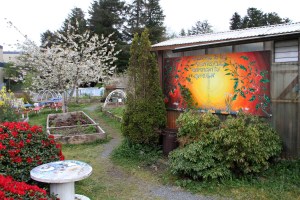
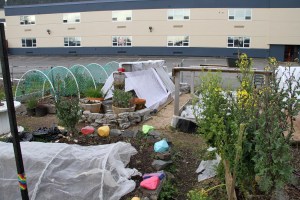
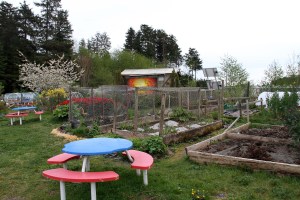
BlatchleyCommunityGardenPicnicTableAndBedsNevertheless, Nuetzel appreciates Blatchley Community Gardens as a space where he and others can experience the tangible results of physical labor. Regular visits to the garden allow him to appreciate how well one can grow food for oneself when one puts in the effort. Nuetzel believes that gardening has grown more popular in Sitka in recent years. He has seen new gardens emerge in yard, and in the future, he would like to see new community gardens established in town. As gardening in the community becomes more popular, he wishes that more people would view gardening as a basic need, not just a hobby.

CherryBlossomsBlatchleyCommunityGarden“At one time, producing food was a requirement for life,” Nuetzel said. “Now, people think that gardening is only something you do if you have lots of ‘extra’ time. But if you provide people with a little bit of guidance and get them invested in the process of gardening, they will value it and treat it like something that is necessary.”

To learn more about Blatchley Community Gardens, go to the Facebook page or contact Dave Nuetzel at community.garden@hotmail.com.

Building a Local Food System: Florence Welsh of Welsh Family Forget Me Not Gardens

IMG_0604 - Version 2

Florence Welsh and her Welsh Family Forget Me Not Gardens occasionally host a booth at the Sitka Farmers Market.

(Editor’s Note: The Sitka Local Foods Network’s Bulldog on Baranof intern this summer, Claire Chang, is writing the Building a Local Food System series of articles about Sitkans working to improve food security. This is the second article of the series.)

FlorenceWelshGoing on a tour of Florence Welsh’s Welsh Family Forget Me Not Garden is a magical experience. Raspberry bushes teem with succulent, red berries. Flowers of many shapes, sizes, and colors draw the eye in all directions. Sea kale yields abundant, hearty leaves, and the squash plants have begun to fruit. A cascade of pink roses hangs over the fence that surrounds fennel and artichoke beds. Rubbing one’s hand through the copious lemon balm or mint is a wonderful, sensory experience. The branches of elegant trees near the border of the garden abound with small, round apples. With a dehydrator, pressure cooker stand, and freezers literally overflowing with frozen berries, her garage indicates that her household makes use of the growing season’s bounty throughout the year

Raised in Weymouth, Mass., Welsh grew up exploring the seashore, swamp, and woods with her large family. She came to Sitka in 1965 and immediately fell in love with the unspoiled nature that she could experience here. For many years, she worked for the Sitka School District as a guidance counselor and as an administrator. During her summers off, she and her family hunted, fished, foraged, and spent lots of time in the garden. Welsh explained that though her family did not have a garden when she was growing up, she has “felt compelled to have at least a little bit of a vegetable garden” wherever she has lived since college.

Florence Welsh with copies of her Sitka gardening book

Florence Welsh with copies of the first edition of her Sitka gardening book

The prolific space that is now Florence Welsh’s garden did not emerge overnight. Her success as a gardener required years of trial and error. Gardening, Welsh explained, “is always place-specific, and the maritime Northwest is rainier and cooler than elsewhere.” Even compared to conditions in Seattle, gardeners in Sitka must adapt to a cooler, wetter climate. As she honed her gardening skills over the years, Welsh developed her place-specific gardening knowledge. For example, she came to understand how to improve soil fertility with seaweed and herring eggs and when to start and transplant various plants.

Forget-Me-Not-Gardens_Page_01Welsh’s desire to share her gardening knowledge inspired her to try to write a book for children and others in the Sitka community. She quickly realized, however, that the highly visual nature of gardening made it difficult for her to share her knowledge in a book. About a year and a half ago, Welsh decided to start a blog, SitkaVores, which allows her to incorporate photographs and format the gardening and foraging information. At sitkavores.blogspot.com, one can read about growing a wide variety of vegetables and flowers here in Sitka, as well as about foraged items like beach asparagus and berries. The blog also includes photos at various stages of the gardening process and recipe ideas. Welsh hopes to continue to add to the blog so she can share as much of her knowledge as she can. “I don’t want people to have to reinvent the wheel when it comes to gardening here,” she says.

SitkaVoresBlogScreenshotAs much as she enjoys working in the garden, what Welsh really loves is “getting out there” and experiencing the surroundings. She fondly remembers her and her family’s many hunting, scuba diving, fishing, and snorkeling adventures. The weather in Sitka, especially in fall and winter, can make it difficult to “get out there”, but Welsh explained that creativity helps people get through the periods spent indoors. In addition to working on her blog, Welsh personally enjoys reading and making artwork, such as drawings on bracket fungus, also called bear bread.

FlorenceWelshNow that she is getting older, Welsh explained that she is in the process of downsizing her garden. She will grow more perennial plants and cultivate fewer beds of vegetables. When her kids lived at home, they both helped out in the garden and ate a lot of the produce. Now, they are all grown, and Welsh “does not have the energy or endurance that she once had.” Still, her years of hard work have most certainly paid off. Not only does Florence Welsh have a beautiful, productive garden, but she has also helped many other gardeners get started her in Sitka. Without her commitment to sharing her hard-earned knowledge, many local gardeners would not have achieved the success that they have.

To learn more about Florence Welsh and the Welsh Family Forget Me Not Gardens, go to http://sitkavores.blogspot.com/.

Sitka Spruce Tips 4H club to host 4H Fair at July 30 Sitka Farmers Market

4H Fair flyer

SitkaFarmersMarketSignThe Sitka Spruce Tips 4H club will host its inaugural 4H Fair at the Sitka Farmers Market from 10 a.m. to 1 p.m. on Saturday, July 30, at the Alaska Native Brotherhood Founders Hall (235 Katlian Street).

The Sitka Spruce Tips 4H club is co-sponsored by the University of Alaska Fairbanks Cooperative Extension Service and the Sitka Conservation Society. It provides a variety of programming promoting the Alaska Way of Life for youth and their families.

According to event organizer Jasmine Shaw of the UAF Cooperative Extension Service Sitka District Office, the 4H members are going to be submitting projects in six different divisions:

  • Division 1 — Food Preservation (jams, jellies, preserves, canned goods, smoked fish, jerky)
  • Division 2 — Baked Goods (pies, cakes, cookies, donuts/frybread, breads)
  • Division 3 — Produce (fruits and vegetables) and Flowers
  • Division 4 — Arts and Crafts (knitting, basketry, natural products, recycled crafts, woodworking, sewing)
  • Division 5 — Art (photography, drawings, paintings)
  • Division 6 — Presentations (posters, reports, displays)
Only one entry per individual per category is allowed, so we are asking members to choose your best item. Other items can be displayed but not entered for judging.
“This is a chance for community members to see what 4H has been up to all year and become involved if they want,” Shaw said. “(We will have registration forms).
“Some members will have items for sale alongside the fair display,” Shaw added. “I’m not sure all of what will be for sale yet, but I do some of our members in our natural product series will be making lotion and lip balm.”

Scenes from the Sitka Kitch’s first Preserving the Harvest class — Simple Pickles and Sauerkraut

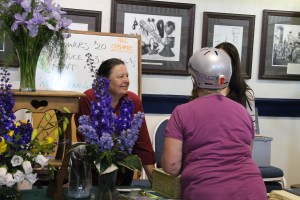
LisaSadleirHartDiscussesProperHeadSpace

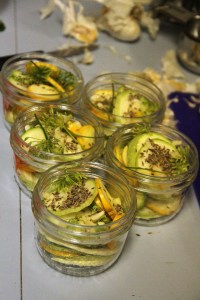
kitch_logo_mainStudents learned how to make pickles from squash and small-batch sauerkraut at the first Preserving the Harvest series class of the summer on Monday, July 18, at the Sitka Kitch community rental commercial kitchen.

The Simple Pickles and Sauerkraut class was taught by Lisa Sadleir-Hart, with assistance from Jasmine Shaw. It is one of six classes in the Preserving the Harvest class series, which will teach people how to safely preserve the summer’s bounty so it can be eaten in the summer.

Other classes in the series will include low-sugar jams and jellies, canning salmon, chutneys and salsas, apple and fruit butters, and a community kale celebration. More details can be found at this link.

JarsPackedWithSquashThe Sitka Kitch was a project of the 2013 Sitka Health Summit, and the project is coordinated by the Sitka Conservation Society in partnership with the Sitka Local Foods Network. The Sitka Kitch can be rented to teach cooking and food preservation classes, by local cottage food industry entrepreneurs who need a commercial kitchen to make their products, and for large groups needing a large kitchen for a community dinner. To learn more about how to rent the Sitka Kitch, please go to the website at http://www.sitkawild.org/sitka_kitch.

To register for classes, go to our online registration page at http://sitkakitch.eventsmart.com/ and click on the class name. We now have a PayPal option so people can pay the registration fees before the class. There are food/supply fees for most of the classes, which are split between the students, and those are paid by cash or check (made out to the Sitka Conservation Society) at the class. Other than for the Kale Celebration event, each class has a limited number of spots available, so register early. Registration for each class closes at 11:55 p.m. on the Friday before the class.

If you have any questions about the class series, please email sitkakitch@sitkawild.org. A slideshow of images from the simple pickles and sauerkraut class is posted below.

This slideshow requires JavaScript.

Alaska Native Sisterhood Culinary Academy graduates first class of students

ANSCAGrads

The first graduating class of the ANS Culinary Academy. Back row: Paulette Moreno, Jenna Martin, Dorothy Gordon, Jessie Natkong, Joy Wood, Marie Lawson, Amy Sutton, Teresa Moses. Front row: Jaiden Martin, Duane Lindoff, Mykle Potter, Zackery Loewen, Chad Titell, Andrew Roberts, Russell James (with Camden). Floor level: Lydia May, Gary May. Not pictured: Adam Geiger, David Thomas, Sarah Smith.

Seventeen students of the new Alaska Native Sisterhood Culinary Academy graduated from the program on Saturday, July 16, at the Alaska Native Brotherhood Founders Hall.

The graduates learned basic culinary skills, and also earned SafeServ and Certified Food Protection Manager (CFPM) certifications. The instructor was Gary May, the owner of New Creations Mobile Bistro and one of a handful of chefs in Alaska qualified to teach CFPM classes. The Alaska Native Sisterhood (ANS) Camp 4 in Sitka, the Alaska Native Brotherhood (ANB) Camp 1 in Sitka, and Faith Mountain Ministries sponsored the classes.

“The vision of the ANS is to have a commercial kitchen at ANB Founders Hall to be here for our people, for koo.éex’ or holiday dinners,” ANS Camp 4 President Paulette Moreno said. “We also want it to be a place of training. The vision of our elders is to get our people in jobs where they can earn an income all year. We also have traditional foods we need people to know how to safely handle.”

Paulette said the ANS already has a waiting list for the next series of classes, which will probably take place this fall. Gary said the training was about 20 hours, and the students had to pass a couple of tests to earn their certifications, which will allow them to get jobs in just about any kitchen in the state..

The graduates were Paulette Moreno, Jenna Martin, Dorothy Gordon, Jessie Natkong, Joy Wood, Marie Lawson, Amy Sutton, Teresa Moses, Duane Lindoff, Mykle Potter, Zackery Loewen, Chad Titell, Andrew Roberts, and Russell James (Teresa’s and Russell’s month-old baby, Camden, received a special certificate for attending all of the classes with his parents). Adam Geiger, David Thomas, and Sarah Smith also graduated from the class but weren’t able to attend the ceremony.

A slideshow of scenes from the graduation ceremony is posted below.

This slideshow requires JavaScript.

Scenes from the second Sitka Farmers Market of the 2016 summer

HeatherAndAllisGardenAnnaWaneTamieParkerSongHeatherHanson

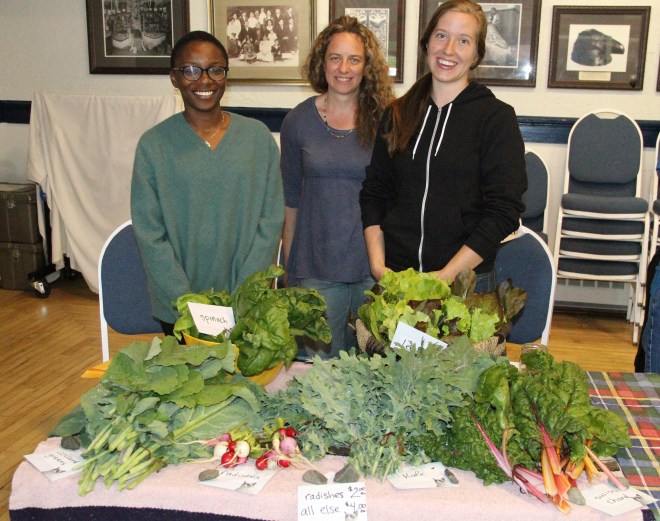
Anna Wane, Tamie Parker-Song and Heather Hanson pose with some of the produce from Heather’s and Alli’s Garden. This was one of the new booths at the market this week.

The wind was blustery, but it didn’t rain when we held the second of the seven Sitka Farmers Markets of the 2016 summer on Saturday, July 16, at the Alaska Native Brotherhood Founders Hall.

MiddleIslandOrganicProduceAndreaFragaKalebAldred

Andrea Fraga and Kaleb Aldred of Middle Island Organic Produce, another of the new booths at the market this week.

We had several new vendors at this market, but not as many customers as usual. We had four booths selling produce, two selling beach greens, another selling homemade bread, another with homemade tamales, and even some frybread.

We always welcome new vendors who want to sell produce they’ve grown, fish they’ve caught, and local cottage food products they’ve made. To learn more about how to be a vendor, contact Matthew Jackson at (907) 821-1412 or jackson.mw08@gmail.com or Brandie Cheatham at (907) 687-9927 or vista_brandie@yahoo.com.

SitkaSpruceCateringJerenSchmidtDishesUpHomemadeTamaleWithCrystal

Jeren Schmidt of Sitka Spruce Catering dishes up a homemade tamale for a customer.

The next Sitka Farmers Market will be from 10 a.m. to 1 p.m. on Saturday, July 30, at the ANB Founders Hall. The other markets this summer are on Saturdays, Aug. 13, Aug. 20, Sept. 3, and Sept. 10. The Sitka Farmers Markets receive sponsorship funding from the SouthEast Alaska Regional Health Consortium (SEARHC). Don’t forget to vote for the Sitka Farmers Market in the American Farmland Trust’s eighth annual Farmers Market Celebration.

A slideshow of scenes from the second Sitka Farmers Market of the 2016 summer is below.

This slideshow requires JavaScript.

Sitka Kitch to offer Preserving the Harvest class series this summer


PreservingTheHarvestFlier

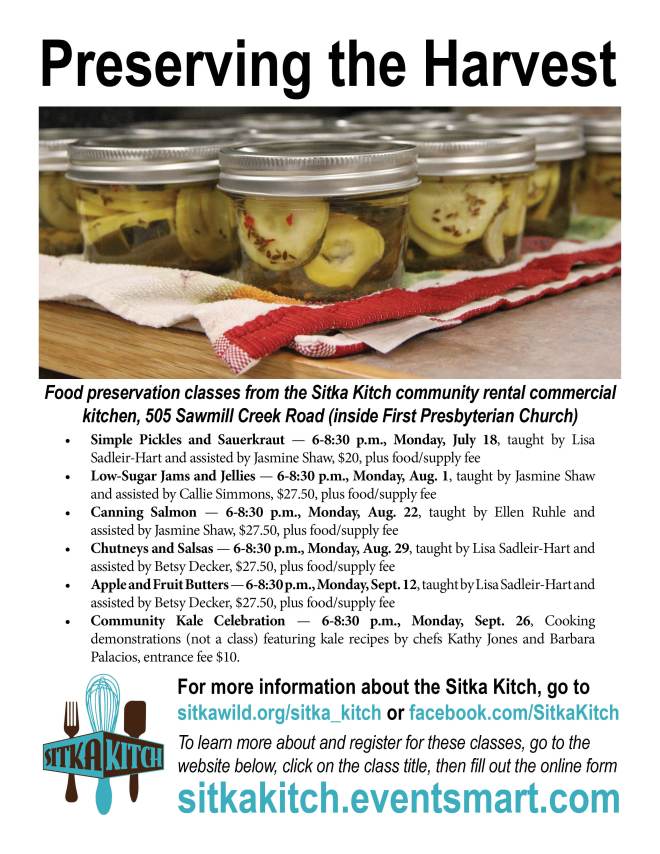
kitch_logo_mainYou grew it, harvested it and/or caught it, so now what do you do? The Sitka Kitch community rental commercial kitchen will be offering the Preserving the Harvest class series to teach Sitkans how to store the summer’s bounty so they can use it during the winter.

This class series features six classes covering a variety of food preservation methods. Students will learn how to safely preserve their food, so it won’t spoil or cause illness. The classes on schedule are:

  • Simple Pickles and Sauerkraut 6-8:30 p.m., Monday, July 18, taught by Lisa Sadleir-Hart and assisted by Jasmine Shaw, $20, plus food/supply fee
  • Low-Sugar Jams and Jellies 6-8:30 p.m., Monday, Aug. 1, taught by Jasmine Shaw and assisted by Callie Simmons, $27.50, plus food/supply fee
  • Canning Salmon6-8:30 p.m., Monday, Aug. 22, taught by Ellen Ruhle and assisted by Jasmine Shaw, $27.50, plus food/supply fee
  • Chutneys and Salsas6-8:30 p.m., Monday, Aug. 29, taught by Lisa Sadleir-Hart and assisted by Betsy Decker, $27.50, plus food/supply fee
  • Apple and Fruit Butters6-8:30 p.m., Monday, Sept. 12, taught by Lisa Sadleir-Hart and assisted by Betsy Decker, $27.50, plus food/supply fee
  • Community Kale Celebration6-8:30 p.m., Monday, Sept. 26, Cooking demonstrations featuring kale recipes by chefs Kathy Jones and Barbara Palacios (not a class), entrance fee $10.

The Sitka Kitch was a project of the 2013 Sitka Health Summit, and the project is coordinated by the Sitka Conservation Society in partnership with the Sitka Local Foods Network. The Sitka Kitch can be rented to teach cooking and food preservation classes, by local cottage food industry entrepreneurs who need a commercial kitchen to make their products, and for large groups needing a large kitchen for a community dinner. To learn more about how to rent the Sitka Kitch, please go to the website at http://www.sitkawild.org/sitka_kitch.

To register for classes, go to our online registration page at http://sitkakitch.eventsmart.com/ and click on the class name. We now have a PayPal option so people can pay the registration fees before the class. There are food/supply fees for most of the classes, which are split between the students, and those are paid by cash or check (made out to the Sitka Conservation Society) at the class. Other than for the Kale Celebration event, each class has a limited number of spots available, so register early. Registration for each class closes at 11:55 p.m. on the Friday before the class.

If you have any questions about the class series, please email sitkakitch@sitkawild.org.