Scenes from the Cooking From Scratch homemade yogurt class at the Sitka Kitch

lisasadleirhartwithjuliecheryllibbykristenatstove

kitch_logo_mainStudents learned how to make homemade yogurt from non-fat powdered milk during the first Cooking From Scratch series class held Monday, Nov. 14, at the Sitka Kitch community rental commercial kitchen.

The homemade yogurt class was the first of three classes in the Fall 2016 Cooking From Scratch series at the Sitka Kitch, which is located at First Presbyterian Church (505 Sawmill Creek Road). The three classes are taught by Lisa Sadleir-Hart, a registered dietitian and health educator. Theclasses designed to help Sitka residents learn how to expand their culinary skills while also eating healthy foods and stretching their food dollars.

The second Sitka Kitch Cooking from Scratch class is from 6-8:30 p.m. on Monday, Nov. 28 (rescheduled from Nov. 7), and will focus on basic whole-grain breads (registration link) using the Tassajara bread technique. This class was offered last year and the students enjoyed learning this simple way to bake whole-grain breads.

homemadeyogurtwithcranberrysaucecrushednutsThe third Cooking from Scratch class will focus on winter morning creations (registration link), featuring baked and fried pancakes from around the world. It will be taught at 6-8:30 p.m. on Monday, Dec. 5. This class is new this fall, and it will teach students how to make a Finnish baked pancake called Krupso, the Eastern/Middle Eastern potato pancakes called Latke, Swedish pancakes, and Strata, a baked bread and egg dish.

The Cooking from Scratch series goal is to teach basic cooking skills using high-quality ingredients, and to help Sitkans take back their kitchens and reduce their food budgets. Interested individuals can register at https://sitkakitch.eventsmart.com/ (click on the event title to register, and use our PayPal feature to pay for the class). We need at least eight students registered for each class to guarantee they happen.

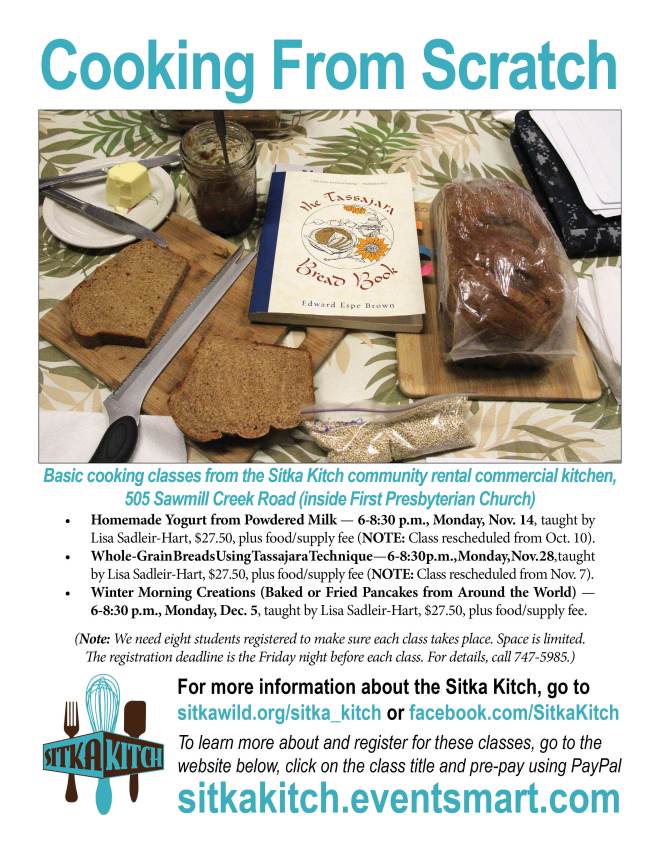
revised2cookingfromscratch2016flierClass size is limited, so register early. The cost is $27.50 per class, plus a food/supply fee that will be divided among registered participants. The registration deadline is late on the Friday night before each class. For more information about the class series, call Lisa Sadleir-Hart at 747-5985.

In addition, the Sitka Kitch will host a Holiday Make and Take class with Nickie Knight from 6-8:30 p.m. on Monday, Dec. 12, where students will learn how to make a variety of organic bath and body products using essential oils (such as body butter, luxurious sugar scrub, lip balm and holiday cheer room spray). This class will cost $20 and more details will be available on our registration site soon. We’re also putting together a Cooking Around The World class series for this spring, so watch for updates once details are confirmed.

A slideshow of scenes from the homemade yogurt class can be found below.
This slideshow requires JavaScript.

Sitka Kitch to host second annual Cooking From Scratch class series in Fall 2016 (Rescheduled dates)

revised2cookingfromscratch2016flier

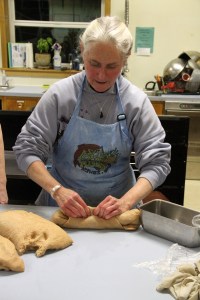
LisaSadleirHartPinchesKneadedBreadDoughEver wanted to learn how to cook more and better food for less money?

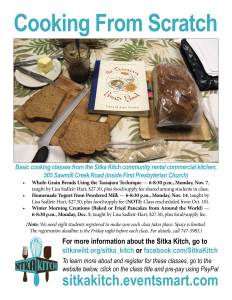
Join us for the second annual Cooking from Scratch series of cooking classes at the Sitka Kitch community rental commercial kitchen, which is located in the First Presbyterian Church (505 Sawmill Creek Road). Registered dietitian and health educator Lisa Sadleir-Hart, MPH, RD, will teach three classes designed to help Sitka residents learn how to expand their culinary skills while also eating healthy and stretching their food dollars. Please note that two of the three classes have been rescheduled from their originally announced dates.

The first class in this year’s fall series will focus on how to make yogurt using nonfat dried milk (registration link). It will be offered from 6-8:30 p.m. on Monday, Nov. 14 (this class was rescheduled from its original Oct. 10 date). We offered this class last year, and it was a big hit.

The second Sitka Kitch Cooking from Scratch class is from 6-8:30 p.m. on Monday, Nov. 28 (rescheduled from Nov. 7), and will focus on basic whole-grain breads (registration link) using the Tassajara bread technique. This class was offered last year and the students enjoyed learning this simple way to bake whole-grain breads.

LisaSadleirHartHoldsUpJarOfYogurtThe third Cooking from Scratch class will focus on winter morning creations (registration link), featuring baked and fried pancakes from around the world. It will be taught at 6-8:30 p.m. on Monday, Dec. 5. This class is new this fall, and it will teach students how to make a Finnish baked pancake called Krupso, the Eastern/Middle Eastern potato pancakes called Latke, Swedish pancakes, and Strata, a baked bread and egg dish.

The Cooking from Scratch series goal is to teach basic cooking skills using high-quality ingredients, and to help Sitkans take back their kitchens and reduce their food budgets. Interested individuals can register at https://sitkakitch.eventsmart.com/ (click on the event title to register, and use our PayPal feature to pay for the class). We need at least eight students registered for each class to guarantee they happen.

Class size is limited, so register early. The cost is $27.50 per class, plus a food/supply fee that will be divided among registered participants. The registration deadline is late on the Friday night before each class. For more information about the class series, call Lisa Sadleir-Hart at 747-5985.

Sitka Conservation Society to host its annual Wild Foods Potluck on Sunday, Nov. 13

wild-foods-4

The Sitka Conservation Society will host its annual Wild Foods Potluck from 5-7 p.m. on Sunday, Nov. 13, at Harrigan Centennial Hall.

Please bring a dish featuring ingredients that were fished, foraged, hunted, or cultivated in Southeast Alaska. Prizes will be awarded for first place in the following categories — Best Dish, Best Dessert, and Most Creative.

The event will highlight subsistence stories and the work performed by the Sitka Conservation Society over the last year. SCS members can pick up their 2017 SCS Calendars at the potluck.

The potluck is open to the entire community, especially SCS members, friends, family, and anyone else interested in learning about the Sitka Conservation Society. Come celebrate Alaska’s wild food bounty with your friends and neighbors.

Interested in volunteering at the potluck or want more information? Contact the Sitka Conservation Society at info@sitkawild.org or call 747-7509.

New harmful algal bloom warning issued for shellfish harvested in Starrigavan Beach North in Sitka

snapshotpspadvisory

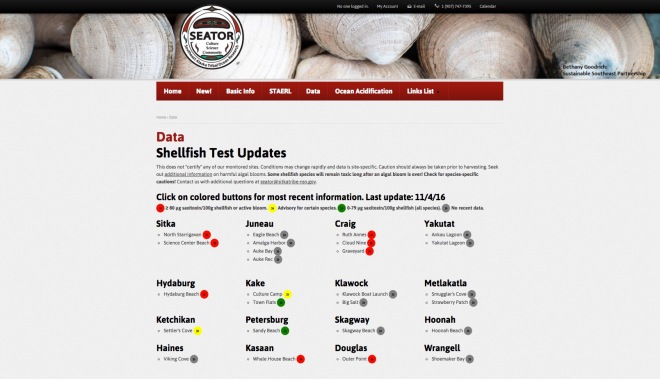
The SouthEast Alaska Tribal Ocean Research (SEATOR) project, SouthEast Alaska Tribal Toxins (SEATT) partnership and the Sitka Tribe of Alaska Environmental Research Lab (STAERL) on Friday, Nov. 4, issued a warning that people should not eat molluscan shellfish (bivalves such as clams, oysters, scallops, mussels, geoducks, cockles, etc.) harvested at Starrigavan Beach North in Sitka. There also is a recent harmful algal bloom warning for the Sitka Sound Science Center Beach.

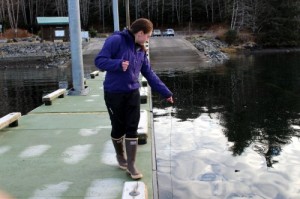
Esther Kennedy of the Sitka Tribe of Alaska Resource Protection Department samples water near the Starrigavan Recreation Area dock for marine biotoxins such as paralytic shellfish poisoning. (Photos by Emily Kwong, KCAW-Raven Radio)

Esther Kennedy of the Sitka Tribe of Alaska Resource Protection Department samples water near the Starrigavan Recreation Area dock for marine biotoxins such as paralytic shellfish poisoning. (Photo by Emily Kwong, KCAW-Raven Radio)

Samples at Starrigavan Beach North harvested Oct. 31 had elevated levels of the paralytic shellfish poisoning (PSP) toxins above theFDA regulatory limit of 80µg/100g. The Sitka Sound Science Center Beach advisory is based on shellfish harvested on Oct. 24. Molluscan shellfish from these sites should not be harvested at this time.

The PSP advisory is for bivalve shellfish that have been recreationally or subsistence harvested. It does not apply to commercially harvested shellfish, which are tested before they enter the market. The advisory does not apply to other shellfish, such as crabs or shrimp, which do not carry PSP (unless you eat the crab butter or viscera).

There have been several harmful algal bloom alerts released by SEATOR this summer, but this recent announcement is a good reminder that PSP can happen throughout the year. It also discredits the myth that you don’t have to worry about shellfish harvested in months containing an R.

According to SEATOR, “This does not ‘certify’ any of our monitored sites. Conditions may change rapidly and data is site-specific. Caution should always be taken prior to harvesting.”

The butter clam has one set of rings that go one direction only, around the same center point (Photo courtesy of Alaska Department of Environmental Conservation)

SEATOR posts updates and information to its website at seator.org/data, which can help provide Southeast Alaska residents with reliable information so they can choose whether or not to harvest shellfish. In addition to testing water samples weekly from certain Southeast beaches, STAERL also tests samples of butter clams, littleneck clams, and blue mussels (which is STAERL’s indicator species, because of how quickly blue mussels absorb saxotoxins).

In addition to the saxitoxins that cause PSP, the lab in Sitka has been monitoring for other blooms that cause amnesic shellfish poisoning (ASP). PSP and ASP can cause severe health problems, including death in some cases.

Since most beaches in Alaska aren’t tested for harmful algal blooms, SEATOR and the SEATT partnership were formed in October 2014 to train people to test beaches in Southeast Alaska. In April 2015, the Sitka Tribe of Alaska opened a regional lab on Katlian Street, so samples could be tested in Sitka without having to be sent to the Lower 48, which delayed results. By testing for harmful algal blooms, SEATOR and the SEATT partnership hope to be able to provide information so people can make informed choices whether or not to harvest or eat shellfish.

Harmful algal blooms, such as paralytic shellfish poisoning (PSP), typically have not been monitored in Southeast Alaska for subsistence and recreational harvesters of clams, mussels, oysters, cockles, and other bivalves (commercial harvests are tested). Even though many people in Southeast Alaska love to harvest shellfish, eating it comes with some risks. There have been several PSP outbreaks in recent years that sent people to the hospital, and in 2010 two deaths were attributed to PSP and other HABs, such as Alexandrium, Pseudo-nitzchia and Dinophysis.

To learn more about harmful algal blooms and how they can raise the risk for PSP and ASP (amnesic shellfish poisoning, which also can be fatal), go to SEATOR’s resources page. If you have shellfish you recently harvested and want to test it, click this link to learn what you need to do to have it tested by STAERL or watch this video. SEATOR also has a new Facebook page, where people can find updates. Please contact STAERL at 747-7395 with any additional questions.

Scenes from the All Beans Considered food preservation class at the Sitka Kitch

brettpoursbrineintojars

kitch_logo_mainStudents learned how to make and can pickled green beans and a pickled three-bean salad during the All Beans Considered food preservation class held Tuesday, Nov. 1, at the Sitka Kitch community rental commercial kitchen.

This class was taught by Callie Simmons, who works for Sitka Conservation Society and helped teach cooking and food preservation classes to the Sitka Spruce Tips 4-H club. Callie was one of seven Sitka residents who took a Food Preservation Instructor certification course in May from the University of Alaska Fairbanks Cooperative Extension Service.

The Sitka Kitch was a project of the 2013 Sitka Health Summit, and is coordinated by the Sitka Conservation Society.. The Sitka Kitch can be rented to teach cooking and food preservation classes, by local cottage food industry entrepreneurs who need a commercial kitchen to make their products, and for large groups needing a large kitchen for a community dinner. To learn more about how to rent the Sitka Kitch, please go to the website at http://www.sitkawild.org/sitka_kitch.

revisedcookingfromscratch2016flierAlso, don’t forget the Sitka Kitch is offering a Cooking From Scratch series of classes this fall. This series includes a whole-grain breads baking class using the Tassajara technique on Monday, Nov. 7; a class on making homemade yogurt from powdered milk class on Monday, Nov. 14 (this class was rescheduled from an earlier date); and a Winter Morning Creations class featuring baked or fried pancakes from around the world on Monday, Dec. 5. All classes are from 6-8:30 p.m. at the Sitka Kitch (located in First Presbyterian Church at 515 Sawmill Creek Road), and all three classes will be taught by Lisa Sadleir-Hart.

The classes cost $27.50 per student, plus a food/supply fee shared among the students in the class. Space is limited and we need at least eight students for the class to happen. The registration deadline is late the Friday evening before each class. For more details and to register for the classes, go to https://sitkakitch.eventsmart.com/and click on the class title.

A slideshow of scenes from the All Beans Considered class is posted below.

This slideshow requires JavaScript.

Check out the November 2016 edition of the Sitka Local Foods Network newsletter

november2016slfnmonthlynewsletterscreenshot

The Sitka Local Foods Network just sent out the November 2016 edition of its monthly newsletter. Feel free to click this link to get a copy.

This edition of the newsletter has brief stories about our need for new board members, a new #GivingTuesday fundraising campaign that launches on Nov. 29, two food-related projects chosen at the recent Sitka Health Summit, and the Sitka Kitch hosting a Cooking From Scratch class series for Fall 2016. Each story has links to our website for more information.

You can sign up for future editions of our newsletter by clicking on the registration form image in the right column of our website and filling in the information. If you received a copy but didn’t want one, there is a link at the bottom of the newsletter so you can unsubscribe. Our intention is to get the word out about upcoming events and not to spam people. We will protect your privacy by not sharing our email list with others.

USDA awards $496,840 grant to Southeast Alaska Watershed Coalition to develop a food hub network

SLFNBoothOnionsCarrots

logo_southeast-alaska-watershed-council_15Farmers and fishermen in Southeast Alaska will soon be able to expand their markets through a recent grant to the Southeast Alaska Watershed Coalition and its partners from the U.S. Department of Agriculture. The grant was part of more than $56 million in local and community food system and organic research grants announced on Sept. 28. This was the only project from Alaska to receive funding.

The grant award is for $496,840, with a match of $178,327, and it will be used to sell and distribute local foods throughout the region over the next three years.  This is the grant description posted with the list of grant winners in the Local Food Promotion Program:

Localizing the Food System in Southeast Alaska: Building Markets and Supply Award

In Southeast Alaska, a more reliable food supply and improved access to local food are critical to self‐reliance and community resiliency. The vast majority of food consumed in Southeast Alaska is shipped in by barge or plane thus increasing its cost and decreasing its nutritional value. The Southeast Alaska Watershed Coalition (SAWC) and its diverse partners propose to increase the consumption of, access to, and production of Southeast Alaska (SEAK) local foods. This will be accomplished by developing new market opportunities using a food hub model. Through a two‐part approach, SAWC and partners will; 1) provide critical training, technical assistance, and business development services to local food entrepreneurs; and 2) increase the consumption of and access to locally produced products through the development of the Southeast Alaska Food Hub Network (SEAK‐FHN).

The Southeast Alaska Watershed Council is working with Haa Aaní, the Sustainable Southeast Partnership and the Takshanuk Watershed Council (Haines) to develop the regional food hub, which they hope will improve food security in the region while also developing new food-related businesses.

TraysOfSalmonPortionsAccording to a post on the Southeast Alaska Watershed Council website, “In Southeast Alaska, improved access to local foods and a more reliable food supply are critical components of self-reliance and community resiliency. Residents of the region’s rural communities face high and rising costs of living, a declining state economy, and dependence upon air and water transport for delivery of basic commodities including food and petroleum products. According to a report commissioned by the Alaska Dept. of Health and Social Services, 95 percent of the food purchased in Alaska is imported, often shipped through extensive supply chains arriving by truck, airplane, and barge.

“The high cost of imported foods and lengthy supply chain make Southeast Alaska communities vulnerable to unforeseen disruptions in larger national food and transport systems, and send local dollars outside of the state. Many communities throughout the region have begun prioritizing the development of a localized food system to promote economic development, increase food security, and bolster the resiliency of Southeast Alaska communities.”

savethedateIn an interview with KSTK-FM radio in Petersburg, SAWC Executive Director Angie Flickinger said the system would be based on an online marketplace, allowing producers such as existing farms in Haines and Petersburg to sell their products throughout the region. The Southeast Alaska Watershed Coalition is based in Wrangell and has member community watershed coalitions in Haines, Skagway, Juneau and on Prince of Wales Island.

“And we would allow consumers to go on there and purchase foods,” Flickinger said. “We would set distribution centers where we would aggregate those foods and either ship them out, or set up a date where folks from the community could come and pick up those foods.”

Flickinger said the coalition hopes to build two distribution centers in Juneau and Haines. Both distribution centers will have cold-storage facilities, and will be certified by the Alaska Department of Environmental Conservation for food safety. The project also will help host the second biannual Southeast Alaska Farmers Summit on Feb. 24-27, 2017, in Haines.

Flickinger told KSTK that this idea was sparked from a feasibility study the Takshanuk Watershed Council did last year examining the market for local foods in Haines.

“So that kind of helped spawn this concept where we thought if we combined a lot of these producers who are based throughout the region, we could create a bigger market and make it more accessible.”

Sitka Kitch to host second annual Cooking From Scratch class series in Fall 2016

revisedcookingfromscratch2016flier

LisaSadleirHartPinchesKneadedBreadDoughEver wanted to learn how to cook more and better food for less money?

Join us for the second annual Cooking from Scratch series of cooking classes at the Sitka Kitch community rental commercial kitchen, which is located in the First Presbyterian Church (505 Sawmill Creek Road). Registered dietitian and health educator Lisa Sadleir-Hart, MPH, RD, will teach three classes designed to help Sitka residents learn how to expand their culinary skills while also eating healthy and stretching their food dollars.

The first Sitka Kitch Cooking from Scratch class is from 6-8:30 p.m. on Monday, Nov. 7, and will focus on basic whole-grain breads (registration link) using the Tassajara bread technique. This class was offered last year and the students enjoyed learning this simple way to bake whole-grain breads.

The second class in this year’s fall series will focus on how to make yogurt using nonfat dried milk (registration link). It will be offered from 6-8:30 p.m. on Monday, Nov. 14 (this class was rescheduled from its original Oct. 10 date). We offered this class last year, and it was a big hit.

LisaSadleirHartHoldsUpJarOfYogurtThe third Cooking from Scratch class will focus on winter morning creations (registration link), featuring baked and fried pancakes from around the world. It will be taught at 6-8:30 p.m. on Monday, Dec. 5. This class is new this fall, and it will teach students how to make a Finnish baked pancake called Krupso, the Eastern/Middle Eastern potato pancakes called Latke, Swedish pancakes, and Strata, a baked bread and egg dish.

The Cooking from Scratch series goal is to teach basic cooking skills using high-quality ingredients, and to help Sitkans take back their kitchens and reduce their food budgets. Interested individuals can register at https://sitkakitch.eventsmart.com/ (click on the event title to register, and use our PayPal feature to pay for the class). We need at least eight students registered for each class to guarantee they happen.

Class size is limited, so register early. The cost is $27.50 per class, plus a food/supply fee that will be divided among registered participants. The registration deadline is late on the Friday night before each class. For more information about the class series, call Lisa Sadleir-Hart at 747-5985.

Sitka Local Foods Network one of 11 Alaska organizations in the 2016 Good Food Org Guide

gfog_1500x900_2

good-food-org-guide-2016The Sitka Local Foods Network is one of 11 Alaska food organizations included in the Food Tank and James Beard Foundation‘s 2016 Good Food Org Guide, released on Oct. 17. This year’s third annual guide expands on last year’s second list and is more than triple the size of last year’s inaugural offering.

According to the Food Tank website, ‘This definitive guide highlights nonprofit organizations that are doing exemplary work in the United States in the areas of food and agriculture, nutrition and health, hunger and obesity, and food justice. Only nonprofit, scholarly, and municipal initiatives have been selected in order to spotlight efforts that are focused on community building and engagement, advocacy, and service.”

The guide is meant to be a definitive resource that highlights the exemplary work non-profit organizations in the United States are doing on food and agriculture, nutrition and health, hunger and obesity, and food justice.

In addition to the Sitka Local Foods Network, the other Alaska groups included in the guide for the third straight year are the Alaska Food Coalition, the Alaska Food Policy Council, the Kenai Peninsula Food Bank, and Kids’ Kitchen, Inc of Anchorage. Making the guide for the second year are the Alaska Sustainable Fisheries Trust/Alaskans Own Seafoods of Sitka, the Southeast Soil and Water Conservation District of Juneau, the University of Alaska Fairbanks Cooperative Extension Service, and Alaska Community Agriculture of Fairbanks. New to the guide this year are the Alaska Farmland Trust of Palmer and the Calypso Farm and Ecology Center of Fairbanks.

You can view the online version of the 2016 Good Food Org Guide by clicking this link, or you can download a hard copy of the 2016 Food Org Guide by clicking the link below.

• Food Tank and James Beard Foundation’s 2016 Good Food Org Guide

Sitka Spruce Tips 4-H program to hold open house on Thursday, Oct. 20, at UAS Sitka Campus

4h-open-house-flyer

Sitka youth ages 5-18 and their parents are invited to an open house from 4-6 p.m. on Monday, Oct. 12, at the University of Alaska Southeast Sitka Campus for the Sitka Spruce Tips 4-H program.

The Sitka Spruce Tips 4-H program offers a variety of programs for kids, including gardening, biking, photography, hiking/expeditions, healthy living, climbing, shooting sports, and environmental stewardship. The program focuses on the Alaska Way of Life, with a variety of activities common to life in Sitka.

The program is coordinated by the Sitka Conservation Society, in partnership with the Sitka District Office of the University of Alaska Fairbanks Cooperative Extension Service (which operates the Alaska 4-H program throughout the state). For more information about the Sitka Spruce Tips 4-H program, contact Jasmine Shaw of the UAF Cooperative Extension Service in Sitka at 747-9440 or jdshaw2@alaska.edu.