Sitka chef Colette Nelson to represent Alaska in Great American Seafood Cook-Off

ColetteGarnishesRabbitThighs

Ludvig’s Bistro owner and executive chef Colette Nelson garnishes rabbit thighs with beach asparagus for a special local foods dinner she prepared as a February 2015 fundraiser for The Sawmill Farm.

Next week, Sitka chef Colette Nelson will carry a special cargo in a violin case when she heads to New Orleans to represent Alaska in the Great American Seafood Cook-Off.

Nelson, the owner and executive chef of Ludvig’s Bistro, will be carrying a frozen white king salmon in her violin case, the fish she plans to cook for the annual contest. The white king salmon was caught July 4 by troller Lou Barr of Auke Bay (who Nelson used to commercial fish with) and flash-frozen earlier this month. Nelson doesn’t plan to let the fish out of her control as she travels to New Orleans.

“I’m going to hold that fish with me. I’m not going to let somebody put it under the plane because that’s our gold,” Nelson told the Juneau Empire in a July 25 article.

On Aug. 6, Nelson will compete against chefs from Alabama, Arkansas, Florida, Louisiana, Massachusetts, Mississippi, Oregon, South Carolina, Texas and Utah. The Great American Seafood Cook-Off is sponsored by the Louisiana Seafood Promotion and Marketing Board, and focuses on domestic, sustainable seafood and local ingredients.

Nelson, who will compete with her sous chef Josh Miller, hopes to become the second straight Alaska chef to win the Best Seafood Chef title, joining Beau Schooler and Travis Hotch of The Rookery Café in Juneau who won last year with a sockeye salmon dish. Nelson was nominated for this year’s contest by Gov. Bill Walker.

Nelson hasn’t said exactly how she plans to cook her white king salmon, but did hint that it will have a Spanish theme in keeping with her restaurant’s use of Mediterranean flavors.

“For me this experience is not only about representing Alaska, but it’s about what Alaska has given to me,” Nelson told the Empire. “I came here to fish in college so that I could study abroad in Spain. I did that and had a great time fishing. I fished for three seasons, then went to Spain and fell in love with the cuisine and with Mediterranean food as a whole. So to go to this competition 25 years later — after being in both the seafood industry and the restaurant business — it feels complete to go there with Spanish ideas.”

The dish will feature a pan-seared fillet of the fish that includes the belly meat.

“For anybody that knows king salmon, the belly meat is where the best flavor is,” Nelson said. “We like it just perfectly cooked so it just starts to separate, when the flakes come off. You can feel the oil, get it on your lips and really taste it.”

Nelson opened Ludvig’s Bistro in 2002, and has been a big supporter of local foods in Sitka (including using her restaurant to host fundraisers for the Sitka Local Foods Network and developing recipes and lesson plans for Sitka’s Fish To Schools lunch program coordinated by the Sitka Conservation Society). She grew up in Oregon and attended the University of Washington, where she trained under Seattle restauranteur Susan Kaufman, who also had a food cart and restaurants in Juneau. She moved to Alaska in 1998, working as chef for Kingfisher Charters & Lodge in Sitka before opening her restaurant.

During the competition, Nelson and sous chef Josh Miller will have an hour to prepare six plates for the judges and one for photos. Nelson and Miller have been practicing, and now feel they’re ready.

“We do this all the time. We cook under pressure,” Nelson said. “When we were practicing (Sunday) I said, ‘Look, we’re just having a dinner party for seven guests and let’s just make it in an hour. We got this.’”
Harmful algal bloom expands PSP advisory to several Southeast Alaska beaches

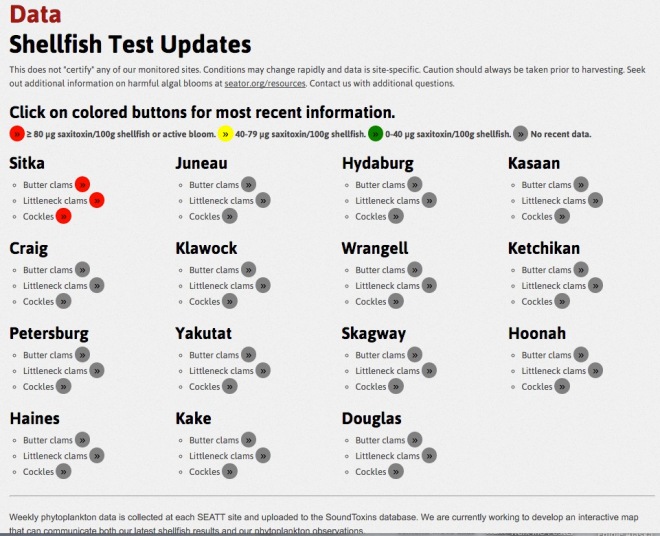
SEATORDataUpdate06102016

Seator-Logo-Best-June-30-2015-7pm-215x215The SouthEast Alaska Tribal Ocean Research (SEATOR) project, SouthEast Alaska Tribal Toxins (SEATT) partnership and the Sitka Tribe of Alaska Environmental Research Lab (STAERL) have expanded a recent paralytic shellfish poisoning (PSP) advisory to include more beaches in Southeast Alaska.

The advisory, initially announced on May 26, now includes multiple beaches in Sitka, Juneau, Craig, Petersburg, and Klawock. The PSP advisory is for bivalve shellfish — such as clams, mussels, oysters, cockles, scallops, geoducks, etc. — that have been recreationally or subsistence harvested. It does not apply to commercially harvested shellfish, which are tested before they enter the market. The advisory does not apply to other shellfish, such as crabs or shrimp, which do not carry PSP (unless you eat the crab butter/viscera).

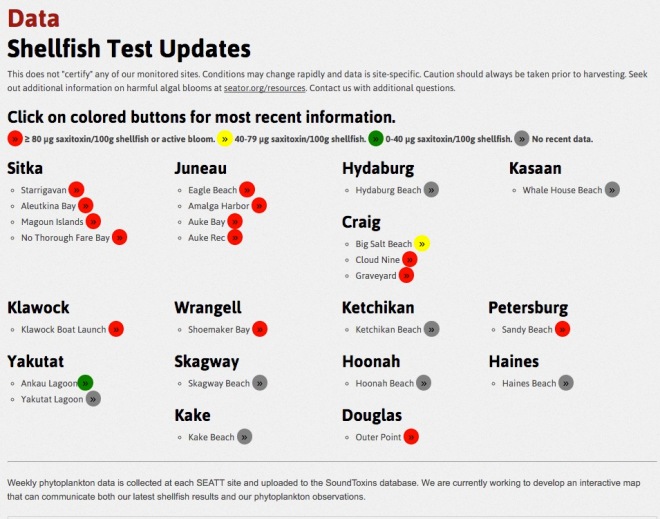
According to a SEATOR press release, “Recent samples on June 6 confirmed elevated levels of Alexandrium, the phytoplankton species that produces saxtoxins causing PSP, have been observed at the following locations and shellfish from these sites should not be harvested at this time.” The affected beaches from June 6 are Auke Bay, Amalga Harbor, Eagle Beach, and Auke Rec beaches in Juneau; Cloud 9 and Graveyard beaches in Craig; Starrigavan beach in Sitka; and the Boat Ramp beach in Klawock.

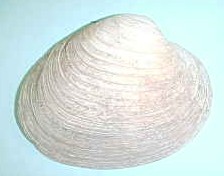
The butter clam has one set of rings that go one direction only, around the same center point (Photo courtesy of Alaska Department of Environmental Conservation)

The butter clam has one set of rings that go one direction only, around the same center point (Photo courtesy of Alaska Department of Environmental Conservation)

In addition, the press release said, “On June 9 shellfish from the following sites tested above the regulatory limit of 80µg/100g for saxitoxins and should not be harvested at this time.” The June 9 list of beaches includes Sandy Beach in Petersburg (butter clams only); Auke Bay, Amalga Harbor, Eagle Beach, and Auke Rec beaches in Juneau; Aleutkina Bay, No Through Fare Bay, Magoun Islands, and Starrigavan (butter clams only) beaches in Sitka; and the Boat Ramp beach in Klawock. The advisory is for all shellfish on all beaches, except where noted.

According to SEATOR, “This does not ‘certify’ any of our monitored sites. Conditions may change rapidly and data is site-specific. Caution should always be taken prior to harvesting.”

SEATOR posts updates and information to its website at seator.org/data, which can help provide Southeast Alaska residents with reliable information so they can choose whether or not to harvest shellfish. In addition to testing water samples weekly from certain Southeast beaches, STAERL also tests samples of butter clams, littleneck clams, and blue mussels (which is STAERL’s indicator species because of how quickly blue mussels absorb saxotoxins).

Since most beaches in Alaska aren’t tested for harmful algal blooms, SEATOR and the SEATT partnership were formed in October 2014 to train people to test beaches in Southeast Alaska. In April 2015, the Sitka Tribe of Alaska opened a regional lab on Katlian Street, so samples could be tested in Sitka without having to be sent to the Lower 48, which delayed results. By testing for harmful algal blooms, SEATOR and the SEATT partnership hope to be able to provide information so people can make informed choices whether or not to harvest or eat shellfish.

Harmful algal blooms, such as paralytic shellfish poisoning (PSP), typically have not been monitored in Southeast Alaska for subsistence and recreational harvesters of clams, mussels, oysters, cockles, and other bivalves (commercial harvests are tested). Even though many people in Southeast Alaska love to harvest shellfish, eating it comes with some risks. There have been several PSP outbreaks in recent years that sent people to the hospital, and in 2010 two deaths were attributed to PSP and other HABs, such as Alexandrium, Pseudo-nitzchia and Dinophysis.

To learn more about harmful algal blooms and how they can raise the risk for PSP and ASP (amnesic shellfish poisoning, which also can be fatal), go to SEATOR’s resources page. If you have shellfish you recently harvested and want to test it, click this link to learn what you need to do to have it tested by STAERL. Please contact STAERL at 747-7395 with any additional questions.

• June 10, 2016, press release about PSP advisory for Southeast Alaska

Check out the June 2016 edition of the Sitka Local Foods Network newsletter

June2016SLFNNewsletterScreenshot

The Sitka Local Foods Network just sent out the June 2016 edition of its newly launched monthly newsletter. Feel free to click this link to get a copy.

This edition of the newsletter has brief stories about a couple of Sitka commercial trollers starting the Edible Alaska magazine, our recruiting new board members, the dates for the 2016 Sitka Farmers Markets, the second batch of classes for the garden mentor program, and a recent shellfish advisory issued for several beaches in Southeast Alaska. Each story has links to our website for more information.

You can sign up for future editions of our newsletter by clicking on the registration form image in the right column of our website and filling in the information. If you received a copy but didn’t want one, there is a link at the bottom of the newsletter so you can unsubscribe. Our intention is to get the word out about upcoming events and not to spam people. We will protect your privacy by not sharing our email list with others.

Harmful algal bloom warning listed for shellfish harvested at Sitka, Craig, Klawock and Petersburg

Clam diggers work the beach at Starrigavan in this file photo. The Sitka Tribe of Alaska is warning Sitkans against harvesting clams in the area due to a harmful algae detected Monday, June 8, 2015. (Daily Sitka Sentinel file photo by James Poulson)

Clam diggers work the beach at Starrigavan in this file photo. The Sitka Tribe of Alaska is warning Sitkans against harvesting clams in the area due to a harmful algae detected Tuesday, May 25, 2016. (Daily Sitka Sentinel file photo by James Poulson)

Seator-Logo-Best-June-30-2015-7pm-215x215The SouthEast Alaska Tribal Ocean Research (SEATOR) project coordinated by the Sitka Tribe of Alaska on Wednesday, May 26, issued a harmful algal bloom warning for shellfish harvested in four Southeast Alaska communities. The warning is for shellfish harvested on Starrigavan Beach in Sitka, Graveyard Beach in Craig, the Klawock Boat Launch, and Sandy Beach in Petersburg.

(Editor’s Note: On Thursday, June 2, SEATOR and the University of Alaska Fairbanks School of Fisheries and Ocean Sciences in Juneau announced a similar shellfish advisory for shellfish harvested on June 1 from several beaches in the Juneau area — Auke Bay, Point Louisa/Auke Rec, Amalga Harbor and Eagle Beach. For more information on Juneau, contact Elizabeth Tobin at 1-907-796- 5455 or edtobin@alaska.edu or Chris Whitehead of SEATOR at chris.whitehead@sitkatribe-nsn.gov. On June 3, SEATOR added Cloud 9 Beach in Craig to the list of beaches affected by the shellfish advisory.)

“The Sitka Tribe of Alaska Environmental Research Lab (STAERL) has been collecting shellfish samples to test for biotoxins, specifically paralytic shellfish poisoning (PSP),” STAERL announced in a press release. “Recent samples on May 25, 2016, confirm that clams at the following beaches have elevated levels of toxins above the FDA regulatory limit of 80µg/100g and should not be harvested at this time.”

The butter clam has one set of rings that go one direction only, around the same center point (Photo courtesy of Alaska Department of Environmental Conservation)

The butter clam has one set of rings that go one direction only, around the same center point (Photo courtesy of Alaska Department of Environmental Conservation)

SEATOR, the Southeast Alaska Tribal Toxins (SEATT) partnership, and the Sitka Tribe of Alaska have been monitoring saxitoxin on Starrigavan Beach in Sitka and other beaches around Southeast Alaska since late 2014. Saxitoxin is produced by the phytoplankton Alexandrium and can get highly concentrated in shellfish, leading to paralytic shellfish poisoning (PSP), which can be fatal.

SEATOR posts updates and information to its website at seator.org/data, which can help provide Southeast Alaska residents with reliable information so they can choose whether or not to harvest shellfish. On May 6, SEATOR announced an advisory for shellfish harvest on Starrigavan Beach in Sitka, when it found Alexandrium in its weekly phytoplankton samples and high levels of saxitoxin in butter clams, littleneck clams, and blue mussels. Because of the high levels, SEATOR advised Sitka residents not to harvest shellfish at the time.

Since most beaches in Alaska aren’t tested for harmful algal blooms, SEATOR and the SEATT partnership were formed in October 2014 to train people to test beaches in Southeast Alaska. In April 2015, the Sitka Tribe of Alaska opened a regional lab on Katlian Street, so samples could be tested in Sitka without having to be sent to the Lower 48, which delayed results. By testing for harmful algal blooms, SEATOR and the SEATT partnership hope to be able to provide information so people can make informed choices whether or not to harvest or eat shellfish.

Harmful algal blooms, such as paralytic shellfish poisoning (PSP), typically have not been monitored in Southeast Alaska for subsistence and recreational harvesters of clams, mussels, oysters, cockles, and other bivalves (commercial harvests are tested). Even though many people in Southeast Alaska love to harvest shellfish, eating it comes with some risks. There have been several PSP outbreaks in recent years that sent people to the hospital, and in 2010 two deaths were attributed to PSP and other HABs, such as Alexandrium, Pseudo-nitzchia and Dinophysis.

To learn more about harmful algal blooms and how they can raise the risk for PSP and ASP (amnesic shellfish poisoning, which also can be fatal), go to SEATOR’s resources page. If you have shellfish you recently harvested and want to test it, click this link to learn what you need to do to have it tested by STAERL.

• Press release about shellfish advisory, May 26, 2016

• Joint SEATOR/UAF School of Fisheries and Ocean Studies press release about Juneau shellfish advisory, June 2, 2016

• June 3, 2016, SEATOR press release updating the list of affected beaches

Scenes from the Safe Home Food Preservation certification course May 14-15 in Sitka

SarahLewisDiscussesTypesOfPressureCanners

Food preservation certificate flierIn an effort to train people to teach safe home food preservation classes in their Southeast Alaska communities, the University of Alaska Fairbanks Cooperative Extension Service hosted a series of certification courses around the region in recent months. The Sitka class on May 14-15 at Blatchley Middle School wrapped up the series, which featured several online lessons followed by two-day hands-on classes in Juneau, Ketchikan and Sitka.

The Sitka class was taught by UAF Cooperative Extension Service Associate Director Roxie Rodgers Dinstel of Fairbanks and Sarah Lewis, a Family and Community Development faculty member from Juneau. In addition to several Sitka residents, there also were students from Haines, Petersburg and Juneau in the Sitka class. The series was funded by a grant from the SouthEast Alaska Regional Health Consortium (SEARHC).

During the class, the 10 students learned which foods need waterbath canning vs. pressure canning, had a lesson on fermenting, tested pressure canner gauges, dehydrated fruits and veggies, made jerky, and learned how to find reliable resources to make sure their home food preservation practices are safe.

In addition to teaching classes, some of the students will use their new skills for cottage food businesses and home canning projects. One of the purposes of the class was to certify people in a variety of Southeast Alaska communities on how to teach safe home food preservation classes, so they don’t have to wait for a UAF Cooperative Extension Service faculty member from Juneau, Anchorage or Fairbanks to come to town to teach.

A slideshow of scenes from the two-day hands-on classes is below.

This slideshow requires JavaScript.


Harmful algal bloom warning listed for shellfish harvested at Starrigavan Beach

SEATORShellfishTestingLevels

The SouthEast Alaska Tribal Ocean Research (SEATOR) project coordinated by the Sitka Tribe of Alaska on Friday, May 6, issued a harmful algal bloom warning for shellfish harvested on Starrigavan Beach in Sitka.

SEATOR, the Southeast Alaska Tribal Toxins (SEATT) partnership, and the Sitka Tribe of Alaska have been monitoring saxitoxin on Starrigavan Beach in Sitka and other beaches around Southeast Alaska since late 2014. Saxitoxin is produced by the phytoplankton Alexandrium and can get highly concentrated in shellfish, leading to paralytic shellfish poisoning (PSP), which can be fatal.

According to SEATOR, “during our weekly phytoplankton sample last week, we noticed our first Alexandrium of the year. Immediately after, we tested saxitoxin levels in butter clams, littleneck clams and blue mussels, and found them all to have elevated levels of saxitoxin. We do not recommend that Sitkans harvest shellfish at this time, and ask them to look on seator.org/data for additional updates and information.”

Since most beaches in Alaska aren’t tested for harmful algal blooms, SEATOR and the SEATT partnership were formed in October 2014 to train people to test beaches in Southeast Alaska. In April 2015, the Sitka Tribe of Alaska opened a regional lab on Katlian Street, so samples could be tested in Sitka without having to be sent to the Lower 48, which delayed results. By testing for harmful algal blooms, SEATOR and the SEATT partnership hope to be able to provide information so people can make informed choices whether or not to harvest or eat shellfish.

Harmful algal blooms, such as paralytic shellfish poisoning (PSP), typically have not been monitored in Southeast Alaska for subsistence and recreational harvesters of clams, mussels, oysters, cockles, and other bivalves (commercial harvests are tested). Even though many people in Southeast Alaska love to harvest shellfish, eating it comes with some risks. There have been several PSP outbreaks in recent years that sent people to the hospital, and in 2010 two deaths were attributed to PSP and other HABs, such as Alexandrium, Pseudo-nitzchia and Dinophysis.

Did you file for your PFD yet? Add a Pick.Click.Give. donation to the Sitka Local Foods Network

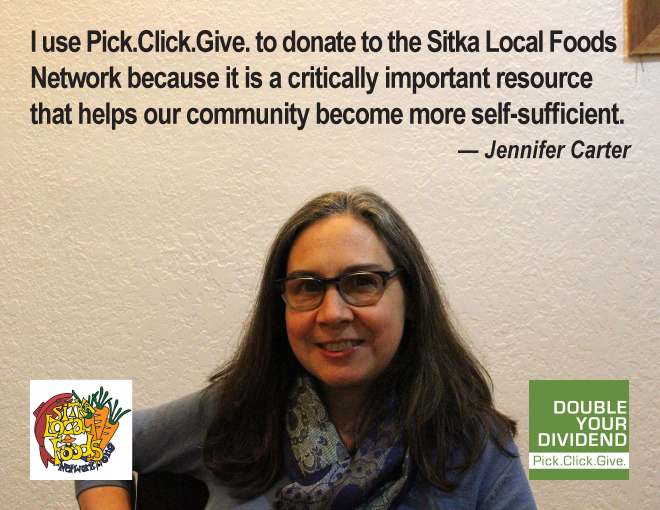
PCGTestemonialJenniferCarter2016

It’s mid-March, which means the deadline is rapidly approaching to file for Alaskans to apply for their 2016 Alaska Permanent Fund Dividends. As usual, Alaskans can share their wealth with a variety of Alaska nonprofits, including the Sitka Local Foods Network, through the PFD’s Pick.Click.Give. charitable giving program.

PCGTestemonialLisaAndMurielSadleirHart2016This is the third year the Sitka Local Foods Network is participating in the Pick.Click.Give. program, which allows people to donate in $25 increments to their favorite statewide and local 501(c)(3) nonprofit organizations when they file their PFD applications from Jan. 1 through March 31. We thank the 64 donors who pledged $3,350 to the Sitka Local Foods Network in 2015, and we appreciate your support again in 2016.

When you choose to donate part of your PFD to the Sitka Local Foods Network, you support the Sitka Farmers Market, St. Peter’s Fellowship Farm, education programs about growing and preserving food, the Sitka Kitch community rental commercial kitchen, Blatchley Community Gardens, the sustainable use of traditional foods, the Sitka Community Food Assessment, the Sitka Food Summit, and a variety of other projects designed to increase access to healthy local foods in Sitka.

PCGTestemonialEllenFrankenstein2016In 2015 a record 33,421 Alaskans made 53,851 pledges of $3,329,575 to their favorite nonprofit organizations, up from $545,000 donated by 5,175 people in the program’s first year of 2009. Some Alaskans choose to donate to just one group, while others may spread several donations around to many groups. There now are more than 500 total 501(c)(3) nonprofit organizations participating in Pick.Click.Give. for 2016 (including multi-location nonprofits), including 24 from Sitka.

PCGTestemonialLindaWilson2016To encourage more Alaskans to donate through the Pick.Click.Give. program, this will be the second year of the Double Your Dividend contest. Anybody who makes a non-anonymous Pick.Click.Give. donation to at least one of the registered nonprofits will be entered into a contest where 10 lucky Alaskans will win a second PFD check. The winners will be announced in October, about the time the PFDs start hitting bank accounts.

PCGTestemonialCharlesBingham2016So how do you make a donation to the Sitka Local Foods Network through the Pick.Click.Give. program? First, go fill out your Alaska Permanent Fund Dividend application at http://pfd.alaska.gov/. When you get to the section of the application asking if you want to participate in Pick.Click.Give. Charitable Contributions program, click on the PCG link and search for the Sitka Local Foods Network. You also can look for us by using the town search for Sitka.

The Pick.Click.Give. program is available only to people who file their PFD applications online, and not to those who file by mail. Even though you can’t file a new PFD application after March 31, you can go back into your application and update your Pick.Click.Give. donations through Aug. 31 each year.

PCGTestemonialCathyLieser2016You still can donate to the Sitka Local Foods Network if you aren’t from Alaska or aren’t eligible for a 2016 PFD. To donate, send your check to the Sitka Local Foods Network, 408D Marine St., Sitka, Alaska, 99835. You also can donate online by going to our online fundraising page on Razoo.com, and clicking the Donate button to make an online contribution. Please let us know if you need a receipt for tax purposes. For more information about donating, you can send an email to sitkalocalfoodsnetwork@gmail.com.

Thank you for supporting our mission of promoting and encouraging the growing, harvesting and eating of local foods in Sitka and Southeast Alaska.

2016PickClickGiveFlier

Third annual Sitka Herring Festival kicks off March 18 with month of events


Events_List

Spring is right around the corner in Sitka, and nothing says spring in Sitka like the arrival of the herring. The Sitka Tribe of Alaska‘s third annual Sitka Herring Festival kicks off on Friday, March 18, with a month of fantastic event for adults and kids alike.

This year the festival kicks off at 11 a.m. on Friday, March 18, with the Blessing of Herring Rock (Yaaw T’eiyí) in front of the Sheet’ka Kwáan Naa Kahídi. Herring Rock is a cultural landmark of the Kiks.ádi clan, and a member of the clan leads this annual ceremony. Please note this event date and time have changed since first announced.

Derby FlyerFor those kids who like a little competition, there’s the Sitka Herring Derby. As in previous years, the Herring Derby will be a fun event for kids and parents. The Derby starts on Saturday, March 19, and continues through Saturday, April 9. Weigh your biggest fish every day (from 9 a.m. to 5 p.m. on Monday through Friday and from 3-6 p.m. on Saturday and Sunday) at the Sitka Tribe of Alaska Resources Production Office at 429 Katlian Street. May the best (biggest) fish win. The awards ceremony will be April 12 at Blatchley Community Swim Pool.

Also on Saturday, March 19, is a herring-themed Discovery Days program at the Sitka Sound Science Center. Discovery Days is a youth educational program from 10 a.m. to noon that meets every other Saturday, and this event will feature Sitka Herring Festival coordinator Jessica Gill discussing the life cycle of herring.

The Sitka Whalefest and Sitka Sound Science Center will host the annual food web cruise fundraiser for the Whalefest from 9 a.m. to noon on Saturday, March 26. This is an Allen Marine harbor cruise that usually features some of the best whale-watching of the spring. The cost is $55 per person, which includes a light breakfast spread. Tickets are available at Old Harbor Books.

This year’s Wearable Arts Show, sponsored by the Greater Sitka Arts Council, will feature a new attraction as local artists team up to dedicate a piece about the growing problem of waste in our oceans.

On April 1, is the ArtiGras Art Walk and logos are due for local high school students to submit their Sitka Herring Festival logo designs. In addition to the usual art found in Sitka galleries and businesses during the art walk (hosted by the Greater Sitka Arts Council), the Sheet’ka Kwáan Naa Kahídi will host a variety of community artists and herring dishes from around the world from 5-8 p.m. on Friday, April 1.

Also like last year, Sitka Community Schools will host the Herring Fun Run. The run will start at 8:30 a.m. on Saturday, April 2, and will feature a couple of loops of the totem trails at Sitka National Historical Park. Herring swim in schools, so bring your friends.

The Sitka Herring Festival community potluck is from 6-8 p.m. on Thursday, April 7, at Sweetland Hall at the Sheldon Jackson Campus. Bring a dish to share. The guest speaker, Ilona Kemp-Noordeloos, is a PhD. student at University of Alaska Fairbanks who will give the presentation, “Herring and the Human Element in the Bristol Bay Fisheries.”

More info for all these events can be found online at http://sitkaherringfestival.wordpress.com or at the festival’s Facebook page. Or you can email sitkaherringfestival@gmail.com or call 747-7168 for info.

• 2016 Sitka Herring Festival calendar of events

• Sitka Herring Festival logo contest rules and entry form

• 2016 Sitka Herring Festival Kids’ Fishing Derby flier

• Alaskans Own community-supported fisheries program announces 2016 season subscription prices

Flier no tabs

Sitka-based Alaskans Own seafood recently announced its subscription prices for its 2016 community-supported fisheries (CSF) program in Sitka, Juneau, and Anchorage.

Alaskans Own was the first CSF program in the state, modeling its program after the successful community-supported agriculture (CSA) programs that let customers deal directly with harvesters so they can buy subscription shares to the year’s crop/catch. In addition to the CSF program, Alaskans Own usually has a table at the Sitka Farmers Markets during the summer (and plans to have a larger presence at the market this summer).

AO flier no tagsThis is the seventh year of the Alaskans Own CSF program, and there are four-month and six-month subscriptions available starting in May. The six-month subscriptions allow people to keep receiving freshly caught seafood through October instead of August, when the traditional four-month subscriptions end. Half-subscriptions also are available. Subscriptions include a mix of locally troll-caught black cod (sablefish), halibut, king salmon, coho salmon, lingcod and miscellaneous rockfish, depending on the commercial fishing season and prices.

AO logo-01 (2)“We’re so excited to be going into another year of connecting more Alaskans with the best fish out there,” said Anya Grenier, Alaskans Own seafood coordinator. “So little of the incredible bounty of our waters stays in state, or even in the U.S. We want to change that dynamic, and we think the place to start is investing in our fishermen and our community.”

This year’s price for a six-month full subscription (about 60 pounds, or 10 pounds a month) in Sitka is $825 (does not include sales tax) and $435 for a half subscription (about 30 pounds). The price for a four-month full subscription (about 40 pounds) is $565 and $300 for a half subscription (about 20 pounds). Sitka residents are required to pay 5 percent city sales tax if purchased before March 31, and 6 percent sales tax after that. Wholesale orders are available, and the deadline for subscription orders is May 1.

Prices and sales tax charges may vary for the other communities participating in the program. People can use the Alaskans Own online store site to purchase their CSF shares. You also can send a check to Alaskans Own, P.O. Box 1229, Sitka, Alaska, 99835. Delivery times and dates in Sitka will be announced later and usually take place at the old mill building next to the Sitka Sound Science Center (834 Lincoln Street).

20150524_sitka_925

Photo by Joshua Roper / Alaska Seafood Marketing Institute (ASMI)

The Alaskans Own seafood program is managed by the Alaska Longline Fishermen’s Association. It also partners with the Alaska Sustainable Fisheries Trust, the Fishery Conservation Network and Local Fish Fund, which have missions to strengthen Alaskan fishing communities and marine resources through scientific research, education, and economic opportunity.

For more information about the Alaskans Own seafood program, contact Anya Grenier at alaskansownfish@gmail.com or 738-2275.

• Sitka’s Fish to Schools program on international list of 16 innovative school lunch programs

SCS-031_smFishToSchoolsTaco

FoodTankLogoSitka’s Fish to Schools program is one of 16 school lunch programs from around the world making a difference, according to an international list released this month by the organization Food Tank.

The Fish to Schools program got its start at the 2010 Sitka Health Summit, when community members decided they wanted to see more locally harvested fish in school lunches. The Sitka Conservation Society coordinates the program, in partnership with local schools.

The program started off with a monthly local fish lunch choice at Blatchley Middle School, but the program quickly expanded to include weekly local fish lunch choices at all Sitka schools (including the state-run Mount Edgecumbe High School boarding school and the private The SEER School).

In addition to putting local fish on the school lunch menu, the program also includes education about the fishing industry and its impact on the community (about one in five adults in Sitka work in the fishing industry). Local fishermen and women periodically share lunches with the students, which helps the students connect with their local food system. Local fishermen also donate coho salmon to the program, to help keep it sustainable.

In May 2014, the Sitka Fish to Schools program released a guidebook so other school districts in Alaska could create similar programs. For more information about the Fish to Schools program in Sitka, contact Sophie Nethercut of the Sitka Conservation Society, sophie@sitkawild.org or 747-7509.