Sitka Kitch to host Seasonal Cooking class series in Winter and Spring 2018

Learn a variety of cooking techniques during the new Seasonal Cooking class series, which will be hosted by the Sitka Kitch community rental commercial kitchen in Winter and Spring 2018.

All classes in this series take place at the Sitka Kitch (505 Sawmill Creek Road, inside First Presbyterian Church). Two of the classes already have taken place, as we delayed the announcement of the complete series while waiting for some dates to finalize.

Here is the list of classes (click on the class title for a direct link to the online registration page, link will open when registration page is available).

  • Cooking With Hank Moore 6-8:30 p.m., Tuesday, Jan. 16, In honor of Martin Luther King Jr. Day, make blackcod, collard greens, black-eyed peas, and brown rice.
  • Spice It Up With Lexie Smith 6-8:30 p.m., Monday, Feb. 12, Make a Valentine’s Day dinner of baked coho salmon with an apricot glaze, curried butternut squash, couscous, and a marinaded salad with arugula, baby tomatoes, strawberries, cucumbers and watermelon, with pistachios, limes and Greek yogurt as a topping. Lexie is the NMS chef manager at the Island Skillet at SEARHC Mt. Edgecumbe Hospital.
  • Pakistani Cooking With AFS Exchange Student Shanzila Ahmed 6-8:30 p.m., Tuesday, Feb. 27, Learn how to make biryani (rice, chicken and a variety of spices).
  • National Nutrition Month Healthy Cooking Demonstration5:30-7 p.m., Tuesday, March 27, Free event with SEARHC health educator Heleena Van Veen, health educator Holly Marban, registered dietitian Jessica Holland and diabetes nurse Kelly Lakin. This year’s National Nutrition Month theme is “Go Further With Food,” so students will learn creative ways to use leftovers and how to store food so it doesn’t spoil.
  • Herring Appreciation With Renee Trafton (Beak Restaurant) 6-8:30 p.m., Tuesday, April 3 (alternate date is April 10 if herring running late), Celebrate the return of herring to Sitka by making herring egg salad and sushi.
  • Naturally Clean Home Products1-3 p.m., Saturday, April 7, Videoconference with Sarah Lewis of Juneau office of UAF Cooperative Extension Service. This class will teach you how to reduce your use of harsh, chemical cleaners but still be able to do deep cleaning. Students need to bring five 32-ounce spray bottles and a 20-ounce jar with lid (or six quart canning jars to store products to take home and then transfer to spray bottles). Class fee is $20, no supply fee.
  • Starting A Cottage Foods Business1-3 p.m., Saturday, April 14, Videoconference
    with Sarah Lewis of Juneau office of UAF Cooperative Extension Service. Learn about state laws regarding home food businesses, and get ideas for businesses you might take to the Sitka Farmers Market or local trade shows. Tours of the Sitka Kitch and rental information will be available. Class fee is $10, no supply fee. The Sitka Local Foods Network offers class participants half-off the registration fee for their first Sitka Farmers Market in 2018.
  • Puerto Rican Cooking With Nina Vizcarrondo 6-8:30 p.m., Wednesday, May 2, Learn how to cook sofrito with recao, empanadas or pastelon, and arroz con gandules from Nina, a former U.S. Coast Guard chef and the current Sitka Farmers Market manager.

Class space is limited, so register early. Unless noted, all Seasonal Cooking classes cost $27.50 per person, plus a food/supply fee split between the registered students. The registration deadline for Shanzila’s class is 11 p.m. on Saturday, Feb. 24, and other registration deadlines are two nights before the class so instructors have time to buy supplies.

Register online at https://sitkakitch.eventsmart.com/ (click on class title) and pre-pay using credit/debit cards or PayPal. To pre-pay by cash or check, contact Chandler, Claire, or Clarice at 747-7509 to arrange payment. For more information about the class series, contact Jasmine at 747-9440.

Scenes from the second Seasonal Cooking class: Spice It Up With Lexie Smith at the Sitka Kitch

Students learned how to make a Valentine’s Day dinner during the Spice It Up With Lexie Smith class on Monday, Feb. 12, at the Sitka Kitch community rental commercial kitchen. This was the second class of the Seasonal Cooking class series at the Sitka Kitch.

Lexie Smith, the NMS chef manager at the Island Skillet at SEARHC Mt. Edgecumbe Hospital, taught students how to make baked coho salmon with an apricot glaze, curried butternut squash, couscous, a marinated salad with arugula, tomatoes, strawberries, watermelon and cucumbers, with yogurt and limes for a garnish.

The next class in the Seasonal Cooking series is Pakistani Cooking with AFS exchange student Shanzila Ahmed, from 6-8:30 p.m. on Tuesday, Feb. 27, at the Sitka Kitch. Shanzila will teach students how to make a very famous Pakistani dish called biryani, which features rice, chicken and a lot of different spices.

Other classes in the Seasonal Cooking class series will be announced soon, but topics include healthy cooking for National Nutrition Month, herring appreciation, and Puerto Rican food. There also will be videoconference classes on earth-friendly cleaning products and how to start a cottage foods business.

Class space is limited, so register early. Unless noted, the Seasonal Cooking classes cost $27.50 per person, plus a food/supply fee split between the registered students. The registration deadline for Shanzila’s class is 11 p.m. on Saturday, Feb. 24.

Register online at https://sitkakitch.eventsmart.com/ (click on class title) and pre-pay using credit/debit cards or PayPal. To pre-pay by cash or check, contact Chandler, Claire, or Clarice at 747-7509 to arrange payment. For more information about the class series, contact Jasmine at 747-9440.

This slideshow requires JavaScript.

Sitka Kitch to offer Seasonal Cooking: Spice It Up With Lexie Smith class on Feb. 12

NMS Chef Manager Lexie Smith holds deer hind quarters before preparing them for Mt. Edgecumbe Hospital patients as part of the hospital’s new traditional food options

Lexie Smith, the NMS chef manager at the Island Skillet at SEARHC Mt. Edgecumbe Hospital, will teach the second class in the Sitka Kitch‘s new class series, Seasonal Cooking, from 6-8:30 p.m. on Monday, Feb. 12, at the Sitka Kitch community rental commercial kitchen. The class is called Spice It Up With Lexie Smith.

Lexie and her students will cook a Valentine’s Day dinner of baked salmon, curried butternut squash, cous cous, marinated tomatoes and cucumbers, with yogurt.

Other classes in the Seasonal Cooking class series will be announced soon, but topics include Pakistani cooking, healthy nutrition cooking, herring appreciation, canning beans and salsa, and Puerto Rican food. There also will be a class on earth-friendly cleaning products.

Class space is limited, so register early. This class costs $27.50 per person, plus a food/supply fee split between the registered students. The registration deadline is 11 p.m. on Saturday, Feb. 10.

Register online at https://sitkakitch.eventsmart.com/ (click on class title) and pre-pay using credit/debit cards or PayPal. To pre-pay by cash or check, contact Chandler, Claire, or Clarice at 747-7509 to arrange payment. For more information about the class series, contact Jasmine at 747-9440.

Check out the February 2018 edition of the Sitka Local Foods Network newsletter

The Sitka Local Foods Network just sent out the February 2018 edition of its monthly newsletter. Feel free to click this link to get a copy.

This month’s newsletter has short articles about our new Sitka Food Business Innovation Contest, a request for volunteer gardening instructors this spring, a reminder about the Pick.Click.Give. donation program, information about our sponsorship program, and an invitation to join our board of directors. Each story has links to our website for more information.

You can sign up for future editions of our newsletter by clicking on the newsletter image in the right column of our website and filling in the information. If you received a copy but didn’t want one, there is a link at the bottom of the newsletter so you can unsubscribe. Our intention is to get the word out about upcoming events and not to spam people. We will protect your privacy by not sharing our email list with others. Don’t forget to like us on Facebooklike our new Sitka Farmers Market page on Facebook and follow us on Twitter (@SitkaLocalFoods).

Sitka Local Foods Network launches Sitka food business innovation contest

A sampling of current food products grown, manufactured or processed in Sitka

Do you think you have a great idea for a food business or product from Sitka? The Sitka Local Foods Network is launching the inaugural Sitka food business innovation contest in an effort to spark local food entrepreneurs so we can make more local food available to residents and visitors.

This contest will provide two $1,500 kicker prizes — one for established food businesses and one for start-up businesses (no older than two years) — to help entrepreneurs launch or expand their food businesses. The contest is open to food businesses and individuals making and selling food products in Sitka, Alaska. All food business ideas must be geared toward getting more locally grown, harvested and/or produced food into the Sitka marketplace through sales in grocery stores, the Sitka Food Co-Op, the Sitka Farmers Market, restaurants, or individual marketing (such as a community supported agriculture/CSA or community supported fisheries/CSF program).

“The Sitka Local Foods Network’s mission is to get more locally harvested and produced food into the diets of Southeast Alaskans,” said Charles Bingham, Sitka Local Foods Network board president. “For the past decade we’ve offered a entrepreneurs a chance to sell their produce, bread and fish at the Sitka Farmers Market, grown produce to sell at the market through St. Peter’s Fellowship Farm, and provided a garden education program to residents. We think this contest is the next step toward getting more local food into the Sitka marketplace.”

Participants in this contest are eligible and encouraged to enter other food business innovation contests, such as the Path To Prosperity or Symphony of Seafood contests. All participants retain the proprietary rights to their products and ideas. This contest is open to new and existing food businesses in Sitka. Student businesses (such as those fostered by Junior Achievement or similar programs) are welcome.

There is a small $25 entry fee for this contest. All participants (business and individual) must complete and submit our contest entry form by 5 p.m. on Friday, April 6, 2018 (by snail mail so it arrives before the deadline to Sitka Local Foods Network, Food Business Innovation Contest Entries, 408-D Marine Street, Sitka, Alaska, 99835, or by email with the Subject Line of “Food Business Innovation Contest Entries” to sitkalocalfoodsnetwork@gmail.com). Submitting a business plan (up to 20 pages) is recommended, but not required.

Our entry form will have room for you to describe your food business idea in a few paragraphs, but submitting a business plan will give you more room to outline your plans for funding and marketing the idea and will help your overall score. Judging will be based on how your food business idea provides new local food options in Sitka, how novel is your food business idea, how feasible is your food business (can it make a profit and be sustainable), and how professional is your presentation. At some time about the third week of April, the Sitka Local Foods Network will host a pitch presentation where judges will interview the contest entrants and try samples of the food products. Our judging panel will score your presentation and entry form based on how your idea has a measurable impact on providing local food in Sitka (25%), has the potential for commercialization (25%), provides new employment in Sitka (25%) and fills a need in the Sitka marketplace (25%).

If we find additional sponsors, we may add additional prizes and categories (such as fish or farm). Depending on the number of entries and interest of the participants, we may host a reception where contestants can demonstrate their products to Sitka residents. If the reception happens, there will be a chance for people to vote on their favorite products with the winner receiving the People’s Choice Award (this will be separate than the two main prizes selected by our judging panel). We are hoping to find a sponsor for the People’s Choice Award. Note, if our panel of judges determine there isn’t a worthy entrant in one or both categories, then the Sitka Local Foods Network reserves the right not to award a prize. Marijuana edibles are not eligible for the contest.

• Sitka Food Business Innovation Contest Entry Form 2018

Sitka UAF student Trevor Schoening earns award to study statewide food production in Alaska

Trevor Schoening (Photo courtesy of Trevor Schoening)

University of Alaska Fairbanks natural resources management student Trevor Schoening of Sitka, a junior, recently received a 2018 Spring Project Award from URSA, the Undergraduate Research and Scholarly Activity program.

The program awards up to $2,500 to students planning to conduct research or pursue creative projects during the spring semester. Twenty UAF students will receive awards this spring.

Schoening said he’s still developing his project and doesn’t want to build up too many expectations, especially since he’s unsure of his outcomes. But he plans to present his findings on April 10 at the UAF Research Day.

According to a UAF School of Natural Resources and Extension (SNRE) press release, Schoening said he hopes to get a better understanding of where food production is taking place around Alaska. He plans to use the directory provided on the Alaska Grown website to find farmers markets and will ask for a list of vendors to contact for production information.

“In short, my principal goal for this project is to gain a deeper spatial understanding of where food is being grown around Alaska, particularly with regard to distribution through farmers markets,” Schoening wrote in an email. “I hope to contact as many producers around the state as possible in order to obtain a sample representative of the state’s food production, and gather information on the physical location in Alaska where the food is produced, what type(s) of food the producer grows, and roughly how much food is grown by the producer annually. Ultimately the goal for the final project is to develop spatial maps (specific maps for different regions of the state) through GIS that display the geographic locations around Alaska where food is being produced for commercial sale at some scale.”

Food producers wanting to contact Schoening about how much food they grew and distributed can contact him by email at tschoening2@alaska.edu.

SEARHC Mt. Edgecumbe Hospital patients now have traditional food options

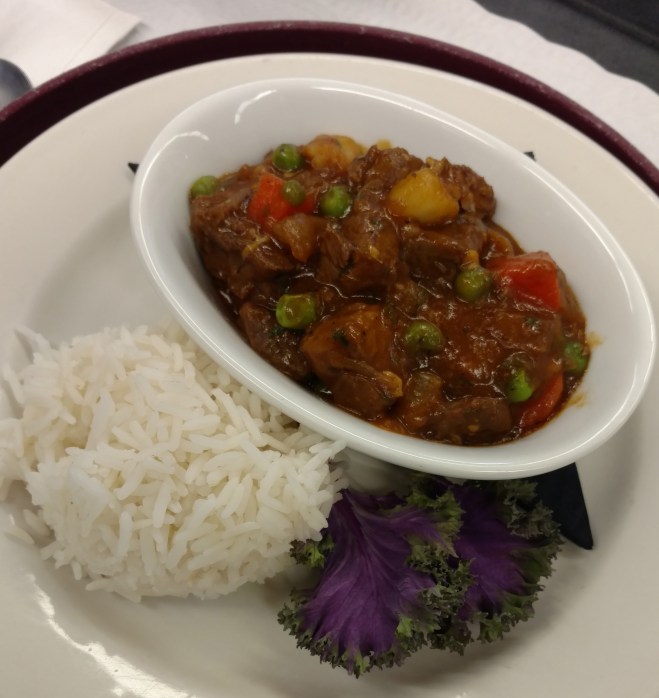
A bowl from venison stew served at the Mt. Edgecumbe Hospital cafeteria (Photos courtesy of SEARHC)

As part of the SouthEast Alaska Regional Health Consortium (SEARHC) Mt. Edgecumbe Hospital’s (MEH) overarching goal to provide the best care possible to individuals receiving medical care at MEH, the Hospital Nutrition staff, in partnership with food service contractor NMS, recently began making traditional food options available to inpatients.

NMS Chef Manager Lexie Smith holds deer hind quarters before preparing them for Mt. Edgecumbe Hospital patients as part of the hospital’s new traditional food options

Providing care means more than traditional medicine, it means comforting those that are not feeling well. One way Mt. Edgecumbe Hospital Nutrition staff thought they could provide additional comfort that was to add traditional foods such as local game, seafood, plants, and berries to the inpatient menu that feel like comfort food. However, adding traditional foods to the hospital’s menu required coordination with more than one Alaska State agency, including the Department of Environmental Conservation and the Department of Fish and Game.

Undaunted by the task and motivated by the inevitable outcome, the MEH Nutrition team set out to develop a policy that would satisfy the state and SEARHC. The Traditional Foods Policy they created took quite a while to finalize, but resulted in a system that now allows Mt. Edgecumbe Hospital to accept donations of locally harvested meat, seafood, vegetables, and berries to be used exclusively for inpatient meals.

“As a team, we truly believe that the food we serve, and the hospitality we provide aid in the healing process. NMS is proud to prepare traditional foods that bring comfort to Mt. Edgecumbe patients, and we are committed to doing so,” said Lexie Smith, NMS Chef Manager at Mt. Edgecumbe Hospital. “The menu is meant to engage our guests, honor tradition, and respect the land. The venison stew, in particular, is a recipe calling for fresh vegetables, herbs, and Sitka venison (as supplies are available). The stew is a popular menu option that many guests relate to and feel comforted by. Our Traditional Foods Policy allows the public to make donations of indigenous foods as long as it has been properly handled,” she added.

“This program is a win-win, great for the health of patients and great for community members who want to donate and be part of systems that emphasize living sustainably off the land and sea,” SEARHC Health Promotion Director Martha Pearson said.

For now, every Friday the MEH “Chef Special” for patients is venison stew. Ideally, however, if MEH were to receive donations of other items like fish, herring eggs, beach asparagus, fiddleheads, berries, reindeer, moose, etc. the Nutrition staff could incorporate those into the menu as well. They could also employ traditional methods of preserving. The hospital nutrition staff would very much like to see items such as local jams and pickles, herring egg salad, bone broths, and smoked fish on the patient menu in the future.

“Patient-centered medical care is a critical component of the way we deliver healthcare at SEARHC. Our Traditional Foods policy is an example of that and an enhancement to our vision of promoting a healthy balance of mind, body, and spirit,” SEARHC President/CEO Charles Clement said. “We are excited to explore ways to demonstrate our appreciation of the area and the local flavor in these offerings and are of course proud to be part of the future of healthcare delivery in the region.”

Additional information regarding traditional foods that may be donated and which are prohibited can be found online at http://dec.alaska.gov/eh/fss/Food/Traditional_Foods.html and reviewing the links under the “Requirements” section near the top of the page.

Individuals that have questions about donating traditional foods to Mt. Edgecumbe Hospital can contact NMS Food Service and Catering General Manager David Alexander at (907) 966-8325 or david.alexander@nmsusa.com, or NMS Chef Manager Lexie Smith at (907) 966-8470 or lexie.smith@nmsusa.com.

Sitka Tribe/SEATOR join new Alaska Ocean Acidification Network tribal research working group

Esther Kennedy at the SEATOR lab in Sitka.

While most people don’t know much about ocean acidification, it has become a major concern of Alaska fishing communities. Higher rates of CO2 means the ocean is 30 percent more acidic than it was three centuries ago, and that has impacted everything from how shellfish build their shells to causing harmful algal blooms that result in paralytic shellfish poisoning and other issues.

In order to monitor ocean acidification and its impact in Alaska coastal communities, the Sitka Tribe of Alaska (STA) and its partners in the Southeast Alaska Tribal Ocean Research (SEATOR) have joined the new Alaska Ocean Acidification Network (AOAN) tribal research working group.

Jeromy Grant, left, and Sean Williams of Hoonah Indian Association take water samples for SEATOR.

“Global warming increases the risk of shellfish toxins, while its partner ocean acidification directly threatens shellfish survival,” STA Environmental Specialist Esther Kennedy said. “We monitor ocean acidification and shellfish toxins at local beaches to ensure that shellfish remain a sustainable and safe wild food source despite ongoing environmental changes.”

The tribal working group was formed to coordinate ocean acidification research and monitoring activities, as well as local community outreach activities, between tribal organizations across Alaska. So far discussions have been on creating consistency in data collection, and expanding data collection to sites in the Arctic that are not currently adequately sampled.  This effort is about expanding tribal capacity for research and monitoring, and having tribes take the lead in some areas in Alaska which are under sampled by university and agency researchers, as well as partnering with those researchers to build local capacity.

In addition to Sitka Tribe of Alaska (STA), other members of the AOAN tribal working group include Alutiiq Pride Shellfish Hatchery in Seward, Sun’aq Tribe of Kodiak, the Native Village of Kotzebue, and Yakutat Tlingít Tribe. SEATOR includes 16 Southeast tribal partners, plus Sun’aq Tribe in Kodiak, with its lab located in Sitka. The Sitka Sound Science Center recently posted an online survey about ocean acidification for the AOAN.

“Over the past few years the Sitka Tribe of Alaska (STA) has become a leader in Alaska in monitoring for shellfish toxicity for communities,” said Davin Holen, who is coordinating the tribal working group for AOAN. “This includes working closely with communities throughout Southeast Alaska to monitor stocks important for subsistence harvests. This effort has lead to the establishment of the Southeast Alaska Tribal Ocean Research (SEATOR), which is housed in the environmental department of STA. Recently the STA lab installed equipment to monitor for ocean acidification. STA worked collaboratively with the Alutiiq Pride Shellfish Hatchery in Seward to set up monitoring protocols for ocean acidification. Using their existing SEATOR network for testing shellfish, STA is beginning to monitor ocean acidification levels throughout Southeast Alaska. Additional monitoring will occur in collaboration with the Sun’aq Tribe of Kodiak for Kodiak Archipelago communities, along with two sites under development in the Arctic. Tribal monitoring of environmental conditions in Southeast Alaska by STA through the SEATOR network has become a model for other areas of Alaska, making STA a vital partner for marine science in Alaska.”

The Sitka Tribe of Alaska continuously monitors the carbonate chemistry of Sitka Harbor and is beginning a discrete sample collection program modeled after the Alutiiq Pride Shellfish Hatchery’s existing program. The Sitka Tribe coordinates discrete sample collection and analysis with the SEATOR partnership’s existing weekly phytoplankton and shellfish biotoxin monitoring programs, including with the Hoonah Indian Association and other Southeast Alaska tribal partners.

Kennedy said SEATOR’s participation in the Alaska Ocean Acidification Network tribal working group is a natural extension of its shellfish testing work.

“We installed a Burke-o-Lator (BoL) in early June, which is an instrument that can continuously monitor the chemistry of water pumped through it and can measure individual preserved water samples,” Kennedy said. “While we’re still working to fully calibrate the individual water sample analysis portion of the instrument, we have started shipping kits of bottles and preservative to our partners. Since our partners are already collecting a phytoplankton sample every week and shellfish samples every two weeks, our goal is for partners to add OA-sample collection to their phytoplankton sampling routine and to ship us preserved samples with their clams every two weeks. Ocean acidification’s specific effects on nearshore ecosystems are still not well known, so we’re hoping that by pairing OA samples with phytoplankton assemblages and shellfish toxins, we’ll get a clearer picture of each community’s vulnerability. We are also interested in seeing whether the chemistry in our OA samples helps us to predict phytoplankton toxins, as work in California has suggested that domoic acid production is higher in more acidic waters.”

UAF Cooperative Extension Service offers Certified Food Protection Manager class by videoconference Feb. 22 in Sitka

Thursday, Feb. 8, is the registration deadline for a certified food protection manager workshop being taught on Thursday, Feb. 22, by University of Alaska Fairbanks Cooperative Extension Service. This is an all-day statewide class that will be offered by videoconferencing to Delta Junction, Fairbanks, Juneau, Palmer and Sitka.

A certified food protection manager (CFPM) is responsible for monitoring and managing all food establishment operations to ensure that the facility is operating in compliance with food establishment regulations.

A CFPM is knowledgeable about food safety practices and uses this knowledge to provide consumers with safe food, protect public health and prevent food-borne illnesses. Alaska regulations require food establishments to have at least one CFPM on staff.

This course takes place from 8:30 a.m. to 5:30 p.m. (with a half-hour lunch), and participants will take a computer-based exam at the end of the class. The reason the deadline is two weeks before the class is to guarantee course materials reach all the students in time for the class. The cost is $200, and the course will be taught by Julie Cascio of Palmer. Students can register here.

The Sitka videoconference for the class will take place in Room 106 at the University of Alaska Southeast Sitka Campus. To learn more, contact Jasmine Shaw at the Sitka District Office of the UAF Cooperative Extension Service at 747-9440, or contact Julie Cascio at (907) 745-3677 (Palmer number) or jmcascio@alaska.edu, or Melissa Clampitt at (907) 745-3551 or mrclampitt@alaska.edu. Note, this class is taught in English but textbooks are available in Korean, Chinese and Spanish, just contact Julie or Melissa at least three weeks before the class.

Also, the ServSafe book ($70) and certification exam ($75) now are available online, if people want to order the book and study independently without taking the class. Just go to this website and purchase the book and exam items.

Alaska Longline Fishermen’s Association wins $142,500 for deckhand apprenticeship program

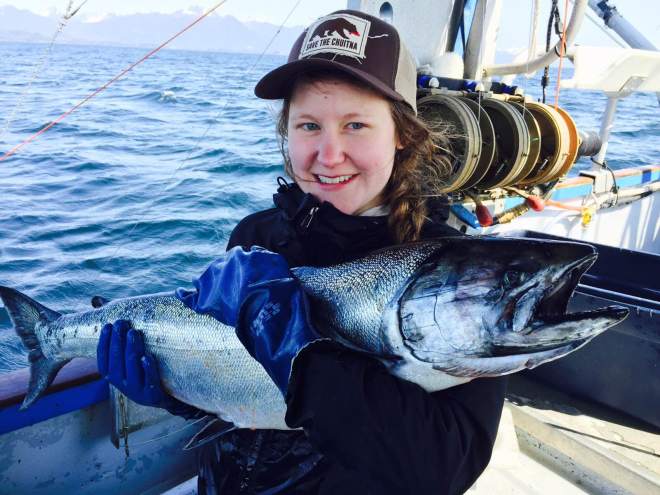
Sophie Nethercut is one of about 25 greenhorns who has served a short stint as a crew member on Eric Jordan’s troller, the I Gotta, in recent years. (PHOTOS COURTESY OF ERIC JORDAN)

Over the last couple of years, Sitka’s Eric Jordan has taken about two dozen young people commercial fishing on his troller, the I Gotta. Now, the Sitka-based Alaska Longline Fishermen’s Association (ALFA) has adopted this program and expanded it to other boats in an effort to counter the graying of the commercial fishing fleet.

Eric Jordan, back center, poses with crew members (l-r) Alyssa Russell, Sarah Jordan (his wife) and Anya Grenier in front of his troller, the I Gotta.

Last month, ALFA’s Supporting the Next Generation of Alaskan Fishermen through the Deckhand Apprentice Program received a $142,496 award ($69,996 grant and $72,500 matching funds) from the National Fish and Wildlife Foundation as part of its Sustainable Fisheries in the United States grant program. The ALFA grant was one of seven grants totaling $766,871 (with $840,887 in matching funds), for a total conservation impact of more than $1.6 million.

“The generous support from the National Fish and Wildlife Foundation will allow us to offer more young people an an entry level commercial fishing opportunity,” ALFA Executive Director Linda Behnken said. “Young fishermen face a host of challenges these days, and ALFA is doing what we can to support the next generation of commercial fishermen by supporting entry level opportunities and policy that safeguards the health of our ocean, fisheries and fishing communities.”

According to the report, “The Graying of the Alaskan Fishing Fleet,” in 2014, the average age of a limited entry permit holder was 50 years old, 10 years older than it was in the 1980s. In 2013, only 17 percent of current permits are held by fishermen younger than 40 years old, a decrease from 38 percent in 1980. This has raised concerns there won’t be enough young people to replace the older fishermen when they retire. Deckhand apprenticeships are one way ALFA and other groups are countering the graying of the fleet.

“With support from NFWF, we plan to expand the program to include more boats, crew, and communities,” Behnken said.”Giving young people the opportunity to participate in our commercial fisheries can help us to sustain our fishing communities and create the next generation of resource stewards.”

Cathryn Klusmeier, left, and Jacob Metzger are among the greenhorns who crewed on Eric Jordan’s troller, the I Gotta.

According to the grant profile, “Alaska Longline Fishermen’s Association will coordinate and expand a state-wide apprentice program to promote resource stewardship, community viability, and opportunity in Alaska’s commercial fisheries. The project will develop curriculum and resources to guide the program expansion, include additional vessels and fisheries, and promote entry level job opportunities.”

“Finding crew with some experience, who loves fishing in Alaska, is so critical to the future of our individual businesses in the industry as a whole,” Jordan said. “This program gives them the taste of it. Deckhands know they like it, and skippers can recommend them for future employment. It is a win-win for everyone.”

“We are currently developing the curriculum — one for skippers, and one for crew,” said ALFA Communications Coordinator Alyssa Russell, who has crewed on the I Gotta. “We want to give skippers the tools they need to mentor someone, and crew the skills they need to have a successful experience and continued employment.”