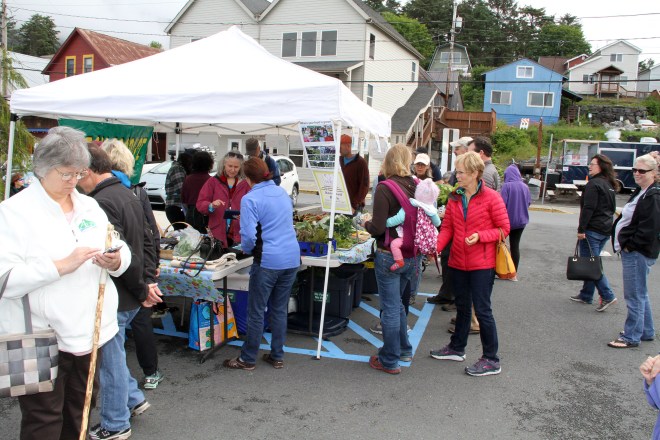
After a week of rain, we lucked out with no rain when we held the third of the seven Sitka Farmers Markets of the 2016 summer on Saturday, July 30, at the Alaska Native Brotherhood Founders Hall.
We always welcome new vendors who want to sell produce they’ve grown, fish they’ve caught, and local cottage food products they’ve made. To learn more about how to be a vendor, contact Matthew Jackson at (907) 821-1412 or jackson.mw08@gmail.com.
The next Sitka Farmers Market will be from 10 a.m. to 1 p.m. on Saturday, Aug. 13, at the ANB Founders Hall. National Farmers Market Week is Aug. 7-13, so celebrate by coming to the market on Aug. 13.
The other markets this summer are on Saturdays, Aug. 20, Sept. 3, and Sept. 10. The Sitka Farmers Markets receive sponsorship funding from the SouthEast Alaska Regional Health Consortium (SEARHC). Don’t forget to vote for the Sitka Farmers Market in the American Farmland Trust’s eighth annual Farmers Market Celebration.
A slideshow of scenes from the third Sitka Farmers Market of the 2016 summer is below.
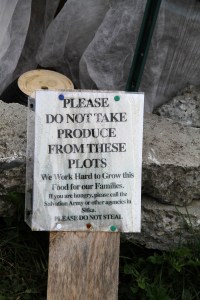
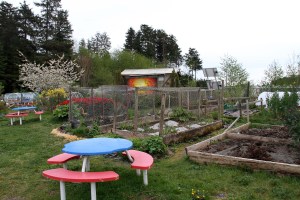
Dave Nuetzel, right, helps build a memorial garden bed for longtime Blatchley Community Gardens supporter Kathy Swanberg.
(Editor’s Note: The Sitka Local Foods Network’s Bulldog on Baranof intern this summer, Claire Chang, is writing the Building a Local Food System series of articles about Sitkans working to improve food security. This is the third article of the series.)
Dave Nuetzel has held the role of lead gardener at Blatchley Community Gardens since 2007. Nuetzel grew up outside of Cleveland, and he toured around the country on a two-year road trip after he graduated from college. At the end of the trip, he wound up in Anchorage. In 2005, he followed his partner, who came to Sitka to work at the Sitka Fine Arts Camp, and he has lived here ever since. With a background in special education, he originally worked for the SouthEast Alaska Regional Health Consortium (SEARHC), and he now works for Southeast Alaska Independent Living (SAIL).
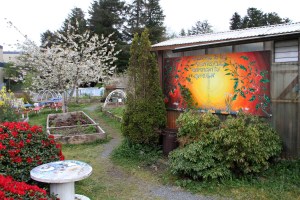
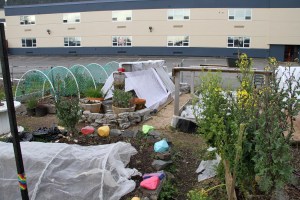
The Blatchley Community Gardens, located behind Sitka’s middle school on what used to be a gravel terrace, started in 2000 as a project of Sitka Community Schools. When Sitka Community Schools lacked the staff to run the garden, Nuetzel took on his role as lead gardener. This year the garden has transitioned from Sitka Community Schools to become a program of Blatchley Middle School. The community garden consists of about fifty garden plots, approximately 6-by-12-feet each. It is personal-use garden, although it does contain a few communal plots of plants such as mint, rhubarb, and flowers. Gardeners pay for the square footage of a plot, and Nuetzel explained that the community garden particularly appeals to people who live in apartments, on boats, or in houses with yards that receive little sunlight.
As someone who “has always liked to fix things and learn new skills,” Nuetzel had small gardens when he was growing up, as well as in college. In addition to his personal plots at the Blatchley Community Gardens, Neutzel says that he has “basically cultivated his whole yard.” Any areas around his house where he is not growing vegetables or flowers contain salmonberry, blueberry, or raspberry plants. Gardening appeals to Nuetzel’s desire to strive for self-sufficiency; he also fishes and forages for beach asparagus for subsistence.
Nuetzel explained that, as lead gardener of Blatchley Community Gardens, maintaining a unified vision for the garden has posed a challenge. At the community garden, each plot represents the gardener’s individual approach to cultivation. Some gardeners devote themselves to experimentation, and they use their plots as a space for attempting to grow one type of vegetable that they have never succeeded in cultivating before. Others are committed to growing a wide variety of plants that they know will yield an ample harvest. Furthermore, gardeners choose to amend the soil in unique ways; while one might opt for buried salmon carcasses, kelp, and ground-up shells, another might rely more heavily on compost and coffee grounds.
An even larger challenge that Nuetzel has faced in his role is coordinating the management of common plots. Dividing up the responsibility of caring for a plot of chard, for example, becomes difficult when gardeners travel schedules and family obligations interfere. Furthermore, trying to ensure that everyone has equal to the resources of common plots, such as the apples from a communal apple tree, can be tricky.
Nevertheless, Nuetzel appreciates Blatchley Community Gardens as a space where he and others can experience the tangible results of physical labor. Regular visits to the garden allow him to appreciate how well one can grow food for oneself when one puts in the effort. Nuetzel believes that gardening has grown more popular in Sitka in recent years. He has seen new gardens emerge in yard, and in the future, he would like to see new community gardens established in town. As gardening in the community becomes more popular, he wishes that more people would view gardening as a basic need, not just a hobby.
“At one time, producing food was a requirement for life,” Nuetzel said. “Now, people think that gardening is only something you do if you have lots of ‘extra’ time. But if you provide people with a little bit of guidance and get them invested in the process of gardening, they will value it and treat it like something that is necessary.”
To learn more about Blatchley Community Gardens, go to the Facebook page or contact Dave Nuetzel at community.garden@hotmail.com.
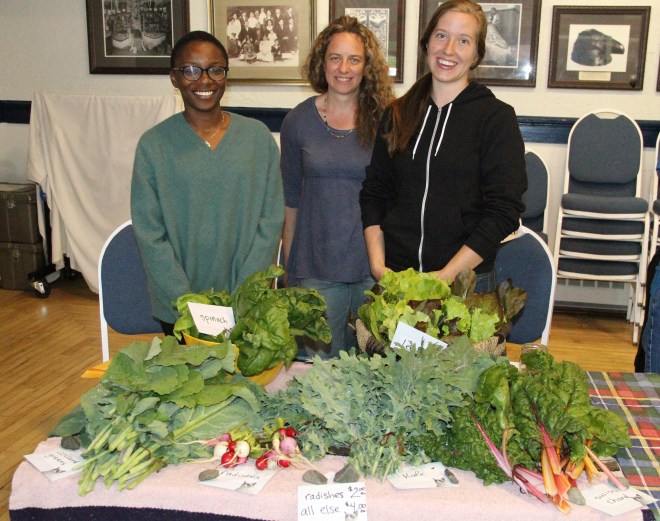
Anna Wane, Tamie Parker-Song and Heather Hanson pose with some of the produce from Heather’s and Alli’s Garden. This was one of the new booths at the market this week.
The wind was blustery, but it didn’t rain when we held the second of the seven Sitka Farmers Markets of the 2016 summer on Saturday, July 16, at the Alaska Native Brotherhood Founders Hall.
Andrea Fraga and Kaleb Aldred of Middle Island Organic Produce, another of the new booths at the market this week.
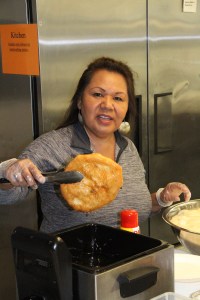
We had several new vendors at this market, but not as many customers as usual. We had four booths selling produce, two selling beach greens, another selling homemade bread, another with homemade tamales, and even some frybread.
We always welcome new vendors who want to sell produce they’ve grown, fish they’ve caught, and local cottage food products they’ve made. To learn more about how to be a vendor, contact Matthew Jackson at (907) 821-1412 or jackson.mw08@gmail.com or Brandie Cheatham at (907) 687-9927 or vista_brandie@yahoo.com.
Jeren Schmidt of Sitka Spruce Catering dishes up a homemade tamale for a customer.
The next Sitka Farmers Market will be from 10 a.m. to 1 p.m. on Saturday, July 30, at the ANB Founders Hall. The other markets this summer are on Saturdays, Aug. 13, Aug. 20, Sept. 3, and Sept. 10. The Sitka Farmers Markets receive sponsorship funding from the SouthEast Alaska Regional Health Consortium (SEARHC). Don’t forget to vote for the Sitka Farmers Market in the American Farmland Trust’s eighth annual Farmers Market Celebration.
A slideshow of scenes from the second Sitka Farmers Market of the 2016 summer is below.
After raining the night before, we ended up with some sun when we held the first of the seven Sitka Farmers Markets of the 2016 summer on Saturday, July 2, at the Alaska Native Brotherhood Founders Hall.
The market was a bit smaller than usual, partially because of competition with the Fourth of July booths at Baranof Elementary School and because of our attempts to refocus the market to put more of an emphasis on local food. We did have some new vendors at the market, and there were a couple of discussions from potential vendors asking about space at the next market.
Jessica Gill was one of our new vendors this market with Marco’s Munchies dog treats.
We always welcome new vendors who want to sell produce they’ve grown, fish they’ve caught, and local cottage food products they’ve made. To learn more about how to be a vendor, contact Matthew Jackson at (907) 821-1412 or jackson.mw08@gmail.com or Brandie Cheatham at (907) 687-9927 or vista_brandie@yahoo.com.
The next Sitka Farmers Market will be from 10 a.m. to 1 p.m. on Saturday, July 16, at the ANB Founders Hall. The other markets this summer are on Saturdays, July 30, Aug. 13, Aug. 20, Sept. 3, and Sept. 10. The Sitka Farmers Markets receive sponsorship funding from the SouthEast Alaska Regional Health Consortium (SEARHC). Don’t forget to vote for the Sitka Farmers Market in the American Farmland Trust’s eighth annual Farmers Market Celebration.
A slideshow of scenes from the first Sitka Farmers Market of the 2016 summer is below.
In an effort to train people to teach safe home food preservation classes in their Southeast Alaska communities, the University of Alaska Fairbanks Cooperative Extension Service hosted a series of certification courses around the region in recent months. The Sitka class on May 14-15 at Blatchley Middle School wrapped up the series, which featured several online lessons followed by two-day hands-on classes in Juneau, Ketchikan and Sitka.
The Sitka class was taught by UAF Cooperative Extension Service Associate Director Roxie Rodgers Dinstel of Fairbanks and Sarah Lewis, a Family and Community Development faculty member from Juneau. In addition to several Sitka residents, there also were students from Haines, Petersburg and Juneau in the Sitka class. The series was funded by a grant from the SouthEast Alaska Regional Health Consortium (SEARHC).
During the class, the 10 students learned which foods need waterbath canning vs. pressure canning, had a lesson on fermenting, tested pressure canner gauges, dehydrated fruits and veggies, made jerky, and learned how to find reliable resources to make sure their home food preservation practices are safe.
In addition to teaching classes, some of the students will use their new skills for cottage food businesses and home canning projects. One of the purposes of the class was to certify people in a variety of Southeast Alaska communities on how to teach safe home food preservation classes, so they don’t have to wait for a UAF Cooperative Extension Service faculty member from Juneau, Anchorage or Fairbanks to come to town to teach.
A slideshow of scenes from the two-day hands-on classes is below.
(EDITOR’S NOTE: The following article first appeared on this site in April 2010. It is repeated because much of the information remains current and newsworthy.)
In the cold winter of 1994, Anchorage Daily News (now called the Alaska Dispatch News) garden columnist and former Garden Writers Association of America President Jeff Lowenfels was returning to his hotel after a Washington, D.C., event when he was approached by a homeless person who asked for some money to buy food. Lowenfels said Washington, D.C., had signs saying, “Don’t give money to panhandlers,” so he shook his head and kept on walking. But the man’s reply, “I really am homeless and I really am hungry. You can come with me and watch me eat,” stayed with Lowenfels for the rest of his trip.
Jeff Lowenfels
The encounter continued to bother Lowenfels, even as he was flying back to Anchorage. During the flight, Lowenfels came up with an idea when he started writing his weekly garden column (the longest continuously running garden column in the country, with no missed weeks since it started on Nov. 13, 1976). He asked his readers to plant one extra row in their gardens to grow food to donate to Bean’s Café, an Anchorage soup kitchen. The idea took off.
When Anchorage hosted the Garden Writers Association of America convention in 1995, Lowenfels took the GWAA members to Bean’s Café to learn about the Plant A Row For Bean’s Café program. The Garden Writers Association of America liked the idea, and it became the national Plant A Row For The Hungry campaign (also known as Plant A Row or PAR). In 2002, the Garden Writers Association Foundation was created as a national 501(c)(3) nonprofit to manage the Plant A Row For The Hungry program.
“I am not surprised by the growth of PAR,” Lowenfels wrote in an e-mail to the Sitka Local Foods Network. “It is now in all 50 states and across Canada and there are thousands of variations of the original program — from prison gardens for the hungry to botanical gardens donating their produce from public display gardens. This is because gardeners always share information and extra food, so the idea was a natural.”
It took five years for the program to reach its first million pounds of donated food, but the second million only took two years and the next eight years saw a million pounds of donated food (or more) each year. Since 1995, more than 14 million pounds of food have been donated. Not only that, the program is getting ready to expand overseas to Australia, England and other countries with avid gardeners.
“We have supplied something in the vicinity of enough food for 50 million meals,” Lowenfels wrote in his e-mail. “Gardeners can solve this hunger problem without the government. And we don’t need a tea party to do it! Or chemicals, I might add, as author of a book on organic gardening!” Lowenfels is the author of Teaming With Microbes, written with Wayne Lewis. He recently released a second book, Teaming With Nutrients, which is a follow-up to his first book.
According to the U.S. Department of Agriculture, one out of every eight U.S. households experiences hunger or the risk of hunger. Many people skip meals or eat too little, sometimes going an entire day or more without food. About 33 million Americans, including 13 million children, have substandard diets or must resort to seeking emergency food because they can’t always afford to buy the food they need. In recent years, the demand for hunger assistance has increased 70 percent, and research shows that hundreds of children and adults are turned away from food banks each year because of lack of resources.
According to the 2014 Sitka Community Food Assessment Indicators Report, about one in six people in Sitka is food insecure. In 2013, there were 1,410 Sitkans (out of a population of about 9,000) and 766 families receiving food assistance (SNAP, aka food stamps). There also were 229 individuals who received food pantry assistance from the Salvation Army and 7,243 meals served through its lunch soup kitchen in 2013, and that number has grown substantially since then.
While many people credit Lowenfels for creating the Plant A Row For The Hungry program, Lowenfels says the real heroes are the gardeners growing the extra food and donating it to local soup kitchens, senior programs, schools, homeless shelters and neighbors. You can hear him pass along the credit to all gardeners at the end of this 2009 interview with an Oklahoma television station (video also embedded below).
“One row. That’s all it takes. No rules other than the food goes to the hungry. You pick the drop-off spot or just give it to a needy friend or neighbor. Nothing slips between the lip and the cup, I say,” Lowenfels wrote in his e-mail.
For people wanting to Plant A Row For The Hungry in Sitka, there are several places that would love to help distribute some fresh locally grown veggies or berries to those who are less fortunate, such as the Salvation Army, Sitkans Against Family Violence (SAFV), local churches, Sitka Tribe of Alaska and other organizations. The food the Sitka Local Foods Network grows at St. Peter’s Fellowship Farm communal garden goes to the Sitka Farmers Market, school lunches and other programs.
The Sitka Local Foods Network also takes donations of local produce to sell at the Sitka Farmers Markets, and all proceeds are used to help pay for SLFN projects geared toward helping more people in Sitka grow and harvest local food. For more information, contact the Sitka Local Foods Network board members at sitkalocalfoodsnetwork@gmail.com.
“Fostering health and wellness in a community is complex and multifaceted,” SEARHC Health Educator Lauren Hughey said. “We are pleased to support these three projects with MAPP Teir 2 funding because while each project has a different approach. All will make Sitka a healthier place to live.”
Earlier this year, the Sitka Health Summit collected MAPP data about community health issues in Sitka, identifying healthy weight as a key focus area. In order to help more Sitkans achieve a healthy weight, SEARHC and the Sitka Health Summit requested project proposals that addressed this key area using the identified strategies that also address the health status of Alaska Native people.
Projects must use one of these strategies and plan an intervention based on evidence-based policy, systems, and environmental (PSE) changes. PSE changes will increase access to and use of traditional and other healthy foods or increase health literacy by making them more readily available at home, work, and in the community. PSE changes are long term changes and reach a large proportion of the population. PSE changes can occur in the community, tribal organizations, schools, healthcare systems, childcare facilities, worksites, or in families.
Here are brief descriptions about the three projects to receive MAPP Tier 2 grant funding:
Sitka Seedling Farms (project info provided by Matthew Jackson) — Sitka Seedling Farms is an initiative to meet Sitka’s food system needs in a thought-out, comprehensive way. Many food-related initiatives have been proposed over the last several years, but most have stalled for lack of space. Sitka Seedling Farms, which is a finalist in the Paths to Prosperity economic development contest for Southeast Alaska, will solve this problem by exploring innovative land relationships with major landowners in our community to develop the resources Sitka’s food system needs to thrive, such as production space for food entrepreneurs, community greenhouses, food storage and processing facilities and more. Sitka Seedling Farms is currently in the land exploration phase. Please contact Matthew Jackson with questions or comments at 907-821-1412.
Sitka Community Playground (project info provided by Lynne Brandon) — The grant award is to assist with the Sitka Community Playground Project Phase II, the design process. The design will help with the subsequent fundraising effort. The Phase III goal is to construct the new playground during the summer of 2017. Phase I was establishing a steering committee with volunteers, getting Assembly approval for the playground location at Crescent Harbor Park playground incorporating one of the three tennis courts, creating a funding plan and a timeline with tasks. The Sitka Community Playground project also is a 2015 Sitka Health Summit community wellness project.
Hames Center Elder Connect project (project info provided by Caitlin Blaisdell) — The Hames Center‘s Tier 2 grant will be used to create delegated senior hours for everyone older than age 65 and their caregivers to use our gym floor free of cost. These hours will incorporate group fitness activities, serve as an indoor walking space, create senior service information dissemination, and spark active, social groups for our growing senior demographic. Through bringing seniors together at the Hames Center with transportation assistance, we aim to remove many of the obstacles, such as social isolation, transportation limitations, and fixed income restrictions, that seniors may face in maintaining their physical and mental well-being all year round. The Hames Center Elder Connect project also is a 2015 Sitka Health Summit community wellness project.
Selected projects are awarded up to $10,000 for the project period of Nov. 1, 2015, through Oct. 31, 2016. For more information about the MAPP Tier 2 grant program, please contact Lauren Hughey at 966-8797 or lauren.hughey@searhc.org.
The Oct. 30 class featured lessons on how to can venison in jars, taught by Ellen Ruhle, as well as info about how to prepare deer jerky and how to smoke venison roasts, taught by Jud Kirkness. Due to the popularity of the class, the Sitka Kitch is hoping to schedule a second class on deer/venison in the near future.
Below is a slideshow of photos taken during the class by Jasmine Shaw of the UAF Cooperative Extension Service Sitka District Office.
Participants in Sitka’s Alaska Way Of Life 4-H program, aka the Sitka Spruce Tips 4-H program, learn how to skin and butcher a deer. (Photo courtesy of the Sitka Conservation Society/Sitka Spruce Tips 4-H program)
The Sitka Kitch is a rental community commercial kitchen project coordinated by the Sitka Conservation Society, in partnership with the Sitka Local Foods Network, located inside the First Presbyterian Church, 505 Sawmill Creek Road. The Sitka Kitch was a project from the 2013 Sitka Health Summit designed to improve food security in Sitka while also providing a space for people wanting to get into the cottage food business or wanting to preserve their harvest for storage in the home pantry. Sitka Kitch officially opened in March 2015 after a series of renovations to make it pass Alaska Department of Environmental Conservation commercial kitchen food safety standards.
The Oct. 30 class will feature lessons on how to can venison in jars, taught by Ellen Ruhle, as well as how to prepare deer jerky and how to smoke venison, taught by Jud Kirkness.
There is a possibility we will be able to harvest a deer next week, and if so we will add on a portion of the workshop to focus on butchering and meat care. And this time we are just offering the food preservation class (canning, jerky, and smoking hind quarters).
Thanks to a grant from the SEARHC WISEFAMILIES Traditional Foods program, all ingredients, jars, and equipment will be supplied in class.
The SEARHC WISEFAMILIES Traditional Foods program promotes healthy lifestyles by connecting Alaska Natives in Southeast Alaska to their culture. Members of the program learn how to harvest, cook, and preserve their traditional Alaska Native foods, which usually are healthier than heavily processed store-bought foods. In addition, participants learn traditional language, dancing, carving, weaving, and other skills that help reconnect them to their culture.
The UAF Cooperative Extension Service offers a variety of programs geared toward food, how to grow it, how to preserve it for storage, and how to make it into cottage foods you can sell. For those who can’t make the classes, the service offers a series of free online tutorials about home canning called Preserving Alaska’s Bounty.
Pre-registration is required for this class, and there are only 12 spots available. For more information and to pre-register, please contact Jasmine Shaw at 747-9440 or jdshaw2@alaska.edu.
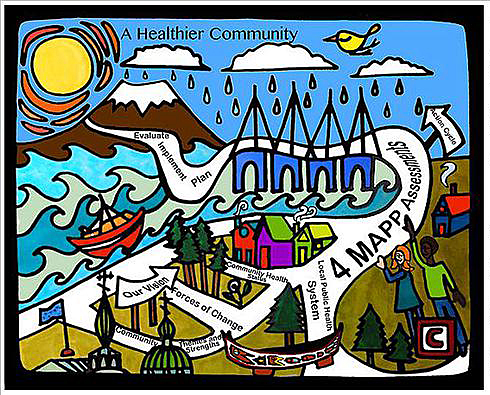
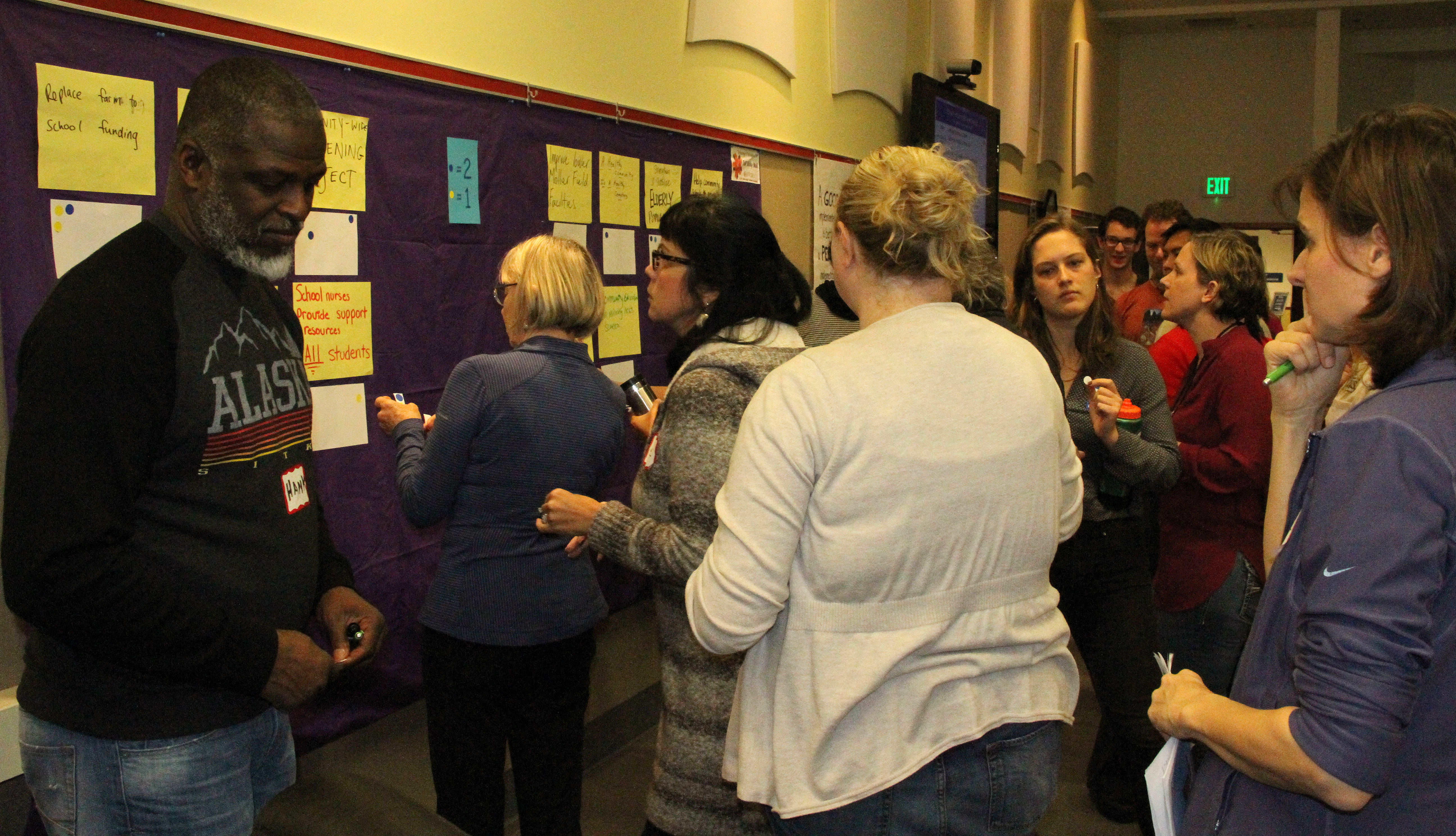
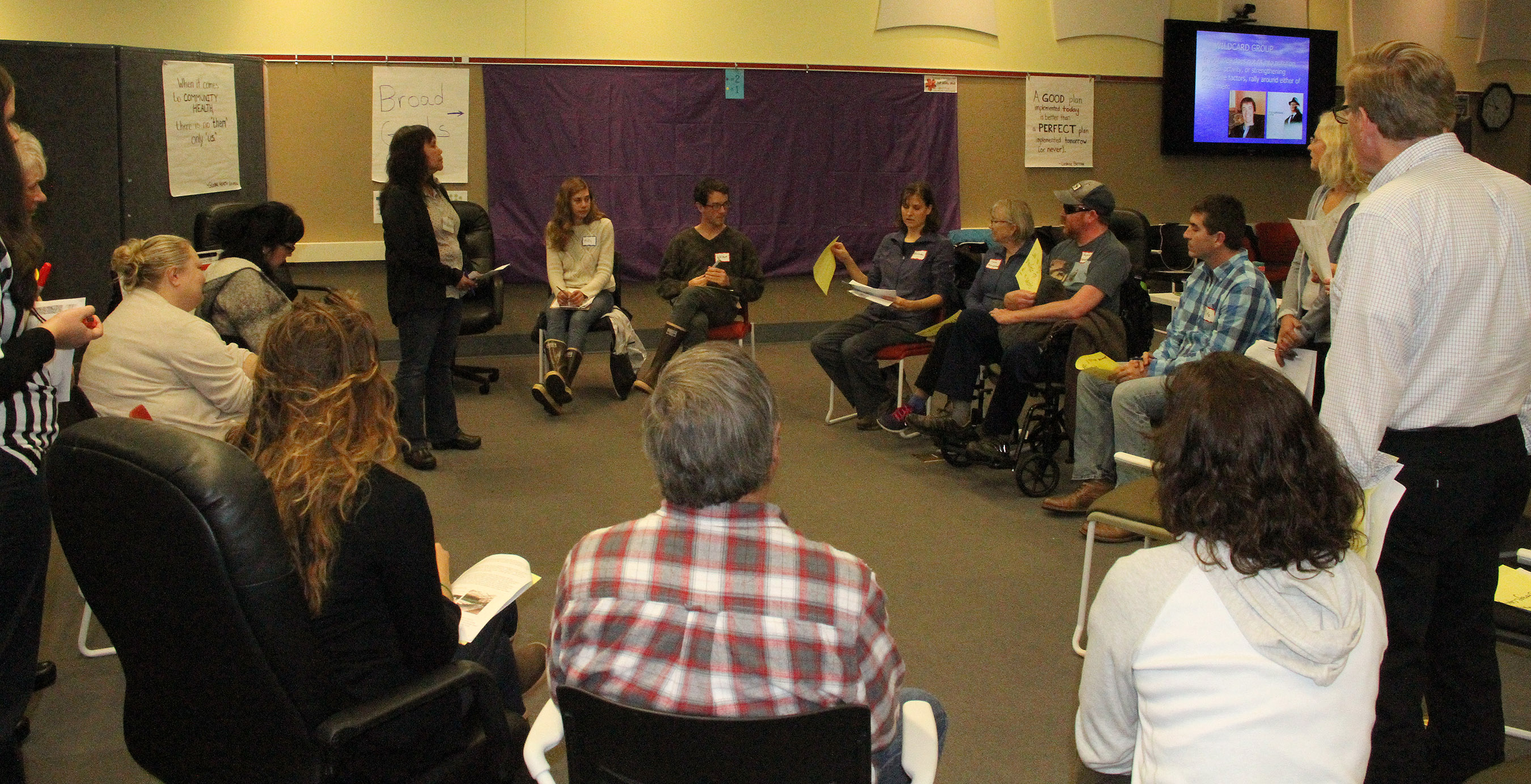
Sitka residents decided to find ways to honor and support our elders, build an accessible community playground near Crescent Harbor, and build a community greenhouse on the roof of the city cold storage building (or a similar-flat-roofed structure), choosing those as the three community wellness projects Sitka residents chose to pursue in 2015-16 at the ninth annual Sitka Health Summit planning day Friday, Oct. 9, at the University of Alaska Southeast Sitka Campus.
These three projects (one broad topic, and two specific topic projects that tied as top vote-getters) each were awarded with $2,000 in Tier 1 seed money to help get them started. The three projects were picked after 57 Sitka residents brainstormed and discussed the advantages and disadvantages of a wide variety of community wellness projects. In addition to the Tier 1 awards, the Sitka Health Summit also made applications available for Tier 2 grants of $10,000 for projects dealing with nutrition (applications are due Oct. 23, contact Lauren Hughey at lauren.hughey@searhc.org or go to http://www.sitkahealthsummitak.org/ for more information).
The Sitka Health Summit also honored Lynne Brandon with a lifetime achievement award for her work promoting healthy lifestyles during her 13 years as Sitka’s Director of Parks and Recreation and now in her new position as executive director of Sitka Trail Works Inc.
Each of the three Tier 1 projects will host a kick-off event in the near future, and these events are open to the public and anybody who wants to help with the project. More information about the projects, their kick-off meetings, and contact people are listed below.
Design and build an ADA-accessible Sitka Community Playground, 6 p.m., Monday, Oct. 26, Sitka Community Hospital classroom, contact Kealoha Harmon, 747-3500 — This project is to create an accessible, attractive, low maintenance and safe community playground that will meet the needs of both children and their families. Right now Sitka does not have any playgrounds that are compliant with the Americans with Disability Act. Building the community playground was selected as a Sitka Health Summit goal in 2011, and a lot of important work has been done. Now it’s time to move this community-supported project forward.
Build a Sitka Community Greenhouse on the roof of the city cold storage plant (or similar flat-roofed building), 6 p.m., Wednesday, Oct. 28, Sitka Pioneer’s Home Manager’s House (Brave Heart Volunteers building), contact Charles Bingham, 623-7660 or charleswbingham3@gmail.com — This project’s goal is to increase local food production and food security by using greenhouses, including ones situated on rooftops, a practice growing in popularity around the world. Everyone needs the nutritional boost that only vegetables provide and the more we grow locally the better. There are so many benefits to growing food here; freshness, nutritional value, sustainability and the economic benefits that come from keeping dollars in Sitka. Rooftop greenhouses also can capture waste heat and provide a flat, slug-free growing environment that will help us with food security. Rooftop greenhouses can be a point of interest for visitors, a point of learning for students, and a point of community pride for everyone who believes in innovation and using space wisely.
Create a way to honor and support the well-being of elders in Sitka, 3 p.m., Friday, Nov. 6, Hames Athletic and Wellness Center, contact Caitlin Blaisdell, 747-5080 — One of the largest and fastest-growing populations in Sitka is its elders. The Elder Connection action group is focused on organizing systems to support the health and well-being of seniors living is Sitka. We want everyone’s Golden Years to be just that, and we know that we can do more to support this critical group of wisdom keepers.

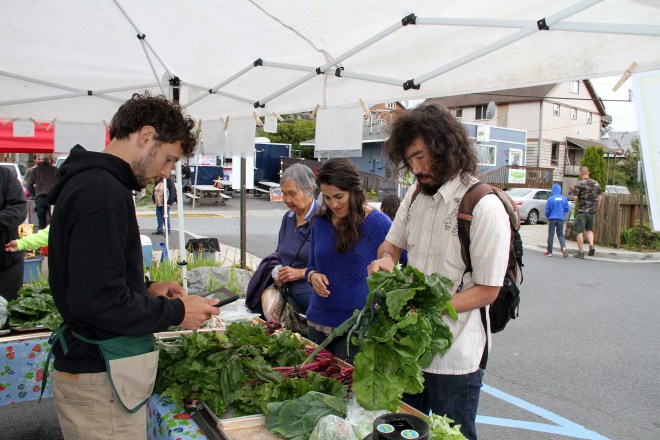
 After a week of rain, we lucked out with no rain when we held the third of the seven Sitka Farmers Markets of the 2016 summer on Saturday, July 30, at the Alaska Native Brotherhood Founders Hall.
 We had several new vendors at this market, and the Sitka Spruce Tips 4H club sponsored by the UAF Cooperative Extension Service and Sitka Conservation Society hosted the first 4H Fair at this market, with lots of exhibits by the 4H kids.
 The next Sitka Farmers Market will be from 10 a.m. to 1 p.m. on Saturday, Aug. 13, at the ANB Founders Hall. National Farmers Market Week is Aug. 7-13, so celebrate by coming to the market on Aug. 13.












 Sitka Local Foods Network
You must be logged in to post a comment.