• Highlights from 2015 for your Sitka Local Foods Network

Some carrots grown at St. Peter's Fellowship Farm communal garden on sale at the Sitka Farmers Market

Some carrots grown at St. Peter’s Fellowship Farm communal garden on sale at the Sitka Farmers Market

As 2015 comes to a close, here are some highlights from the past year for your Sitka Local Foods Network. We are looking forward to a lot of new adventures in 2016, and encourage people to join us. We always need new volunteers, and please donate to us through Pick.Click.Give. when you file for your Alaska Permanent Fund Dividend starting on Jan. 1 and ending March 31. Your donations help fund a variety of Sitka Local Foods Network programs, such as the Sitka Farmers Market, St. Peter’s Fellowship Farm communal garden, and a host of garden and food education opportunities.

Our annual meeting and potluck will be from 5:30-8 p.m. on Saturday, Jan. 30, at the Sitka Unitarian Universalist Fellowship Hall (408 Marine Street, parking is off Spruce Street). This event is open to the public, just bring a dish (preferably with local foods) to share with everybody. We usually introduce new board members, confirm our new officers, and give an update on our finances and programs.

And now here are those 2015 highlights from your Sitka Local Foods Network:

Grew food at St. Peter’s Fellowship Farm and extension gardens

St. Peter's Fellowship Farm communal garden

St. Peter’s Fellowship Farm communal garden

For the eighth straight year, the Sitka Local Foods Network expanded its produce-growing operations at the St. Peter’s Fellowship Farm communal garden and our extension gardens, such as the one on land owned by Pat Arvin. The food grown from these gardens is sold at the Sitka Farmers Market, where Sitka residents, including people with SNAP (food stamps) and WIC (supplemental nutrition program for women, infants and children) benefits, have access to fresh local produce. In addition to supplying the Sitka Farmers Market, this year we grew enough to sell to some school lunch programs, at the Sitka Seafood Festival, at the Running of the Boots costumed fun run, and at a booth on days when Chelan Produce was in Sitka.

Hosted six Sitka Farmers Market events

Some of the booths at the Sitka Farmers Market

Some of the booths at the Sitka Farmers Market

We hosted the Sitka Farmers Market for the eighth straight summer, and this year there were six markets on alternate Saturdays from July 4 through Sept. 12. In addition to selling produce from St. Peter’s Fellowship Farm and our extension gardens, the Sitka Farmers Market serves as a business incubator where budding entrepreneurs sell jams/jellies, baked goods, fish, prepared food ready to eat, and a variety of local arts and crafts. Our emphasis is on local products always. The Sitka Farmers Market also provides a venue for local musicians (we hire a few to play at each market). One of the highlights this year was a brief performance by the students involved in the musical with the Sitka Fine Arts Camp. Another highlight was the inaugural Sitka Slug Races, where Sitka residents brought their own slugs (or rented ones we harvested) for a series of races on a glass table.

Taught a variety of garden education classes and mentored some novice gardeners

Tammy O'Neill, a student in the garden mentor program, poses with her garden beds after her second year in the program

Tammy O’Neill, a student in the garden mentor program, poses with her garden beds during her second year in the program

The Sitka Local Foods Network education committee hosted a variety of classes this year for local food gardeners. We started out with a couple of classes about basic gardening in Sitka, and followed those with classes on starting seeds, composting, chickens, rabbits, fruit trees, potatoes, carrots, rhubarb, and more. In addition, we hosted the second year of our family garden mentoring program with funding from First Bank. In this program we provided one-on-one mentoring for four families of novice gardeners and two families returning for a second year of the program. We are hoping to bring this innovative program back in 2016 and we are recruiting for new families. This fall we received a small grant from the United Way of Southeast Alaska that we will use to develop a teaching garden at Baranof Elementary School near downtown Sitka.

Partnered with several organizations to launch and operate the Sitka Kitch

LisaSadleirHartHelpsRebaAndRobertScoopCultureStarterIntoMilk

Sitka Kitch “Cooking From Scratch” instructor Lisa Sadleir-Hart, center, helps Reba Traini and Robert Baines make homemade yogurt

This year we partnered with the Sitka Conservation Society, UAF Cooperative Extension Service, First Presbyterian Church, Sitka Food Co-op, and other organizations to help launch the Sitka Kitch community rental commercial kitchen, which officially opened in March 2015. The Sitka Kitch is available for cottage food entrepreneurs to rent as they make their products, plus we have been offering a variety of food preservation and cooking classes. The Sitka Kitch also is available for people to rent who need a larger kitchen to cook a community meal.

Helped launch the Sitka Food Collaborative

Toward the end of the year, the Sitka Local Foods Network, Sitka Conservation Society, Sitka Kitch, Sitka Food Co-op, Sitka Seedling Farms, and other food groups created the Sitka Food Collaborative and then submitted an application for a USDA grant to conduct a Sitka Food Systems Assessment. This will build on the work done in 2013-14 with the Sitka Community Food Assessment, but will look at ways we can improve our local food system so we have better food security.

Fundraising and strategic planning
50-states-logoThe Sitka Local Foods Network is maturing as an organization, and this year we decided we needed to start raising money so we eventually can hire a part-time director to take care of some of the daily chores dealt with by our volunteer board of directors. We have started to set aside a little bit of money, still have a ways to go. This year we received a grant from the Alaska Community Foundation that will allow us to work with the Foraker Group in 2016 to create a fundraising and long-term strategic plan. We participated in the Pick.Click.Give. program for the second year, and we are preparing for our third year of receiving donations from Alaskans when they file for their Permanent Fund Dividends. We launched an online donation page on Razoo.com (a donation website for nonprofit groups), and hosted fundraisers for St. Peter’s Fellowship Farm, the Sitka Sound Suppers (with a totally local meal) and #GivingTuesday (#GivingTuesdayAK in Alaska). This fall we received a small grant from the United Way of Southeast Alaska that we will use to develop a teaching garden at Baranof Elementary School near downtown Sitka. In December, the Sitka Local Foods Network was named Alaska’s winner in the 50 States For Good contest, hosted by Tom’s of Maine. Each of the winning community nonprofits from each state won $20,000 to improve their programming, which we should receive in January.

• The Inuit Circumpolar Council-Alaska (ICC-AK) releases report on Inuit food security

Food Security Summary and Reccomendations Report _Page_01
Drastic changes are occurring within the Arctic and Inuit are on the forefront of these changes. In recent years food security has increasingly become a topic of conversation and is gaining more attention. But what does food security mean to those that call the Arctic home?

Through this Inuit Circumpolar Council-Alaska (ICC-AK) project led by the Alaskan Inuit (Iñupiaq, St. Lawrence Island Yupik, Central Yup’ik and Cup’ik), the Alaskan Inuit Food Security Conceptual Framework: How to Access the Arctic from an Inuit Perspective report illuminates the meaning of Alaskan Inuit food security and lay out an assessment process.

In the report it is clear that Inuit food security is more than calories, more than nutrients, as explained by a contributing author:  “We are speaking about the entire Arctic ecosystem and the relationships between all components within; we are talking about how our language teaches us when, where and how to obtain, process, store and consume food; we are talking about the importance of dancing and potlucks to share foods and how our economic system is tied to this; we are talking about our rights to govern how we obtain, process, store and consume food; about our Indigenous knowledge and how it will aid in illuminating these changes that are occurring. We are talking about what food security means to us, to our people, to our environment and how we see this environment; we are talking about our culture.” — Executive Summary

The report is the product of 146 contributing Inuit authors, a 12-member advisory committee, ICC-AK and their membership organizations. A summary and recommendations report was created for those who are looking for a quick glimpse at what food security means to Alaskan Inuit, what it means to apply a food security lens to assessments, and recommendations for strengthening food security. For a deeper understanding and more in-depth discussion, a technical report has been created. Within both reports you will find: 1) recommendations, 2) key barriers, 3) the food security conceptual framework, and 4) drivers of food security and insecurity. The technical report also lays out a food security assessment process.

“To look at environmental health through an Inuit food security lens requires one to undergo a paradigm shift. One must be willing to attempt to understand the Inuit culture to know what Inuit mean when they talk about food security.” — James Stotts

ICC-Alaska hopes that the report will be of use to a broad spectrum of people. Villages may use the report to aid in communicating with those from outside their communities. Decision-makers, academics, environmentalists, policy-makers and industry may use the reports as a tool to enhance their understanding of the Arctic. The report is accessible on the ICC-Alaska website.

The food security report also is linked below:

• Inuit Circumpolar Council-Alaska Food Security Summary and Recommendations Report

• Inuit Circumpolar Council-Alaska Food Security Technical Report

• New biotoxin lab in Sitka allows for quicker, better monitoring of harmful algal blooms in Southeast Alaska

MichaelJamrosChrisWhiteheadEstherKennedyJohnDorothyOrbisonDeanOrbison

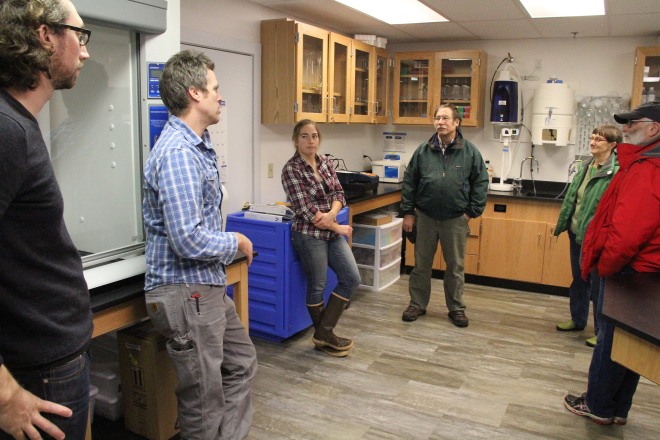
From left, Sitka Tribe of Alaska Environmental Lab Manager Michael Jamros, STA Environmental Program Manager Chris Whitehead, and STA Environmental Specialist Esther Kennedy discuss the new Sitka Biotoxin Lab with visitors to an open house on Monday, Nov. 30, 2015. The new lab will help Southeast subsistence and sport shellfish harvesters learn about harmful algal blooms in the region so they can avoid paralytic shellfish poisoning (PSP) or amnesic shellfish poisoning (ASP).

Most shellfish eaters are aware of the massive algal bloom that shut down many shellfish operations on the Pacific Coast this summer. The algal bloom even reached Sitka’s Starrigavan Beach with the June discovery of Pseudo-nitzchia, a species of plankton that sometimes produces domoic acid which can cause amnesic shellfish poisoning (ASP). ASP causes gastrointestinal issues in mild cases, such as nausea, vomiting, diarrhea, and abdominal cramps. In more severe cases there will be neurological problems, such as headaches, confusion, hallucinations, short-term memory loss, respiratory difficulty, seizures, coma, and in extreme cases, death.

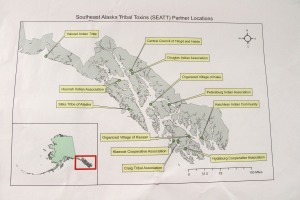
SEAKTribalToxinsSEATTPartnerLocationsUntil two years ago, Southeast Alaska beaches and subsistence- and sport-harvested shellfish weren’t tested for harmful biotoxins. That changed with the Southeast Alaska Tribal Testing (SEATT) program, a partnership of regional tribes coordinated by Sitka Tribe of Alaska, that began training technicians from six villages (now 12 villages) in the region on how to gather water samples so they could be tested. SEATT is part of a program called Southeast Alaska Tribal Ocean Research (SEATOR).

Now the project has moved to the next phase, the creation of a Sitka Biotoxin Lab, located at 429 Katlian Street, that can provide quicker and better testing results to people in the region who want to eat shellfish. Instead of sending samples to the Lower 48 for testing, which can take more than a week or two, samples from Southeast Alaska can be tested in Sitka and data can be available in less than 24 hours, Sitka Tribe of Alaska Environmental Program Manager Chris Whitehead said during an open house at the lab on Monday, Nov. 30. Before the lab opened, the program just took water samples. But now it will be able to actually test the shellfish for biotoxins.

Whitehead said one of the purposes of the lab is to give shellfish harvesters as much information as possible about possible harmful algal blooms so they can make informed decisions about if they still want to harvest and eat local shellfish. Harmful algal blooms spread a variety of biotoxins, such as domoic acid and saxitoxin, which can cause paralytic shellfish poisoning (PSP) and amnesic shellfish poisoning (ASP). PSP and ASP can be deadly, and in 2010 there were two people in Southeast Alaska who died from PSP.

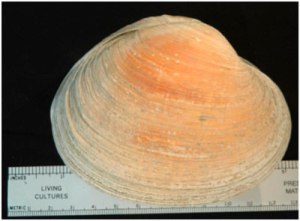
Cockles-Alaska-Department-of-Health-and-Social-Services“The toxins can stay in butter clams for 2 1/2 to three years,” Whitehead said, disproving the common local myth that shellfish is safe to eat in months with R in the name. “We’re still seeing blooms in December.”

Whitehead said he’s hoping to eventually be able to do baseline sampling of a variety of beaches in Southeast Alaska. He said they are sampling bays for cyst beds by digging cores in the beach soil, and they’ve found cysts 3-4 meters (9-13 feet) below the surface. While the beach might be safe for now, if people start building piers or docks it can stir up the cyst beds and launch a harmful algal bloom.

The lab and testing program is funded by the Environmental Protection Agency (EPA) Indian Environmental General Assistance Program, the Bureau of Indian Affairs (BIA) and Tribal Cooperative Landscape Conservation Program, and the Administration for Native Americans’Environmental Regulatory Enhancement program. The National Oceanic and Atmospheric Administration (NOAA) Marine Biotoxin Programs from Seattle, Wash., and Charleston, S.C., provided training through workshops to help develop the SEATT program.

raw-clams-350Michael Jamros, PhD, was hired in October as the STA Environmental Lab Manager, and he will be handling most of the actual testing and diagnosis of the seawater and shellfish. He said right now the lab is focused on subsistence and sports harvests, but down the road it’s hoping to become FDA-certified so it can test commercial harvests.

Esther Kennedy is the STA Environmental Specialist, and she said “every week I go plankton hunting.” This summer all of her tests were at Starrigavan State Recreation Area, but now that the lab is open she will be able to test in more areas, “wherever you think people might harvest shellfish.”

pe-fig1“I think this will help our food security,” Kennedy said. “People will be able to see this abundant resource of shellfish, and now they’ll have better information about whether it’s safe to harvest.”

In addition to the Sitka staff, the program also trains monitors from 12 partner villages to test in their areas, which range from Ketchikan on the south to Yakutat on the north. These monitors come to Sitka twice a year for training, with their most recent training in early November. A slideshow of photos from the training is posted below.

This slideshow requires JavaScript.

• Scenes from the Sitka Kitch venison class hosted by UAF Cooperative Extension, SEARHC

22747125432_327d8c7356_o

kitch_logo_mainSitka residents love their venison, so the University of Alaska Fairbanks Cooperative Extension Service and the SouthEast Alaska Regional Health Consortium (SEARHC) WISEFAMILIES Traditional Foods program hosted a free class on canning, smoking, and making deer jerky on Oct. 30 at the Sitka Kitch community rental commercial kitchen.

The Oct. 30 class featured lessons on how to can venison in jars, taught by Ellen Ruhle, as well as info about how to prepare deer jerky and how to smoke venison roasts, taught by Jud Kirkness. Due to the popularity of the class, the Sitka Kitch is hoping to schedule a second class on deer/venison in the near future.

Below is a slideshow of photos taken during the class by Jasmine Shaw of the UAF Cooperative Extension Service Sitka District Office.

This slideshow requires JavaScript.


• Sitka Conservation Society to host its annual Wild Foods Potluck on Sunday, Nov. 15

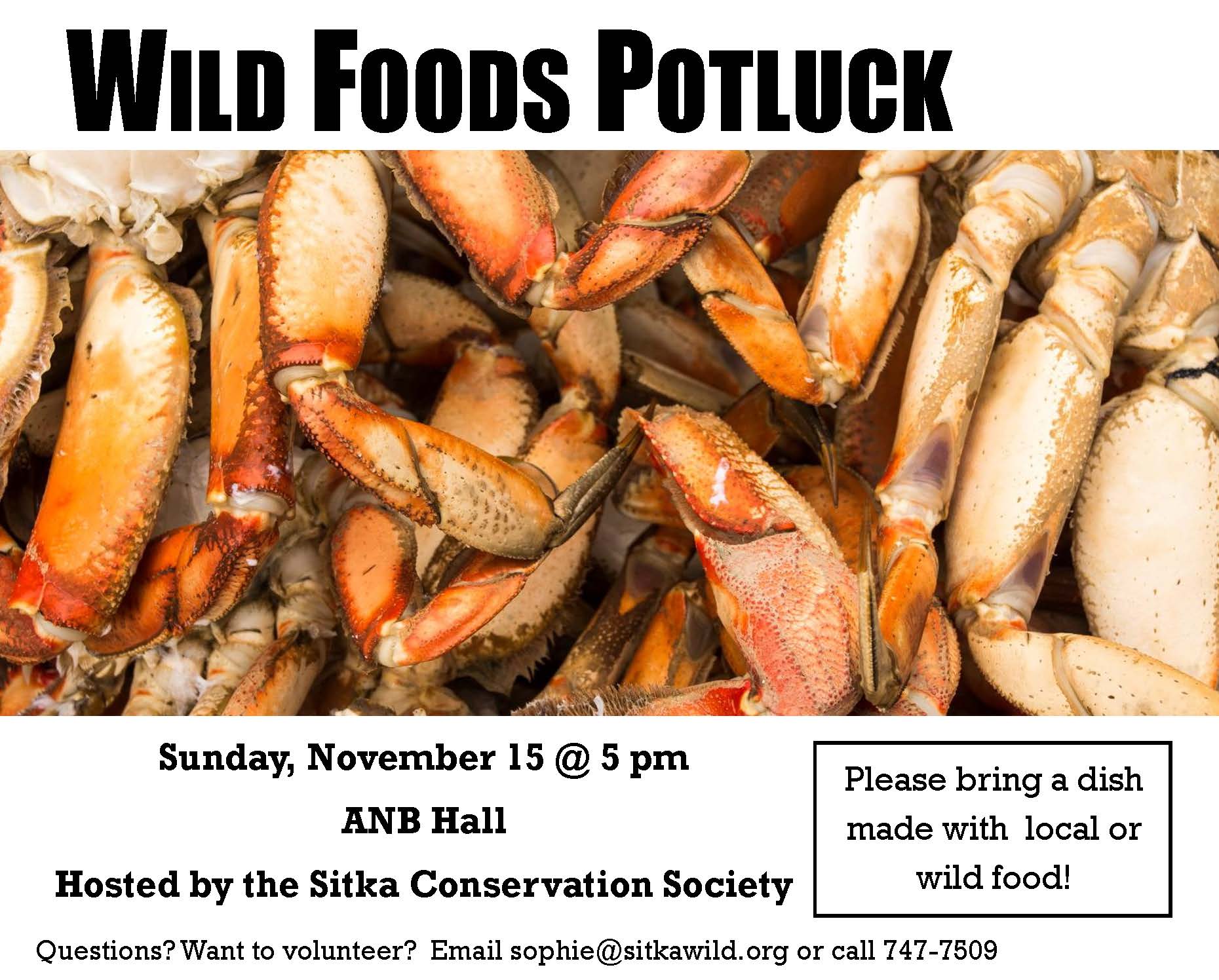
Wild foods potluck poster 2015 - CRAB

The Sitka Conservation Society will host its annual Wild Foods Potluck from 5-7 p.m. on Sunday, Nov. 15, at the Alaska Native Brotherhood Founders Hall (235 Katlian St.).

Please bring a dish featuring ingredients that were fished, foraged, hunted, or cultivated in Southeast Alaska. Prizes will be awarded for first place in the following categories — Best Dish, Best Dessert, and Most Creative.

The event will highlight subsistence stories and the work performed by the Sitka Conservation Society over the last year. SCS members can pick up their 2016 SCS Calendars at the potluck.

The potluck is open to SCS members, friends, family, and anyone else interested in learning about the Sitka Conservation Society. Come celebrate Alaska’s wild food bounty.

Interested in volunteering at the potluck or want more information? Contact Sophie Nethercut at sophie@sitkawild.org or call 747-7509.

• SEARHC, UAF Cooperative Extension Service to host deer/venison canning classes

Participants in Sitka's Alaska Way Of Life 4-H program, aka the Sitka Spruce Tips 4-H program, learn how to skin and butcher a deer. (Photo courtesy of the Sitka Conservation Society/Sitka Spruce Tips 4-H program)

Participants in Sitka’s Alaska Way Of Life 4-H program, aka the Sitka Spruce Tips 4-H program, learn how to skin and butcher a deer. (Photo courtesy of the Sitka Conservation Society/Sitka Spruce Tips 4-H program)

kitch_logo_mainThe SouthEast Alaska Regional Health Consortium (SEARHC) WISEFAMILIES Traditional Foods program and the University of Alaska Fairbanks Cooperative Extension Service are teaming up to offer a deer and venison workshop from 3-7 p.m. on Friday, Oct. 30, at the Sitka Kitch.

The Sitka Kitch is a rental community commercial kitchen project coordinated by the Sitka Conservation Society, in partnership with the Sitka Local Foods Network, located inside the First Presbyterian Church, 505 Sawmill Creek Road. The Sitka Kitch was a project from the 2013 Sitka Health Summit designed to improve food security in Sitka while also providing a space for people wanting to get into the cottage food business or wanting to preserve their harvest for storage in the home pantry. Sitka Kitch officially opened in March 2015 after a series of renovations to make it pass Alaska Department of Environmental Conservation commercial kitchen food safety standards.

The Oct. 30 class will feature lessons on how to can venison in jars, taught by Ellen Ruhle, as well as how to prepare deer jerky and how to smoke venison, taught by Jud Kirkness.

There is a possibility we will be able to harvest a deer next week, and if so we will add on a portion of the workshop to focus on butchering and meat care. And this time we are just offering the food preservation class (canning, jerky, and smoking hind quarters).

Thanks to a grant from the SEARHC WISEFAMILIES Traditional Foods program, all ingredients, jars, and equipment will be supplied in class.

The SEARHC WISEFAMILIES Traditional Foods program promotes healthy lifestyles by connecting Alaska Natives in Southeast Alaska to their culture. Members of the program learn how to harvest, cook, and preserve their traditional Alaska Native foods, which usually are healthier than heavily processed store-bought foods. In addition, participants learn traditional language, dancing, carving, weaving, and other skills that help reconnect them to their culture.

The UAF Cooperative Extension Service offers a variety of programs geared toward food, how to grow it, how to preserve it for storage, and how to make it into cottage foods you can sell. For those who can’t make the classes, the service offers a series of free online tutorials about home canning called Preserving Alaska’s Bounty.

Pre-registration is required for this class, and there are only 12 spots available. For more information and to pre-register, please contact Jasmine Shaw at 747-9440 or jdshaw2@alaska.edu.

• Alaska’s potential for increasing agricultural potential immense; hard work, clear vision needed

AlaskaFoodPolicyCouncilLogo

(The following is a commentary about increasing Alaska’s access to local food by Alaska Food Policy Council co-chairs Liz Snyder and Victoria Briggs. It originally ran in the Sept. 10, 2015, edition of the Homer News.)


If you’ve visited a local farmers market recently, you’ll appreciate the bounty of delicious, healthy food that Alaska can produce when cultivated by knowledgeable, dedicated hands.

The prospects for increasing this bounty are immense. To take full advantage of our agricultural potential, we will need political will, consumer advocacy, recruitment and education of new farmers, financial support and incentives and a long-term vision. This vision, of course, will also need to take into account the changing climate in which Alaska farmers grow our food.

Imagine a glacier that retreats, then expands for several years, only to retreat again, repeating this process over and over. Such has been the history of agriculture in Alaska. We’ve experienced several booms and busts of both enthusiasm and productivity since the early 1900s.

Booms were the result of such things as co-development with gold mining, collaboration with local businesses, federal support of farming settlements and agricultural innovations. Busts came when challenges (that still exist today) got the better of farmers — the temptation to grow too big too fast, unsustainable and mismanaged support mechanisms, high costs and resulting debt; competition from the Lower 48, infrastructure designed for resource development instead of agriculture, inexperience and being far from home, a lack of replacements for retiring farmers, and, of course, climate.

Today, farmers and consumers are enjoying a boom of interest and enthusiasm around local foods. While it’s true that we send about 1.9 billion Alaska dollars out of the state each year to import food (which supplements the impressive $900 million worth of subsistence and personal-use foods), the good news is that direct sales between farmers and consumers are strong (13 times greater than the national average), Alaska farmers are notoriously tenacious and innovative, and demand continues to motivate increases in supply.

What we have now is a fantastic opportunity to throw a wrench into the boom/bust cycle, expand on the status quo and ultimately pump about $2 billion into, instead of out of, the Alaska economy each year — in effect, supporting the local farmers we know and love, strengthening our food system, lowering food costs, and increasing food security and resilience.

Of course, strengthening our food system will require both short-term goals and long-term planning. When it comes to climate change and agriculture, we’ve got three courses of action to consider:

  1. reduce our impact;
  2. respond to current changes; and
  3. prepare for future changes.

In the Lower 48, agriculture is a major contributor to climate change with high fossil fuel use (to manufacture pesticides and fertilizers, and to operate machinery) and greenhouse gas emissions from concentrated animal feeding operations (CAFOs).

In Alaska, however, the relative scales of agriculture and pest pressure are small. Our primary agriculturally related contribution to climate change is through the importation of approximately 95 percent of our food, which requires the burning of fossil fuels to power transport. Just think of the impact we could have if we expanded Alaska agriculture in thoughtful, sustainable ways to simultaneously produce more food and reduce total greenhouse gas emissions.

With respect to responding to current changes in Alaska’s climate and preparing for the future, we have a host of actions that are either already being taken or need to be taken. These actions should use the best natural, economic and social science information available.

Such preparations include the conservation of arable land; crop diversification and expansion into new growing zones; anticipation of changes in water distribution and quality; measures to address changes in pest, disease and invasive species pressures; education and support of new farmers focused on sustainable agricultural development, and construction of weather-resistant food caches and transportation routes.

Of course, in reality there is an even longer list of recommendations that can be made to strengthen Alaska’s food system, but all of these recommendations will need to be made in light of the climate changes we’re experiencing now and those that lie ahead. The Alaska Food Policy Council is dedicated to helping develop, share and advocate for policies that will result in an Alaska food system that is sustainable, resilient and healthy — and we ask our local, state, and federal leaders to tune in to the issues of food security and climate change and make them a priority. The health of our great state depends on it.

Liz Snyder and Victoria Briggs are co-chairs of the Alaska Food Policy Council, or AFPC. To learn more about food security in Alaska, find the following research resources on the AFPC webpage (akfoodpolicycouncil.wordpress.com):

Building Food Security in Alaska (a report commissioned by AFPC).

• A three-part series of articles (Part I, Part II, Part III) on circumpolar agriculture by Stevenson et al. (2014) and

• An article entitled “Food in the Last Frontier” by Snyder and Meter (2015).

• Fish to Schools program seeks donations of coho salmon, photos from commercial fishermen

FishtoSchool

The Fish to Schools program needs help from Sitka’s commercial fishermen. The program needs a few hundred pounds of coho salmon to help make Fish to Schools meals for Sitka students during the upcoming 2015-16 school year. The program also is seeking photos of commercial fishermen at work, which can be used to teach the students more about how the fish got to their plates.

The coho salmon donation period is Monday. Aug. 24, through Monday, Aug. 31. To donate, commercial fishermen can sign up and indicate how many pounds they want to donate when they offload at Seafood Producers Cooperative or Sitka Sound Seafoods during the donation period. The program can only accept commercially caught fish (no sport or subsistence fish). The hope is to get enough coho donated that locally caught salmon can be offered to students at least once a week.

The Sitka Fish To Schools project (click here to see short video) got its start as a community wellness project at the 2010 Sitka Health Summit, and now is managed by the Sitka Conservation Society. It started by providing a monthly fish dish as part of the school lunch as Blatchley Middle School, and since then has grown to feature regular fish dishes as part of the lunch programs at Baranof Elementary School, Keet Gooshi Heen Elementary SchoolBlatchley Middle School, Sitka High SchoolPacific High School (where the alternative high school students cook the meals themselves), the SEER School, and Mount Edgecumbe High School.

FishtoSchool2In addition to serving locally caught fish meals as part of the school lunch program, the Fish To Schools program also brings local fishermen, fisheries biologists and chefs to the classroom to teach the kids about the importance of locally caught fish in Sitka. The program received an innovation award from the Alaska Farm To Schools program during a community celebration dinner in May 2012, and now serves as a model for other school districts from coastal fishing communities. In May 2014, the Fish to Schools program released a guidebook so other school districts in Alaska could create similar programs.

For more information, contact Sophie Nethercut of the Sitka Conservation Society, sophie@sitkawild.org or 747-7509. You also can contact Beth Short-Rhoads at 738-9942 or elianise@yahoo.com. Photos and captions of commercial fishermen working out on the water should be sent to Sophie.

• Scenes from the 2015 Sitka Seafood Festival events held Saturday, Aug. 8

SonnyCropleyScoopsOutShrimp

ssflogo2There were tote races, a parade, a marathon/half-marathon, food booths, live music, canning classes, salmon-head bobbing, halibut-head tossing, the Sitka Highland Games, and scores of other events Saturday during the sixth annual Sitka Seafood Festival at Sheldon Jackson Campus.

There also was nice weather — a little cloudy with light rain for the marathon/half-marathon, followed by warm sunny weather for the tote races, parade, and marketplace events later in the day.

A few scenes from the 2015 Sitka Seafood Festival are in a slideshow below.

This slideshow requires JavaScript.

• Scenes from a series of Sitka Seafood Festival food preservation classes at the Sitka Kitch

JasmineShawMichellePutzLeslieShallcrossConsult

ssflogo2On Aug. 6-8, the Sitka Seafood Festival hosted Leslie Shallcross from the Anchorage District Office of the University of Alaska Fairbanks Cooperative Extension Service to teach a series of food preservation classes at the Sitka Kitch community rental commercial kitchen (Aug. 6-7) and Sweetland Hall on Sheldon Jackson Campus (Aug. 8).

Leslie taught a class on Thursday at the Sitka Kitch about how to make low-sugar jams and jellies (a class on preserving local garden greens was canceled), and on Friday she taught a class on making kelp pickles and sauerkraut and a class on canning salmon. On Saturday, she moved over to the Sweetland Hall to be closer to the Sitka Seafood Festival events and she taught another canning salmon class and a class on the process of smoking salmon.

For those who missed the classes but still want to learn more about home canning, the UAF Cooperative Extension Service has a series of online tutorials on its website called “Preserving Alaska’s Bounty.”

Also, don’t forget to make sure your pressure canner gauge is tested at least once a year. Jasmine Shaw from the Sitka District Office of the UAF Cooperative Extension Service has a tester in her office and you can call her at 747-9440 to schedule a test.

kitch_logo_mainSitka Kitch is a community wellness project from the 2013 Sitka Health Summit designed to improve food security in Sitka. The different parts of the project include creating a community kitchen Sitka residents can rent to prepare food for their small businesses or to preserve their family harvest of fish, game, or garden veggies; expanding Sitka’s emergency food storage capacity; and providing education about preserving food and building family emergency food pantries.

For more information about the Sitka Kitch project, go to the Sitka Kitch website or Facebook page. For rental information, contact Kristy Miller at sitkakitch@sitkawild.org. Click this link to take a quick tour of the facility.

A slideshow with scenes from the various classes is posted below.

This slideshow requires JavaScript.