What you put #OnMyFork matters during ninth annual Farmers Market Celebration

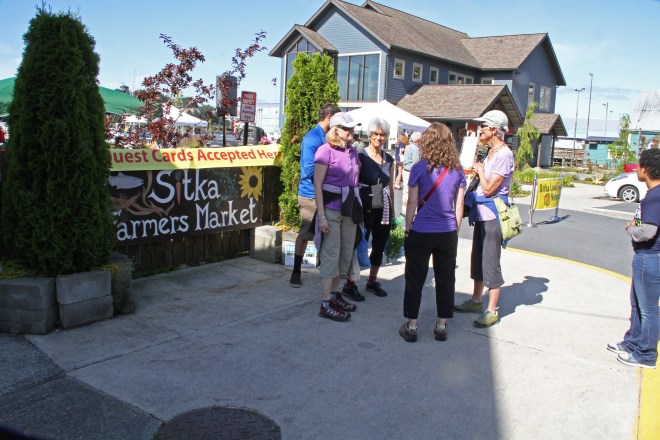
What you put #OnMyFork matters. That’s the message behind American Farmland Trust’s ninth annual Farmers Market Celebration. The celebration calls on shoppers to help identify the cream of the crop — the best of America’s farmers markets — and in Alaska we think that’s the Sitka Farmers Market.
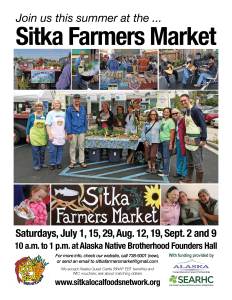
The celebration calls on shoppers to help identify the best of America’s farmers markets. The summer-long event launched June 21 and runs through Sept. 22. The first Sitka Farmers Market of the 2017 summer is from 10 a.m. to 1 p.m. on Saturday, July 1, at the Alaska Native Brotherhood Founders Hall. The other six Sitka Farmers Markets this summer are on Saturdays, July 15, July 29, Aug. 12, Aug. 19, Sept. 2, and Sept. 9.

“The Celebration encourages market customers, family farmers, community activists – anyone who believes they’ve got the best farmers market in the country – to endorse their market in four special areas: Focus on Farmers, Healthy Food for All, Pillar of the Community, and Champion for the Environment,” said Susan Sink, American Farmland Trust vice president of development and external relations.

Shoppers are encouraged to use Instagram and join the local food community in saving farmland with their forks, as part of AFT’s “#OnMyFork” social media campaign. Supporters are encouraged to post pictures or videos of their farmers market to Instagram using the hashtag #OnMyFork. If you do post something about the Sitka Farmers Market, please tag our Sitka Local Foods Network page on Facebook, https://www.facebook.com/SitkaLocalFoodsNetwork or share it on our Twitter page, https://www.twitter.com/SitkaLocalFoods. Please use the hashtags #SitkaLocalFoodsNetwork and #SitkaFarmersMarket if you share a photo.

“While farmers markets have been growing in popularity, keeping family farmers on farmland remains a nationwide challenge,” Sink says. “Many family farmers are struggling to stay financially afloat and face daily pressure from development to sell their land. Farmers markets provide a wonderful opportunity for family farmers to sell directly to consumers and to help make a living on their land.”
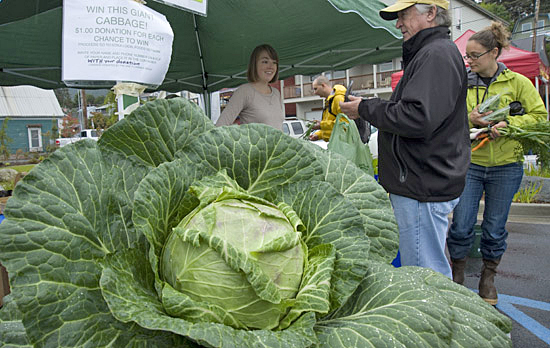
bigcabbagewsFarmers markets have a lot to offer. Beyond the beautiful array of fresh and local food, farmers markets help family farmers thrive, connect us as a community and can be catalysts for both environmental and social good. That is why American Farmland Trust is giving away awards to farmers markets who are the Best in Class in four special areas — Focus on Farmers, Healthy Food for All, Pillar of the Community, and Champion for the Environment. There also is a People’s Choice category.

If you have ever been to the Sitka Farmers Market, you may already know it as setting the gold standard for farmers markets in these areas. If you haven’t been to the market before, here are a few reasons why the Sitka Farmers Market deserves to be named one of America’s top markets:

  • Focus on Farmers — The Sitka Local Foods Network, which sponsors the Sitka Farmers Market, has been working with local gardeners and small farmers to increase the amount of locally grown fruits and veggies in Sitka. Not only is locally grown food fresher and better tasting, but it’s better on the environment because it doesn’t have to travel thousands of miles to get to Alaska.
  • Healthy Food for All — The Sitka Farmers Market was the first farmers market in Southeast Alaska to accept SNAP (food stamps/Alaska Quest cards) and WIC vouchers for people benefitting from those programs. In addition, we have matching dollars of up to $20 per person per market available for SNAP-eligible foods (produce, fish, baked goods, barley products, etc.).
  • Pillar of the Community — The Sitka Farmers Market not only serves as a community gathering place, but it also is a business incubator. It’s a good place for budding entrepreneurs to test ideas and products before going into full production. The Sitka Farmers Market emphasizes local, local, local, which helps put the focus on products from Sitka.
  • Champion for the Environment — It’s estimated that Alaska residents import about 90-95 percent of their food from the Lower 48 or foreign countries. By encouraging people to grow or harvest food locally, we’re cutting down on thousands of miles of transportation costs. That means less fuel is used, and fewer pollutants in the air.

To help shine a light on the Sitka Farmers Market, just go to http://markets.farmland.org/market/sitka-farmers-market/ and recommend our market. In past Farmers Market Celebrations, sponsored by the American Farmland Trust, the Sitka Farmers Market has been at or near the top among the Alaska rankings. In 2015, the Sitka Farmers Market was the top Alaska market in this contest. In 2016, the Sitka Farmers Market earned Best In Class honors in the contest. We have a couple of new wrinkles in 2017 (vendor rates back to 2015 levels, a new Alaska Grown booth featuring products from around the state, a kids vendor program, etc.), so this year could be the best yet.
Sitka Farmers Market to host meeting June 22 for prospective and past vendors

The Sitka Local Foods Network will host a meeting for prospective and past vendors of the Sitka Farmers Market from 6:30-8 p.m. on Thursday, June 22, at the Sitka Unitarian Universalist Fellowship Hall (408 Marine Street, parking off Spruce Street). There are a few changes to the vendor rules and table rates this year, so this is a good time to learn about them.

This is the ninth year of operation for the Sitka Farmers Market, which features seven markets from 10 a.m. to 1 p.m. on Saturdays, July 1, July 15, July 29, Aug. 12, Aug. 19, Sept. 2, and Sept. 9, at the Alaska Native Brotherhood Founders Hall (235 Katlian Street). The Sitka Farmers Market was a community health initiative from the 2008 Sitka Health Summit.

The farmers markets feature booths from local farmers and gardeners, local fishermen, local bakers, and local artisans and craftspeople. Our emphasis is on local products from Sitka and Southeast Alaska. The farmers markets also are great Sitka gathering places.

A detailed description of the farmers markets and vendor forms can be found our websitehttp://www.sitkalocalfoodsnetwork.org/ (scroll down or look in the right-hand column). If you have any questions, please email Sitka Farmers Market Manager Nina Vizcarrondo at sitkafarmersmarket@gmail.com or call her at (907) 738-9301 (new number).

• 2017 Vendor Rules and Responsibilities (with Registration Form, updated July 3, 2017)

Check out the June 2017 edition of the Sitka Local Foods Network newsletter

The Sitka Local Foods Network just sent out the June 2017 edition of its monthly newsletter. Feel free to click this link to get a copy.

This month’s newsletter includes brief items about the Sitka Farmers Market seeking vendors and volunteers for 2017, information about the Sitka Kitch’s Preserving the Harvest class series, and details about a new study on the economic impacts of locally grown produce in Southeast Alaska. Each story has links to our website for more information.

You can sign up for future editions of our newsletter by clicking on the newsletter image in the right column of our website and filling in the information. If you received a copy but didn’t want one, there is a link at the bottom of the newsletter so you can unsubscribe. Our intention is to get the word out about upcoming events and not to spam people. We will protect your privacy by not sharing our email list with others. Don’t forget to like us on Facebook and follow us on Twitter.

Sustainable Southeast Partnership and Spruce Root Inc. release report on the economic impacts of local produce in Southeast Alaska

The Sustainable Southeast Partnership and Spruce Root Inc. have officially released a report, “Current and Potential Economic Impacts of Locally Grown Produce in Southeast Alaska.” The report, which was first presented at the Southeast Alaska Farmers Summit held in February in Haines, was written by the McDowell Group.

“This study is the first to measure the amount of produce grown in Southeast Alaska,” said Dan Lesh, a research analyst with the McDowell Group. “Even though I’m an avid gardener and lifelong Southeast Alaskan, I was surprised at the high level of gardening we found through the survey. It was also interesting to see what crops people are growing and which are the most productive.”

The 47-page study surveyed residents of several Southeast Alaska communities to try and find out how much food they grew locally, and how much was imported. For example, even though 38 percent of Southeast Alaskans garden, only 4.4 percent of the vegetables eaten in the region were produced locally (and 95.6 percent were imported from the Lower 48 or overseas).

Southeast Alaskans spent $19 million on imported veggies in 2016, and many of those veggies can be grown here in the region. While commercial growers in Southeast Alaska only sold about $180,000 in locally grown produce, gardeners and commercial growers spent about $1.8 million to support growing food in the region. Money spent on locally grown produce tends to circulate within the region instead of going elsewhere.

“There is tremendous opportunity to expand commercial and home-scale food production in Southeast Alaska,” said Lia Heifetz, food security regional catalyst for the Sustainable Southeast Partnership. “This contributes to community and regional food security. There is also significant opportunity to create economic activity through support services — like the local production of seeds and soil, or local sources of agriculture infrastructure and tools — as well as adding value to raw agricultural products. In addition to supporting services, either growing your own food or supporting our region’s food producers through farmers markets, or online farmers markets, like the Salt & Soil Marketplace, is a great way to contribute to localizing our food system.”

The report includes a breakdown of what veggies commercial growers in the region are growing, and what they’re selling for. It also includes a breakdown of what households are growing and consuming. There are charts showing food purchases over the years, and vegetable consumption.

There also is information on trends within the region when it comes to growing veggies, and how that impacts the economy. It details some of the challenges for the region, and what’s being done to meet those challenges. In addition, the report touches on the food security of the region.

“The commercial agriculture industry in Southeast Alaska is clearly at a small scale right now, but there is room for growth and a variety of creative opportunities exist to expand the economic impacts of the industry,” Lesh said. “A lot of new businesses have been created in recent years, with support from Path to Prosperity business competition and other sources. Looking forward to seeing where those businesses go.”

• Current and Potential Economic Impacts of Locally Grown Produce in Southeast Alaska (PDF file)

Sitka Farmers Market vendor registration information for 2017 now available

Registration for the 2017 Sitka Farmers Markets is open, and vendors looking to sell local food, arts and crafts, and other items at the markets can find all the vendor forms, information sheets, rules and regulations for this year by going to the Documents page on this site, or look at the bottom of this post for the documents. The forms include information about how to register your table for this year’s markets.

The 2017 Sitka Farmers Market manager is Nina Vizcarrondo, who helped manage a New York City farmers market and brings experience to Sitka. She can be reached at sitkafarmersmarket@gmail.com or (907) 738-9301 (Note: new phone number) during the market season. The dates for our 2017 Sitka Farmers Markets will be from 10 a.m. to 1 p.m. on seven Saturdays — July 1, July 15, July 29, Aug. 12, Aug. 19, Sept. 2, and Sept. 9 — at the Alaska Native Brotherhood Founders Hall at 235 Katlian Street.

This year, the Sitka Local Foods Network rolled back its Sitka Farmers Market table prices to 2015 levels and simplified them, and we hope this helps us reclaim some of the vendors we lost last year. The table fees will be $40 for a full table (slightly longer than eight feet) or $20 for a half table per market. We also have a deal where vendors who reserve space for and participate in all seven markets can receive a refund of one market fee after the season (so get seven markets for the price of six). There no longer is a price differential between indoor and outdoor booths. We want to bring back some of the excitement to the markets, where it returns to being a community gathering place, and that means we have to make the market attractive to vendors.

If you are an Alaska food vendor and don’t have the time to host a table at the market, we might be interested in buying your products at wholesale rates or selling them on consignment at our Sitka Local Foods Network farm stand. We want to show Sitkans the variety of local food products available in our community and state.

New this year is a children’s vendor program, where kids get to become entrepreneurs and sell their own locally made food or arts and crafts. This program is modeled after the city’s program where children younger than age 12 buy a season permit to sell items near Harrigan Centennial Hall on cruise ship days. In our children’s vendor program, the fee is $10 for the full market season.

Nina is available to answer questions and to make suggestions that will help new and returning vendors adjust to any food regulation changes from the Alaska Department of Environmental Conservation, updates to the Alaska Quest electronic benefits program and WIC (Women, Infants, Children) supplemental food program, etc. We hope to schedule a pre-market meeting or two for potential vendors between now and the first market.

There are several changes to the 2017 rules and responsibilities, so please read them carefully. The last page has the vendor registration form for adult and child vendors.

In addition, we are trying to increase our labor pool of volunteers to help out with the market. We need people to help us set up, take down, sell produce at the Sitka Local Foods Network farm stand, and more. If you are interested in volunteering, send us a note with your contact info. We usually have musicians play at the market, so we are gathering a list of music groups that want to perform.

For more information, contact Sitka Farmers Market manager Nina Vizcarrondo at (907) 738-9301 (new number) or sitkafarmersmarket@gmail.com, or you can email the Sitka Local Foods Network Board of Directors at sitkalocalfoodsnetwork@gmail.com. Tiffany Justice is the SLFN board liaison to the market (and board treasurer) and Charles Bingham is the SLFN board president, and both will assist with the market.

Sitka Farmers Market vendor forms

• 2017 Vendor Rules and Responsibilities (with Registration Form, updated July 3, 2017)

• Sitka Farmers Market vendor agreement to accept Alaska Quest SNAP EBT tokens (2017)

• Link to 2015 Farmers Market Resource Fact Sheets from Alaska Division of Agriculture

• 2015 City and Borough of Sitka Sales Tax Form for Sitka Farmers Market Vendors

• Cottage Food Fact Sheet — “Understanding Alaska’s Cottage Food Exemptions”

• Cottage Food Exemptions

• Washington Farmers Market Vendor Marketing Guide (March 2014)

• Guide to Operating a Successful Home-Based Food Business (March 2014 document from UAF Cooperative Extension Service and Alaska Department of Environmental Conservation includes Alaska food safety information and regulations for farmers markets and other food sales)

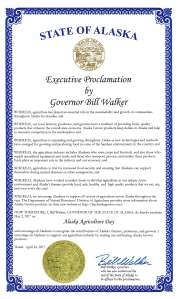
Celebrate local farmers and gardeners on Alaska Agriculture Day on Tuesday, May 2

Alaskans will celebrate Alaska Agriculture Day on Tuesday, May 2. On this day, Alaskans are encouraged to support local agriculture by seeking out and purchasing products produced in Alaska and educating youth about the vital role that agriculture plays in our economy. This is Alaska’s version of National Ag Day (which took place on March 21 this year, when many parts of Alaska were still thawing out).

Here are a few ideas from the Division of Agriculture on how to celebrate Alaska Agriculture Day:

In Sitka, you can celebrate Alaska Agriculture Day by starting a food garden (even a couple of containers on your deck can provide you with potatoes, carrots or greens). Teachers are encouraged to offer a lesson plan or two about the importance of agriculture in Alaska and in Sitka. Here’s a link to an article about how Sitka was Alaska’s original garden city back in the late 19th and early 20th Centuries. Also, the Sitka History Minute feature on KCAW-Raven Radio has had several episodes about agriculture in Sitka (click here to listen to a feature about the potato in Sitka, click here to listen to a feature about the Sitka Agricultural Station, and click here to listen to a feature about the cows of Iris Meadows).

During the growing season, please support the Sitka farmers and production gardeners listed in the 2016-17 Alaska Grown Source Book (chief contact in parentheses) — Anam Cara Family Garden (Lisa Sadleir-Hart), Blatchley Community Gardens (David Nuetzel, this garden closed in 2016 and there is a group seeking a new location for what will be called Sitka Community Gardens), Down To Earth U-Pick Garden (Lori Adams, switched to a CSA in 2017 and no longer is a public u-pick garden), Finn Island Farm (Keith Nyitray), Sprucecot Gardens (Judy Johnstone), and St. Peter’s Fellowship Farm (Laura Schmidt/Sitka Local Foods Network). There also are a few Sitka farms and production gardens not listed in the 2016-17 Alaska Grown Source Book, such as Humpback Farm (Peter Williams), Middle Island Organic Produce (Andrea Fraga/Kaleb Aldred), Sea View Garden (Linda Wilson), The Sawmill Farm (Bobbi Daniels), Sitka Seedling Farms (Matthew Jackson) and Welsh Family Forget-Me-Not Garden(Florence Welsh).

Many of these farms and gardens will be vendors during the Sitka Farmers Markets this summer. The Sitka Farmers Markets take place from 10 a.m. to 1 p.m. on Saturdays, July 1, July 15, July 29, Aug. 12, Aug. 19, Sept. 2, and Sept 9, at the Alaska Native Brotherhood Founders Hall (235 Katlian St.).

UAF Cooperative Extension Service, Alaska Sea Grant to host online specialty food business class series

The University of Alaska Fairbanks Cooperative Extension Service and Alaska Sea Grant program are teaming up to offer a four-session online-only class on how to start and operate a specialty food business. The four classes are from 6-8:30 p.m. on Monday through Thursday, May 15-18, and the classes will cost $50 for all four sessions. To register, go to http://bit.ly/SpecialtyFoodBusiness.

This course outlines the development and management of a successful specialty food business from inception to operation. Participants will learn about the practical application of business planning, obtaining
financing, permitting, feasibility analysis and marketing along with the operational aspects of a specialty food business.

This course will be delivered primarily by lectures, with four homework assignments that are individualized to help you develop an action plan for your business. At the end of this course, the student will understand and use the appropriate managerial and decision-making tools that are needed to start and run a specialty food business.

The course is available statewide from any computer with a reliable connection. We will be using Zoom to deliver class content. Students must have access to a video camera, speakers and microphone to actively participate. To learn more about the system requirements for Zoom, visit https://support.zoom.us/hc/en-us/articles/201362023-System-Requirements-for-PC-and-Mac.

For more information, contact Sarah Lewis of the Juneau District Office of the UAF Cooperative Extension Service at (907) 523-3280, Ext. 1, or sarah.lewis@alaska.edu, or Quentin Fong of the Alaska Sea Grant program at (907) 486-1516 or qsfong@alaska.edu.

Alaskans Own Seafood CSF program subscriptions open for the 2017 season

(Photo by Nancy Behnken)

Alaskan’s Own Seafood, which is a community-supported fishery (CSF) program run by the Alaska Longline Fishermen’s Association (ALFA), has opened and is receiving subscription orders for the 2017 season.

Alaskans Own was the first CSF program in Alaska. Now in its eighth year, AO was created to connect consumers to small boat fishermen, ensure that more fish caught in Alaska stays in Alaska, and create a sustainable source of revenue to support ALFA’s Fishery Conservation Network, which engages fishermen and scientists in conservation and research initiatives.

(Photo by Caroline Lester)

Similar to community-supported agriculture (CSA) programs, CSF programs address an important environmental and socio-economic need by strengthening consumer-producer relationships. By forward-funding a season of seafood, subscribers invest in sustainable harvest and the rural fishermen who catch their fish, as well as supporting the web of seafood-related jobs that provide the economic backbone for our coastal communities.

Alaskans Own has just released its prices, and early bird customers who subscribe before Saturday, April 15, will receive these prices (which are at a 10-percent discount).

Sitka CSF Prices:

  • Four Month half share (5 lbs/month, May-August), $300
  • Four Month full share (10 lbs/month, May-August), $435
  • Six Month half share (5 lbs/month, May-October), $565
  • Six Month full share (10 lbs/month, May-October), $825

Non-Sitka CSF Prices (available in Juneau, Fairbanks, Anchorage, and Seattle):

  • Four Month half share (5 lbs/month, May-August), $330
  • Four Month full share (10 lbs/month, May-August), $480
  • Six Month half share (5 lbs/month, May-October), $605
  • Six Month full share (10 lbs/month, May-October), $885

(Photo by Josh Roper/ASMI)

There are four-month and six-month subscriptions available starting in May. The six-month subscriptions allow people to keep receiving freshly caught seafood through October instead of August, when the traditional four-month subscriptions end. Half-subscriptions also are available. Subscriptions include a mix of locally troll-caught black cod (sablefish), halibut, king salmon, coho salmon, lingcod and miscellaneous rockfish, depending on the commercial fishing season and prices.

(Photo by Josh Roper/ASMI)

“Alaskans Own’s model is unique from other CSFs because it is not only connecting customers to the fishermen that caught their fish, it is supporting a range of fishermen-sourced conservation initiatives,” says Alyssa Russell, ALFA’s Communications Coordinator. “We’re so excited to be bringing customers to another year of sustainably-caught, delicious seafood.”

If you don’t live in one of our CSF cities and are interested in ordering fish in bulk, please feel free to contact Alyssa Russell or Willow Moore at alaskansownfish@gmail.com or 747-3400.

Please purchase your fish by visiting our online store at alaskansown.com

Learn more about our Fishery Conservation Network at alfafish.org

UAF Cooperative Extension Service offers Certified Food Protection Manager class by videoconference April 26 in Sitka

Wednesday, April 12, is the registration deadline for a certified food protection manager workshop being taught on Wednesday, April 26, by University of Alaska Fairbanks Cooperative Extension Service. This is an all-day statewide class that will be offered by videoconferencing to Delta Junction, Fairbanks, Juneau, Palmer and Sitka.

A certified food protection manager (CFPM) is responsible for monitoring and managing all food establishment operations to ensure that the facility is operating in compliance with food establishment regulations.

A CFPM is knowledgeable about food safety practices and uses this knowledge to provide consumers with safe food, protect public health and prevent food-borne illnesses. Alaska regulations require food establishments to have at least one CFPM on staff.

This course takes place from 8:30 a.m. to 5:30 p.m. (with a half-hour lunch), and participants will take a computer-based exam at the end of the class. The reason the deadline is two weeks before the class is to guarantee course materials reach all the students in time for the class. The cost is $200, and the course will be taught by Julie Cascio of Palmer. Students can register here.

The Sitka videoconference for the class will take place in Room 106 at the University of Alaska Southeast Sitka Campus. To learn more, contact Jasmine Shaw at the Sitka District Office of the UAF Cooperative Extension Service at 747-9440, or contact Julie Cascio at (907) 745-3360 (Palmer number) or jmcascio@alaska.edu. Note, this class is taught in English but textbooks are available in Korean, Chinese and Spanish, just contact Julie at least three weeks before the class.

Also, the ServSafe book ($70) and certification exam ($75) now are available online, if people want to order the book and study independently without taking the class. Just go to this website and purchase the book and exam items.

Path To Prosperity contest seeks innovative food businesses for 2017 competition

Two Southeast Alaska businesses were recognized as innovative entrepreneurs in the 2016 Path To Prosperity sustainable business competition. Skya’ana Coffee Company of Klawock (Tina Steffen, left) and Wild Alaska Kelp Company of Juneau (Matt Kern, right) will each receive up to $40,000 in seed money for consulting/technical assistance to develop the business concept, along with support in finding investor funding. (Photos by Michael Penn, Juneau Empire)

Are you trying to launch or grow a food business?  The 2017 Path To Prosperity Competition (P2P) sustainable business competition aims to identify and support innovative Southeast Alaska food businesses.  Supporting local food businesses reduces Southeast Alaska’s dependence on imports, strengthens community resiliency, and promotes sustainable use of the region’s natural bounty.

Path To Prosperity is a collaboration between The Nature Conservancy (TNC) and Spruce Root, Inc. (formerly the Haa Aaní Community Development Fund, Inc.). Spruce Root and TNC are committed to strengthening local food systems by supporting food entrepreneurs from across the region. In previous years, the Path To Prosperity competition included a variety of businesses, such as locally made skis and guitars, but this year the competition is focused on food.

“We’re excited to try something a little different for the next round and connect with the growing local foods movement in Southeast Alaska,” says P2P competition administrator Paul Hackenmueller. “This year’s competition will provide resources to help local food entrepreneurs incorporate social, economic, and environmental sustainability techniques into their business models.”

Eligible businesses must operate primarily in Southeast Alaska and be involved in the growing, harvesting, processing, aggregation, preparation or distribution of food. “P2P applicants can be existing businesses or start-ups, but do not need to submit a full business plan in the first round of the application process,” said Paul Hackenmueller, P2P competition administrator. “We want to encourage new entrepreneurs to apply, even if they haven’t started their business yet, so the Round 1 application doesn’t require a full business plan.  We only ask for a basic description of the business concept.” P2P helps entrepreneurs identify ways to make their businesses profitable, while also having positive social and environmental impacts on their communities.

Twelve applicants will be selected as finalists to advance to Round 2 of the competition and attend P2P’s innovative Business Boot Camp weekend in Juneau. All 12 finalists receive one-on-one mentorship and consulting that they can use to help write their business plans and grow their businesses after they return to their communities. The Boot Camp experience is valuable for all finalists who attend, whether or not they win the competition.

“Thanks to P2P, I have a clear vision of where I am headed and a solid business plan that I developed as the roadmap to the future of our company,” said Tina Steffen of Skya’ana Coffee Company in Klawock, one of two winners of the 2016 competition.

Timeline for 2017 Path To Prosperity Competition

  • April 1, 2017 – Application Period Opens
  • May 9, 2017 – Webinar
  • May 31, 2017 – Applications Due
  • July 7, 2017 – Announce Finalists Advancing to Round 2
  • Sept. 29 to Oct.1, 2017 – Boot Camp Weekend in Juneau
  • Dec. 3, 2017 – Business Plan Submissions Deadline
  • February 2018 –Two Winners Announced

The competition is open to all Southeast Alaska residents.  This includes individuals, for-profit businesses and tribal entities.

For more information on how to apply or learn more, click here.