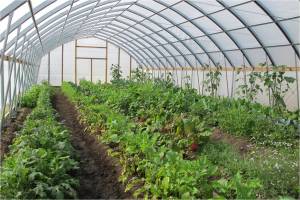
Are you interested in learning how soil quality impacts your home garden? Do you want to learn how to get funding for a high tunnel to extend your growing season? Join Samia Savell of the U.S. Department of Agriculture’s Natural Resources Conservation Service office in Juneau for an informal discussion about those topics and others at noon to 1 p.m. on Thursday, Aug. 9, in the Gus Adams Meeting Room at the Sitka Public Library. Note, Samia has reserved the meeting room until 2 p.m. in case people want to stay after and ask her questions.
The USDA Natural Resources Conservation Service (NRCS) assists agricultural producers with conservation efforts on their cultivated land. Technical assistance is available upon request, and is tailored to each landowner’s unique situation. Working with NRCS staff, landowners identify resource concerns such as poor soil quality or plant health, inefficient water use, or even energy conservation, and develop a plan to address those concerns while supporting their production goals.
Program funding through the Environmental Quality Incentives Program (EQIP) can help defray costs of implementing conservation practices outlined in the plan. Applications are currently being accepted for fiscal year 2019 EQIP funding. Interested producers must first establish farm records with the Farm Services Agency, and verify that they and their land are eligible for funding.
Typical practices supported through EQIP funding in Southeast Alaska include nutrient management, crop rotation, cover crops, and high tunnels. High tunnels, also known as hoop houses or temporary greenhouses, extend the growing season so more food is produced before and after the traditional weather dates for growing stuff outdoors. They also can help with irrigation and drainage, and with pest control.
High tunnels differ from greenhouses in that crops are grown in the ground or in raised beds rather than in containers. Geodomes are also eligible for funding. Funding through EQIP requires the landowner to purchase a structure and install it according to the manufacturer’s instructions. Additional information can be found in the NRCS high tunnel fact sheet (attached), or by contacting the Juneau Field Office. Low tunnels, which usually involve some PVC pipe bent over a garden bed and covered with row cover, and homemade structures are not eligible in this program.
The 2019 SEAK Farmers Summit is right around the corner (February in Sitka) and in the spirit of the event, we are looking to include a few “cooperative farmer presentations” this year. The idea being that 2-4 farmers/growers team up to create a presentation that addresses (from a personal experience perspective) a topic that was requested on evaluations from the last summit in Haines. What follows is a list of the requested topics/ideas:
Irrigation Systems
Pest/Disease Management
Greenhouse Growing/Supplemental Lighting
Packaging & Distribution
Specific Crop Information (exactly how YOU grow it)
“Worst mistakes you’ve ever made”
Growing Berries in SEAK
Methods for Seed Starting
Weed Suppression Techniques
Root Cellars
If you feel you have anything to contribute (even just a couple minutes worth) to sharing experience/knowledge related to any of these topics and would like to be included as a presenter for one of these cooperative presentations, please email Marja Smets of Farragut Farm for more information (farragutfarm@gmail.com). She will be coordinating this part of the agenda. We are looking for folks to prepare a 2-10 minute presentation (hopefully with pictures, but it is not required) and be willing to answer questions from the audience. Again, the idea is to foster conversation and the exchange of ideas among participating farmers/farmers-to-be.
Thanks and looking forward to seeing you all in February 2019.
—
Lia G. Heifetz
Director, Grow Southeast
1107 W. 8th Street, Suite 234
Juneau, Alaska 99801
321.5425
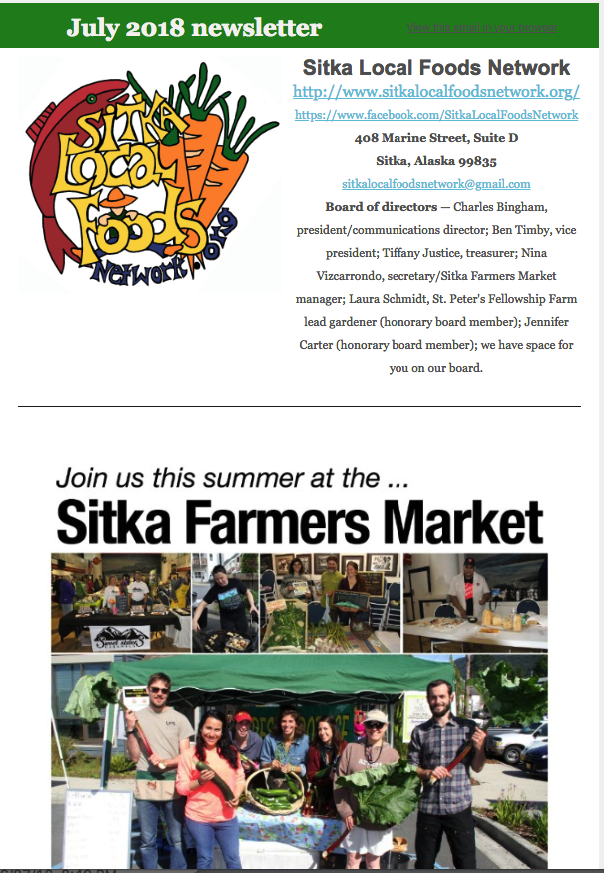
The Sitka Local Foods Network just sent out the July 2018 edition of its monthly newsletter. Feel free to click this link to get a copy.
This month’s newsletter includes short stories about the first Sitka Farmers Market taking place on Saturday, a a community discussion about our food with food policy expert Mark Winne, an invitation to join our board of directors, and an item about our sponsorship program.. Each story has links to our website for more information.
You can sign up for future editions of our newsletter by clicking on the newsletter image in the right column of our website and filling in the information. If you received a copy but didn’t want one, there is a link at the bottom of the newsletter so you can unsubscribe. Our intention is to get the word out about upcoming events and not to spam people. We will protect your privacy by not sharing our email list with others. Don’t forget to like us on Facebook, like our new Sitka Farmers Market page on Facebook and follow us on Twitter (@SitkaLocalFoods).
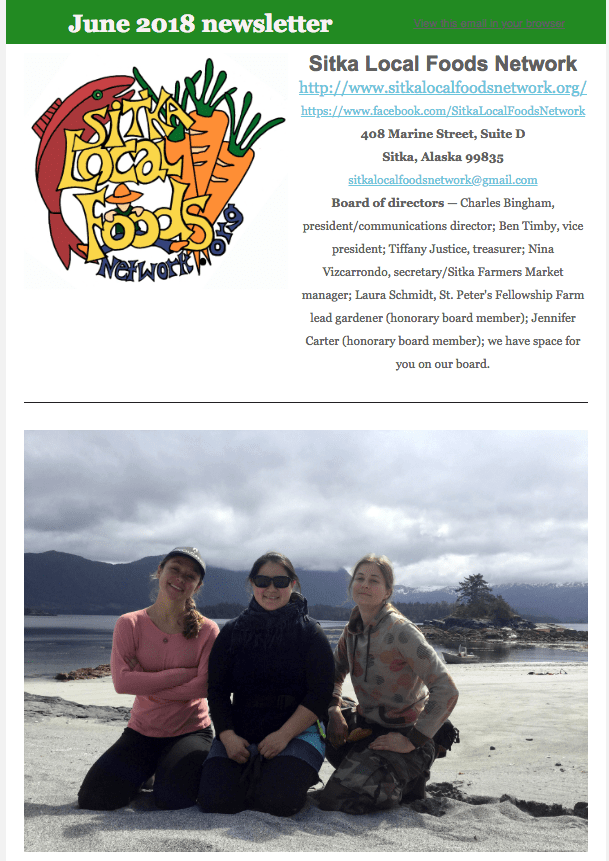
The Sitka Local Foods Network just sent out the June 2018 edition of its monthly newsletter. Feel free to click this link to get a copy.
This month’s newsletter has short articles about Gimbal Botanicals winning the Sitka Food Business Innovation Contest, Sitka Farmers Market vendor registration information being available, an invitation for people to join the Sitka Local Foods Network board of directors, information about a variety of food classes at the Sitka Kitch community rental commercial kitchen, and information about the Sitka Local Foods Network sponsorship program. Each story has links to our website for more information.
You can sign up for future editions of our newsletter by clicking on the newsletter image in the right column of our website and filling in the information. If you received a copy but didn’t want one, there is a link at the bottom of the newsletter so you can unsubscribe. Our intention is to get the word out about upcoming events and not to spam people. We will protect your privacy by not sharing our email list with others. Don’t forget to like us on Facebook, like our new Sitka Farmers Market page on Facebook and follow us on Twitter (@SitkaLocalFoods).
The Sitka Local Foods Network just sent out the May 2018 edition of its monthly newsletter. Feel free to click this link to get a copy.
This month’s newsletter has short articles about a garden work party at St. Peter’s Fellowship Farm on May 4, an update on spring garden classes and a new class series from the Sitka Kitch, an Sitka Farmers Market vendor meeting on May 17, an update on our sponsorship program, and an invitation to join our board of directors. Each story has links to our website for more information.
You can sign up for future editions of our newsletter by clicking on the newsletter image in the right column of our website and filling in the information. If you received a copy but didn’t want one, there is a link at the bottom of the newsletter so you can unsubscribe. Our intention is to get the word out about upcoming events and not to spam people. We will protect your privacy by not sharing our email list with others. Don’t forget to like us on Facebook, like our new Sitka Farmers Market page on Facebook and follow us on Twitter (@SitkaLocalFoods).
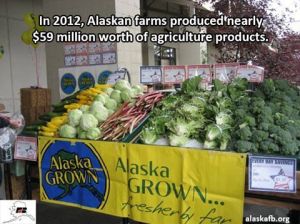
Alaskans will celebrate Alaska Agriculture Day on Tuesday, May 1. On this day, Alaskans are encouraged to support local agriculture by seeking out and purchasing products produced in Alaska and educating youth about the vital role that agriculture plays in our economy. This is Alaska’s version of National Ag Day (which took place on March 20 this year, when many parts of Alaska were still thawing out).
Here are a few ideas from the Division of Agriculture on how to celebrate Alaska Agriculture Day:
Join the 57,479 people who “like” the Alaska Grown Facebook page at https://www.facebook.com/dnr.alaskagrown and learn about the exciting things Alaskans are producing around the state.
Sign up for a Community Supported Agriculture (CSA) program at a local farm.
Buy and incorporate Alaska Grown products into your meals. The Alaska Grown program has a new Buy Alaska Grown website where it is registering Alaska farmers so they can list their items on the web. In Southeast Alaska, a new food hub called the Salt and Soil Marketplace just launched a similar website where Southeast food producers (including fishermen) can list their products.
If you are a farmer, consider asking a local school if you can visit a classroom to educate children about your operation and Alaska agriculture. The Alaska Division of Agriculture provided this lesson plan for how to make carrot seed tape.
In Sitka, you can celebrate Alaska Agriculture Day by starting a food garden (even a couple of containers on your deck can provide you with potatoes, carrots or greens). Teachers are encouraged to offer a lesson plan or two about the importance of agriculture in Alaska and in Sitka. Here’s a linkto an article about how Sitka was Alaska’s original garden city back in the late 19th and early 20th Centuries. Also, the Sitka History Minute feature on KCAW-Raven Radio has had several episodes about agriculture in Sitka (click here to listen to a feature about the potato in Sitka, click here to listen to a feature about the Sitka Agricultural Station, and click here to listen to a feature about the cows of Iris Meadows).
During the growing season, please support the Sitka farmers and production gardeners listed in the 2016-17 Alaska Grown Source Book(chief contact in parentheses) — Anam Cara Family Garden (Lisa Sadleir-Hart), Blatchley Community Gardens (David Nuetzel, this garden closed in 2016 and there is a group seeking a new location for what will be called Sitka Community Gardens, but its 2018 status is unknown), Down To Earth U-Pick Garden (Lori Adams, switched to a CSA in 2017 and no longer is a public u-pick garden), Finn Island Farm (Keith Nyitray, this farm closed), Sprucecot Gardens (Judy Johnstone), and St. Peter’s Fellowship Farm (Laura Schmidt/Sitka Local Foods Network). There also are a few Sitka farms and production gardens not listed in the 2016-17 Alaska Grown Source Book, such as Beyond Leafy LLC (Jimmy and Leslie Kranz), Middle Island Gardens (Andrea Fraga/Kaleb Aldred), and Welsh Family Forget-Me-Not Garden (Florence Welsh).
Many of these farms and gardens will be vendors during the Sitka Farmers Markets this summer. The Sitka Farmers Markets take place from 10 a.m. to 1 p.m. on seven Saturdays — July 7, July 21, Aug. 4, Aug. 11, Aug. 25, Sept. 1, and Sept 15 — at the Alaska Native Brotherhood Founders Hall (235 Katlian St.). There will be a Sitka Farmers Market vendor meeting from 6:30-8 p.m. on Thursday, May 17, at the Sitka Unitarian Universalist Fellowship Hall (408 Marine Street, parking off Spruce Street) where rules and responsibilities will be discussed.
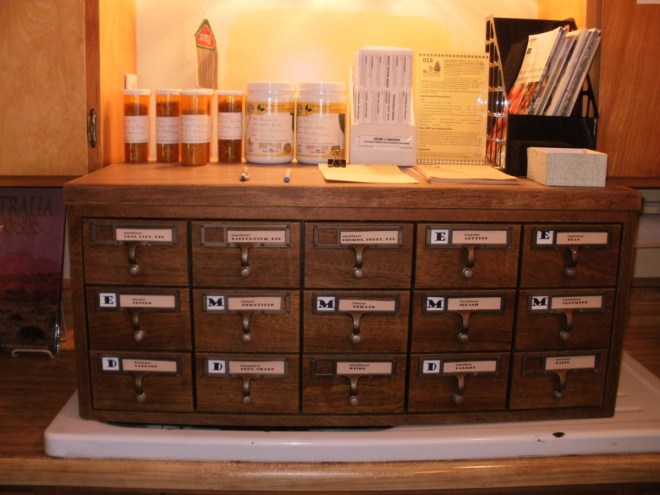
The seed library at the John Trigg Ester Library, just outside Fairbanks.
Gardeners and community members can now participate in local seed exchanges and opportunities for seed sharing without onerous regulations on the books. House Bill 197, sponsored by Rep. Jennifer Johnston (R-Anchorage, Girdwood, Indian) passed the Senate unanimously on Wednesday (April 18), after receiving bipartisan support last week in the House.
Over the last several years, community seeds libraries, such as the one at the John Trigg Ester Library just outside Fairbanks, have been springing up organically around the state, offering opportunities for gardeners to share seeds and stories of growing great Alaskan plants. To encourage these libraries to flourish and allow more Alaskans to participate in this time-honored tradition, House Bill 197 removes regulatory barriers for community seed saving and sharing.
“I was intrigued when this idea was brought to me by community members” Rep. Johnston said. “It didn’t make sense that such homegrown, community-centric activity would be regulated in the same way as commercial operations.”
The labeling requirements for noncommercial seed sharing will now be the seeds’ common name, information on the seed library, and a label denoting any toxic treatment of the seeds. Additionally, the seed library must display the statement, “Not authorized for commercial use and not classified, graded, or inspected by the State of Alaska.” Currently there are more than two pages of requirements for seeds that are shared within the state.
“Improving community unity, access to healthy produce and decreasing food insecurity have brought the Legislature together, and I’m pleased to see the bill get so much support,” Rep. Johnston said.
House Bill 197 now heads to Gov. Bill Walker for his signature.
(EDITOR’S NOTE: The following article first appeared on this site in April 2010. It is repeated because much of the information remains current and newsworthy.)
In the cold winter of 1994, Anchorage Daily News garden columnist and former Garden Writers Association of America President Jeff Lowenfels was returning to his hotel after a Washington, D.C., event when he was approached by a homeless person who asked for some money to buy food. Lowenfels said Washington, D.C., had signs saying, “Don’t give money to panhandlers,” so he shook his head and kept on walking. But the man’s reply, “I really am homeless and I really am hungry. You can come with me and watch me eat,” stayed with Lowenfels for the rest of his trip.
Jeff Lowenfels
The encounter continued to bother Lowenfels, even as he was flying back to Anchorage. During the flight, Lowenfels came up with an idea when he started writing his weekly garden column (the longest continuously running garden column in the country, with no missed weeks since it started on Nov. 13, 1976). He asked his readers to plant one extra row in their gardens to grow food to donate to Bean’s Café, an Anchorage soup kitchen. The idea took off.
When Anchorage hosted the Garden Writers Association of America convention in 1995, Lowenfels took the GWAA members to Bean’s Café to learn about the Plant A Row For Bean’s Café program. The Garden Writers Association of America liked the idea, and it became the national Plant A Row For The Hungry campaign (also known as Plant A Row or PAR). In 2002, the Garden Writers Association Foundation was created as a national 501(c)(3) nonprofit to manage the Plant A Row For The Hungry program.
“I am not surprised by the growth of PAR,” Lowenfels wrote in an e-mail to the Sitka Local Foods Network. “It is now in all 50 states and across Canada and there are thousands of variations of the original program — from prison gardens for the hungry to botanical gardens donating their produce from public display gardens. This is because gardeners always share information and extra food, so the idea was a natural.”
It took five years for the program to reach its first million pounds of donated food, but the second million only took two years and the next eight years saw a million pounds of donated food (or more) each year. Since 1995, more than 14 million pounds of food have been donated. Not only that, the program is getting ready to expand overseas to Australia, England and other countries with avid gardeners.
“We have supplied something in the vicinity of enough food for 50 million meals,” Lowenfels wrote in his e-mail. “Gardeners can solve this hunger problem without the government. And we don’t need a tea party to do it! Or chemicals, I might add, as author of a book on organic gardening!” Lowenfels is the author of Teaming With Microbes, written with Wayne Lewis. He released a second book, Teaming With Nutrients, as a follow-up to his first book, and in 2017 released a third book, Teaming With Fungi, as a second follow-up book.
According to the U.S. Department of Agriculture, one out of every eight U.S. households experiences hunger or the risk of hunger. Many people skip meals or eat too little, sometimes going an entire day or more without food. About 33 million Americans, including 13 million children, have substandard diets or must resort to seeking emergency food because they can’t always afford to buy the food they need. In recent years, the demand for hunger assistance has increased 70 percent, and research shows that hundreds of children and adults are turned away from food banks each year because of lack of resources.
According to the 2014 Sitka Community Food Assessment Indicators Report, about one in six people in Sitka is food insecure. In 2013, there were 1,410 Sitkans (out of a population of about 9,000) and 766 families receiving food assistance (SNAP, aka food stamps). There also were 229 individuals who received food pantry assistance from the Salvation Army and 7,243 meals served through its lunch soup kitchen in 2013, and that number has grown substantially since then.
While many people credit Lowenfels for creating the Plant A Row For The Hungry program, Lowenfels says the real heroes are the gardeners growing the extra food and donating it to local soup kitchens, senior programs, schools, homeless shelters and neighbors. You can hear him pass along the credit to all gardeners at the end of this 2009 interview with an Oklahoma television station (video also embedded below).
“One row. That’s all it takes. No rules other than the food goes to the hungry. You pick the drop-off spot or just give it to a needy friend or neighbor. Nothing slips between the lip and the cup, I say,” Lowenfels wrote in his e-mail.
For people wanting to Plant A Row For The Hungry in Sitka, there are several places that would love to help distribute some fresh locally grown veggies or berries to those who are less fortunate, such as the Salvation Army, Sitkans Against Family Violence (SAFV), local churches, Sitka Tribe of Alaska and other organizations. The food the Sitka Local Foods Network grows at St. Peter’s Fellowship Farm communal garden goes to the Sitka Farmers Market, school lunches and other programs.
The Sitka Local Foods Network also takes donations of local produce to sell at the Sitka Farmers Markets, and all proceeds are used to help pay for SLFN projects geared toward helping more people in Sitka grow and harvest local food. For more information, contact the Sitka Local Foods Network board members at sitkalocalfoodsnetwork@gmail.com.
The Sitka Local Foods Network just sent out the April 2018 edition of its monthly newsletter. Feel free to click this link to get a copy.
This month’s newsletter has short articles that include the announcement of spring gardening classes, a deadline reminder about the Pick.Click.Give. donation program, an update on the deadline for our new Sitka Food Business Innovation Contest, information about our sponsorship program, and an invitation to join our board of directors. Each story has links to our website for more information.
You can sign up for future editions of our newsletter by clicking on the newsletter image in the right column of our website and filling in the information. If you received a copy but didn’t want one, there is a link at the bottom of the newsletter so you can unsubscribe. Our intention is to get the word out about upcoming events and not to spam people. We will protect your privacy by not sharing our email list with others. Don’t forget to like us on Facebook, like our new Sitka Farmers Market page on Facebook and follow us on Twitter (@SitkaLocalFoods).
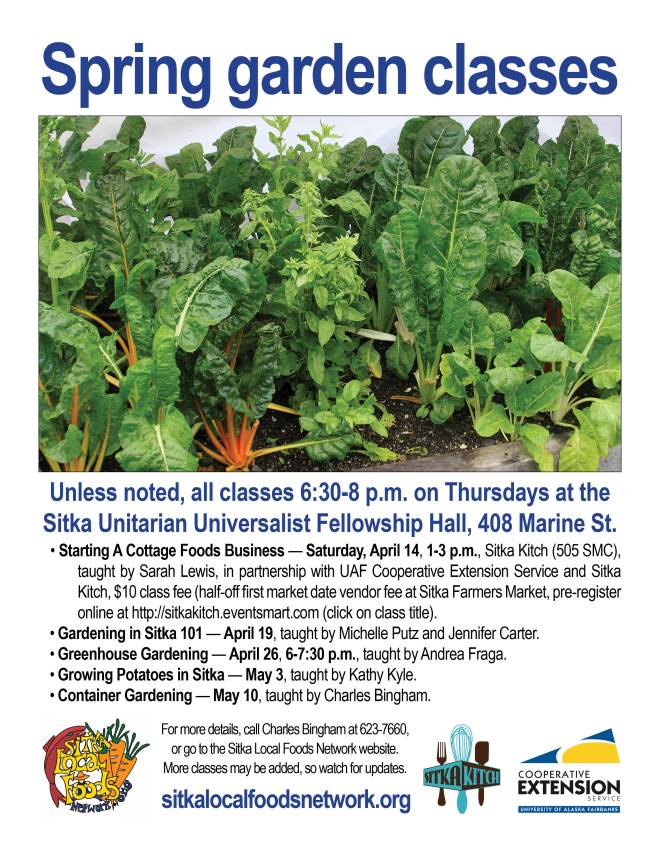
Want to learn how to grow your own food? Are you new to Sitka and want to learn what veggies grow in our town? The Sitka Local Foods Network education committee has a list of free 2018 spring garden classes that can help you learn what to do and when to do it so you have a healthy garden.
This spring, most of our classes will take place from 6:30-8 p.m. on Thursdays at the Sitka Unitarian Universalist Fellowship Hall (408 Marine Street, parking off Spruce Street). Each week will feature a different topic, and all classes are free (donations to the Sitka Local Foods Network will be accepted). The class schedule is as follows:
Starting A Cottage Foods Business — Saturday, April 14, 1-3 p.m., Sitka Kitch (505 SMC), taught by Sarah Lewis, in partnership with UAF Cooperative Extension Service and Sitka Kitch, $10 class fee (half-off first market date vendor fee at Sitka Farmers Market, pre-register online at http://sitkakitch.eventsmart.com (click on class title).
Gardening in Sitka 101 — April 19, taught by Michelle Putz and Jennifer Carter.
Greenhouse Gardening — April 26, 6-7:30 p.m., taught by Andrea Fraga.
Growing Potatoes in Sitka — May 3, taught by Kathy Kyle.
Container Gardening — May 10, taught by Charles Bingham.
For more information about the classes, contact Charles Bingham at 623-7660 or charleswbingham3@gmail.com. Other classes may be added at a later date if we find volunteers to teach them. If you are a Sitka gardener who wants to teach a class, contact Charles at the info above.


 Are you interested in learning how soil quality impacts your home garden? Do you want to learn how to get funding for a high tunnel to extend your growing season? Join Samia Savell of the U.S. Department of Agriculture’s Natural Resources Conservation Service office in Juneau for an informal discussion about those topics and others at noon to 1 p.m. on Thursday, Aug. 9, in the Gus Adams Meeting Room at the Sitka Public Library. Note, Samia has reserved the meeting room until 2 p.m. in case people want to stay after and ask her questions.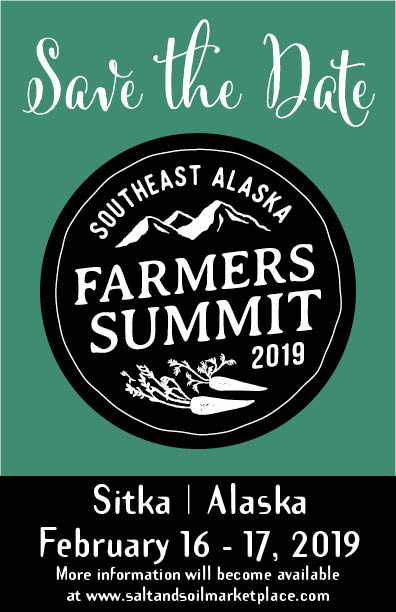





 Sitka Local Foods Network
You must be logged in to post a comment.