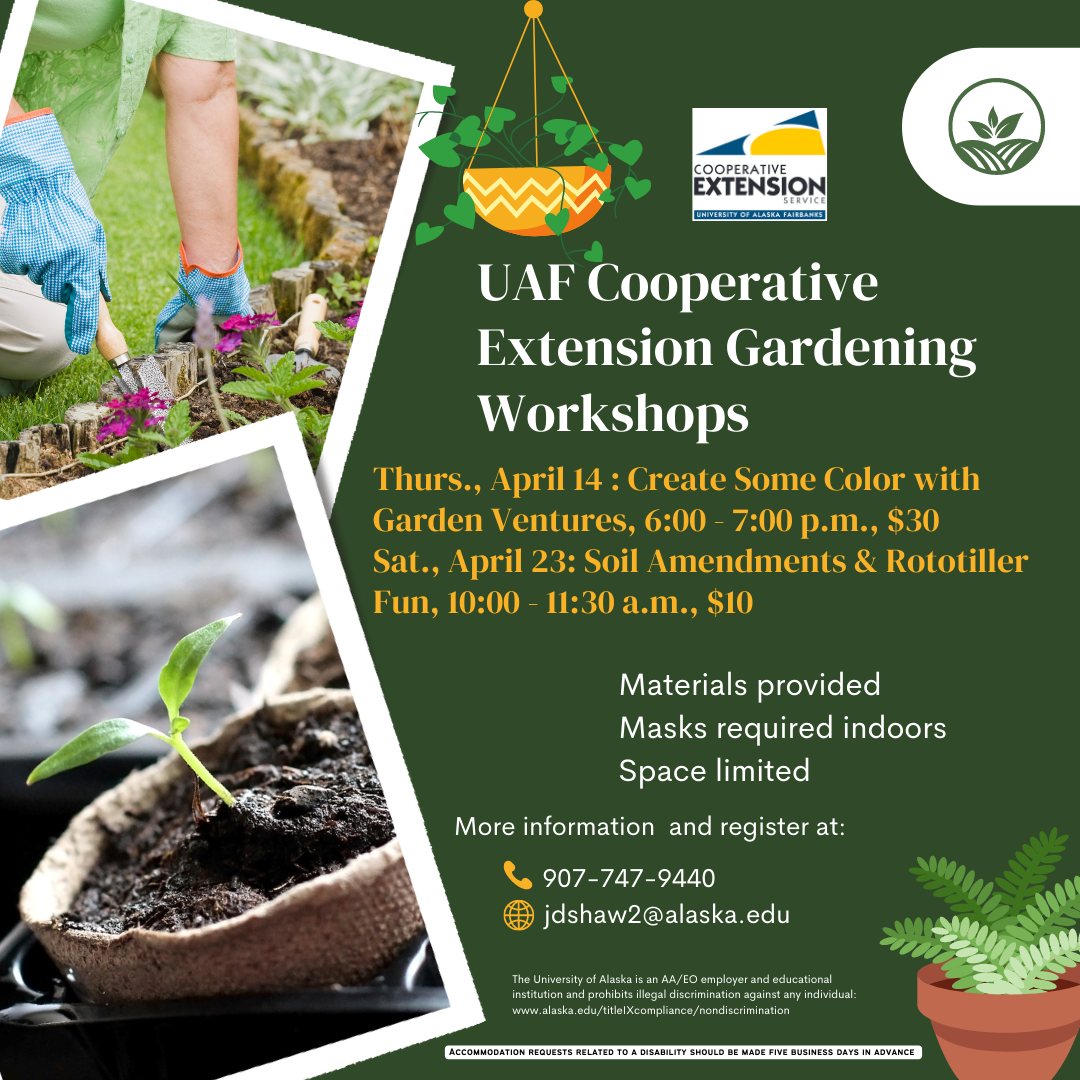
Two classes have been announced for the end April, one on building a colorful container of flowers and another on using soil amendments. More classes for May may be announced later. The classes have various costs, but materials are provided. Masks are required for indoor classes. Space is limited on all classes, so register early.
The classes scheduled so far are:
Create Some Color With Garden Ventures — Thursday, April 17, 6-7 p.m.; Penny Brown, owner of Garden Ventures Nursery, will lead a hands-on workshop for how to design your own planter full of colorful flowers. She will also give a short presentation on the topic. This class is $30 and takes place at Garden Ventures, 4013 Halibut Point Road. You can register here.
Soil Amendments and Rototiller Fun — Saturday, April 23, 10-11:30 a.m.; In this workshop you will learn what you can to help build soil nutrition, revitalize garden beds with depleted soil, make a little fertilizer to take home, and try your hand at a rototiller. This workshop is taught by Kitty LaBounty and Andrea Fraga at a location TBA. The cost is $10. You can register here.
For more information and to register, email jdshaw2@alaska.edu or call 907-747-9440.
For 31 years, Mollie Kabler and Kitty LaBounty have taken to the KCAW-Raven Radio airwaves during the spring months to broadcast The Garden Show.
They’ve already recorded two shows this year, and the Garden Show will have a regular 9:30-10 a.m. slot on Fridays. Since this week is KCAW’s spring pledge drive, the show will take pace from 9-10 a.m. on Friday, April 8. Kitty also has a regular music show (Hometown Brew) from 2-4 p.m. on Thursdays, and in the past the half-hour Garden Shows sometimes took place during her program.
Garden Show topics include timely tasks for gardening in Southeast Alaska, taking on-air questions, and themes around basic and more advanced gardening of vegetables, flowers, fruit, trees, etc. The station’s website has links to previous shows.
Mollie and Kitty have been gardening in Sitka for more than 30 years each, and they also have significant gardening experience from their childhoods in Wisconsin (Mollie) and Oregon (Kitty). They both are certified as Master Gardeners, after completing the class series offered by the University of Alaska Fairbanks Cooperative Extension Service.
To call the show with gardening questions, call 747-5877 and ask to be connected to the show.
The Sitka Local Foods Network just sent out the April 2022 edition of its monthly newsletter. Feel free to click this link to get a copy.
This month’s newsletter includes short stories about the about the deadline of the Alaska Permanent Fund Dividend application period (and Pick.Click.Give. application) on March 31, an update about how you can support the Sitka Local Foods Network by buying a t-shirt or hoodie from our online store, information about our 2022 sponsorship programs, and an invitation to join our board of directors. Each story has links to our website for more information.
You can sign up for future editions of our newsletter by clicking on the newsletter image in the right column of our website and filling in the information. If you received a copy but didn’t want one, there is a link at the bottom of the newsletter so you can unsubscribe. Our intention is to get the word out about upcoming events and not to spam people. We will protect your privacy by not sharing our email list with others. Don’t forget to like us on Facebook, like our Sitka Farmers Market page on Facebook and follow us on Twitter (@SitkaLocalFoods).
HOMER, Alaska (March 29, 2022) — The Alaska Farmers Markets Association will host its 2022 virtual summit from 8 a.m. to 5 p.m. on Friday, April 8. The theme is “Gather and Grow.” This event is free, but pre-registration is required.
“Whether you have run a market for 10 years or are just in the planning stages, the Alaska Farmers Markets Association is open to anyone interested in learning more about Alaska’s farmers markets, CSAs (community supported agriculture programs), farm stands, and food hubs,” said AFMA director Robbi Mixon, who recently was named to the board of directors for the national Farmers Market Coalition. “Grow your network and learn from market managers, farmers, government officials, and more.”
The keynote speakers this year are Mat-Su Health Foundation President/CEO Elizabeth A. Ripley and Dr. Gail Meyers, co-founder of Farms to Grow, Inc. Other presentations and discussion panels will be on how to keep farmers markets safe and the public healthy, why a census of agriculture matters for food security in Alaska, National Farmers Market Week (Aug. 7-13) events, a lunch-and-learn on ranked-choice voting, farmers market evaluation and data collection, food access programs, and more.
Alaska leads the nation in agricultural growth and there’s no sign of it slowing down. The average age of a producer in Alaska is 2.5 years younger compared to the national average age. Alaska leads the nation in the percent of new and beginning producers. Almost half – 46 percent – of the state’s farmers have 10 years or fewer of farm experience.
With help and support from the Alaska Farmers Market Association, we are launching an Alaska chapter of the National Young Farmers Coalition (http://www.youngfarmers.org), a national nonprofit whose mission is to “…shift power and change policy to equitably resource our new generation of working farmers.” The chapter will serve beginning and young farmers/ranchers in Alaska. The goal is to have representation from each Alaska region and from every agricultural sector.
We are collecting individual information, such as contact information, farm types, experience, demographics, and interest levels for participating in the chapter in order to identify the chapter’s direction, trends, and insights that can help bring the group together. You can take the survey at this link.
We will keep your answers confidential and all results produced will be anonymous.
Feel free to contact Kyra Harty at 907-235-4068, ext 20, or email her at Kyra@AlaskaFarmersMarkets.org if you have any questions or would like more information.
(EDITOR’S NOTE: The following article first appeared on this site in April 2010. It is repeated with some updates because much of the information remains current and newsworthy.)
In the cold winter of 1994, Anchorage Daily News garden columnist and former Garden Writers Association of America President Jeff Lowenfels was returning to his hotel after a Washington, D.C., event when he was approached by a homeless person who asked for some money to buy food. Lowenfels said Washington, D.C., had signs saying, “Don’t give money to panhandlers,” so he shook his head and kept on walking. But the man’s reply, “I really am homeless and I really am hungry. You can come with me and watch me eat,” stayed with Lowenfels for the rest of his trip.
Jeff Lowenfels
The encounter continued to bother Lowenfels, even as he was flying back to Anchorage. During the flight, Lowenfels came up with an idea when he started writing his weekly garden column (the longest continuously running garden column in the country, with no missed weeks since it started on Nov. 13, 1976). He asked his readers to plant one extra row in their gardens to grow food to donate to Bean’s Café, an Anchorage soup kitchen. The idea took off.
When Anchorage hosted the Garden Writers Association of America convention in 1995, Lowenfels took the GWAA members to Bean’s Café to learn about the Plant A Row For Bean’s Café program. The Garden Writers Association of America liked the idea, and it became the national Plant A Row For The Hungry campaign (also known as Plant A Row or PAR). In 2002, the Garden Writers Association Foundation (now Garden Communicators International) was created as a national 501(c)(3) nonprofit to manage the Plant A Row For The Hungry program.
“I am not surprised by the growth of PAR,” Lowenfels wrote in a 2010 e-mail to the Sitka Local Foods Network. “It is now in all 50 states and across Canada and there are thousands of variations of the original program — from prison gardens for the hungry to botanical gardens donating their produce from public display gardens. This is because gardeners always share information and extra food, so the idea was a natural.”
It took five years for the program to reach its first million pounds of donated food, but the second million only took two years and the next eight years saw a million pounds of donated food (or more) each year. Since 1995, more than 20 million pounds of food (about 80 million meals, as of 2020) have been donated by American gardeners. Not only that, the program is getting ready to expand overseas to Australia, England and other countries with avid gardeners.
“We have supplied something in the vicinity of enough food for 50 million meals,” Lowenfels wrote in his e-mail. “Gardeners can solve this hunger problem without the government. And we don’t need a tea party to do it! Or chemicals, I might add, as author of a book on organic gardening!” Lowenfels is the author of Teaming With Microbes, written with Wayne Lewis. He released a second book, Teaming With Nutrients, as a follow-up to his first book, and in 2017 released a third book, Teaming With Fungi, as a second follow-up book.
According to the U.S. Department of Agriculture, in 2019 one out of every nine U.S. households experiences hunger or the risk of hunger. Many people skip meals or eat too little, sometimes going an entire day or more without food. About 35.2 million Americans, including 13 million children, have substandard diets or must resort to seeking emergency food because they can’t always afford to buy the food they need. In recent years, the demand for hunger assistance has increased 70 percent, and research shows that hundreds of children and adults are turned away from food banks each year because of lack of resources. The demand has grown with the Covid-19 pandemic
According to the 2014 Sitka Community Food Assessment Indicators Report, about one in six people in Sitka is food insecure. In 2013, there were 1,410 Sitkans (out of a population of about 9,000) and 766 families receiving food assistance (SNAP, aka food stamps). There also were 229 individuals who received food pantry assistance from the Salvation Army and 7,243 meals served through its lunch soup kitchen in 2013, and that number has grown substantially since then.
While many people credit Lowenfels for creating the Plant A Row For The Hungry program, Lowenfels says the real heroes are the gardeners growing the extra food and donating it to local soup kitchens, senior programs, schools, homeless shelters and neighbors. You can hear him pass along the credit to all gardeners at the end of this 2009 interview with an Oklahoma television station (video also embedded below).
“One row. That’s all it takes. No rules other than the food goes to the hungry. You pick the drop-off spot or just give it to a needy friend or neighbor. Nothing slips between the lip and the cup, I say,” Lowenfels wrote in his e-mail.
With all of the jobs lost because of the COVID-19 coronavirus quarantines in 2020-22, this year there will be even more people who need food assistance. It will be more important than ever to help get extra produce into our local food banks and soup kitchens.
For people wanting to Plant A Row For The Hungry in Sitka, there are several places that would love to help distribute some fresh locally grown veggies or berries to those who are less fortunate, such as the Salvation Army, Sitkans Against Family Violence (SAFV), local churches, Sitka Tribe of Alaska and other organizations. The food the Sitka Local Foods Network grows at St. Peter’s Fellowship Farm communal garden goes to the Sitka Farmers Market, school lunches and other programs.
The Sitka Local Foods Network also takes donations of local produce to sell at the Sitka Farmers Markets, and all proceeds are used to help pay for SLFN projects geared toward helping more people in Sitka grow and harvest local food. For more information, contact the Sitka Local Foods Network board members at sitkalocalfoodsnetwork@gmail.com.
Two classes have been announced for the end of March, one on tree-pruning and one on seed-starting, and more classes for April will be announced later. The classes cost $10 each, with materials provided. Masks are required for indoor classes. Space is limited, so register early.
The classes scheduled so far are:
Tree Pruning Workshop — Saturday, March 19, 8:30-10 a.m.; A workshop on pruning fruit trees, demonstration, instruction and a chance to practice are taught by Jud Kirkness. The location will be emailed to registrants.
Seed Starting and Seed Swap — Saturday, March 26, 10-11:30 a.m.; Kitty LaBounty and Jasmine Shaw lead a hands-on workshop on seed starting on the UAS Sitka Campus. Students will be able to start seeds to take home. All materials will be provided. Students also can take seeds to swap with others.
For more information and to register, email jdshaw2@alaska.edu or call 907-747-9440.
HOMER, Alaska (March 10, 2022) — The agenda has been released for the 2022 Alaska Food Festival and Conference, which is going virtual on Thursday through Saturday, March 17-19, this year due to the COVID-19 pandemic. This year’s theme is “Everybody Eats: Nourishing Our Culture, Our Health, Our Future.”
This year’s agenda includes a variety of presentation topics, including a tribal youth track, a legislative update, the American Indian foods program, seaweed mariculture and wild harvest, sustaining traditional foods with science and technology, navigating the USDA for tribes, the Micro-Grants for Food Security program, and many others. These are just a small portion of the scheduled presentations, and the full agenda can be found at this link, https://whova.com/embedded/event/afpc_202203/?utc_source=ems.
Hosted by the Alaska Food Policy Council (AFPC), the Alaska Food Festival and Conference previously took place in Anchorage in 2014 and 2016, in Fairbanks in 2017, in Homer in 2019, and was virtual in 2020. This year, as in 2020, the conference was scheduled for Anchorage before going virtual due to COVID-19. The event takes place every 18 months.
In addition to the Alaska Food Policy Council, this event is co-sponsored by the Intertribal Agriculture Council and the University of Alaska Anchorage (UAA) Dietetics and Nutrition Program.
The four focus areas of this year’s conference are: Policy and Education, Production and Harvest, Culture and Community, and Business and Industry.
The goals of the conference and festival are to:
increase awareness of Alaska food issues among the general population;
provide training, resources, and networking opportunities to increase involvement in local food issues by community members and decision makers; and
increase connections and build community between the public, Alaska food businesses, NGOs, governmental entities, tribal entities, and others to support local economic development and innovative solutions.
Before the conference, the movie “Food for the Rest of Us” will be shown at 6 p.m. on Thursday, March 17, using Zoom. The screening and post-screening panel discussion are free, but registration is required by going to this link, https://us02web.zoom.us/meeting/register/tZ0qdeChrT0tG9DzyKsjJA5NKuE49P3Rpzjb.
“Food for the Rest of Us”, https://www.foodfortherestofus.org/, is a feature film that presents four stories of people living life on their own terms, serving as leaders who are lending their voice to the underdog and leading a revolution to a better world, from the ground up. An Indigenous-owned, youth-run organic farm in Hawai’i, a Black urban grower in Kansas City who runs a land-farm at East High School, a female Kosher butcher in Colorado working with the queer community, and an Inuit community on the Arctic Coast that is adapting to climate change with a community garden in a small geodesic dome. A panel discussion with the director and producer will follow the film.
This year’s confirmed keynote speakers and featured guests include:
Janie Simms Hipp, USDA general counsel
Eva Dawn Burke, University of Alaska Fairbanks College of Rural and Community Development and The Alaska Center for Climate Assessment and Policy
Helga Garcia-Garza, executive director of Agri-Cultura Network and La Cosecha CSA
Caroline Cox (director) and Tiffany Ayalik (producer), Film: “Food for the Rest of Us” (special guests)
Iris Sutton, Ice Wedge Art and Farm (conference artist)
In addition, the three Alaska Food Hero Awards will be presented during the conference. A list of past Alaska Food Hero Award winners can be found at, https://www.akfoodpolicycouncil.org/akfoodheroes.
For more information about the conference and the Alaska Food Policy Council (https://www.akfoodpolicycouncil.org/), contact Robbi Mixon at (907) 235-4068, Ext. 23, or director@alaskafoodpolicycouncil.org.
###
• The Alaska Food Policy Council (https://www.akfoodpolicycouncil.org/) is a nonprofit organization whose diverse membership works to engage Alaskans to make positive changes for the state’s food system, and to create a healthier, more prosperous and more secure future for all.
• The Intertribal Agriculture Council (https://www.indianag.org/) was founded in 1987 to pursue and promote the conservation, development and use of our agricultural resources for the betterment of our people. Land-based agricultural resources are vital to the economic and social welfare of many Native American and Alaskan Tribes. The harmonies of man, soil, water, air, vegetation and wildlife that collectively make-up the American Indian agriculture community, influence our emotional and spiritual well-being. The IAC has, over the last three decades, become recognized as the most respected voice within the Indian community and government circles on agricultural policies and programs in Indian country.
• The University of Alaska Anchorage (UAA) Dietetics and Nutrition Program (https://www.uaa.alaska.edu/academics/college-of-health/departments/school-of-allied-health/academics/dietetics-nutrition/)is a statewide education program that meets the growing needs of the dietetics and nutrition industry. This nationally accredited program trains entry-level, registered dietitian nutritionists, and community nutrition and nutrition science professionals throughout Alaska. Using an array of online and campus-based courses, the UAA Dietetics and nutrition program offers a minor in Nutrition, a Bachelor of Science in Dietetics, and a Master of Science in Dietetics.
This free training takes place from 9 a.m. to 3:30 p.m. on Monday and Tuesday, April 25-26, using Zoom. Registration closes on Monday, April 11.
This Food and Drug Administration (FDA)-approved course will satisfy the grower training curriculum requirements under the FDA’s Food Safety Modernization Act Produce Safety Rule. There is no charge for class participants. Funding is provided by a FDA-State of Alaska Cooperative Agreement. Growers who attend all seven modules of the course will receive a FREE Certificate of Course Completion. The workshop is open to all interested growers. Please see the attached flyer for more information. Space will be limited, so pre-registration is required. Contact Dena at dena.cologgi@alaska.gov to register.
NOTE: This training will be held remotely using videoconferencing software (e.g. Zoom). Participants must have a computer or mobile device with audio and video capabilities, as well as access to a strong internet connection and adequate bandwidth. Attendees who wish to receive a Certificate of Course Completion will be required to use the web camera to ensure participation.
For more information, or if you require accommodation for a disability, please contact Dena Cologgi at dena.cologgi@alaska.gov or (907) 375-8212.
Thanks to Lisa Trocchia for facilitating the workshop, as well as the other local/regional asset-mapping sessions taking place this winter across Alaska. This is part of an 18-month USDA Regional Food System Partnership planning grant coordinated by the Alaska Food Policy Council. The next step will be part of an implementation grant to take the results of all of of the local/regional asset-mapping sessions and use them to build a 10-year state food security plan.
In Sitka, we hope to use some of the information and connections gathered in today’s workshop to improve our local food security. We also hope to use the information to possibly update the 2014 Sitka Community Food Assessment Indicators Report, which gave us a lot of baseline planning data that now is nearly a decade old.
For those who weren’t able to attend, please watch for a survey link that will be posted in the next few weeks to gather more information. Also, the recorded Zoom meeting and the asset-mapping Google document are linked in the Documents section of this website, under food security.
If you are interested in helping improve Sitka’s food security, contact Sitka Local Foods Network board president Charles Bingham at sitkalocalfoodsnetwork@gmail.com or 907-623-7660. The next SLFN board meeting is at 6 p.m. on Wednesday, March 30, by Zoom, and these meetings are open to the public.








 Sitka Local Foods Network
You must be logged in to post a comment.