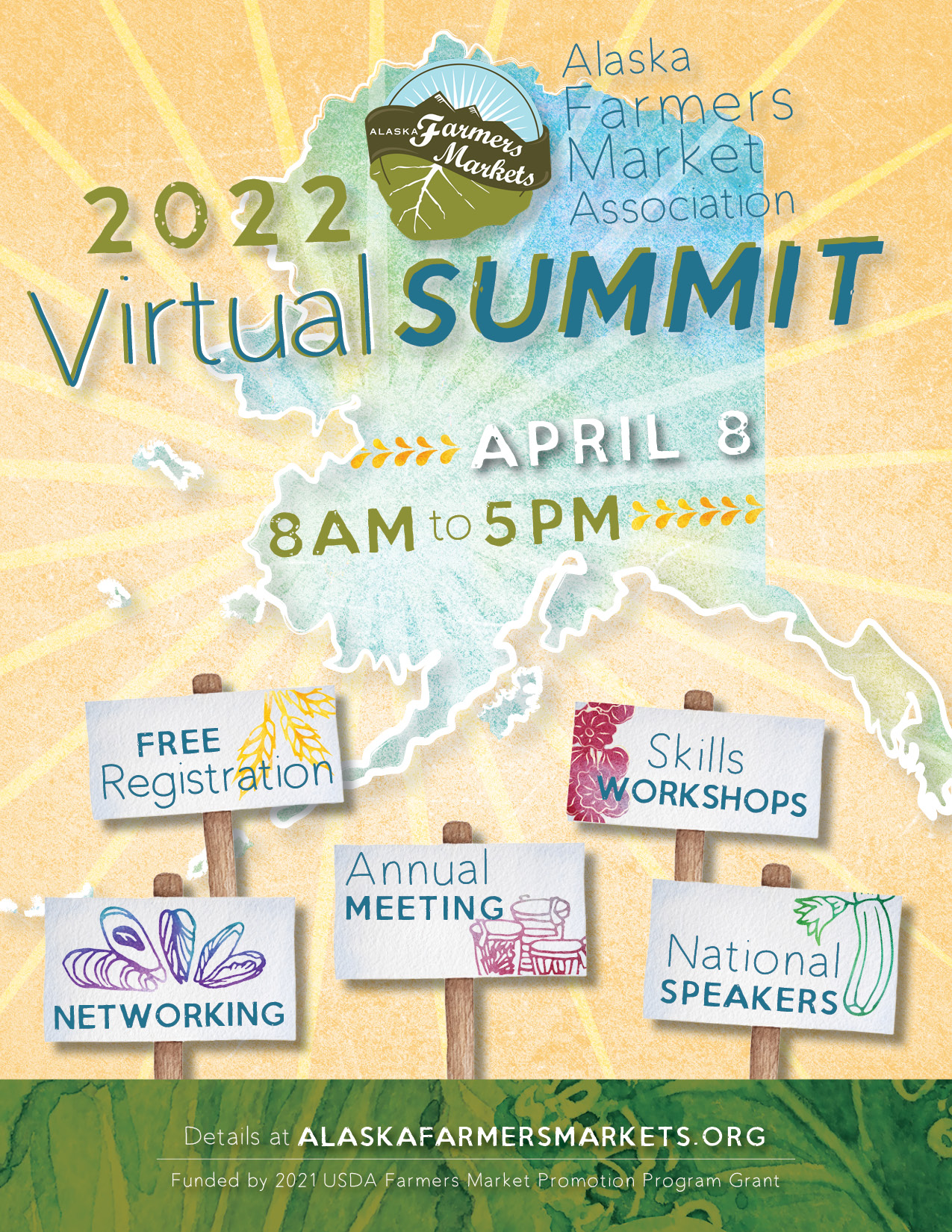
HOMER, Alaska (March 29, 2022) — The Alaska Farmers Markets Association will host its 2022 virtual summit from 8 a.m. to 5 p.m. on Friday, April 8. The theme is “Gather and Grow.” This event is free, but pre-registration is required.
“Whether you have run a market for 10 years or are just in the planning stages, the Alaska Farmers Markets Association is open to anyone interested in learning more about Alaska’s farmers markets, CSAs (community supported agriculture programs), farm stands, and food hubs,” said AFMA director Robbi Mixon, who recently was named to the board of directors for the national Farmers Market Coalition. “Grow your network and learn from market managers, farmers, government officials, and more.”
The keynote speakers this year are Mat-Su Health Foundation President/CEO Elizabeth A. Ripley and Dr. Gail Meyers, co-founder of Farms to Grow, Inc. Other presentations and discussion panels will be on how to keep farmers markets safe and the public healthy, why a census of agriculture matters for food security in Alaska, National Farmers Market Week (Aug. 7-13) events, a lunch-and-learn on ranked-choice voting, farmers market evaluation and data collection, food access programs, and more.
Alaska leads the nation in agricultural growth and there’s no sign of it slowing down. The average age of a producer in Alaska is 2.5 years younger compared to the national average age. Alaska leads the nation in the percent of new and beginning producers. Almost half – 46 percent – of the state’s farmers have 10 years or fewer of farm experience.
With help and support from the Alaska Farmers Market Association, we are launching an Alaska chapter of the National Young Farmers Coalition (http://www.youngfarmers.org), a national nonprofit whose mission is to “…shift power and change policy to equitably resource our new generation of working farmers.” The chapter will serve beginning and young farmers/ranchers in Alaska. The goal is to have representation from each Alaska region and from every agricultural sector.
We are collecting individual information, such as contact information, farm types, experience, demographics, and interest levels for participating in the chapter in order to identify the chapter’s direction, trends, and insights that can help bring the group together. You can take the survey at this link.
We will keep your answers confidential and all results produced will be anonymous.
Feel free to contact Kyra Harty at 907-235-4068, ext 20, or email her at Kyra@AlaskaFarmersMarkets.org if you have any questions or would like more information.
HOMER, Alaska (March 10, 2022) — The agenda has been released for the 2022 Alaska Food Festival and Conference, which is going virtual on Thursday through Saturday, March 17-19, this year due to the COVID-19 pandemic. This year’s theme is “Everybody Eats: Nourishing Our Culture, Our Health, Our Future.”
This year’s agenda includes a variety of presentation topics, including a tribal youth track, a legislative update, the American Indian foods program, seaweed mariculture and wild harvest, sustaining traditional foods with science and technology, navigating the USDA for tribes, the Micro-Grants for Food Security program, and many others. These are just a small portion of the scheduled presentations, and the full agenda can be found at this link, https://whova.com/embedded/event/afpc_202203/?utc_source=ems.
Hosted by the Alaska Food Policy Council (AFPC), the Alaska Food Festival and Conference previously took place in Anchorage in 2014 and 2016, in Fairbanks in 2017, in Homer in 2019, and was virtual in 2020. This year, as in 2020, the conference was scheduled for Anchorage before going virtual due to COVID-19. The event takes place every 18 months.
In addition to the Alaska Food Policy Council, this event is co-sponsored by the Intertribal Agriculture Council and the University of Alaska Anchorage (UAA) Dietetics and Nutrition Program.
The four focus areas of this year’s conference are: Policy and Education, Production and Harvest, Culture and Community, and Business and Industry.
The goals of the conference and festival are to:
increase awareness of Alaska food issues among the general population;
provide training, resources, and networking opportunities to increase involvement in local food issues by community members and decision makers; and
increase connections and build community between the public, Alaska food businesses, NGOs, governmental entities, tribal entities, and others to support local economic development and innovative solutions.
Before the conference, the movie “Food for the Rest of Us” will be shown at 6 p.m. on Thursday, March 17, using Zoom. The screening and post-screening panel discussion are free, but registration is required by going to this link, https://us02web.zoom.us/meeting/register/tZ0qdeChrT0tG9DzyKsjJA5NKuE49P3Rpzjb.
“Food for the Rest of Us”, https://www.foodfortherestofus.org/, is a feature film that presents four stories of people living life on their own terms, serving as leaders who are lending their voice to the underdog and leading a revolution to a better world, from the ground up. An Indigenous-owned, youth-run organic farm in Hawai’i, a Black urban grower in Kansas City who runs a land-farm at East High School, a female Kosher butcher in Colorado working with the queer community, and an Inuit community on the Arctic Coast that is adapting to climate change with a community garden in a small geodesic dome. A panel discussion with the director and producer will follow the film.
This year’s confirmed keynote speakers and featured guests include:
Janie Simms Hipp, USDA general counsel
Eva Dawn Burke, University of Alaska Fairbanks College of Rural and Community Development and The Alaska Center for Climate Assessment and Policy
Helga Garcia-Garza, executive director of Agri-Cultura Network and La Cosecha CSA
Caroline Cox (director) and Tiffany Ayalik (producer), Film: “Food for the Rest of Us” (special guests)
Iris Sutton, Ice Wedge Art and Farm (conference artist)
In addition, the three Alaska Food Hero Awards will be presented during the conference. A list of past Alaska Food Hero Award winners can be found at, https://www.akfoodpolicycouncil.org/akfoodheroes.
For more information about the conference and the Alaska Food Policy Council (https://www.akfoodpolicycouncil.org/), contact Robbi Mixon at (907) 235-4068, Ext. 23, or director@alaskafoodpolicycouncil.org.
###
• The Alaska Food Policy Council (https://www.akfoodpolicycouncil.org/) is a nonprofit organization whose diverse membership works to engage Alaskans to make positive changes for the state’s food system, and to create a healthier, more prosperous and more secure future for all.
• The Intertribal Agriculture Council (https://www.indianag.org/) was founded in 1987 to pursue and promote the conservation, development and use of our agricultural resources for the betterment of our people. Land-based agricultural resources are vital to the economic and social welfare of many Native American and Alaskan Tribes. The harmonies of man, soil, water, air, vegetation and wildlife that collectively make-up the American Indian agriculture community, influence our emotional and spiritual well-being. The IAC has, over the last three decades, become recognized as the most respected voice within the Indian community and government circles on agricultural policies and programs in Indian country.
• The University of Alaska Anchorage (UAA) Dietetics and Nutrition Program (https://www.uaa.alaska.edu/academics/college-of-health/departments/school-of-allied-health/academics/dietetics-nutrition/)is a statewide education program that meets the growing needs of the dietetics and nutrition industry. This nationally accredited program trains entry-level, registered dietitian nutritionists, and community nutrition and nutrition science professionals throughout Alaska. Using an array of online and campus-based courses, the UAA Dietetics and nutrition program offers a minor in Nutrition, a Bachelor of Science in Dietetics, and a Master of Science in Dietetics.
Thanks to Lisa Trocchia for facilitating the workshop, as well as the other local/regional asset-mapping sessions taking place this winter across Alaska. This is part of an 18-month USDA Regional Food System Partnership planning grant coordinated by the Alaska Food Policy Council. The next step will be part of an implementation grant to take the results of all of of the local/regional asset-mapping sessions and use them to build a 10-year state food security plan.
In Sitka, we hope to use some of the information and connections gathered in today’s workshop to improve our local food security. We also hope to use the information to possibly update the 2014 Sitka Community Food Assessment Indicators Report, which gave us a lot of baseline planning data that now is nearly a decade old.
For those who weren’t able to attend, please watch for a survey link that will be posted in the next few weeks to gather more information. Also, the recorded Zoom meeting and the asset-mapping Google document are linked in the Documents section of this website, under food security.
If you are interested in helping improve Sitka’s food security, contact Sitka Local Foods Network board president Charles Bingham at sitkalocalfoodsnetwork@gmail.com or 907-623-7660. The next SLFN board meeting is at 6 p.m. on Wednesday, March 30, by Zoom, and these meetings are open to the public.
Registration is open for the 2022 Alaska Food Festival and Conference, which is going virtual on Friday and Saturday, March 18-19, this year due to the COVID-19 pandemic. It opens with a pre-conference movie on Thursday, March 17. This year’s theme is “Everybody Eats: Nourishing Our Culture, Our Health, Our Future.”
Hosted by the Alaska Food Policy Council (AFPC), the Alaska Food Festival and Conference previously took place in Anchorage in 2014 and 2016, in Fairbanks in 2017, in Homer in 2019, and was virtual in 2020. This year, as in 2020, the conference was scheduled for Anchorage before going virtual due to COVID-19. The event takes place every 18 months.
The four focus areas of this year’s conference are: Policy and Education, Production and Harvest, Culture and Community, and Business and Industry.
The goals of the conference and festival are to:
increase awareness of Alaska food issues among the general population;
provide training, resources, and networking opportunities to increase involvement in local food issues by community members and decision makers; and
increase connections and build community between the public, Alaska food businesses, NGOs, governmental entities, tribal entities, and others to support local economic development and innovative solutions.
Details for the event are still in the planning stage. But past conferences have included presentations on food systems in Alaska, food security/insecurity, traditional foods, farmers markets, agriculture in Alaska, fisheries, food policy, food waste reduction, and more. Other plans include holding an online auction, a youth track, and a pre-conference workshop with Alaska Village Initiatives.
This year’s confirmed keynote speakers and featured guests include:
Janie Simms Hipp, USDA general counsel
Eva Dawn Burke, University of Alaska Fairbanks College of Rural and Community Development and The Alaska Center for Climate Assessment and Policy
Helga Garcia-Garza, executive director of Agri-Cultura Network and La Cosecha CSA
Caroline Cox (director) and Tiffany Ayalik (producer), Film: “Food for the Rest of Us” (special guests)
Iris Sutton, Ice Wedge Art and Farm (conference artist)
Before the conference, the movie “Food for the Rest of Us” will be shown at 6 p.m. on Thursday, March 17, using Zoom. The screening and post-screening panel discussion are free, but registration is required by going to this link, https://zoom.us/webinar/register/WN_8huQr-GeR-W8UwCBXMhx7w.
“Food for the Rest of Us”, https://www.foodfortherestofus.org/, is a feature film that presents four stories of people living life on their own terms, serving as leaders who are lending their voice to the underdog and leading a revolution to a better world, from the ground up. An Indigenous-owned, youth-run organic farm in Hawai’i, a Black urban grower in Kansas City who runs a land-farm at East High School, a female Kosher butcher in Colorado working with the queer community, and an Inuit community on the Arctic Coast that is adapting to climate change with a community garden in a small geodesic dome. A panel discussion with the director and producer will follow the film.
Registration costs $40-$150, depending on the package, and you can register at this link, https://www.eventbrite.com/e/2022-alaska-food-festival-conference-tickets-232976558157. Early bird registration and pricing ends on Monday, Jan. 31. You also can purchase an Alaska Food Policy Council membership at that link. Thanks to the generosity of the Intertribal Agriculture Council and the Alaska Farmers Market Association, a limited number of registration fee scholarships are available on a first-come, first-served basis, and you can apply at https://forms.gle/CPffkjzz3UuFWD7Y8.
For more information about the conference, contact Robbi Mixon at (907) 235-4068, Ext. 23, or director@alaskafoodpolicycouncil.org.
###
• The Alaska Food Policy Council (https://www.akfoodpolicycouncil.org/) is a nonprofit organization whose diverse membership works to engage Alaskans to make positive changes for the state’s food system, and to create a healthier, more prosperous and more secure future for all.
• The Intertribal Agriculture Council (https://www.indianag.org/) was founded in 1987 to pursue and promote the conservation, development and use of our agricultural resources for the betterment of our people. Land-based agricultural resources are vital to the economic and social welfare of many Native American and Alaskan Tribes. The harmonies of man, soil, water, air, vegetation and wildlife that collectively make-up the American Indian agriculture community, influence our emotional and spiritual well-being. The IAC has, over the last three decades, become recognized as the most respected voice within the Indian community and government circles on agricultural policies and programs in Indian country.
• The University of Alaska Anchorage (UAA) Dietetics and Nutrition Program (https://www.uaa.alaska.edu/academics/college-of-health/departments/school-of-allied-health/academics/dietetics-nutrition/) is a statewide education program that meets the growing needs of the dietetics and nutrition industry. This nationally accredited program trains entry-level, registered dietitian nutritionists, and community nutrition and nutrition science professionals throughout Alaska. Using an array of online and campus-based courses, the UAA Dietetics and nutrition program offers a minor in Nutrition, a Bachelor of Science in Dietetics, and a Master of Science in Dietetics.
The 2022 Southeast Alaska Farmers Summit, originally scheduled for Feb. 25-27 in Petersburg, has been postponed until the last weekend of February 2023 due to the Omicron variant of Covid-19, organizers Bo Varsano and Marja Smets wrote in an email.
“This was an extremely difficult choice; we want nothing more than to gather and share with you all this winter, however, we feel that no matter what mitigation strategies we implement, a conference that brings together folks from around Southeast Alaska and beyond for a long weekend of indoor activities runs too great of a risk of becoming a super-spreader event,” wrote Varsano and Smets, who run Farragut Farm near Petersburg.
The Southeast Alaska Farmers Summit started in 2015 in Petersburg, and was followed by events in 2017 in Haines and 2019 in Sitka. The 2021 Southeast Alaska Farmers Summit was postponed to 2022 because of Covid, and now it’s been postponed again to 2023.
People who already had registered for the 2022 summit will receive full refunds. They are asking 2022 sponsors if they can hold the donations for the 2023 rescheduled event.
“We feel strongly about the value of keeping this an in-person event, so we hope to reschedule the SEAK Farmers Summit for the last weekend in February in 2023, as long as our primary grant funding will allow for the extension. We will keep you all posted!” Varsano and Smets wrote. “In the meantime, we are working on pulling together a fun Zoom evening event to maintain connection within the community of growers and supporters, so keep your eye out for more details via email soon. … Sorry for the bad news, but you know what they say … ‘third time’s a charm!'”
Vendor registration is finally open for the 2021 Sitka Farmers Markets. This 14th annual event is hosted by the Sitka Local Foods Network, a nonprofit working to improve Sitka’s food security. The new online vendor registration page, http://sitkafarmersmarket.wordpress.com, is live and ready for vendors to sign up and pre-pay for their spots.
This summer there are eight Sitka Farmers Markets, from 10 a.m. to 1 p.m. on Saturdays, July 3, July 17, July 31, Aug. 7, Aug. 21, Aug. 28, Sept. 11, and Sept. 18, at the plaza outside Harrigan Centennial Hall. In addition to table space under the building overhang and on the plaza, there are parking spots for food trucks and food carts.
All vendors will pay $40 per market, regardless of whether you have a table or a food truck. We have a special rate of $280 for vendors who register for all eight markets, which means you get one market free. Vendors can register for one or two markets, or all eight. We also have youth vendor program for ages 14 and younger, which is $20 for all eight markets. Vendors will need to supply their own tables (preferably 30×72-inch banquet tables, please no tables longer than eight feet), and in some cases their own 10×10-foot tents.
The Sitka Farmers Market is a community event hosted by the Sitka Local Foods Network, whose mission is to increase the amount of locally produced and harvested food in the diets of Southeast Alaskans. Our focus is on local — fresh produce, fish, baked goods, prepared foods, cottage foods, arts and crafts — and all products must be made in Alaska (preferably in Sitka or Southeast Alaska, cooked foods may use non-local foods so long as the food is cooked on site).
We are holding the market entirely outside this year to help protect against the spread of COVID-19. While most people now are vaccinated against the coronavirus, there still are people who aren’t vaccinated and there are periodic hot spots where the illness flares up. We don’t want the market to be one of them. We encourage vendors and customers to wear masks, to use hand sanitizer, and to avoid bunching up while giving others six feet of space.
Vendors can pay using PayPal or credit/debit card. When you get to the Payment options, click PayPal and it should give you the option of using a PayPal account or four different types of cards (Visa, MasterCard, AmEx, Discover). If you prefer to pay by cash or check, contact Charles Bingham at 623-7660.
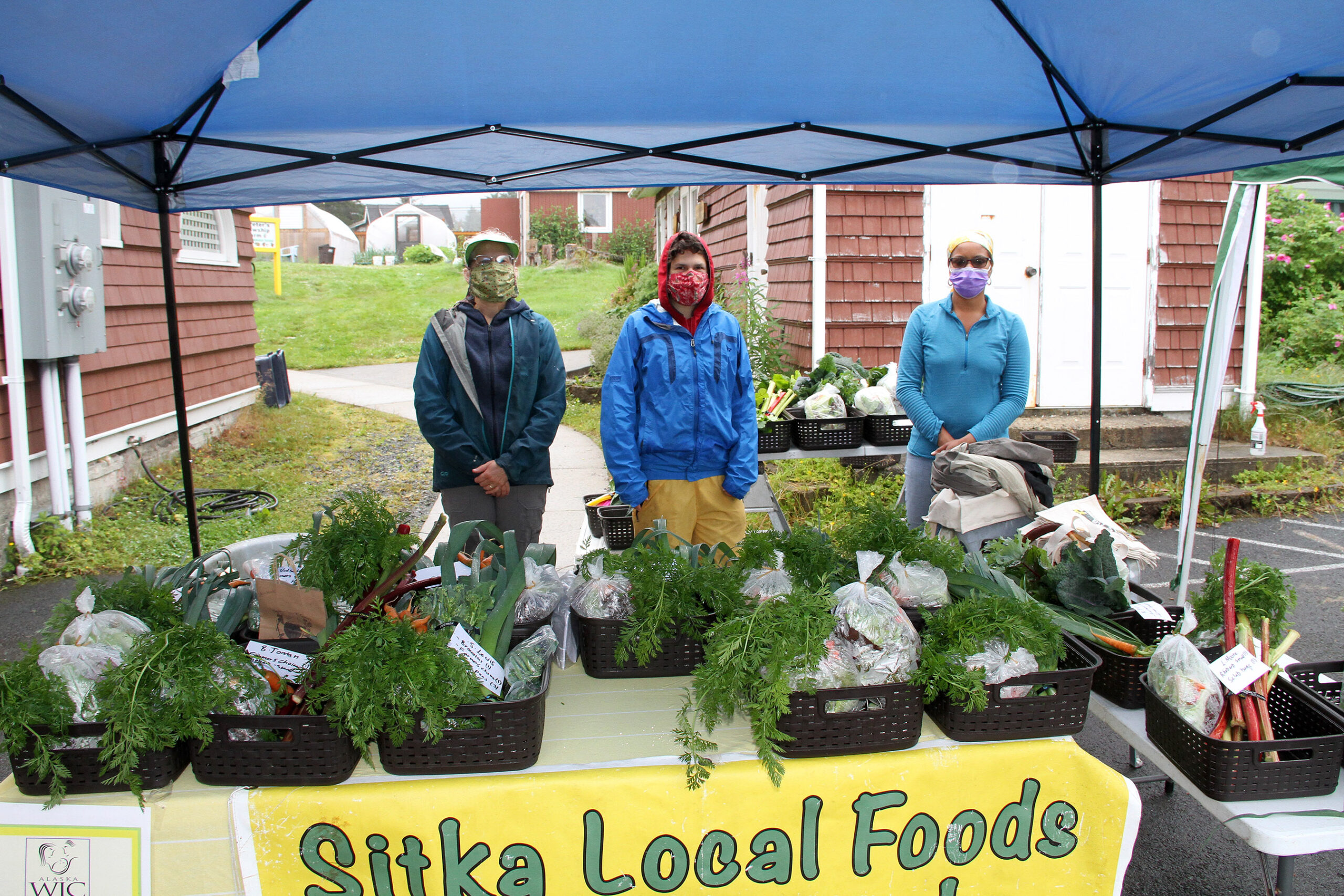
Nalani James is the Sitka Farmers Market manager this summer (she’s on the right in the photo above). Laura Schmidt (left in photo) is our lead gardener at St. Peter’s Fellowship Farm, where the Sitka Local Foods Network grows most of the produce it sells at the market. Charles Bingham is the assistant market manager.
One winner is making frozen mud pies while the other winner is raising chickens for fresh, local eggs to sell to Sitka residents. Congratulations to Joanne “Chef Jo” Michalski of Muddy Mermaid Mudd Pies and Nalani James of Eggstravagant, who won the two $1,500 prizes in the fourth annual Sitka Food Business Innovation Contest.
“We are happy to encourage more businesses to get into the local food system with our contest,” said Charles Bingham, board president of the Sitka Local Foods Network, which sponsors the contest. “Both businesses already are selling products, even with the pandemic, even though these are relatively new businesses. The Sitka Local Foods Network’s mission is to increase the amount of locally harvested and produced foods into the diets of Southeast Alaskans, so we hope our prizes continue to encourage local food entrepreneurs here in Sitka.”
The Sitka Food Business Innovation Contest has $1,500 prizes for each of two categories, start-ups (less than two years old) and existing businesses. This year all of the entries were in the start-up category, but since Chef Jo already owns Jo’s Downtown Dawgs and has been selling her mud pies to restaurants, her entry was moved to the existing business category so there could be two awards. “We felt both entries were deserving of awards,” Bingham said.
Chef Jo has a long association with food in Sitka, being a former chef with the Westmark and current general manager for the NMS contract with the Sitka School District. She started Jo’s Downtown Dawgs four years ago next to Russell’s, and last summer started making her Muddy Mermaid Mudd Pies. A Muddy Mermaid Mudd Pie is double layers of hand-crafted sea-salted caramel frozen yogurt, with a house-made caramel ribbon in the middle topped with home-made fudge sauce and crushed peanuts. She also has made special-occasion mud pies with crushed Oreos crumb crust, and for Valentine’s Day it was Dutch chocolate-raspberry with a ladyfinger crust. She currently is selling her Muddy Mermaid Mudd Pies through the Mean Queen and she sells retail whole pies to the public. She also sells slices of her pie at her food cart.
One of her barriers to being able to produce more mud pies is the lack of a commercial-grade ice cream maker, so she’s only been able to produce two pies at a time. She plans to use her prize money to purchase a commercial-grade ice cream maker so she can increase her production. She also will use it to buy product supplies, and to give a tip to two teenage girls who helped her last summer, twin sisters Michelle and Andrea Winger.
“My challenge at first was how to keep it frozen, and I found a ‘cooler’ that seriously keeps it frozen for 24 hours. YES!” Chef Jo said on her entry form. “The local response has been amazing, and in this time of ‘what’s next’ indulging in a slice of pie is something we all can use.”
Nalani is fairly new to Sitka, but already has been active in the local food scene as a co-manager of the Sitka Farmers Market in 2020 and vendor in 2019, and as an occasional instructor of Sitka Kitch cooking classes. (NOTE: Even though Nalani has an association with the Sitka Local Foods Network, which hosts the Sitka Farmers Market, she did not participate in the contest judging).
Nalani said she plans to use the prize money to help improve her chicken coop’s protection and deterrence from predators, such as rodents and bears. She and her family are moving to a new location in town, so she is in the process of rebuilding her coop, and wants to provide an electric fence perimeter to protect her birds. She started selling eggs through her Facebook page earlier this year, and plans to sell them through the page and at Sitka Farmers Markets during the summer. She plans to hire two intermittent employees to help her in the summer with cleaning the chicken coop and taking care of the chickens.
“Eggs will be a great addition to the fresh vegetables and fish in town,” Nalani said in her application. “There are many essential vitamins in eggs, and protein needed for children and elderly in the area. They taste better, too.”
Last year’s winners were Andrew Jylkka of Southeast Dough Company (fresh sourdough bread and fermented foods) and Levi Adams of Forage and Farm (mushroom growing and foraging). In 2019, our winners were Brittany Dumag of Castaway (food cart with Cuban pork sandwiches using Alaska pork) and Tamara Kyle of Sitka Sauers (fermented foods), with a special youth winner award for Abigail Ward of Sitka Spices (meat and fish rubs). In 2018, the winner was Hope Merritt of Gimbal Botanicals (beach greens and local teas).
The Alaska Division of Agriculture is excited to announce that it is accepting initial “scoping” applications for the new micro-grants for food security.
The micro-grants program has a two-step application process, with initial scoping applications being submitted first. Then, the top projects from the initial applications submitting a more detailed application before money is awarded this spring. The due date for two-page initial applications is Feb. 15.
The global COVID-19 pandemic reminded Alaskans they live at the end of a long and sometimes tenuous food supply chain. These micro-grants are aimed at strengthening local food security.
“While Alaska enjoys the benefits of a global supply system, it is simply responsible to support home-grown systems we can rely on, just in case,” said David W. Schade, director of the Alaska Division of Agriculture. “We are fortunate to now be able to offer micro-grants aimed at enhancing our ability to be more self-reliant when it comes to necessities like food.”
At the urging of Sen. Lisa Murkowski, the 2018 federal Farm Bill authorized the state to issue micro-grants to support innovative ways to improve Alaska’s food security. The division has begun accepting scoping applications for three-year grants of up to $15,000 for individuals ($5,000 per year), or $30,000 for qualified organizations ($10,000 per year). Individuals and qualified organizations can partner with each other to be eligible for combined funding (for example, if two individuals and an organization partner they would be eligible for $20,000 per year). The U.S. Division of Agriculture will provide $1.8 million to the division in each of the program’s first two years.
“We will prioritize funding of grants for projects that will increase local food production and storage, as well as education efforts to support these local efforts,” Schade said. Qualifying activities may include small-scale gardening, small-scale herding and livestock operations, and/or expanding access to food, safe food storage, and knowledge of food security.
Grant applicants must provide an initial scoping application to the division by Feb. 15. The division will then invite qualifying applicants to submit a full project proposal. Multiple individuals or organizations may submit joint applications for grants to support coordinated activities. The initial scoping application form and deadline information are available online at http://dnr.alaska.gov/ag/ag_grants.htm.
All individual Alaskans and many organizations qualify to apply for these grants, and the division hopes to have a strong batch of applications in the program’s first year. The security of two years of federal funding means projects the division cannot fund in 2021 will have another chance next year, Schade said.
“Alaska will have $1.8 million to help Alaskans grow more nutritious food locally and become more food secure. Individuals are eligible for up to $5,000 grants,” said According to Karen McCarthy, senior legislative assistant for Sen. Murkowski.
“Organizations such as Indian tribes and tribal organizations; non-profits such as religious organizations, food banks and food pantries; federally-funded educational facilities including Head Start and Early Head Start programs, public schools, public institutions of higher education, tribal colleges and Universities, and job training programs; and local and tribal governments that may not levy local taxes under state or federal law will be eligible for up to $10,000 in grant funds. Eligible projects are those that will increase the quantity and quality of locally grown food for food insecure individuals, families, neighborhoods, and communities — a pretty wide-open range of projects that Alaskans’ innovative thinking can really make exciting.”
The website, http://dnr.alaska.gov/ag/ag_grants.htm, includes a variety of information about the program. Click this link for access to a Facebook Live video presentation on Thursday, Jan. 21. Click this link for the PowerPoint slides used during the Facebook Live presentation. Click this link for the two-page scoping application form (which can be filled out online or printed and completed), and click this link for an application guide and instructions. Click this link for a one-page information sheet from Sen. Murkowski’s office about the program. Applications can be submitted by email and by regular mail, but they should be timed to arrive by Monday, Feb. 15.
If you have further questions, please reach out to Catherine Cheadle, the grants specialist who is heading up this program. You can call her at 907-761-3851 or email her at catherine.cheadle@alaska.gov.
HOMER, Alaska (Aug. 5, 2020) — Save the dates of Friday and Saturday, Nov. 6-7, on your calendar as the 2020 Alaska Food Festival and Conference is going virtual this year due to the COVID-19 pandemic. This year the themes are food entrepreneurship and rural and Indigenous food systems.
Hosted by the Alaska Food Policy Council (AFPC), this fifth semi-annual event previously took place in Anchorage in 2014 and 2016, in Fairbanks in 2017 and Homer in 2019. This year, the conference was scheduled for Anchorage before going virtual.
In addition to the Alaska Food Policy Council, this event is co-sponsored by the Alaska Village Initiatives AgAlaska Program, FRESH (the Food Research, Enterprise, and Sustainability Hub of the North), and Alaska Pacific University.
The goals of the conference and festival are to:
increase awareness of Alaska food issues among the general population;
provide training, resources, and networking opportunities to increase involvement in local food issues by community members and decision makers; and
increase connections and build community between the public, Alaska food businesses, NGOs, governmental entities, tribal entities, and others to support local economic development and innovative solutions.
Details for the event are still in the planning stage. But past conferences have included presentations on food systems in Alaska, food security/insecurity, traditional foods, farmers markets, agriculture in Alaska, fisheries, food policy, food waste reduction, and more. We also plan to hold a silent auction featuring food-related items from around the state.
The Alaska Food Policy Council (https://www.akfoodpolicycouncil.org/) is a nonprofit organization whose diverse membership works to engage Alaskans to make positive changes for the state’s food system, and to create a healthier, more prosperous and more secure future for all.
Alaska Village Initiatives (https://akvillage.com/) is a non-profit membership-based company dedicated to improving the well-being of rural Alaska communities, families, and individuals. AgAlaska (https://agalaska.net/) affords rural villages support and resources needed to begin community gardening farming and ranching. Information and links provide current grant opportunities, best garden practices, and resource links to government and non-government agencies.
FRESH (Food Research, Enterprise, and Sustainability Hub of the North (https://www.freshnorth.org/) works to catalyze the modern food landscape of tomorrow by honoring the living traditions of yesterday and harnessing the innovative spirit of today’s Circumpolar North.
Alaska Pacific University (https://www.alaskapacific.edu/) is a small liberal arts college located in Anchorage, Alaska, that emphasizes experiential and active learning. APU, along with the University of Alaska Anchorage, is home to FRESH.






 Sitka Local Foods Network
You must be logged in to post a comment.