Like what we do? Now you or your business can sponsor the Sitka Local Foods Network in 2024

The Sitka Local Foods Network in recent years created a sponsorship program to help promote our mission, and Sitka businesses and individuals are welcome to join for 2024. The goal of the sponsorship program is to make the projects we undertake (Sitka Farmers Market, St. Peter’s Fellowship Farm, gardening education, food business development, etc.) more sustainable.

“Sitka has a precarious position when it comes to food security, and the Sitka Local Foods Network is trying to improve our community food security through our mission to increase the amount of locally harvested and produced foods in the diets of Southeast Alaskans,” Sitka Local Foods Network president Charles Bingham said. “Sponsors of the Sitka Local Foods Network are working with an organization and a farmers market that places a high value on local food and businesses, fun, premium quality goods and experiences.”

In recent years, the Sitka Local Foods Network has hosted 7-8 Sitka Farmers Markets during the summer (from July to September). Due to COVID-19, we had to greatly scale back our 2020 Sitka Farmers Markets, focusing just on produce sales and using an online sales portal, but we did double our number of market weeks. In 2021, we hosted an outdoor-only market that brought back some of our vendors. In 2022, we returned to our usual venue of the Alaska Native Brotherhood Founders Hall after a two-year absence, and we almost had a normal market (with masking to prevent the spread of COVID-19 and no half-tables to spread out vendors). We had a similar experience in our 2023 markets. We haven’t set our 2024 market dates yet, but we anticipate we will announce them in the spring.

In addition, we grow most of the local produce sold at the markets at St. Peter’s Fellowship Farm communal garden and a couple of other locations in town. In March 2020 we built a new high tunnel at St. Peter’s Fellowship Farm, and we were able to add another new high tunnel before the 2021 growing season. These high tunnels allowed us to extend our growing season and helped reduce the impact of our last couple of cold, wet summers. We usually offer a variety of garden education classes in the spring. And one way we ensured fresh, local produce is available to lower-income Sitkans is through our matching program for WIC and SNAP beneficiaries (the first $20 spent on produce at the market), courtesy of recent grants from the Sitka White Elephant Shop and the Sitka Legacy Foundation.

In 2018 we launched the Sitka Food Business Innovation Contest to inspire food entrepreneurs in Sitka, and have continued the program with the expectation of hosting it again in 2024 (our 2023 winners were Andrea Fraga of Middle Island Gardens and Michael and Julie Miller of Field to Fire). In 2023-24, the Sitka Local Foods Network is partnering with Transition Sitka on two projects — one to update the 2014 Sitka Community Food Assessment Indicators Report and the other to build a new community garden at the top of Jarvis Street. In addition, we support other local food projects in Sitka, such as the Fish to Schools lunch program and the Sitka Kitch community rental commercial kitchen.

There are four levels of sponsorship available, and each has its own set of perks.

  • Grower ($2,500-plus) — We’ll hang your banner at ANB Hall during the Sitka Farmers Markets, include your logo and company name prominently in our merchandise and advertisements, and thank you on our social media and web pages. If appropriate for the Sitka Farmers Market, you may set up a free promotional booth.
  • Harvester ($1,000-$2,499) — We’ll hang your banner at ANB Hall during the Sitka Farmers Markets and include your logo and company name in our merchandise and advertisements.
  • Planter ($250-$999) — Your banner will hang at ANB Hall during the Sitka Farmers Markets.
  • Friend ($50-$249) — You are listed on our online sponsor page.

We have limited space for banners at the Sitka Farmers Markets, so please contact us before June 1 to guarantee your spot. To learn more about the sponsorship program, click the link below for details and a registration form. For more information, contact Charles Bingham at (907) 623-7660 or by email at sitkalocalfoodsnetwork@gmail.com.

• 2024 Sitka Local Foods Network sponsorship program details and registration form
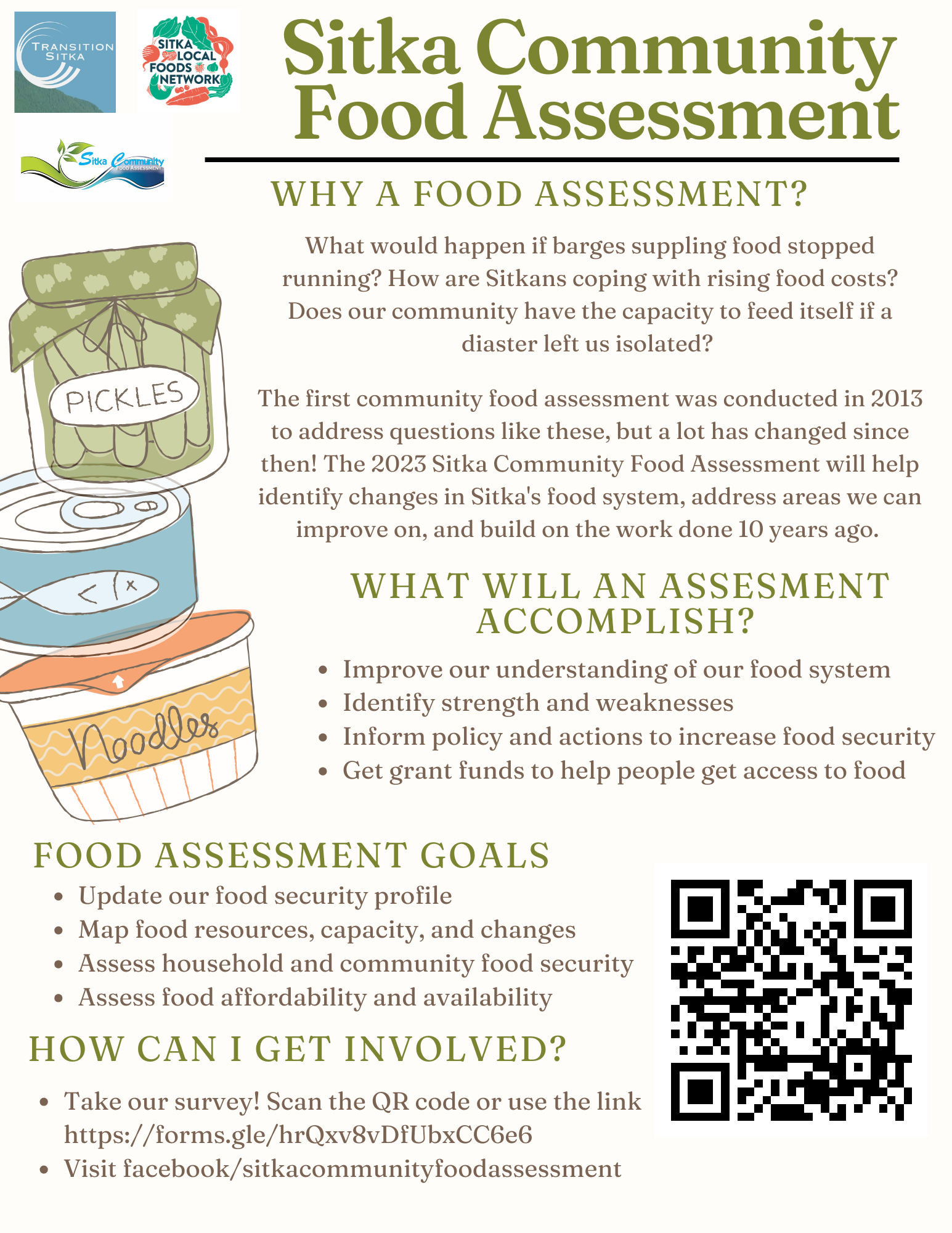
Sitka Community Food Assessment update kicks off with new food security survey

Struggling to buy the foods you prefer to eat? Have food stored in case of an emergency?  Able to access the local, wild foods you love? Take the Sitka Food Security Survey and help local organizations better understand the food challenges facing Sitkans and the community. 

This project will update the Sitka Community Food Assessment Indicators Report, which was released in April 2014 as part of a 2012 Sitka Health Summit community wellness project. That data now is at least a decade old, so an update is needed for better community planning and food security.

The survey takes less than 10 minutes and the link can be found below and hard copies will be available at the Sitka Farmers Market and the Sitka Public Library. A link to the survey can be found at https://forms.gle/LGWTYRT6XsdgLCgaA, or you can scan the QR code on the flier above. Please submit your surveys before Saturday, Oct. 21 (NOTE: The deadline for submitting surveys has been extended to Tuesday, Oct. 31.).

Questions or concerns? Please contact Callie Simmons at sitkafoodassessment@gmail.com. This update is being coordinated by Transition Sitka, the Sitka Local Foods Network, and the Sitka Community Food Assessment.

As you build your 2023 garden this spring, don’t forget to Plant A Row For The Hungry

(EDITOR’S NOTE: The following article first appeared on this site in April 2010. It is repeated with some updates because much of the information remains current and newsworthy.)

As you start to plan your garden for this spring and summer, don’t forget to Plant A Row For The Hungry. The Plant A Row For The Hungry program (also known as Plant A Row or PAR) is a national campaign by the Garden Writers Association of America (which recently changed its name to the Garden Communicators International) that has its roots in Alaska.

In the cold winter of 1994, Anchorage Daily News garden columnist and former Garden Writers Association of America President Jeff Lowenfels was returning to his hotel after a Washington, D.C., event when he was approached by a homeless person who asked for some money to buy food. Lowenfels said Washington, D.C., had signs saying, “Don’t give money to panhandlers,” so he shook his head and kept on walking. But the man’s reply, “I really am homeless and I really am hungry. You can come with me and watch me eat,” stayed with Lowenfels for the rest of his trip.

Jeff Lowenfels

Jeff Lowenfels

The encounter continued to bother Lowenfels, even as he was flying back to Anchorage. During the flight, Lowenfels came up with an idea when he started writing his weekly garden column (the longest continuously running garden column in the country, with no missed weeks since it started on Nov. 13, 1976). He asked his readers to plant one extra row in their gardens to grow food to donate to Bean’s Café, an Anchorage soup kitchen. The idea took off.

When Anchorage hosted the Garden Writers Association of America convention in 1995, Lowenfels took the GWAA members to Bean’s Café to learn about the Plant A Row For Bean’s Café program. The Garden Writers Association of America liked the idea, and it became the national Plant A Row For The Hungry campaign (also known as Plant A Row or PAR). In 2002, the Garden Writers Association Foundation (now Garden Communicators International) was created as a national 501(c)(3) nonprofit to manage the Plant A Row For The Hungry program.

“I am not surprised by the growth of PAR,” Lowenfels wrote in a 2010 e-mail to the Sitka Local Foods Network. “It is now in all 50 states and across Canada and there are thousands of variations of the original program — from prison gardens for the hungry to botanical gardens donating their produce from public display gardens. This is because gardeners always share information and extra food, so the idea was a natural.”

It took five years for the program to reach its first million pounds of donated food, but the second million only took two years and the next eight years saw a million pounds of donated food (or more) each year. Since 1995, more than 20 million pounds of food (about 80 million meals, as of 2020) have been donated by American gardeners. Not only that, the program is getting ready to expand overseas to Australia, England and other countries with avid gardeners.

“We have supplied something in the vicinity of enough food for 50 million meals,” Lowenfels wrote in his e-mail. “Gardeners can solve this hunger problem without the government. And we don’t need a tea party to do it! Or chemicals, I might add, as author of a book on organic gardening!” Lowenfels is the author of Teaming With Microbes, written with Wayne Lewis. He released a second book, Teaming With Nutrients, as a follow-up to his first book, and in 2017 released a third book, Teaming With Fungi, as a second follow-up book.

According to the U.S. Department of Agriculture, in 2019 one out of every nine U.S. households experiences hunger or the risk of hunger. Many people skip meals or eat too little, sometimes going an entire day or more without food. About 35.2 million Americans, including 13 million children, have substandard diets or must resort to seeking emergency food because they can’t always afford to buy the food they need. In recent years, the demand for hunger assistance has increased 70 percent, and research shows that hundreds of children and adults are turned away from food banks each year because of lack of resources. The demand has grown with the Covid-19 pandemic

According to the 2014 Sitka Community Food Assessment Indicators Report, about one in six people in Sitka is food insecure. In 2013, there were 1,410 Sitkans (out of a population of about 9,000) and 766 families receiving food assistance (SNAP, aka food stamps). There also were 229 individuals who received food pantry assistance from the Salvation Army and 7,243 meals served through its lunch soup kitchen in 2013, and that number has grown substantially since then.

While many people credit Lowenfels for creating the Plant A Row For The Hungry program, Lowenfels says the real heroes are the gardeners growing the extra food and donating it to local soup kitchens, senior programs, schools, homeless shelters and neighbors. You can hear him pass along the credit to all gardeners at the end of this 2009 interview with an Oklahoma television station (video also embedded below).

“One row. That’s all it takes. No rules other than the food goes to the hungry. You pick the drop-off spot or just give it to a needy friend or neighbor. Nothing slips between the lip and the cup, I say,” Lowenfels wrote in his e-mail.

With all of the jobs lost because of the COVID-19 coronavirus quarantines in 2020-22, this year there will be even more people who need food assistance. It will be more important than ever to help get extra produce into our local food banks and soup kitchens.

For people wanting to Plant A Row For The Hungry in Sitka, there are several places that would love to help distribute some fresh locally grown veggies or berries to those who are less fortunate, such as the Salvation ArmySitkans Against Family Violence (SAFV), local churches, Sitka Tribe of Alaska and other organizations. The food the Sitka Local Foods Network grows at St. Peter’s Fellowship Farm communal garden goes to the Sitka Farmers Market, school lunches and other programs.

People who participate in the Alaska SNAP (food stamp) program can use their Alaska Quest Cards to purchase produce and fish at the Sitka Farmers Market and other farmers markets around the state. People who participate in the  WIC (Women, Infants, Children) supplemental food program (operated in Southeast Alaska by the SouthEast Alaska Regional Health Consortium or SEARHC) also can use special farmers market vouchers to buy fresh vegetables at the Sitka Farmers Market and other farmers markets in Alaska (this is part of the national WIC Farmers Market Nutrition Program). The Sitka Local Foods Network matches up to $20 for produce purchased using WIC or SNAP benefits at the Sitka Farmers Market.

The Sitka Local Foods Network also takes donations of local produce to sell at the Sitka Farmers Markets, and all proceeds are used to help pay for SLFN projects geared toward helping more people in Sitka grow and harvest local food. For more information, contact the Sitka Local Foods Network board members at sitkalocalfoodsnetwork@gmail.com.

• Plant A Row informational brochure (2017)

As you build your 2022 garden this spring, don’t forget to Plant A Row For The Hungry

(EDITOR’S NOTE: The following article first appeared on this site in April 2010. It is repeated with some updates because much of the information remains current and newsworthy.)

As you start to plan your garden for this spring and summer, don’t forget to Plant A Row For The Hungry. The Plant A Row For The Hungry program (also known as Plant A Row or PAR) is a national campaign by the Garden Writers Association of America (which recently changed its name to the Garden Communicators International) that has its roots in Alaska.

In the cold winter of 1994, Anchorage Daily News garden columnist and former Garden Writers Association of America President Jeff Lowenfels was returning to his hotel after a Washington, D.C., event when he was approached by a homeless person who asked for some money to buy food. Lowenfels said Washington, D.C., had signs saying, “Don’t give money to panhandlers,” so he shook his head and kept on walking. But the man’s reply, “I really am homeless and I really am hungry. You can come with me and watch me eat,” stayed with Lowenfels for the rest of his trip.

Jeff Lowenfels

Jeff Lowenfels

The encounter continued to bother Lowenfels, even as he was flying back to Anchorage. During the flight, Lowenfels came up with an idea when he started writing his weekly garden column (the longest continuously running garden column in the country, with no missed weeks since it started on Nov. 13, 1976). He asked his readers to plant one extra row in their gardens to grow food to donate to Bean’s Café, an Anchorage soup kitchen. The idea took off.

When Anchorage hosted the Garden Writers Association of America convention in 1995, Lowenfels took the GWAA members to Bean’s Café to learn about the Plant A Row For Bean’s Café program. The Garden Writers Association of America liked the idea, and it became the national Plant A Row For The Hungry campaign (also known as Plant A Row or PAR). In 2002, the Garden Writers Association Foundation (now Garden Communicators International) was created as a national 501(c)(3) nonprofit to manage the Plant A Row For The Hungry program.

“I am not surprised by the growth of PAR,” Lowenfels wrote in a 2010 e-mail to the Sitka Local Foods Network. “It is now in all 50 states and across Canada and there are thousands of variations of the original program — from prison gardens for the hungry to botanical gardens donating their produce from public display gardens. This is because gardeners always share information and extra food, so the idea was a natural.”

It took five years for the program to reach its first million pounds of donated food, but the second million only took two years and the next eight years saw a million pounds of donated food (or more) each year. Since 1995, more than 20 million pounds of food (about 80 million meals, as of 2020) have been donated by American gardeners. Not only that, the program is getting ready to expand overseas to Australia, England and other countries with avid gardeners.

“We have supplied something in the vicinity of enough food for 50 million meals,” Lowenfels wrote in his e-mail. “Gardeners can solve this hunger problem without the government. And we don’t need a tea party to do it! Or chemicals, I might add, as author of a book on organic gardening!” Lowenfels is the author of Teaming With Microbes, written with Wayne Lewis. He released a second book, Teaming With Nutrients, as a follow-up to his first book, and in 2017 released a third book, Teaming With Fungi, as a second follow-up book.

According to the U.S. Department of Agriculture, in 2019 one out of every nine U.S. households experiences hunger or the risk of hunger. Many people skip meals or eat too little, sometimes going an entire day or more without food. About 35.2 million Americans, including 13 million children, have substandard diets or must resort to seeking emergency food because they can’t always afford to buy the food they need. In recent years, the demand for hunger assistance has increased 70 percent, and research shows that hundreds of children and adults are turned away from food banks each year because of lack of resources. The demand has grown with the Covid-19 pandemic

According to the 2014 Sitka Community Food Assessment Indicators Report, about one in six people in Sitka is food insecure. In 2013, there were 1,410 Sitkans (out of a population of about 9,000) and 766 families receiving food assistance (SNAP, aka food stamps). There also were 229 individuals who received food pantry assistance from the Salvation Army and 7,243 meals served through its lunch soup kitchen in 2013, and that number has grown substantially since then.

While many people credit Lowenfels for creating the Plant A Row For The Hungry program, Lowenfels says the real heroes are the gardeners growing the extra food and donating it to local soup kitchens, senior programs, schools, homeless shelters and neighbors. You can hear him pass along the credit to all gardeners at the end of this 2009 interview with an Oklahoma television station (video also embedded below).

“One row. That’s all it takes. No rules other than the food goes to the hungry. You pick the drop-off spot or just give it to a needy friend or neighbor. Nothing slips between the lip and the cup, I say,” Lowenfels wrote in his e-mail.

With all of the jobs lost because of the COVID-19 coronavirus quarantines in 2020-22, this year there will be even more people who need food assistance. It will be more important than ever to help get extra produce into our local food banks and soup kitchens.

For people wanting to Plant A Row For The Hungry in Sitka, there are several places that would love to help distribute some fresh locally grown veggies or berries to those who are less fortunate, such as the Salvation ArmySitkans Against Family Violence (SAFV), local churches, Sitka Tribe of Alaska and other organizations. The food the Sitka Local Foods Network grows at St. Peter’s Fellowship Farm communal garden goes to the Sitka Farmers Market, school lunches and other programs.

People who participate in the Alaska SNAP (food stamp) program can use their Alaska Quest Cards to purchase produce and fish at the Sitka Farmers Market and other farmers markets around the state. People who participate in the  WIC (Women, Infants, Children) supplemental food program (operated in Southeast Alaska by the SouthEast Alaska Regional Health Consortium or SEARHC) also can use special farmers market vouchers to buy fresh vegetables at the Sitka Farmers Market and other farmers markets in Alaska (this is part of the national WIC Farmers Market Nutrition Program). The Sitka Local Foods Network matches up to $20 for produce purchased using WIC or SNAP benefits at the Sitka Farmers Market.

The Sitka Local Foods Network also takes donations of local produce to sell at the Sitka Farmers Markets, and all proceeds are used to help pay for SLFN projects geared toward helping more people in Sitka grow and harvest local food. For more information, contact the Sitka Local Foods Network board members at sitkalocalfoodsnetwork@gmail.com.

• Plant A Row informational brochure (2017)

Thanks to all who participated in the Sitka community food asset-mapping workshop

The Sitka Local Foods Network wants to thank everybody who participated in the Sitka community food system asset-mapping workshop held Saturday afternoon (Feb. 19).

Thanks to Lisa Trocchia for facilitating the workshop, as well as the other local/regional asset-mapping sessions taking place this winter across Alaska. This is part of an 18-month USDA Regional Food System Partnership planning grant coordinated by the Alaska Food Policy Council. The next step will be part of an implementation grant to take the results of all of of the local/regional asset-mapping sessions and use them to build a 10-year state food security plan.

In Sitka, we hope to use some of the information and connections gathered in today’s workshop to improve our local food security. We also hope to use the information to possibly update the 2014 Sitka Community Food Assessment Indicators Report, which gave us a lot of baseline planning data that now is nearly a decade old.

For those who weren’t able to attend, please watch for a survey link that will be posted in the next few weeks to gather more information. Also, the recorded Zoom meeting and the asset-mapping Google document are linked in the Documents section of this website, under food security.

If you are interested in helping improve Sitka’s food security, contact Sitka Local Foods Network board president Charles Bingham at sitkalocalfoodsnetwork@gmail.com or 907-623-7660. The next SLFN board meeting is at 6 p.m. on Wednesday, March 30, by Zoom, and these meetings are open to the public.

Sitka to host community food system asset-mapping workshop on Feb. 19 using Zoom

Over the past year or so, the Sitka Local Foods Network has been working with a dozen other local and regional groups as part of a two-year USDA Regional Food System Partnership grant coordinated by the Alaska Food Policy Council.

As part of this work, the Sitka Local Foods Network will host a community-focussed food system asset-mapping workshop from 1:30-3:30 p.m. on Saturday, Feb. 19, using Zoom. The goal of this project is to examine the strengths and weaknesses of the 13 local and regional food systems, then use that knowledge to create a 10-year statewide food security plan. The workshop on Feb. 19 will use an outside facilitator, Lisa Trocchia, who is facilitating all of the regional/local workshops.

“Food security, or insecurity, is a big issue in Alaska and in Sitka,” Sitka Local Foods Network board president Charles Bingham said. “Hopefully this project will give us some strategies on how to improve Alaska’s food security. We have special challenges in Alaska, with our remoteness and climate, and we see that every time the grocery store shelves are empty or when we go to a village store and can’t find fresh fruit and veggies. If you have concerns about Alaska’s, and Sitka’s, food system, then this workshop is for you.”

Sitka has a bit of an advantage over some of the other communities involved in the project, because in 2014 we released the Sitka Community Food Assessment Indicators Report, which came out of a Sitka Health Summit project. This gave us some baseline data about food security in Sitka. But most of the data is a decade old and is becoming dated. It’s hoped this workshop might inspire discussions that will help us update the report.

We want people from all parts of the Sitka community to attend this meeting — Alaska Native, Filipino, people on public assistance, people who hunt and gather, gardeners, commercial fishermen, people who run food businesses, young people, elders, etc. The broader the diversity in our group, the better our results.

If you are interested in attending, please RSVP before Tuesday, Feb. 15, by sending an email with the note “food security” in the subject line to sitkalocalfoodsnetwork@gmail.com. Space is limited. You will receive an email a few days before the event with a Zoom link. Those who can’t attend on Feb. 19 still can participate when there is a statewide survey announced. For more details, contact Charles Bingham at 907-623-7660

City planner launches new working group to examine food security in Sitka and Alaska

Did you know Alaska is one of the top five most food insecure states in the nation? Sitka chief planner Michael Scarcelli is launching a new group to change that, especially in Sitka which Scarcelli considers “food insecure.”

“I know there has already been a great amount of exceptional work done in regards to local and regional food security reports and efforts,” Scarcelli wrote in an email. “The focal point of this discussion is to include:

  • “A brief overview of that work
  • “How food has been addressed in past and current comprehensive planning documents in relation to economy, socio-culture, community health, and environmental topics
  • “A discussion about the opportunities, strengths, challenges, and gaps within Sitka now
  • “How the Planning and Community Development programs can create incentives and remove barriers to help the community better provide food security, while also promoting the public health and safety of all Sitkans.
  • “A focus on opportunities for every day food security: lowering costs of food and increasing access to healthy food for the community at large
  • “Planning for the low-risk, but high impact catastrophic food emergency (including syncing Comprehensive Plan, Multi-Hazard Mitigation Plans, and Local Emergency Plans and efforts)
  • “Consensus building on final recommendations”

This informal working group will collaborate with me to draft some suggestions and information to a future Planning Commission discussion on the topic and may include suggestions for zoning changes, conditional uses and development standards for horticulture and agriculture, as well as a suggestion for how to better prepare for a catastrophic or major event that would impact food security in terms of long-range hazard mitigation planning.

In an interview, Scarcelli said in addition to a cataclysmic event that impacts food security (such as a tsunami), there are everyday events such as rising fuel costs or late barges that impact food security in Sitka. After he graduated from law school, Scarcelli bought a farm where he grew heirloom vegetables in Michigan, so he has practical experience in food issues. He thinks increasing the amount of food produced in Sitka is a win to the triple-bottom line. There are advantages to Sitka in the use of renewable energy, a shorter distance for the food to travel, better health to the community, and new jobs.

“One area I am specifically asking for help on is bringing a range of citizens to the table that offer different viewpoints, expertise, skills, and business perspectives,” Scarcelli wrote. “If you know of someone or a group that has an interest in this topic, please forward this invite. Included in this email are individuals that indicated interest in this group, chair and liaison to the Planning Commission, chair and liaison to the local emergency planning commission, and various business owners I felt may have an interest in the topic.”

In his email, Scarcelli included copies of six different local, regional and statewide food security reports that all can be found at this link on this website (scroll down), https://sitkalocalfoodsnetwork.org/documents/. He makes special note of the 2014 Sitka Community Food Assessment Indicators Report.

Scarcelli has yet to set a time for the group’s first meeting, but he did include a Doodle poll with a few possibilities to try to find the time that works best for the most people. For more information, contact Scarcelli at 747-1815 or michael.scarcelli@cityofsitka.org.

• Sitka Local Foods Network receives Strengthening Organizations grant from the Alaska Community Foundation

SLFNBoothGroupPhoto

Alaska CF headerThe Sitka Local Foods Network is one of 15 nonprofits in Alaska — two from Sitka — to earn a “Strengthening Organizations Program” grant from the Alaska Community Foundation.

The 15 grants totaled $75,353, with both Sitka organizations winning $4,600. The Island Institute, which partnered with the Sitka Local Foods Network to produce the Sitka Community Food Assessment Indicators Report in 2014, is the other Sitka organization to be awarded a grant.

The grant-winners “were recognized for their initiative in building internal structures to enhance capacity. Grant proposals ranged from requests for leadership development support, funding for staff to attend conferences, financial management training, digitizing collections for website purposes, and much more,” according to an Alaska Community Foundation press release.

The Sitka Local Foods Network applied for the grant to take a step toward the next level as a growing organization. It plans to use the grant to create a formal fundraising and business plan, with the intent to start putting money aside to hire a part-time staff person to take over some of the group’s day-to-day duties from the volunteer board of directors. Other than a few select positions which are contracted out, such as the Sitka Farmers Market manager and St. Peter’s Fellowship Farm lead gardener, the organization is entirely operated by volunteers.

“That is not sustainable in the long run,” Sitka Local Foods Network Board President Lisa Sadleir-Hart told the Daily Sitka Sentinel. “We have to start thinking about staffing in the long run, and that requires capital. We’re moving in that direction.” She also said the grant will help the network become “more strategic in how we use precious volunteer energy.”

The Sitka Local Foods Network will work with consultants from the Foraker Group, an organization that provides support and training to Alaska nonprofit organizations, to develop the fundraising and business plan. The grant was written by Matthew Jackson, the board vice-president.

The Alaska Community Foundation’s Strengthening Organizations Program is unique in the funding it makes available to nonprofits, as it focuses on internal capacity building, rather than programs or outreach. This program awards capacity building grants up to $10,000, with typical awards ranging from $3,000-$5,000, to 501(c)(3) nonprofits or equivalent organizations, which may include tribes, schools, churches and local government agencies and programs.

Applications are accepted on an ongoing basis and the next deadline is Sept. 1. The Alaska Community Foundation program staff strongly encourages interested applicants to submit drafts for review a minimum of two weeks before the deadline. For more information or to apply, visit The Alaska Community Foundation at http://alaskacf.org/grants or call (907) 274-6705.

• Please remember those people in Sitka in need during this Thanksgiving season

SalvationArmyTunaShelf

As we approach Thanksgiving, many families are gathering their supplies for the traditional feast. But there are a lot of people in Sitka who are struggling just to put food on the table.

In Sitka, the Salvation Army serves as the USDA-designated food bank and distribution point for commodity food. Maj. Turnie Wright (who teams up with his wife, Maj. Evadne Wright to run the local Salvation Army) said there are many items the Sitka Salvation Army can use to keep up with Sitka’s growing hunger needs. He said they served 77 meals at the soup kitchen the other day. You can learn more about Sitka’s growing number of people who need food assistance in the Sitka Community Food Assessment Indicators Report released in April 2014 (note, the number of people using the Salvation Army food bank and soup kitchen already is much higher than the numbers listed in the report).

Here’s a list:

  • gloves/mittens, hats, and coats (especially kids sizes)
  • sample-size toiletry kits
  • diapers (all sizes)
  • vegetables (canned, if possible, due to limited freezer space, or fresh for the soup kitchen)
  • cereals (avoid the sugar-laden junk masquerading as cereal)
  • peanut butter
  • potted meat (spreadable, such as Libby’s)
  • Ramen noodles
  • powdered milk
  • canned meats (such as chicken, salmon, Spam, etc.)
  • pork and beans
  • soups
  • spaghetti and other pasta
  • spaghetti sauce
  • fish (any type, frozen is preferred for the soup kitchen and canned for the food bank)
  • wild game (for the soup kitchen)
  • six-packs of Ocean Spray or other juices
  • bottled water/tea
  • raisins (preferably in the snack boxes)

Maj. Turnie Wright said the Salvation Army can break down bulk sizes of different foods for the food bank. He also said they accept grocery gift cards from the local stores and Costco. In addition, they can work with people who are taking their vehicles to Juneau on the ferry and have room to bring stuff back from the Southeast Food Bank or Costco (this helps Salvation Army avoid freight charges). Finally, when you design your garden this year, don’t forget to Plant A Row For The Hungry.

The Salvation Army is one of several food assistance programs in Sitka, with others being centered around local churches, the Sitka Tribe of Alaska, and Sitkans Against Family Violence. The Salvation Army will assist the Sitka Tlingít and Haida Community, Sitka Tribe of Alaska, and the Alaska Native Brotherhood/Alaska Native Sisterhood to host the annual community Thanksgiving dinner on Thursday, Nov. 27, at ANB Founders Hall. Doors open at 1 p.m., and food will start being served at 2 p.m. until it runs out (probably about 4 p.m.). Volunteers are needed, and donations of side dishes and desserts are appreciated (call Rachel Moreno at 738-6595 for details on the dinner).

For more information about how to help with the Salvation Army food bank and soup kitchen, contact Maj. Turnie Wright at 738-5854.

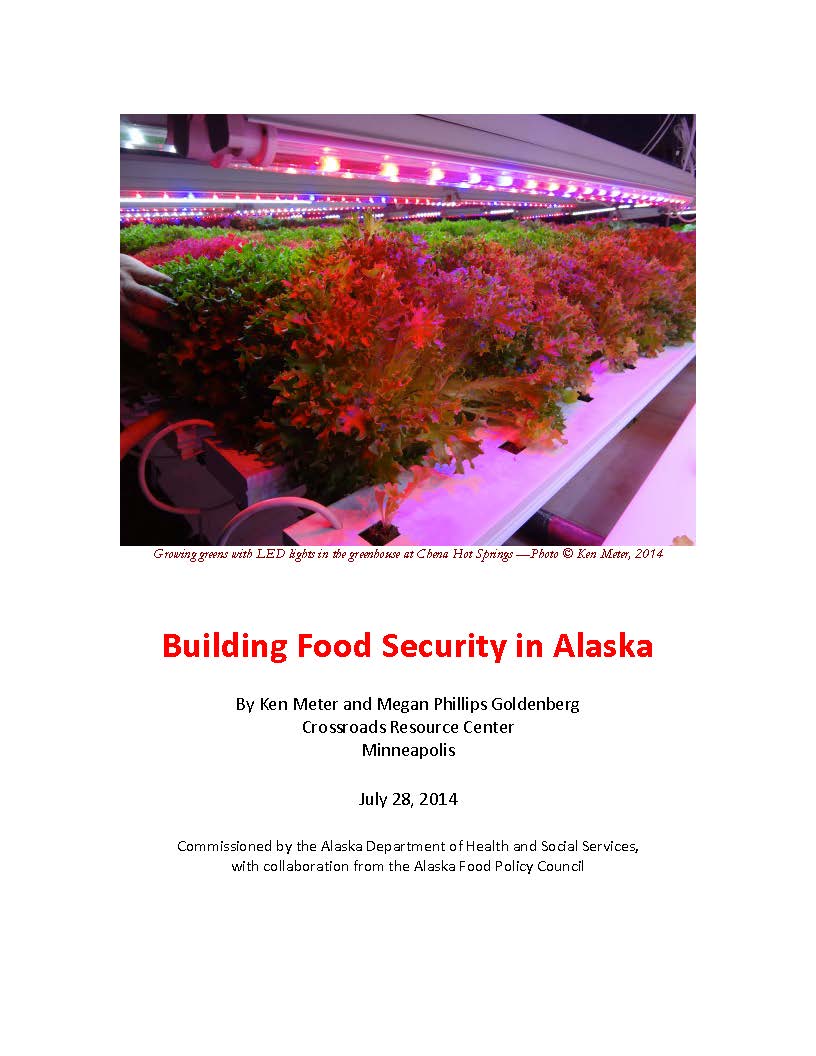
• ‘Building Food Security in Alaska’ report released during Alaska Food Festival and Conference

14-09-17_building-food-security-in-ak_exec-summary-recommendations_Page_01

The release of a new report, “Building Food Security in Alaska,” was one of the highlights of the recent Alaska Food Festival and Conference (Nov. 7-9 at the University of Alaska Lucy Anchorage Cuddy Center). This is one of the first comprehensive statewide food security reports compiled for Alaska.

The report was written by Ken Meter and Megan Phillips Goldenberg of the Crossroads Resource Center in Minneapolis, which has done six in-depth statewide food assessments over the past five years and 14 statewide food assessments overall. The report was commissioned by the Alaska Department of Health and Social Services, with collaboration from the Alaska Food Policy Council.

The Crossroads Resource Center website provides this summary of the report:

Like most other states, Alaska imports about 95 percent of the food it purchases. Yet this state is more distant from prevailing food production regions than other states. Alaskans feel a special sense of vulnerability. Despite a rich history in dairy and cattle production, most of these foods are now imported. Much of the arable farmland has been paved over by development. Moreover, Alaskans who wish to purchase some of the $3 billion of seafood harvested from its ocean waters typically have no choice but to buy through Seattle vendors.

Still, farms produce a rich variety of crops and livestock. Direct sales from farmers to household consumers run at 13 times the national average, amounting to one of every six dollars farmers earn selling food to humans. Lettuce, peppers, and cucumbers are available year-round from indoor farms. Chickens are grown inside greenhouses that rely upon surplus heat from nearby buildings.

In no other state is harvesting wild foods as important. Subsistence and personal use hunters bring in an estimated $900 million worth of salmon, caribou, moose, foraged greens and berries, and other foods. Yet even here, hunters and gatherers face special challenges: a decline of hunting skills, weakening ice, changing migrations, and radioactive fallout.

Our study, written by Ken Meter and Megan Phillips Goldenberg, offers practical steps for building a more reliable food supply by growing, storing, and marketing more Alaska-grown food to Alaskans. Commissioned by the Alaska Department of Health and Social Services.

Copies of the full 180-page report and a shorter executive summary and recommendations are linked below. In addition, most of the presentations and panel discussions from the Alaska Food Festival and Conference can be found here. This link includes a keynote presentation by Sitka Local Foods Network Board President Lisa Sadleir-Hart about the experience of compiling the Sitka Community Food Assessment, plus Sitka residents Keith Nyitray of the Sitka Food Co-op and Gordon Blue of the Alaska Sustainable Fisheries Trust participated in panel discussions about food cooperatives and community-based fisheries, respectively.

In addition, earlier this year two locally focussed food assessments were released. Copies of the Sitka Community Food Assessment Indicators Report (released in April 2014) and the Southeast Alaska Food System Assessment (released in February 2014) can be found in the Documents section of our website.

• Building Food Security in Alaska, Executive Summary and Recommendations, by Ken Meter and Megan Phillips Goldenberg (released November 2014)

• Building Food Security in Alaska, by Ken Meter and Megan Phillips Goldenberg (released November 2014)