UAS Sitka Campus to host its annual class on how to identify Southeast Alaska mushrooms

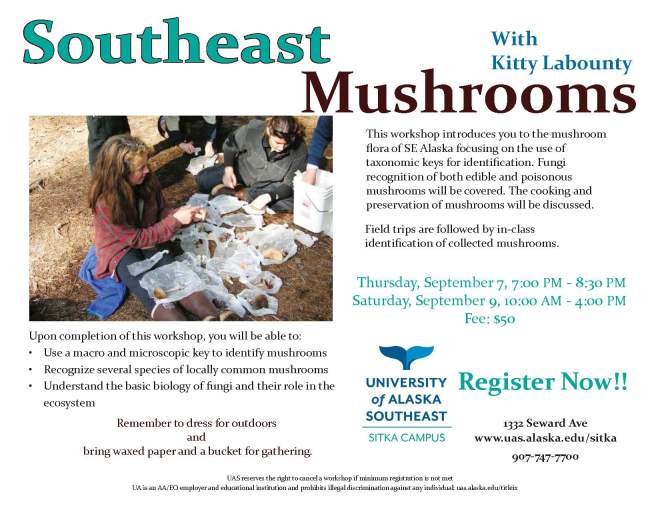
The University of Alaska Southeast Sitka Campus Office of Continuing Education will host its annual class “Southeast Mushrooms: How to Identify Them.”

This two-day class takes place from 7-8:30 p.m. on Thursday, Sept. 7, and from 10 a.m. to 4 p.m. on Saturday, Sept. 9, at the UAS Sitka Campus (with field trips). The course fee is $50. Students should dress for the outdoors, and bring waxed paper and a bucket for gathering.

This course is designed to introduce students to the mushroom flora of Southeast Alaska. The focus will be on the use of taxonomic keys for identification of fungi and recognition of both edible and poisonous mushrooms. Cooking and preservation of mushrooms will be discussed. Field trips are followed by in-class identification of collected mushrooms.

There is a maximum of 18 students allowed in this class, and the class may be canceled if at least 10 people don’t pre-register for it. For more information, contact the UAS Sitka Campus Office of Continuing Education at 747-7700. To register, call 1-800-478-6653, Ext. 7700, or go to http://uas.ce.alaska.edu/community-workshops/identifying-southeast-mushrooms.

Scenes from the Sitka Kitch classes on filleting and canning salmon for the Sitka Seafood Festival

As part of the rekindled Sitka Seafood Festival, the Sitka Kitch community rental commercial kitchen hosted two classes this week — Tuesday, Aug. 15, on how to fillet a salmon, and Wednesday, Aug. 16, on how to can salmon.

The Tuesday class was taught by Renée Jakaitis Trafton, chef-owner of Beak Restaurant. Renée taught students the basics of filleting a salmon (using freshly caught, ungutted salmon), and she taught them how to pull pinbones and how to skin the fillet.

The Wednesday class was led by Jasmine Shaw, who works for the University of Alaska Fairbanks Cooperative Extension Service‘s Sitka District Office. In addition to teaching students how to can salmon, Jasmine also taught them how to make a simple raspberry-currant jam while the salmon was processing.

Slideshows from both classes are posted below, with the Tuesday class slideshow on top of the Wednesday class. In the Wednesday class slideshow there are photos of several UAF Cooperative Extension Service publications, including several free handouts that can be downloaded off the UAF CES website and a couple of books that can be purchased from Jasmine at her office (contact her at 747-9440 or jdshaw2@alaska.edu to set up a time to get them).

Also, don’t forget the Sitka Kitch still has openings in its Ring Around The Rose Hip class from its Preserving The Harvest class series. You can learn more about our upcoming classes by going to http://sitkakitch.eventsmart.com and clicking on the class title to register.

Tuesday class slideshow

This slideshow requires JavaScript.

Wednesday class slideshow

This slideshow requires JavaScript.


Scenes from the Sitka Seafood Festival events on Saturday, Aug. 12

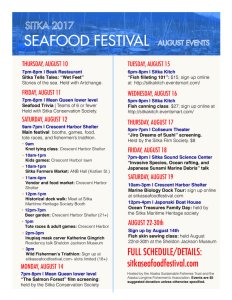
After a year in hiatus, the Sitka Seafood Festival returned this month with a variety of events from Aug. 6-30 around town. The big day for the Sitka Seafood Festival was Saturday, Aug. 12, when there were vendor booths, fun and games, a fishermen’s triathlon and other events at the Crescent Harbor Shelter and nearby locations.

A slideshow of scenes from the market vendor booths and fishermen’s triathlon (which featured two-person teams coiling line into a bucket, putting on a survival suit/Gumby suit, a three-legged race using a pair of Grundens, setting a skate, and a tote race) are linked below. There are still a couple of events left on the schedule, so check them out at http://www.sitkaseafoodfestival.com/.

This slideshow requires JavaScript.

Fish to Schools program launches coho salmon donation drive for commercial fishermen

The Fish to Schools program needs help from Sitka’s commercial fishermen. The program needs a few hundred pounds of coho salmon to help make Fish to Schools meals for Sitka students during the upcoming 2017-18 school year. The program also is seeking photos of commercial fishermen at work, which can be used to teach the students more about how the fish got to their plates.

The coho salmon donation period is Wednesday. Aug. 16, through Thursday, Aug. 31. To donate, commercial fishermen can sign up and indicate how many pounds they want to donate when they offload at Seafood Producers Cooperative or Sitka Sound Seafoods during the donation period. The program can only accept commercially caught fish (no sport or subsistence fish). The hope is to get enough coho donated that locally caught salmon can be offered to students at least once a week. Sign-up sheets will be posted at the scale shacks and in the main offices. Only coho salmon will be accepted.

The Sitka Fish To Schools project (click here to see short video) got its start as a community wellness project at the 2010 Sitka Health Summit, and now is managed by the Sitka Conservation Society. It started by providing a monthly fish dish as part of the school lunch as Blatchley Middle School, and since then has grown to feature regular fish dishes as part of the lunch programs at Baranof Elementary SchoolKeet Gooshi Heen Elementary SchoolBlatchley Middle SchoolSitka High SchoolPacific High School (where the alternative high school students cook the meals themselves), the SEER School, and Mount Edgecumbe High School.

In addition to serving locally caught fish meals as part of the school lunch program, the Fish To Schools program also brings local fishermen, fisheries biologists and chefs to the classroom to teach the kids about the importance of locally caught fish in Sitka. The program received an innovation award from the Alaska Farm To Schools program during a community celebration dinner in May 2012, and now serves as a model for other school districts from coastal fishing communities. In May 2014, the Fish to Schools program released a guidebook so other school districts in Alaska could create similar programs.

For more information, contact Sophie Nethercut of the Sitka Conservation Society at 747-7509 or email sophie@sitkawild.org. If you would like to donate FAS (frozen at sea) fish, please call or text Lexi Fish Hackett at 738-5684.

Do you like zucchini? We have lots of fresh local zucchini for sale

While our cold, wet summer hampered the growth of some of our veggies, zucchini has been our bumper crop of the season at the St. Peter’s Fellowship Farm communal garden. We’re harvesting about 70 pounds a week right now. We tried a new type of zucchini seed from FoundRoot seed company in Haines, and it really does well in Sitka.

So if you need any zucchini, please give St. Peter’s Fellowship Farm lead gardener Laura Schmidt a call at 738-7009. We also will have zucchini for sale at the Sitka Farmers Market from 10 a.m. to 1 p.m. on Saturday, Aug. 12, at the Alaska Native Brotherhood Founders Hall (and again on Aug. 19, and possibly on Sept. 2 and Sept. 9).

Don’t know how to use zucchini? The UAF Cooperative Extension Service has this free publication that has all kinds of information about zucchini and several recipes. Zucchini is very versatile and can be used in main dishes, side dishes, pickles, breads, salads, and desserts.

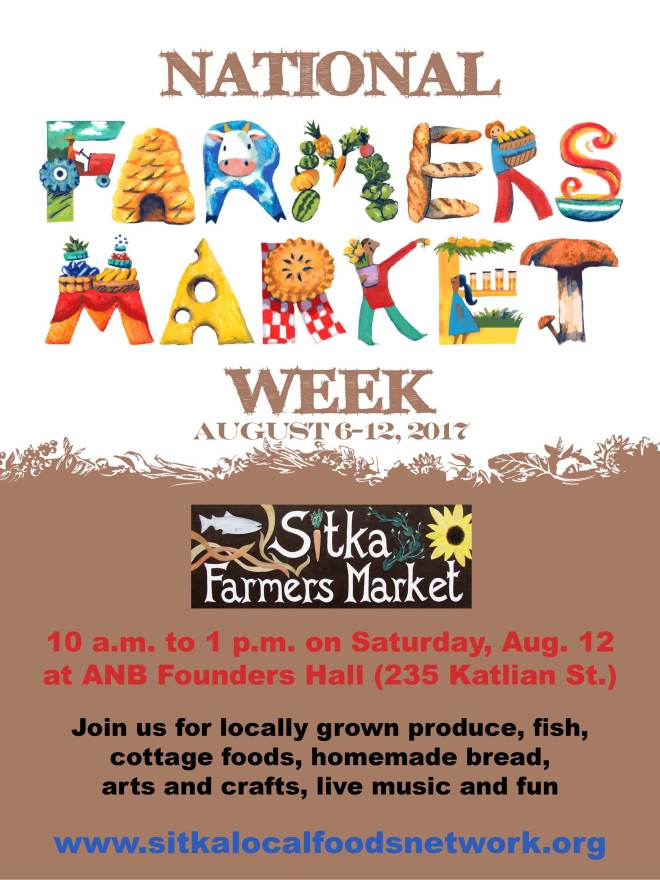
Celebrate National Farmers Market Week by attending the Sitka Farmers Market on Aug. 12

The 18th annual National Farmers Market Week is Aug. 6-12 this year, so stop by the Sitka Farmers Market to join the celebration, from 10 a.m. to 1 p.m. on Saturday, Aug. 12, at the Alaska Native Brotherhood Founders Hall. This is the 10th season of Sitka Farmers Markets.

The annual National Farmers Market Week celebration is the first full week of August, when growing season is peaking around the country. Click here to read this year’s National Farmers Market Week proclamation from U.S. Secretary of Agriculture Sonny Perdue.

The number of farmers markets in the country has more than tripled since 1996, growing from 2,410 markets in 1996 to 8,675 in 2016. There has been similar growth in Alaska, and now markets can be found in many Bush communities from Bethel to Thorne Bay. This growth has improved Alaska’s food security while also serving as an incubator for new businesses.

According to the Farmers Market Coalition, farmers markets …

  • Preserve America’s rural livelihoods and farmland. Farmers markets provide one of the only low-barrier entry points for beginning farmers, allowing them to start small, test the market, and grow their businesses.
  • Stimulate local economies. Growers selling locally create 13 full-time farm operator jobs per $1 million in revenue earned. Those growers that do not sell locally create three jobs.
  • Increase access to fresh, nutritious food. Several  studies have found lower prices for conventional and organic produce at farmers markets than at supermarkets. Due to this and other factors, 52 percent more SNAP households shop at farmers markets and from direct marketing farmers today than in 2011. The Sitka Farmers Market was the first market in Southeast Alaska to accept SNAP and WIC benefits, and we have a matching program for SNAP and WIC beneficiaries.
  • Support healthy communities. Farmers market vendors educate their shoppers. Four out of five farmers selling at markets discuss farming practices with their customers, and three in five discuss nutrition and how to prepare food.
  • Promote sustainability. Three out of every four farmers selling at farmers markets say they use practices consistent with organic standards.

Sitka Kitch to offer two classes in conjunction with the Sitka Seafood Festival

Sitkans love their seafood, and the Sitka Kitch community rental commercial kitchen is offering two great classes in conjunction with the Sitka Seafood FestivalHow to Fillet a Salmon and How to Can Salmon.

In the first class, held from 6-8 p.m. on Tuesday, Aug. 15, at the Sitka Kitch (505 Sawmill Creek Road, inside First Presbyterian Church), local chef Renée Jakaitis Trafton of the Beak Restaurant will teach students how to fillet a salmon. This includes lessons on how to remove the pinbones from the salmon and how to remove the skin. Participants must bring a fillet knife or let the instructor know they need one in advance. Knives can be made available for $15 for those who need them. This class costs $15.

In the second class, held from 5-9 p.m. on Wednesday, Aug. 16, at the Sitka Kitch, Jasmine Shaw of the UAF Cooperative Extension Service‘s Sitka District Office will teach students how to can the salmon (using the filleted salmon from Tuesday’s class). In addition, she will teach students how to make a simple berry jam while the class waits for the salmon to process in the canner. This class costs $27.50.

As a special deal, the Sitka Kitch has a $35 fee for students registering for both classes. The Sitka Seafood Festival is providing fish and jars for the classes, so there should be little or no food/supply fee.

The registration deadline is 6:55 p.m. on Monday, Aug. 14. Registration is capped at 10 students so sign up early to secure your space in these classes.

Register online at our EventSmart page, http://sitkakitch.eventsmart.com/ (click on class title, there is a separate class title to register for both classes and get the discount), using a debit or credit card or PayPal account. You also can call Chandler or Clarice at Sitka Conservation Society (747-7509) to arrange payment by cash or check. For more information about the two classes, contact Jasmine Shaw at 747-9440 or email sitkakitch@sitkawild.org.

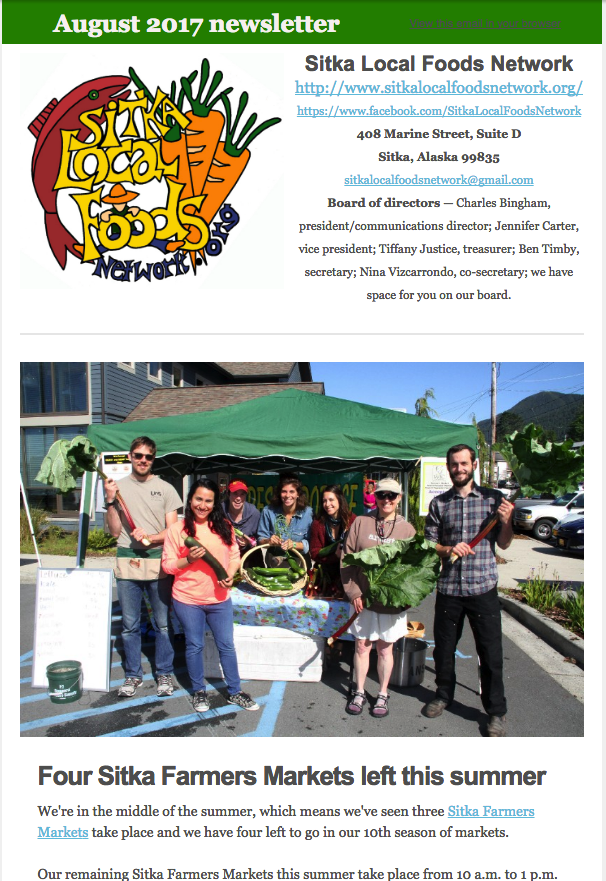
Check out the August 2017 edition of the Sitka Local Foods Network newsletter

The Sitka Local Foods Network just sent out the August 2017 edition of its monthly newsletter. Feel free to click this link to get a copy.

This month’s newsletter includes brief items about the Sitka Farmers Markets this summer, the Sitka Local Foods Network being this month’s nonprofit to receive tips from Harry’s Soda Shop, and an invitation to join our board of directors. Each story has links to our website for more information.

You can sign up for future editions of our newsletter by clicking on the newsletter image in the right column of our website and filling in the information. If you received a copy but didn’t want one, there is a link at the bottom of the newsletter so you can unsubscribe. Our intention is to get the word out about upcoming events and not to spam people. We will protect your privacy by not sharing our email list with others. Don’t forget to like us on Facebook, like our new Sitka Farmers Market page on Facebook and follow us on Twitter.

Scenes from the Sitka Kitch’s Preserving the Harvest class on making jams and jellies

Students learned about jams, jellies, fruit butters, marmalades, preserves and conserves during the Jam Session: Preserving Jams and Jellies class on Monday, July 24, at the Sitka Kitch community rental commercial kitchen. This was the fourth of six scheduled classes in the Preserving the Harvest food preservation class series offered this summer.

The class was taught by Lisa Sadleir-Hart, a Sitka dietitian and health educator who has taught several cooking and food preservation classes for the Sitka Kitch. In this class, students learned how to make strawberry-kiwi jam, a blueberry conserve (with lemon, orange and raisins), a rhubarb-strawberry conserve (with cranberries or raisins and walnuts), and plum jam.

This was the fourth class in the Preserving the Harvest food preservation class series, which is sponsored by the SouthEast Alaska Regional Health Consortium (SEARHC). The other classes in the series are (underlined titles take you to the class registration page):

  • Ring Around the Rose Hip: Rose Hip Relish and More — 6-8:30 p.m., Monday, Sept. 18, taught by Lisa Sadleir-Hart, $27.50 registration fee
  • Venison Jerky — 6-8:30 p.m., Monday, Oct. 30 (this date and class topic may change), taught by Lisa Sadleir-Hart and Jasmine Shaw, $27.50 registration fee

The Sitka Kitch programming team is working on other classes to be offered later this summer and next fall. We also might reschedule the Clear the Freezer, Fill the Pantry community canning session for later this summer, but on a Saturday instead of during the week. Watch the Sitka Kitch page on Facebook or our online registration page to see when these and any future classes are scheduled.

When registering, students should prepay for the class through the Sitka Kitch online registration sitehttp://sitkakitch.eventsmart.com, using PayPal or credit/debit card. If you need other payment arrangements, contact Chandler or Clarice of Sitka Conservation Society at 747-7509 to arrange a time when you can pay with cash or check. To qualify for a partial refund, please notify us at least three days in advance if you need to cancel. The registration deadline is three days before each class so our instructors have time to purchase materials. Please email sitkakitch@sitkawild.org with any questions.

A slideshow of scenes from the jams and jellies class follows below.

• Link to UAF Cooperative Extension Service publication Jams and Jellies

• Link to UAF Cooperative Extension Service publication Alaska Blueberries

• Link to UAF Cooperative Extension Service publication Wild Strawberries

This slideshow requires JavaScript.

How to use WIC coupons, Alaska Quest SNAP cards or credit/debit cards at the Sitka Farmers Market

Have you ever come up a bit short of cash while shopping at the Sitka Farmers Market? Well, there are other methods to use.

The Sitka Farmers Market was the first market in Southeast Alaska to accept the Alaska Quest EBT (electronic benefits transfer) cards for people on SNAP (formerly called food stamps). We also accept WIC farmers market coupons. In both cases, we match up to the first $20 for produce (on WIC) or produce and other SNAP-eligible foods (on Quest).

While many of our vendors have attachments on their cellphones that allow them to run credit or debit card transactions, sometimes it’s hard to get an Internet signal in the Alaska Native Brotherhood Founders Hall. We sell tokens (wooden nickels) at our Sitka Local Foods Network swag booth, next to our farm stand outside, that people can use like cash with vendors at the market.

Here is a short primer on how to use each type of transaction:

WIC Farmers Market Coupons

WIC Farmers Market Coupons may only be used at the Sitka Local Foods Network farm stand, found outside in the parking lot.

Present your coupons, and we will match the value up to $20 for produce (so $20 in WIC coupons gives you $40 in value). Our WIC matching program is for produce only and does not include our Alaska Grown products, due to WIC restrictions

Alaska Quest Cards (SNAP Electronic Benefits Transfer)

Bring your Alaska Quest card to the Sitka Local Foods Network swag booth, found outside in the parking lot next to the SLFN farm stand booth.

We swipe your card and give you wooden nickels (tokens) for the value you think you will spend on produce, Alaska Grown products, bread, jams or jellies, or other food that is not meant to be eaten at the market. You can use your wooden nickels at the SLFN farm stand booth, and with certain vendors that have signed agreements to accept SNAP wooden nickels (ask us which vendors have signed agreements when you swipe your card). We will match up to $20 in wooden nickels for produce at the SLFN farm stand.

No cash change will be given for people using SNAP wooden nickels (available in $1 and $5 increments). If you have leftover wooden nickels at the end of the market, take them back to the SLFN swag booth and we will credit them back to your SNAP account. This credit must be done at the same market.

Credit/Debit Cards

While some of our vendors can run credit/debit cards at their booths, there are many that can’t. If you are low in cash and want to run your credit/debit card to buy something at the market, stop by the Sitka Local Foods Network swag booth and we will run your credit/debit card and give you wooden nickels in $5 or $10 increments.

You can then spend your credit/debit card wooden nickels like cash with many of the vendors at the market (most booths will have a sign saying they accept credit/debit card wooden nickels). Credit/debit card tokens may be used for food and non-food items, and customers may receive cash as change.