Sitka Ranger District, Sitka Tribe to harvest Tlingit community potato garden

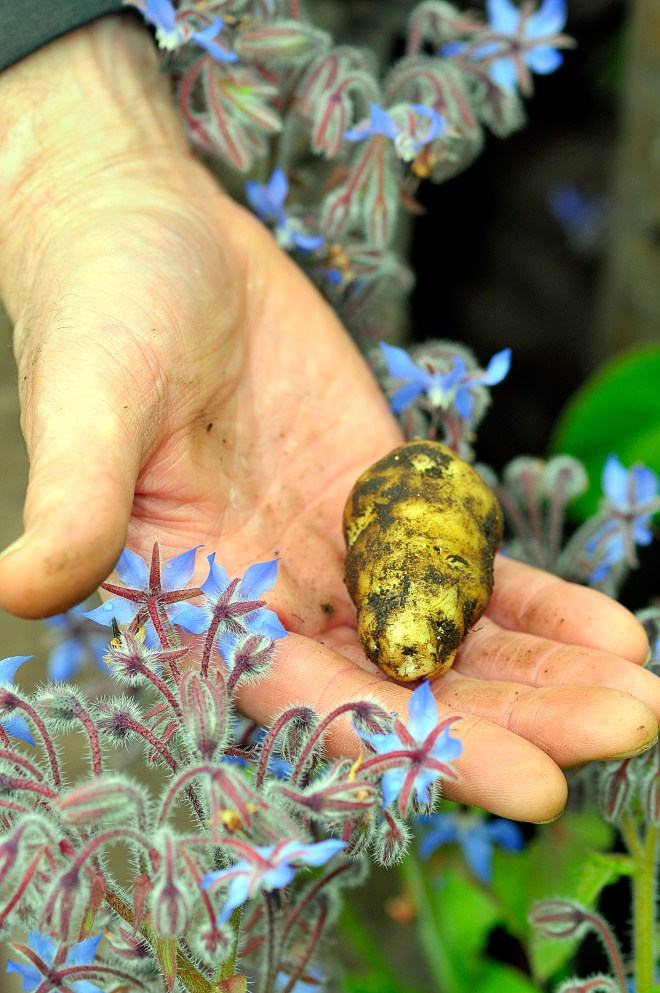
(Photo courtesy of Klas Stolpe/Juneau Empire) Bill Ehlers, assistant gardener at the Jensen-Olson Arboretum in Juneau, holds a Tlingít potato next to some of the potato plant’s flowers.

The community is invited to help harvest the Sitka Ranger District/Sitka Tribe of Alaska Tlingit potato garden and learn scientific and cultural information about the unique crop at 3 p.m. on Monday, Sept. 25, at the USDA Forest Service Sitka Ranger District office, 2108 Halibut Point Road.

Leading Tlingit potato researcher Elizabeth Kunibe will join the group to present information on the biology, history, and cultural aspects Tlingit potatoes. Topics will include harvesting potatoes, learning to store potatoes for seed and for food, preparation for next year’s garden, and the cultural aspects of Tlingit potatoes and native gardening.

The Sitka Ranger District provided the sunny plot of land for the shared potato garden and tended the garden over the summer after volunteers from the Sitka Tribe’s Traditional Foods Program, the gardening class from Pacific High School, and others from the community planted the potatoes in April.

Community involvement is needed for the harvest. Participants should come prepared for the weather as all activities will occur outdoors. All of the attendees are asked to wear boots, gardening gloves, and bring hand trowels or shovels. Bringing buckets of kelp to incorporate into the soil after harvesting would be beneficial.

The potatoes will need to be dried and prepared for storage. Many of the potatoes harvested will be saved for next year’s seed potatoes, Depending on the size of the harvest, the group hopes to share the harvest among the volunteers and through the Sitka Tribe’s Traditional Foods Program and Social Services.

Tlingit potatoes (sometimes called Maria’s potatoes) have been present in Tlingit gardens for over 200 years. The potatoes originate from Mexico or Chile and were a trade item in Southeast Alaska in the early 1800s.

This work day and educational opportunity will be at the Sitka Ranger District office, located at 2108 Halibut Point Road. For more information, contact Michelle Putz at 907-747-2708 or mputz@fs.fed.us. For interviews and information to be used for publication, contactthe Tongass Public Affairs Officer Paul Robbins at 907-228-6201 or paulrobbins@fs.fed.us.

UAF Cooperative Extension Service offers Certified Food Protection Manager class by videoconference Oct. 3 in Sitka

Tuesday, Sept. 19, is the registration deadline for a certified food protection manager workshop being taught on Tuesday, Oct. 3, by University of Alaska Fairbanks Cooperative Extension Service. This is an all-day statewide class that will be offered by videoconferencing to Delta Junction, Fairbanks, Juneau, Palmer and Sitka.

A certified food protection manager (CFPM) is responsible for monitoring and managing all food establishment operations to ensure that the facility is operating in compliance with food establishment regulations.

A CFPM is knowledgeable about food safety practices and uses this knowledge to provide consumers with safe food, protect public health and prevent food-borne illnesses. Alaska regulations require food establishments to have at least one CFPM on staff.

This course takes place from 8:30 a.m. to 5:30 p.m. (with a half-hour lunch), and participants will take a computer-based exam at the end of the class. The reason the deadline is two weeks before the class is to guarantee course materials reach all the students in time for the class. The cost is $200, and the course will be taught by Julie Cascio of Palmer. Students can register here.

The Sitka videoconference for the class will take place in Room 106 at the University of Alaska Southeast Sitka Campus. To learn more, contact Jasmine Shaw at the Sitka District Office of the UAF Cooperative Extension Service at 747-9440, or contact Julie Cascio at (907) 745-3677 (Palmer number) or jmcascio@alaska.edu, or Melissa Clampitt at (907) 745-3551 or mrclampitt@alaska.edu. Note, this class is taught in English but textbooks are available in Korean, Chinese and Spanish, just contact Julie or Melissa at least three weeks before the class.

Also, the ServSafe book ($70) and certification exam ($75) now are available online, if people want to order the book and study independently without taking the class. Just go to this website and purchase the book and exam items.

First-graders harvest the seeds they planted while in kindergarten last spring

LITTLE HARVEST – First-grader Taylor McCarty, 6, holds up a slightly deformed carrot at the Russian Bishop’s House garden this morning (Thursday, Sept. 7, 2017). Students in Sarah Eddy’s Baranof Elementary School class and other first graders were harvesting the vegetables they planted in the spring when they were in kindergarten. This summer was not good for growing crops said Sitka National Historical Park Ranger Ryan Carpenter. Most of the carrots were only about an inch or so long. (Daily Sitka Sentinel Photo by James Poulson)

Beyond Leafy LLC grows fresh, local basil for Sitka market using vertical hydroponics

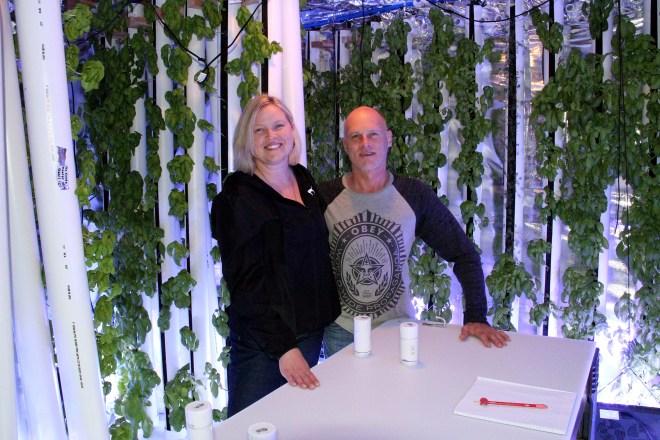
From the outside, it looks like any suburban garage. But inside there’s a 2,000-cubic-foot box where Jimmie and Leslie Kranz are growing fresh, local basil for the Sitka market using a vertical hydroponic greenhouse system.

Their company, called Beyond Leafy LLC, recently started supplying basil to a few Sitka restaurants and also provides it for the Market Center grocery store. Soon, the couple hopes to expand their business so their basil is available at Sea Mart.

“We’ve been brainstorming for years to find a product or service that would serve the people and our community,” Jimmie Kranz said. “The thing about this business is we’re not selling a service or product that people question. We’re selling what most people already have in their refrigerator.”

They also wanted something they could do together, especially since until earlier this year Jimmie was working about 14 hours a day with the Alaska Marine Highway System at the ferry terminal and Leslie was working about 10 hours a day with the Transportation Security Administration at the airport. Jimmie quit his state job in February, and Leslie quit her federal gig in June.

“We like working together,” Leslie Kranz said. “We’re having fun and the reception from the community has been extraordinarily positive.”

In addition to the couple, there are five kids and all except the oldest (Kameron, 32, who runs his own business in Arizona) are involved in the company. Tray, 25, is based in Grenada, but he’s been doing the website and social media for the company and helps with finances. Jake, 22, is a commercial fisherman but spent 3 1/2 months helping Jimmie build the hydroponic towers. The younger two kids, Madi, a 17-year-old senior at Sitka High School, and Kale, an 11-year-old sixth-grader at Blatchley Middle School, both help Jimmie and Leslie trim the basil plants and prepare orders. The family also has weekly business meetings.

Beyond Leafy LLC is serving a big need in Sitka. Many restaurants and bars use basil in their food dishes and drinks, and locally grown basil tastes better and is picked at peak freshness (not a week or two early so it can be sent here by barge). When food has to travel long distances it can lose nutrients and flavor. Beyond Leafy also fills a niche found by a previous company in Sitka that provided basil to local restaurants and grocery stores, but switched to growing weed once marijuana was legalized. When the switch to weed happened last year, it left some restaurants scrambling for a new source of local basil.

“The Mean Queen is thrilled to once again have a local basil provider,” said Mary Magnuson, co-owner of the Mean Queen restaurant. “Beyond Leafy provides a very high quality product that graces both pizzas and our signature LA Preppy Martini. There is literally no comparison in the local product and what we can order from our suppliers. We are looking forward to their growth into more items.”

To grow the basil, Jimmie and Leslie take a package of rock wool (A-OK Starter Plugs) and plant seeds into each section square. The seeds grow in trays until they are a couple of weeks old, when their rock wool section squares are broken apart and the pieces of rock wool are inserted into the towers, spaced about 6-8 inches apart.

Each tower features an eight-foot-long piece of four-inch-diameter PVC pipe that has been split vertically so a felt/foam media can be inserted into each piece (the felt/foam media is purchased locally from Ben Franklin). The individual towers can be removed from their spots and moved to another spot (they move the towers every two weeks to chart the progress of their basil plants), or they can be placed on the table in the middle of the box for trimming.

Scattered throughout the box and within each tower section, there are lights connected to a roller system that moves the lights back and forth and up and down so each plant gets what it needs to grow. The light system is on a timer. The roller system helps control the temperature in the box and prevents the basil leaves from being burned by stationary lights, and also means they don’t have to use as many lights as some operations. The vertical hydroponic system also includes a recirculating watering tank and hoses that deliver water to each of the towers.

Jimmie said he designed the family’s system after taking an online university class on vertical hydroponics from Bright Agrotech, which recently was bought out by a company called Plenty that plans to develop larger-scale vertical hydroponic systems.
Jimmie and Leslie usually harvest the basil from 6-9 a.m., and it’s in the stores and restaurants by 10 a.m. From seed to harvest, it usually takes about 8-10 weeks for the basil to reach maturity. Beyond Leafy is selling its basil for $56 a pound or $3.50 an ounce (it takes a lot of basil to make an ounce), which might seem high but Jimmie noted that most restaurants only get about six ounces of usable product out of a pound of basil because of all the stems and other parts. Because they hand-trim their basil it’s all usable product, so Jimmie said the price works out to be about the same.

Right now, Beyond Leafy LLC is growing several types of basil (Genovese, Italian, sweet, purple opal, Thai and lemon), and also experimenting with dill and rosemary. They currently are growing about 10-15 pounds of basil a week, and expect to grow to about 40-50 pounds a week once Sea Mart starts carrying their product.

“Since we started the business it changed our whole mindset, and now we’re thinking more about what we can do for our community,” Jimmie said. “We also are eating more local, healthy food. I’d say basically the four of us still in the house (Jimmie, Leslie, Madi, and Kale) have lost about 100 pounds since we started the business.”

Eventually, they hope to find a warehouse unit to lease so they can expand their operation to include several types of lettuce, kale and chard. In order to help the business grow and expand, the couple set up a GoFundMe site.

“We can’t do it alone,” Jimmie said. “There is a bit of fear when you quit your jobs, cash in your retirements and take your family on a venture like this. But entrepreneurs have to take risks to move forward.”

This slideshow requires JavaScript.

UAS Sitka Campus to host its annual class on how to identify Southeast Alaska mushrooms

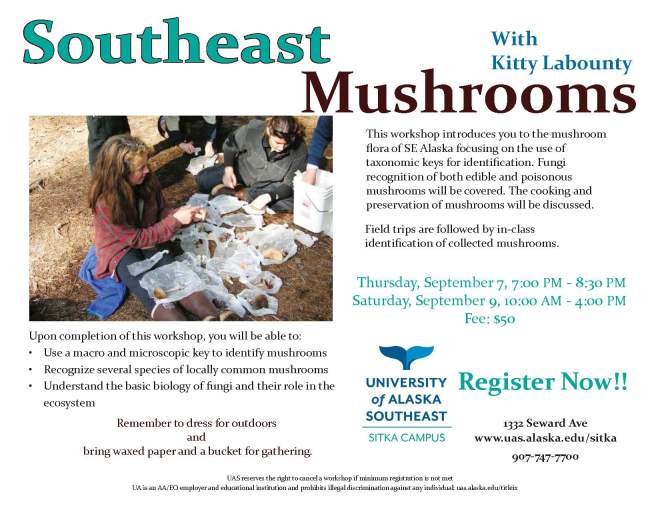
The University of Alaska Southeast Sitka Campus Office of Continuing Education will host its annual class “Southeast Mushrooms: How to Identify Them.”

This two-day class takes place from 7-8:30 p.m. on Thursday, Sept. 7, and from 10 a.m. to 4 p.m. on Saturday, Sept. 9, at the UAS Sitka Campus (with field trips). The course fee is $50. Students should dress for the outdoors, and bring waxed paper and a bucket for gathering.

This course is designed to introduce students to the mushroom flora of Southeast Alaska. The focus will be on the use of taxonomic keys for identification of fungi and recognition of both edible and poisonous mushrooms. Cooking and preservation of mushrooms will be discussed. Field trips are followed by in-class identification of collected mushrooms.

There is a maximum of 18 students allowed in this class, and the class may be canceled if at least 10 people don’t pre-register for it. For more information, contact the UAS Sitka Campus Office of Continuing Education at 747-7700. To register, call 1-800-478-6653, Ext. 7700, or go to http://uas.ce.alaska.edu/community-workshops/identifying-southeast-mushrooms.

Scenes from the Sitka Kitch classes on filleting and canning salmon for the Sitka Seafood Festival

As part of the rekindled Sitka Seafood Festival, the Sitka Kitch community rental commercial kitchen hosted two classes this week — Tuesday, Aug. 15, on how to fillet a salmon, and Wednesday, Aug. 16, on how to can salmon.

The Tuesday class was taught by Renée Jakaitis Trafton, chef-owner of Beak Restaurant. Renée taught students the basics of filleting a salmon (using freshly caught, ungutted salmon), and she taught them how to pull pinbones and how to skin the fillet.

The Wednesday class was led by Jasmine Shaw, who works for the University of Alaska Fairbanks Cooperative Extension Service‘s Sitka District Office. In addition to teaching students how to can salmon, Jasmine also taught them how to make a simple raspberry-currant jam while the salmon was processing.

Slideshows from both classes are posted below, with the Tuesday class slideshow on top of the Wednesday class. In the Wednesday class slideshow there are photos of several UAF Cooperative Extension Service publications, including several free handouts that can be downloaded off the UAF CES website and a couple of books that can be purchased from Jasmine at her office (contact her at 747-9440 or jdshaw2@alaska.edu to set up a time to get them).

Also, don’t forget the Sitka Kitch still has openings in its Ring Around The Rose Hip class from its Preserving The Harvest class series. You can learn more about our upcoming classes by going to http://sitkakitch.eventsmart.com and clicking on the class title to register.

Tuesday class slideshow

This slideshow requires JavaScript.

Wednesday class slideshow

This slideshow requires JavaScript.
 

Scenes from the Sitka Seafood Festival events on Saturday, Aug. 12

After a year in hiatus, the Sitka Seafood Festival returned this month with a variety of events from Aug. 6-30 around town. The big day for the Sitka Seafood Festival was Saturday, Aug. 12, when there were vendor booths, fun and games, a fishermen’s triathlon and other events at the Crescent Harbor Shelter and nearby locations.

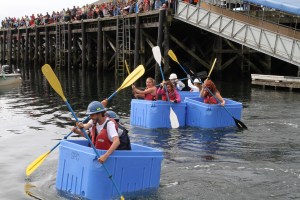
A slideshow of scenes from the market vendor booths and fishermen’s triathlon (which featured two-person teams coiling line into a bucket, putting on a survival suit/Gumby suit, a three-legged race using a pair of Grundens, setting a skate, and a tote race) are linked below. There are still a couple of events left on the schedule, so check them out at http://www.sitkaseafoodfestival.com/.

This slideshow requires JavaScript.

Scenes from the fourth Sitka Farmers Market of the 2017 summer

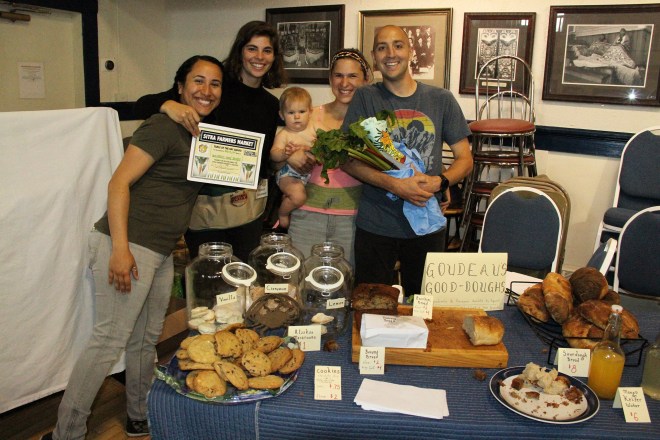
Table of the Day: Sitka Farmers Market manager Nina Vizcarrondo, left, and Sitka Local Foods Network Bulldog On Baranof intern Al Simon, second from left, present the Table of the Day award to Ariane Martin Goudeau (holding baby Elodie Goudeau) and Geoffrey Goudeau of Goudeau’s Good-Doughs during the fourth Sitka Farmers Market of the 2017 summer, held Saturday, Aug. 12, at the Alaska Native Brotherhood Founders Hall. Ariane and Geoffrey sold cookies, bread, and a variety of other baked goods. They received a Sitka Local Foods Network apron loaded with some rhubarb, beets, a Sitka Local Foods Network t-shirt, and an Alaska Grown sticker.

It rained when we held our fourth Sitka Farmers Market of the 2017 summer season on Saturday, Aug. 12, at the Alaska Native Brotherhood Founders Hall (235 Katlian Street), so we moved most of our booths indoors. It also was National Farmers Markets Week, so we had a decent crowd despite some competition from the Sitka Seafood Festival.

While our cold weather this spring means we don’t have as much produce as we like, we still had several local produce vendors at the market (did you see the size of those zucchinis at the Sitka Local Foods Network farm stand?). We also had about three dozen vendors at the market (between those inside ANB Founders Hall and those outside in the Baranof Island Housing Authority parking lot) so there was a nice variety of items being sold. Vendors sold harvested foods (such as chaga tea and traditional medicinal tinctures), homemade baked goods, banana-Nutella crepes, hot seafood dishes, fresh smoothies, reindeer hot dogs, blackcod tips, arts and crafts, and home-baked bread. We also had an expanded selection of Alaska Grown products at the Sitka Local Foods Network farm stand.

The next Sitka Farmers Market takes place from 10 a.m. to 1 p.m. on Saturday, Aug. 19, at the ANB Founders Hall. There also are markets scheduled for Sept. 2, and Sept. 9. To learn how to be a vendor at the market, contact market manager Nina Vizcarrondo at (907) 738-9301 (new number) or assistant manager Charles Bingham (907) 623-7660, or email us at sitkafarmersmarket@gmail.com. We also have a new kids vendor program at the market for young entrepreneurs age 12 or younger. Don’t forget to like our new Sitka Farmers Market page on Facebook.

A slideshow of scenes from the fourth Sitka Farmers Market is posted below.

This slideshow requires JavaScript.

Fish to Schools program launches coho salmon donation drive for commercial fishermen

The Fish to Schools program needs help from Sitka’s commercial fishermen. The program needs a few hundred pounds of coho salmon to help make Fish to Schools meals for Sitka students during the upcoming 2017-18 school year. The program also is seeking photos of commercial fishermen at work, which can be used to teach the students more about how the fish got to their plates.

The coho salmon donation period is Wednesday. Aug. 16, through Thursday, Aug. 31. To donate, commercial fishermen can sign up and indicate how many pounds they want to donate when they offload at Seafood Producers Cooperative or Sitka Sound Seafoods during the donation period. The program can only accept commercially caught fish (no sport or subsistence fish). The hope is to get enough coho donated that locally caught salmon can be offered to students at least once a week. Sign-up sheets will be posted at the scale shacks and in the main offices. Only coho salmon will be accepted.

The Sitka Fish To Schools project (click here to see short video) got its start as a community wellness project at the 2010 Sitka Health Summit, and now is managed by the Sitka Conservation Society. It started by providing a monthly fish dish as part of the school lunch as Blatchley Middle School, and since then has grown to feature regular fish dishes as part of the lunch programs at Baranof Elementary SchoolKeet Gooshi Heen Elementary SchoolBlatchley Middle SchoolSitka High SchoolPacific High School (where the alternative high school students cook the meals themselves), the SEER School, and Mount Edgecumbe High School.

In addition to serving locally caught fish meals as part of the school lunch program, the Fish To Schools program also brings local fishermen, fisheries biologists and chefs to the classroom to teach the kids about the importance of locally caught fish in Sitka. The program received an innovation award from the Alaska Farm To Schools program during a community celebration dinner in May 2012, and now serves as a model for other school districts from coastal fishing communities. In May 2014, the Fish to Schools program released a guidebook so other school districts in Alaska could create similar programs.

For more information, contact Sophie Nethercut of the Sitka Conservation Society at 747-7509 or email sophie@sitkawild.org. If you would like to donate FAS (frozen at sea) fish, please call or text Lexi Fish Hackett at 738-5684.

Sitka Seafood Festival returns Aug. 10-19 after spending a year in hiatus

After spending a year in hiatus, the Sitka Seafood Festival returns Aug. 10-19 with a wide variety of events as Sitka celebrates its local seafood culture.

“Southeast Alaska is an amazing place, and the Sitka Seafood Festival is going to be a great opportunity to bring our community together to celebrate it,” Sitka Seafood Festival coordinator Emma Edson said. “There are a lot of great minds coming together to make it happen. It’ll be a lot of fun, and it’s all for a good cause.”

The Sitka Seafood Festival began in 2009 through the work of volunteers, and became its own nonprofit in 2012. But in 2016, organizers decided they needed to take a break.

The rekindled Sitka Seafood Festival now is sponsored by the Alaska Sustainable Fisheries Trust and the Alaska Longline Fishermen’s Association. The proceeds from the festival will benefit the Young Fishermen’s Initiative, which helps young Alaskans get into the fishing industry with financing for permits and boats, deck hand apprenticeships, and policy programs.

“Central to the mission of the Sitka Seafood Festival (SSF), as well as the mission of Alaska Sustainable Fisheries Trust, is the belief that Alaska needs a vibrant and sustainable fishing industry supporting economically empowered and self-sufficient Alaska communities,” said Willow Moore, ASFT’s executive director. “Also, no one knows good seafood (and where to find it) like Alaskans. The Sitka Seafood Festival celebrates the fishing culture and heritage that local economies (and plates and palates) depend on, and the unique ecosystems of Southeast Alaska that sustain our local fish and families as they grow.”

In addition to the two host organizations, there are several partner groups hosting activities, such as ArtChange Inc., the Sitka Maritime Heritage Society, Sitka Film Society, Sheldon Jackson Museum, Sitka Local Foods Network, the Sitka Kitch, and Sitka Tribe of Alaska.

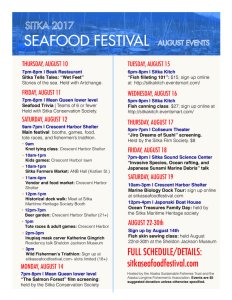
The main festival day is Saturday, Aug. 12, when there are vendor and food booths plus a variety of fun and games events at Crescent Harbor Shelter. Knot-tying games open the event at 9 a.m., followed by kids games at 10 a.m., the vendor market from 11 a.m. to 4 p.m., older kids games from 11 a.m. to 1 p.m., a dock walk from noon to 1 p.m., tote races at 1 p.m., and the wild fishermen’s triathlon (which includes fish tote races and other obstacles) at 3 p.m.

Other highlights from this year’s event schedule include a pre-festival screening of the movie “Jaws” on Aug. 6 at the Coliseum Theater; Sitka Tells Tales hosting “Wet Feet: Stories On, In, Under, or Of the Sea” on Aug. 10 at the Beak Restaurant; seafood trivia on Aug. 11 at the Mean Queen; a lecture by Iñupiaq mask carver Erin Katherine Gingrich on Aug. 12 at the Sheldon Jackson Museum; a screening of the film “The Salmon Forest” on Aug. 14 at the Mean Queen; a class on filleting salmon on Aug. 15 at the Sitka Kitch; a class on canning salmon on Aug. 16 at the Sitka Kitch; a film screening of an ocean and fisheries documentary TBA on Aug. 17 at the Coliseum Theater; a “Coming to America: Invasive Species, Ocean Rafting, and Japanese Tsunami Marine Debris” lecture on Aug. a8 at the Sitka Sound Science Center; a walk about the docks on Aug. 19; an ocean treasures family day Aug. 19 at the Japonski Island Boat House; and a fish skin sewing class taught by Joel Isaak from Aug. 22-30 at the Sheldon Jackson Museum.

Don’t forget the Sitka Local Foods Network is hosting a Sitka Farmers Market from 10 a.m. to 1 p.m. on Aug. 12 at the ANB Founders Hall, and another one at the same time on Aug. 19. So make time to attend both events.

The 2017 Sitka Seafood Festival grand finale will come with the Young Fishermen’s Expo and Season’s End Banquet, taking place in early November at Harrigan Centennial Hall.

For more information about the Sitka Seafood Festival, go to http://www.sitkaseafoodfestival.com, or call 747-3400.