The Sitka Local Foods Network just sent out the June 2023 edition of its monthly newsletter. Feel free to click this link to get a copy.
This month’s newsletter includes short stories about vendor registration being open for the 2023 Sitka Farmers Market, the winners of the Sitka Food Business Innovation Contest, an upcoming class about cottage foods business basics, an update about how you can support the Sitka Local Foods Network by buying a t-shirt or hoodie from our online store, information about our 2023 sponsorship programs, and an invitation to join our board of directors. Each story has links to our website for more information.
You can sign up for future editions of our newsletter by clicking on the newsletter image in the right column of our website and filling in the information. If you received a copy but didn’t want one, there is a link at the bottom of the newsletter so you can unsubscribe. Our intention is to get the word out about upcoming events and not to spam people. We will protect your privacy by not sharing our email list with others. Don’t forget to like us on Facebook, like our Sitka Farmers Market page on Facebook and follow us on Twitter (@SitkaLocalFoods).
Learn what the basics of starting and running a cottage foods business as Sarah Lewis teaches students How to Start a Cottage Foods Business (also known as a home-based food business) from 4-5:30 p.m. on Wednesday, June 21, at the Sitka Public Library.
This class is designed to help vendors prepare for the upcoming Sitka Farmers Markets hosted by the Sitka Local Foods Network.
Sarah Lewis — the home, health and family development agent for the Juneau office of the UAF Cooperative Extension Service — will teach this class live in Sitka. Students will learn about state laws regarding home-based food businesses, and get ideas for businesses you might take to the Sitka Farmers Market or local trade shows. The first hour will be spent discussing rules and regulations, and the second part of the class will be for questions and answers.
The Sitka Local Foods Network is offering students of this class half off their Sitka Farmers Market vendor fee for the first market of the season where they host a table (as a rebate). Representatives from the Sitka Local Foods Network/Sitka Farmers Market and (hopefully) the Sitka food safety office of the Alaska Department of Environmental Conservation are planning to attend so they can answer any questions potential cottage foods business owners may have.
For more information about the class, contact Charles Bingham of the Sitka Local Foods Network at 907-623-7660 or Jasmine Shaw at the UAF Cooperative Extension Service Sitka District Office at 907-747-9440.
Sitka Local Foods Network farm stand volunteers Trish White, left, Laura Schmidt, second from left, Ilima James, third from left, and Nalani James, hold locally grown zucchini at the last Sitka Farmers Market of the 2022 season (Sept. 24) at Alaska Native Brotherhood Founders Hall. We are gearing up for the 2023 Sitka Farmers Market season, which starts on July 1.
Vendor registration is open for the 2023 Sitka Farmers Markets. This 16th annual community event is hosted by the Sitka Local Foods Network, a nonprofit working to improve Sitka’s food security. The online vendor registration page, http://sitkafarmersmarket.eventsmart.com, is live and ready for vendors to sign up and pre-pay for their spots.
This summer the Sitka Local Foods Network is hosting seven markets from 10 a.m. to 1 p.m. on Saturdays — July 1, July 15, July 29, Aug. 12, Aug. 26, Sept. 9, and Sept. 23 — at Alaska Native Brotherhood Founders Hall (235 Katlian Street), where we held our first 13 years of markets.
All vendors will pay $40 per market for a full table inside or outside or to bring a food truck, and $25 for a half table inside. We have a special rate of $240 for vendors who register for all seven markets before the first market happens, which means you pay for six markets and get one market free. Vendors can register for one or two markets, or all seven. We also have a youth vendor program for ages 14 and younger, which is $20 for all seven markets (please let us know ahead of time which specific markets you plan to attend).
The Sitka Farmers Market is a community event hosted by the Sitka Local Foods Network, whose mission is to increase the amount of locally produced and harvested food in the diets of Southeast Alaskans. Our focus is on local — fresh produce, fish, baked goods, prepared foods, cottage foods, arts and crafts — and all products must be made in Alaska (preferably in Sitka or Southeast Alaska, cooked foods may use non-local foods so long as the food is cooked on site). Since our mission is geared toward food security and our space is limited this year, if we have too many vendors try to register our food booths will have a higher priority over arts and crafts.
After having to relocate for two years due to COVID-19, we returned to our ANB Hall roots last year for our 15th season of markets. We are back at ANB Hall this summer, and we plan to bring back half tables after dropping them to help spread out the crowds with COVID-19. We will have indoor and outdoor spaces. Since COVID-19 is still around, we will require masks inside the ANB Hall when Sitka is at the Moderate or High risk levels. While most people now are vaccinated against the coronavirus, there still are people who aren’t vaccinated and there are periodic hot spots when the illness flares up. We don’t want the market to be a place that spreads the coronavirus. Even with our outside booths, we encourage vendors and customers to wear masks, to use hand sanitizer, and to avoid bunching up while giving others six feet of space.
Please read the market vendor rules and responsibilities document linked below. All vendors using this site to register for the market will be held to these rules. We ask all vendors to register by the Thursday morning before the markets where they intend to sell. Unless you specify you want to be outside, we will try to find room for you indoors. We are back to selling half-tables this year after not having them because we needed to have social-distancing to prevent the spread of COVID-19.
Vendors can pay using PayPal or credit/debit card. When you get to the Payment options, click PayPal (not Invoice) and it should give you the option of using a PayPal account or four different types of cards (Visa, MasterCard, AmEx, Discover). If you prefer to pay by cash or check, contact Charles Bingham at 907-623-7660. We will provide a $35 refund for full-table and outside cancellations or $20 for a half-table cancellation, but to get the refund you are required to let us know before Wednesday of the week of your registered market that you can’t make it. We are billed for transaction fees and other expenses, so the $5 covers that. There is no refund if you don’t let us know until after Wednesday.
Anastasia Stefanowicz is the Sitka Farmers Market manager this summer. Laura Schmidt is our lead gardener at St. Peter’s Fellowship Farm, where the Sitka Local Foods Network grows most of the produce it sells at the market. Charles Bingham is the assistant market manager and the president of the Sitka Local Foods Network.
The garden program at Pacific High School will host a garden plant sale from 2-4 p.m. on Friday, May 5, and from 10 a.m. to 2 p.m. on Saturday, May 6, at the SouthEast Alaska Career Center (SEACC) building, 205 Baranof St. (the building behind the school).
The high school has offered students a garden club and class for several years, even hosting MOBY the Mobile Greenhouse during the 2019-20 school year. In September 2021, Pacific High School received a USDA Farm To School grant for its edible garden project. The students are growing the starts and selling them to raise money for the school activities fund. The students have flower, herb, kale and other veggie starts available.
Customers are asked to park at the Crescent Harbor parking lot and walk over to the school at 509 Lincoln Street. The starts will be available on a table in front of the school. All starts are $6-8, and people can pay with cash or checks. Masks and social distancing are respected. For more details, call 907-747-0525.
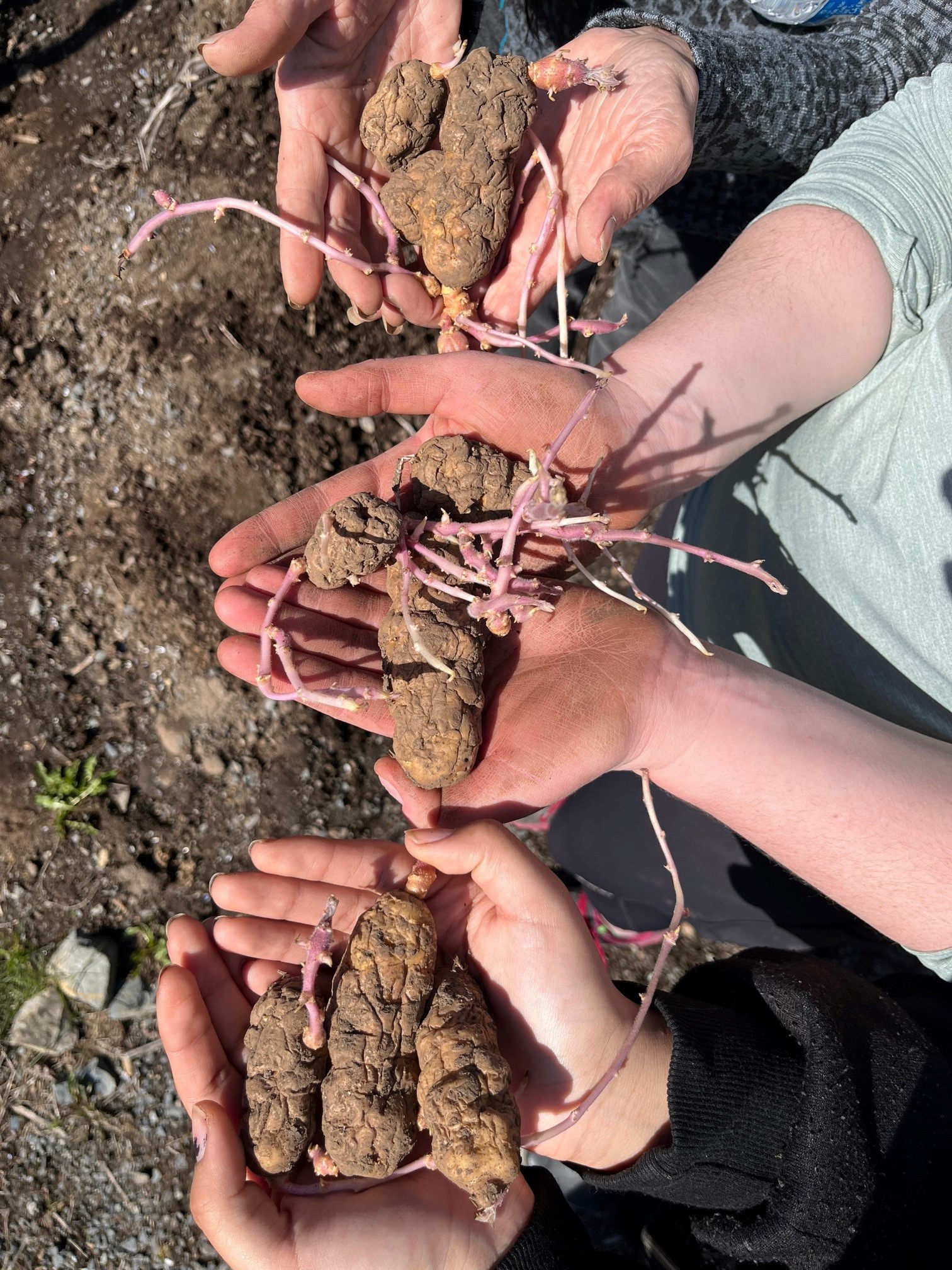
SITKA, Alaska, April 26, 2023 — The Sitka Tribe of Alaska (STA), Pacific High School, and Tongass National Forest joined forces last week for the sixth consecutive year to plant Tlingít (also called Maria’s) potatoes. Several STA staff and elders led the 10 school volunteers and 11 Forest Service staff in the planting process, then shared the potato’s history and some stories.
“It was a beautiful, sunny day, and the perfect opportunity to learn the biology, history, and cultural aspects of these interesting root vegetables,” said Eric Garner, Sitka District Ranger.
Tlingít potatoes have been present in Tlingít gardens for more than 200 years. The potatoes originate from Peru, Mexico or Chile, and were a trade item in Southeast Alaska in the early 1800s.
“When you handle these potatoes, you are touching a part of history,” said Tammy Young, a cultural resources coordinator with the STA.
The group plans to harvest the potatoes in October. Since 2017, the Sitka Ranger District has provided a sunny plot of land to serve as the shared potato garden and provided the seed potatoes to plant the garden. Last year, over 700 pounds of Tlingít potatoes were harvested between this garden and the STA plot to feed tribal families. The Tlingít potato continues to be a sustainable food resource, generations later.
For more information on the Tlingít potatoes, contact Tammy Young at 907-738-7689 or tammy.young@sitkatribe-nsn.gov. Those interested in learning more about these interesting potatoes can view the Forest Service video, Tlingít Potato Garden: Culture, Horticulture, Stories, History at https://vimeo.com/416075040.
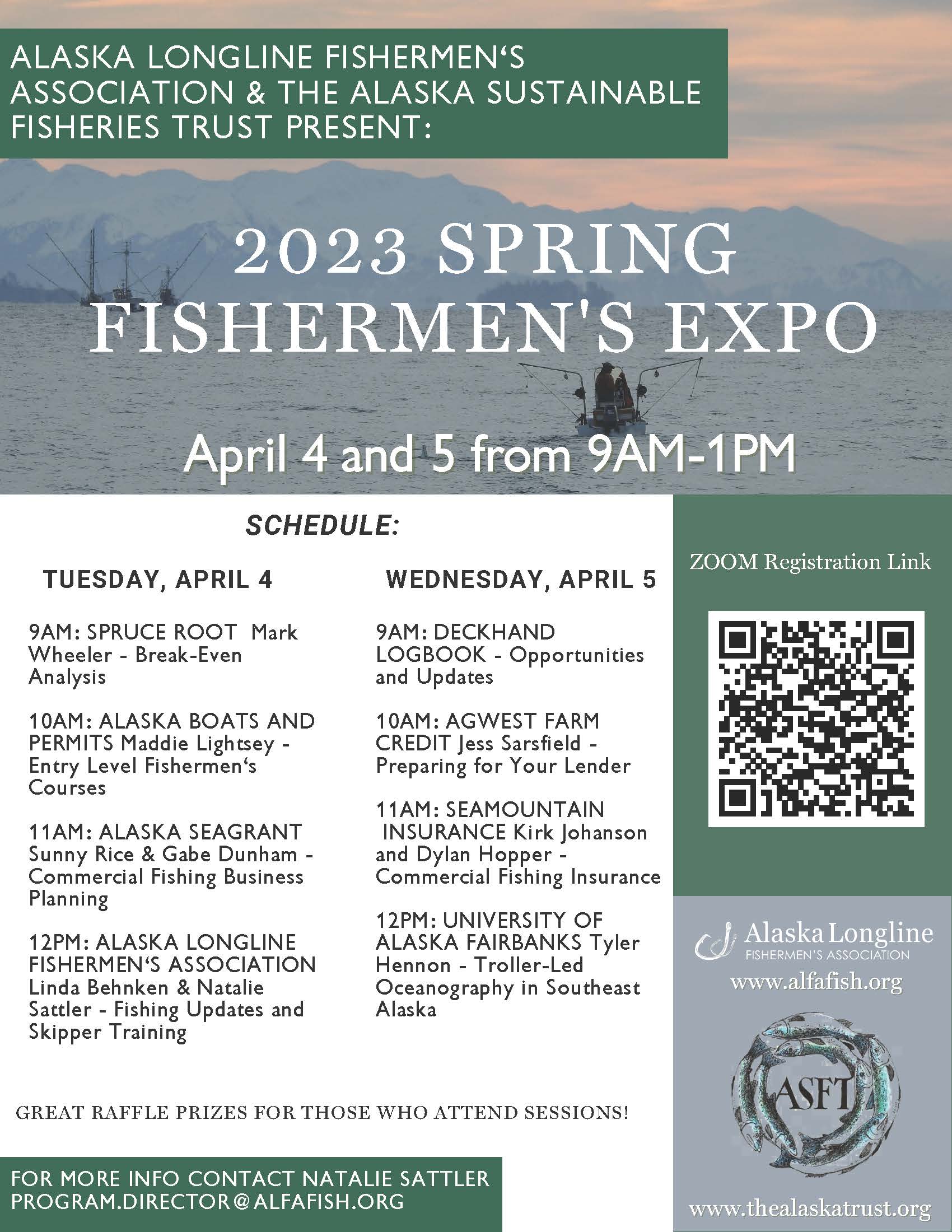
The EXPO will provide educational workshops and training to new and experienced local fishermen as well as others with interest in the fishing sector. During this EXPO all the workshops and presentations will be offered in a virtual format.
Commercial and subsistence fishermen of all gear types will have the opportunity to attend free and interactive classes on fishermen training courses, commercial fishing insurance, management updates on halibut bycatch and and pending salmon bycatch actions, business planning for fishermen, break-even analysis, preparing for your lender, deckhand logbook updates, troller-led oceanography in Southeast Alaska, ALFA’s crew training program and more.
Presenters include Maddie Lightsey with Alaska Boats and Permits, Jess Sarsfield with AgWest Farm Credit, Marc Wheeler with Spruce Root, Sunny Rice and Gabe Dunham with Alaska SeaGrant, Linda Behnken and Natalie Sattler with ALFA, Kirk Johanson and Dylan Hopper with SeaMountain Insurance and Tyler Hennon with the University of Alaska Fairbanks.
Attendees are welcome to participate in as many sessions as they are able. Raffle prizes are available for those that attend sessions.
Please reach out to Natalie Sattler at program.director@alfafish.org or 907-738-1286 with any questions. Visit alfafish.org for a full schedule of events and to register. All presentations will provide time for questions and discussion.
This series is part of a push by ALFA and ASFT to provide resources and educational opportunities for fishermen, especially those who are just starting out in the industry. “Thanks to the support of our sponsors and ALFA’s membership, we are able to offer these workshops free and open to the public,” ALFA executive director Linda Behnken said.
ALFA is an alliance of small-boat, commercial fishermen that support sustainable fisheries and thriving coastal communities by involving fishermen in research, advocacy, and conservation initiatives.
ASFT is a nonprofit dedicated to strengthening fishing communities and marine resources through research, education, and economic opportunity.
(EDITOR’S NOTE: The following article first appeared on this site in April 2010. It is repeated with some updates because much of the information remains current and newsworthy.)
In the cold winter of 1994, Anchorage Daily News garden columnist and former Garden Writers Association of America President Jeff Lowenfels was returning to his hotel after a Washington, D.C., event when he was approached by a homeless person who asked for some money to buy food. Lowenfels said Washington, D.C., had signs saying, “Don’t give money to panhandlers,” so he shook his head and kept on walking. But the man’s reply, “I really am homeless and I really am hungry. You can come with me and watch me eat,” stayed with Lowenfels for the rest of his trip.
Jeff Lowenfels
The encounter continued to bother Lowenfels, even as he was flying back to Anchorage. During the flight, Lowenfels came up with an idea when he started writing his weekly garden column (the longest continuously running garden column in the country, with no missed weeks since it started on Nov. 13, 1976). He asked his readers to plant one extra row in their gardens to grow food to donate to Bean’s Café, an Anchorage soup kitchen. The idea took off.
When Anchorage hosted the Garden Writers Association of America convention in 1995, Lowenfels took the GWAA members to Bean’s Café to learn about the Plant A Row For Bean’s Café program. The Garden Writers Association of America liked the idea, and it became the national Plant A Row For The Hungry campaign (also known as Plant A Row or PAR). In 2002, the Garden Writers Association Foundation (now Garden Communicators International) was created as a national 501(c)(3) nonprofit to manage the Plant A Row For The Hungry program.
“I am not surprised by the growth of PAR,” Lowenfels wrote in a 2010 e-mail to the Sitka Local Foods Network. “It is now in all 50 states and across Canada and there are thousands of variations of the original program — from prison gardens for the hungry to botanical gardens donating their produce from public display gardens. This is because gardeners always share information and extra food, so the idea was a natural.”
It took five years for the program to reach its first million pounds of donated food, but the second million only took two years and the next eight years saw a million pounds of donated food (or more) each year. Since 1995, more than 20 million pounds of food (about 80 million meals, as of 2020) have been donated by American gardeners. Not only that, the program is getting ready to expand overseas to Australia, England and other countries with avid gardeners.
“We have supplied something in the vicinity of enough food for 50 million meals,” Lowenfels wrote in his e-mail. “Gardeners can solve this hunger problem without the government. And we don’t need a tea party to do it! Or chemicals, I might add, as author of a book on organic gardening!” Lowenfels is the author of Teaming With Microbes, written with Wayne Lewis. He released a second book, Teaming With Nutrients, as a follow-up to his first book, and in 2017 released a third book, Teaming With Fungi, as a second follow-up book.
According to the U.S. Department of Agriculture, in 2019 one out of every nine U.S. households experiences hunger or the risk of hunger. Many people skip meals or eat too little, sometimes going an entire day or more without food. About 35.2 million Americans, including 13 million children, have substandard diets or must resort to seeking emergency food because they can’t always afford to buy the food they need. In recent years, the demand for hunger assistance has increased 70 percent, and research shows that hundreds of children and adults are turned away from food banks each year because of lack of resources. The demand has grown with the Covid-19 pandemic
According to the 2014 Sitka Community Food Assessment Indicators Report, about one in six people in Sitka is food insecure. In 2013, there were 1,410 Sitkans (out of a population of about 9,000) and 766 families receiving food assistance (SNAP, aka food stamps). There also were 229 individuals who received food pantry assistance from the Salvation Army and 7,243 meals served through its lunch soup kitchen in 2013, and that number has grown substantially since then.
While many people credit Lowenfels for creating the Plant A Row For The Hungry program, Lowenfels says the real heroes are the gardeners growing the extra food and donating it to local soup kitchens, senior programs, schools, homeless shelters and neighbors. You can hear him pass along the credit to all gardeners at the end of this 2009 interview with an Oklahoma television station (video also embedded below).
“One row. That’s all it takes. No rules other than the food goes to the hungry. You pick the drop-off spot or just give it to a needy friend or neighbor. Nothing slips between the lip and the cup, I say,” Lowenfels wrote in his e-mail.
With all of the jobs lost because of the COVID-19 coronavirus quarantines in 2020-22, this year there will be even more people who need food assistance. It will be more important than ever to help get extra produce into our local food banks and soup kitchens.
For people wanting to Plant A Row For The Hungry in Sitka, there are several places that would love to help distribute some fresh locally grown veggies or berries to those who are less fortunate, such as the Salvation Army, Sitkans Against Family Violence (SAFV), local churches, Sitka Tribe of Alaska and other organizations. The food the Sitka Local Foods Network grows at St. Peter’s Fellowship Farm communal garden goes to the Sitka Farmers Market, school lunches and other programs.
The Sitka Local Foods Network also takes donations of local produce to sell at the Sitka Farmers Markets, and all proceeds are used to help pay for SLFN projects geared toward helping more people in Sitka grow and harvest local food. For more information, contact the Sitka Local Foods Network board members at sitkalocalfoodsnetwork@gmail.com.
The Sitka Local Foods Network just sent out the April 2023 edition of its monthly newsletter. Feel free to click this link to get a copy.
This month’s newsletter includes short stories about an effort to build two new community gardens in Sitka, our search for a 2023 Sitka Farmers Market manager, the upcoming deadline of the 2023 Pick.Click.Give. donation period, an update about how you can support the Sitka Local Foods Network by buying a t-shirt or hoodie from our online store, information about our 2023 sponsorship programs, and an invitation to join our board of directors. Each story has links to our website for more information.
You can sign up for future editions of our newsletter by clicking on the newsletter image in the right column of our website and filling in the information. If you received a copy but didn’t want one, there is a link at the bottom of the newsletter so you can unsubscribe. Our intention is to get the word out about upcoming events and not to spam people. We will protect your privacy by not sharing our email list with others. Don’t forget to like us on Facebook, like our Sitka Farmers Market page on Facebook and follow us on Twitter (@SitkaLocalFoods).
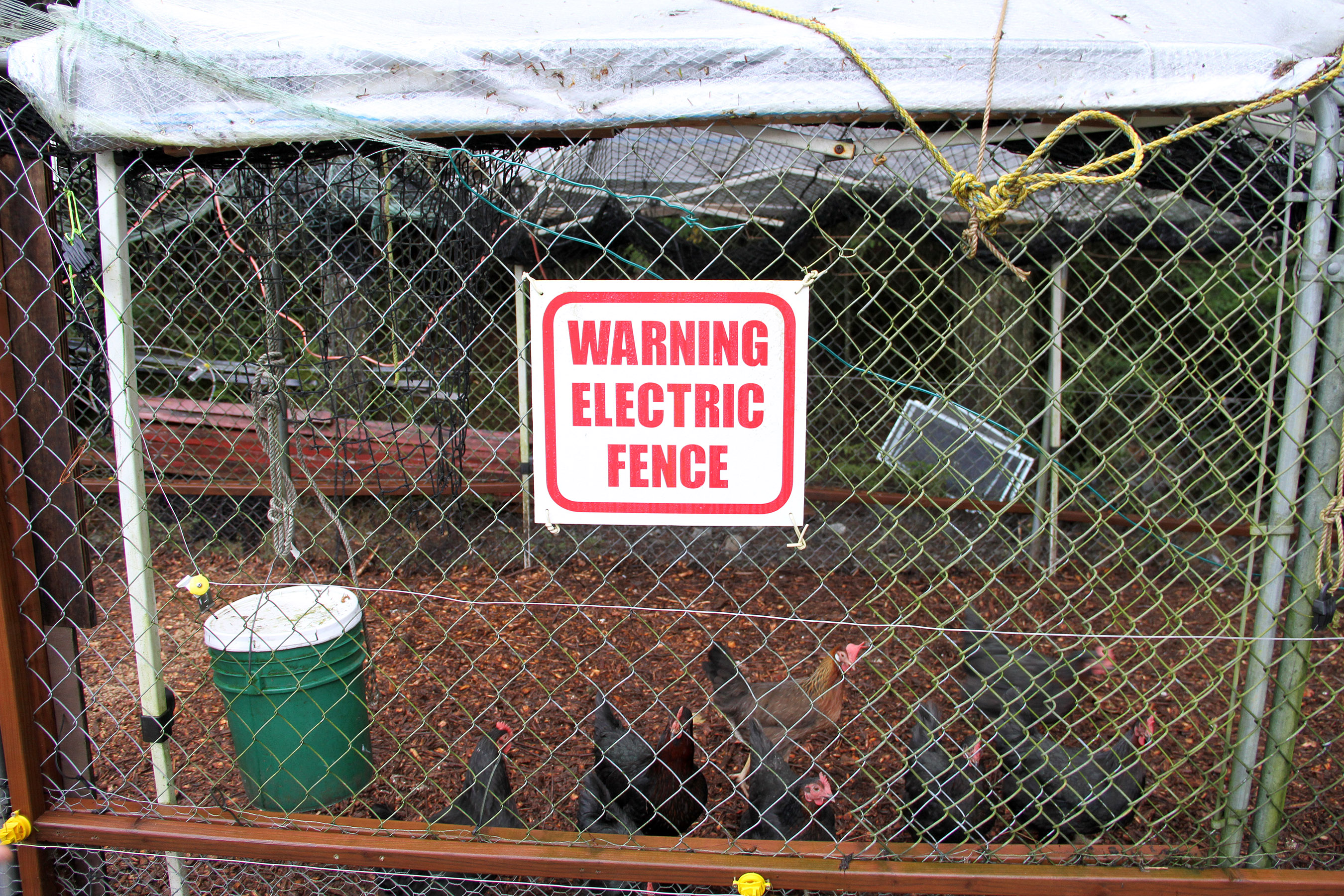
Most people who garden in Southeast Alaska, or raise chickens, have run into problems with bears, or deer, or even the little critters such as mink or ermine, getting into the garden or coop.
One remedy is an electric fence, and the nonprofit Defenders of Wildlife has a program for people in Southeast Alaska and on the Kenai Peninsula that reimburses residents and property owners for 50 percent of the total electric fence installation cost (up to $500).
“Electric fencing is a safe and effective way to prevent conflict with bears over common attractants like gardens, fruit trees, beehives, chicken coops, compost piles, etc.,” program manager Isabel Grant said. The program is designed to help promote the coexistence of people and natural wildlife in communities.
Brad Smith will host an apple-tree grafting workshop from 1-3 p.m. on Sunday, March 19, in the smokestack building on the Sitka Fine Arts Camp campus.
The class requires an RSVP, and is by donation. Half of any proceeds go to Sitka Fine Arts Camp. It’s an introductory class. If there is enough interest, Brad will host another class later in the week.
Participants will learn about rootstock, scion, how to practice at grafting, and if you have a good place for it, you can take home a baby apple tree.
Also I will have scion wood available the rest of that week for free to take. There will be a few different varieties of apple and pear. I want to encourage you to graft apple varieties onto local crabapples, and try putting pear wood onto mountain ash. If you are interested in any of this, email Brad Smith at scion@fastmail.com.
The class is brought to you by the Agrarian Sharing Network, an Oregon-based group focused on hosting events to distribute high-quality and rare fruit-tree genetics and seeds freely to the public.


 This summer the
  Please read the market vendor rules and responsibilities document linked below. All vendors using this site to register for the market will be held to these rules. We ask all vendors to register by the Thursday morning before the markets where they intend to sell. Unless you specify you want to be outside, we will try to find room for you indoors. We are back to selling half-tables this year after not having them because we needed to have social-distancing to prevent the spread of COVID-19.


 According to the


 Sitka Local Foods Network
You must be logged in to post a comment.