Sitka Farmers Market to host meeting June 22 for prospective and past vendors

The Sitka Local Foods Network will host a meeting for prospective and past vendors of the Sitka Farmers Market from 6:30-8 p.m. on Thursday, June 22, at the Sitka Unitarian Universalist Fellowship Hall (408 Marine Street, parking off Spruce Street). There are a few changes to the vendor rules and table rates this year, so this is a good time to learn about them.

This is the ninth year of operation for the Sitka Farmers Market, which features seven markets from 10 a.m. to 1 p.m. on Saturdays, July 1, July 15, July 29, Aug. 12, Aug. 19, Sept. 2, and Sept. 9, at the Alaska Native Brotherhood Founders Hall (235 Katlian Street). The Sitka Farmers Market was a community health initiative from the 2008 Sitka Health Summit.

The farmers markets feature booths from local farmers and gardeners, local fishermen, local bakers, and local artisans and craftspeople. Our emphasis is on local products from Sitka and Southeast Alaska. The farmers markets also are great Sitka gathering places.

A detailed description of the farmers markets and vendor forms can be found our website, http://www.sitkalocalfoodsnetwork.org/ (scroll down or look in the right-hand column). If you have any questions, please email Sitka Farmers Market Manager Nina Vizcarrondo at sitkafarmersmarket@gmail.com or call her at (907) 738-9301 (new number).

• 2017 Vendor Rules and Responsibilities (with Registration Form, updated July 3, 2017)

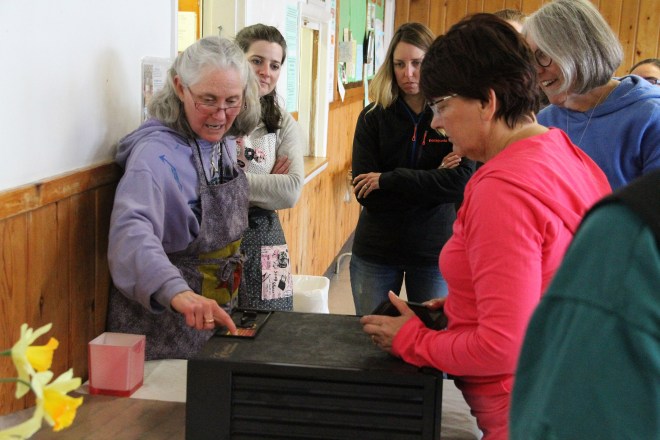
Scenes from the Sitka Kitch’s Preserving the Harvest series class on food dehydration

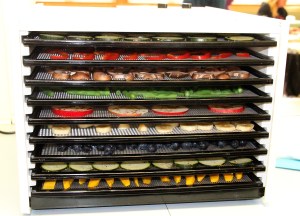
Students learned how to make fruit leathers and how to dehydrate a variety of fruits and vegetables in the Just Dry It: Intro to Food Dehydration class on Monday, June 12, at the Sitka Kitch community rental commercial kitchen. This was the first of six scheduled classes in the Preserving the Harvest food preservation class series offered this summer.

The class was taught by Lisa Sadleir-Hart, a Sitka dietitian and health educator who has taught several cooking and food preservation classes for the Sitka Kitch. In this class, students learned how to dehydrate four types of fruit (bananas, blueberries, mangoes, and apples), dehydrate four types of vegetables (zucchini, peppers, green beans, and mushrooms), and make four types of fruit leather (blueberry, rosehip, strawberry-rhubarb, and rosehip-blueberry).

This was the first class in the Preserving the Harvest food preservation class series, which is sponsored by the SouthEast Alaska Regional Health Consortium (SEARHC). The other classes in the series are (underlined titles take you to the class registration page):

The Sitka Kitch programming team is working on other classes to be offered later this summer and next fall. We also might reschedule the Clear the Freezer, Fill the Pantry community canning session for later this summer, but on a Saturday instead of during the week. Watch the Sitka Kitch page on Facebook or our online registration page to see when these and any future classes are scheduled.

When registering, students should prepay for the class through the Sitka Kitch online registration site, http://sitkakitch.eventsmart.com, using PayPal or credit/debit card. If you need other payment arrangements, contact Chandler or Clarice of Sitka Conservation Society at 747-7509 to arrange a time when you can pay with cash or check. To qualify for a partial refund, please notify us at least three days in advance if you need to cancel. The registration deadline is three days before each class so our instructors have time to purchase materials. Please email sitkakitch@sitkawild.org with any questions.

A slideshow of scenes from the food dehydration class follows below.

• UAF Cooperative Extension Service handout, “Drying Fruits and Vegetables”

• UAF Cooperative Extension Service handout, “Fruit Leather”

This slideshow requires JavaScript.

Sitka Public Library to host local foods snack tasting and recipe pouch making for kids

The Sitka Conservation Society will host a local foods tasting and recipe pouch making event for kids ages 7-10 from 2-3:30 p.m. on Wednesday, June 21, at the Sitka Public Library.

This program will help kids learn how to make delicious, kid-friendly snacks from foods foraged from the Tongass National Forest. There also will be materials to make local foods recipe pouches and recipes to take home. This is a drop-in activity.

For more information, contact Maite Lorente at 747-8708 or Julia Tawney at 747-7509.

SEARHC to host men’s healthy cooking demonstration June 13 at the Sitka Kitch

June is National Men’s Health Month, and June 12-18 is National Men’s Health Week, so the SouthEast Alaska Regional Health Consortium (SEARHC) Health Promotion Program will host a quick and heart-healthy food demonstration for men. The free cooking demonstration takes place from 6-7:30 p.m. on Tuesday, June 13, at the Sitka Kitch community rental commercial kitchen, located inside the First Presbyterian Church (505 Sawmill Creek Road).

“It’s just a quick and healthy food demonstration, a one-pan meal that is lower fat, and baked, and some quick healthy snacks to make,” SEARHC Health Educator Heleena Van Veen said. “The menu is nothing fancy, but good eating, it is affordable and usually things we already have in our cupboards, and it tastes good!”

For more information, contact Heleena at 966-8614 or heleenav@searhc.org.

Paralytic shellfish toxin warning issued for Sitka’s North Starrigavan Beach and other Southeast beaches

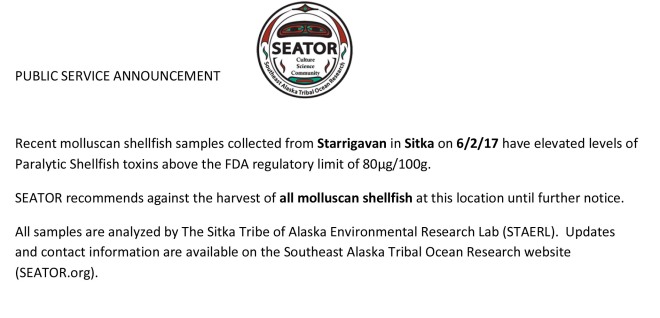
The SouthEast Alaska Tribal Ocean Research (SEATOR) project, SouthEast Alaska Tribal Toxins (SEATT) partnership and the Sitka Tribe of Alaska Environmental Research Lab (STAERL) on Monday, June 5, issued an advisory warning that people should not eat molluscan shellfish (bivalves such as clams, oysters, scallops, mussels, geoducks, cockles, etc.) harvested at North Starrigavan Beach North in Sitka.

This is one of several recent advisory warnings issued by SEATOR about elevated levels of the paralytic shellfish poisoning (PSP) toxins above the FDA regulatory limit of 80µg/100g. Recent warnings have been issued for all species of molluscan shellfish at three beaches in Ketchikan (with extremely high levels that could be deadly), Metlakatla, Craig, Kodiak and Hoonah. There also are species-specific warnings issued in Klawock and Skagway.

Harmful algal blooms, such as paralytic shellfish poisoning (PSP), typically have not been monitored in Southeast Alaska for subsistence and recreational harvesters of clams, mussels, oysters, cockles, and other bivalves (commercial harvests are tested). Even though many people in Southeast Alaska love to harvest shellfish, eating it comes with some risks. There have been several PSP outbreaks in recent years that sent people to the hospital, and in 2010 two deaths were attributed to PSP and other HABs, such as Alexandrium, Pseudo-nitzchia and Dinophysis.
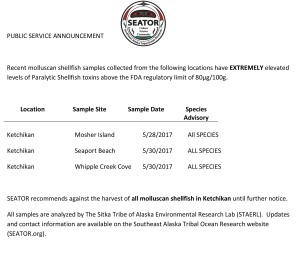
The PSP advisories are for bivalve shellfish that have been recreationally or subsistence harvested. It does not apply to commercially harvested shellfish, which are tested before they enter the market. The advisory does not apply to other shellfish, such as crabs or shrimp, which do not carry PSP (unless you eat the crab butter or viscera).

The warnings, according to SEATOR, “This does not ‘certify’ any of our monitored sites. Conditions may change rapidly and data is site-specific. Caution should always be taken prior to harvesting.”

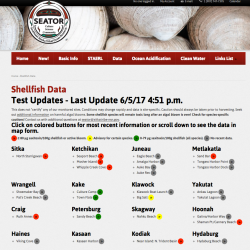
SEATOR posts updates and information to its website at seator.org/data, which can help provide Southeast Alaska residents with reliable information so they can choose whether or not to harvest shellfish. In addition to testing water samples weekly from certain Southeast beaches, STAERL also tests samples of butter clams, littleneck clams, and blue mussels (which is STAERL’s indicator species, because of how quickly blue mussels absorb saxotoxins).

In addition to the saxitoxins that cause PSP, the lab in Sitka has been monitoring for other blooms that cause amnesic shellfish poisoning (ASP). PSP and ASP can cause severe health problems, including death in some cases.

Since most beaches in Alaska aren’t tested for harmful algal blooms, SEATOR and the SEATT partnership were formed in October 2014 to train people to test beaches in Southeast Alaska. In April 2015, the Sitka Tribe of Alaska opened a regional lab on Katlian Street, so samples could be tested in Sitka without having to be sent to the Lower 48, which delayed results. By testing for harmful algal blooms, SEATOR and the SEATT partnership hope to be able to provide information so people can make informed choices whether or not to harvest or eat shellfish.

To learn more about harmful algal blooms and how they can raise the risk for PSP and ASP (amnesic shellfish poisoning, which also can be fatal), go to SEATOR’s resources page. If you have shellfish you recently harvested and want to test it, click this link to learn what you need to do to have it tested by STAERL or watch this video. SEATOR also has a new Facebook page, where people can find updates. Please contact STAERL at 747-7395 with any additional questions.

Check out the June 2017 edition of the Sitka Local Foods Network newsletter

The Sitka Local Foods Network just sent out the June 2017 edition of its monthly newsletter. Feel free to click this link to get a copy.

This month’s newsletter includes brief items about the Sitka Farmers Market seeking vendors and volunteers for 2017, information about the Sitka Kitch’s Preserving the Harvest class series, and details about a new study on the economic impacts of locally grown produce in Southeast Alaska. Each story has links to our website for more information.

You can sign up for future editions of our newsletter by clicking on the newsletter image in the right column of our website and filling in the information. If you received a copy but didn’t want one, there is a link at the bottom of the newsletter so you can unsubscribe. Our intention is to get the word out about upcoming events and not to spam people. We will protect your privacy by not sharing our email list with others. Don’t forget to like us on Facebook and follow us on Twitter.

Alaskans invited to join the new $5 Alaska Grown, Five Month Challenge

Starting Wednesday, June 1, the Alaska Division of Agriculture is launching a brand-new $5 Alaska Grown, Five Month Challenge to support the growth of Alaska’s agriculture industry.

From June through October, Alaskans are encouraged to spend $5 per week on Alaska Grown products at their local grocery stores and/or farmers markets. If every Alaskan participates in the challenge, tens of millions of dollars in local purchases could be circulated within local economies rather than sent outside of Alaska. According to the Alaska Farm Bureau, if every Alaskan spent $5 per week on Alaska Grown products, year-round, it would have a $188 million dollar impact.

For the $5 Alaska Grown Challenge, the Division of Agriculture is partnering with dozens of retailers across the state including Carrs-Safeway, Fred Meyer, Wal-mart and SaveUMore. These retailers will be creating specialty Alaska Grown displays in their stores that prominently place and showcase the Alaska Grown products they carry, making it easy for customers to find Alaska Grown products on which to spend $5 per week.

The challenge will run for the five-month period when Alaska Grown products are most available. Each month, new produce and flowers will be introduced into stores as they become seasonally available. Customers can also spend their $5 per week on year-round Alaska Grown products including meat (including fish), fresh eggs and packaged products at their local retailers.

In Sitka, Alaskans can participate by purchasing Alaska Grown produce at the Sitka Farmers Markets. There will be seven Sitka Farmers Markets this summer, from 10 a.m. to 1 p.m. on Saturdays, July 1, July 15, July 29, Aug. 12, Aug. 19, Sept. 2, and Sept. 9, at the Alaska Native Brotherhood Founders Hall (235 Katlian St.). In addition, there are several growers in town, and you can find out more about them in the Alaska Grown Source Book.

“Why buy Alaska grown?” the Alaska Farm Bureau website asks. “Not only are you supporting Alaskans and boosting our economy, you’re also getting a fresher, tastier, more nutritious product. In a blind taste test, 82 percent of Alaskans surveyed could taste the difference between products grown here and those shipped up. Adults and kids say Alaska grown is sweeter, fresher-tasting and crispier.”

• Taste of Alaska White Paper (taste tests of Alaska vs. Lower 48 produce from 2011 Alaska State Fair in Palmer)

Janice Chumley to give presentation on integrated pest management June 5 at the library

Janice Chumley, who is the integrated pest management tech for the University of Alaska Fairbanks Cooperative Extension Service, will be in Sitka on Monday and Tuesday, June 5-6, for one-on-one consultations with local gardeners/farmers. She also will give a presentation about integrated pest management in greenhouses and high tunnels from 6-7 p.m. on Monday, June 5, at the Sitka Public Library (note, this is a location change from what was announced in April).

“I have been employed as a pest scout for that past 19 years and enjoy working with growers of crops large and small across Alaska,” said Chumley, who is based out of the UAF Cooperative Extension Service’s Kenai Peninsula District Office. “My work has been varied from home gardeners (like me) to commercial potato, hay, mixed vegetable producers, to peony producers. I have had to privilege to learn and work with many folks across the state and now I have funding to be able to come to Southeast.”

Chumley originally was scheduled to come to Sitka in May, but had to change her travel schedule due to illness.

“I hope that your schedule will allow time for us to visit and discuss any established pests you encounter along with a few new ones that might be heading north,” Chumley said. “Since IPM (integrated pest management) focuses on the least toxic approach, that is where we start, but all concepts are discussed and it is up to you to make an informed choice for your growing conditions. If you would like a site visit please let me know how to find you and if you have any specific concerns.”

For more information, contact Chumley at 1-907-262-5824 or jichumley@alaska.edu, or contact Jasmine Shaw at the Sitka District Office of the UAF Cooperative Extension Service at 747-9440 or jdshaw2@alaska.edu.

Date changed to May 26 for spring garden class about raising trees

There is one spring garden class left on this year’s schedule, but the date has been changed. The “Everything You Need To Know About Trees” class taught by Jud Kirkness now will take place from 6:30-8 p.m. on Friday, May 26, at the Sitka Unitarian Universalist Fellowship Hall (408 Marine Street, parking off Spruce Street).

The class is free, but donations to the Sitka Local Foods Network will be accepted.

For more information about the class, contact Jennifer Carter at 747-0520. Other classes may be added at a later date if we find volunteers to teach them.

Sustainable Southeast Partnership and Spruce Root Inc. release report on the economic impacts of local produce in Southeast Alaska

The Sustainable Southeast Partnership and Spruce Root Inc. have officially released a report, “Current and Potential Economic Impacts of Locally Grown Produce in Southeast Alaska.” The report, which was first presented at the Southeast Alaska Farmers Summit held in February in Haines, was written by the McDowell Group.

“This study is the first to measure the amount of produce grown in Southeast Alaska,” said Dan Lesh, a research analyst with the McDowell Group. “Even though I’m an avid gardener and lifelong Southeast Alaskan, I was surprised at the high level of gardening we found through the survey. It was also interesting to see what crops people are growing and which are the most productive.”

The 47-page study surveyed residents of several Southeast Alaska communities to try and find out how much food they grew locally, and how much was imported. For example, even though 38 percent of Southeast Alaskans garden, only 4.4 percent of the vegetables eaten in the region were produced locally (and 95.6 percent were imported from the Lower 48 or overseas).

Southeast Alaskans spent $19 million on imported veggies in 2016, and many of those veggies can be grown here in the region. While commercial growers in Southeast Alaska only sold about $180,000 in locally grown produce, gardeners and commercial growers spent about $1.8 million to support growing food in the region. Money spent on locally grown produce tends to circulate within the region instead of going elsewhere.

“There is tremendous opportunity to expand commercial and home-scale food production in Southeast Alaska,” said Lia Heifetz, food security regional catalyst for the Sustainable Southeast Partnership. “This contributes to community and regional food security. There is also significant opportunity to create economic activity through support services — like the local production of seeds and soil, or local sources of agriculture infrastructure and tools — as well as adding value to raw agricultural products. In addition to supporting services, either growing your own food or supporting our region’s food producers through farmers markets, or online farmers markets, like the Salt & Soil Marketplace, is a great way to contribute to localizing our food system.”

The report includes a breakdown of what veggies commercial growers in the region are growing, and what they’re selling for. It also includes a breakdown of what households are growing and consuming. There are charts showing food purchases over the years, and vegetable consumption.

There also is information on trends within the region when it comes to growing veggies, and how that impacts the economy. It details some of the challenges for the region, and what’s being done to meet those challenges. In addition, the report touches on the food security of the region.

“The commercial agriculture industry in Southeast Alaska is clearly at a small scale right now, but there is room for growth and a variety of creative opportunities exist to expand the economic impacts of the industry,” Lesh said. “A lot of new businesses have been created in recent years, with support from Path to Prosperity business competition and other sources. Looking forward to seeing where those businesses go.”

• Current and Potential Economic Impacts of Locally Grown Produce in Southeast Alaska (PDF file)