Alaska Food Policy Council announces 2022 Alaska Food Hero winners

Top two photos: Cyrus Harris, left, Joanna Barton, center, and Chris Dankmeyer with first batch of approved seal oil made by the Maniilaq Association Traditional Foods Team in Kotzebue. Third photo: Milo and Bryce Wrigley in one of their barley fields in Delta Junction.

HOMER, Alaska (March 19, 2022) — The Alaska Food Policy Council announced three winners of its Alaska Food Hero Award on Saturday morning during a ceremony at the 2022 Alaska Food Festival and Conference.

This year’s winners are Cyrus Harris and the Maniilaq Association Traditional Foods Team (Kotzebue), the Wrigley family — Bryce, Jan, Milo, and Leah — of Alaska Flour Company (Delta Junction), and the Aleutian and Pribilof Islands Association (APIA) Traditional Foods and Wellness Programs. They were among a number of people or organizations nominated for the award by community members around the state. The three winners receive a glass plaque and a homemade quilt featuring the Alaska Food Policy Council logo made by AFPC governing board member Mel Sikes of Fairbanks.

Hosted by the Alaska Food Policy Council (AFPC), this sixth semi-annual Alaska Food Festival and Conference event previously took place in Anchorage in 2014 and 2016, in Fairbanks in 2017 and Homer in 2019. In 2020 and again in 2022, the conference was scheduled for Anchorage before going virtual due to the pandemic. In addition to the Alaska Food Policy Council, the 2022 event was co-sponsored by the Intertribal Agriculture Council and the University of Alaska Anchorage (UAA) Dietetics and Nutrition Program.

The Alaska Food Hero Award(s) are presented at the Alaska Food Festival and Conference, which takes place every 18 months Awardees demonstrate a substantial impact on Alaska’s food system, transform an aspect of their community’s food system, and make a difference for Alaska’s prosperity, health and self-reliance.

Past winners of the award are:

  • 2020 — Native Village of Savoonga Reindeer Crew (Richmond Toolie, chief herder, and crew members Freeman Kingeekuk, Michael Kralik, Nick Toolie, Sidney Kulowiyi, Scott Toolie, Kacy Pungowiyi, Christopher Miklahook, Ronald Kingeekuk, Derek Toolie, Derek Akeya, Justina Noongwook, and Orville Toolie); Chef Amy Foote of the Alaska Native Medical Center Traditional Foods Donation Center in Anchorage; and Marsh Skeele of Sitka Salmon Shares
  • 2019Tim and Lisa Meyers of Meyers Farm in Bethel, Lia Heifetz of Barnacle Foods in Juneau, and Heidi Chay of the Kenai Soil and Water Conservation District
  • 2018Robbi Mixon of the Homer Farmers Market, Alaska Food Hub, Alaska Farmers Market Association, and the Alaska Food Policy Council
  • 2016Kyra Wagner of the Sustainable Homer; Tyonek Tribal Conservation District, Outstanding Service Award goes to Diane Peck of the Obesity Prevention Program from the Alaska Division of Public Health.
  • 2014 — No award.

Short biographies of the winners follow below:

Cyrus Harris and the Maniilaq Association Traditional Foods Team (Kotzebue)

Cyrus Harris and the Maniilaq Association Traditional Foods Team have worked together to provide niqipiaq (Iñupiaq food) to elders at the Utuqqanaat Inaat long-term care facility in Kotzebue since 2015, through a state-permitted traditional food processing and cold storage facility known as the Siġḷuaq. In 2021, the team made years of hard work from countless helping hands a reality by achieving State of Alaska approval for serving seal oil.

They used experimentation and a pasteurization process to reduce the risk of botulism, a rare but deadly foodborne illness linked with traditionally made seal oil. Now, the elders at the Utuqqanaat Inaat are able to enjoy on-demand the seal oil they grew up eating daily. The team hopes to expand the list of safe and nutritious niqipiaq foods offered to the elders and share lessons learned with other tribal groups across the continent interested in serving traditional foods in long-term care settings.

The Wrigley family — Bryce, Jan, Milo, and Leah (Delta Junction)

Settling in Delta Junction, Alaska back in 1983, the Wrigleys imagined building a farm that would increase Alaska’s food security, create markets for fellow farmers, provide healthy, locally grown food options, and offer their children the opportunity to continue the operation into the future. The Wrigleys knew Alaska’s unique conditions — a short growing season and long, dark winters — would require innovative farming techniques and never-say-quit determination.

They use sustainable farming practices on their 1,700-acre farm, on which Bryce and Jan raised five children. In 2011, their hard work, perseverance, and passion for nutritious, locally grown products paid off when they founded the Alaska Flour Company, the only commercial flour mill in Alaska. (The next nearest mill is more than 1,500 miles away.)

Aleutian and Pribilof Islands Association (APIA) Traditional Foods and Wellness Programs
The Traditional Foods and Wellness Programs at APIA work in tandem to carry out food-related initiatives and are dedicated to supporting the health and wellness of the Unangax̂ people. Current projects are focused on working with elders and community leaders to preserve traditional food knowledge and address food access and food security throughout the region.

One exceptional team member working with these programs is Sally Swetzof, from Atka. Sally grew up living a subsistence lifestyle and has been able to pass this cultural knowledge down, not only to her children and grandchildren, but also to her greater Unangax̂ community. She is a respected elder and mentor on a variety of traditional practices, including traditional Unangax̂ food harvesting, preparation, and preservation. She is also a fluent speaker in the traditional Atkan dialect of the Unangam Tunuu language and has been a leader in revitalizing the language.

Sally has been a tremendous resource and an essential team member in many projects at APIA, including most recently being involved in the Qaqamiigux: Traditional Foods Film Series. Sally is a central figure in many of the films, including the topics of: chocolate lily, reindeer, eider duck, and bidarki. Her involvement in the project has been key to the success of the films in light of her skills as an educator, traditional knowledge bearer, and fluent Unangam Tunuu speaker.

###

The Alaska Food Policy Council (https://www.akfoodpolicycouncil.org/) is a nonprofit organization whose diverse membership works to engage Alaskans to make positive changes for the state’s food system, and to create a healthier, more prosperous and more secure future for all.

The Intertribal Agriculture Council (https://www.indianag.org/) was founded in 1987 to pursue and promote the conservation, development and use of our agricultural resources for the betterment of our people. Land-based agricultural resources are vital to the economic and social welfare of many Native American and Alaskan Tribes. The harmonies of man, soil, water, air, vegetation and wildlife that collectively make-up the American Indian agriculture community, influence our emotional and spiritual well-being. The IAC has, over the last three decades, become recognized as the most respected voice within the Indian community and government circles on agricultural policies and programs in Indian country.

The University of Alaska Anchorage (UAA) Dietetics and Nutrition Program (https://www.uaa.alaska.edu/academics/college-of-health/departments/school-of-allied-health/academics/dietetics-nutrition/) is a statewide education program that meets the growing needs of the dietetics and nutrition industry. This nationally accredited program trains entry-level, registered dietitian nutritionists, and community nutrition and nutrition science professionals throughout Alaska. Using an array of online and campus-based courses, the UAA Dietetics and Nutrition Program offers a minor in Nutrition, a Bachelor of Science in Dietetics, and a Master of Science in Dietetics.

ALFA, ASFT to host 2022 Spring Fishermen’s EXPO virtually on March 30

The Alaska Longline Fishermen’s Association (ALFA) and the Alaska Sustainable Fisheries Trust (ASFT) are hosting a Spring Fishermen’s EXPO on Wednesday, March 30, to provide free educational workshops and training to new and experienced local fishermen. During this EXPO all the workshops and presentations will be offered virtually.

The EXPO event will be offered on an online platform so that all Alaskan fishermen and others that are interested are welcome to attend. Tools and links to attend the workshops will be provided prior to the event. 

Commercial and subsistence fishermen of all gear types will have the opportunity to attend free and interactive classes on bathymetry mapping updates; halibut catch sharing plan and fishery policy updates; large shark electronic monitoring project; skipper training for ALFA’s Crewmember Training Program; hear from representatives on Smart Buoys and PredictWind fishing vessel products; Skipper Science plans for 2022; Dangers, Health, and Near Misses AMSEA Round Table; and more.  Presenters include Daniel Joram from Nobeltec, Leann Fay from AMSEA, Keith Fuller postdoctoral researcher with the FAST lab at Alaska Pacific University, Kortney Opshaug (founder and CEO of Blue Ocean Gear), Lindsey Bloom and Hannah-Marie Garcia from the Skipper Science Partnership, Linda Behnken (executive director of ALFA), and others.

Attendees are welcome to participate in as many sessions as they are able. Raffle prizes are available for those that attend sessions. Thank you to Alaska Boats and Permits Inc. and Hames Corporation for their support in sponsoring this event. 

Please reach out to Natalie Sattler at program.director@alfafish.org or 907-738-1286 with any questions. Visit alfafish.org for a full schedule of events and to register. All presentations will provide time for questions.

This series is part of a push by ALFA and ASFT to provide resources and educational opportunities for fishermen, especially those who are just starting out in the industry. “Thanks to the support of our sponsors and ALFA’s membership, we are able to offer these workshops free and open to the public,” ALFA executive director Linda Behnken said.

ALFA is an alliance of small-boat, commercial fishermen that support sustainable fisheries and thriving coastal communities by involving fishermen in research, advocacy and conservation initiatives. 

ASFT is a non-profit dedicated to strengthening fishing communities and marine resources through research, education and economic opportunity.

UAF Cooperative Extension Service to offer gardening workshops in Sitka

The University of Alaska Fairbanks Cooperative Extension Service will offer a series of in-person gardening workshops in Sitka starting in March.

Two classes have been announced for the end of March, one on tree-pruning and one on seed-starting, and more classes for April will be announced later. The classes cost $10 each, with materials provided. Masks are required for indoor classes. Space is limited, so register early.

The classes scheduled so far are:

  • Tree Pruning WorkshopSaturday, March 19, 8:30-10 a.m.; A workshop on pruning fruit trees, demonstration, instruction and a chance to practice are taught by Jud Kirkness. The location will be emailed to registrants.
  • Seed Starting and Seed SwapSaturday, March 26, 10-11:30 a.m.; Kitty LaBounty and Jasmine Shaw lead a hands-on workshop on seed starting on the UAS Sitka Campus. Students will be able to start seeds to take home. All materials will be provided. Students also can take seeds to swap with others.

For more information and to register, email jdshaw2@alaska.edu or call 907-747-9440.

Produce Safety Alliance Grower training scheduled for April 25-26

The Alaska Department of Environmental Conservation and the University of Alaska Fairbanks Cooperative Extensive Service are planning a Produce Safety Alliance Grower Training in April.

This free training takes place from 9 a.m. to 3:30 p.m. on Monday and Tuesday, April 25-26, using Zoom. Registration closes on Monday, April 11.

This Food and Drug Administration (FDA)-approved course will satisfy the grower training curriculum requirements under the FDA’s Food Safety Modernization Act Produce Safety Rule. There is no charge for class participants. Funding is provided by a FDA-State of Alaska Cooperative Agreement. Growers who attend all seven modules of the course will receive a FREE Certificate of Course Completion. The workshop is open to all interested growers. Please see the attached flyer for more information. Space will be limited, so pre-registration is required. Contact Dena at dena.cologgi@alaska.gov to register.

NOTE: This training will be held remotely using videoconferencing software (e.g. Zoom). Participants must have a computer or mobile device with audio and video capabilities, as well as access to a strong internet connection and adequate bandwidth. Attendees who wish to receive a Certificate of Course Completion will be required to use the web camera to ensure participation.

For more information, or if you require accommodation for a disability, please contact Dena Cologgi at dena.cologgi@alaska.gov or (907) 375-8212.

UAF Cooperative Extension Service offers Certified Food Protection Manager class by videoconference March 30-31 in Sitka

The University of Alaska Fairbanks Cooperative Extension Service will teach a certified food protection manager workshop on Wednesday and Thursday, March 30-31. This is a two-day statewide class that will be offered by videoconferencing to Fairbanks, Palmer, Juneau, and Sitka, plus other locations that may arrange for the class.

A certified food protection manager (CFPM) is responsible for monitoring and managing all food establishment operations to ensure that the facility is operating in compliance with food establishment regulations.

A CFPM is knowledgeable about food safety practices and uses this knowledge to provide consumers with safe food, protect public health and prevent food-borne illnesses. Alaska regulations require food establishments to have at least one CFPM on staff.

This course takes place from 8:30 a.m. to 3 p.m., and participants will take a proctored computer-based exam at the end of the second day of class. The reason the registration deadline is two weeks before the class is to guarantee course materials reach all the students in time. The cost is $200, and the course will be taught by Julie Cascio of Palmer. Students can register here, and the registration deadline is Wednesday, March 16.

The Sitka videoconference for the class will take place in a room TBA at the University of Alaska Southeast Sitka Campus. To learn more, contact Jasmine Shaw at the Sitka District Office of the UAF Cooperative Extension Service at 747-9440, or contact Julie Cascio at (907) 745-3677 (Palmer number) or jmcascio@alaska.edu. Note, this class is taught in English but textbooks are available in Korean, Chinese and Spanish, just contact Julie at least three weeks before the class.

Also, the ServSafe book ($70) and certification exam ($85) now are available online, if people want to order the book and study independently without taking the class. Just go to this website and purchase the book and exam items.

AARP Alaska, UAF Cooperative Extension Service team up to teach five-class garden series online

Join AARP Alaska and the University of Alaska Fairbanks Cooperative Extension Service for a free, five-part virtual series on gardening, from starting seeds to cooking with home-grown herbs (and more). Each event will feature a different speaker and new topic, so you can join one or all.

You can register to receive the meeting link or watch live at the scheduled time on the AARP Facebook page.

Gardening: How to Successfully Start Seeds at Home 

Wednesday, March 30, 11 a.m. to 12 p.m.

Join Glenna Gannon from the Cooperative Extension Service in this workshop and demonstration to learn the basics of starting seeds at home in Alaska. You will learn which start-up supplies are necessary and the simple techniques to successfully start your own seeds. The benefit of starting your own seeds is that you can choose varieties that work well for your specific growing conditions, choose from a much wider selection of varieties that are often not found at your local nursery, and save money on plant starts year after year once you’ve made the initial investment in seed starting supplies. 

Register at https://aarp.cventevents.com/event/bdfeeeba-3fe9-42ef-81a4-dc45c722bccf/regProcessStep1

Gardening: Container Gardening

Wednesday, April 6, 11 a.m.to 12 p.m.  

Join Gina Dionne from the Cooperative Extension Service in this workshop to learn about container gardening, which has become very popular, and for good reason! In this class, you will learn how to make creative use of container gardens to allow you to grow your own food on a sunny deck, windowsill and other non-traditional spaces. 

Register at https://aarp.cventevents.com/event/9628b88c-e896-4b45-b8c6-2b6059414e07/regProcessStep1

Gardening: Growing and Cooking with Herbs 

Wednesday, April 13, 11 a.m. to 12 p.m.

Join Heidi Rader from the Cooperative Extension Service in this workshop to learn what herbs grow well in Alaska. Which ones come back (perennials) and which ones should you plant year after year? Which ones are easy to start from seed and which ones are easiest to grow from transplants or cuttings? Once you’ve started your herb garden, how do you use them in your everyday cooking? Learn about classic flavor combinations. 

Register at https://aarp.cventevents.com/event/7fa5e549-1f28-4646-bab2-0992473d89ec/regProcessStep1

Gardening: Growing Vegetables in Alaska 

Wednesday, April 20, 11 a.m. to 12 p.m.

Join Steve Brown from the Cooperative Extension Service in this workshop to learn how growing bountiful veggies is very easy if you know the tips of the Far North. This presentation will show you the secrets behind planning, planting, season extension, fertilization and pest control. 

Register at https://aarp.cventevents.com/event/6dcf11b6-bcb3-47bd-99d1-c8f2974f862b/regProcessStep1

Gardening: Love to Garden but Aches and Pains Getting in the Way? 

Wednesday, April 27, 11 a.m. to 12 p.m.

Join Art Nash from the Cooperative Extension Service to talk about accessible gardening ideas. Barriers to growing can come from injuries when we are young or normal pains as we grow older. Yet there are adaptations in how we plan out growing areas, modify the growing area or use altered tools. This session will look at various build-outs and alterations that can hopefully help as you age in place — in the garden.

Register at https://aarp.cventevents.com/event/4936d781-3866-4fbd-aed7-1d0e3a891764/regProcessStep1

Check out the March 2022 edition of the Sitka Local Foods Network newsletter

The Sitka Local Foods Network just sent out the March 2022 edition of its monthly newsletter. Feel free to click this link to get a copy.

This month’s newsletter includes short stories about the upcoming Alaska Food Festival and Conference on March 17-19, an update on the launch of the 2022 Sitka Food Business Innovation Contest, an item about the opening of the Alaska Permanent Fund Dividend application period (and Pick.Click.Give. application) on Jan. 1, an update about how you can support the Sitka Local Foods Network by buying a t-shirt or hoodie from our online store, information about our 2022 sponsorship programs, and an invitation to join our board of directors. Each story has links to our website for more information.

You can sign up for future editions of our newsletter by clicking on the newsletter image in the right column of our website and filling in the information. If you received a copy but didn’t want one, there is a link at the bottom of the newsletter so you can unsubscribe. Our intention is to get the word out about upcoming events and not to spam people. We will protect your privacy by not sharing our email list with others. Don’t forget to like us on Facebooklike our Sitka Farmers Market page on Facebook and follow us on Twitter (@SitkaLocalFoods).

Sitka Kitch to offer three classes for National Nutrition Month in March

JessicaFalafelSaladLettuce

March is National Nutrition Month, and the Sitka Kitch is offering three classes to help celebrate the month and healthy eating habits. These classes will be offered virtually using Zoom.

Jessica Holland, a registered dietitian nutritionist and certified diabetes educator specialist from the SouthEast Alaska Regional Health Consortium (SEARHC) in Sitka will teach the first and last of the three classes. Audra Henderson will teach the middle class. She is a functional nutritional therapy practitioner, a certified personal trainer, and a nutrition educator who works with the University of Alaska Fairbanks Cooperative Extension Service in Juneau.

Both teachers have private practices, and you can learn more about Jessica at https://www.realnutritionrd.com/ and more about Audra at https://www.audrawellness.com/.

The three classes and their basic details are as follows:

  • Class No. 1 — Falafel Salad, 5:30-7 p.m., Friday, March 11, taught by Jessica Holland, $40. Learn how to make deep-fried or pan-seared falafel balls with ground chickpeas, herbs, spices, and onions, then add them to a salad. Ingredients provided (pick up from 4-6 p.m. on Thursday, March 10, at the SEARHC Health Promotion table at the regional basketball tournament at Mount Edgecumbe High School). Registration deadline 11:30 p.m. on Tuesday, March 8, class limited to eight students. Eligible for Sitka Food Co-op discount (see details below).
  • Class No. 2 — Celebrate Making A Change, 5-6 p.m., Sunday, March 20, taught by Audra Henderson, Free. Want to make a healthy change? This is your first step! In this class we will focus on eating a nutrient dense, properly prepared diet, safe and fun ways to move our body, and healthy habit formation. Registration deadline 11:30 p.m. on Thursday, March 17, class limited to 20 students. Even though the class is free, please register online so we can send you the Zoom link.
  • Class No. 3 — Alaska Bounty Salad, 5:30-7 p.m. on Friday, March 25, taught by Jessica Holland, $40. Learn how to celebrate your Alaska harvest by making a salad with halibut (or salmon) and veggies you can grow or harvest locally. Ingredients provided (pick up from 4-6 p.m. on Thursday, March 24, at Beak Restaurant). Registration deadline 11:30 p.m. on Tuesday, March 22. Class limited to eight students. Eligible for Sitka Food Co-op discount (see details below).

The class cost is $40 for both of Jessica’s classes (Audra’s class is free). There is limit on the class size, and ingredients for Jessica’s classes will be provided at the location mentioned in the bulleted list. A link to the Zoom event also will be sent at the end of the registration period. Please connect online at least 10 minutes before the class starts.

Current (paid) members of the Sitka Food Co-op are now able to attend Jessica’s online classes for $30 each (the co-op will cover the other $10 of your class fee). Please use the Sitka Food Co-op ticket when you register and send an email to sitkafoodcoop@gmail.com letting them know you’re in the class. (NOTE, Only one person per Co-op household may use the Co-op discount per class. Please name that person when you register so the name can be checked against the Co-op membership list.)

The registration deadline is 11:30 p.m. two days before each class. Space is limited, so register early to secure your place in the class. Even though Audra’s class is free, please register online so we can send you the Zoom link. You can register and pre-pay using credit/debit cards or PayPal on the Sitka Kitch EventSmart online registration page, http://sitkakitch.eventsmart.com (click on class title). For those wanting to pre-pay with cash or check, please call Chandler O’Connell or Kylee Jones at Sitka Conservation Society (747-7509) to arrange a payment.

For more information about the class, contact Jasmine Shaw at 747-9440. We occasionally offer one scholarship spot per class for people with limited incomes, provided we have enough students registered to make the class happen. Contact Chandler or Kylee at SCS for more details about the scholarship.

The Sitka Kitch is supported in partnership by Sitka Conservation Society with UAF Cooperative Extension Service. These classes are fundraisers for the Sitka Kitch community rental commercial kitchen.

The Sitka Kitch also has a new class cancelation policy. If you register for a class, then find out you can’t attend, please email us at sitkakitch@sitkawild.org and we may be able to help fill your slot through our waiting list. If you cancel from the class at least five days in advance (eg, by Wednesday the week before for a Monday class), you are eligible for a partial refund of your class fee, minus $5 for processing (in this case, $35 or $25, depending on if you are paying full price or getting the Sitka Food Co-op discount). If you need to cancel with fewer than five days advance notice, there is no refund.

Southeast Alaska Master Gardeners Association to host Weedy Wednesdays in March

The Southeast Alaska Master Gardeners Association will host a series of Zoom classes on gardening in Southeast Alaska starting in March.

The Weedy Wednesdays classes will be taught online from noon to 1 p.m., and will be archived for people who missed them. A brief presentation will be given, followed by a panel of Master Gardeners available to answer questions related to the presentation or general gardening.

The class dates and their topics are:

  • March 16 — Spuds 101
  • March 23 — Seed Starting
  • March 30 — Prepping a New Garden
  • April 6 — Transplanting

Please submit questions ahead of time to info@seak-mastergardeners.org. Please make any accommodation requests related to a disability seven business days in advance. To register, please visit https://bit.ly/3LV4ioE.

Division of Agriculture offers micro-grants to improve food security in Alaska

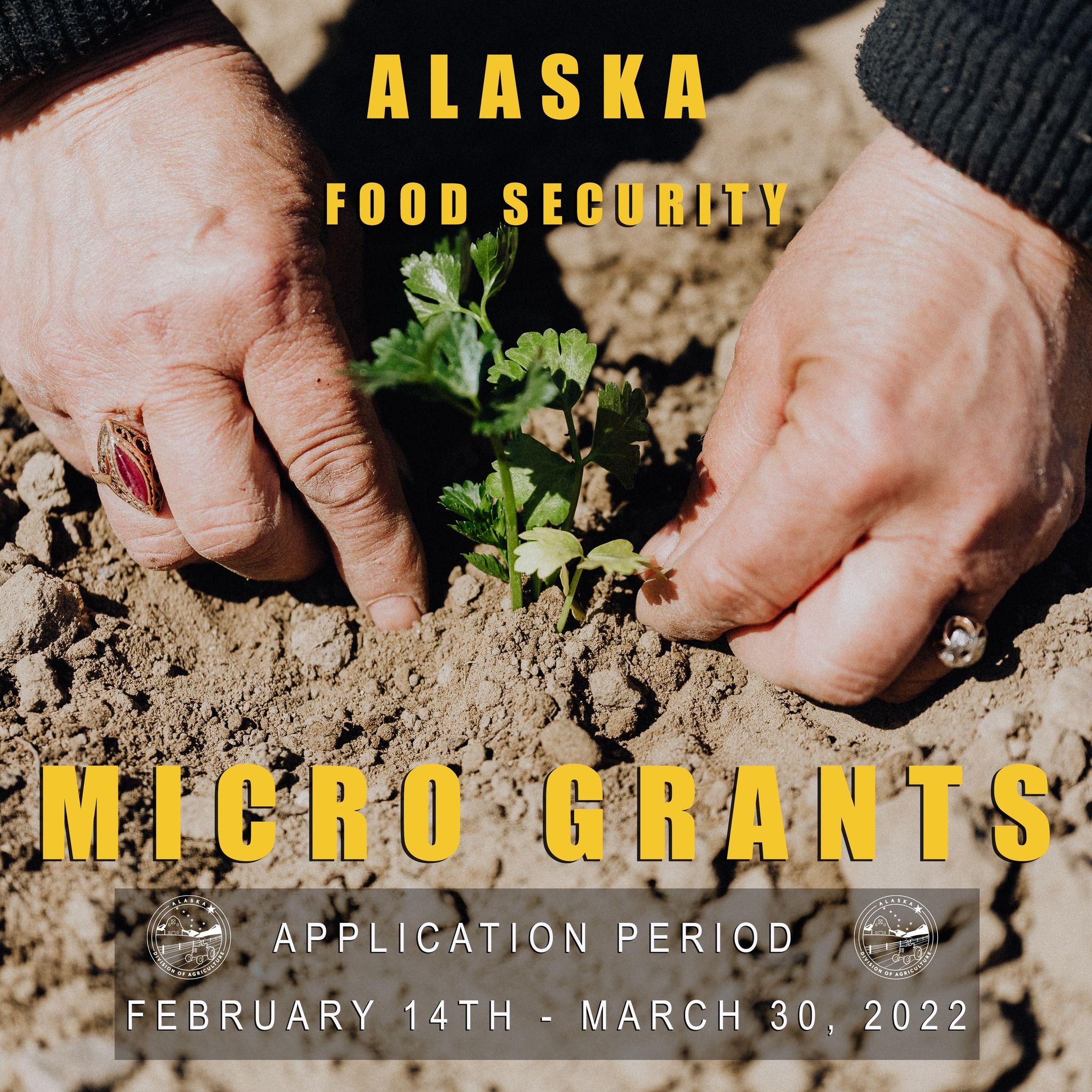
PALMER, Alaska – As part of a continuing effort to improve food security for Alaskans, the Alaska Division of Agriculture is offering $2 million in micro-grants to individuals and organizations who want to grow and preserve their own food.

The grants are being offered through the U.S. Department of Agriculture’s Micro-Grants for Food Security Program (MGFSP). This is the second year the grants have been offered in Alaska. In 2021, the Division of Agriculture received more than 1,000 proposals for funding and awarded more than $1.6 million to 234 grantees (Including several in Sitka). 

“The last two years have taught Alaskans the importance of increasing local production of food and storage capabilities,” Alaska Division of Agriculture Director David W. Schade said, referring to supply chain issues related to the COVID-19 pandemic. “We are fortunate to offer another opportunity to apply for the micro-grants in 2022. We have worked with USDA to simplify the process and expand the opportunity for more Alaskans to receive funding.” 

The grant application period opened on Monday, Feb. 14, and closes at 5 p.m. on Wednesday, March 30. 

Individuals can apply for up to $5,000 and qualifying organizations can apply for up to $10,000. The grants are for one year and can be for anything from building a greenhouse to growing a garden to buying a freezer to fencing in livestock. Preference is given to individuals and groups in Alaska’s most vulnerable areas in terms of food security. 

“We will prioritize funding of grants for projects that affect our most food-insecure areas and increase local food production and storage.” Schade said. 

The Micro-Grants for Food Security program is part of the 2018 Farm Bill that created a special program for Alaska, Hawaii and the U.S. Territories for improvements to food security. The program helps individuals and organizations increase the quantity and quality of locally grown food in food insecure communities through small-scale, agricultural-related projects. Qualifying projects may include small-scale gardening, small-scale herding and livestock operations, and/or expanding access to food, safe food storage, and knowledge of food security. 

The program has undergone several changes, which will increase the opportunities for more Alaskans to participate and reduce the challenges of the reimbursement process and reporting for those receiving grants. 

“I am pleased that the USDA Agriculture Marketing Service has approved Alaska’s new streamlined, simple process for grant projects, as many grant programs are difficult for many of our rural residents to use,” Gov. Mike Dunleavy said. “Food security is a high priority of my administration and support of this program continues my administration’s efforts to move Alaska toward greater food independence”. 

More detailed information on the micro-grants can be accessed at the Division of Agriculture website. For questions not addressed on the website refer to the Alaska Grown Facebook LIve events. You may also submit questions with Micro-grants 2022 in the subject line to dnr.ag.grants@Alaska.gov. 

Applications must be submitted electronically via the Division of Agriculture SmartSimple application portal. Instructional videos for how to submit the application can be found at Alaska Grown – YouTube