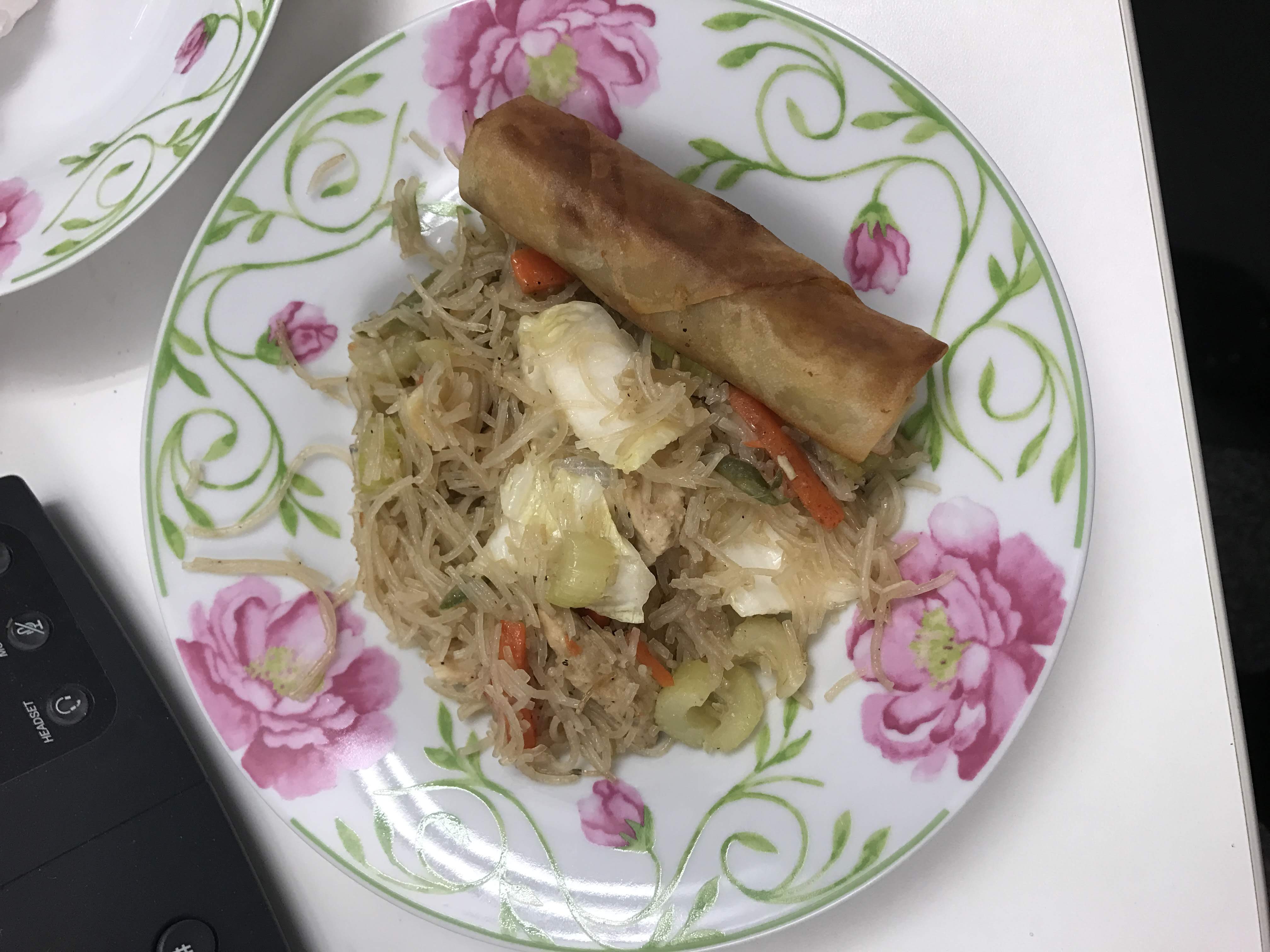
Learn how to make chicken adobo with a boiled egg, chicken tinola (soup) and other dishes during the upcoming Sitka Kitch class, Filipino Cooking with David Felts and Sonia Malabot-Felts. This class takes place from 6-8:30 p.m. on Tuesday, May 14, at the new location of the Sitka Kitch community rental commercial kitchen at the Sitka Lutheran Church (224 Lincoln Street, please use the back entrance through the alley by Bev’s Flowers & Gifts, off Harbor Drive). This class is part of our Cooking Around the World series and is a fundraiser for the Sitka Kitch.
David and Sonia are husband and wife, and they have lived in Sitka about seven years. They met in the Philippines, and ran a restaurant together for 7-8 years in the town of Makati. Over the years, they have hosted Fourth of July and other booths around Sitka. They both work at the University of Alaska Southeast Sitka Campus.
The menu will include chicken adobo and chicken tinola as the main dishes; pork lumpia, pancit bihon and rice as the side dishes; and banana turon as the dessert.
The registration deadline for the Filipino cooking class is 11:30 p.m. on Saturday, May 11, so register now since space is limited. We need at least eight students to register and pre-pay to make this class happen. The class costs $40, which is part of our new all-inclusive fee system (you no longer have to pay a class fee to register, then a separate food/supply fee). You can register and pre-pay using credit/debit cards or PayPal on our EventSmart page, http://sitkakitch.eventsmart.com (click on class title). For those wanting to pre-pay with cash or check, please call Claire Sanchez or Clarice Johnson at Sitka Conservation Society (747-7509) to arrange a payment. For more information about the class, contact Jasmine Shaw at 747-9440. We do offer one potential scholarship spot per class for people with limited incomes, so long as we have enough students registered to make the class happen. Contact Claire at SCS for more details about the scholarship. This class is a fundraiser for the Sitka Kitch.
Students should enter the Sitka Lutheran Church through the back entrance (through the alley off Harbor Drive by Bev’s Flowers and Gifts). The door on the right should be open for students to enter. Please do not park in the church’s back parking lot. Please use the public parking lots off Harbor Drive.
The Sitka Kitch also has a new class cancelation policy. If you register for a class, then find out you can’t attend, please email us at sitkakitch@sitkawild.org and we may be able to help fill your slot through our waiting list. If you cancel from the class at least five days in advance (eg, by Wednesday for a Monday class), you are eligible for a partial refund of your class fee, minus $5 for processing (in this case, $35). If you need to cancel with less than five days advance notice, there is no refund.
Students learned how to cook chicken curry with a lime-cilantro chutney during the Sitka Kitch’s Cooking Around The World class Indian Cooking With Dr. Supriya Mathur on Friday, April 26, at the new Sitka Kitch location in the Sitka Lutheran Church. This class was originally scheduled for March 22, but was postponed after Dr. Mathur had a death in the family.
Dr. Mathur is an ear, nose and throat surgeon at SEARHC whose family is from India. She discussed some of the differences in regional cuisines of India, and also taught the students how to make garam masala using black pepper, cinnamon, cloves, black cardamom, green cardamom, and mace.
The next Sitka Kitch class is an Around The World cooking class on Filipino cooking with David Felts and Sonia Malabot-Felts. It will take place from 6-8:30 p.m. on Tuesday, May 14, at the Sitka Kitch. The class is now posted on our online registration page, since David and Sonia have finalized the menu, and registration is open.
A slideshow of images from the Indian cooking class is posted below.
Registration for the 2019 Sitka Farmers Markets is open, and vendors looking to sell local food, arts and crafts, and other items at the markets can find all the vendor forms, information sheets, rules and regulations for this year by going to the Documents page on this site (scroll down to vendor forms), or look at the bottom of this post for the documents. The forms include information about how to register your table for this year’s markets.
The 2019 Sitka Farmers Market manager is Nina Vizcarrondo, who managed the market the past two years and before that helped manage a New York City farmers market. She can be reached at sitkafarmersmarket@gmail.com or (907) 738-9301 during the market season. Sitka Local Foods Network board president Charles Bingham is assisting with the market again this year.
The dates for our 2019 Sitka Farmers Markets will be from 10 a.m. to 1 p.m. on seven Saturdays — July 6, July 27, Aug. 10, Aug. 17, Aug. 31, Sept. 7, and Sept. 21 — at the Alaska Native Brotherhood Founders Hall at 235 Katlian Street. We hope to schedule a vendor information meeting or two before the markets, which might be attended by Bruce Gazaway of the Food Safety Program from the Alaska Department of Environmental Conservation. We also hope to schedule another cottage foods basics class with Sarah Lewis of the UAF Cooperative Extension Service’s Juneau office, which in past years has been done through videoconference at the University of Alaska Southeast Sitka Campus.
This year we don’t have many changes from our last 2-3 years, when the Sitka Local Foods Network rolled back its Sitka Farmers Market table prices to 2015 levels and simplified them. We hope this helps us reclaim and keep some of the vendors we lost in previous years. The table fees will be $40 for a full table (slightly longer than eight feet) or $20 for a half table per market. We also have a deal where vendors who reserve space for and participate in all seven markets can receive a refund of one market fee after the season (so get seven markets for the price of six). There no longer is a price differential between indoor and outdoor booths (outdoor booths are charged the full table rate). We want to bring back some of the excitement to the markets, where it returns to being a community gathering place, and that means we have to make the market attractive to vendors.
If you are an Alaska food vendor and don’t have the time to host a table at the market, we might be interested in buying your products at wholesale rates or selling them on consignment at our Sitka Local Foods Network farm stand. Most of the produce we sell at the SLFN farm stand is grown at St. Peter’s Fellowship Farm communal garden and its satellite gardens, but we do sell some donated local produce. We also offer a matching program for people using WIC and SNAP benefits at our SLFN farm stand.
We want to show Sitkans the variety of local food products available in our community and state. In recent years we expanded our Alaska Grown products at the Sitka Local Foods Network farm stand, selling Chugach Chocolates from Girdwood, barley products from Alaska Flour Company of Delta Junction, fermented foods from Evie’s Brinery of Anchorage, and kelp pickles and salsa from Barnacle Foods of Juneau. This year we plan to try some new products in addition to keeping the rest of these brands in stock.
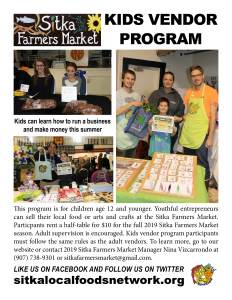
We are hosting a third year of the children’s vendor program, where kids get to become entrepreneurs and sell their own locally made food or arts and crafts. This program is modeled after the city’s program where children younger than age 12 buy a season permit to sell items near Harrigan Centennial Hall on cruise ship days. In our children’s vendor program, the fee is $10 for the full market season.
Nina is available to answer questions and to make suggestions that will help new and returning vendors adjust to any food regulation changes from the Alaska Department of Environmental Conservation, updates to the Alaska Quest electronic benefits program and WIC (Women, Infants, Children) supplemental food program, etc.
We have updated the 2019 vendor rules and responsibilities, but the only major changes are we won’t have access to the Alaska Native Sisterhood Kitchen (if you want to use it to cook something for the market, you will have to contact ANS to rent the kitchen) and vendors will not be able to store equipment at ANB Founders Hall between markets. The last page of the rules and responsibilities packet has the vendor registration form for adult and child vendors.
In addition, we are trying to increase our labor pool of volunteers to help out with the market. We need people to help us set up, take down, sell produce at the Sitka Local Foods Network farm stand, and more. If you are interested in volunteering, send us a note with your contact info. We usually have musicians play at the market, so we are gathering a list of music groups that want to perform.
For more information, contact Sitka Farmers Market manager Nina Vizcarrondo at (907) 738-9301 or sitkafarmersmarket@gmail.com, or you can email the Sitka Local Foods Network Board of Directors at sitkalocalfoodsnetwork@gmail.com. Amanda Anjum is the SLFN board liaison to the market (and board treasurer) and Charles Bingham is the SLFN board president, and both will assist with the market.
(EDITOR’S NOTE: The following article first appeared on this site in April 2010. It is repeated because much of the information remains current and newsworthy.)
In the cold winter of 1994, Anchorage Daily News garden columnist and former Garden Writers Association of America President Jeff Lowenfels was returning to his hotel after a Washington, D.C., event when he was approached by a homeless person who asked for some money to buy food. Lowenfels said Washington, D.C., had signs saying, “Don’t give money to panhandlers,” so he shook his head and kept on walking. But the man’s reply, “I really am homeless and I really am hungry. You can come with me and watch me eat,” stayed with Lowenfels for the rest of his trip.
Jeff Lowenfels
The encounter continued to bother Lowenfels, even as he was flying back to Anchorage. During the flight, Lowenfels came up with an idea when he started writing his weekly garden column (the longest continuously running garden column in the country, with no missed weeks since it started on Nov. 13, 1976). He asked his readers to plant one extra row in their gardens to grow food to donate to Bean’s Café, an Anchorage soup kitchen. The idea took off.
When Anchorage hosted the Garden Writers Association of America convention in 1995, Lowenfels took the GWAA members to Bean’s Café to learn about the Plant A Row For Bean’s Café program. The Garden Writers Association of America liked the idea, and it became the national Plant A Row For The Hungry campaign (also known as Plant A Row or PAR). In 2002, the Garden Writers Association Foundation (now Garden Communicators International) was created as a national 501(c)(3) nonprofit to manage the Plant A Row For The Hungry program.
“I am not surprised by the growth of PAR,” Lowenfels wrote in an e-mail to the Sitka Local Foods Network. “It is now in all 50 states and across Canada and there are thousands of variations of the original program — from prison gardens for the hungry to botanical gardens donating their produce from public display gardens. This is because gardeners always share information and extra food, so the idea was a natural.”
It took five years for the program to reach its first million pounds of donated food, but the second million only took two years and the next eight years saw a million pounds of donated food (or more) each year. Since 1995, more than 14 million pounds of food have been donated. Not only that, the program is getting ready to expand overseas to Australia, England and other countries with avid gardeners.
“We have supplied something in the vicinity of enough food for 50 million meals,” Lowenfels wrote in his e-mail. “Gardeners can solve this hunger problem without the government. And we don’t need a tea party to do it! Or chemicals, I might add, as author of a book on organic gardening!” Lowenfels is the author of Teaming With Microbes, written with Wayne Lewis. He released a second book, Teaming With Nutrients, as a follow-up to his first book, and in 2017 released a third book, Teaming With Fungi, as a second follow-up book.
According to the U.S. Department of Agriculture, one out of every eight U.S. households experiences hunger or the risk of hunger. Many people skip meals or eat too little, sometimes going an entire day or more without food. About 33 million Americans, including 13 million children, have substandard diets or must resort to seeking emergency food because they can’t always afford to buy the food they need. In recent years, the demand for hunger assistance has increased 70 percent, and research shows that hundreds of children and adults are turned away from food banks each year because of lack of resources.
According to the 2014 Sitka Community Food Assessment Indicators Report, about one in six people in Sitka is food insecure. In 2013, there were 1,410 Sitkans (out of a population of about 9,000) and 766 families receiving food assistance (SNAP, aka food stamps). There also were 229 individuals who received food pantry assistance from the Salvation Army and 7,243 meals served through its lunch soup kitchen in 2013, and that number has grown substantially since then.
While many people credit Lowenfels for creating the Plant A Row For The Hungry program, Lowenfels says the real heroes are the gardeners growing the extra food and donating it to local soup kitchens, senior programs, schools, homeless shelters and neighbors. You can hear him pass along the credit to all gardeners at the end of this 2009 interview with an Oklahoma television station (video also embedded below).
“One row. That’s all it takes. No rules other than the food goes to the hungry. You pick the drop-off spot or just give it to a needy friend or neighbor. Nothing slips between the lip and the cup, I say,” Lowenfels wrote in his e-mail.
For people wanting to Plant A Row For The Hungry in Sitka, there are several places that would love to help distribute some fresh locally grown veggies or berries to those who are less fortunate, such as the Salvation Army, Sitkans Against Family Violence (SAFV), local churches, Sitka Tribe of Alaska and other organizations. The food the Sitka Local Foods Network grows at St. Peter’s Fellowship Farm communal garden goes to the Sitka Farmers Market, school lunches and other programs.
The Sitka Local Foods Network also takes donations of local produce to sell at the Sitka Farmers Markets, and all proceeds are used to help pay for SLFN projects geared toward helping more people in Sitka grow and harvest local food. For more information, contact the Sitka Local Foods Network board members at sitkalocalfoodsnetwork@gmail.com.
The USDA Forest Service Sitka Ranger District and Sitka Tribe of Alaska will work together again from 10:45 a.m. to 12:30 p.m. on Friday, April 19, at the Sitka Ranger District (2108 Halibut Point Road) to create an educational opportunity and traditional food source for community members. Forest Service staff and the tribe will share how to grow Tlingít (sometimes called Maria’s) potatoes, and share the biology, history, and cultural aspects of these interesting potatoes.
Since 2017, the Sitka Ranger District has provided a sunny plot of land to serve as the shared Tlingít potato garden. Together, the Tribe and the Forest Service provide the seed potatoes to plant the garden. The Sitka Tribe’s Traditional Foods Program and the gardening class from Pacific High School will again assist with the planting.
Community involvement is also needed to get the garden planted. Volunteers are asked to bring boots, gardening gloves, and shovels. Five-gallon buckets of seaweed to incorporate into the soil are beneficial, too. Members of the community who help tend the shared garden may receive more than gratitude as their reward.
“Last fall we harvested 90 pounds of potatoes. We shared the harvest among those helping out and through the Sitka Tribe’s Traditional Foods Program. And this year, we will be expanding the garden so we can grow even more potatoes,” said District Ranger Perry Edwards. “This project teaches people how to grow and sustain a traditional food, while supporting the need for food security among Sitka Families. It’s also a fun and very sustainable way to celebrate Earth Day.”
Tlingit potatoes have been present in Tlingit gardens for over 200 years. The potatoes originate from Mexico or Chile* and were a trade item in Southeast Alaska in the early 1800’s.
This work day and educational opportunity will be from 10:45 a.m. to 12:30 p.m. on Friday, April 19, at the Sitka Ranger District office, located at 2108 Halibut Point Road. For more information, contact Michelle Putz at 907-747-2708 ormichelle.putz@usda.gov.
*Zhang, Linhai with Charles R. Brown, David Culley, Barbara Baker, Elizabeth Kunibe, Hazel Denney, Cassandra Smith, Neuee Ward, Tia Beavert, Julie Coburn, J. J. Pavek, Nora Dauenhauer and Richard Dauenhauer. Inferred origin of several Native American potatoes from the Pacific Northwest and Southeast Alaska using SSR markers. Euphytica 174:15-29
Come to the Sitka Public Library from 6-7:30 p.m. on Monday night, April 8, for a presentation and conversation by Peter Bradley about the history of commercial herring fishing in Southeast Alaska and its impacts on the traditional harvest of herring.
Using excerpts from Alaska Department of Fish & Game research reports, Alaska Board of Fisheries meetings, Daily Sitka Sentinel articles, and various other sources, Peter will share some notes and observations from my ongoing research into the history of commercial herring fishing in Southeast Alaska and Sitka Sound. Although Peter will highlight some of the early history of herring fishing from 1878-1970, he will mostly focus on the 1970s, 80s, and 90s in an attempt to demonstrate some of the ways that the fishery has evolved over the years into what it is today.
Throughout, he will offer an outline to the long history of opposition to herring fishing in Southeast Alaska and will share some ideas about why there is such a discrepancy between widespread local observational knowledge and ADF&G data.
After the presentation Peter will open up for questions and conversation, recognizing that what he has been looking at is only a small part of the story.
The Sitka Local Foods Network just sent out the April 2019 edition of its monthly newsletter. Feel free to click this link to get a copy.
This month’s newsletter includes short stories about today being the deadline to apply for Permanent Fund Dividends (and a reminder about Pick.Click.Give. donations), a reminder about the April 5 deadline for the Sitka Local Foods Business Innovation Contest, info about the 2019 Sitka Local Foods Network sponsors, and a request for new board members. Each story has links to our website for more information.
You can sign up for future editions of our newsletter by clicking on the newsletter image in the right column of our website and filling in the information. If you received a copy but didn’t want one, there is a link at the bottom of the newsletter so you can unsubscribe. Our intention is to get the word out about upcoming events and not to spam people. We will protect your privacy by not sharing our email list with others. Don’t forget to like us on Facebook, like our Sitka Farmers Market page on Facebook and follow us on Twitter (@SitkaLocalFoods).
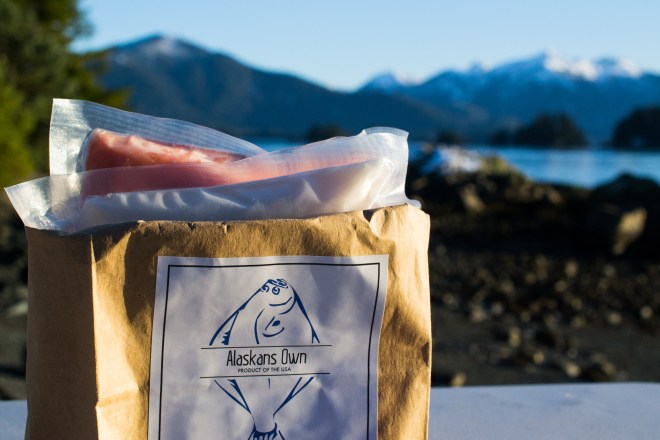
Alaskans Own was the first community-supported fishery (CSF) program in Alaska. Now in its 10th year, AO was created to connect consumers to small-boat fishermen, ensure that more fish caught in Alaska stays in Alaska, and create a sustainable source of revenue to support ALFA’s Fishery Conservation Network, which engages fishermen and scientists in conservation and research initiatives.
Similar to community-supported agriculture (CSA) programs, CSF programs address an important environmental and socio-economic need by strengthening consumer-producer relationships. By forward-funding a season of seafood, subscribers invest in sustainable harvest and the rural fishermen who catch their fish, as well as supporting the web of seafood-related jobs that provide the economic backbone for our coastal communities.
There are four-month and six-month subscriptions available starting in May. The six-month subscriptions allow people to keep receiving fish through October instead of August, when the traditional four-month subscriptions end. Subscriptions include a mix of premium locally hook-and-line caught black cod (sablefish), halibut, king salmon, coho salmon, lingcod and rockfish, depending on the commercial fishing season and prices.
Alaskans Own has just released its 2019 prices — choose either monthly installments or pay all at once and receive 5 percent off.
CSF Prices:
Four-Month Feed-A-Few share (5 lbs/month, May-August, 20 lbs total), $375 paid in full or $99 monthly payment ($396 total for four months)
Six-Month Feed-A-Few share (5 lbs/month, May-October, 30 lbs total), $565 paid in full or $99 monthly payment ($594 total for six months)
Besides the monthly shares there are a variety of other packages, including different sampler boxes of wild-caught, flash-frozen, high-quality seafood available on the AO website.
In a Feb. 2019 customer survey taken by 40 randomly-selected Alaskans Own CSF subscribers, more than 73 percent gave their overall experience the highest possible rating, 5 out of 5 stars, which was designated as “very satisfied.” The survey asked CSF members what they liked best about Alaskans Own CSF, and the most common answers were excellent, great quality seafood, the variety of species, and supporting local, Alaskan fishermen.
Alaskans Own not only connects consumers with the local fishermen who caught their seafood, which is so important for transparency of the seafood supply chain, it also gives customers the opportunity to give to conservation projects because all AO profits go to the Fishery Conservation Network.
Customers who don’t live in one of Alaskans Own’s CSF cities (Sitka, Juneau, Anchorage, Fairbanks, and Seattle) can also partake by setting up a custom order with the Alaskans Own staff. The AO staff can be reached at alaskansownfish@gmail.com or (907) 747-3400.
Shares and seafood boxes can be purchased on the AO online store at alaskansown.com, and the deadline to order for this year is May 15.
Alaskans Own is a non-profit, community supported fisheries program. Joining Alaskans Own is about a lot more than buying great fish. It’s an investment in the health of both fish and fisherman, in a cleaner environment, more vibrant local economies and a better future for Alaska. Learn more about our Fishery Conservation Network at alfafish.org
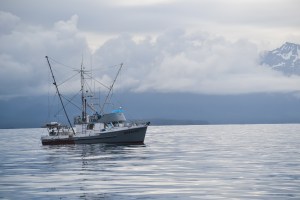
The Local Fish Fund is a program of Alaska Sustainable Fisheries Trust, a non-profit corporation based in Sitka, Alaska. The mission of the Trust is to protect and support local fishing businesses, promote sustainable fishing practices, and revitalize fishing communities in Alaska. The Local Fish Fund program aims to incentivize ocean conservation practices and strengthen fishery leadership in Alaska communities by structuring loan products that will support Alaska residents in purchasing quota and retaining fishery access opportunities. (Photo by Laurie Mistretta)
The Local Fish Fund is an innovative fisheries loan program that will provide a new financing tool for the next generation of commercial fishers in Alaska’s fishing communities.
The Local Fish Fund is a collaborative effort spearheaded by the Alaska Sustainable Fisheries Trust, a Sitka-based nonprofit organization that protects and promotes fishing and fisheries. The loan fund aims to support Alaska’s fishing communities by reducing specific barriers to entry into commercial fisheries and engaging next-generation fishermen in marine stewardship and policy leadership. Alaska Sustainable Fisheries Trust was supported in setting up and capitalizing the fund by The Nature Conservancy, Craft3, Rasmuson Foundation, and Catch Together.
“The cost and risk involved in accessing Alaska’s quota share fisheries are comparable to purchasing a hotel as a first step in home ownership,” says Linda Behnken, commercial fisherman and founding member of the Alaska Sustainable Fisheries Trust. “As a result, the number of young rural residents entering the fisheries has dropped over the past 15 years. Local Fish Fund aims to change that trend by lowering barriers to entry while engaging the next generation of community-based fishermen in resource conservation and management.”
The Local Fish Fund loan structure has been developed in close consultation with commercial fishermen in Alaska to increase local ownership of halibut and sablefish quota. Traditional commercial fish loans require fixed payments, like a home loan. This presents substantial risk for entry-level commercial fishing businesses because the allowable catch and fish price can vary dramatically from year to year. In contrast, the Local Fish Fund loans use a “revenue participation” approach in which loan repayment is based on fish landings rather than a fixed loan repayment structure. The Local Fish Fund offers loans with competitive interest rates and reduced down payment options, and allows fishermen to build sufficient equity to eventually access conventional loans.
In addition to providing easier access to quota purchase, this loan program has been developed to increase marine stewardship and leadership capacity in the field of sustainable fisheries management. Loan recipients will be incentivized to participate in a flexible set of conservation programs that contribute to sustainable fisheries management by collecting better scientific data; engaging in policy and management decision-making; and working on conservation education and outreach.
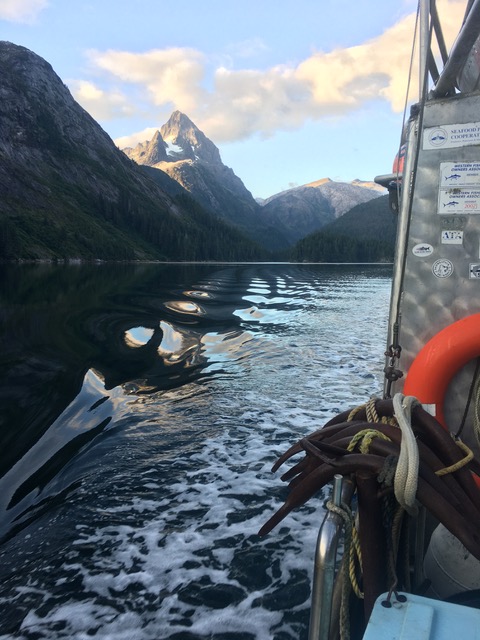
Alaska Longline Fishermen’s Association executive director and Alaska Sustainable Fisheries Trust founding member Linda Behnken’s longliner, the Woodstock (Photo Copyright Josh Roper)
“Alaska has some of the most sustainably managed fisheries in the world,” says Christine Woll, the Southeast Alaska program director for The Nature Conservancy. “This is due in large part to Alaskans having an active voice in how our fisheries are managed. Encouraging local participation in our commercial fisheries helps foster a long-standing Alaska tradition of community-based stewardship of our natural resources.”
The launch of this loan fund was made possible by a unique collaboration that brought together varied expertise across fisheries, conservation, and finance. In addition to the Alaska Sustainable Fisheries Trust, the launch of the fund was supported by the Alaska Longline Fishermen’s Association, which has a long history of leadership in Alaskan fisheries management; The Nature Conservancy, which has worked with fishing communities to develop economic incentives for fisheries conservation in communities across the globe; and Craft3, a community development financial institution, which provides loans to benefit Pacific Northwest communities, and is originating and servicing loans on Local Fish Fund’s behalf. The Rasmuson Foundation and Catch Together have capitalized the loan fund, which will seek to make a series of loans over the next two to three years.
“We know how important quota ownership is to fishing communities in Southeast Alaska, and we are pleased to be a financing partner to the Local Fish Fund and its program to keep quota in the hands of local fishermen” says Kelly Wachowicz, Managing Partner of Catch Together.
“Joining Alaska Sustainable Fisheries Trust and The Nature Conservancy to launch the Local Fish Fund makes perfect sense to Craft3. This effort expands on our decades-long commitment to sustainable fisheries, conservation, and community development,” stated Craft3 President & CEO Adam Zimmerman. “The Local Fish Fund’s flexible credit and conservation incentives will preserve local fishery ownership, build equity in communities and families, and sustain fisheries health. This can be a model for how private, nonprofit, and philanthropic partners can work together to invest in current and next generation fishermen committed to sustainability.”
“The Local Fish Fund relies on creative thinking – and strong local and national partners – to open up economic opportunities in one of Alaska’s most valued industries, fishing,” said Chris Perez, Rasmuson Foundation senior program officer.
Behnken also thanked the National Fish and Wildlife Foundation and The Oak Foundation, which provided long-time support for the Alaska Sustainable Fisheries Trust and helped out with the development of the Local Fish Fund.
The seventh annual Sitka Food Co-op annual meeting and potluck dinner will be from 4-6 p.m. on Saturday, March 9, at the Alaska Raptor Center. This meeting is free and open to the public, so please bring a dish to share (what’s a food co-op meeting without food?). You can RSVP for the meeting by clicking this link (Note: this link also includes a survey for those who can’t make the annual meeting).
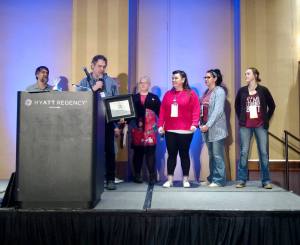
Sitka Food Co-Op general manager Keith Nyitray accepts the Co-Op Citizen Award this week at the 2019 Up & Coming Food Co-Op Conference in Milwaukee. Also pictured are (from left) Food Co-Op Initiative (FCI) executive director Stuart Reid, Jacqueline Hannah of FCI, Sitka Food Co-Op (SFC) member Donna Barragan, SFC board member Hannah Green and SFC board member/staff person Kate DesRosiers.
General Manager Keith Nyitray will go over all the operations and financials of this past year and the board will review the results from its recent survey and talk about future needs and plans for the co-op. The co-op paid members also will vote on by-law changes and where to send the “Co-op Cares” donations.
The co-op also is looking for new board members. The terms will last one or two years so that we can stagger terms out for board continuity. The co-op needs an active board to handle all the things a general manager can not, or should not, handle.
If you’re interested in joining the board, let us know by filling out the board application form. A copy of the tentative agenda can be found here.
In addition, the Sitka Food Co-Op earlier this week won the Co-Op Citizen award at the 2019 Up & Coming Food Co-Op Conference. There were three co-ops from around the country nominated for the award.
According to Nyitray, “The Cooperative Citizen award is awarded for exceptional embodiment of cooperative principle six, ‘cooperation among cooperatives’, within the startup food co-op community. Awardees have gone far above and beyond to share their knowledge, experience, and solutions with peer startups, contributing significantly to the growth of the overall food co-op startup community. Sitka Food Co-op was recognized specifically for its passionate and generous sharing of their unique development with other rural and small town food co-op startups that may benefit from using a similar model.”

 Learn how to make chicken adobo with a boiled egg, chicken tinola (soup) and other dishes during the upcoming Sitka Kitch class, Filipino Cooking with David Felts and Sonia Malabot-Felts. This class takes place from 6-8:30 p.m. on Tuesday, May 14, at the new location of the Sitka Kitch community rental commercial kitchen at the Sitka Lutheran Church (224 Lincoln Street, please use the back entrance through the alley by Bev’s Flowers & Gifts, off Harbor Drive). This class is part of our Cooking Around the World series and is a fundraiser for the Sitka Kitch.
 The registration deadline for the Filipino cooking class is 11:30 p.m. on Saturday, May 11, so register now since space is limited. We need at least eight students to register and pre-pay to make this class happen. The class costs $40, which is part of our new all-inclusive fee system (you no longer have to pay a class fee to register, then a separate food/supply fee). You can register and pre-pay using credit/debit cards or PayPal on our EventSmart page, http://sitkakitch.eventsmart.com (click on class title). For those wanting to pre-pay with cash or check, please call Claire Sanchez or Clarice Johnson at Sitka Conservation Society (747-7509) to arrange a payment. For more information about the class, contact Jasmine Shaw at 747-9440. We do offer one potential scholarship spot per class for people with limited incomes, so long as we have enough students registered to make the class happen. Contact Claire at SCS for more details about the scholarship. This class is a fundraiser for the Sitka Kitch.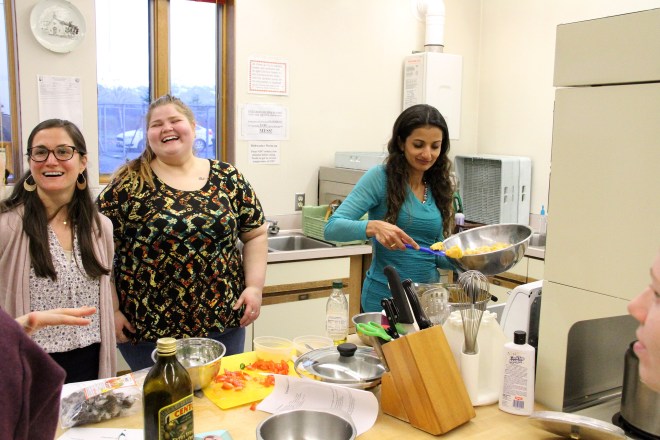












 Sitka Local Foods Network
You must be logged in to post a comment.