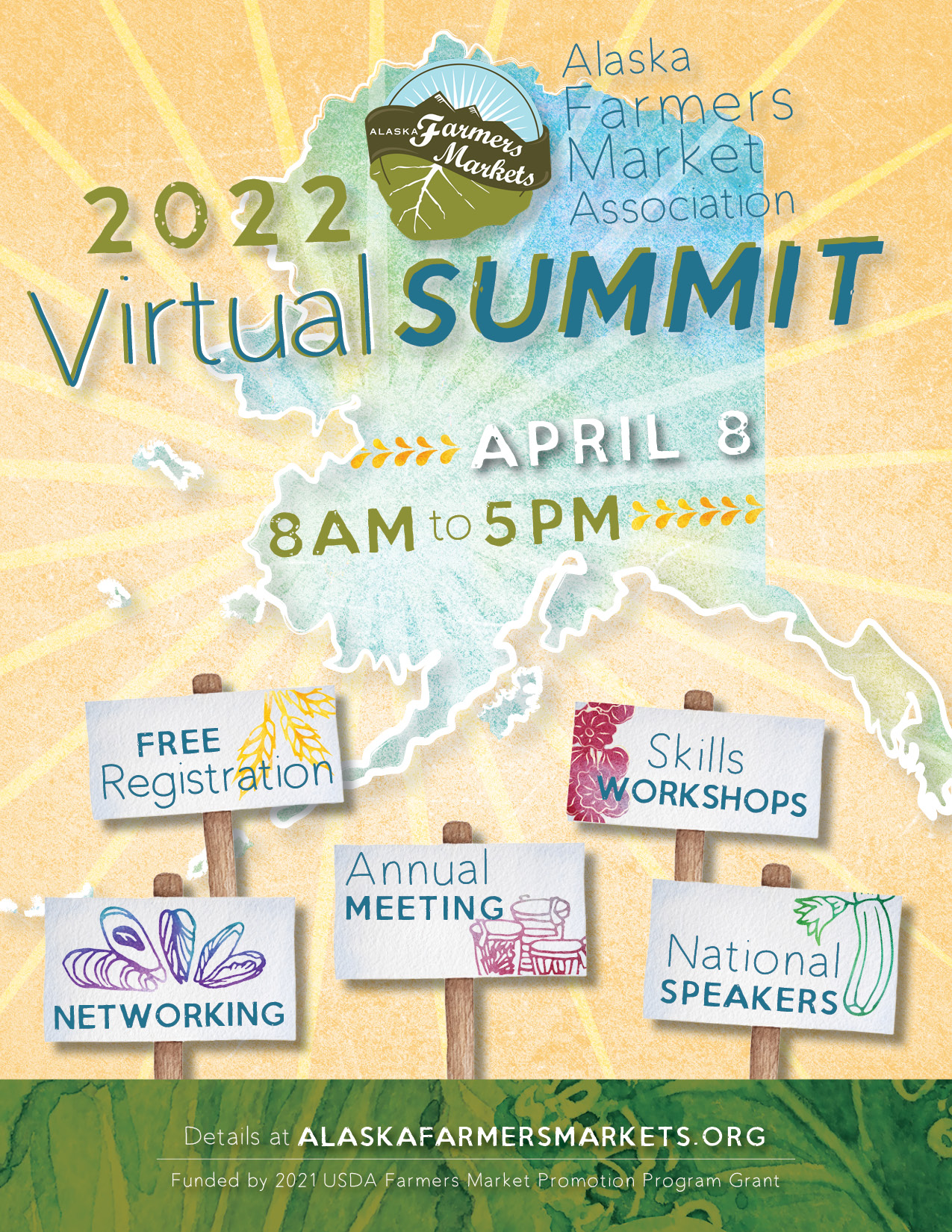
HOMER, Alaska (March 29, 2022) — The Alaska Farmers Markets Association will host its 2022 virtual summit from 8 a.m. to 5 p.m. on Friday, April 8. The theme is “Gather and Grow.” This event is free, but pre-registration is required.
“Whether you have run a market for 10 years or are just in the planning stages, the Alaska Farmers Markets Association is open to anyone interested in learning more about Alaska’s farmers markets, CSAs (community supported agriculture programs), farm stands, and food hubs,” said AFMA director Robbi Mixon, who recently was named to the board of directors for the national Farmers Market Coalition. “Grow your network and learn from market managers, farmers, government officials, and more.”
The keynote speakers this year are Mat-Su Health Foundation President/CEO Elizabeth A. Ripley and Dr. Gail Meyers, co-founder of Farms to Grow, Inc. Other presentations and discussion panels will be on how to keep farmers markets safe and the public healthy, why a census of agriculture matters for food security in Alaska, National Farmers Market Week (Aug. 7-13) events, a lunch-and-learn on ranked-choice voting, farmers market evaluation and data collection, food access programs, and more.
HOMER, Alaska (March 10, 2022) — The agenda has been released for the 2022 Alaska Food Festival and Conference, which is going virtual on Thursday through Saturday, March 17-19, this year due to the COVID-19 pandemic. This year’s theme is “Everybody Eats: Nourishing Our Culture, Our Health, Our Future.”
This year’s agenda includes a variety of presentation topics, including a tribal youth track, a legislative update, the American Indian foods program, seaweed mariculture and wild harvest, sustaining traditional foods with science and technology, navigating the USDA for tribes, the Micro-Grants for Food Security program, and many others. These are just a small portion of the scheduled presentations, and the full agenda can be found at this link, https://whova.com/embedded/event/afpc_202203/?utc_source=ems.
Hosted by the Alaska Food Policy Council (AFPC), the Alaska Food Festival and Conference previously took place in Anchorage in 2014 and 2016, in Fairbanks in 2017, in Homer in 2019, and was virtual in 2020. This year, as in 2020, the conference was scheduled for Anchorage before going virtual due to COVID-19. The event takes place every 18 months.
In addition to the Alaska Food Policy Council, this event is co-sponsored by the Intertribal Agriculture Council and the University of Alaska Anchorage (UAA) Dietetics and Nutrition Program.
The four focus areas of this year’s conference are: Policy and Education, Production and Harvest, Culture and Community, and Business and Industry.
The goals of the conference and festival are to:
increase awareness of Alaska food issues among the general population;
provide training, resources, and networking opportunities to increase involvement in local food issues by community members and decision makers; and
increase connections and build community between the public, Alaska food businesses, NGOs, governmental entities, tribal entities, and others to support local economic development and innovative solutions.
Before the conference, the movie “Food for the Rest of Us” will be shown at 6 p.m. on Thursday, March 17, using Zoom. The screening and post-screening panel discussion are free, but registration is required by going to this link, https://us02web.zoom.us/meeting/register/tZ0qdeChrT0tG9DzyKsjJA5NKuE49P3Rpzjb.
“Food for the Rest of Us”, https://www.foodfortherestofus.org/, is a feature film that presents four stories of people living life on their own terms, serving as leaders who are lending their voice to the underdog and leading a revolution to a better world, from the ground up. An Indigenous-owned, youth-run organic farm in Hawai’i, a Black urban grower in Kansas City who runs a land-farm at East High School, a female Kosher butcher in Colorado working with the queer community, and an Inuit community on the Arctic Coast that is adapting to climate change with a community garden in a small geodesic dome. A panel discussion with the director and producer will follow the film.
This year’s confirmed keynote speakers and featured guests include:
Janie Simms Hipp, USDA general counsel
Eva Dawn Burke, University of Alaska Fairbanks College of Rural and Community Development and The Alaska Center for Climate Assessment and Policy
Helga Garcia-Garza, executive director of Agri-Cultura Network and La Cosecha CSA
Caroline Cox (director) and Tiffany Ayalik (producer), Film: “Food for the Rest of Us” (special guests)
Iris Sutton, Ice Wedge Art and Farm (conference artist)
In addition, the three Alaska Food Hero Awards will be presented during the conference. A list of past Alaska Food Hero Award winners can be found at, https://www.akfoodpolicycouncil.org/akfoodheroes.
For more information about the conference and the Alaska Food Policy Council (https://www.akfoodpolicycouncil.org/), contact Robbi Mixon at (907) 235-4068, Ext. 23, or director@alaskafoodpolicycouncil.org.
###
• The Alaska Food Policy Council (https://www.akfoodpolicycouncil.org/) is a nonprofit organization whose diverse membership works to engage Alaskans to make positive changes for the state’s food system, and to create a healthier, more prosperous and more secure future for all.
• The Intertribal Agriculture Council (https://www.indianag.org/) was founded in 1987 to pursue and promote the conservation, development and use of our agricultural resources for the betterment of our people. Land-based agricultural resources are vital to the economic and social welfare of many Native American and Alaskan Tribes. The harmonies of man, soil, water, air, vegetation and wildlife that collectively make-up the American Indian agriculture community, influence our emotional and spiritual well-being. The IAC has, over the last three decades, become recognized as the most respected voice within the Indian community and government circles on agricultural policies and programs in Indian country.
• The University of Alaska Anchorage (UAA) Dietetics and Nutrition Program (https://www.uaa.alaska.edu/academics/college-of-health/departments/school-of-allied-health/academics/dietetics-nutrition/)is a statewide education program that meets the growing needs of the dietetics and nutrition industry. This nationally accredited program trains entry-level, registered dietitian nutritionists, and community nutrition and nutrition science professionals throughout Alaska. Using an array of online and campus-based courses, the UAA Dietetics and nutrition program offers a minor in Nutrition, a Bachelor of Science in Dietetics, and a Master of Science in Dietetics.
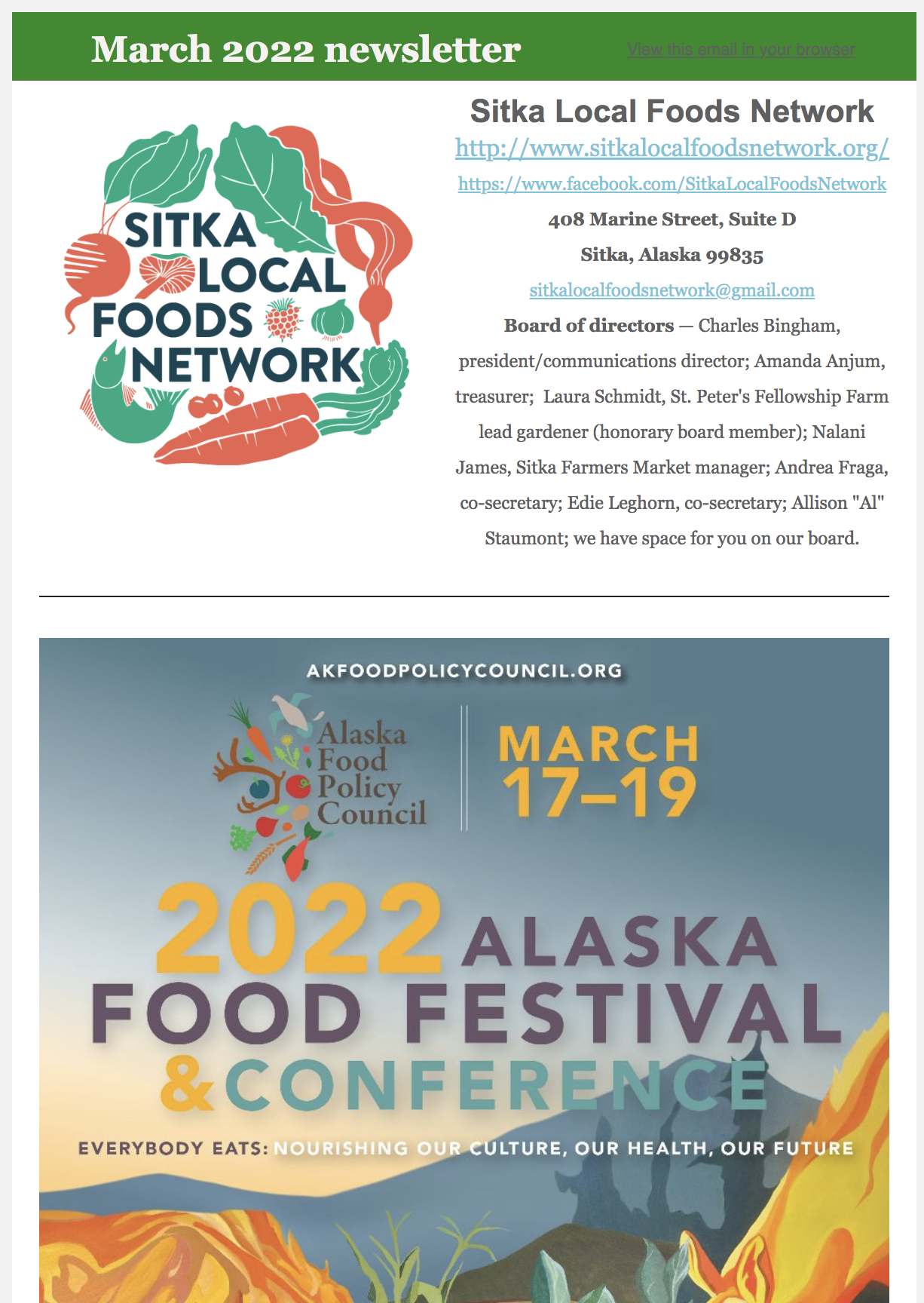
The Sitka Local Foods Network just sent out the March 2022 edition of its monthly newsletter. Feel free to click this link to get a copy.
This month’s newsletter includes short stories about the upcoming Alaska Food Festival and Conference on March 17-19, an update on the launch of the 2022 Sitka Food Business Innovation Contest, an item about the opening of the Alaska Permanent Fund Dividend application period (and Pick.Click.Give. application) on Jan. 1, an update about how you can support the Sitka Local Foods Network by buying a t-shirt or hoodie from our online store, information about our 2022 sponsorship programs, and an invitation to join our board of directors. Each story has links to our website for more information.
You can sign up for future editions of our newsletter by clicking on the newsletter image in the right column of our website and filling in the information. If you received a copy but didn’t want one, there is a link at the bottom of the newsletter so you can unsubscribe. Our intention is to get the word out about upcoming events and not to spam people. We will protect your privacy by not sharing our email list with others. Don’t forget to like us on Facebook, like our Sitka Farmers Market page on Facebook and follow us on Twitter (@SitkaLocalFoods).
Thanks to Lisa Trocchia for facilitating the workshop, as well as the other local/regional asset-mapping sessions taking place this winter across Alaska. This is part of an 18-month USDA Regional Food System Partnership planning grant coordinated by the Alaska Food Policy Council. The next step will be part of an implementation grant to take the results of all of of the local/regional asset-mapping sessions and use them to build a 10-year state food security plan.
In Sitka, we hope to use some of the information and connections gathered in today’s workshop to improve our local food security. We also hope to use the information to possibly update the 2014 Sitka Community Food Assessment Indicators Report, which gave us a lot of baseline planning data that now is nearly a decade old.
For those who weren’t able to attend, please watch for a survey link that will be posted in the next few weeks to gather more information. Also, the recorded Zoom meeting and the asset-mapping Google document are linked in the Documents section of this website, under food security.
If you are interested in helping improve Sitka’s food security, contact Sitka Local Foods Network board president Charles Bingham at sitkalocalfoodsnetwork@gmail.com or 907-623-7660. The next SLFN board meeting is at 6 p.m. on Wednesday, March 30, by Zoom, and these meetings are open to the public.
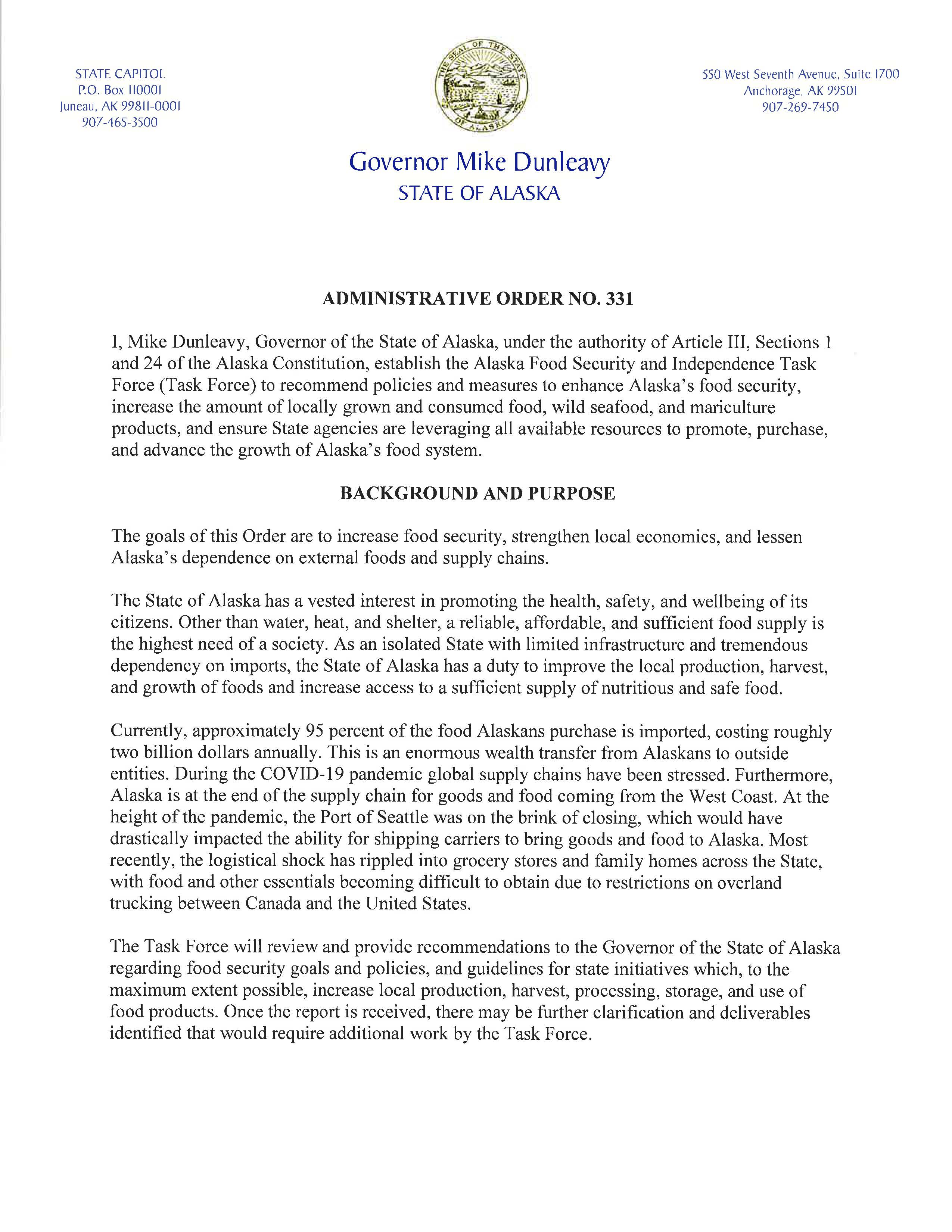
The first of four pages of Administrative Order 331, which creates the task force.
Today (Feb. 9, 2022), Gov. Mike Dunleavy issued Administrative Order 331(downloads the full four-page document as PDF) establishing the Alaska Food Security and Independence Task Force.
Alaska currently imports 95 percent of its food supplies at a cost of $2 billion per year. The global pandemic triggered supply chain disruptions on the West Coast of the United States that continue to impact the regular delivery of food and other essential goods to Alaska. The 18-member task force will be responsible for recommendations on how to increase all types of food production and harvesting in Alaska, and to identify any statutory or regulatory barriers preventing our state from achieving greater food security.
“Over the past two years Alaskans have walked into grocery stores and been greeted by row after row of empty shelves,” Gov. Dunleavy said. “One of the lessons the pandemic taught us is how vulnerable Alaska could be if the regularly scheduled shipments of food shipped up from Seattle were to suddenly stop – even a few days. The good news is Alaska has tremendous potential to grow, harvest and catch more nutritious food for in-state consumption. The recommendations from the task force will draw a roadmap for my administration, legislators and Alaska’s food producers to make Alaska more food secure the next time the supply chain is disrupted.”
The task force will have 10 main duties and responsibilities:
Provide recommendations that increase the procurement and use of Alaska-sourced foods within state and local agencies, institutions, and schools, including any administrative and statutory changes that are required.
Identify barriers that farmers, stock growers, fishermen, mariculture professionals, and others engaged in the growing, harvesting, or raising of food, face when starting a business or getting their products in to the Alaska market. Provide recommendations on how the state can address those obstacles, including through administrative or statutory changes.
Assess the levels of wild game and fish harvests in Alaska. Suggest measures that would increase the abundance and harvest of wild game, fish, and food by Alaskans.
Recommend a program to assist communities and households impacted by fishery shortfalls and disasters.
Identify factors, including regulatory or statutory burdens, that might discourage or prevent locally harvested and produced food from being purchased by federal, state, and local agencies, institutions, and schools.
Identify research needed to support and encourage increased consumption and production of Alaska-sourced food within the state.
Engage with the public to seek additional input on ways to promote the above listed goals.
Assess the need for disaster food caches within the state; and how the caches can be developed utilizing Alaskan-sourced foods.
Provide a report and summary of findings and recommendations, including what administrative and statutory changes would be needed to accomplish the recommendations of the task force.
The chair of the task force shall report regularly to the office of the governor on activities conducted and issues that arise under this order.
The task force will be made up of 16 voting members. Twelve Alaskans representing a cross section of the state’s farming, mariculture and seafood industries and four state commissioners (Natural Resources, Fish and Game, Environmental Conservation, Military and Veterans Affairs) or their designees will serve on the board. Two ex-officio members from the Alaska House of Representatives and the Alaska State Senate are to be appointed by the Senate President and the Speaker of the House.
The administrative order requests, but does not require, the two legislators be current members of the Alaska Grown Legislative Caucus.
The Task Force will issue a report on its findings and recommendations on or before September 1, 2022.
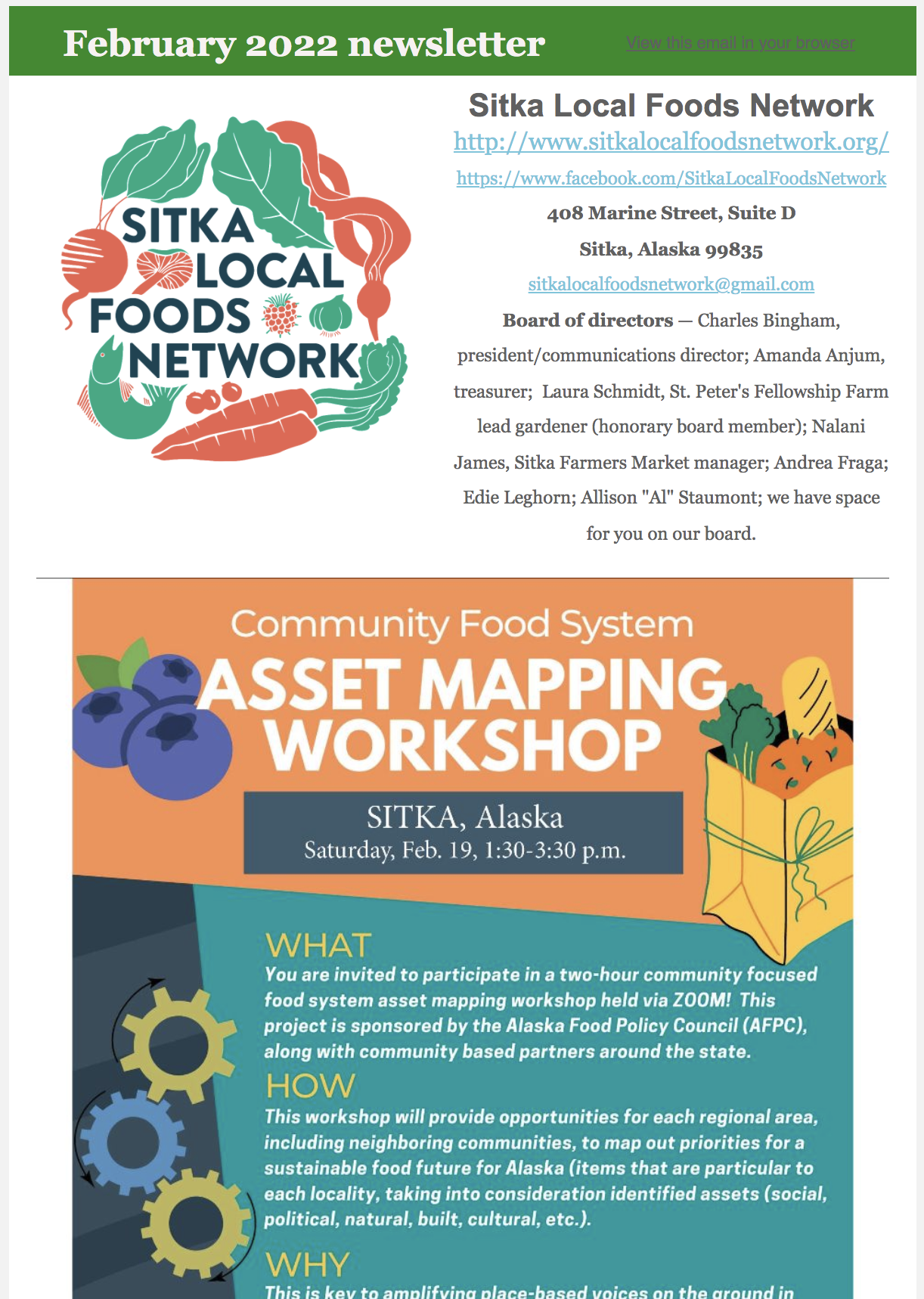
The Sitka Local Foods Network just sent out the February 2022 edition of its monthly newsletter. Feel free to click this link to get a copy.
This month’s newsletter includes short stories about an upcoming local food system asset-mapping workshop on Feb. 19, an update on the launch of the 2022 Sitka Food Business Innovation Contest, an item about the opening of the Alaska Permanent Fund Dividend application period (and Pick.Click.Give. application) on Jan. 1, an update about how you can support the Sitka Local Foods Network by buying a t-shirt or hoodie from our online store, information about our 2022 sponsorship programs, and an invitation to join our board of directors. Each story has links to our website for more information.
You can sign up for future editions of our newsletter by clicking on the newsletter image in the right column of our website and filling in the information. If you received a copy but didn’t want one, there is a link at the bottom of the newsletter so you can unsubscribe. Our intention is to get the word out about upcoming events and not to spam people. We will protect your privacy by not sharing our email list with others. Don’t forget to like us on Facebook, like our Sitka Farmers Market page on Facebook and follow us on Twitter (@SitkaLocalFoods).
Do you think you have a great idea for a food business or product from Sitka? Do you grow food, fish for food, or cook food in Sitka? The Sitka Local Foods Network is hosting the fifth annual Sitka Food Business Innovation Contest in an effort to spark local food entrepreneurs so we can make more local food available to residents and visitors. The contest entry deadline is Friday, March 18.
This contest will provide two $1,500 kicker prizes to help entrepreneurs launch or expand their food businesses. The contest is open to food businesses and individuals making and selling food products in Sitka, Alaska. All food business ideas must be geared toward getting more locally grown, harvested and/or produced food into the Sitka marketplace through sales in grocery stores, the Sitka Food Co-Op, the Sitka Farmers Market, restaurants, or individual marketing (such as a community supported agriculture/CSA or community supported fisheries/CSF program).
“The Sitka Local Foods Network’s mission is to get more locally harvested and produced food into the diets of Southeast Alaskans,” said Charles Bingham, Sitka Local Foods Network board president. “For the past decade we’ve offered entrepreneurs a chance to sell their produce, bread and fish at the Sitka Farmers Market, grown produce to sell at the market through St. Peter’s Fellowship Farm, and provided a garden education program to residents. We think this contest is the next step toward getting more local food into the Sitka marketplace. Our prizes are available to Sitka residents who are sustainably growing, foraging, fishing, or manufacturing food for people in Sitka.”
Last year, we awarded our $1,500 prize for established business to Jo Michalski of Muddy Mermaid Mudd Pies, which she sells at her Jo’s Downtown Dawgs hotdog/burger cart and to local restaurants. Our $1,500 prize for start-up business went to Nalani James of Eggstravagent, which are eggs from chickens she raised in town and sold to local customers (sometimes at the Sitka Farmers Market).
In 2020, we awarded our $1,500 prize for established business to Andrew Jylkka of Southeast Dough Co., who is baking sourdough bread, as well as making sauerkraut and kimchi. Our $1,500 prize for start-up business went to Levi Adams of Forage & Farm, where he is harvesting and growing mushrooms. Our prizes were determined before the Covid-19 shutdowns, but both business owners found ways to develop and build their businesses during the pandemic.
In 2019, we gave $1,500 prizes to Brittany Dumag of the Castaway food cart in the start-up business category and to Tamara Kyle of Sitka Sauers in the established business category. We also gave a special $250 award to 12-year-old Abigail Ward who entered her Sitka Seasonings business. Brittany made Cuban pork sandwiches (using pork from North Pole) and other food to sell at various places in Sitka, including the Sitka Farmers Market. Tamara planned to ramp up her fermented foods business, but she ended up having some health issues that prevented her from completing her project and she ended up refunding most of her prize money. Abby made spice blends for seafood and other meats, which she sold at the first two Sitka Farmers Markets of 2019 and at other venues.
In our inaugural contest in 2018, we gave a $1,500 prize to Hope Merritt of Gimbal Botanicals in the established business category. We had no entrants in the start-up business category, so no prize was awarded in 2018. Hope used her prize money to hire two interns to help her harvest seaweed and kelp and to help produce her products.
Participants in this contest are eligible and encouraged to enter other food business innovation contests, such as the Path To Prosperity or Symphony of Seafood contests. All participants retain the proprietary rights to their products and ideas. This contest is open to new and existing food businesses in Sitka, but this year we eliminated the separate categories and everybody is competing for the same awards. Student businesses (such as those fostered by Junior Achievement or similar programs) are welcome.
There is a small $25 entry fee for this contest. All participants (business and individual) must complete and submit our contest entry form by 5 p.m. on Friday, March 18, 2022 (by snail mail so it arrives before the deadline to Sitka Local Foods Network, Food Business Innovation Contest Entries, 408-D Marine Street, Sitka, Alaska, 99835, or by email with the Subject Line of “Food Business Innovation Contest Entries” to sitkalocalfoodsnetwork@gmail.com). Submitting a business plan (up to 20 pages) is recommended, but not required.
Our entry form will have room for you to describe your food business idea in a few paragraphs, but submitting a business plan will give you more room to outline your plans for funding and marketing the idea and will help your overall score. Judging will be based on how your food business idea provides new local food options in Sitka, how novel is your food business idea, how feasible is your food business (can it make a profit and be sustainable), and how professional is your presentation. At some time in late March or early April, the Sitka Local Foods Network may host a pitch presentation, where judges will interview the contest entrants and try samples of the food products. Our judging panel will score your presentation and entry form based on how your idea has a measurable impact on providing local food in Sitka (25%), has the potential for commercialization (25%), provides new employment in Sitka (25%) and fills a need in the Sitka marketplace (25%). We will give bonus points to those businesses that plan to participate in the 2022 Sitka Farmers Market.
In 2022 we are making a few changes to the rules. First, since we ended up moving a couple of entries between categories the past two years we decided to eliminate the categories and now everybody is competing for the same two awards. Second, each entry now MUST include a sample, itemized budget showing how the business owner plans to use the prize money. Third, each prize winner will sign a winner’s agreement contract before receiving the prize money that lists a series of benchmarks toward getting the product/service to market that need to be met by a certain date or else all or part of the prize money will need to be refunded to the Sitka Local Foods Network.
The Sitka Local Foods Network reserves the right to reduce or not make an award if the judges determine the applications don’t meet the minimum standards. Purchasing items such as masks and hand sanitizer to prevent the spread of Covid-19 are acceptable uses of prize money. Marijuana edibles are not eligible for the contest.
As part of this work, the Sitka Local Foods Network will host a community-focussed food system asset-mapping workshop from 1:30-3:30 p.m. on Saturday, Feb. 19, using Zoom. The goal of this project is to examine the strengths and weaknesses of the 13 local and regional food systems, then use that knowledge to create a 10-year statewide food security plan. The workshop on Feb. 19 will use an outside facilitator, Lisa Trocchia, who is facilitating all of the regional/local workshops.
“Food security, or insecurity, is a big issue in Alaska and in Sitka,” Sitka Local Foods Network board president Charles Bingham said. “Hopefully this project will give us some strategies on how to improve Alaska’s food security. We have special challenges in Alaska, with our remoteness and climate, and we see that every time the grocery store shelves are empty or when we go to a village store and can’t find fresh fruit and veggies. If you have concerns about Alaska’s, and Sitka’s, food system, then this workshop is for you.”
Sitka has a bit of an advantage over some of the other communities involved in the project, because in 2014 we released the Sitka Community Food Assessment Indicators Report, which came out of a Sitka Health Summit project. This gave us some baseline data about food security in Sitka. But most of the data is a decade old and is becoming dated. It’s hoped this workshop might inspire discussions that will help us update the report.
We want people from all parts of the Sitka community to attend this meeting — Alaska Native, Filipino, people on public assistance, people who hunt and gather, gardeners, commercial fishermen, people who run food businesses, young people, elders, etc. The broader the diversity in our group, the better our results.
If you are interested in attending, please RSVP before Tuesday, Feb. 15, by sending an email with the note “food security” in the subject line to sitkalocalfoodsnetwork@gmail.com. Space is limited. You will receive an email a few days before the event with a Zoom link. Those who can’t attend on Feb. 19 still can participate when there is a statewide survey announced. For more details, contact Charles Bingham at 907-623-7660
Registration is open for the 2022 Alaska Food Festival and Conference, which is going virtual on Friday and Saturday, March 18-19, this year due to the COVID-19 pandemic. It opens with a pre-conference movie on Thursday, March 17. This year’s theme is “Everybody Eats: Nourishing Our Culture, Our Health, Our Future.”
Hosted by the Alaska Food Policy Council (AFPC), the Alaska Food Festival and Conference previously took place in Anchorage in 2014 and 2016, in Fairbanks in 2017, in Homer in 2019, and was virtual in 2020. This year, as in 2020, the conference was scheduled for Anchorage before going virtual due to COVID-19. The event takes place every 18 months.
The four focus areas of this year’s conference are: Policy and Education, Production and Harvest, Culture and Community, and Business and Industry.
The goals of the conference and festival are to:
increase awareness of Alaska food issues among the general population;
provide training, resources, and networking opportunities to increase involvement in local food issues by community members and decision makers; and
increase connections and build community between the public, Alaska food businesses, NGOs, governmental entities, tribal entities, and others to support local economic development and innovative solutions.
Details for the event are still in the planning stage. But past conferences have included presentations on food systems in Alaska, food security/insecurity, traditional foods, farmers markets, agriculture in Alaska, fisheries, food policy, food waste reduction, and more. Other plans include holding an online auction, a youth track, and a pre-conference workshop with Alaska Village Initiatives.
This year’s confirmed keynote speakers and featured guests include:
Janie Simms Hipp, USDA general counsel
Eva Dawn Burke, University of Alaska Fairbanks College of Rural and Community Development and The Alaska Center for Climate Assessment and Policy
Helga Garcia-Garza, executive director of Agri-Cultura Network and La Cosecha CSA
Caroline Cox (director) and Tiffany Ayalik (producer), Film: “Food for the Rest of Us” (special guests)
Iris Sutton, Ice Wedge Art and Farm (conference artist)
Before the conference, the movie “Food for the Rest of Us” will be shown at 6 p.m. on Thursday, March 17, using Zoom. The screening and post-screening panel discussion are free, but registration is required by going to this link, https://zoom.us/webinar/register/WN_8huQr-GeR-W8UwCBXMhx7w.
“Food for the Rest of Us”, https://www.foodfortherestofus.org/, is a feature film that presents four stories of people living life on their own terms, serving as leaders who are lending their voice to the underdog and leading a revolution to a better world, from the ground up. An Indigenous-owned, youth-run organic farm in Hawai’i, a Black urban grower in Kansas City who runs a land-farm at East High School, a female Kosher butcher in Colorado working with the queer community, and an Inuit community on the Arctic Coast that is adapting to climate change with a community garden in a small geodesic dome. A panel discussion with the director and producer will follow the film.
Registration costs $40-$150, depending on the package, and you can register at this link, https://www.eventbrite.com/e/2022-alaska-food-festival-conference-tickets-232976558157. Early bird registration and pricing ends on Monday, Jan. 31. You also can purchase an Alaska Food Policy Council membership at that link. Thanks to the generosity of the Intertribal Agriculture Council and the Alaska Farmers Market Association, a limited number of registration fee scholarships are available on a first-come, first-served basis, and you can apply at https://forms.gle/CPffkjzz3UuFWD7Y8.
For more information about the conference, contact Robbi Mixon at (907) 235-4068, Ext. 23, or director@alaskafoodpolicycouncil.org.
###
• The Alaska Food Policy Council (https://www.akfoodpolicycouncil.org/) is a nonprofit organization whose diverse membership works to engage Alaskans to make positive changes for the state’s food system, and to create a healthier, more prosperous and more secure future for all.
• The Intertribal Agriculture Council (https://www.indianag.org/) was founded in 1987 to pursue and promote the conservation, development and use of our agricultural resources for the betterment of our people. Land-based agricultural resources are vital to the economic and social welfare of many Native American and Alaskan Tribes. The harmonies of man, soil, water, air, vegetation and wildlife that collectively make-up the American Indian agriculture community, influence our emotional and spiritual well-being. The IAC has, over the last three decades, become recognized as the most respected voice within the Indian community and government circles on agricultural policies and programs in Indian country.
• The University of Alaska Anchorage (UAA) Dietetics and Nutrition Program (https://www.uaa.alaska.edu/academics/college-of-health/departments/school-of-allied-health/academics/dietetics-nutrition/) is a statewide education program that meets the growing needs of the dietetics and nutrition industry. This nationally accredited program trains entry-level, registered dietitian nutritionists, and community nutrition and nutrition science professionals throughout Alaska. Using an array of online and campus-based courses, the UAA Dietetics and nutrition program offers a minor in Nutrition, a Bachelor of Science in Dietetics, and a Master of Science in Dietetics.
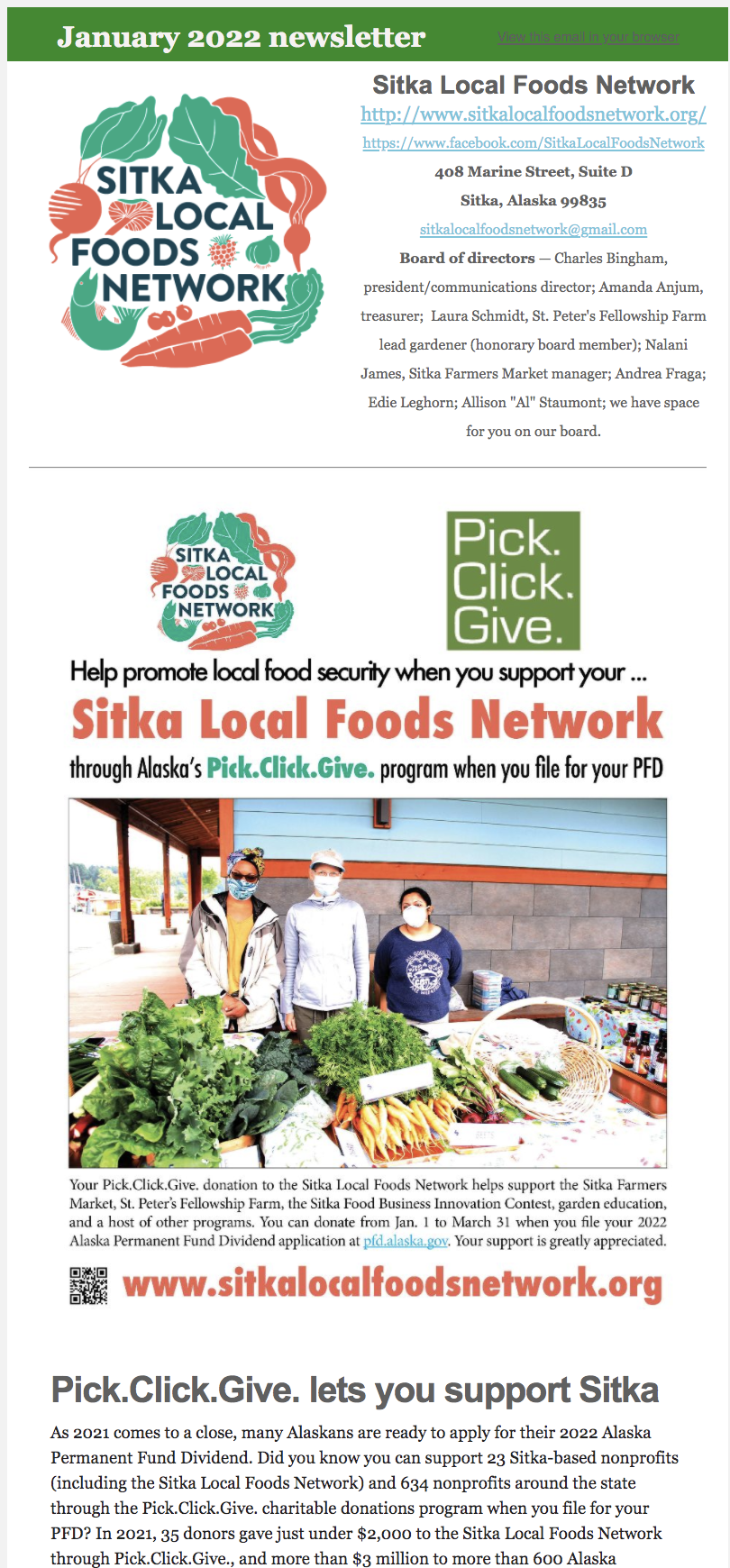
The Sitka Local Foods Network just sent out the January 2022 edition of its monthly newsletter. Feel free to click this link to get a copy.
This month’s newsletter includes short stories with a notice about the opening of the Alaska Permanent Fund Dividend application period (and Pick.Click.Give. application) on Jan. 1, an update about how you can support the Sitka Local Foods Network by buying a t-shirt or hoodie from our online store, information about our 2022 sponsorship programs, and an invitation to join our board of directors. Each story has links to our website for more information.
You can sign up for future editions of our newsletter by clicking on the newsletter image in the right column of our website and filling in the information. If you received a copy but didn’t want one, there is a link at the bottom of the newsletter so you can unsubscribe. Our intention is to get the word out about upcoming events and not to spam people. We will protect your privacy by not sharing our email list with others. Don’t forget to like us on Facebook, like our Sitka Farmers Market page on Facebook and follow us on Twitter (@SitkaLocalFoods).





 Sitka Local Foods Network
You must be logged in to post a comment.