The Sitka Local Foods Network just sent out the June 2019 edition of its monthly newsletter. Feel free to click this link to get a copy.
This month’s newsletter includes short stories about vendor registration being open for the 2019 Sitka Farmers Markets, the Sitka Kitch hosting a class on starting a cottage foods business, and an invitation to join the Sitka Local Foods Network board of directorsEach story has links to our website for more information.
You can sign up for future editions of our newsletter by clicking on the newsletter image in the right column of our website and filling in the information. If you received a copy but didn’t want one, there is a link at the bottom of the newsletter so you can unsubscribe. Our intention is to get the word out about upcoming events and not to spam people. We will protect your privacy by not sharing our email list with others. Don’t forget to like us on Facebook, like our Sitka Farmers Market page on Facebook and follow us on Twitter (@SitkaLocalFoods).
Alaskans will celebrate Alaska Agriculture Day on Tuesday, May 7. On this day, Alaskans are encouraged to support local agriculture by seeking out and purchasing products produced in Alaska and educating youth about the vital role that agriculture plays in our economy. This is Alaska’s version of National Ag Day (which took place on March 14 this year, when many parts of Alaska were still thawing out). The 2019 Alaska Ag Day theme is Farm Animal Fun. Don’t forget Monday, May 6, is the third annual Drive Your Tractor To Work Day in Alaska.
Here are a few ideas from the Division of Agriculture on how to celebrate Alaska Agriculture Day:
Join the 58,201 people who “like” the Alaska Grown Facebook page at https://www.facebook.com/dnr.alaskagrown and learn about the exciting things Alaskans are producing around the state.
Sign up for a Community Supported Agriculture (CSA) program at a local farm.
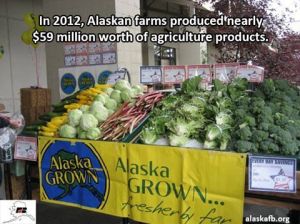
Buy and incorporate Alaska Grown products into your meals. The Alaska Grown program has a new Buy Alaska Grown website (with cellphone apps) where it is registering Alaska farmers so they can list their items on the web. In Southeast Alaska, a new food hub called the Salt and Soil Marketplace just launched a similar website where Southeast food producers (including fishermen) can list their products.
If you are a farmer, consider asking a local school if you can visit a classroom to educate children about your operation and Alaska agriculture. The Alaska Division of Agriculture provided this lesson plan for how to make carrot seed tape.
In Sitka, you can celebrate Alaska Agriculture Day by starting a food garden (even a couple of containers on your deck can provide you with potatoes, carrots or greens). Teachers are encouraged to offer a lesson plan or two about the importance of agriculture in Alaska and in Sitka. Here’s a link to an article about how Sitka was Alaska’s original garden city back in the late 19th and early 20th Centuries. Also, the Sitka History Minute feature on KCAW-Raven Radio has had several episodes about agriculture in Sitka (click here to listen to a feature about the potato in Sitka, click here to listen to a feature about the Sitka Agricultural Station, and click here to listen to a feature about the cows of Iris Meadows).
During the growing season, please support the Sitka farmers and production gardeners listed in the 2016-17 Alaska Grown Source Book (chief contact in parentheses, the Buy Alaska Grown website is still using this information even though it is somewhat dated) — Anam Cara Family Garden (Lisa Sadleir-Hart), Blatchley Community Gardens (David Nuetzel, this garden closed in 2016 and there is a group seeking a new location for what will be called Sitka Community Gardens, but its 2019 status is unknown), Down To Earth U-Pick Garden (Lori Adams, switched to a CSA in 2017 and no longer is a public u-pick garden), Finn Island Farm (Keith Nyitray, this farm closed), Sprucecot Gardens (Judy Johnstone, this may be closed), and St. Peter’s Fellowship Farm (Laura Schmidt/Sitka Local Foods Network). There also are a few Sitka farms and production gardens not listed in the 2016-17 Alaska Grown Source Book, such as Beyond Leafy LLC (Jimmy and Leslie Kranz, this hydroponic basil growing operation may be closed in 2019), Middle Island Gardens (Andrea Fraga/Kaleb Aldred), and Welsh Family Forget-Me-Not Garden (Florence Welsh).
Many of these farms and gardens will be vendors during the Sitka Farmers Markets this summer. The Sitka Farmers Markets take place from 10 a.m. to 1 p.m. on seven Saturdays — July 6, July 27, Aug. 10, Aug. 17, Aug. 31, Sept. 7, and Sept 21 — at the Alaska Native Brotherhood Founders Hall (235 Katlian St.). We are in the process of scheduling a Sitka Farmers Market vendors meeting or two where rules and responsibilities will be discussed.
The Sitka Local Foods Network just sent out the May 2019 edition of its monthly newsletter. Feel free to click this link to get a copy.
This month’s newsletter includes short stories about registration being open for the 2019 Sitka Farmers Market, the winners being announced in the second annual Sitka Food Business Innovation Contest, a new Filipino cooking class from the Sitka Kitch, and an invitation to join our board of directors. Each story has links to our website for more information.
You can sign up for future editions of our newsletter by clicking on the newsletter image in the right column of our website and filling in the information. If you received a copy but didn’t want one, there is a link at the bottom of the newsletter so you can unsubscribe. Our intention is to get the word out about upcoming events and not to spam people. We will protect your privacy by not sharing our email list with others. Don’t forget to like us on Facebook, like our Sitka Farmers Market page on Facebook and follow us on Twitter (@SitkaLocalFoods).
A certified food protection manager (CFPM) is responsible for monitoring and managing all food establishment operations to ensure that the facility is operating in compliance with food establishment regulations.
A CFPM is knowledgeable about food safety practices and uses this knowledge to provide consumers with safe food, protect public health and prevent food-borne illnesses. Alaska regulations require food establishments to have at least one CFPM on staff.
This course takes place from 8 a.m. to 5:30 p.m. (with a half-hour lunch), and participants will take a computer-based exam at the end of the class. The reason the deadline is two weeks before the class is to guarantee course materials reach all the students in time for the class. The cost is $200, and the course will be taught by Julie Cascio of Palmer. Students can register here, and the registration deadline is May 8.
The Sitka videoconference for the class will take place in a room TBA at the University of Alaska Southeast Sitka Campus. To learn more, contact Jasmine Shaw at the Sitka District Office of the UAF Cooperative Extension Service at 747-9440, or contact Julie Cascio at (907) 745-3677 (Palmer number) or jmcascio@alaska.edu. Note, this class is taught in English but textbooks are available in Korean, Chinese and Spanish, just contact Julie at least three weeks before the class.
Also, the ServSafe book ($70) and certification exam ($75) now are available online, if people want to order the book and study independently without taking the class. Just go to this website and purchase the book and exam items.
(EDITOR’S NOTE: The following article first appeared on this site in April 2010. It is repeated because much of the information remains current and newsworthy.)
In the cold winter of 1994, Anchorage Daily News garden columnist and former Garden Writers Association of America President Jeff Lowenfels was returning to his hotel after a Washington, D.C., event when he was approached by a homeless person who asked for some money to buy food. Lowenfels said Washington, D.C., had signs saying, “Don’t give money to panhandlers,” so he shook his head and kept on walking. But the man’s reply, “I really am homeless and I really am hungry. You can come with me and watch me eat,” stayed with Lowenfels for the rest of his trip.
Jeff Lowenfels
The encounter continued to bother Lowenfels, even as he was flying back to Anchorage. During the flight, Lowenfels came up with an idea when he started writing his weekly garden column (the longest continuously running garden column in the country, with no missed weeks since it started on Nov. 13, 1976). He asked his readers to plant one extra row in their gardens to grow food to donate to Bean’s Café, an Anchorage soup kitchen. The idea took off.
When Anchorage hosted the Garden Writers Association of America convention in 1995, Lowenfels took the GWAA members to Bean’s Café to learn about the Plant A Row For Bean’s Café program. The Garden Writers Association of America liked the idea, and it became the national Plant A Row For The Hungry campaign (also known as Plant A Row or PAR). In 2002, the Garden Writers Association Foundation (now Garden Communicators International) was created as a national 501(c)(3) nonprofit to manage the Plant A Row For The Hungry program.
“I am not surprised by the growth of PAR,” Lowenfels wrote in an e-mail to the Sitka Local Foods Network. “It is now in all 50 states and across Canada and there are thousands of variations of the original program — from prison gardens for the hungry to botanical gardens donating their produce from public display gardens. This is because gardeners always share information and extra food, so the idea was a natural.”
It took five years for the program to reach its first million pounds of donated food, but the second million only took two years and the next eight years saw a million pounds of donated food (or more) each year. Since 1995, more than 14 million pounds of food have been donated. Not only that, the program is getting ready to expand overseas to Australia, England and other countries with avid gardeners.
“We have supplied something in the vicinity of enough food for 50 million meals,” Lowenfels wrote in his e-mail. “Gardeners can solve this hunger problem without the government. And we don’t need a tea party to do it! Or chemicals, I might add, as author of a book on organic gardening!” Lowenfels is the author of Teaming With Microbes, written with Wayne Lewis. He released a second book, Teaming With Nutrients, as a follow-up to his first book, and in 2017 released a third book, Teaming With Fungi, as a second follow-up book.
According to the U.S. Department of Agriculture, one out of every eight U.S. households experiences hunger or the risk of hunger. Many people skip meals or eat too little, sometimes going an entire day or more without food. About 33 million Americans, including 13 million children, have substandard diets or must resort to seeking emergency food because they can’t always afford to buy the food they need. In recent years, the demand for hunger assistance has increased 70 percent, and research shows that hundreds of children and adults are turned away from food banks each year because of lack of resources.
According to the 2014 Sitka Community Food Assessment Indicators Report, about one in six people in Sitka is food insecure. In 2013, there were 1,410 Sitkans (out of a population of about 9,000) and 766 families receiving food assistance (SNAP, aka food stamps). There also were 229 individuals who received food pantry assistance from the Salvation Army and 7,243 meals served through its lunch soup kitchen in 2013, and that number has grown substantially since then.
While many people credit Lowenfels for creating the Plant A Row For The Hungry program, Lowenfels says the real heroes are the gardeners growing the extra food and donating it to local soup kitchens, senior programs, schools, homeless shelters and neighbors. You can hear him pass along the credit to all gardeners at the end of this 2009 interview with an Oklahoma television station (video also embedded below).
“One row. That’s all it takes. No rules other than the food goes to the hungry. You pick the drop-off spot or just give it to a needy friend or neighbor. Nothing slips between the lip and the cup, I say,” Lowenfels wrote in his e-mail.
For people wanting to Plant A Row For The Hungry in Sitka, there are several places that would love to help distribute some fresh locally grown veggies or berries to those who are less fortunate, such as the Salvation Army, Sitkans Against Family Violence (SAFV), local churches, Sitka Tribe of Alaska and other organizations. The food the Sitka Local Foods Network grows at St. Peter’s Fellowship Farm communal garden goes to the Sitka Farmers Market, school lunches and other programs.
The Sitka Local Foods Network also takes donations of local produce to sell at the Sitka Farmers Markets, and all proceeds are used to help pay for SLFN projects geared toward helping more people in Sitka grow and harvest local food. For more information, contact the Sitka Local Foods Network board members at sitkalocalfoodsnetwork@gmail.com.
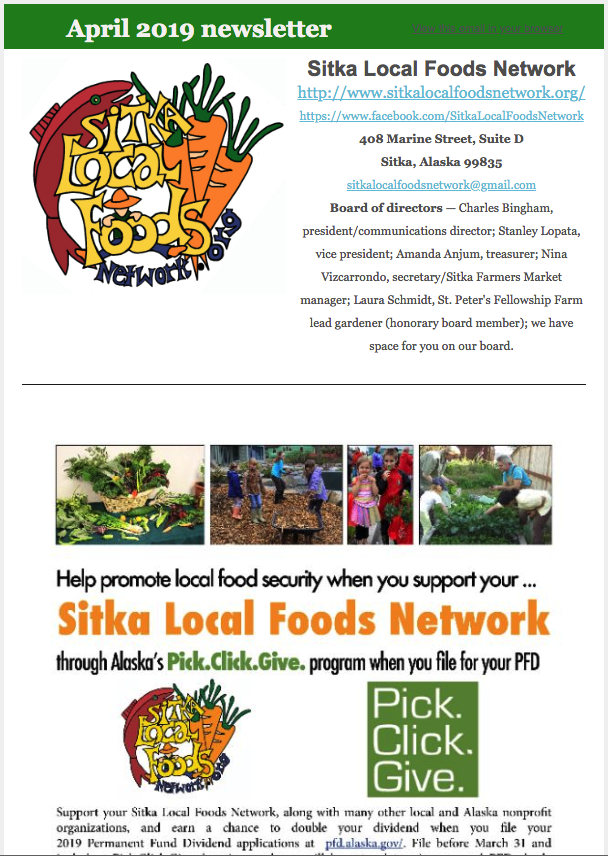
The Sitka Local Foods Network just sent out the April 2019 edition of its monthly newsletter. Feel free to click this link to get a copy.
This month’s newsletter includes short stories about today being the deadline to apply for Permanent Fund Dividends (and a reminder about Pick.Click.Give. donations), a reminder about the April 5 deadline for the Sitka Local Foods Business Innovation Contest, info about the 2019 Sitka Local Foods Network sponsors, and a request for new board members. Each story has links to our website for more information.
You can sign up for future editions of our newsletter by clicking on the newsletter image in the right column of our website and filling in the information. If you received a copy but didn’t want one, there is a link at the bottom of the newsletter so you can unsubscribe. Our intention is to get the word out about upcoming events and not to spam people. We will protect your privacy by not sharing our email list with others. Don’t forget to like us on Facebook, like our Sitka Farmers Market page on Facebook and follow us on Twitter (@SitkaLocalFoods).
A certified food protection manager (CFPM) is responsible for monitoring and managing all food establishment operations to ensure that the facility is operating in compliance with food establishment regulations.
A CFPM is knowledgeable about food safety practices and uses this knowledge to provide consumers with safe food, protect public health and prevent food-borne illnesses. Alaska regulations require food establishments to have at least one CFPM on staff.
This course takes place from 8 a.m. to 5:30 p.m. (with a half-hour lunch), and participants will take a computer-based exam at the end of the class. The reason the deadline is two weeks before the class is to guarantee course materials reach all the students in time for the class. The cost is $200, and the course will be taught by Julie Cascio of Palmer. Students can register here, and the registration deadline is March 20.
The Sitka videoconference for the class will take place in a room TBA at the University of Alaska Southeast Sitka Campus. To learn more, contact Jasmine Shaw at the Sitka District Office of the UAF Cooperative Extension Service at 747-9440, or contact Julie Cascio at (907) 745-3677 (Palmer number) or jmcascio@alaska.edu. Note, this class is taught in English but textbooks are available in Korean, Chinese and Spanish, just contact Julie at least three weeks before the class.
Also, the ServSafe book ($70) and certification exam ($75) now are available online, if people want to order the book and study independently without taking the class. Just go to this website and purchase the book and exam items.
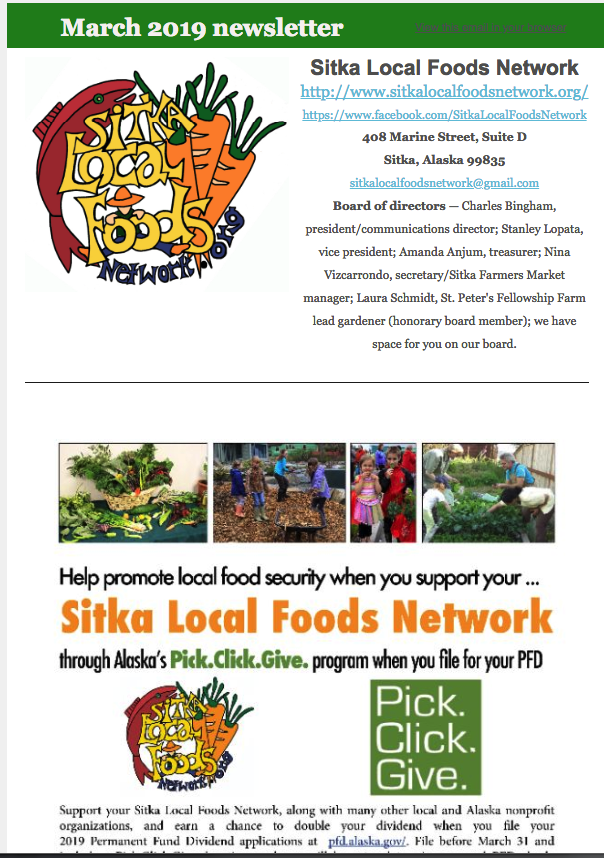
The Sitka Local Foods Network just sent out the March 2019 edition of its monthly newsletter. Feel free to click this link to get a copy.
This month’s newsletter includes short stories about Pick.Click.Give. donations, a request for volunteer garden class teachers, a reminder about the deadline for the Sitka Local Foods Business Innovation Contest, info about the 2019 Sitka Local Foods Network sponsors, info about Sitka Kitch classes in March, and a request for new board members. Each story has links to our website for more information.
You can sign up for future editions of our newsletter by clicking on the newsletter image in the right column of our website and filling in the information. If you received a copy but didn’t want one, there is a link at the bottom of the newsletter so you can unsubscribe. Our intention is to get the word out about upcoming events and not to spam people. We will protect your privacy by not sharing our email list with others. Don’t forget to like us on Facebook, like our Sitka Farmers Market page on Facebook and follow us on Twitter (@SitkaLocalFoods).
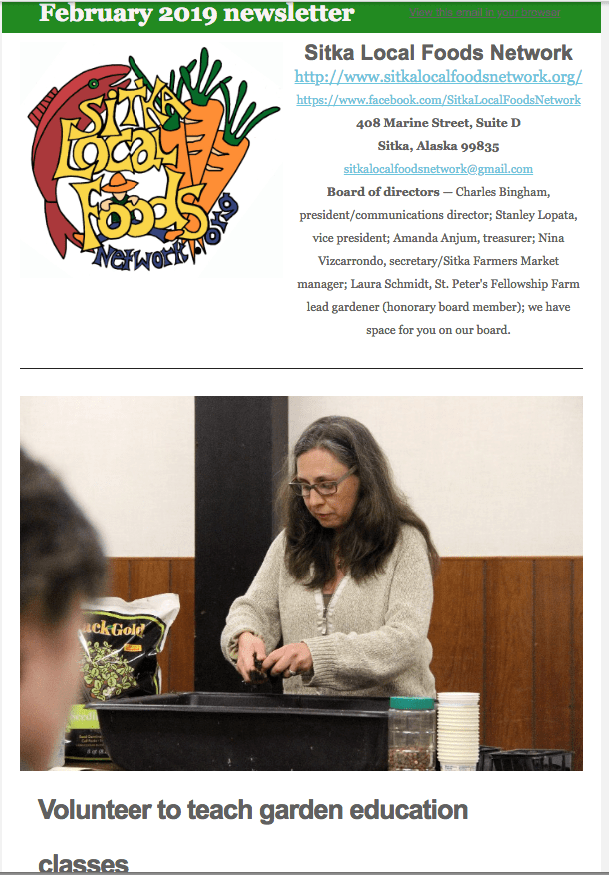
The Sitka Local Foods Network just sent out the February 2019 edition of its monthly newsletter. Feel free to click this link to get a copy.
This month’s newsletter includes short stories about a need for volunteer garden education instructors, the Pick.Click.Give. charitable donation program, the Southeast Alaska Farmers Summit in Sitka, the Sitka Food Business Innovation Contest, and an invitation to join our board and attend our next monthly board meeting. Each story has links to our website for more information.
You can sign up for future editions of our newsletter by clicking on the newsletter image in the right column of our website and filling in the information. If you received a copy but didn’t want one, there is a link at the bottom of the newsletter so you can unsubscribe. Our intention is to get the word out about upcoming events and not to spam people. We will protect your privacy by not sharing our email list with others. Don’t forget to like us on Facebook, like our Sitka Farmers Market page on Facebook and follow us on Twitter (@SitkaLocalFoods).
A certified food protection manager (CFPM) is responsible for monitoring and managing all food establishment operations to ensure that the facility is operating in compliance with food establishment regulations.
A CFPM is knowledgeable about food safety practices and uses this knowledge to provide consumers with safe food, protect public health and prevent food-borne illnesses. Alaska regulations require food establishments to have at least one CFPM on staff.
This course takes place from 8 a.m. to 5:30 p.m. (with a half-hour lunch), and participants will take a computer-based exam at the end of the class. The reason the deadline is two weeks before the class is to guarantee course materials reach all the students in time for the class. The cost is $200, and the course will be taught by Julie Cascio of Palmer. Students can register here, and the registration deadline is Jan. 28.
The Sitka videoconference for the class will take place in a room TBA at the University of Alaska Southeast Sitka Campus. To learn more, contact Jasmine Shaw at the Sitka District Office of the UAF Cooperative Extension Service at 747-9440, or contact Julie Cascio at (907) 745-3677 (Palmer number) or jmcascio@alaska.edu. Note, this class is taught in English but textbooks are available in Korean, Chinese and Spanish, just contact Julie at least three weeks before the class.
Also, the ServSafe book ($70) and certification exam ($75) now are available online, if people want to order the book and study independently without taking the class. Just go to this website and purchase the book and exam items.






 Sitka Local Foods Network
You must be logged in to post a comment.