UAF Cooperative Extension Service offers Certified Food Protection Manager class by videoconference March 30-31 in Sitka

The University of Alaska Fairbanks Cooperative Extension Service will teach a certified food protection manager workshop on Wednesday and Thursday, March 30-31. This is a two-day statewide class that will be offered by videoconferencing to Fairbanks, Palmer, Juneau, and Sitka, plus other locations that may arrange for the class.

A certified food protection manager (CFPM) is responsible for monitoring and managing all food establishment operations to ensure that the facility is operating in compliance with food establishment regulations.

A CFPM is knowledgeable about food safety practices and uses this knowledge to provide consumers with safe food, protect public health and prevent food-borne illnesses. Alaska regulations require food establishments to have at least one CFPM on staff.

This course takes place from 8:30 a.m. to 3 p.m., and participants will take a proctored computer-based exam at the end of the second day of class. The reason the registration deadline is two weeks before the class is to guarantee course materials reach all the students in time. The cost is $200, and the course will be taught by Julie Cascio of Palmer. Students can register here, and the registration deadline is Wednesday, March 16.

The Sitka videoconference for the class will take place in a room TBA at the University of Alaska Southeast Sitka Campus. To learn more, contact Jasmine Shaw at the Sitka District Office of the UAF Cooperative Extension Service at 747-9440, or contact Julie Cascio at (907) 745-3677 (Palmer number) or jmcascio@alaska.edu. Note, this class is taught in English but textbooks are available in Korean, Chinese and Spanish, just contact Julie at least three weeks before the class.

Also, the ServSafe book ($70) and certification exam ($85) now are available online, if people want to order the book and study independently without taking the class. Just go to this website and purchase the book and exam items.

AARP Alaska, UAF Cooperative Extension Service team up to teach five-class garden series online

Join AARP Alaska and the University of Alaska Fairbanks Cooperative Extension Service for a free, five-part virtual series on gardening, from starting seeds to cooking with home-grown herbs (and more). Each event will feature a different speaker and new topic, so you can join one or all.

You can register to receive the meeting link or watch live at the scheduled time on the AARP Facebook page.

Gardening: How to Successfully Start Seeds at Home 

Wednesday, March 30, 11 a.m. to 12 p.m.

Join Glenna Gannon from the Cooperative Extension Service in this workshop and demonstration to learn the basics of starting seeds at home in Alaska. You will learn which start-up supplies are necessary and the simple techniques to successfully start your own seeds. The benefit of starting your own seeds is that you can choose varieties that work well for your specific growing conditions, choose from a much wider selection of varieties that are often not found at your local nursery, and save money on plant starts year after year once you’ve made the initial investment in seed starting supplies. 

Register at https://aarp.cventevents.com/event/bdfeeeba-3fe9-42ef-81a4-dc45c722bccf/regProcessStep1

Gardening: Container Gardening

Wednesday, April 6, 11 a.m.to 12 p.m.  

Join Gina Dionne from the Cooperative Extension Service in this workshop to learn about container gardening, which has become very popular, and for good reason! In this class, you will learn how to make creative use of container gardens to allow you to grow your own food on a sunny deck, windowsill and other non-traditional spaces. 

Register at https://aarp.cventevents.com/event/9628b88c-e896-4b45-b8c6-2b6059414e07/regProcessStep1

Gardening: Growing and Cooking with Herbs 

Wednesday, April 13, 11 a.m. to 12 p.m.

Join Heidi Rader from the Cooperative Extension Service in this workshop to learn what herbs grow well in Alaska. Which ones come back (perennials) and which ones should you plant year after year? Which ones are easy to start from seed and which ones are easiest to grow from transplants or cuttings? Once you’ve started your herb garden, how do you use them in your everyday cooking? Learn about classic flavor combinations. 

Register at https://aarp.cventevents.com/event/7fa5e549-1f28-4646-bab2-0992473d89ec/regProcessStep1

Gardening: Growing Vegetables in Alaska 

Wednesday, April 20, 11 a.m. to 12 p.m.

Join Steve Brown from the Cooperative Extension Service in this workshop to learn how growing bountiful veggies is very easy if you know the tips of the Far North. This presentation will show you the secrets behind planning, planting, season extension, fertilization and pest control. 

Register at https://aarp.cventevents.com/event/6dcf11b6-bcb3-47bd-99d1-c8f2974f862b/regProcessStep1

Gardening: Love to Garden but Aches and Pains Getting in the Way? 

Wednesday, April 27, 11 a.m. to 12 p.m.

Join Art Nash from the Cooperative Extension Service to talk about accessible gardening ideas. Barriers to growing can come from injuries when we are young or normal pains as we grow older. Yet there are adaptations in how we plan out growing areas, modify the growing area or use altered tools. This session will look at various build-outs and alterations that can hopefully help as you age in place — in the garden.

Register at https://aarp.cventevents.com/event/4936d781-3866-4fbd-aed7-1d0e3a891764/regProcessStep1

Alaskans Own community-supported seafood program opens 2022 membership sales

Alaskans Own is excited to announce that seafood lovers throughout Alaska and Seattle can now sign up for Alaskans Own seafood’s 2022  monthly seafood shares, with the early bird sale starting on Monday, March 7.

This year marks the 13th year that Sitka-based Alaskans Own will deliver monthly shares of wild Alaska seafood directly to consumers through its community-supported fishery (CSF). Based on the widespread community-supported agriculture (aka, CSAs) model where people pay a farmer before the season for a share of the crop, CSFs are a way for people to buy a “share” of seafood before the fishing season, giving fishermen some certainty that they have a market before they head out to the fishing grounds. Founded in 2009 by the Alaska Longline Fishermen’s Association (ALFA), Alaskans Own is Alaska’s first and oldest community supported fishery and offers monthly seafood shares subscriptions in Fairbanks, Anchorage, Sitka, Juneau, and Seattle. 

In 2022, all profits from Alaskans Own seafood sales will go towards ALFA’s Fishery Conservation Network and Seafood Donation Program. The Seafood Donation Program was created in 2020 in response to COVID-19 and the rise in demand for food assistance throughout Alaska and the greater Pacific Northwest region. Thanks to funding from Catch Together, Multiplier, The Alaska Community Foundation and affiliates Sitka Legacy Fund, First Bank of Alaska, Sealaska, Sitka Rotary Club, and a host of individual and business donors, ALFA was able to help deliver more than 640,000 donated seafood meals to more than 100,000 families in 2020 and 2021. Given the Seafood Donation Program’s success and continued food insecurity amongst thousands of Alaska households, ALFA is hoping to expand the Seafood Donation Program and use Alaskans Own’s monthly seafood shares sales as a way to help sustain it.

“As a Community Supported Fishery, community is at the heart of who we are and everything we do at Alaskans Own. Our top priority is to take care of our community, whether that’s by paying local fishermen a good price for their catch, providing our customers with premium quality fish, or ensuring that all Alaskans can have access to nutritious, wild seafood,” said Natalie Sattler, Alaskans Own program director. “When someone signs up for our monthly seafood share, they’re not only taking care of their family’s health, but they’re also directly supporting conservation of Alaska’s fisheries and seafood donations for families in need.”

This year will be the option again for Alaskans Own customers to choose from a selection of monthly seafood shares, including a seafood variety share, salmon lovers share, and white fish share. All monthly seafood share options feature hook-and-line caught wild Alaska seafood harvested by Southeast Alaska’s troll and longline fishermen.

“The challenges that we all experienced as a result of the Covid pandemic  really reinforced for us at Alaskans Own that we want to do more than just deliver high quality seafood. We want our fish to do good for the greater good. We’re so grateful for our customers who believe in our mission and invest in it every time they buy seafood from Alaskans Own,” Alaskans Own founder, commercial fisherman, and ALFA executive director, Linda Behnken said. 

To learn more about Alaskans Own’s monthly seafood shares and other seafood products, visit www.alaskansown.com

Check out the March 2022 edition of the Sitka Local Foods Network newsletter

The Sitka Local Foods Network just sent out the March 2022 edition of its monthly newsletter. Feel free to click this link to get a copy.

This month’s newsletter includes short stories about the upcoming Alaska Food Festival and Conference on March 17-19, an update on the launch of the 2022 Sitka Food Business Innovation Contest, an item about the opening of the Alaska Permanent Fund Dividend application period (and Pick.Click.Give. application) on Jan. 1, an update about how you can support the Sitka Local Foods Network by buying a t-shirt or hoodie from our online store, information about our 2022 sponsorship programs, and an invitation to join our board of directors. Each story has links to our website for more information.

You can sign up for future editions of our newsletter by clicking on the newsletter image in the right column of our website and filling in the information. If you received a copy but didn’t want one, there is a link at the bottom of the newsletter so you can unsubscribe. Our intention is to get the word out about upcoming events and not to spam people. We will protect your privacy by not sharing our email list with others. Don’t forget to like us on Facebooklike our Sitka Farmers Market page on Facebook and follow us on Twitter (@SitkaLocalFoods).

Sitka Kitch to offer three classes for National Nutrition Month in March

JessicaFalafelSaladLettuce

March is National Nutrition Month, and the Sitka Kitch is offering three classes to help celebrate the month and healthy eating habits. These classes will be offered virtually using Zoom.

Jessica Holland, a registered dietitian nutritionist and certified diabetes educator specialist from the SouthEast Alaska Regional Health Consortium (SEARHC) in Sitka will teach the first and last of the three classes. Audra Henderson will teach the middle class. She is a functional nutritional therapy practitioner, a certified personal trainer, and a nutrition educator who works with the University of Alaska Fairbanks Cooperative Extension Service in Juneau.

Both teachers have private practices, and you can learn more about Jessica at https://www.realnutritionrd.com/ and more about Audra at https://www.audrawellness.com/.

The three classes and their basic details are as follows:

  • Class No. 1 — Falafel Salad, 5:30-7 p.m., Friday, March 11, taught by Jessica Holland, $40. Learn how to make deep-fried or pan-seared falafel balls with ground chickpeas, herbs, spices, and onions, then add them to a salad. Ingredients provided (pick up from 4-6 p.m. on Thursday, March 10, at the SEARHC Health Promotion table at the regional basketball tournament at Mount Edgecumbe High School). Registration deadline 11:30 p.m. on Tuesday, March 8, class limited to eight students. Eligible for Sitka Food Co-op discount (see details below).
  • Class No. 2 — Celebrate Making A Change, 5-6 p.m., Sunday, March 20, taught by Audra Henderson, Free. Want to make a healthy change? This is your first step! In this class we will focus on eating a nutrient dense, properly prepared diet, safe and fun ways to move our body, and healthy habit formation. Registration deadline 11:30 p.m. on Thursday, March 17, class limited to 20 students. Even though the class is free, please register online so we can send you the Zoom link.
  • Class No. 3 — Alaska Bounty Salad, 5:30-7 p.m. on Friday, March 25, taught by Jessica Holland, $40. Learn how to celebrate your Alaska harvest by making a salad with halibut (or salmon) and veggies you can grow or harvest locally. Ingredients provided (pick up from 4-6 p.m. on Thursday, March 24, at Beak Restaurant). Registration deadline 11:30 p.m. on Tuesday, March 22. Class limited to eight students. Eligible for Sitka Food Co-op discount (see details below).

The class cost is $40 for both of Jessica’s classes (Audra’s class is free). There is limit on the class size, and ingredients for Jessica’s classes will be provided at the location mentioned in the bulleted list. A link to the Zoom event also will be sent at the end of the registration period. Please connect online at least 10 minutes before the class starts.

Current (paid) members of the Sitka Food Co-op are now able to attend Jessica’s online classes for $30 each (the co-op will cover the other $10 of your class fee). Please use the Sitka Food Co-op ticket when you register and send an email to sitkafoodcoop@gmail.com letting them know you’re in the class. (NOTE, Only one person per Co-op household may use the Co-op discount per class. Please name that person when you register so the name can be checked against the Co-op membership list.)

The registration deadline is 11:30 p.m. two days before each class. Space is limited, so register early to secure your place in the class. Even though Audra’s class is free, please register online so we can send you the Zoom link. You can register and pre-pay using credit/debit cards or PayPal on the Sitka Kitch EventSmart online registration page, http://sitkakitch.eventsmart.com (click on class title). For those wanting to pre-pay with cash or check, please call Chandler O’Connell or Kylee Jones at Sitka Conservation Society (747-7509) to arrange a payment.

For more information about the class, contact Jasmine Shaw at 747-9440. We occasionally offer one scholarship spot per class for people with limited incomes, provided we have enough students registered to make the class happen. Contact Chandler or Kylee at SCS for more details about the scholarship.

The Sitka Kitch is supported in partnership by Sitka Conservation Society with UAF Cooperative Extension Service. These classes are fundraisers for the Sitka Kitch community rental commercial kitchen.

The Sitka Kitch also has a new class cancelation policy. If you register for a class, then find out you can’t attend, please email us at sitkakitch@sitkawild.org and we may be able to help fill your slot through our waiting list. If you cancel from the class at least five days in advance (eg, by Wednesday the week before for a Monday class), you are eligible for a partial refund of your class fee, minus $5 for processing (in this case, $35 or $25, depending on if you are paying full price or getting the Sitka Food Co-op discount). If you need to cancel with fewer than five days advance notice, there is no refund.

Southeast Alaska Master Gardeners Association to host Weedy Wednesdays in March

The Southeast Alaska Master Gardeners Association will host a series of Zoom classes on gardening in Southeast Alaska starting in March.

The Weedy Wednesdays classes will be taught online from noon to 1 p.m., and will be archived for people who missed them. A brief presentation will be given, followed by a panel of Master Gardeners available to answer questions related to the presentation or general gardening.

The class dates and their topics are:

  • March 16 — Spuds 101
  • March 23 — Seed Starting
  • March 30 — Prepping a New Garden
  • April 6 — Transplanting

Please submit questions ahead of time to info@seak-mastergardeners.org. Please make any accommodation requests related to a disability seven business days in advance. To register, please visit https://bit.ly/3LV4ioE.

Thanks to all who participated in the Sitka community food asset-mapping workshop

The Sitka Local Foods Network wants to thank everybody who participated in the Sitka community food system asset-mapping workshop held Saturday afternoon (Feb. 19).

Thanks to Lisa Trocchia for facilitating the workshop, as well as the other local/regional asset-mapping sessions taking place this winter across Alaska. This is part of an 18-month USDA Regional Food System Partnership planning grant coordinated by the Alaska Food Policy Council. The next step will be part of an implementation grant to take the results of all of of the local/regional asset-mapping sessions and use them to build a 10-year state food security plan.

In Sitka, we hope to use some of the information and connections gathered in today’s workshop to improve our local food security. We also hope to use the information to possibly update the 2014 Sitka Community Food Assessment Indicators Report, which gave us a lot of baseline planning data that now is nearly a decade old.

For those who weren’t able to attend, please watch for a survey link that will be posted in the next few weeks to gather more information. Also, the recorded Zoom meeting and the asset-mapping Google document are linked in the Documents section of this website, under food security.

If you are interested in helping improve Sitka’s food security, contact Sitka Local Foods Network board president Charles Bingham at sitkalocalfoodsnetwork@gmail.com or 907-623-7660. The next SLFN board meeting is at 6 p.m. on Wednesday, March 30, by Zoom, and these meetings are open to the public.

Division of Agriculture offers micro-grants to improve food security in Alaska

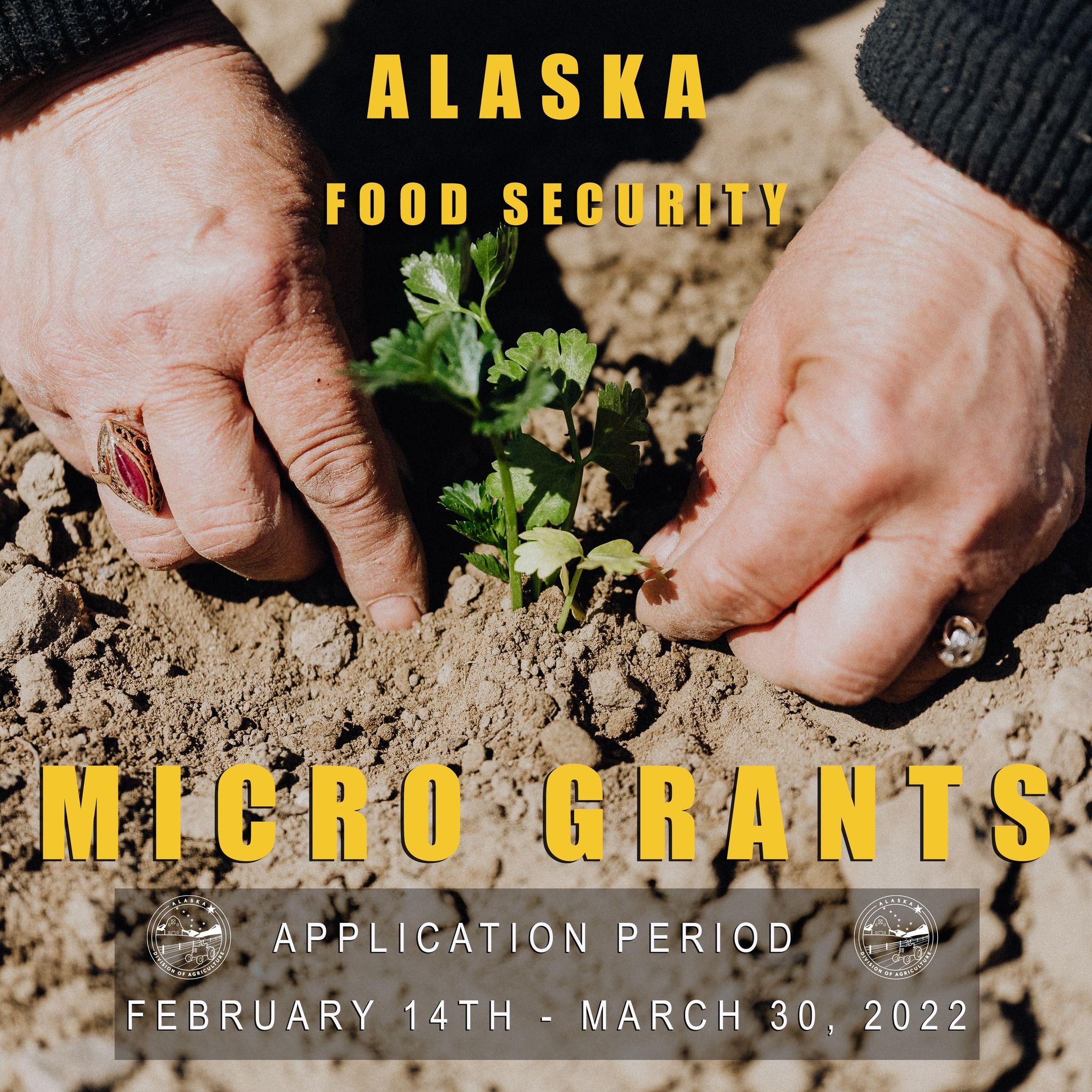
PALMER, Alaska – As part of a continuing effort to improve food security for Alaskans, the Alaska Division of Agriculture is offering $2 million in micro-grants to individuals and organizations who want to grow and preserve their own food.

The grants are being offered through the U.S. Department of Agriculture’s Micro-Grants for Food Security Program (MGFSP). This is the second year the grants have been offered in Alaska. In 2021, the Division of Agriculture received more than 1,000 proposals for funding and awarded more than $1.6 million to 234 grantees (Including several in Sitka). 

“The last two years have taught Alaskans the importance of increasing local production of food and storage capabilities,” Alaska Division of Agriculture Director David W. Schade said, referring to supply chain issues related to the COVID-19 pandemic. “We are fortunate to offer another opportunity to apply for the micro-grants in 2022. We have worked with USDA to simplify the process and expand the opportunity for more Alaskans to receive funding.” 

The grant application period opened on Monday, Feb. 14, and closes at 5 p.m. on Wednesday, March 30. 

Individuals can apply for up to $5,000 and qualifying organizations can apply for up to $10,000. The grants are for one year and can be for anything from building a greenhouse to growing a garden to buying a freezer to fencing in livestock. Preference is given to individuals and groups in Alaska’s most vulnerable areas in terms of food security. 

“We will prioritize funding of grants for projects that affect our most food-insecure areas and increase local food production and storage.” Schade said. 

The Micro-Grants for Food Security program is part of the 2018 Farm Bill that created a special program for Alaska, Hawaii and the U.S. Territories for improvements to food security. The program helps individuals and organizations increase the quantity and quality of locally grown food in food insecure communities through small-scale, agricultural-related projects. Qualifying projects may include small-scale gardening, small-scale herding and livestock operations, and/or expanding access to food, safe food storage, and knowledge of food security. 

The program has undergone several changes, which will increase the opportunities for more Alaskans to participate and reduce the challenges of the reimbursement process and reporting for those receiving grants. 

“I am pleased that the USDA Agriculture Marketing Service has approved Alaska’s new streamlined, simple process for grant projects, as many grant programs are difficult for many of our rural residents to use,” Gov. Mike Dunleavy said. “Food security is a high priority of my administration and support of this program continues my administration’s efforts to move Alaska toward greater food independence”. 

More detailed information on the micro-grants can be accessed at the Division of Agriculture website. For questions not addressed on the website refer to the Alaska Grown Facebook LIve events. You may also submit questions with Micro-grants 2022 in the subject line to dnr.ag.grants@Alaska.gov. 

Applications must be submitted electronically via the Division of Agriculture SmartSimple application portal. Instructional videos for how to submit the application can be found at Alaska Grown – YouTube

Southeast Alaska Farmers Summit to host virtual farm tours on Feb. 26

The 2022 Southeast Alaska Farmers Summit may have been postponed until 2023, due to Covid-19, but there’s still a way for Southeast growers to connect this month. The Southeast Alaska Farmers Summit will host virtual farm tours from 9 a.m. to just past noon on Saturday, Feb,. 26, via Zoom. This will be a relaxed and informal event.

“Whether you are a farmer, gardener, agricultural industry professional, or local food enthusiast, this event is for you,” event organizers Bo Varsano and Marja Smets of Farragut Farm near Petersburg wrote in an email. “Everyone is welcome to ‘Zoom in’ on a snapshot of what agriculture looks like in Southeast Alaska today. Three regional farmers — Ivy Patch Produce in Wrangell, Foundroot in Haines and St. Peter’s Fellowship Farm in Sitka — will be sharing photos and stories of their farming operations, with plenty of time allotted for questions from the audience.”

After a welcome and introduction from 9-9:30 a.m., Katherine Ivy of Ivy Patch Produce in Wrangell will give a talk and show photos of her operation from 9:30-10:15 a.m. Leah Wagner and Nick Schlosstein of Foundroot in Haines will present from 10:15-11 a.m. After a short break from 11-11:10 a.m., Laura Schmidt of St. Peter’s Fellowship Farm (operated by the Sitka Local Foods Network) will speak from 11:10-11:55 a.m. There will be closing remarks at noon.

“The 2022 Southeast Alaska Farmers Summit has been postponed until February 2023,” Bo and Marja wrote. “If you were planning on attending that event, this is a great opportunity to touch base and make connections in the meantime.”

To register and get the Zoom link, click this link. To learn more about the Southeast Alaska Farmers Summit, click this link.

Gov. Mike Dunleavy establishes Alaska Food Security and Independence Task Force

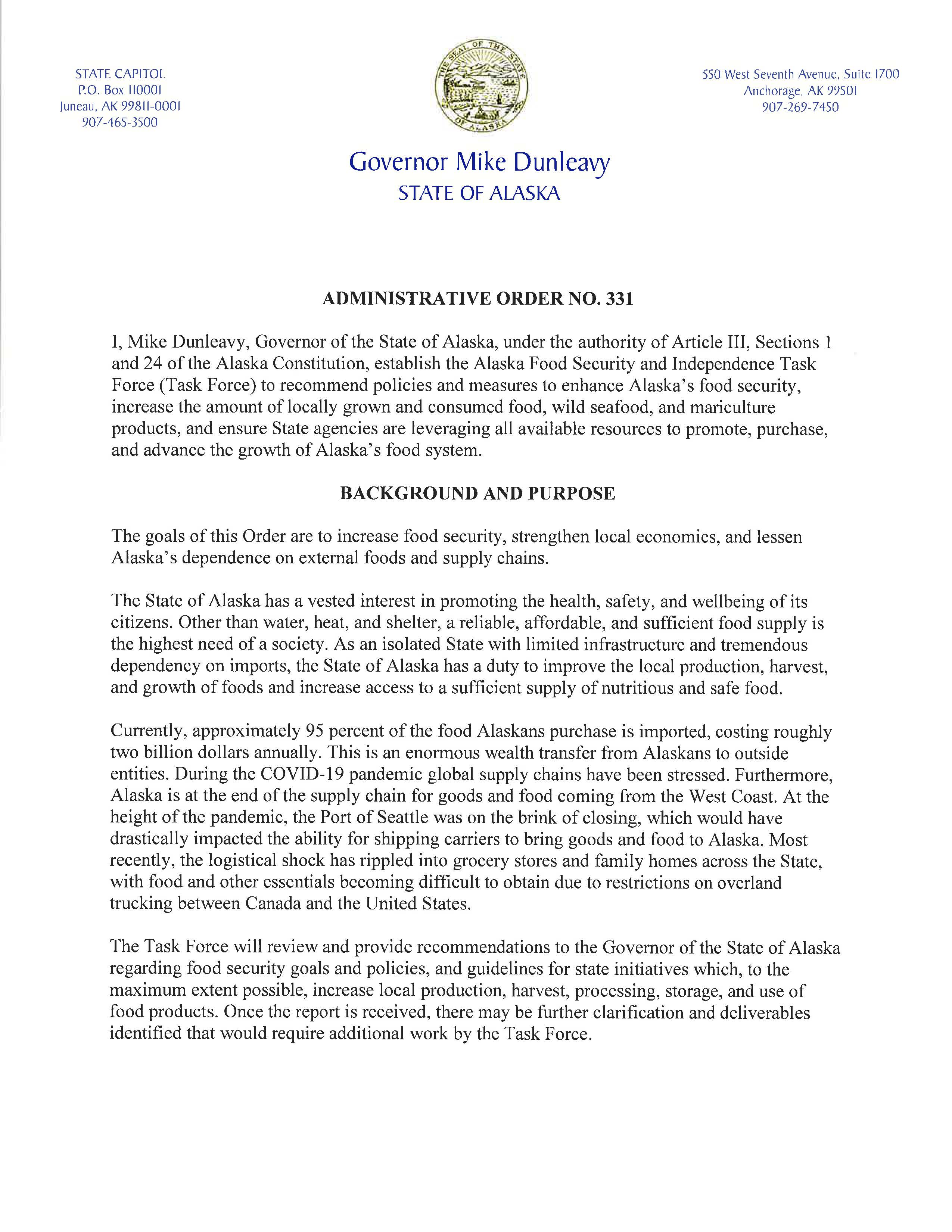
The first of four pages of Administrative Order 331, which creates the task force.

Today (Feb. 9, 2022), Gov. Mike Dunleavy issued Administrative Order 331  (downloads the full four-page document as PDF) establishing the Alaska Food Security and Independence Task Force.

Alaska currently imports 95 percent of its food supplies at a cost of $2 billion per year. The global pandemic triggered supply chain disruptions on the West Coast of the United States that continue to impact the regular delivery of food and other essential goods to Alaska. The 18-member task force will be responsible for recommendations on how to increase all types of food production and harvesting in Alaska, and to identify any statutory or regulatory barriers preventing our state from achieving greater food security.   

“Over the past two years Alaskans have walked into grocery stores and been greeted by row after row of empty shelves,” Gov. Dunleavy said. “One of the lessons the pandemic taught us is how vulnerable Alaska could be if the regularly scheduled shipments of food shipped up from Seattle were to suddenly stop – even a few days. The good news is Alaska has tremendous potential to grow, harvest and catch more nutritious food for in-state consumption. The recommendations from the task force will draw a roadmap for my administration, legislators and Alaska’s food producers to make Alaska more food secure the next time the supply chain is disrupted.”

The task force will have 10 main duties and responsibilities:

  • Provide recommendations that increase the procurement and use of Alaska-sourced foods within state and local agencies, institutions, and schools, including any administrative and statutory changes that are required.
  • Identify barriers that farmers, stock growers, fishermen, mariculture professionals, and others engaged in the growing, harvesting, or raising of food, face when starting a business or getting their products in to the Alaska market. Provide recommendations on how the state can address those obstacles, including through administrative or statutory changes.
  • Assess the levels of wild game and fish harvests in Alaska. Suggest measures that would increase the abundance and harvest of wild game, fish, and food by Alaskans.
  • Recommend a program to assist communities and households impacted by fishery shortfalls and disasters.
  • Identify factors, including regulatory or statutory burdens, that might discourage or prevent locally harvested and produced food from being purchased by federal, state, and local agencies, institutions, and schools.
  • Identify research needed to support and encourage increased consumption and production of Alaska-sourced food within the state.
  • Engage with the public to seek additional input on ways to promote the above listed goals.
  • Assess the need for disaster food caches within the state; and how the caches can be developed utilizing Alaskan-sourced foods.
  • Provide a report and summary of findings and recommendations, including what administrative and statutory changes would be needed to accomplish the recommendations of the task force.
  • The chair of the task force shall report regularly to the office of the governor on activities conducted and issues that arise under this order.

The task force will be made up of 16 voting members. Twelve Alaskans representing a cross section of the state’s farming, mariculture and seafood industries and four state commissioners (Natural Resources, Fish and Game, Environmental Conservation, Military and Veterans Affairs) or their designees will serve on the board. Two ex-officio members from the Alaska House of Representatives and the Alaska State Senate are to be appointed by the Senate President and the Speaker of the House.

The administrative order requests, but does not require, the two legislators be current members of the Alaska Grown Legislative Caucus.

The Task Force will issue a report on its findings and recommendations on or before September 1, 2022.