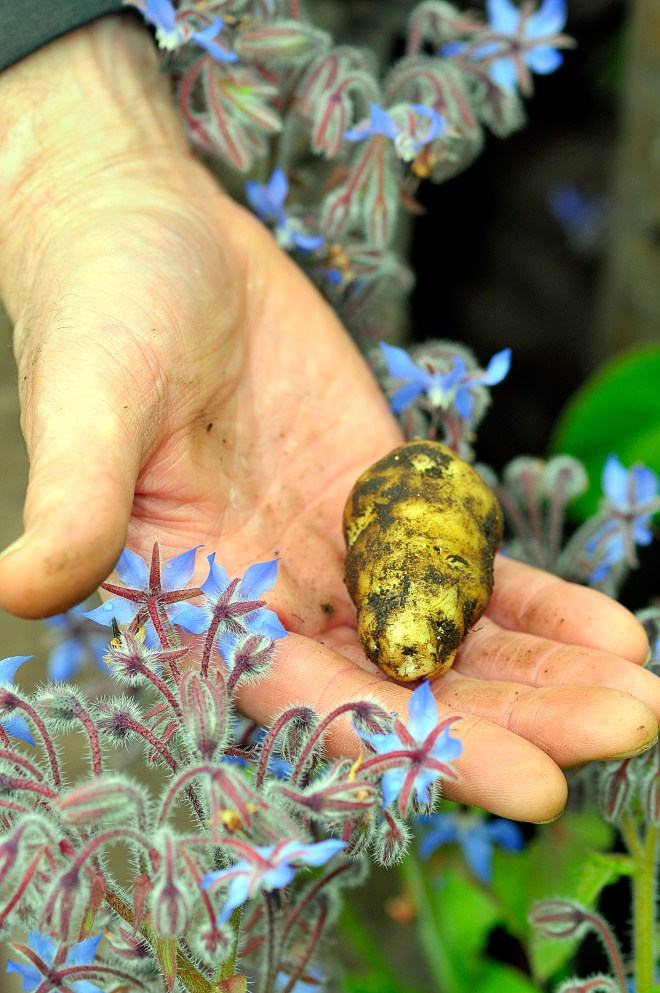
(Photo courtesy of Klas Stolpe/Juneau Empire) Bill Ehlers, assistant gardener at the Jensen-Olson Arboretum in Juneau, holds a Tlingít potato next to some of the potato plant’s flowers.
The U.S. Forest Service-Sitka Ranger District and Sitka Tribe of Alaska will join forces again on Friday, April 20, to create an educational opportunity and traditional food source for community members. Forest Service staff and the tribe will share how to grow Tlingít (sometimes called Maria’s) potatoes, and share the biology, history, and cultural aspects of these interesting potatoes.
Since 2017, the Sitka Ranger District has provided a sunny plot of land to serve as the shared potato garden and provided the seed potatoes to plant the garden. The Sitka Tribe’s Traditional Foods Program and the gardening class from Pacific High School assisted on the project, and will again this year. But community involvement is also needed. Volunteers are asked to bring boots, gardening gloves, and shovels. Five gallon buckets of kelp to incorporate into the soil would be beneficial as well. Members of the community who help tend the shared garden may receive more than gratitude as their reward.
“Last fall we shared the harvest among those helping out and through the Sitka Tribe’s Traditional Foods Program. We’ve been growing and naturally enhancing our soil this spring, so this year we hope the crop is even larger,” District Ranger Perry Edwards said. “This project teaches people how to grow and sustain a traditional food, while supporting the need for food security among Sitka families. It’s also a fun and very sustainable way to celebrate Earth Day.”
Tlingit potatoes have been present in Tlingit gardens for over 200 years. The potatoes originate from Mexico or Chile* and were a trade item in Southeast Alaska in the early 1800’s.
The first work day and educational opportunity will be from 9:30-11:30 a.m. on Friday, April 20, at the Sitka Ranger District office, located at 2108 Halibut Point Road. For more information, contact Michelle Putz at 907-747-2708 or mputz@fs.fed.us.
*Zhang, Linhai with Charles R. Brown, David Culley, Barbara Baker, Elizabeth Kunibe, Hazel Denney, Cassandra Smith, Neuee Ward, Tia Beavert, Julie Coburn, J. J. Pavek, Nora Dauenhauer and Richard Dauenhauer. Inferred origin of several Native American potatoes from the Pacific Northwest and Southeast Alaska using SSR markers. Euphytica 174:15-29
A Mount Edgecumbe High School student examines herring gills under a microscope. (Photo courtesy of Bethany Goodrich)
Students in Sitka schools have been diving deep into the study of herring during Sitka Tribe of Alaska’s fifth annual Herring Camp. The Herring Camp programming was centered on the cultural and ecological importance of Pacific herring and timed to coincide with the arrival of herring in Sitka Sound. Sitka Tribe of Alaska staff spent a week at both Mount Edgecumbe High School and Sitka High School studying herring anatomy and collecting oceanographic data. Sitka Tribe of Alaska staff also examined marine food webs with Blatchley Middle School and will present a “Herring in the Hallways” microscopy event at Keet Gooshi Heen Elementary School next week.
A Sitka High School student collects plankton aboard a Sitka Herring Camp research cruise. (Photo courtesy of Tara Racine)
Students and teachers have responded positively to the herring programming. Chohla Moll, MEHS science teacher said, “The STA Herring Camp curriculum is an amazing integration of science and traditional ecological knowledge. It illustrates to students the strong connection between the knowledge of their elders and the scientific information they are learning in school.”
The purpose of Sitka Tribe of Alaska’s Herring Camp is to invest in youth skills, providing students with hands-on science experience and exposing them to Alaska-based career opportunities. Kyle Rosendale, Sitka Tribe of Alaska’s Fisheries Biologist said, “We hope students will gain a greater understanding and appreciation of their local ecosystems and be motivated to become the next generation of stewards for important cultural and ecological resources like herring.”
Students who participated in the Herring Camp learned scientific techniques, gained exposure to traditional ecological knowledge, and connected with Sitka professionals working on natural resource management. The week-long high school camp sessions included dissection labs, discussions on cultural connections and herring ecology, oceanographic and morphometric data analysis, an introduction to fisheries management techniques, career path discussions, and a research cruise during which students applied a variety of field observation and data collection skills.
Herring provide a rich topic of study for local students. Sitka Sound is the last remaining population of herring in the state that consistently provides a significant subsistence herring egg harvest. Sitka herring eggs are shared widely throughout Alaska. Herring are a forage fish and a critical part of the marine food web, providing food for other important species such as lingcod, coho salmon, king salmon, halibut, sea lions and humpback whales. Coastal archeologist Iain McKechnie called herring the “central node of the marine ecosystem”, adding “they aren’t the base, they aren’t the top, but they are the thing through which everything else flows.”
Herring Camp (aka, Yaa Khusgé Yaaw Woogoo, or Knowledge of Herring Camp) was started in 2014 and was originally held at Sitka National Historical Park. Now in its fifth year, the Herring Camp has grown to reach classrooms in four local schools and is made possible through collaboration with MEHS, the Sitka School District, the Alaska Department of Fish & Game, the US Forest Service, the National Park Service, the University of Alaska Southeast Sitka Campus, the Sitka Conservation Society, the Sitka Sound Science Center, and Allen Marine. Rosendale explains, “Collaboration is absolutely critical to the success of Herring Camp; we couldn’t do it without our collaborators, all of whom have made important contributions to herring outreach and education in Sitka.”
Sitka Tribe of Alaska’s work with Blatchley students was also a part of another community collaboration on herring and food webs. In addition to working with Sitka Tribe of Alaska staff, BMS science teacher Stacy Golden also planned lessons with Charlie Skulkta, Jr., St. Lazaria National Wildlife Refuge, the Alaska Raptor Center, and a boat trip to St. Lazaria.
Financial support for this initiative was generously provided the Bureau of Indian Affairs and the Alaska Conservation Foundation.
This year’s camp is held in loving memory of Michelle Ridgeway of Oceanus Alaska. Michelle was a passionate scientist and youth educator. She helped get the Herring Camp off the ground in 2014 and was an integral part of the camp every year until her passing in January of 2018. Her creativity and enthusiasm are deeply missed.
(EDITOR’S NOTE: The following article first appeared on this site in April 2010. It is repeated because much of the information remains current and newsworthy.)
In the cold winter of 1994, Anchorage Daily News garden columnist and former Garden Writers Association of America President Jeff Lowenfels was returning to his hotel after a Washington, D.C., event when he was approached by a homeless person who asked for some money to buy food. Lowenfels said Washington, D.C., had signs saying, “Don’t give money to panhandlers,” so he shook his head and kept on walking. But the man’s reply, “I really am homeless and I really am hungry. You can come with me and watch me eat,” stayed with Lowenfels for the rest of his trip.
Jeff Lowenfels
The encounter continued to bother Lowenfels, even as he was flying back to Anchorage. During the flight, Lowenfels came up with an idea when he started writing his weekly garden column (the longest continuously running garden column in the country, with no missed weeks since it started on Nov. 13, 1976). He asked his readers to plant one extra row in their gardens to grow food to donate to Bean’s Café, an Anchorage soup kitchen. The idea took off.
When Anchorage hosted the Garden Writers Association of America convention in 1995, Lowenfels took the GWAA members to Bean’s Café to learn about the Plant A Row For Bean’s Café program. The Garden Writers Association of America liked the idea, and it became the national Plant A Row For The Hungry campaign (also known as Plant A Row or PAR). In 2002, the Garden Writers Association Foundation was created as a national 501(c)(3) nonprofit to manage the Plant A Row For The Hungry program.
“I am not surprised by the growth of PAR,” Lowenfels wrote in an e-mail to the Sitka Local Foods Network. “It is now in all 50 states and across Canada and there are thousands of variations of the original program — from prison gardens for the hungry to botanical gardens donating their produce from public display gardens. This is because gardeners always share information and extra food, so the idea was a natural.”
It took five years for the program to reach its first million pounds of donated food, but the second million only took two years and the next eight years saw a million pounds of donated food (or more) each year. Since 1995, more than 14 million pounds of food have been donated. Not only that, the program is getting ready to expand overseas to Australia, England and other countries with avid gardeners.
“We have supplied something in the vicinity of enough food for 50 million meals,” Lowenfels wrote in his e-mail. “Gardeners can solve this hunger problem without the government. And we don’t need a tea party to do it! Or chemicals, I might add, as author of a book on organic gardening!” Lowenfels is the author of Teaming With Microbes, written with Wayne Lewis. He released a second book, Teaming With Nutrients, as a follow-up to his first book, and in 2017 released a third book, Teaming With Fungi, as a second follow-up book.
According to the U.S. Department of Agriculture, one out of every eight U.S. households experiences hunger or the risk of hunger. Many people skip meals or eat too little, sometimes going an entire day or more without food. About 33 million Americans, including 13 million children, have substandard diets or must resort to seeking emergency food because they can’t always afford to buy the food they need. In recent years, the demand for hunger assistance has increased 70 percent, and research shows that hundreds of children and adults are turned away from food banks each year because of lack of resources.
According to the 2014 Sitka Community Food Assessment Indicators Report, about one in six people in Sitka is food insecure. In 2013, there were 1,410 Sitkans (out of a population of about 9,000) and 766 families receiving food assistance (SNAP, aka food stamps). There also were 229 individuals who received food pantry assistance from the Salvation Army and 7,243 meals served through its lunch soup kitchen in 2013, and that number has grown substantially since then.
While many people credit Lowenfels for creating the Plant A Row For The Hungry program, Lowenfels says the real heroes are the gardeners growing the extra food and donating it to local soup kitchens, senior programs, schools, homeless shelters and neighbors. You can hear him pass along the credit to all gardeners at the end of this 2009 interview with an Oklahoma television station (video also embedded below).
“One row. That’s all it takes. No rules other than the food goes to the hungry. You pick the drop-off spot or just give it to a needy friend or neighbor. Nothing slips between the lip and the cup, I say,” Lowenfels wrote in his e-mail.
For people wanting to Plant A Row For The Hungry in Sitka, there are several places that would love to help distribute some fresh locally grown veggies or berries to those who are less fortunate, such as the Salvation Army, Sitkans Against Family Violence (SAFV), local churches, Sitka Tribe of Alaska and other organizations. The food the Sitka Local Foods Network grows at St. Peter’s Fellowship Farm communal garden goes to the Sitka Farmers Market, school lunches and other programs.
The Sitka Local Foods Network also takes donations of local produce to sell at the Sitka Farmers Markets, and all proceeds are used to help pay for SLFN projects geared toward helping more people in Sitka grow and harvest local food. For more information, contact the Sitka Local Foods Network board members at sitkalocalfoodsnetwork@gmail.com.
The Sitka Kitch is hosting two food and home skills classes this month in partnership with the Juneau office of the University of Alaska Fairbanks Cooperative Extension Service. The first class is Naturally Clean Home Products, and the second class is Starting a Cottage Foods Business. Both classes will be taught by videoconference in Sitka with Sarah Lewis teaching in Juneau.
Naturally Clean Home Products — 1-3 p.m., Saturday, April 7, Videoconference with Sarah Lewis of Juneau office of UAF Cooperative Extension Service. This class will teach you how to reduce your use of harsh, chemical cleaners but still be able to do deep cleaning. Students need to bring five 32-ounce spray bottles and a 20-ounce jar with lid (or six quart canning jars to store products to take home and then transfer to spray bottles). Class fee is $20, no supply fee.
Starting A Cottage Foods Business — 1-3 p.m., Saturday, April 14, Videoconference with Sarah Lewis of Juneau office of UAF Cooperative Extension Service. Learn about state laws regarding home food businesses, and get ideas for businesses you might take to the Sitka Farmers Market or local trade shows. Tours of the Sitka Kitch and rental information will be available. Class fee is $10, no supply fee. The Sitka Local Foods Network offers class participants half-off the registration fee for their first Sitka Farmers Market in 2018.
You can register online and pre-pay using credit/debit cards or PayPal at https://sitkakitch.eventsmart.com (click on the class title to register). To pre-pay by cash or check, contact Chandler, Claire, or Clarice at 747-7509 to arrange payment. For more information about the class series, contact Jasmine at 747-9440.
The Sitka Local Foods Network just sent out the April 2018 edition of its monthly newsletter. Feel free to click this link to get a copy.
This month’s newsletter has short articles that include the announcement of spring gardening classes, a deadline reminder about the Pick.Click.Give. donation program, an update on the deadline for our new Sitka Food Business Innovation Contest, information about our sponsorship program, and an invitation to join our board of directors. Each story has links to our website for more information.
You can sign up for future editions of our newsletter by clicking on the newsletter image in the right column of our website and filling in the information. If you received a copy but didn’t want one, there is a link at the bottom of the newsletter so you can unsubscribe. Our intention is to get the word out about upcoming events and not to spam people. We will protect your privacy by not sharing our email list with others. Don’t forget to like us on Facebook, like our new Sitka Farmers Market page on Facebook and follow us on Twitter (@SitkaLocalFoods).
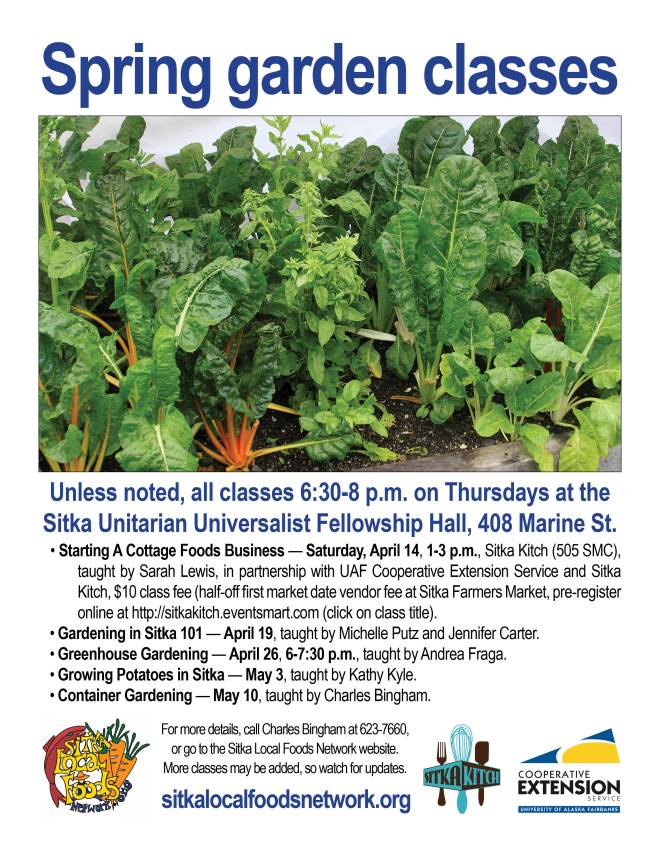
Want to learn how to grow your own food? Are you new to Sitka and want to learn what veggies grow in our town? The Sitka Local Foods Network education committee has a list of free 2018 spring garden classes that can help you learn what to do and when to do it so you have a healthy garden.
This spring, most of our classes will take place from 6:30-8 p.m. on Thursdays at the Sitka Unitarian Universalist Fellowship Hall (408 Marine Street, parking off Spruce Street). Each week will feature a different topic, and all classes are free (donations to the Sitka Local Foods Network will be accepted). The class schedule is as follows:
Starting A Cottage Foods Business — Saturday, April 14, 1-3 p.m., Sitka Kitch (505 SMC), taught by Sarah Lewis, in partnership with UAF Cooperative Extension Service and Sitka Kitch, $10 class fee (half-off first market date vendor fee at Sitka Farmers Market, pre-register online at http://sitkakitch.eventsmart.com (click on class title).
Gardening in Sitka 101 — April 19, taught by Michelle Putz and Jennifer Carter.
Greenhouse Gardening — April 26, 6-7:30 p.m., taught by Andrea Fraga.
Growing Potatoes in Sitka — May 3, taught by Kathy Kyle.
Container Gardening — May 10, taught by Charles Bingham.
For more information about the classes, contact Charles Bingham at 623-7660 or charleswbingham3@gmail.com. Other classes may be added at a later date if we find volunteers to teach them. If you are a Sitka gardener who wants to teach a class, contact Charles at the info above.
Renée will teach students how to make a herring egg salad and sushi. Due to the vagaries of the seasons in Sitka, this class will be moved to April 10 if the herring are running late (students will be notified and refunds will be available for students who can’t make the later date).
National Nutrition Month Healthy Cooking Demonstration — 5:30-7 p.m., Tuesday, March 27, Free event with SEARHC health educator Heleena Van Veen, health educator Holly Marban, registered dietitian Jessica Holland and diabetes nurse Kelly Lakin. This year’s National Nutrition Month theme is “Go Further With Food,” so students will learn creative ways to use leftovers and how to store food so it doesn’t spoil.
Naturally Clean Home Products — 1-3 p.m., Saturday, April 7, Videoconference with Sarah Lewis of Juneau office of UAF Cooperative Extension Service. This class will teach you how to reduce your use of harsh, chemical cleaners but still be able to do deep cleaning. Students need to bring five 32-ounce spray bottles and a 20-ounce jar with lid (or six quart canning jars to store products to take home and then transfer to spray bottles). Class fee is $20, no supply fee.
Starting A Cottage Foods Business — 1-3 p.m., Saturday, April 14, Videoconference with Sarah Lewis of Juneau office of UAF Cooperative Extension Service. Learn about state laws regarding home food businesses, and get ideas for businesses you might take to the Sitka Farmers Market or local trade shows. Tours of the Sitka Kitch and rental information will be available. Class fee is $10, no supply fee. The Sitka Local Foods Network offers class participants half-off the registration fee for their first Sitka Farmers Market in 2018.
Puerto Rican Cooking With Nina Vizcarrondo — 6-8:30 p.m., Wednesday, May 2, Learn how to cook sofrito with recao, empanadas or pastelon, and arroz con gandules from Nina, a former U.S. Coast Guard chef and the current Sitka Farmers Market manager.
Class space is limited, so register early. This class costs $27.50 per person, plus a food/supply fee split between the registered students. The Herring Appreciation class registration deadline is 11 p.m. on Saturday, March 31.
You can register online and pre-pay using credit/debit cards or PayPal at https://sitkakitch.eventsmart.com (click on the class title to register). To pre-pay by cash or check, contact Chandler, Claire, or Clarice at 747-7509 to arrange payment. For more information about the class series, contact Jasmine at 747-9440.
SEARHC health educator Heleena Van Veen, health educator Holly Marban, registered dietitian Jessica Holland and diabetes nurse Kelly Lakin will lead this demonstration. Topics include which grocery staples people should buy for their kitchens, how to prevent food waste, how to make a variety of meals using grocery staples and subsistence food, and how to use leftovers to fertilize your garden.
Since this event is free, there is no online registration page. For more details, contact Heleena Van Veen at 966-8914 or heleenav@searhc.org.
After this event, the next Seasonal Cooking classes include:
Naturally Clean Home Products — 1-3 p.m., Saturday, April 7, Videoconference with Sarah Lewis of Juneau office of UAF Cooperative Extension Service. This class will teach you how to reduce your use of harsh, chemical cleaners but still be able to do deep cleaning. Students need to bring five 32-ounce spray bottles and a 20-ounce jar with lid (or six quart canning jars to store products to take home and then transfer to spray bottles). Class fee is $20, no supply fee.
Starting A Cottage Foods Business — 1-3 p.m., Saturday, April 14, Videoconference with Sarah Lewis of Juneau office of UAF Cooperative Extension Service. Learn about state laws regarding home food businesses, and get ideas for businesses you might take to the Sitka Farmers Market or local trade shows. Tours of the Sitka Kitch and rental information will be available. Class fee is $10, no supply fee. The Sitka Local Foods Network offers class participants half-off the registration fee for their first Sitka Farmers Market in 2018.
Puerto Rican Cooking With Nina Vizcarrondo — 6-8:30 p.m., Wednesday, May 2, Learn how to cook sofrito with recao, empanadas or pastelon, and arroz con gandules from Nina, a former U.S. Coast Guard chef and the current Sitka Farmers Market manager.
Class space is limited, so register early. Unless noted, the Seasonal Cooking classes cost $27.50 per person, plus a food/supply fee split between the registered students.
Register online at https://sitkakitch.eventsmart.com/ (click on class title) and pre-pay using credit/debit cards or PayPal. To pre-pay by cash or check, contact Chandler, Claire, or Clarice at 747-7509 to arrange payment. For more information about the class series, contact Jasmine at 747-9440.
The sixth annual Sitka Food Co-op annual meeting and potluck dinner will be from 3-5 p.m. on Sunday, March 11, at the Sitka Fire Hall Conference Room. This meeting is free and open to the public, so please bring a dish to share (what’s a food co-op meeting without food?). You can RSVP for the meeting by clicking this link.
General Manager Keith Nyitray will go over all the operations and financials of this past year and the board will review the results from our recent survey and talk about future needs and plans for the co-op. We will also vote on a by-law changes and where to send the “Co-op Cares” donations.
We also are looking for board members. Currently, we are just an interim board with some of us hoping to get officially elected in. The terms will last one or two years so that we can stagger terms out for board continuity. The co-op needs an active board to handle all the things a general manager can not, or should not, handle.
If you’re interested in joining the board, let us know by filling out the board application form.
We can’t wait to see you all on March 11 and, together, we’ll eat some yummy food and help the co-op continue thriving
The Sitka Local Foods Network just sent out the March 2018 edition of its monthly newsletter. Feel free to click this link to get a copy.
This month’s newsletter has short articles that include a reminder about the Pick.Click.Give. donation program, our new Sitka Food Business Innovation Contest, a request for volunteer gardening instructors this spring, information about our sponsorship program, and an invitation to join our board of directors. Each story has links to our website for more information.
You can sign up for future editions of our newsletter by clicking on the newsletter image in the right column of our website and filling in the information. If you received a copy but didn’t want one, there is a link at the bottom of the newsletter so you can unsubscribe. Our intention is to get the word out about upcoming events and not to spam people. We will protect your privacy by not sharing our email list with others. Don’t forget to like us on Facebook, like our new Sitka Farmers Market page on Facebook and follow us on Twitter (@SitkaLocalFoods).





 Sitka Local Foods Network
You must be logged in to post a comment.