What you need to know about the 2022 Highly Pathogenic Avian Influenza (HPAI) outbreak

The United States Department of Agriculture’s (USDA) National Veterinary Services Laboratories (NVSL) has confirmed the presence of Highly Pathogenic Avian Influenza (HPAI) in commercial and backyard birds in numerous states.

HPAI can infect poultry (such as chickens, turkeys, pheasants, quail, domestic ducks, geese, and guinea fowl) and wild birds (especially waterfowl). With the recent detections of HPAI in wild birds and domestic poultry in the United States, bird owners should review their biosecurity practices and stay alert to protect poultry and pet birds from this disease. Non-bird owners should also know the signs and symptoms of this disease for situational awareness and to help with the ongoing surveillance efforts.

The clinical signs of birds with Avian Influenza include:

  • Sudden death without clinical signs
  • Decreased water consumption up to 72 hours before other clinical signs
  • Lack of energy and appetite
  • Decreased egg production
  • Soft–shelled or misshapen eggs
  • Swelling of the head, eyelids, comb, wattles, and hocks
  • Purple discoloration of the wattles, combs, and legs
  • Nasal discharge
  • Coughing, sneezing
  • Lack of coordination
  • Diarrhea

Both domestic and wild birds can be infected and show no signs of illness. Wild birds can carry the disease to new areas when migrating, potentially exposing domestic poultry to the virus. The following bio-safety guidelines are effective methods for safeguarding commercial operations, smaller flocks, and pet birds:

  • Backyard flock owners should practice strict biosecurity, including preventing birds from exposure and/or co-mingling with wild birds and other types of poultry.
  • Shower, change clothes, and clean and disinfect footwear before entering your poultry housing areas.
  • Respiratory protection such as a medical facemask, would also be important and remember to always wear clean clothes when encountering healthy domestic birds.
  • Carefully follow safe entry and exit procedures into your flock’s clean area.
  • Reduce the attractiveness for wild birds to stop at your place by cleaning up litter and spilled feed around poultry housing areas.
  • If you have free range guinea fowl and waterfowl, consider bringing them into coops or flight pens under nets to prevent interaction of domesticated poultry with wild birds and their droppings.
  • It is best to restrict visitors from interacting with your birds currently.
  • Do not touch sick or dead wildlife and keep them away from domestic poultry
  • Try not to handle sick or deceased domestic birds (if you must, use proper personal protective equipment to minimize direct contact and cautiously disinfect anything that comes into contact with the deceased and or sick bird).

The United States has the strongest Avian Influenza surveillance program in the world, where we actively look for the disease and provide fair market value compensation to affected producers to encourage reporting. Positive domestic cases are handled by USDA’s Animal and Plant Health Inspection Service (APHIS), and its partners. Sick or deceased domestic birds should be reported to your local veterinarian. Sick or deceased domestic birds should be reported to your local veterinarian.

According to the Centers for Disease Control and Prevention (CDC), this strain of Avian Influenza is a low risk to the public. While the transmission rate from animals to humans is low, it is a zoonotic disease, meaning it can be shared between species.
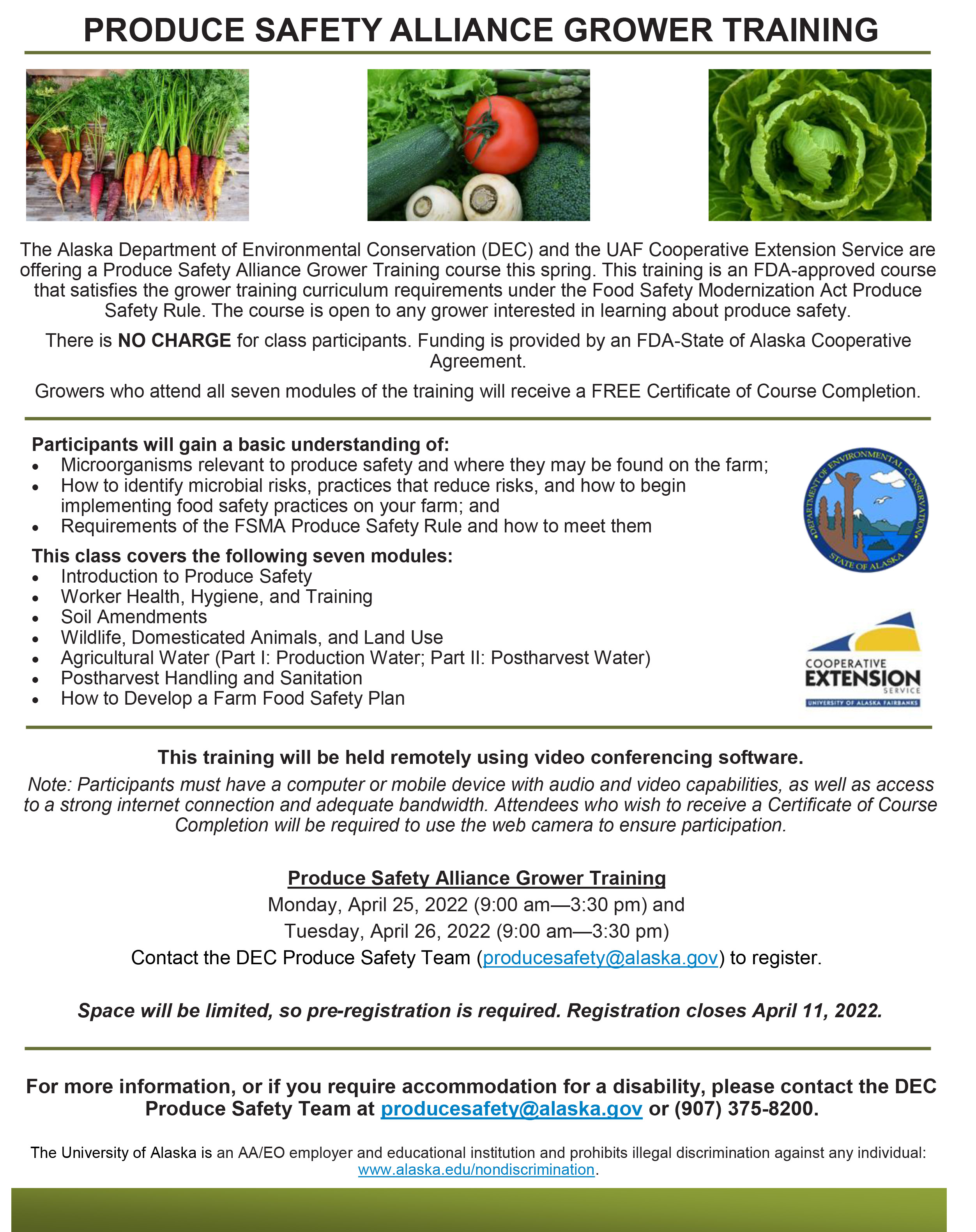

Produce Safety Alliance Grower training scheduled for April 25-26

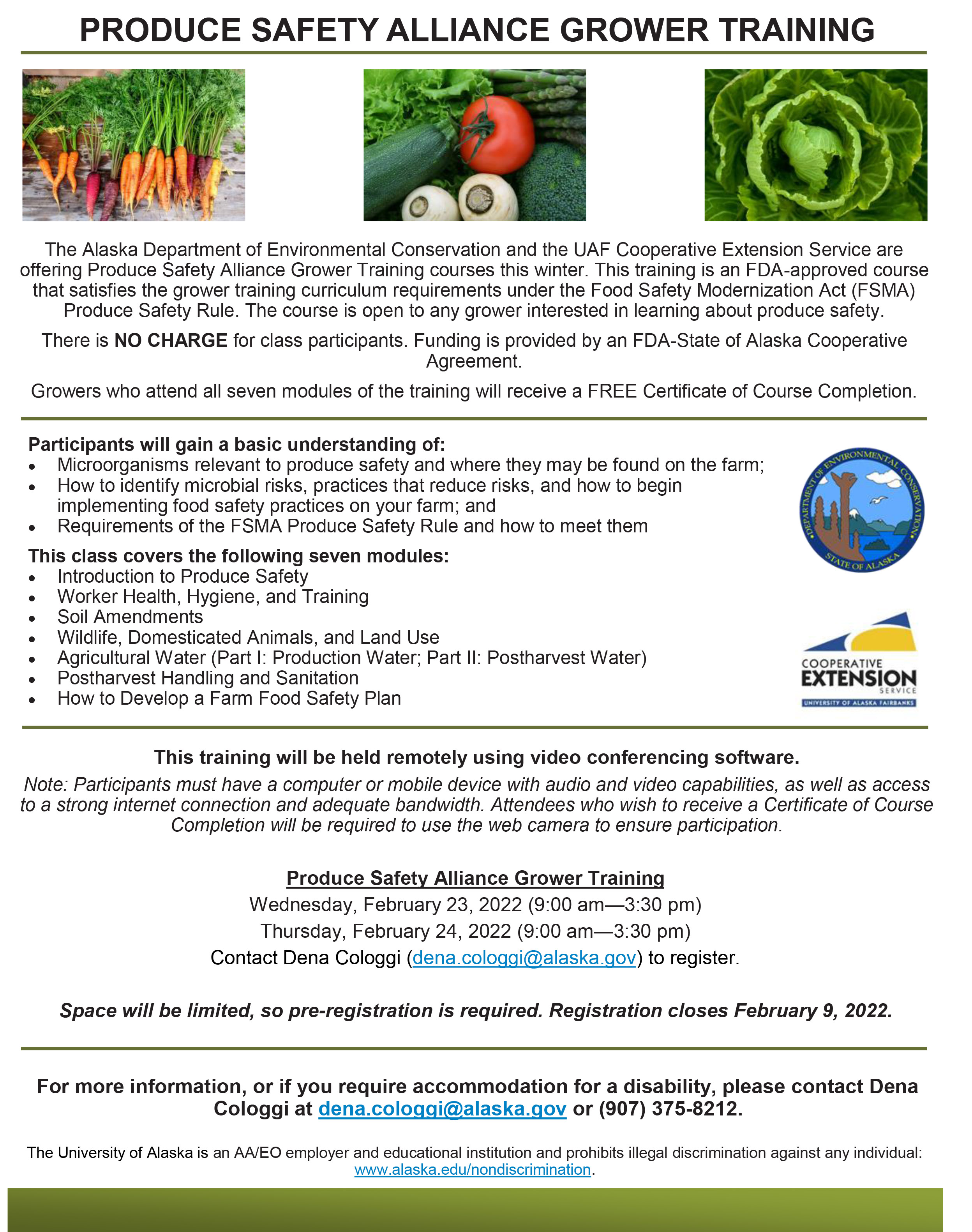
The Alaska Department of Environmental Conservation and the University of Alaska Fairbanks Cooperative Extensive Service are planning a Produce Safety Alliance Grower Training in April.

This free training takes place from 9 a.m. to 3:30 p.m. on Monday and Tuesday, April 25-26, using Zoom. Registration closes on Monday, April 11.

This Food and Drug Administration (FDA)-approved course will satisfy the grower training curriculum requirements under the FDA’s Food Safety Modernization Act Produce Safety Rule. There is no charge for class participants. Funding is provided by a FDA-State of Alaska Cooperative Agreement. Growers who attend all seven modules of the course will receive a FREE Certificate of Course Completion. The workshop is open to all interested growers. Please see the attached flyer for more information. Space will be limited, so pre-registration is required. Contact Dena at dena.cologgi@alaska.gov to register.

NOTE: This training will be held remotely using videoconferencing software (e.g. Zoom). Participants must have a computer or mobile device with audio and video capabilities, as well as access to a strong internet connection and adequate bandwidth. Attendees who wish to receive a Certificate of Course Completion will be required to use the web camera to ensure participation.

For more information, or if you require accommodation for a disability, please contact Dena Cologgi at dena.cologgi@alaska.gov or (907) 375-8212.

UAF Cooperative Extension Service offers Certified Food Protection Manager class by videoconference March 30-31 in Sitka

The University of Alaska Fairbanks Cooperative Extension Service will teach a certified food protection manager workshop on Wednesday and Thursday, March 30-31. This is a two-day statewide class that will be offered by videoconferencing to Fairbanks, Palmer, Juneau, and Sitka, plus other locations that may arrange for the class.

A certified food protection manager (CFPM) is responsible for monitoring and managing all food establishment operations to ensure that the facility is operating in compliance with food establishment regulations.

A CFPM is knowledgeable about food safety practices and uses this knowledge to provide consumers with safe food, protect public health and prevent food-borne illnesses. Alaska regulations require food establishments to have at least one CFPM on staff.

This course takes place from 8:30 a.m. to 3 p.m., and participants will take a proctored computer-based exam at the end of the second day of class. The reason the registration deadline is two weeks before the class is to guarantee course materials reach all the students in time. The cost is $200, and the course will be taught by Julie Cascio of Palmer. Students can register here, and the registration deadline is Wednesday, March 16.

The Sitka videoconference for the class will take place in a room TBA at the University of Alaska Southeast Sitka Campus. To learn more, contact Jasmine Shaw at the Sitka District Office of the UAF Cooperative Extension Service at 747-9440, or contact Julie Cascio at (907) 745-3677 (Palmer number) or jmcascio@alaska.edu. Note, this class is taught in English but textbooks are available in Korean, Chinese and Spanish, just contact Julie at least three weeks before the class.

Also, the ServSafe book ($70) and certification exam ($85) now are available online, if people want to order the book and study independently without taking the class. Just go to this website and purchase the book and exam items.

Produce Safety Alliance Grower training scheduled for Feb. 23-24

The Alaska Department of Environmental Conservation and the University of Alaska Fairbanks Cooperative Extensive Service are planning a Produce Safety Alliance Grower Training in February.

This free training takes place from 9 a.m. to 3:30 p.m. on Wednesday and Thursday, Feb. 23-24, using Zoom. Registration closes on Wednesday, Feb. 9.

This Food and Drug Administration (FDA)-approved course will satisfy the grower training curriculum requirements under the FDA’s Food Safety Modernization Act Produce Safety Rule. There is no charge for class participants. Funding is provided by a FDA-State of Alaska Cooperative Agreement. Growers who attend all seven modules of the course will receive a FREE Certificate of Course Completion. The workshop is open to all interested growers. Please see the attached flyer for more information. Space will be limited, so pre-registration is required. Contact Dena at dena.cologgi@alaska.gov to register.

NOTE: This training will be held remotely using videoconferencing software (e.g. Zoom). Participants must have a computer or mobile device with audio and video capabilities, as well as access to a strong internet connection and adequate bandwidth. Attendees who wish to receive a Certificate of Course Completion will be required to use the web camera to ensure participation.

For more information, or if you require accommodation for a disability, please contact Dena Cologgi at dena.cologgi@alaska.gov or (907) 375-8212.

Register now for the 2022 Alaska Food Festival and Conference

Registration is open for the 2022 Alaska Food Festival and Conference, which is going virtual on Friday and Saturday, March 18-19, this year due to the COVID-19 pandemic. It opens with a pre-conference movie on Thursday, March 17. This year’s theme is “Everybody Eats: Nourishing Our Culture, Our Health, Our Future.”

Hosted by the Alaska Food Policy Council (AFPC), the Alaska Food Festival and Conference previously took place in Anchorage in 2014 and 2016, in Fairbanks in 2017, in Homer in 2019, and was virtual in 2020. This year, as in 2020, the conference was scheduled for Anchorage before going virtual due to COVID-19. The event takes place every 18 months.

In addition to the Alaska Food Policy Council, this event is co-sponsored by the Intertribal Agriculture Council and the University of Alaska Anchorage (UAA) Dietetics and Nutrition Program.

The four focus areas of this year’s conference are: Policy and Education, Production and Harvest, Culture and Community, and Business and Industry.

The goals of the conference and festival are to:

  1. increase awareness of Alaska food issues among the general population;
  2. provide training, resources, and networking opportunities to increase involvement in local food issues by community members and decision makers; and
  3. increase connections and build community between the public, Alaska food businesses, NGOs, governmental entities, tribal entities, and others to support local economic development and innovative solutions.

Details for the event are still in the planning stage. But past conferences have included presentations on food systems in Alaska, food security/insecurity, traditional foods, farmers markets, agriculture in Alaska, fisheries, food policy, food waste reduction, and more. Other plans include holding an online auction, a youth track, and a pre-conference workshop with Alaska Village Initiatives.

This year’s confirmed keynote speakers and featured guests include:

  • Janie Simms Hipp, USDA general counsel
  • Eva Dawn Burke, University of Alaska Fairbanks College of Rural and Community Development and The Alaska Center for Climate Assessment and Policy
  • Helga Garcia-Garza, executive director of Agri-Cultura Network and La Cosecha CSA
  • Caroline Cox (director) and Tiffany Ayalik (producer), Film: “Food for the Rest of Us” (special guests)
  • Iris Sutton, Ice Wedge Art and Farm (conference artist)

Before the conference, the movie “Food for the Rest of Us” will be shown at 6 p.m. on Thursday, March 17, using Zoom. The screening and post-screening panel discussion are free, but registration is required by going to this link, https://zoom.us/webinar/register/WN_8huQr-GeR-W8UwCBXMhx7w.

“Food for the Rest of Us”, https://www.foodfortherestofus.org/, is a feature film that presents four stories of people living life on their own terms, serving as leaders who are lending their voice to the underdog and leading a revolution to a better world, from the ground up. An Indigenous-owned, youth-run organic farm in Hawai’i, a Black urban grower in Kansas City who runs a land-farm at East High School, a female Kosher butcher in Colorado working with the queer community, and an Inuit community on the Arctic Coast that is adapting to climate change with a community garden in a small geodesic dome. A panel discussion with the director and producer will follow the film.

In addition, the Alaska Food Hero Awards will be presented during the conference, and nominations are accepted at this link until Monday, Feb. 21, https://docs.google.com/forms/d/e/1FAIpQLScJaHS_okDTYOdZojViXm4gC9w7C_v1J4uIpn4D9rVk0q1CyQ/viewform. A list of past Alaska Food Hero Award winners can be found at, https://www.akfoodpolicycouncil.org/akfoodheroes.

People and organizations interested in presenting about Alaska food topics can submit presentation abstracts by Monday, Feb. 14, to https://docs.google.com/forms/d/e/1FAIpQLSeompK0G3jpNNFOeL1NOduc8QKG9tFPzNGaIAf0-VA9X6CVRQ/viewform. Information about previous conferences and their agendas can be found in the left column of this link, https://www.akfoodpolicycouncil.org/2022-festival-conference.

If you’re interested in sponsoring the event, you can go to this link for more details about our sponsorship tiers, https://www.akfoodpolicycouncil.org/2022-conference-sponsors.  

Registration costs $40-$150, depending on the package, and you can register at this link, https://www.eventbrite.com/e/2022-alaska-food-festival-conference-tickets-232976558157. Early bird registration and pricing ends on Monday, Jan. 31. You also can purchase an Alaska Food Policy Council membership at that link. Thanks to the generosity of the Intertribal Agriculture Council and the Alaska Farmers Market Association, a limited number of registration fee scholarships are available on a first-come, first-served basis, and you can apply at https://forms.gle/CPffkjzz3UuFWD7Y8.

A conference agenda will be available in late February. More details about the conference are available at this link, https://www.akfoodpolicycouncil.org/2022-festival-conference.

For more information about the conference, contact Robbi Mixon at (907) 235-4068, Ext. 23, or director@alaskafoodpolicycouncil.org.

###

The Alaska Food Policy Council (https://www.akfoodpolicycouncil.org/) is a nonprofit organization whose diverse membership works to engage Alaskans to make positive changes for the state’s food system, and to create a healthier, more prosperous and more secure future for all.

The Intertribal Agriculture Council (https://www.indianag.org/) was founded in 1987 to pursue and promote the conservation, development and use of our agricultural resources for the betterment of our people. Land-based agricultural resources are vital to the economic and social welfare of many Native American and Alaskan Tribes. The harmonies of man, soil, water, air, vegetation and wildlife that collectively make-up the American Indian agriculture community, influence our emotional and spiritual well-being. The IAC has, over the last three decades, become recognized as the most respected voice within the Indian community and government circles on agricultural policies and programs in Indian country.

The University of Alaska Anchorage (UAA) Dietetics and Nutrition Program (https://www.uaa.alaska.edu/academics/college-of-health/departments/school-of-allied-health/academics/dietetics-nutrition/) is a statewide education program that meets the growing needs of the dietetics and nutrition industry. This nationally accredited program trains entry-level, registered dietitian nutritionists, and community nutrition and nutrition science professionals throughout Alaska. Using an array of online and campus-based courses, the UAA Dietetics and nutrition program offers a minor in Nutrition, a Bachelor of Science in Dietetics, and a Master of Science in Dietetics.

UAF Cooperative Extension Service offers Certified Food Protection Manager class by videoconference Feb. 2-3 in Sitka

The University of Alaska Fairbanks Cooperative Extension Service will teach a certified food protection manager workshop on Wednesday and Thursday, Feb. 2-3. This is a two-day statewide class that will be offered by videoconferencing to Fairbanks, Palmer, Juneau, and Sitka, plus other locations that may arrange for the class.

A certified food protection manager (CFPM) is responsible for monitoring and managing all food establishment operations to ensure that the facility is operating in compliance with food establishment regulations.

A CFPM is knowledgeable about food safety practices and uses this knowledge to provide consumers with safe food, protect public health and prevent food-borne illnesses. Alaska regulations require food establishments to have at least one CFPM on staff.

This course takes place from 8:30 a.m. to 3 p.m., and participants will take a proctored computer-based exam at the end of the second day of class. The reason the registration deadline is two weeks before the class is to guarantee course materials reach all the students in time. The cost is $200, and the course will be taught by Julie Cascio of Palmer. Students can register here, and the registration deadline is Wednesday, Jan. 19.

The Sitka videoconference for the class will take place in a room TBA at the University of Alaska Southeast Sitka Campus. To learn more, contact Jasmine Shaw at the Sitka District Office of the UAF Cooperative Extension Service at 747-9440, or contact Julie Cascio at (907) 745-3677 (Palmer number) or jmcascio@alaska.edu. Note, this class is taught in English but textbooks are available in Korean, Chinese and Spanish, just contact Julie at least three weeks before the class.

Also, the ServSafe book ($70) and certification exam ($85) now are available online, if people want to order the book and study independently without taking the class. Just go to this website and purchase the book and exam items.

Check out the January 2022 edition of the Sitka Local Foods Network newsletter

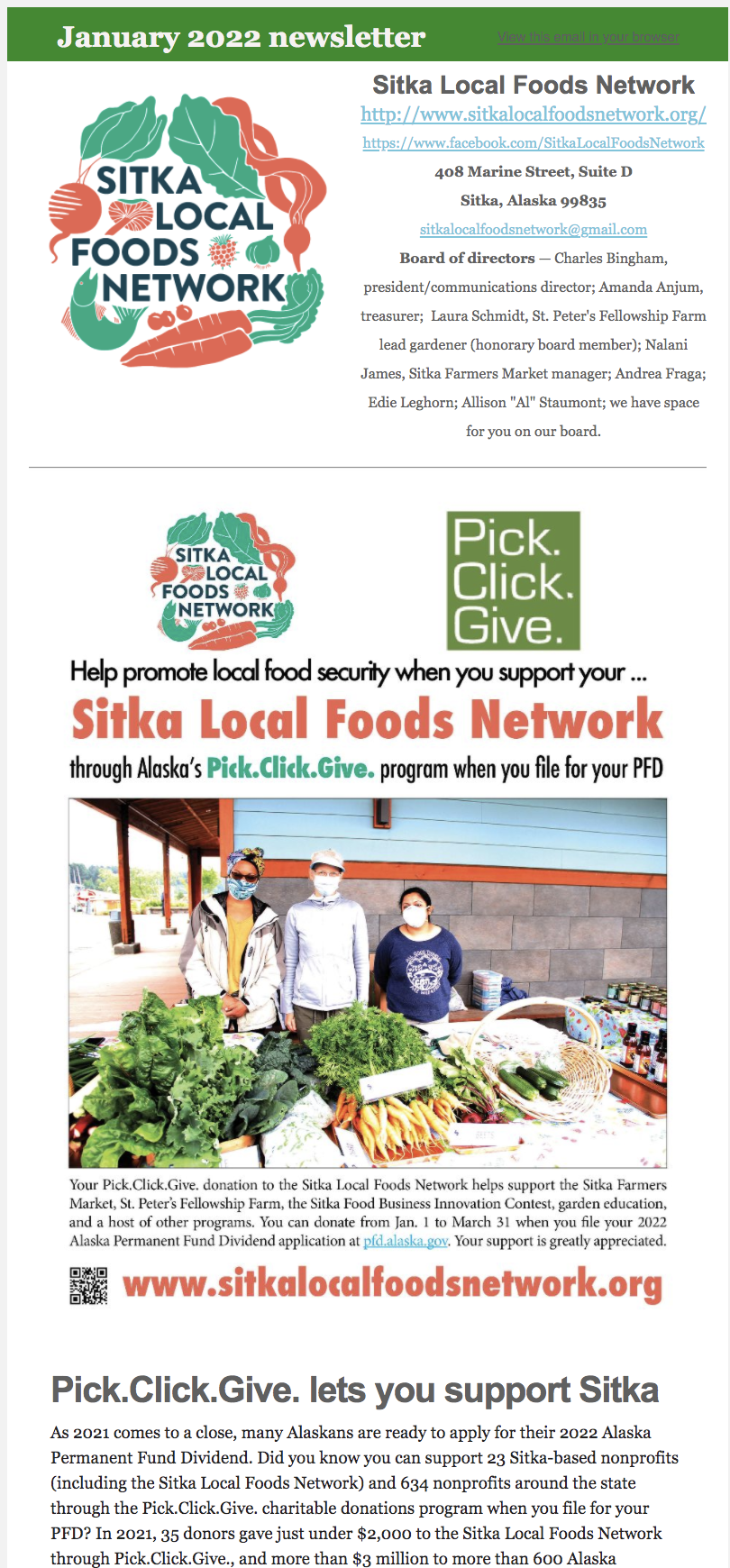
The Sitka Local Foods Network just sent out the January 2022 edition of its monthly newsletter. Feel free to click this link to get a copy.

This month’s newsletter includes short stories with a notice about the opening of the Alaska Permanent Fund Dividend application period (and Pick.Click.Give. application) on Jan. 1, an update about how you can support the Sitka Local Foods Network by buying a t-shirt or hoodie from our online store, information about our 2022 sponsorship programs, and an invitation to join our board of directors. Each story has links to our website for more information.

You can sign up for future editions of our newsletter by clicking on the newsletter image in the right column of our website and filling in the information. If you received a copy but didn’t want one, there is a link at the bottom of the newsletter so you can unsubscribe. Our intention is to get the word out about upcoming events and not to spam people. We will protect your privacy by not sharing our email list with others. Don’t forget to like us on Facebooklike our Sitka Farmers Market page on Facebook and follow us on Twitter (@SitkaLocalFoods).

Saturday’s the day to start filing your 2022 PFD applications with Pick.Click.Give. donations

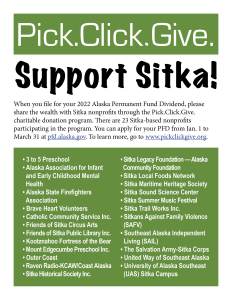
As 2021 draws to a close, many Alaskans already are thinking about applying for their 2022 Alaska Permanent Fund Dividend check in January. As usual, Alaskans can share their wealth with a variety of Alaska nonprofits, including the Sitka Local Foods Network, through the PFD’s Pick.Click.Give. program.

For the past several years, the Sitka Local Foods Network has participated in the Pick.Click.Give. program, which allows people to donate in $25 increments to their favorite statewide and local 501(c)(3) nonprofit organizations when they file their PFD applications from Jan. 1 through March 31.

When you choose to donate part of your PFD to the Sitka Local Foods Network, you support the Sitka Farmers Market, St. Peter’s Fellowship Farm, the Sitka Food Business Innovation Contest, education programs about growing and preserving food, the Sitka Kitch community rental commercial kitchen, Sitka Community Gardens, matching dollars at the Sitka Farmers Market for SNAP/WIC beneficiaries, the sustainable use of traditional foods, the Sitka Community Food Assessment, the Sitka Food Summit, and a variety of other projects designed to increase access to healthy local foods in Sitka.

In 2021 Alaskans contributed $3.04 million to 613 Alaska nonprofit organizations, and more than $30.1 million has been donated since the program started in 2009. Some Alaskans choose to donate to just one group, while others may spread several donations around to many groups. There now are 634 total 501(c)(3) nonprofit organizations participating in Pick.Click.Give. for 2022 (including multi-location nonprofits), including 23 from Sitka. In 2021, Alaskans donated $94,575 to Sitka-based nonprofits (note, total includes some nonprofits that are based in multiple cities).

So how do you make a donation to the Sitka Local Foods Network through the Pick.Click.Give. program? First, starting at 9 a.m. on Saturday, Jan. 1, go fill out your Alaska Permanent Fund Dividend application at http://pfd.alaska.gov/. When you get to the section of the application asking if you want to participate in Pick.Click.Give. Charitable Contributions program, click on the PCG link and search for the Sitka Local Foods Network. You also can look for us by using the town search for Sitka.

The Pick.Click.Give. program is available only to people who file their PFD applications online, and not to those who file by mail. Even though you can’t file a new PFD application after March 31, you can go back into your application and update your Pick.Click.Give. donations through Aug. 31 each year.

You still can donate to the Sitka Local Foods Network if you aren’t from Alaska or aren’t eligible for a 2022 PFD. To donate, send your check to the Sitka Local Foods Network, 408-D Marine St., Sitka, Alaska, 99835. You also can donate online by going to our online fundraising page on MightyCause.com, and clicking the Donate button to make an online contribution. In addition, there is an online giving page through the PayPal Giving Fund. If you are trying to make nonprofit donations before the end of the 2021 tax year, you can mail in a check or make an online donation. Please let us know if you need a receipt for tax purposes. For more information about donating, you can send an email to sitkalocalfoodsnetwork@gmail.com.

Thank you for supporting our mission of increasing the amount of locally produced and harvested food in the diets of Southeast Alaskans.

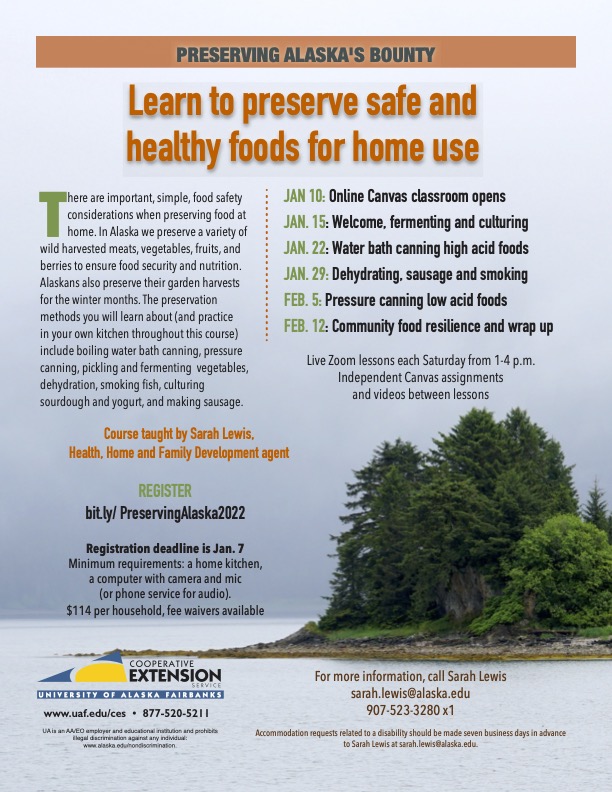
Learn to preserve safe and healthy foods for home use with Sarah Lewis

In Alaska, we preserve a variety of wild harvested meats, vegetables, fruits, and berries to ensure food security and nutrition. Alaskans also preserve their garden harvests for the winter months. 

University of Alaska Fairbanks Cooperative Extension Service agent Sarah Lewis will demonstrate how to preserve this bounty by canning, dehydrating, pickling, fermenting, and smoking.

There are important, simple, food safety considerations when preserving food at home. The preservation methods you will learn about (and practice in your own kitchen throughout this course) include water-bath canning, pressure canning, pickling and fermenting vegetables, dehydration, smoking fish, culturing sourdough and yogurt, and making sausage.

Lewis will teach the course online via Zoom, and participants can practice these techniques in their own kitchens. They’ll complete independent online assignments and view videos via the Canvas online course platform, which will open Jan. 10. Zoom classes will be held from 1-4 p.m. on Saturdays, Jan. 15 through Feb. 12. 

The course will use “So Easy to Preserve,” sixth edition, from the University of Georgia Cooperative Extension Service. The book is included in the cost of the course and will be mailed to each student. 

Students must have a home kitchen, a computer with a camera, and either a computer microphone or phone service for audio. The cost is $114 per household; fee waivers are available.

Register at bit.ly/PreservingAlaska2022. The registration deadline is Jan. 7. 

For more information, contact Sarah Lewis at sarah.lewis@alaska.edu or 907-523-3280, ext. 1. 

Check out the November 2021 edition of the Sitka Local Foods Network newsletter

The Sitka Local Foods Network just sent out the November 2021 edition of its monthly newsletter. Feel free to click this link to get a copy.

This month’s newsletter includes short stories with information about our 2022 sponsorship programs, information about how you can support the Sitka Local Foods Network by buying a t-shirt or hoodie from our online store, an announcement about a series of online food preservation workshops from the UAF Cooperative Extension Service, and an invitation to join our board of directors. Each story has links to our website for more information.

You can sign up for future editions of our newsletter by clicking on the newsletter image in the right column of our website and filling in the information. If you received a copy but didn’t want one, there is a link at the bottom of the newsletter so you can unsubscribe. Our intention is to get the word out about upcoming events and not to spam people. We will protect your privacy by not sharing our email list with others. Don’t forget to like us on Facebooklike our Sitka Farmers Market page on Facebook and follow us on Twitter (@SitkaLocalFoods).