As the world deals with the COVID-19 pandemic, many nonprofits have seen their funding reduced due to event cancelations and venue closures. The Sitka Local Foods Network is one of them. That’s why we’re participating in #GivingTuesdayNow on May 5, a special global day of unity to help nonprofits during this time of crisis. We have created an online #GivingTuesdayNow fundraiser on our MightyCause donation page, and hope you will help.
Normally, #GivingTuesday takes place on the first Tuesday after Thanksgiving, and the Sitka Local Foods Network has hosted five #GivingTuesday fundraisers. The regular #GivingTuesday fundraiser will be Dec. 1, 2020, and we expect to have our usual fundraiser during the holiday season. But #GivingTuesdayNow is a special event to help nonprofits during COVID-19.
So what does this mean for the Sitka Local Foods Network?
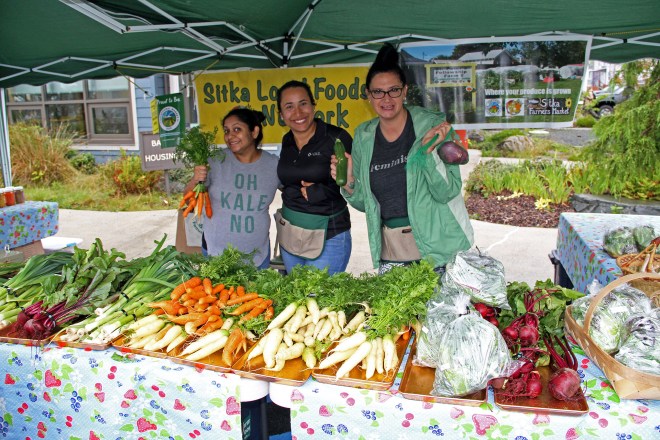
With the COVID-19 pandemic, the Sitka Local Foods Network is having to dramatically scale back the 13th season of the Sitka Farmers Market, which will reduce our our operations budget for the year. The Sitka Farmers Market is one of our biggest fundraisers, and this summer we will be reduced to two produce vendors and won’t have our other usual vendors selling breads, jams and jellies, arts and crafts, and prepared foods.
But our mission is to increase the amount of locally harvested and produced foods into the diets of Southeast Alaskans. So that means we will be selling fresh, local produce we grow at St. Peter’s Fellowship Farm. But to reduce the risk of spreading the SARS-CoV-2 coronavirus, which causes COVID-19, we will be limiting our customer contact. We will use an online ordering portal so people order $20 or $40 boxes of produce during the week and then pick them up on Saturdays.
Due to our switch to an online sales portal, we won’t be able to accept and match SNAP and WIC benefits like normal. We still want to get fresh, local produce into the hands of low-income Sitka residents, so we are trying to come up with a plan for this, even if it means we have to use our general fund to cover the costs of giving a $20 box of produce to WIC/SNAP beneficiaries. We hope this fundraiser will help us cover the costs of providing this produce to low-income Sitkans. You can learn more about our plans at our website, http://www.sitkalocalfoodsnetwork.org, or you can contact Sitka Local Foods Network board president Charles Bingham at sitkalocalfoodsnetwork@gmail.com or 623-7660.
It’s May and we are still living in unusual times, with the SARS-CoV-2 coronavirus and COVID-19 disease outbreak keeping many of us sheltered in place. The pandemic has scuttled some of our plans for the 2020 Sitka Farmers Market season, and we’re trying to adapt to our changing world so we can host something this year. We gave Sitka an update on our plans in late March, and now it’s time for another update.
We are still finalizing plans, but it doesn’t look as if we’ll be able to host a full Sitka Farmers Market this summer. Our regular venue, Alaska Native Brotherhood Founders Hall, is still closed, and even if we could use the building current state mandates limit what we can do. While the state considers farmers markets to be essential businesses, the state is limiting markets to food sales only and not allowing arts and crafts (about 65-70 percent of our vendors). We’d love to hold a regular market, but under the current situation we just can’t. We love serving as an incubator for small businesses and a community gathering place, so we hope to return to having a full market next summer.
So where does that leave us for the 2020 summer? The Sitka Local Foods Network, as usual, is growing fresh produce at St. Peter’s Fellowship Farm. Our produced-growing operation has a Certified Naturally Grown designation, showing our commitment to sustainable agriculture, and we built a second high tunnel this spring to extend our growing season.
We think giving Sitka residents access to healthy, local food is critical to our food security, and we still plan to sell produce this summer. It’s in our mission, and we plan to do it. Since we are losing our market manager of the past three years (Nina Vizcarrondo) to Coast Guard relocation, we hired two co-managers to replace her — Ariane Martin Goudeau and Nalani James. Sitka Local Foods Network board president Charles Bingham also will assist with the markets, and Laura Schmidt has been our lead gardener at St. Peter’s Fellowship Farm for about a decade.
Right now our plan is to use an online sales portal, Salt and Soil Marketplace based in Juneau, where people will order a box of produce during the week, pay for it online, and then pick it up on Saturday. We plan to sell a $20 box of produce that will feature four selected veggies that are currently in season, and a $40 box which will include additional veggies. We also may sell selected individual veggies when we have an abundance beyond what we’d put in the boxes. In order to simplify things this year, we will not carry our usual Alaska Grown products this summer. We plan to work with Middle Island Gardens, which will sell its produce on Salt and Soil Marketplace and have its own delivery pick-ups at the same time and location.
We are still trying to finalize our agreement on dates and times with our proposed venue, and that will be announced once it’s confirmed. We are negotiating with a centralized outdoor venue, and our proposed hours are from 10 a.m. to noon on Saturdays. We hope to hold our first pick-up on June 20, and then every Saturday in July, August, and September.
Due to health and safety concerns from the COVID-19 outbreak, things will look different on market Saturdays. We are trying to minimize contact as much as possible, and all of our volunteers will wear gloves and masks and we ask all of our customers to also wear masks. We have been attending several workshops on how to safely run a market, and we decided simplicity and safety was our priority this year. That’s why there will only be two vendors — the Sitka Local Foods Network and Middle Island Gardens — this year and all of our produce will be pre-sold before Saturday, so customers can get in and out as quickly as possible and we don’t have to handle cash or checks.
We will ask customers to drive up to our pick-up location, and wait in their cars (with engines turned off) until our greeters get their names and then gets their orders so they can be placed in their vehicle. There will be no at-market sales, so please stay with your vehicles and don’t come up to our tables. If you bike or walk, we will ask you to maintain proper social distancing until we can bring you your order. The first half-hour we are open will be designated for seniors and those with high-risk health issues, so they can get in and out before the big rush. Periodically, we may stop what we’re doing so everybody can wash their hands and reglove, and we can wipe down our tables. We want to make this safe for our customers and our volunteers.
One of our biggest issues is how we will be able to make sure our produce gets into the hands of lower-income Sitka residents. Normally we accept SNAP Alaska Quest EBT cards and WIC farmers market nutrition vouchers, but unless something changes soon we’re not allowed to use those methods if we use an online sales portal. We are trying to come up with a solution, and that may mean we have WIC/SNAP beneficiaries send us an email or call a special phone number to receive a free $20 box of produce every other week. Since we won’t get reimbursed by the state, we’ll cover the costs from our general fund. This will only be for the Sitka Local Foods Network produce.
We still have a few things to work out, so we will will provide another update as those details are confirmed. If you have any questions, feel free to call Sitka Local Foods Network board president Charles Bingham at 623-7660 or email sitkalocalfoodsnetwork@gmail.com.
This class includes an intro to Alaska Department of Environmental Conservation‘s cottage foods (aka, home-based foods) regulations and information about the “non-potentially hazardous” food preservation methods that are allowed: dehydration, boiling water-bath canning, and pickling. In addition, Sarah will emphasize the best food safety and sanitation methods to use in a cottage foods business, and how a cottage foods business can continue sales during this time of social distancing.
Upcoming online classes include:
April 25, 2 – 3:30 p.m. Starting a Cottage Foods Business in Alaska – taught by Sarah Lewis on Zoom https://bit.ly/cfbinalaska
Online registration is required for each class, and registration for the cottage foods business class can be accomplished by going to this link. For more information, contact the UAF Cooperative Extension Service in Juneau at (907) 523-3280 x1 or sarah.lewis@alaska.edu.
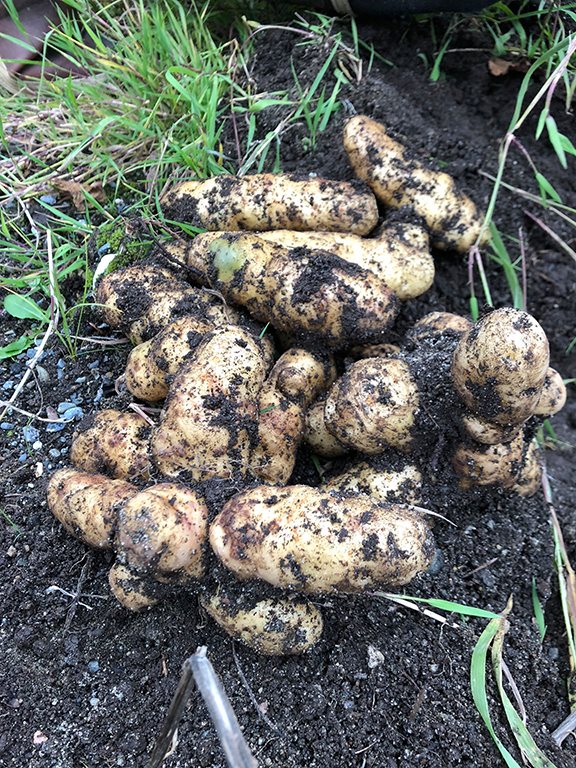
SITKA, Alaska – The USDA Forest-Service Sitka Ranger District and Sitka Tribe of Alaska will join forces for the fourth consecutive year to educate people about Tlingít potatoes (also called Maria’s potatoes) and plant a crop of potatoes. The community is invited to participate in a web-based educational program on April 22, 2020. USDA Forest Service staff, the tribe, and tribal citizens will share how to grow Tlingít potatoes, and share the biology, history, and cultural aspects of these interesting root vegetables.
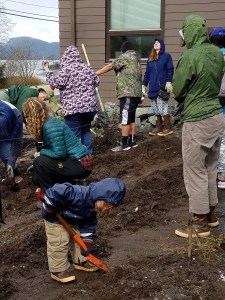
Separate from the education event, Tongass National Forest employees will, this year, plant the potatoes themselves. Since 2017, the Sitka Ranger District has provided a sunny plot of land to serve as the shared potato garden and provided the seed potatoes to plant the garden. In previous years, the Sitka Tribe’s Traditional Foods Program, the gardening class from Pacific High School, and Sitka community volunteers have assisted on the project.
“Because of the limited window for planting and the need to keep people safe and healthy, we decided that a virtual event, followed by one or two employees planting the bed, was our best plan of action for 2020,” Sitka District Ranger Perry Edwards said. “By teaching people through a web-based event, even more people can learn how to grow and sustain an easily grown, very productive traditional food.”
The virtual educational event is happening from 1:30-2:30 p.m. on Wednesday, April 22, which is Earth Day. Attendees should use a computer or tablet, and are encouraged to sign in a few minutes early using their full name. Organizers will use a Teams meeting at https://tinyurl.com/tlingitpotatoes for both video and audio. Organizers suggest using the button: “join in on the web instead” once they have connected to the Teams meeting. For more information, contact Michelle Putz at 907- 747-2708 or email michelle.putz@usda.gov.
Tlingít potatoes have been present in Tlingit gardens for more than 200 years. The potatoes originate from Mexico or Chile, and were a trade item in Southeast Alaska in the early 1800s.
For 29 years, Mollie Kabler and Kitty LaBounty have taken to the KCAW-Raven Radio airwaves during the spring months to broadcast The Garden Show.
This year, with the coronavirus affecting shows, the Garden Show will have a regular 9:30-10 a.m. slot on Fridays, starting on Friday, April 10. Kitty has a regular music show (Hometown Brew) from 2-4 p.m. on Thursdays, and sometimes in the past the half-hour Garden Shows took place during her program.
Garden Show topics include timely tasks for gardening in Southeast Alaska, taking on-air questions, and themes around basic and more advanced gardening of vegetables, flowers, fruit, trees, etc. The station’s website has links to previous shows.
This virtual conference brings together gardeners for two presentations by area garden experts on each of eight nights from 6-8 p.m. on Wednesdays and Fridays from April 15 through May 8. For a schedule, click the link below or go to https://www.seak-mastergardeners.org/index.html. The conference is free, but registration is required by going to this link and filling out the form.
Presentation topics include:
Wednesday, April 15, 6-6:45 p.m. — Patterns on the Land: Sustainable Landscape Design for Southeast Alaska, David Lendrum and Margaret Tharp, owners of Landscape Alaska
Wednesday, April 15, 7-7:45 p.m. — Growing Fruit Trees in High Tunnels, Rob Bishop of Alaska Apple Trees
Friday, April 17, 6-6:45 p.m. — Raised Beds, Ed Buyarski owner of Ed’s Edible Landscapes
Friday, April 17, 7-7:45 p.m. — Unique and Flavorful Rhubarb: Preliminary Research Results, David Love
Wednesday, April 22, 6-6:45 p.m. (Earth Day) — Panel Discussion: Growing Produce for Juneau a Worthy Endeavor a Fool’s Errand, Joe Orsi owner of Orsi Organic Produce (moderator), Bob Trousil, Sharon Fleming, Joel Boss, John Kraypek, Colin Peacock, Sarah Lewis
Wednesday, April 22, 7-7:45 p.m. (Earth Day) — Panel Discussion: Growing Crops “Undercover”: High Tunnel and Greenhouse Experiences, Joe Orsi (Moderator), Ed Buyarski, David Love, Will Murray and Eli Wray
Friday, April 24, 6-6:45 p.m. — All About the Basil (and Other Fabulous Herbs), Sarah Lewis-UAF/CEST
Friday, April 24, 7-7:45 p.m. — Climate Trends Affecting Gardeners; The Science and Mystique of Weather Forecasting in Southeast Alaska, NATIONAL WEATHER SERVICE /NOAA
Wednesday, April 29, 6-6:45 p.m. — Integrated Weed Management for the Master Gardener, Geno Graziano
Wednesday, April 29, 7-7:45 p.m. — Yard and Garden Insects, Jessie Moan
Friday, May 1, 6-6:45 p.m. — Earth Worms-Garden Good Guys or Eco Invaders, Darren Snyder
Friday, May 1, 7-7:45 p.m. — Gardening for Pollinators-The Birds, The Bees and The Beetles, Deb Rudis
Wednesday, May 6, 6-6:45 p.m. — New and Exciting, Classic and Applicable, Fascinating Developments in the World of Horticulture, Dave Lendrum and Margaret Tharp, owners of Landscape Alaska
Wednesday, May 6, 7-7:45 p.m. — Exploring the World for Hardy Rhododendron, Steve Hootman
Friday, May 8, 6-6:45 p.m. — The Wow Factor; Beyond being Pretty! Growing and Using Edible Flowers, Patricia Hartman
Friday, May 8, 7-7:45 p.m. — Grow Your Own Soil, Samia Savell
Click below for a description of the presentations and presenter biographies.
(EDITOR’S NOTE: The following article first appeared on this site in April 2010. It is repeated with some updates because much of the information remains current and newsworthy.)
In the cold winter of 1994, Anchorage Daily News garden columnist and former Garden Writers Association of America President Jeff Lowenfels was returning to his hotel after a Washington, D.C., event when he was approached by a homeless person who asked for some money to buy food. Lowenfels said Washington, D.C., had signs saying, “Don’t give money to panhandlers,” so he shook his head and kept on walking. But the man’s reply, “I really am homeless and I really am hungry. You can come with me and watch me eat,” stayed with Lowenfels for the rest of his trip.
Jeff Lowenfels
The encounter continued to bother Lowenfels, even as he was flying back to Anchorage. During the flight, Lowenfels came up with an idea when he started writing his weekly garden column (the longest continuously running garden column in the country, with no missed weeks since it started on Nov. 13, 1976). He asked his readers to plant one extra row in their gardens to grow food to donate to Bean’s Café, an Anchorage soup kitchen. The idea took off.
When Anchorage hosted the Garden Writers Association of America convention in 1995, Lowenfels took the GWAA members to Bean’s Café to learn about the Plant A Row For Bean’s Café program. The Garden Writers Association of America liked the idea, and it became the national Plant A Row For The Hungry campaign (also known as Plant A Row or PAR). In 2002, the Garden Writers Association Foundation (now Garden Communicators International) was created as a national 501(c)(3) nonprofit to manage the Plant A Row For The Hungry program.
“I am not surprised by the growth of PAR,” Lowenfels wrote in a 2010 e-mail to the Sitka Local Foods Network. “It is now in all 50 states and across Canada and there are thousands of variations of the original program — from prison gardens for the hungry to botanical gardens donating their produce from public display gardens. This is because gardeners always share information and extra food, so the idea was a natural.”
It took five years for the program to reach its first million pounds of donated food, but the second million only took two years and the next eight years saw a million pounds of donated food (or more) each year. Since 1995, more than 20 million pounds of food (about 80 million meals, as of 2020) have been donated by American gardeners. Not only that, the program is getting ready to expand overseas to Australia, England and other countries with avid gardeners.
“We have supplied something in the vicinity of enough food for 50 million meals,” Lowenfels wrote in his e-mail. “Gardeners can solve this hunger problem without the government. And we don’t need a tea party to do it! Or chemicals, I might add, as author of a book on organic gardening!” Lowenfels is the author of Teaming With Microbes, written with Wayne Lewis. He released a second book, Teaming With Nutrients, as a follow-up to his first book, and in 2017 released a third book, Teaming With Fungi, as a second follow-up book.
According to the U.S. Department of Agriculture, one out of every eight U.S. households experiences hunger or the risk of hunger. Many people skip meals or eat too little, sometimes going an entire day or more without food. About 33 million Americans, including 13 million children, have substandard diets or must resort to seeking emergency food because they can’t always afford to buy the food they need. In recent years, the demand for hunger assistance has increased 70 percent, and research shows that hundreds of children and adults are turned away from food banks each year because of lack of resources.
According to the 2014 Sitka Community Food Assessment Indicators Report, about one in six people in Sitka is food insecure. In 2013, there were 1,410 Sitkans (out of a population of about 9,000) and 766 families receiving food assistance (SNAP, aka food stamps). There also were 229 individuals who received food pantry assistance from the Salvation Army and 7,243 meals served through its lunch soup kitchen in 2013, and that number has grown substantially since then.
While many people credit Lowenfels for creating the Plant A Row For The Hungry program, Lowenfels says the real heroes are the gardeners growing the extra food and donating it to local soup kitchens, senior programs, schools, homeless shelters and neighbors. You can hear him pass along the credit to all gardeners at the end of this 2009 interview with an Oklahoma television station (video also embedded below).
“One row. That’s all it takes. No rules other than the food goes to the hungry. You pick the drop-off spot or just give it to a needy friend or neighbor. Nothing slips between the lip and the cup, I say,” Lowenfels wrote in his e-mail.
With all of the jobs lost because of the COVID-19 coronavirus quarantines in 2020, this year there will be even more people who need food assistance. It will be more important than ever to help get extra produce into our local food banks and soup kitchens.
For people wanting to Plant A Row For The Hungry in Sitka, there are several places that would love to help distribute some fresh locally grown veggies or berries to those who are less fortunate, such as the Salvation Army, Sitkans Against Family Violence (SAFV), local churches, Sitka Tribe of Alaska and other organizations. The food the Sitka Local Foods Network grows at St. Peter’s Fellowship Farm communal garden goes to the Sitka Farmers Market, school lunches and other programs.
The Sitka Local Foods Network also takes donations of local produce to sell at the Sitka Farmers Markets, and all proceeds are used to help pay for SLFN projects geared toward helping more people in Sitka grow and harvest local food. For more information, contact the Sitka Local Foods Network board members at sitkalocalfoodsnetwork@gmail.com.
The Sitka Local Foods Network just sent out the April 2020 edition of its monthly newsletter. Feel free to click this link to get a copy.
This month’s newsletter includes short articles about the winners of the Sitka Food Business Innovation Contest, this week’s deadline to apply for the Alaska Permanent Fund Dividend and Pick.Click.Give. donations, an update on the Sitka Farmers Market and our contingency plans for the COVID-19 coronavirus outbreak, a fundraiser to help us build a new high tunnel at St. Peter’s Fellowship Farm, an invitation to join our board of directors, and an opportunity to sponsor us for 2020. Each story has links to our website for more information.
You can sign up for future editions of our newsletter by clicking on the newsletter image in the right column of our website and filling in the information. If you received a copy but didn’t want one, there is a link at the bottom of the newsletter so you can unsubscribe. Our intention is to get the word out about upcoming events and not to spam people. We will protect your privacy by not sharing our email list with others. Don’t forget to like us on Facebook, like our Sitka Farmers Market page on Facebook and follow us on Twitter (@SitkaLocalFoods).
Usually the Sitka Local Foods Network has announced the dates of the summer’s Sitka Farmers Market by now. But, as most of you are aware, these are not ordinary times.
We had been making our usual plans, and even had dates we planned to announce about now, but with the COVID-19 coronavirus outbreak we had to go into wait-and-see mode. We even hired two new people to coordinate the Sitka Farmers Market this year — Ariane Martin Goudeau and Nalani James — because we’re losing our market manager of the past three years, Nina Vizcarrondo, to Coast Guard relocation.
Even though we’re in wait-and-see mode, the SLFN feels it does need to update the community.
First, we had big plans to grow even more produce than before at St. Peter’s Fellowship Farm communal garden. We bought a second high tunnel, which has been erected on the site, so we can extend our growing season and have a little help with climate control. Laura Schmidt has been our lead gardener for about a decade, and deserves a lot of respect for how much produce she grows on the small patch of land we have access to behind St. Peter’s By The Sea Episcopal Church. We thank St. Peter’s for allowing us to continue growing food for the community on its property.
Regardless of whether we hold the Sitka Farmers Market or not, we will grow produce this summer at St. Peter’s Fellowship Farm. Sitka’s food security needs more local food, so we plan to find ways to get the food into the community, somehow, someway.
If all things were normal, our plan was to hold seven Sitka Farmers Markets again this summer for our 13th season. Our tentative dates are from 10 a.m. to 1 p.m. on Saturdays, July 4, July 25, Aug. 8, Aug. 15, Aug. 29, Sept. 5, and Sept. 19, all at the Alaska Native Brotherhood Founders Hall.
The Sitka Farmers Market is about local food, but it’s so much more. It’s about community and providing local entrepreneurs with a place to sell their products. We really enjoy seeing everybody come together to see their neighbors and friends at the market. That’s a big reason we want to host the market, if it’s possible.
But we don’t know when our shelter-in-place orders are going to end and we can start returning to normal. We are researching alternative ways to get our fresh produce into the hands of Sitka residents. We want to provide fresh produce, but also need to be conscious of everybody’s health during an outbreak.
That may mean going to an online portal, such as the Salt and Soil Marketplace out of Juneau, which has been expanding into Sitka and other towns in Southeast Alaska. Middle Island Gardens, Gimbal Botanicals, and a couple of other Sitka businesses have used Salt and Soil Marketplace, so it’s not a new concept. How it works for Sitka is vendors post their products online, and from Tuesday through Thursday Sitka residents go online and order what they want, with a delivery usually on Saturday.
This is great and relatively easy, except you lose the community aspect of the market when it’s online. Also, the Sitka Farmers Market serves as a business incubator, and we lose that when we can’t have a market.
There’s another thing we lose, and that’s the ability to accept WIC farmers market coupons and SNAP Alaska Quest EBT cards, which is how we get local produce into the hands of lower-income Sitkans. We are still trying to work that problem out. We want to get fresh local produce into this part of the community, because Sitka has some major inequality with about one in every six residents on some form of food assistance program. Our mission is “to increase the amount of locally harvested and produced food into the diets of Southeast Alaskans,” so we have to make sure we include getting food to lower income people.
We will come up with a plan of some sort to make sure we do get produce into the hands of all Sitkans, but we have to be conscious of not spreading the coronavirus. It may mean we donate produce to a local food bank for distribution, or we donate some produce to WIC/SNAP beneficiaries and skip the normal reimbursement we’d get from the state. We have our White E grant to match WIC/SNAP benefits, so we can use that grant to help distribute the food, and absorb some of the loss through our general fund. It’s within our mission, and we can afford to do it for a few months.
Ideally, we will host our Sitka Farmers Markets as normal. But these are unusual times. We will look at what’s happening in mid-May, and we will make a further announcement then as to what our plans are. Hopefully we will be recruiting vendors for our market. If not, we will start setting up an account so people can order produce online.
If you have any questions, feel free to call Sitka Local Foods Network board chairman Charles Bingham at 623-7660 or email sitkalocalfoodsnetwork@gmail.com.
The Sitka Master Gardener training— originally scheduled to start on Wednesday, March 25, and then postponed due to coronavirus precautions — will become distance-delivered and start on Monday, March 30.
Participants will meet from 6-8:30 p.m. on Mondays with the Juneau Master Gardeners class, through May 11. Because the Juneau training has already begun, additional classes will be scheduled online for Sitka participants at 6 p.m. on Wednesdays from April 1-22 to make up some of the hours missed. There also is one class session from 9 a.m. to noon on Saturday, April 25.
The UAF Cooperative Extension Service will host the session and the additional classes via Zoom webinar. The Juneau class is taught by Extension agent Darren Snyder, experts, and other Extension agents and staff. The Sitka additions will be organized by Extension assistant Jasmine Shaw and University of Alaska Southeast Sitka Campus biology professor Kitty LaBounty. Those also will be available by Zoom, through home internet.
Participants will commit to providing at least 40 hours of volunteer service to their communities within a year of completing the class. Trainees will be provided opportunities to share their skills with the community through various service projects and other venues.
Registration and additional details are available at http://bit.ly/SitkaMG. The $300 fee includes an Alaska gardening manual (Alaska’s Sustainable Gardening Handbook) and a $150 deposit that will be refunded if service hours are completed within a year. For more information, contact Jasmine Shaw at jdshaw2@alaska.edu.








 Sitka Local Foods Network
You must be logged in to post a comment.