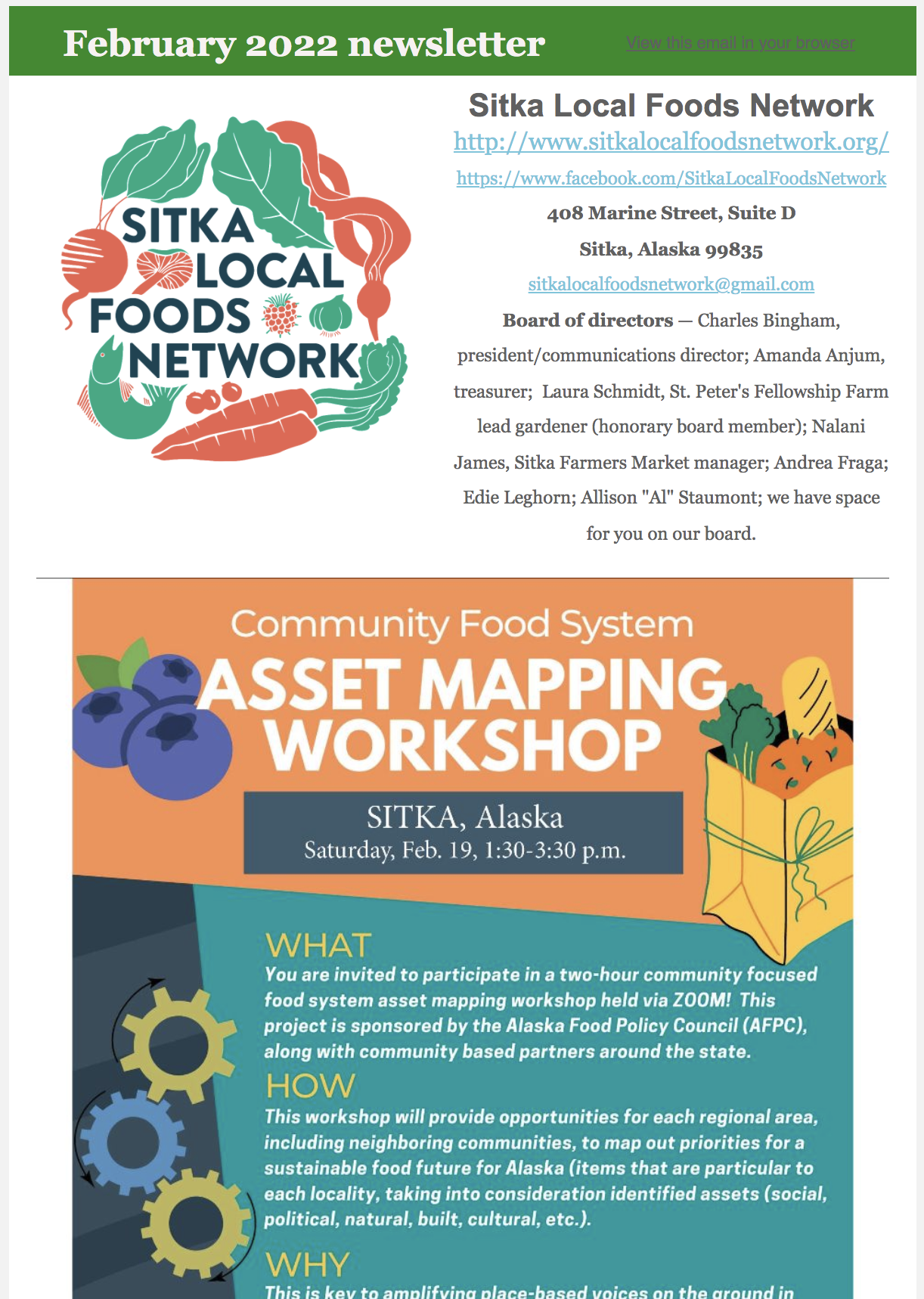
The Sitka Local Foods Network just sent out the February 2022 edition of its monthly newsletter. Feel free to click this link to get a copy.
This month’s newsletter includes short stories about an upcoming local food system asset-mapping workshop on Feb. 19, an update on the launch of the 2022 Sitka Food Business Innovation Contest, an item about the opening of the Alaska Permanent Fund Dividend application period (and Pick.Click.Give. application) on Jan. 1, an update about how you can support the Sitka Local Foods Network by buying a t-shirt or hoodie from our online store, information about our 2022 sponsorship programs, and an invitation to join our board of directors. Each story has links to our website for more information.
You can sign up for future editions of our newsletter by clicking on the newsletter image in the right column of our website and filling in the information. If you received a copy but didn’t want one, there is a link at the bottom of the newsletter so you can unsubscribe. Our intention is to get the word out about upcoming events and not to spam people. We will protect your privacy by not sharing our email list with others. Don’t forget to like us on Facebook, like our Sitka Farmers Market page on Facebook and follow us on Twitter (@SitkaLocalFoods).
Do you think you have a great idea for a food business or product from Sitka? Do you grow food, fish for food, or cook food in Sitka? The Sitka Local Foods Network is hosting the fifth annual Sitka Food Business Innovation Contest in an effort to spark local food entrepreneurs so we can make more local food available to residents and visitors. The contest entry deadline is Friday, March 18.
This contest will provide two $1,500 kicker prizes to help entrepreneurs launch or expand their food businesses. The contest is open to food businesses and individuals making and selling food products in Sitka, Alaska. All food business ideas must be geared toward getting more locally grown, harvested and/or produced food into the Sitka marketplace through sales in grocery stores, the Sitka Food Co-Op, the Sitka Farmers Market, restaurants, or individual marketing (such as a community supported agriculture/CSA or community supported fisheries/CSF program).
“The Sitka Local Foods Network’s mission is to get more locally harvested and produced food into the diets of Southeast Alaskans,” said Charles Bingham, Sitka Local Foods Network board president. “For the past decade we’ve offered entrepreneurs a chance to sell their produce, bread and fish at the Sitka Farmers Market, grown produce to sell at the market through St. Peter’s Fellowship Farm, and provided a garden education program to residents. We think this contest is the next step toward getting more local food into the Sitka marketplace. Our prizes are available to Sitka residents who are sustainably growing, foraging, fishing, or manufacturing food for people in Sitka.”
Last year, we awarded our $1,500 prize for established business to Jo Michalski of Muddy Mermaid Mudd Pies, which she sells at her Jo’s Downtown Dawgs hotdog/burger cart and to local restaurants. Our $1,500 prize for start-up business went to Nalani James of Eggstravagent, which are eggs from chickens she raised in town and sold to local customers (sometimes at the Sitka Farmers Market).
In 2020, we awarded our $1,500 prize for established business to Andrew Jylkka of Southeast Dough Co., who is baking sourdough bread, as well as making sauerkraut and kimchi. Our $1,500 prize for start-up business went to Levi Adams of Forage & Farm, where he is harvesting and growing mushrooms. Our prizes were determined before the Covid-19 shutdowns, but both business owners found ways to develop and build their businesses during the pandemic.
In 2019, we gave $1,500 prizes to Brittany Dumag of the Castaway food cart in the start-up business category and to Tamara Kyle of Sitka Sauers in the established business category. We also gave a special $250 award to 12-year-old Abigail Ward who entered her Sitka Seasonings business. Brittany made Cuban pork sandwiches (using pork from North Pole) and other food to sell at various places in Sitka, including the Sitka Farmers Market. Tamara planned to ramp up her fermented foods business, but she ended up having some health issues that prevented her from completing her project and she ended up refunding most of her prize money. Abby made spice blends for seafood and other meats, which she sold at the first two Sitka Farmers Markets of 2019 and at other venues.
In our inaugural contest in 2018, we gave a $1,500 prize to Hope Merritt of Gimbal Botanicals in the established business category. We had no entrants in the start-up business category, so no prize was awarded in 2018. Hope used her prize money to hire two interns to help her harvest seaweed and kelp and to help produce her products.
Participants in this contest are eligible and encouraged to enter other food business innovation contests, such as the Path To Prosperity or Symphony of Seafood contests. All participants retain the proprietary rights to their products and ideas. This contest is open to new and existing food businesses in Sitka, but this year we eliminated the separate categories and everybody is competing for the same awards. Student businesses (such as those fostered by Junior Achievement or similar programs) are welcome.
There is a small $25 entry fee for this contest. All participants (business and individual) must complete and submit our contest entry form by 5 p.m. on Friday, March 18, 2022 (by snail mail so it arrives before the deadline to Sitka Local Foods Network, Food Business Innovation Contest Entries, 408-D Marine Street, Sitka, Alaska, 99835, or by email with the Subject Line of “Food Business Innovation Contest Entries” to sitkalocalfoodsnetwork@gmail.com). Submitting a business plan (up to 20 pages) is recommended, but not required.
Our entry form will have room for you to describe your food business idea in a few paragraphs, but submitting a business plan will give you more room to outline your plans for funding and marketing the idea and will help your overall score. Judging will be based on how your food business idea provides new local food options in Sitka, how novel is your food business idea, how feasible is your food business (can it make a profit and be sustainable), and how professional is your presentation. At some time in late March or early April, the Sitka Local Foods Network may host a pitch presentation, where judges will interview the contest entrants and try samples of the food products. Our judging panel will score your presentation and entry form based on how your idea has a measurable impact on providing local food in Sitka (25%), has the potential for commercialization (25%), provides new employment in Sitka (25%) and fills a need in the Sitka marketplace (25%). We will give bonus points to those businesses that plan to participate in the 2022 Sitka Farmers Market.
In 2022 we are making a few changes to the rules. First, since we ended up moving a couple of entries between categories the past two years we decided to eliminate the categories and now everybody is competing for the same two awards. Second, each entry now MUST include a sample, itemized budget showing how the business owner plans to use the prize money. Third, each prize winner will sign a winner’s agreement contract before receiving the prize money that lists a series of benchmarks toward getting the product/service to market that need to be met by a certain date or else all or part of the prize money will need to be refunded to the Sitka Local Foods Network.
The Sitka Local Foods Network reserves the right to reduce or not make an award if the judges determine the applications don’t meet the minimum standards. Purchasing items such as masks and hand sanitizer to prevent the spread of Covid-19 are acceptable uses of prize money. Marijuana edibles are not eligible for the contest.
Join a panel of experienced gardeners to listen, learn, and ask questions about growing your own food. Our focus will be issues faced by rural gardeners, but we welcome one and all.
March 15 — Hosting a Seed-Starting Workshop for your Community
March 29 — Incorporating a Community Garden into Your Food Pantry
April 12 — Forming a Food Security Task Force
April 26 — Pro-tips for Running a Greenhouse
May 10 — Responsible Foraging
After registering, you will receive a confirmation email containing information about joining the meeting.
This project was made possible by funding provided by a Community Service Block Grant awarded to Rural Alaska Community Action Program, Inc., through the Coronavirus Aid, Relief, and Economic Security Act.
Accommodation requests related to a disability should be made five business days in advance to Gina Dionne at gddionne@alaska.edu or 907-786-6313.
A certified food protection manager (CFPM) is responsible for monitoring and managing all food establishment operations to ensure that the facility is operating in compliance with food establishment regulations.
A CFPM is knowledgeable about food safety practices and uses this knowledge to provide consumers with safe food, protect public health and prevent food-borne illnesses. Alaska regulations require food establishments to have at least one CFPM on staff.
This course takes place from 8:30 a.m. to 3 p.m., and participants will take a proctored computer-based exam at the end of the second day of class. The reason the registration deadline is two weeks before the class is to guarantee course materials reach all the students in time. The cost is $200, and the course will be taught by Julie Cascio of Palmer. Students can register here, and the registration deadline is Wednesday, Jan. 19.
The Sitka videoconference for the class will take place in a room TBA at the University of Alaska Southeast Sitka Campus. To learn more, contact Jasmine Shaw at the Sitka District Office of the UAF Cooperative Extension Service at 747-9440, or contact Julie Cascio at (907) 745-3677 (Palmer number) or jmcascio@alaska.edu. Note, this class is taught in English but textbooks are available in Korean, Chinese and Spanish, just contact Julie at least three weeks before the class.
Also, the ServSafe book ($70) and certification exam ($85) now are available online, if people want to order the book and study independently without taking the class. Just go to this website and purchase the book and exam items.
The 2022 Southeast Alaska Farmers Summit, originally scheduled for Feb. 25-27 in Petersburg, has been postponed until the last weekend of February 2023 due to the Omicron variant of Covid-19, organizers Bo Varsano and Marja Smets wrote in an email.
“This was an extremely difficult choice; we want nothing more than to gather and share with you all this winter, however, we feel that no matter what mitigation strategies we implement, a conference that brings together folks from around Southeast Alaska and beyond for a long weekend of indoor activities runs too great of a risk of becoming a super-spreader event,” wrote Varsano and Smets, who run Farragut Farm near Petersburg.
The Southeast Alaska Farmers Summit started in 2015 in Petersburg, and was followed by events in 2017 in Haines and 2019 in Sitka. The 2021 Southeast Alaska Farmers Summit was postponed to 2022 because of Covid, and now it’s been postponed again to 2023.
People who already had registered for the 2022 summit will receive full refunds. They are asking 2022 sponsors if they can hold the donations for the 2023 rescheduled event.
“We feel strongly about the value of keeping this an in-person event, so we hope to reschedule the SEAK Farmers Summit for the last weekend in February in 2023, as long as our primary grant funding will allow for the extension. We will keep you all posted!” Varsano and Smets wrote. “In the meantime, we are working on pulling together a fun Zoom evening event to maintain connection within the community of growers and supporters, so keep your eye out for more details via email soon. … Sorry for the bad news, but you know what they say … ‘third time’s a charm!'”
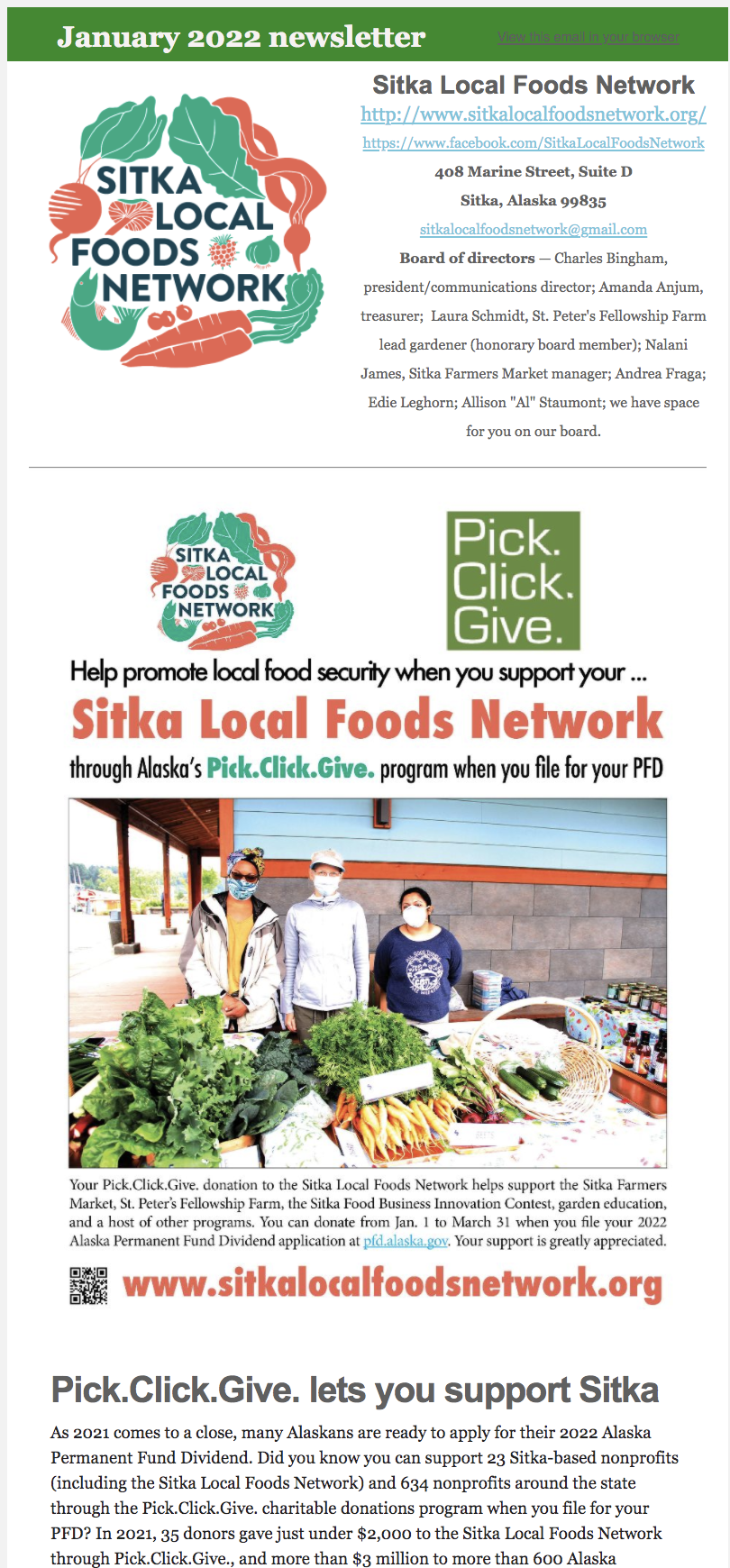
The Sitka Local Foods Network just sent out the January 2022 edition of its monthly newsletter. Feel free to click this link to get a copy.
This month’s newsletter includes short stories with a notice about the opening of the Alaska Permanent Fund Dividend application period (and Pick.Click.Give. application) on Jan. 1, an update about how you can support the Sitka Local Foods Network by buying a t-shirt or hoodie from our online store, information about our 2022 sponsorship programs, and an invitation to join our board of directors. Each story has links to our website for more information.
You can sign up for future editions of our newsletter by clicking on the newsletter image in the right column of our website and filling in the information. If you received a copy but didn’t want one, there is a link at the bottom of the newsletter so you can unsubscribe. Our intention is to get the word out about upcoming events and not to spam people. We will protect your privacy by not sharing our email list with others. Don’t forget to like us on Facebook, like our Sitka Farmers Market page on Facebook and follow us on Twitter (@SitkaLocalFoods).
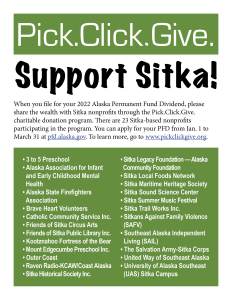
As 2021 draws to a close, many Alaskans already are thinking about applying for their 2022 Alaska Permanent Fund Dividend check in January. As usual, Alaskans can share their wealth with a variety of Alaska nonprofits, including the Sitka Local Foods Network, through the PFD’s Pick.Click.Give. program.
For the past several years, the Sitka Local Foods Network has participated in the Pick.Click.Give. program, which allows people to donate in $25 increments to their favorite statewide and local 501(c)(3) nonprofit organizations when they file their PFD applications from Jan. 1 through March 31.
When you choose to donate part of your PFD to the Sitka Local Foods Network, you support the Sitka Farmers Market, St. Peter’s Fellowship Farm, the Sitka Food Business Innovation Contest, education programs about growing and preserving food, the Sitka Kitch community rental commercial kitchen, Sitka Community Gardens, matching dollars at the Sitka Farmers Market for SNAP/WIC beneficiaries, the sustainable use of traditional foods, the Sitka Community Food Assessment, the Sitka Food Summit, and a variety of other projects designed to increase access to healthy local foods in Sitka.
In 2021 Alaskans contributed $3.04 million to 613 Alaska nonprofit organizations, and more than $30.1 million has been donated since the program started in 2009. Some Alaskans choose to donate to just one group, while others may spread several donations around to many groups. There now are 634 total 501(c)(3) nonprofit organizations participating in Pick.Click.Give. for 2022 (including multi-location nonprofits), including 23 from Sitka. In 2021, Alaskans donated $94,575 to Sitka-based nonprofits (note, total includes some nonprofits that are based in multiple cities).
So how do you make a donation to the Sitka Local Foods Network through the Pick.Click.Give. program? First, starting at 9 a.m. on Saturday, Jan. 1, go fill out your Alaska Permanent Fund Dividend application at http://pfd.alaska.gov/. When you get to the section of the application asking if you want to participate in Pick.Click.Give. Charitable Contributions program, click on the PCG link and search for the Sitka Local Foods Network. You also can look for us by using the town search for Sitka.
The Pick.Click.Give. program is available only to people who file their PFD applications online, and not to those who file by mail. Even though you can’t file a new PFD application after March 31, you can go back into your application and update your Pick.Click.Give. donations through Aug. 31 each year.
You still can donate to the Sitka Local Foods Network if you aren’t from Alaska or aren’t eligible for a 2022 PFD. To donate, send your check to the Sitka Local Foods Network, 408-D Marine St., Sitka, Alaska, 99835. You also can donate online by going to our online fundraising page on MightyCause.com, and clicking the Donate button to make an online contribution. In addition, there is an online giving page through the PayPal Giving Fund. If you are trying to make nonprofit donations before the end of the 2021 tax year, you can mail in a check or make an online donation. Please let us know if you need a receipt for tax purposes. For more information about donating, you can send an email to sitkalocalfoodsnetwork@gmail.com.
Thank you for supporting our mission of increasing the amount of locally produced and harvested food in the diets of Southeast Alaskans.
SITKA, Alaska – The Alaska Longline Fishermen’s Association (ALFA) is pleased to announce it was selected by the U.S. Department of Agriculture (USDA) to receive $209,100 from a Regional Food System Partnerships (RFSP) grant as part of the Agriculture Marketing Service’s Local Agriculture Marketing Program (LAMP). ALFA was one of 30 projects selected across 24 states to receive an RFSP grant and will use the funding to foster new partnerships around Alaska that help build a more resilient regional food system, specifically when it comes to local seafood access and seafood industry workforce development.
The impacts of Covid-19 highlighted long standing workforce development and food insecurity issues in Alaska. The seafood industry provides the backbone of coastal economies but relies on outside labor for processing, marketing, and shipping. Quarantine requirements led to significant labor shortages and high costs. In addition, currently less than 1 percent of the seafood caught in Alaska stays in Alaska to benefit the local economy. Alaska is one of the top five most food insecure states in the nation. It is estimated 95 percent of the $2 billion of food Alaskans purchase each year is imported, and 14 percent of Alaskans, including 20 percent of children, face food insecurity.
In response to the pandemic and food insecurity in Alaska, in March 2020, the Alaska Longline Fishermen’s Association formed a statewide coalition of nonprofits, tribal organizations, military organizations, city and boroughs, foundations, fishermen, and seafood processors to address food insecurity and workforce development challenges. The coalition was made possible with funding from Catch Together; a nonprofit that supports innovative conservation endeavors and fishermen-led efforts that address long-term access to local fishery resources. This initiative, which became known as the Seafood Donation Program, provided stipends and workforce support to the seafood industry and deployed $2.5 million to purchase local seafood for distribution, providing more than 630,000 free meals of Alaska seafood to individuals and families facing food insecurity.
With funding from the USDA, ALFA will develop and implement a two-year assessment that looks at its pilot Seafood Donation Program and the feasibility of potentially continuing and expanding it into an ongoing program. In addition, the assessment will look at current seafood industry workforce development programs and identify gaps and barriers keeping local Alaskans from participating in the seafood industry. The project will culminate with the development of a feasibility study for a ten-year statewide seafood distribution and workforce development plan with emphasis on cultural relevance of seafood and serving marginalized communities.
“We’re honored to carry this project forward and help lay the groundwork for new projects and programs in Alaska that could help make our communities healthier and more resilient,” said Linda Behnken, executive director of the Alaska Longline Fishermen’s Association. “Thanks to this support from the USDA, we’ll be able to work with a wide range of partners to assess where the biggest needs and opportunities are for ensuring that our local food systems are better prepared for future disruptions such as COVID-19, and that we have the tools in place to encourage local employment in our local seafood industry.”
As a “partnership” grant, ALFA’s project will rely heavily on the engagement of diverse stakeholders and will be guided by a formal steering committee including representatives from Alaska tribes, seafood distributors, national and state philanthropic and foundation leadership, chefs, community, and policy leaders as well as youth representatives. Some of these steering committee members will include founding partners of the Seafood Donation Program, including Sam Schimmel from Kenai, who helped spearhead several salmon distributions to Alaska Native families in the Anchorage and Fairbanks communities.
“I’m really excited to be part of this project and help create new, locally grown solutions to some very complex problems,” Schimmel said. “We know that these needs are not going away, so this project is an important opportunity for us to all come together, share information, and figure out how we can ensure our Alaska Native communities continue to have access to the native foods that keep us connected to our traditions and to our cultures.”
“There’s no question that Alaska’s seafood industry faces a lot of challenges when it comes to workforce, whether that’s graying of the fleet or lack of new recruitment into the fisheries,” said Norm Pillen, president of Seafood Producers Cooperative in Sitka. “I”m looking forward to seeing what we learn through this project and how it can help advance conversations already underway about the future of Alaska’s seafood industry and our coastal communities.”
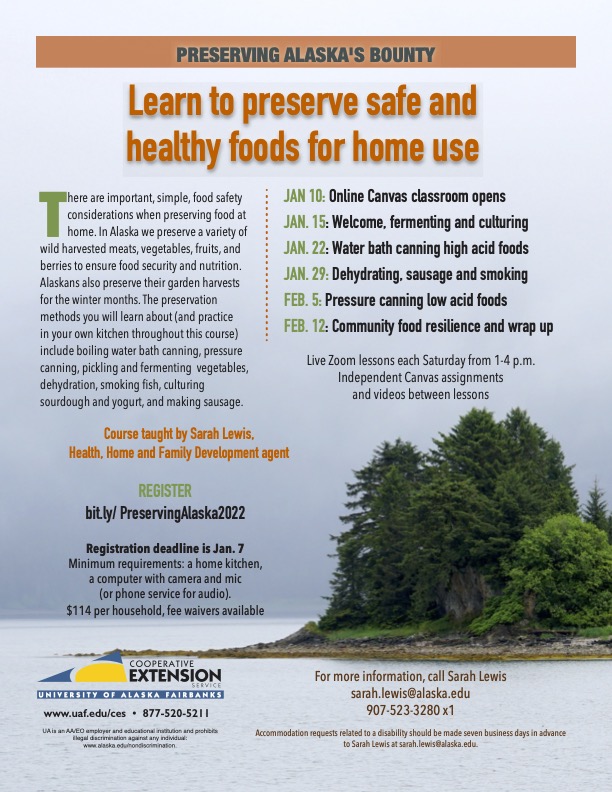
In Alaska, we preserve a variety of wild harvested meats, vegetables, fruits, and berries to ensure food security and nutrition. Alaskans also preserve their garden harvests for the winter months.
There are important, simple, food safety considerations when preserving food at home. The preservation methods you will learn about (and practice in your own kitchen throughout this course) include water-bath canning, pressure canning, pickling and fermenting vegetables, dehydration, smoking fish, culturing sourdough and yogurt, and making sausage.
Lewis will teach the course online via Zoom, and participants can practice these techniques in their own kitchens. They’ll complete independent online assignments and view videos via the Canvas online course platform, which will open Jan. 10. Zoom classes will be held from 1-4 p.m. on Saturdays, Jan. 15 through Feb. 12.
The course will use “So Easy to Preserve,” sixth edition, from the University of Georgia Cooperative Extension Service. The book is included in the cost of the course and will be mailed to each student.
Students must have a home kitchen, a computer with a camera, and either a computer microphone or phone service for audio. The cost is $114 per household; fee waivers are available.
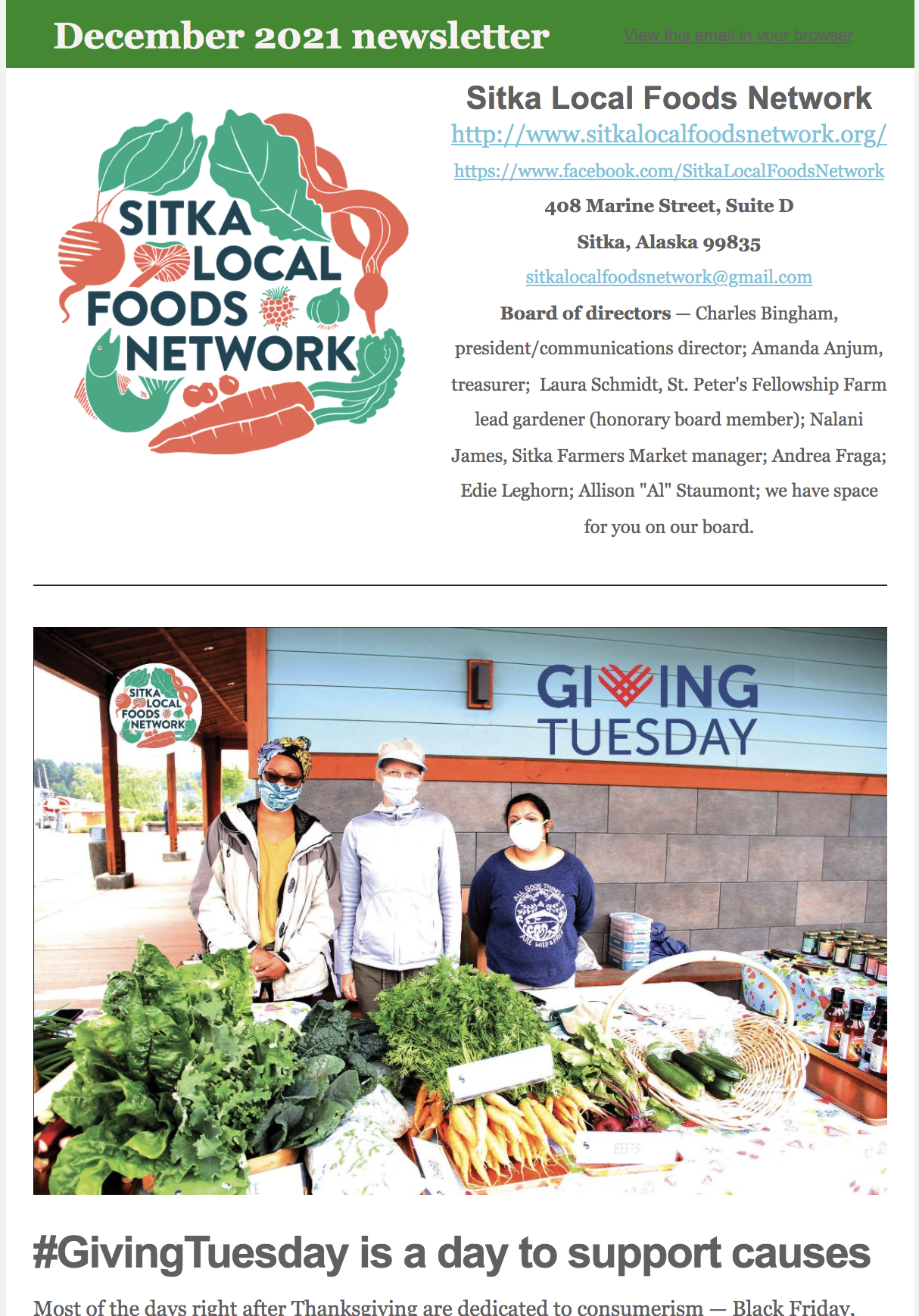
The Sitka Local Foods Network just sent out the December 2021 edition of its monthly newsletter. Feel free to click this link to get a copy.
This month’s newsletter includes short stories with a notice about #GivingTuesday on Nov. 30, information about how you can eat some chowder and support the Sitka Local Foods Network from Dec. 1-4, an update about how you can support the Sitka Local Foods Network by buying a t-shirt or hoodie from our online store, information about our 2022 sponsorship programs, and an invitation to join our board of directors. Each story has links to our website for more information.
You can sign up for future editions of our newsletter by clicking on the newsletter image in the right column of our website and filling in the information. If you received a copy but didn’t want one, there is a link at the bottom of the newsletter so you can unsubscribe. Our intention is to get the word out about upcoming events and not to spam people. We will protect your privacy by not sharing our email list with others. Don’t forget to like us on Facebook, like our Sitka Farmers Market page on Facebook and follow us on Twitter (@SitkaLocalFoods).






 Sitka Local Foods Network
You must be logged in to post a comment.