What happens when a vegetarian from New York moves to rural Alaska and marries a commercial fisherman? Sitka filmmaker Ellen Frankenstein explored this and other food security issues in her 2008 film, Eating Alaska.
Feb. 7-13, 2021, is Alaska Food Security Week and Eating Alaska will be shown in a free online screening from 6-7:30 p.m. on Thursday, Feb. 11, using Zoom. After the movie, there will be a short panel session about how Alaska’s food security has changed over the past decade with Ellen Frankenstein, and Rep. Geran Tarr (D-Anchorage), Rep. George Rauscher (R-Sutton), and Rep. Mike Cronk (R-Tok).
This event is co-sponsored by the Alaska Farmland Trust, Alaska Farm Bureau and Alaska Farmers Market Association, in collaboration with the Alaska Food Coalition, the Alaska Food Policy Council, and the Food Bank of Alaska.
Eating Alaska is a serious and humorous film about connecting to where you live and eating locally. Made by a former city dweller now living on an island in Alaska and married to fisherman, deer hunter and environmental activist, it is a journey into food politics, regional food traditions, our connection to the wilderness and to what we put into our mouths.
In her quest for the “right thing” to eat, Ellen stops by a farmers market in the Lower 48 stocked with fresh local fruits and vegetables and then heads back to Alaska, climbing mountains with women hunters, fishing for wild salmon and communing with vegans. She visits a grocery store with kids to study labels and heads to the Arctic to talk with Iñupiat teens in a home economics class, making pretzels while they describe their favorite traditional foods from moose meat to whale blubber.
The postcard like scenery in Alaska may be a contrast to what most urban residents see everyday and the filmmaker may have gone into the wild, but she also finds farmed salmon, toxics getting into wild foods and the colonization of the indigenous diet.
Eating Alaska doesn’t preach or give answers, but points out dilemmas in a style that provokes discussion on questions such as:
• What is the ethical way to eat in Alaska-or anywhere?
• Is it better to shoot a deer than buy tofu that has been shipped thousands of miles?
• Where is your comfort level in taking a life for food?
This wry personal look at what’s on your plate explores ideas about eating healthy, safe and sustainable food from one’s own backyard, either urban or wild, versus industrially produced food shipped thousands of miles. Eating Alaska is also a thought-provoking resource for discussing our assumptions about gendered behavior and women’s relationship to the natural world.
Have you always wanted to start a food business, but don’t have access to a commercial kitchen? Have you wondered what the regulations are regarding basic food safety for small food businesses? The Alaska Food Code allows the sale of non-potentially hazardous foods sold directly to the consumer without a permit as long as certain conditions are met.
You can learn about the Alaska Food Code and food safety regulations at the Alaska Cottage Foods Producers Webinar from 8:30-10:30 a.m. on Tuesday, Feb. 23, using Zoom. Presenters from the Alaska Department of Environmental Conservation and Municipality of Anchorage Food Safety and Sanitation programs will provide an overview of cottage food regulations and requirements and answer questions. (Cottage food businesses also are known as home-based food businesses in the regulations.)
This webinar is co-sponsored by the Alaska Food Policy Council, Alaska Farm Bureau, and Alaska Farmers Market Association. This is good info to know for people who are thinking about entering the Sitka Food Business Innovation Contest, or thinking about selling local food products at the Sitka Farmers Market and Sitka Food Co-op delivery days.
You can join the webinar via Zoom using meeting ID 893 3138 2743 and passcode 278411. You also can join by phone at 1-253-215-8782.
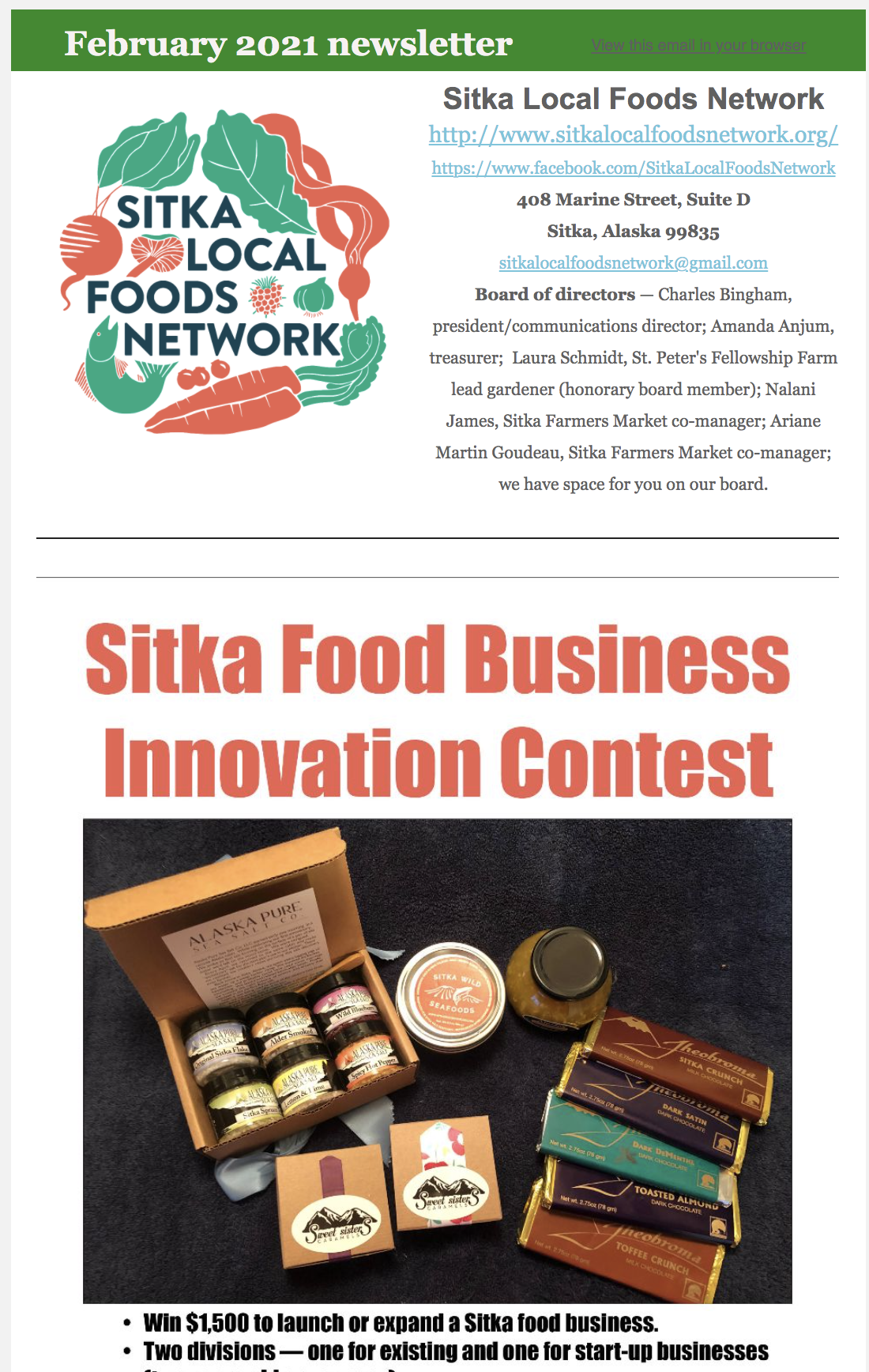
The Sitka Local Foods Network just sent out the February 2021 edition of its monthly newsletter. Feel free to click this link to get a copy.
This month’s newsletter includes short stories about the 2021 Sitka Food Business Innovation Contest, the Pick.Click.Give. charitable giving program being active for when people file for their PFDs, an invitation to join our board of directors, and information about our 2021 sponsorship program. Each story has links to our website for more information.
You can sign up for future editions of our newsletter by clicking on the newsletter image in the right column of our website and filling in the information. If you received a copy but didn’t want one, there is a link at the bottom of the newsletter so you can unsubscribe. Our intention is to get the word out about upcoming events and not to spam people. We will protect your privacy by not sharing our email list with others. Don’t forget to like us on Facebook, like our Sitka Farmers Market page on Facebook and follow us on Twitter (@SitkaLocalFoods).
Do you think you have a great idea for a food business or product from Sitka? Do you grow food, fish for food, or cook food in Sitka? The Sitka Local Foods Network is hosting the fourth annual Sitka Food Business Innovation Contest in an effort to spark local food entrepreneurs so we can make more local food available to residents and visitors. The contest entry deadline is Friday, March 5.
This contest will provide two $1,500 kicker prizes — one for established food businesses and one for start-up businesses (no older than two years) — to help entrepreneurs launch or expand their food businesses. The contest is open to food businesses and individuals making and selling food products in Sitka, Alaska. All food business ideas must be geared toward getting more locally grown, harvested and/or produced food into the Sitka marketplace through sales in grocery stores, the Sitka Food Co-Op, the Sitka Farmers Market, restaurants, or individual marketing (such as a community supported agriculture/CSA or community supported fisheries/CSF program).
“The Sitka Local Foods Network’s mission is to get more locally harvested and produced food into the diets of Southeast Alaskans,” said Charles Bingham, Sitka Local Foods Network board president. “For the past decade we’ve offered a entrepreneurs a chance to sell their produce, bread and fish at the Sitka Farmers Market, grown produce to sell at the market through St. Peter’s Fellowship Farm, and provided a garden education program to residents. We think this contest is the next step toward getting more local food into the Sitka marketplace.”
Last year, we awarded our $1,500 prize for established business to Andrew Jylkka of Southeast Dough Co., who is baking sourdough bread, as well as making sauerkraut and kimchi. Our $1,500 prize for start-up business went to Levi Adams of Forage & Farm, where he is harvesting and growing mushrooms. Our prizes were determined before the Covid-19 shutdowns, but both business owners found ways to develop and build their businesses during the pandemic.
In 2019, we gave $1,500 prizes to Brittany Dumag of the Castaway food cart in the start-up business category and to Tamara Kyle of Sitka Sauers in the established business category. We also gave a special $250 award to 12-year-old Abigail Ward who entered her Sitka Seasonings business. Brittany made Cuban pork sandwiches (using pork from North Pole) and other food to sell at various places in Sitka, including the Sitka Farmers Market. Tamara planned to ramp up her fermented foods business, but she ended up having some health issues that prevented her from completing her project and she ended up refunding most of her prize money. Abby made spice blends for seafood and other meats, which she sold at the first two Sitka Farmers Markets of 2019 and at other venues.
In our inaugural contest in 2018, we gave a $1,500 prize to Hope Merritt of Gimbal Botanicals in the established business category. We had no entrants in the start-up business category, so no prize was awarded in 2018. Hope used her prize money to hire two interns to help her harvest seaweed and kelp and to help produce her products.
Participants in this contest are eligible and encouraged to enter other food business innovation contests, such as the Path To Prosperity or Symphony of Seafood contests. All participants retain the proprietary rights to their products and ideas. This contest is open to new and existing food businesses in Sitka. Student businesses (such as those fostered by Junior Achievement or similar programs) are welcome.
There is a small $25 entry fee for this contest. All participants (business and individual) must complete and submit our contest entry form by 5 p.m. on Friday, March 5, 2021 (by snail mail so it arrives before the deadline to Sitka Local Foods Network, Food Business Innovation Contest Entries, 408-D Marine Street, Sitka, Alaska, 99835, or by email with the Subject Line of “Food Business Innovation Contest Entries” to sitkalocalfoodsnetwork@gmail.com). Submitting a business plan (up to 20 pages) is recommended, but not required.
Our entry form will have room for you to describe your food business idea in a few paragraphs, but submitting a business plan will give you more room to outline your plans for funding and marketing the idea and will help your overall score. Judging will be based on how your food business idea provides new local food options in Sitka, how novel is your food business idea, how feasible is your food business (can it make a profit and be sustainable), and how professional is your presentation. At some time in late March or early April, the Sitka Local Foods Network may host a pitch presentation, where judges will interview the contest entrants and try samples of the food products. Our judging panel will score your presentation and entry form based on how your idea has a measurable impact on providing local food in Sitka (25%), has the potential for commercialization (25%), provides new employment in Sitka (25%) and fills a need in the Sitka marketplace (25%).
In 2020 we made some changes to the rules, and those changes will continue in 2021. First, each entry now MUST include a sample, itemized budget showing how the business owner plans to use the prize money. Second, each prize winner will sign a winner’s agreement contract before receiving the prize money that lists a series of benchmarks toward getting the product/service to market that need to be met by a certain date or else all or part of the prize money will need to be refunded to the Sitka Local Foods Network. Purchasing items such as masks and hand sanitizer to prevent the spread of Covid-19 are acceptable uses of prize money.
If we find additional sponsors, we may add additional prizes and categories (such as fish or farm). Depending on the number of entries and interest of the participants, we may host a reception where contestants can demonstrate their products to Sitka residents. If the reception happens, there will be a chance for people to vote on their favorite products with the winner receiving the People’s Choice Award (this will be separate than the two main prizes selected by our judging panel). We are hoping to find a sponsor for the People’s Choice Award. Note, if our panel of judges determine there isn’t a worthy entrant in one or both categories, then the Sitka Local Foods Network reserves the right not to award a prize. Marijuana edibles are not eligible for the contest.
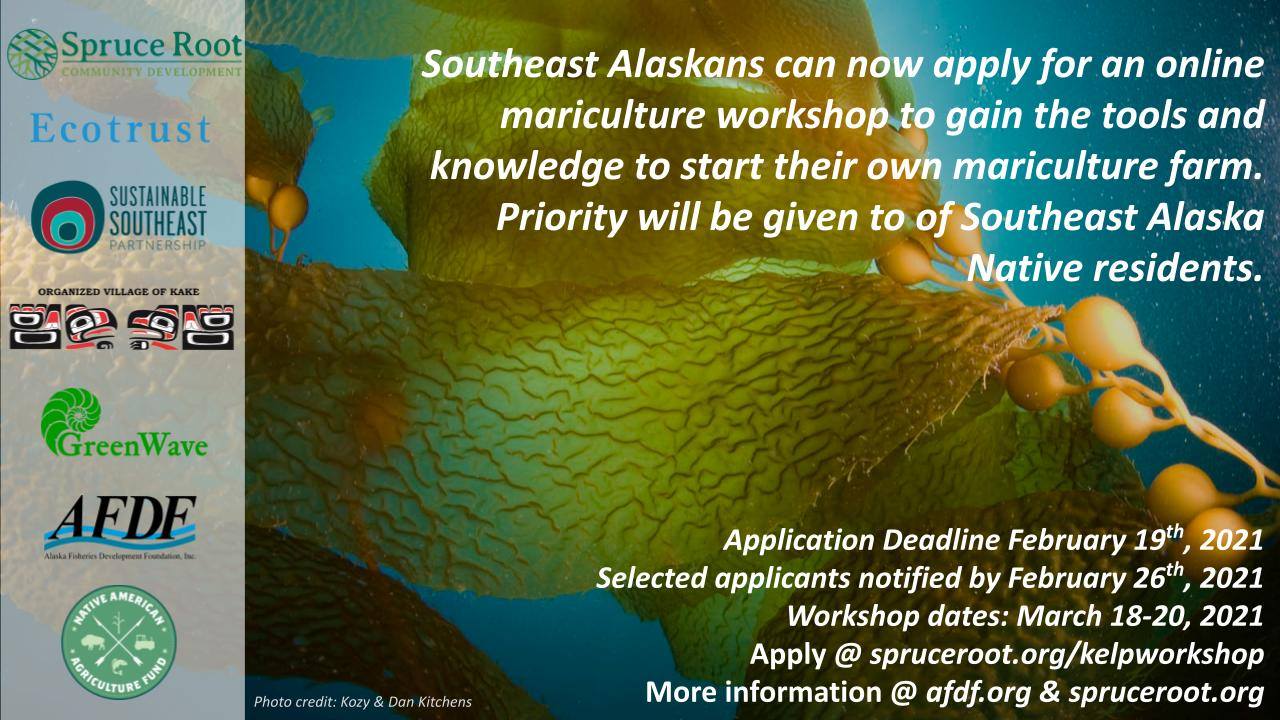
Spruce Root, the Sustainable Southeast Partnership, and other organizations are offering a free, online workshop that will provide tools and training for Alaska Natives in Southeast Alaska interested in starting kelp, oyster, or multi-species ocean farms. The workshop will begin on the evening of Thursday, March 18, and continue with day-long sessions on Friday and Saturday, March 19-20. The workshop will be delivered using Zoom.
The program is free, but space is limited to 24 participants –– selected through an application process. Project partners at Spruce Root will review applications and select participants based on the thoughtfulness of responses to application questions. The application period closes on Feb. 19. Selected applicants will be notified by Feb. 26.
Topics covered include:
an overview of kelp and oyster harvest and cultivation, and field identification of seaweed species
logistics of collecting, growing, and purchasing seed
farm site evaluation and planning, leasing, and permitting
farm design and build out
harvesting and processing techniques, and quality handling
All interested Southeast Alaska residents are invited to apply, however, priority will be given to Southeast Alaska Native residents.
Participants will need access to the internet and a computer, tablet, or smartphone in order to participate in the sessions and view presentations and panel discussions.
Following the workshop, participants may be eligible for one-on-one mentoring and, pending safety and travel restrictions due to the COVID-19 pandemic, participation in farm tours and other hands-on activities at a later date. Participants will be expected to attend and complete the workshop to be eligible for mentoring and hands-on activities.
Materials, final workshop times, and other workshop information will be distributed to selected participants prior to the technical workshops.
If you have questions about this program, you can contact Aaron Ferguson (aaron@spruceroot.org) or Lindsay Olsen (lindsay@greenwave.org). Click this link for the online application.
Alaska Sea Grant and partners are excited to announce the 2021 Seaweed Farm Start-up Training Program to be held for Alaska residents interested in starting their own seaweed farm in Alaska.
In 2020, this program was held in Kodiak, Ketchikan, and Sitka as part of Phase 2 of the Alaska Mariculture Initiative. In February of 2021, this program will be held again for a new cohort of participants, and will be conducted online via Zoom due to COVID-19 health and safety mandates. This virtual format will allow more participants to access the training program, from 48 participants in 2020 to potentially more than 100 in 2021. Registration for the training program will be completed in two parts:
All interested Alaska residents are invited to register for a free two-hour webinar to be held from 4-6 p.m. on Feb. 2. Registration closes Feb. 1.
Webinar attendees will then be eligible to register for a series of in-depth, virtual, technical, multi-day workshops over one week, beginning on Feb. 22. Each session will be 2–3 hours.
The goal of this program is to provide the tools and training necessary for Alaskans to start their own seaweed farm. The program is targeted towards commercial fishermen, Alaska Natives, and fishing communities. The program will be completed in four sections:
online webinar on Feb. 2
series of virtual technical multi-day workshops over one-week beginning on Feb. 22
one-on-one mentoring for high-performing participants
potential in-person hands-on field training in Spring/Summer 2021 (COVID-19 permitting).
Participants will be required to attend the Feb. 2 webinar in order to register for the series of technical workshops. Although there is no expected cap on the number of participants for the webinar, participation for the series of technical multi-day workshops is expected to be capped at 150 participants. Registration will be first-come first-serve for eligible participants. Registration for the series of technical multi-day workshops will be open from Feb. 3 to Feb. 10. Materials, final workshop dates/times, and workshop information will be distributed to registered participants prior to both the webinar and technical workshops.
Topics covered will include identification of seaweed species, lifecycles of seaweed, the hatchery process, site evaluation, use of the Mariculture Map, farm gear and equipment, business plan development, farm loans available, state lease application process, gear deployment, seeding and harvesting techniques, quality handling, and safety considerations. Information and instruction will be provided by GreenWave, Alaska Sea Grant, Alaska Department of Natural Resources, Alaska Department of Fish and Game, Blue Evolution, OceansAlaska, Alaska Longline Fishermen’s Association, Alaska Fisheries Development Foundation Inc., Alaska Marine Safety Education Association, seaweed farmers, and others.
Register now to learn more about what it takes to become a seaweed farmer in Alaska. Please visit the Alaska Fisheries Development Foundation website for more information about the training program. To register online, click this link. For more details, contact Melissa Good of Alaska Sea Grant at melissa.good@alaska.edu.
The Sitka Local Foods Network just sent out the January 2021 edition of its monthly newsletter. Feel free to click this link to get a copy.
This month’s newsletter has short articles about the 2021 Pick.Click.Give. donation period opening, a Preserving Alaska’s Bounty online class series, an invitation to join the Sitka Local Foods Network’s board of directors, and an item about the 2021 SLFN sponsorship program. Each story has links to our website for more information.
You can sign up for future editions of our newsletter by clicking on the newsletter image in the right column of our website and filling in the information. If you received a copy but didn’t want one, there is a link at the bottom of the newsletter so you can unsubscribe. Our intention is to get the word out about upcoming events and not to spam people. We will protect your privacy by not sharing our email list with others. Don’t forget to like us on Facebook, like our Sitka Farmers Market page on Facebook and follow us on Twitter (@SitkaLocalFoods).
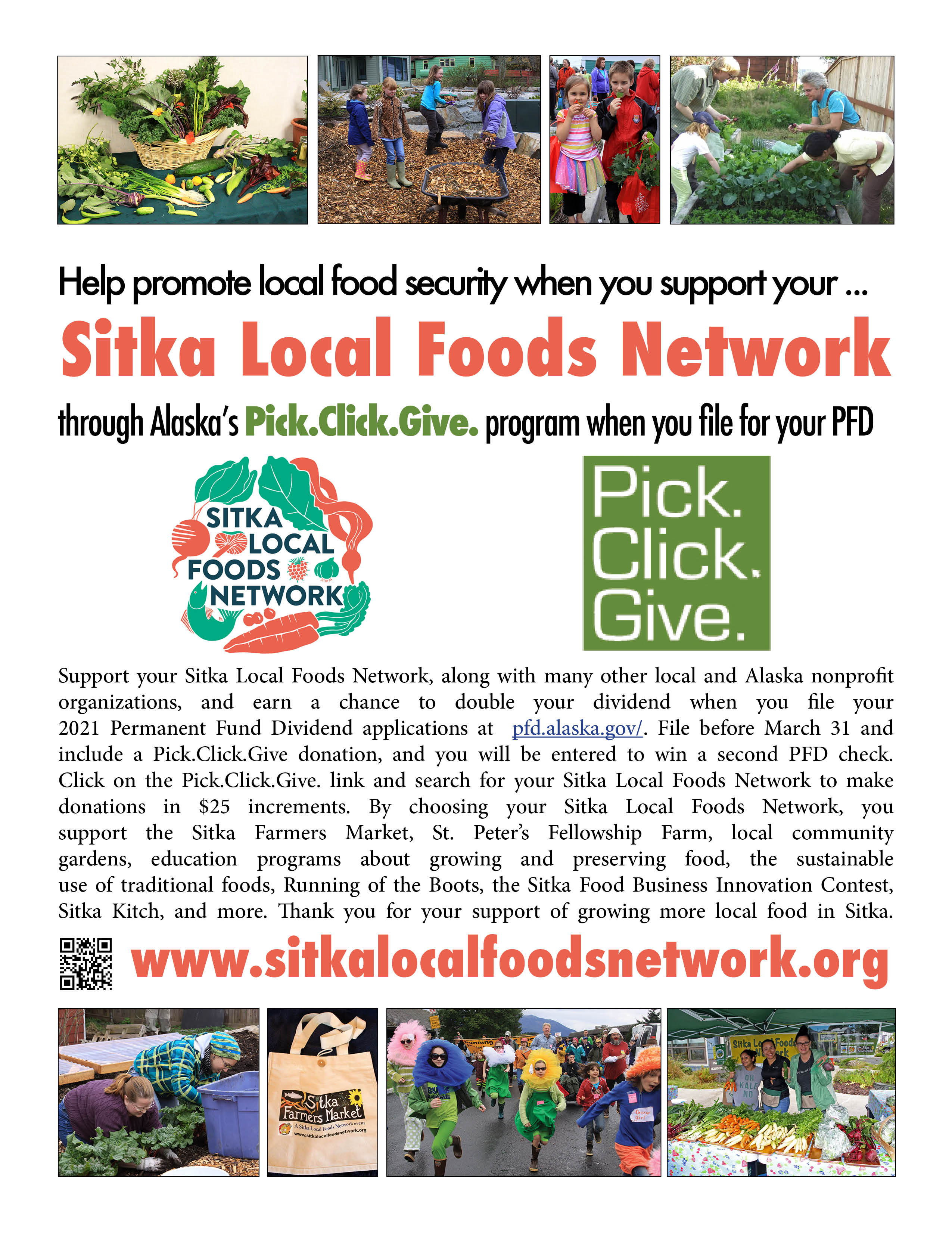
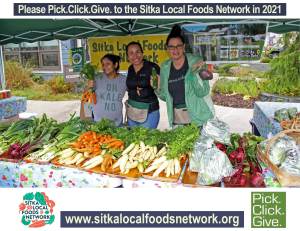
As 2020 draws to a close, many Alaskans already are thinking about applying for their 2021 Alaska Permanent Fund Dividend check in January. As usual, Alaskans can share their wealth with a variety of Alaska nonprofits, including the Sitka Local Foods Network, through the PFD’s Pick.Click.Give. program.
This is the seventh year the Sitka Local Foods Network will participate in the Pick.Click.Give. program, which allows people to donate in $25 increments to their favorite statewide and local 501(c)(3) nonprofit organizations when they file their PFD applications from Jan. 1 through March 31.
When you choose to donate part of your PFD to the Sitka Local Foods Network, you support the Sitka Farmers Market, St. Peter’s Fellowship Farm, education programs about growing and preserving food, the Sitka Kitch community rental commercial kitchen, Sitka Community Gardens, matching dollars at the Sitka Farmers Market for SNAP/WIC beneficiaries, the sustainable use of traditional foods, the Sitka Community Food Assessment, the Sitka Food Summit, and a variety of other projects designed to increase access to healthy local foods in Sitka. We recently launched the Sitka Food Business Innovation Contest to try and inspire entrepreneurs in Sitka to work more with local foods.
In 2020 Alaskans contributed $2.96 million to 622 Alaska nonprofit organizations, and more than $27.0 million has been donated since the program started in 2009. Some Alaskans choose to donate to just one group, while others may spread several donations around to many groups. There now are 611 total 501(c)(3) nonprofit organizations participating in Pick.Click.Give. for 2021 (including multi-location nonprofits), including 21 from Sitka. In 2020, Alaskans donated $86,025 to Sitka-based nonprofits (note, total includes some nonprofits that are based in multiple cities).
So how do you make a donation to the Sitka Local Foods Network through the Pick.Click.Give. program? First, starting at 9 a.m. on Wednesday, Jan. 1, go fill out your Alaska Permanent Fund Dividend application at http://pfd.alaska.gov/. When you get to the section of the application asking if you want to participate in Pick.Click.Give. Charitable Contributions program, click on the PCG link and search for the Sitka Local Foods Network. You also can look for us by using the town search for Sitka.
The Pick.Click.Give. program is available only to people who file their PFD applications online, and not to those who file by mail. Even though you can’t file a new PFD application after March 31, you can go back into your application and update your Pick.Click.Give. donations through Aug. 31 each year. In 2020, the Alaska Permanent Fund Dividends were released in July instead of their usual October, and the last day for editing was moved up to June 17 from Aug. 31. We don’t know yet if there will be similar adjustments.
You still can donate to the Sitka Local Foods Network if you aren’t from Alaska or aren’t eligible for a 2021 PFD. To donate, send your check to the Sitka Local Foods Network, 408-D Marine St., Sitka, Alaska, 99835. You also can donate online by going to our online fundraising page on MightyCause.com, and clicking the Donate button to make an online contribution. You also can send in a check or make an online donation if you are trying to make nonprofit donations before the end of the 2020 tax year. In December 2020, we just ordered a new high tunnel so we can grow more fresh, local produce at St. Peter’s Fellowship Farm to sell at the Sitka Farmers Market and other events. Please let us know if you need a receipt for tax purposes. For more information about donating, you can send an email to sitkalocalfoodsnetwork@gmail.com.
Thank you for supporting our mission of promoting and encouraging the growing, harvesting and eating of local foods in Sitka and Southeast Alaska.
The Sitka Local Foods Network in recent years created a sponsorship program to help promote our mission, and Sitka businesses and individuals are welcome to join for 2021. The goal of the sponsorship program is to make the projects we undertake (Sitka Farmers Market, St. Peter’s Fellowship Farm, gardening education, food business development, etc.) more sustainable.
“Sitka has a precarious position when it comes to food security, and the Sitka Local Foods Network is trying to improve our food security through our mission to increase the amount of locally harvested and produced foods in the diets of Southeast Alaskans,” Sitka Local Foods Network president Charles Bingham said. “Sponsors of the Sitka Local Foods Network are working with an organization and a farmers market that values local food and businesses, fun, premium quality goods and experiences.”
In recent years, the Sitka Local Foods Network has hosted seven Sitka Farmers Markets during the summer (from July to September). Due to COVID-19, we had to greatly scale back our 2020 Sitka Farmers Markets, focusing just on produce sales and using an online sales portal, but we did double our number of market weeks. We haven’t set our 2021 dates yet, but we anticipate we will have a more normal market experience this year.
In addition, we grow most of the local produce sold at the markets at St. Peter’s Fellowship Farm communal garden and a couple of other locations in town. In March 2020 we built a new high tunnel at St. Peter’s Fellowship Farm, which helped us increase our produce production despite a wet and cold summer, and we’re looking to add another new high tunnel before the 2021 growing season. We usually offer a variety of garden education classes in the spring. And one way we ensured fresh, local produce is available to lower-income Sitkans is through our matching program for WIC and SNAP beneficiaries (the first $20 spent on produce at the market), courtesy of recent grants from the Sitka White Elephant Shop.
In 2018 we launched a new food business innovation contest to inspire food entrepreneurs in Sitka, and have continued the program with the expectation of hosting it in 2021 (our 2020 winners were baker Andrew Jylkka of Southeast Dough Company and mushroom grower/harvester Levi Adams of Forage and Farm). We also have hosted the annual Running of the Boots costumed fun run fundraiser, with 2018 and 2019 in partnership with Youth Advocates of Sitka and canceled in 2020 due to COVID-19. In addition, we support other local food projects in Sitka, such as the Fish to Schools lunch program and the Sitka Kitch community rental commercial kitchen.
There are four levels of sponsorship available, and each has its own set of perks.
Grower ($2,500-plus) — We’ll hang your banner at ANB Hall during the Sitka Farmers Markets, include your logo and company name prominently in our merchandise and advertisements, and thank you on our social media and web pages. If appropriate for the Sitka Farmers Market, you may set up a free promotional booth.
Harvester ($1,000-$2,499) — We’ll hang your banner at ANB Hall during the Sitka Farmers Markets and include your logo and company name in our merchandise and advertisements.
Planter ($250-$999) — Your banner will hang at ANB Hall during the Sitka Farmers Markets.
Friend ($50-$249) — You are listed on our online sponsor page.
We have limited space for banners at the Sitka Farmers Markets, so please contact us before May 1 to guarantee your spot. To learn more about the sponsorship program, click the link below for details and a registration form. For more information, contact Charles Bingham at (907) 623-7660 or by email at charleswbingham3@gmail.com, or email us at sitkalocalfoodsnetwork@gmail.com.
This is the fourth straight year the Sitka Farmers Market has been the top market in Alaska, and sixth time in seven years. The contest uses online voting, but each email address is only allowed to vote once so people can’t stuff the ballot box. Voting opened in June and ended earlier this week.
“This year, with COVID-19, we had to greatly scale back the market and make significant changes, such as stripping down to just produce vendors, using an online ordering system during the week followed by Saturday morning pick-up events at St. Peter’s Fellowship Farm,” said Charles Bingham, board president of the Sitka Local Foods Network, which sponsors the Sitka Farmers Market. “Our main goal was to safely distribute locally grown produce without spreading the coronavirus. I’m glad we were able to do that.”
Sitka Farmers Market co-managers Nalani James, left, and Ariane Goudeau carry a farmers market sign to the curb in front of St. Peter’s By The Sea Episcopal Church.
This year the People’s Choice Award (the only national award) went to the Clarksville Downtown Farmers Market in Clarksville, Tenn., earning the market a $1,000 prize. Second place and $500 went to the Charlottesville City (Va.) Market, while third place and $250 went to the Boise (Idaho) Farmers Market. Rounding out the top-five markets in the standings were the 3rd Street Farmers Market in Tompkinsville, Ky., in fourth place, and the Napa (Calif.) Farmers Market in fifth place. Last year’s People’s Choice Award went to the Troy (N.Y.) Waterfront Farmers Market, which finished seventh nationally this summer.
The top market in the Pacific region was the Boise (Idaho) Farmers Market; followed by the Napa (Calif.) Farmers Market in second place; the Moscow (Idaho) Farmers Market in third place; the Vancouver (Wash.) Farmers Market in fourth place; and the Kaka’ako Farmers Market of Honolulu, Hawai’i in fifth place (last year’s Pacific region winner).
The other regional winners included the Tuscarawas Valley Farmers Market of Dover, Ohio, in the Midwest; the Ligonier (Penn.) Country Market in the Northeast; the Clarksville (Tenn.) Downtown Farmers Market in the Southeast; and the Grand Prairie (Texas) Farmers Market in the Southwest.
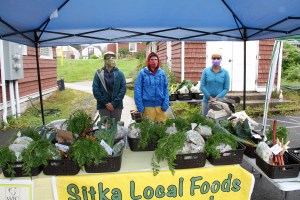
St. Peter’s Fellowship Farm lead gardener Laura Schmidt, left, and Sitka Farmers Market co-managers Ariane Goudeau, center, and Nalani James with baskets of produce ready for pick-up.
“We have a small market compared to others around the country, but I’m happy the people who visit our market think enough of it to recommend it in this contest,” Bingham said. “We thank everybody who came to one of our markets this summer and supported more local food in Sitka and Southeast Alaska.”
Andrea Fraga of Middle Island Gardens, left, and Brooke Schafer of Raincoast Flowers with some of their products.
This year the last Sitka Farmers Market order period was Sept. 15-17 and last pick-up day was Sept. 19. Due to COVID-19, the 26th annual Running of the Boots fun run fundraiser won’t take place in late September (we usually had a farm stand at that event, which raised money for the Sitka Local Foods Network and Youth Advocates of Sitka last year).
The Sitka Local Foods Network hopes to be able to return to a full market, or a hybrid with some pre-orders and some market-day sales, next year.
“We really missed having all of the booths this year, and the feel of a real community gathering instead of just a quick pick-up of your order,” Bingham said. “One of the nice things about hosting the market is it serves as a business incubator for smaller cottage foods and arts/crafts businesses, and those folks lost a market this summer.”












 Sitka Local Foods Network
You must be logged in to post a comment.