Second Sitka Food Summit to take place on Monday, April 22

Join Transition Sitka and the Sitka Local Foods Network for the second Sitka Food Summit on Monday, April 22. This event will explore findings, offer feedback, and view the information collected for the 2024 Sitka Community Food Assessment.

Come by Harrigan Centennial Hall any time between 6-8 p.m. on Monday, April 22, for dinner, a chance to win prizes, and to participate in an informal data-sharing event.

The inaugural Sitka Community Food Assessment was a project from the 2012 Sitka Health Summit and was published in 2014. Since it’s now a decade later and the data in the original assessment is obsolete, an update has been in the works. This event will present some preliminary findings before the new assessment is published.

The Sitka Community Food Assessment examines where Sitka residents get their food, what types they eat, what they grow, what they hunt and fish for, where they shop, what type of access people have to healthy food, and other questions about Sitka’s food supply. The findings of the food assessment will help Sitka improve its food security.

Callie Simmons has been coordinating the updated assessment, with mentorship from Lisa Sadleir-Hart who coordinated the original. During the project they had a community survey that had nearly 400 responses, led several focus groups, and more. For more information, contact sitkafoodassessment@gmail.com.

Sitka Community Food Assessment Team thanks those who helped with food security survey

Thank you, Sitka, for taking, sharing, and supporting the Sitka Food Security Survey! Our survey ran from September to the end of October, and we gathered more than 400 responses. This survey is part of a larger effort to better understand food security in Sitka and capture the ways in which we can make it easier for all Sitkans to have access to affordable, nutritious, and culturally relevant food. We are so grateful for the outpouring of support and for each person who took time out of their day to complete the survey.

This work is a result of a partnership between the Sitka Local Foods Network and Transition Sitka, both local nonprofits with a vested interest in food security in Sitka. We are grateful to the dedicated members of those organizations who donated their time to help spread the word about the survey, especially Charles Bingham, Leah Mason, Barbara Bingham, and Toby Campbell. This work would not be possible without the dedicated support and guidance of our steering committee which include community partners at the Sitka Tribe of Alaska Social Services Department, The Sitka Public Library, Sitkans Against Family Violence, Blessings in a Backpack, Sitka Conservation Society, and UAF Cooperative Extension Services.

A special thanks to the organizations and events in town that shared and hosted the survey including the Sitka Sound Science Center, the Sitka Public Library, Indigenous People’s Day, Coffee with Elders, Southeast Alaska Independent Living, UAS Sitka Campus, AC Lakeside, Sitka Homeless Coalition, Sitka Sentinel, and Raven Radio.

Gunalchéesh, thank you for your support in this work! We plan to share results from the survey in early spring. If you would like to be added to our listserv to receive updates, including summary survey results, please email sitkafoodassessment@gmail.com.

In gratitude and service,
The Sitka Community Food Assessment Team

Sitka Community Food Assessment update kicks off with new food security survey

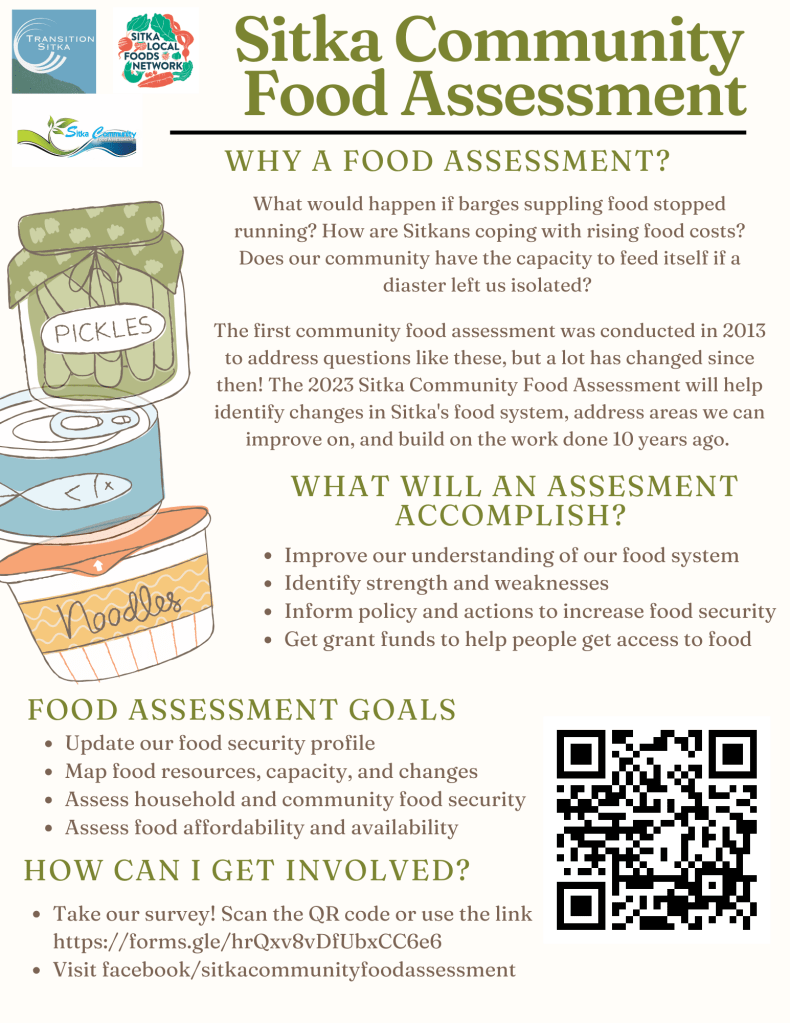
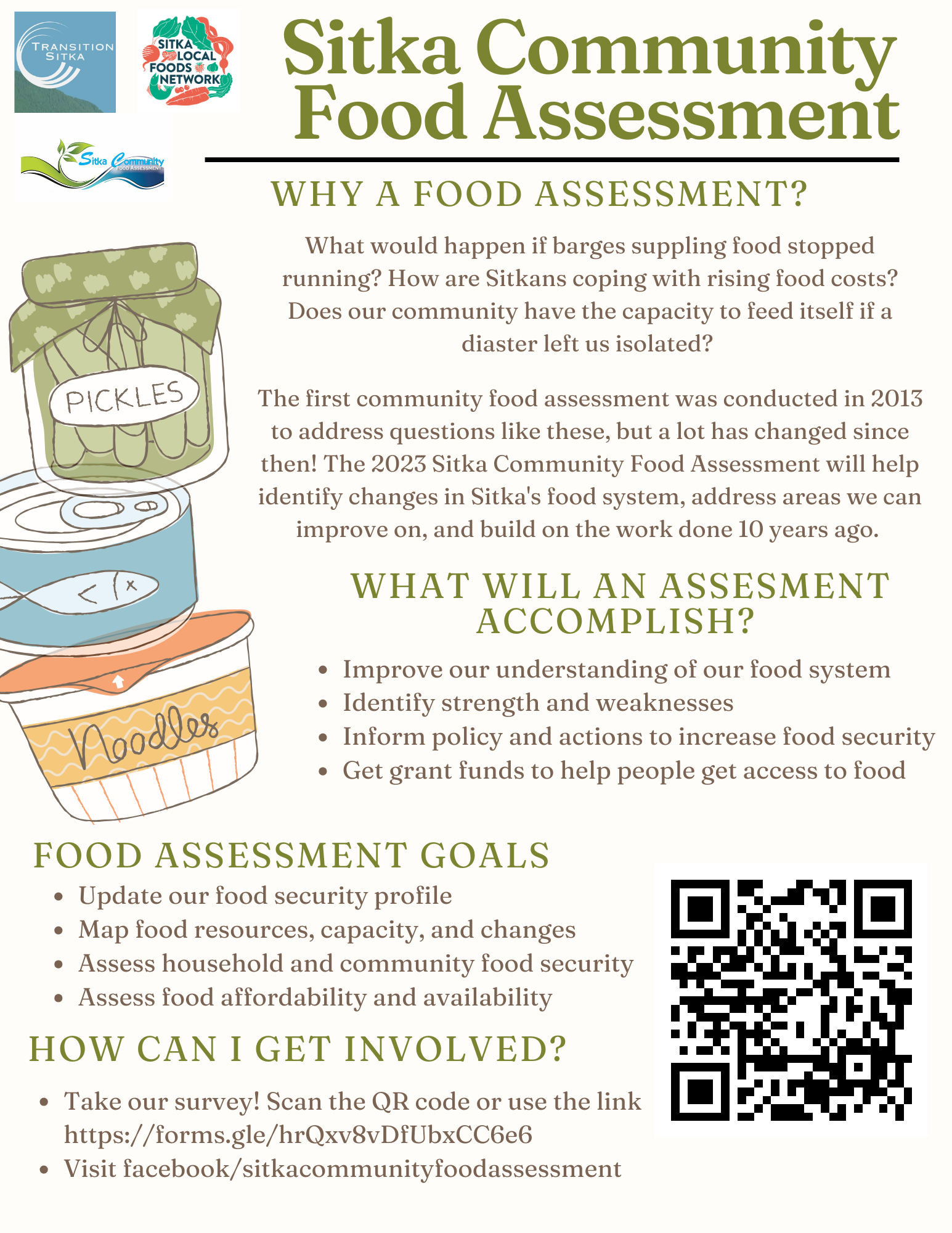
Struggling to buy the foods you prefer to eat? Have food stored in case of an emergency?  Able to access the local, wild foods you love? Take the Sitka Food Security Survey and help local organizations better understand the food challenges facing Sitkans and the community. 

This project will update the Sitka Community Food Assessment Indicators Report, which was released in April 2014 as part of a 2012 Sitka Health Summit community wellness project. That data now is at least a decade old, so an update is needed for better community planning and food security.

The survey takes less than 10 minutes and the link can be found below and hard copies will be available at the Sitka Farmers Market and the Sitka Public Library. A link to the survey can be found at https://forms.gle/LGWTYRT6XsdgLCgaA, or you can scan the QR code on the flier above. Please submit your surveys before Saturday, Oct. 21 (NOTE: The deadline for submitting surveys has been extended to Tuesday, Oct. 31.).

Questions or concerns? Please contact Callie Simmons at sitkafoodassessment@gmail.com. This update is being coordinated by Transition Sitka, the Sitka Local Foods Network, and the Sitka Community Food Assessment.

UAF Cooperative Extension Service to teach online Preserving Alaska’s Bounty class series

UAF Cooperative Extension Service agent Sarah Lewis will teach the Preserving Alaska’s Bounty online class series from Jan. 7 to Feb. 4, 2023. The five-week series will give participants the skills necessary to safely preserve foods for their own household. Anyone who wishes to become a food preservation educator within their community may also complete a final exam.

Students will learn about and practice pickling and fermenting vegetables; boiling water-bath canning of fruits, berries, and pickles; pressure canning of meat, fish, and vegetables; as well as dehydration of fruits and vegetables; making jerky; and smoking fish. Other topics will include emergency preparedness, how to start a cottage foods business (aka, a home-based foods business), and information about wild harvested plants.

The course will be offered on the Canvas platform. Live instruction will be offered in a 3-hour Zoom session each Saturday at 1 p.m., with assignments to be completed in the student’s kitchen on their own schedule, as well as assigned readings and other activities. The final session will be on Feb. 4.

Participants must be 16 or older (unless joining a household adult). The registration deadline is Dec. 31. Registration and more class details are available at http://bit.ly/PreservingAlaska2022, or by contacting Sarah at sarah.lewis@alaska.edu. Even though Sarah is based in Juneau, this is an online class so you can take it from anywhere in the state.

A course fee of $150 per household or Zoom connection includes one class textbook, which will be mailed to students. A 50-percent reduction (scholarship) is available if requested. Accommodation requests related to a disability should be made 10 business days in advance of the Jan. 7 start, to sarah.lewis@alaska.edu.

The University of Alaska Fairbanks (UAF) is an Affirmative Action/Equal Opportunity employer, educational institution and provider and prohibits illegal discrimination against any individual: http://www.alaska.edu/nondiscrimination.

Alaska Food Policy Council releases food system action plan

HOMER, Alaska (Sept. 12, 2022) — The Alaska Food Policy Council has released the results and food security action plan from a USDA Regional Food System Partnership program grant for Alaska received in 2020.

This two-year process involved local food system leaders in 13 regional nodes around the state, including one in Sitka hosted by the Sitka Local Foods Network. The node leaders looked at their local and regional food systems, and how they connect with food systems in other parts of the state. The project also taught the node leaders how to develop and connect the people and companies within their local food systems to strengthen them.

Alaska has major food security issues, with an estimated 90-95 percent of all food coming to the state from somewhere else. One of the long-term goals of this project is to use the information gathered to create a 10-year statewide food security plan.

“This two-year project has engaged communities from around the state, bringing together Alaskans who care deeply about building a better food system,” Alaska Food Policy Council Executive Director Robbi Mixon said. “The resulting food security plan contains actionable ideas that can be implemented by communities in a way that makes sense for their own place-based needs and capacities.”

The three main objectives of this project are to improve the connection and collaboration of local and regional food systems around the state to improve Alaska’s food system; to identify food system assets, barriers, and capacities to help with the connection and collaboration; and to create a statewide food security plan that is informed by the regional nodes representing a variety of locations and stakeholder groups.

The next step is to apply for a USDA Rural Food System Partnership Implementation grant. This will allow state food system leaders to build on this groundwork and improve Alaska’s food security.

More information on the project and a link to the report can be found at https://www.akfoodpolicycouncil.org/blog/2022/9/8/2022-regional-food-system-partnership-project-report-amp-food-security-action-plan-released

###

The Alaska Food Policy Council (https://www.akfoodpolicycouncil.org/) is a nonprofit organization whose diverse membership works to engage Alaskans to make positive changes for the state’s food system, and to create a healthier, more prosperous and more secure future for all.

Gov. Mike Dunleavy establishes Alaska Food Security and Independence Task Force

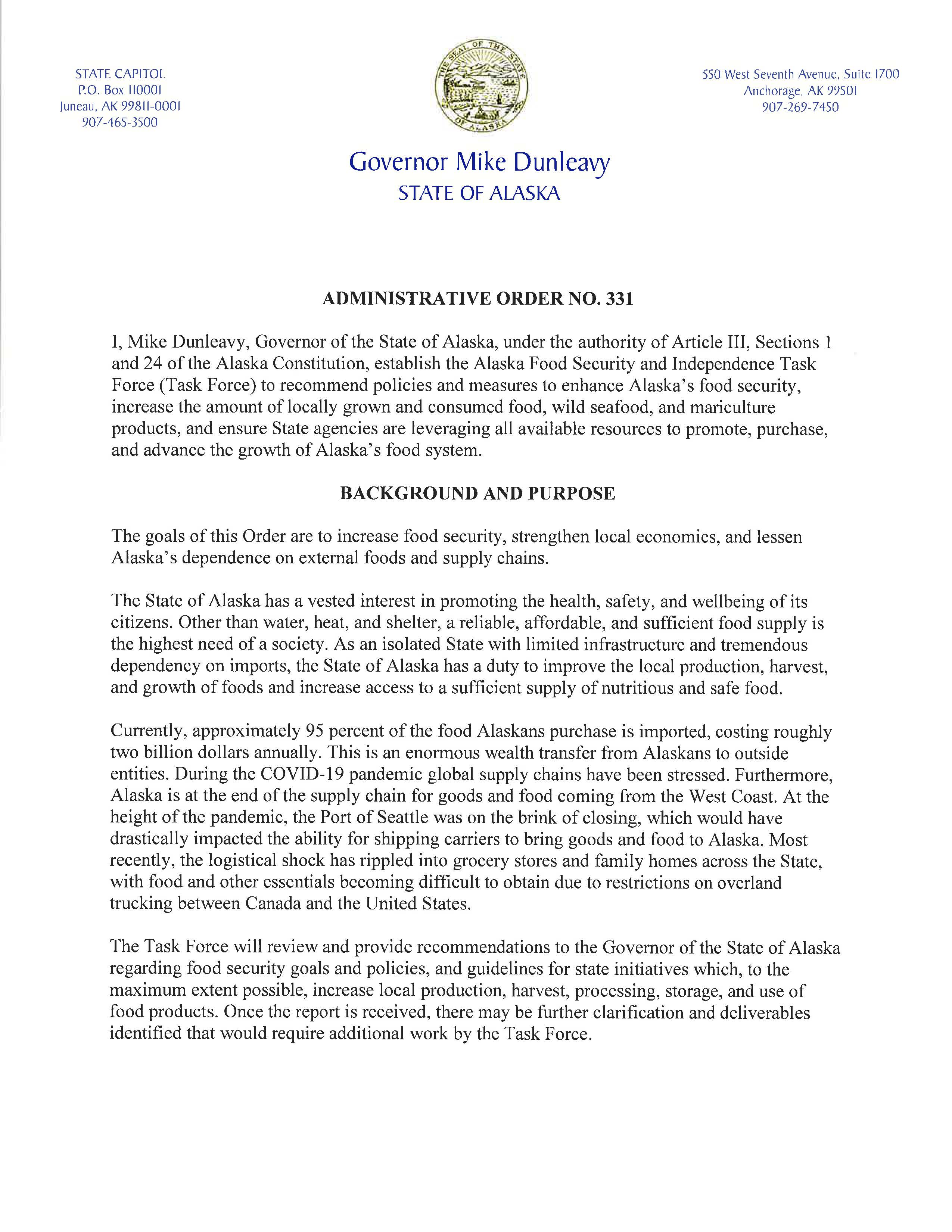
The first of four pages of Administrative Order 331, which creates the task force.

Today (Feb. 9, 2022), Gov. Mike Dunleavy issued Administrative Order 331  (downloads the full four-page document as PDF) establishing the Alaska Food Security and Independence Task Force.

Alaska currently imports 95 percent of its food supplies at a cost of $2 billion per year. The global pandemic triggered supply chain disruptions on the West Coast of the United States that continue to impact the regular delivery of food and other essential goods to Alaska. The 18-member task force will be responsible for recommendations on how to increase all types of food production and harvesting in Alaska, and to identify any statutory or regulatory barriers preventing our state from achieving greater food security.   

“Over the past two years Alaskans have walked into grocery stores and been greeted by row after row of empty shelves,” Gov. Dunleavy said. “One of the lessons the pandemic taught us is how vulnerable Alaska could be if the regularly scheduled shipments of food shipped up from Seattle were to suddenly stop – even a few days. The good news is Alaska has tremendous potential to grow, harvest and catch more nutritious food for in-state consumption. The recommendations from the task force will draw a roadmap for my administration, legislators and Alaska’s food producers to make Alaska more food secure the next time the supply chain is disrupted.”

The task force will have 10 main duties and responsibilities:

  • Provide recommendations that increase the procurement and use of Alaska-sourced foods within state and local agencies, institutions, and schools, including any administrative and statutory changes that are required.
  • Identify barriers that farmers, stock growers, fishermen, mariculture professionals, and others engaged in the growing, harvesting, or raising of food, face when starting a business or getting their products in to the Alaska market. Provide recommendations on how the state can address those obstacles, including through administrative or statutory changes.
  • Assess the levels of wild game and fish harvests in Alaska. Suggest measures that would increase the abundance and harvest of wild game, fish, and food by Alaskans.
  • Recommend a program to assist communities and households impacted by fishery shortfalls and disasters.
  • Identify factors, including regulatory or statutory burdens, that might discourage or prevent locally harvested and produced food from being purchased by federal, state, and local agencies, institutions, and schools.
  • Identify research needed to support and encourage increased consumption and production of Alaska-sourced food within the state.
  • Engage with the public to seek additional input on ways to promote the above listed goals.
  • Assess the need for disaster food caches within the state; and how the caches can be developed utilizing Alaskan-sourced foods.
  • Provide a report and summary of findings and recommendations, including what administrative and statutory changes would be needed to accomplish the recommendations of the task force.
  • The chair of the task force shall report regularly to the office of the governor on activities conducted and issues that arise under this order.

The task force will be made up of 16 voting members. Twelve Alaskans representing a cross section of the state’s farming, mariculture and seafood industries and four state commissioners (Natural Resources, Fish and Game, Environmental Conservation, Military and Veterans Affairs) or their designees will serve on the board. Two ex-officio members from the Alaska House of Representatives and the Alaska State Senate are to be appointed by the Senate President and the Speaker of the House.

The administrative order requests, but does not require, the two legislators be current members of the Alaska Grown Legislative Caucus.

The Task Force will issue a report on its findings and recommendations on or before September 1, 2022.

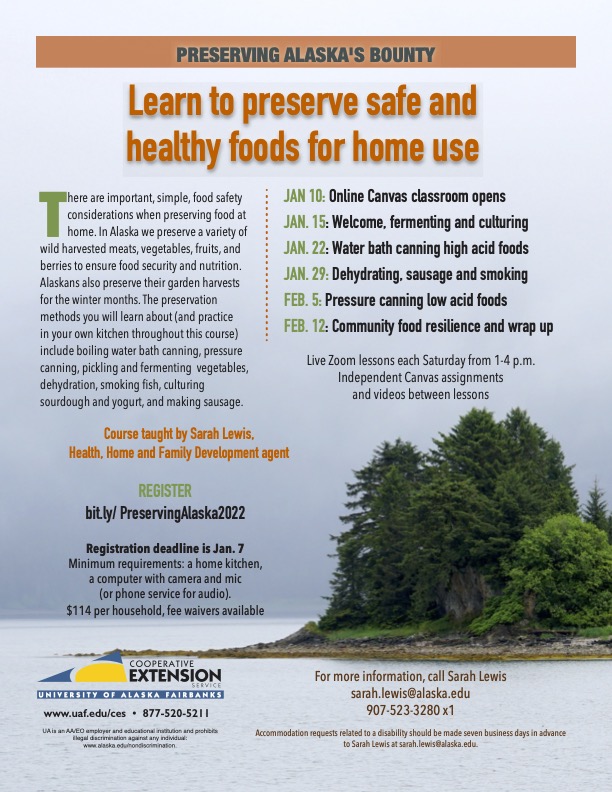
Learn to preserve safe and healthy foods for home use with Sarah Lewis

In Alaska, we preserve a variety of wild harvested meats, vegetables, fruits, and berries to ensure food security and nutrition. Alaskans also preserve their garden harvests for the winter months. 

University of Alaska Fairbanks Cooperative Extension Service agent Sarah Lewis will demonstrate how to preserve this bounty by canning, dehydrating, pickling, fermenting, and smoking.

There are important, simple, food safety considerations when preserving food at home. The preservation methods you will learn about (and practice in your own kitchen throughout this course) include water-bath canning, pressure canning, pickling and fermenting vegetables, dehydration, smoking fish, culturing sourdough and yogurt, and making sausage.

Lewis will teach the course online via Zoom, and participants can practice these techniques in their own kitchens. They’ll complete independent online assignments and view videos via the Canvas online course platform, which will open Jan. 10. Zoom classes will be held from 1-4 p.m. on Saturdays, Jan. 15 through Feb. 12. 

The course will use “So Easy to Preserve,” sixth edition, from the University of Georgia Cooperative Extension Service. The book is included in the cost of the course and will be mailed to each student. 

Students must have a home kitchen, a computer with a camera, and either a computer microphone or phone service for audio. The cost is $114 per household; fee waivers are available.

Register at bit.ly/PreservingAlaska2022. The registration deadline is Jan. 7. 

For more information, contact Sarah Lewis at sarah.lewis@alaska.edu or 907-523-3280, ext. 1. 

Sitka Kitch and UAF Cooperative Extension Service to host all-day Salmonganza classes July 17 at Halibut Point Recreation Area

The Sitka Kitch community rental commercial kitchen, in partnership with the University of Alaska Fairbanks Cooperative Extension Service, will host Salmonganza from 10 a.m. to 5 p.m. on Saturday, July 17, at the main shelter at Halibut Point Recreation Area.

(Click image to enlarge)

This will be a day focused on salmon, with classes on preparing salmon, pressure canning salmon, smoking salmon, making salmon sausage and jerky, and even preparing condiments for the salmon using salmonberries. In addition, there will be free pressure canner gauge testing from noon until 1 p.m.

The classes will be taught by Sarah Lewis from the Juneau District Office of the UAF Cooperative Extension Service. As part of her Maritime Extension Program, Sarah is traveling via the JunieBell to communities around Southeast Alaska to teach family and community resilience workshops.

This class is for all experience levels, ages 16 and older. No pets, please. Students should bring: a cooking knife, apron, dish towel, six wide-mouth half-pint canning jars with new lids, and your pressure canner’s dial gauge (with or without lid), if you would like it tested.

The class costs $40, which is part of our all-inclusive fee system (you no longer have to pay a class fee to register, then a separate food/supply fee). The Sitka Kitch will supply all of the food supplies for this class, but students will need to bring certain cooking items from a list provided before the class. Due to the Covid-19 pandemic, the class will be limited to 10 students, face masks must be worn, and social distancing must be observed.

The registration deadline is 11:30 p.m. on Thursday, July 15. Space is limited, so register early at http://sitkakitch.eventsmart.com (click class title) to secure your place in the class. We need at least eight students to register and pre-pay to make this class happen.

Current (paid) members of the Sitka Food Co-Op are now able to attend the classes for $30 each (the co-op will cover the other $10 of your class fee). Please use the Sitka Food Co-Op ticket when you register and send an email to sitkafoodcoop@gmail.com letting them know you’re in the class. (NOTE, Only one person per Co-op household may use the Co-op discount per class. Please name that person when you register so the name can be checked against the Co-op membership list.)

You can register and pre-pay using credit/debit cards or PayPal on our EventSmart page, http://sitkakitch.eventsmart.com (click on class title). For those wanting to pre-pay with cash or check, please call Clarice Johnson at Sitka Conservation Society (747-7509) to arrange a payment. Please note there is a $5 charge for parking at Halibut Point Rec, which is payable to the State of Alaska.

For more information about the class, contact Jasmine Shaw at 747-9440. We do offer one potential scholarship spot per class for people with limited incomes, so long as we have enough students registered to make the class happen. This class is a fundraiser for the Sitka Kitch community rental commercial kitchen.

The Sitka Kitch also has a new class cancelation policy. If you register for a class, then find out you can’t attend, please email us at sitkakitch@sitkawild.org and we may be able to help fill your slot through our waiting list. If you cancel from the class at least five days in advance (eg, by Wednesday the week before for a Monday class), you are eligible for a partial refund of your class fee, minus $5 for processing (in this case, $35). If you need to cancel with less than five days advance notice, there is no refund.

Micro-grants available to improve security of Alaska’s food supply

The Alaska Division of Agriculture is excited to announce that it is accepting initial “scoping” applications for the new micro-grants for food security.

The micro-grants program has a two-step application process, with initial scoping applications being submitted first. Then, the top projects from the initial applications submitting a more detailed application before money is awarded this spring. The due date for two-page initial applications is Feb. 15.

The global COVID-19 pandemic reminded Alaskans they live at the end of a long and sometimes tenuous food supply chain. These micro-grants are aimed at strengthening local food security.

“While Alaska enjoys the benefits of a global supply system, it is simply responsible to support home-grown systems we can rely on, just in case,” said David W. Schade, director of the Alaska Division of Agriculture. “We are fortunate to now be able to offer micro-grants aimed at enhancing our ability to be more self-reliant when it comes to necessities like food.”

At the urging of Sen. Lisa Murkowski, the 2018 federal Farm Bill authorized the state to issue micro-grants to support innovative ways to improve Alaska’s food security. The division has begun accepting scoping applications for three-year grants of up to $15,000 for individuals ($5,000 per year), or $30,000 for qualified organizations ($10,000 per year). Individuals and qualified organizations can partner with each other to be eligible for combined funding (for example, if two individuals and an organization partner they would be eligible for $20,000 per year). The U.S. Division of Agriculture will provide $1.8 million to the division in each of the program’s first two years.

“We will prioritize funding of grants for projects that will increase local food production and storage, as well as education efforts to support these local efforts,” Schade said. Qualifying activities may include small-scale gardening, small-scale herding and livestock operations, and/or expanding access to food, safe food storage, and knowledge of food security.

Grant applicants must provide an initial scoping application to the division by Feb. 15. The division will then invite qualifying applicants to submit a full project proposal. Multiple individuals or organizations may submit joint applications for grants to support coordinated activities. The initial scoping application form and deadline information are available online at http://dnr.alaska.gov/ag/ag_grants.htm.

All individual Alaskans and many organizations qualify to apply for these grants, and the division hopes to have a strong batch of applications in the program’s first year. The security of two years of federal funding means projects the division cannot fund in 2021 will have another chance next year, Schade said.

“Alaska will have $1.8 million to help Alaskans grow more nutritious food locally and become more food secure. Individuals are eligible for up to $5,000 grants,” said According to Karen McCarthy, senior legislative assistant for Sen. Murkowski.

“Organizations such as Indian tribes and tribal organizations; non-profits such as religious organizations, food banks and food pantries; federally-funded educational facilities including Head Start and Early Head Start programs, public schools, public institutions of higher education, tribal colleges and Universities, and job training programs; and local and tribal governments that may not levy local taxes under state or federal law will be eligible for up to $10,000 in grant funds. Eligible projects are those that will increase the quantity and quality of locally grown food for food insecure individuals, families, neighborhoods, and communities — a pretty wide-open range of projects that Alaskans’ innovative thinking can really make exciting.”

The website, http://dnr.alaska.gov/ag/ag_grants.htm, includes a variety of information about the program. Click this link for access to a Facebook Live video presentation on Thursday, Jan. 21. Click this link for the PowerPoint slides used during the Facebook Live presentation. Click this link for the two-page scoping application form (which can be filled out online or printed and completed), and click this link for an application guide and instructions. Click this link for a one-page information sheet from Sen. Murkowski’s office about the program. Applications can be submitted by email and by regular mail, but they should be timed to arrive by Monday, Feb. 15.

If you have further questions, please reach out to Catherine Cheadle, the grants specialist who is heading up this program. You can call her at 907-761-3851 or email her at catherine.cheadle@alaska.gov.

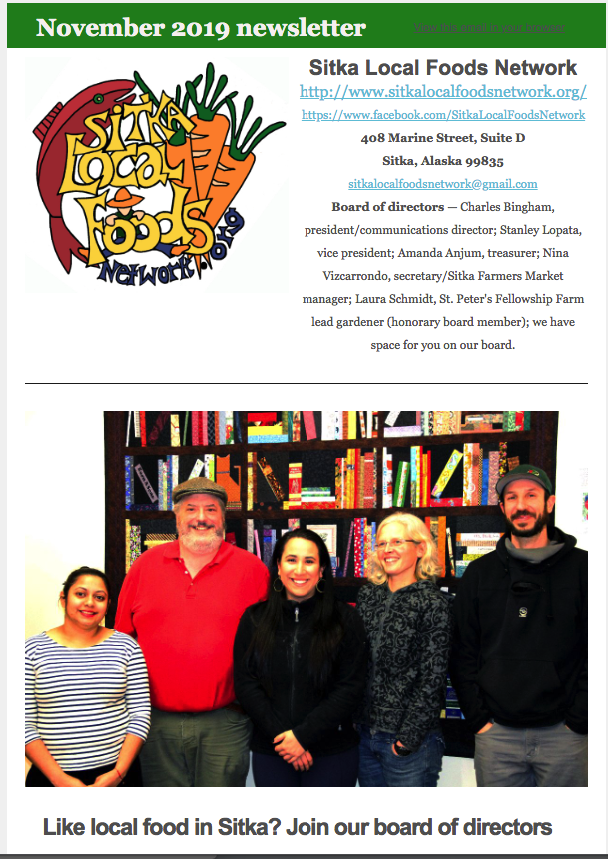
Check out the November 2019 edition of the Sitka Local Foods Network newsletter

The Sitka Local Foods Network just sent out the November 2019 edition of its monthly newsletter. Feel free to click this link to get a copy.

This month’s newsletter includes short articles about how to join our board of directors, about our 2020 sponsorship program, and about #GivingTuesday on Dec. 3. Each story has links to our website for more information.

You can sign up for future editions of our newsletter by clicking on the newsletter image in the right column of our website and filling in the information. If you received a copy but didn’t want one, there is a link at the bottom of the newsletter so you can unsubscribe. Our intention is to get the word out about upcoming events and not to spam people. We will protect your privacy by not sharing our email list with others. Don’t forget to like us on Facebooklike our Sitka Farmers Market page on Facebook and follow us on Twitter (@SitkaLocalFoods).